
"Viva Cuba!" Kirill, Cuba, and Fidel Castro
Sergianism (the pattern of accommodating state power over the faith, documented in Chapter 9) continues. The spirit of Sergianism is alive in Patriarch Kirill’s actions today.
Beginning in the late 1990s, Metropolitan Kirill (then head of the Department for External Church Relations) cultivated a relationship with Fidel Castro’s Communist dictatorship in Cuba that would span nearly two decades.[1]
But surely, according to some, this was pastoral engagement? Diplomacy? Christian charity that seeks dialogue with all men?
But what do the saints teach about accommodating the enemies of God?
A. What the Saints and Canons Teach
Silence Before Error Is Hatred
St. Maximus the Confessor, who had his tongue and right hand cut off for refusing to compromise with imperial heresy, explained the spiritual danger of accommodating error:
For I reckon it hatred towards man and a departure from Divine love to lend support to error, so that those previously seized by it might be even more greatly corrupted.
— St. Maximus the Confessor, PG 91:465C; https://orthochristian.com/100726.html[2]
According to St. Maximus the Confessor, to lend support to error is “hatred towards man.” When deadly error goes uncorrected, souls seized by it remain corrupted. Thus, what may resemble diplomacy or loving tolerance, according to St. Maximus, is spiritual cruelty.
Silence Is the Third Type of Atheism
Elder Gabriel of Koutloumousiou Monastery, a disciple of St. Paisios, invoked St. Gregory Palamas on the three forms of atheism:
The first type of atheism: the atheist who says God does not exist. The second type of atheism is the heretic. Third type of atheism is when the faith is in danger and I am silent… I don’t speak up.
— Elder Gabriel of Koutloumousiou Monastery, https://www.youtube.com/watch?v=HXJ65qfUdGY[3]
He added St. Theodore the Studite’s commandment: “It’s a Commandment from God to not be silent, do not stay silent when the faith is in danger.”[4]
Silence before blasphemy is itself a form of atheism.
Patriarch Kirill maintained a 21-year relationship with Fidel Castro, a dictator whose regime systematically crushed basic civil and political freedoms, jailed and tortured dissidents, and is credibly blamed for tens of thousands of deaths through executions, extrajudicial killings, and prison abuses. Most importantly, even until his last breath, Fidel Castro was self-declared Marxist-Leninist, something incompatible with Orthodox Christianity.
To understand why this matters canonically, we must first establish what Marxism is in the eyes of the Church.
Marxism Is a Heresy
Geronda Ephraim of Arizona (+2019), a revered Athonite elder who established seventeen monasteries in North America, stated the canonical principle directly:
Marxism is not only a political system, but entails a secular worldview, indeed a heresy.
— Geronda Ephraim of Arizona, “My View of the Russian Orthodox Church Abroad” (1991), http://orthodoxinfo.com/ecumenism/ephraim_roca.aspx
If Marxism is a heresy, certainly making friends with someone who holds this position whilst refusing to correct them is the atheism that St. Gregory Palamas speaks of, and lending support to error, as St. Maximus the Confessor speaks of.
The New Martyrs (those who chose death over accommodation with Soviet power) ceased commemorating Metropolitan Sergius for accommodating Marxism-Leninism. Geronda Ephraim of Arizona affirms this was canonically justified. Patriarch Kirill on the other hand, seeks out such persons and develops fraternal relationships with them.
Christianity and Marxism Are Incompatible
Archbishop Averky (Taushev) of Syracuse was the fourth rector of Holy Trinity Seminary at Jordanville and one of ROCOR’s most revered theologians. He himself fled the Russian Revolution and witnessed firsthand what Marxism meant for the Church. He explained the theological incompatibility:
Materialism is the natural offspring and logical development of humanism. The ideal of the full stomach, concealed behind the loud names of the “ideal of social justice” and “social truth,” became the highest ideal for a mankind that had renounced Christianity. The doctrine of socialism and Marxism-communism naturally grew from the ground of materialism. Humanism and materialism, by denying man’s spiritual foundation and proclaiming him as god, thereby legitimatized the self-asserting human pride and animal egoism they naturally engendered.
— Archbishop Averky (Taushev), The Struggle for Virtue (Holy Trinity Publications, 2014), Chapter 1: “Self-Asserting Pride and Christian Humility,” p. 13
Marxism-Leninism denies the existence of the soul. It teaches that matter is all there is: no God, no spirit, no eternal life. Human beings are merely bodies requiring food, and history is merely the struggle over who controls the food.
This is the opposite of Orthodoxy. There is no compatibility between Christ and Marx.
This is why the correction Kirill owed Castro was not a diplomatic footnote, but the Gospel itself. Archbishop Averky makes the underlying principle explicit: outside faith in Christ as the Incarnate Son of God, there is no true love at all, neither for God nor for neighbor. No amount of revolutionary rhetoric, no appeal to “social justice” or “social truth,” can substitute for it:
Without faith in Jesus Christ as the Son of God, there cannot be true love for God or for neighbor. True, unselfish, pure love for God and man is impossible except under the action of faith in the divinity of Christ the Saviour—faith in the fact that He is the Incarnate Son of God who came down to earth to save mankind.
— Archbishop Averky (Taushev), The Struggle for Virtue (Holy Trinity Publications, 2014), Chapter 3: “Gospel Love and Humanistic Altruism,” p. 34
This is what Kirill owed Castro across twenty-one years of personal meetings. He did not deliver it. Castro died an unrepentant Marxist-Leninist, self-declared to the last day of his life, and Kirill had never pointed him to the only foundation on which true love for his Cuban people could have been built.
Archbishop Averky names the deeper cultural move at work. What Castro claimed, and what Kirill accepted on his behalf, is the five-century-old humanist substitution: the replacement of the Gospel’s exclusive, dogmatic teaching on love with a vague “morality independent of religion”:
The spirit of modernity or, otherwise put, the spirit of self-asserting human pride, although incapable of totally denying love as a creative force in man, nonetheless attempts to distort that healthful Gospel teaching on love, substituting it with its own type of love, where self-love strives to establish itself even more. Since the time of the Renaissance, the Gospel’s teaching on love has been supplanted by the concepts of “altruism,” “philanthropy,” and so-called situational ethics, a morality independent of religion, of faith in God, and of the law of God. The advocates of this irreligious morality attempt to convince everyone that “one can be a true Christian without believing in Christ.”
— Archbishop Averky (Taushev), The Struggle for Virtue (Holy Trinity Publications, 2014), Chapter 3: “Gospel Love and Humanistic Altruism,” pp. 35–36
Castro was exactly the figure Archbishop Averky describes. He professed Marxism-Leninism “until the last day of my life,” an ideology that denies the existence of God and reduces all reality to matter. He simultaneously demanded moral recognition as a kindred spirit, a builder of “social justice” and “social truth.” Kirill did not refuse the framing; he ratified it. On October 19, 2008, he awarded Fidel Castro the Order of Glory and Honor of the Russian Orthodox Church, “in recognition of his contribution to interreligious dialogue.” The moral-theological recognition Archbishop Averky says is impossible, Kirill effectively granted through an official church honor.
We will be judged for giving false reassurance
St. Paisios the Athonite teaches us how to properly engage those in error:
There is no need for us to tell Christians who are not Orthodox that they are going to hell or that they are antichrists; but we also must not tell them that they will be saved, because that’s giving them false reassurance, and we will be judged for it. We have to give them a good kind of uneasiness: we have to tell them that they are in error.
— St. Paisios the Athonite, Hieromonk Isaac, Elder Paisios of Mount Athos, p. 658
Where do we see Patriarch Kirill giving the good uneasiness to Fidel Castro?
Fr. Seraphim Rose witnessed this failure across the Orthodox jurisdictions in America:
Here in America we are very familiar with the apostasy of “Athenagoras & Co.,” and unfortunately the other national jurisdictions in America are hardly any better; all of them fraternize and pray with Catholics and Protestants and are ashamed to tell the heterodox that they have wandered far from the Truth, which is only in Orthodoxy.
— Fr. Seraphim Rose, Letter to the Madrid Mission, September 4/17, 1970, Letters from Father Seraphim. http://www.orthodoxriver.org/post/letters-of-fr.-seraphim-rose/
Fr. Seraphim Rose, greatly venerated worldwide, describes the behavior of many Ecumenists in our day, who fraternize with the non-Orthodox on a pretense of their so-called love (which is actually hatred, according to the witness of St. Maximus the Confessor) but if one pays attention very closely, in these fraternal relations, these loving Orthodox Christians refuse to tell these heterodox (gently) that they are in error, and that that Truth only resides in Orthodoxy.
This is the witness of Fr. Seraphim Rose, and this witness is all the more accurate in our time.
This is the behavior of Patriarch Kirill.
Patriarch Kirill is content with repeatedly stressing the importance of, and engaging in talks, dialogue, and friendly relations with Catholics (Chapter 6: Recognizing Roman Catholic Saints and Sacred Spaces), Muslims (Chapter 5: Muslims and Orthodox Pray to the Same God), Monophysites (Chapter 8: Praying with Monophysites), without doing the very thing the saints call him to do, which is to witness to Holy Orthodoxy, and not just to cultivate superficial friendships and acquaintances.
The saints teach neither harshness nor false comfort. They teach truth. Again, as St. Paisios says: “We [Orthodox Christians] have to tell them that they are in error” and if we do not, “we will be judged for it.”
Many think to level the teachings of Orthodox Christianity with their “supposed kindness”. If the mentality of these sentimentalists prevailed, we would never have any saints.
This may be a bitter statement, but this is what St. Paisios the Athonite states:
Some others again, out of supposed “kindness”, give the following advice: “Don’t tell the heretics that they are in error, to show them love.” So, everything is leveled. If these people had lived during the early years of Christianity, we wouldn’t have had a single Saint.
— St. Paisios the Athonite, Spiritual Counsels, Vol. 2: Spiritual Awakening, p. 52[5]
These are caustic and bitter words for our Ecumenistically minded brethren, who venerate the saints, but do so emptily; their very mindset betrays the very saints they think to venerate.
The public record examined here confirms the problem: over the course of their long relationship, the cited official and Cuban sources record no public instance in which Patriarch Kirill told Fidel Castro he was in error. That is the “supposed kindness” St. Paisios condemns. Patriarch Kirill, operating under the guise of an Orthodox phronema (φρόνημα, the way of thinking preserved among Orthodox Christians; not merely an intellectual position, but the whole orientation of thought, life, and action shaped by participation in the life of the Church, rooted in the Apostle Paul’s command: “Let this mind be in you which was also in Christ Jesus,” Phil. 2:5), has diplomatic relationships with heretics and anti-Christian rulers. But the sources cited here do not show him doing what our saints call him to do, which is to call them to Orthodoxy.
With this witness established, let us now examine the person of Fidel Castro.
B. The Evidence
Who Exactly Was Fidel Castro?
Who was Fidel Castro? He told us himself: “I am a Marxist-Leninist and I will be one until the last day of my life.”[6]
Fidel Castro ruled Cuba for nearly fifty years: as Prime Minister from 1959, then as President from 1976 until illness forced his retirement in 2008. Under his rule, Cuba became a one-party Communist state that banned political opposition, nationalized all private enterprise, and controlled every aspect of public life.
Historians estimate that the regime executed thousands; between 5,000 and 10,000 by firing squad in the first decade alone. The Cuba Archive has documented over 10,000 deaths directly attributable to the regime.[7]
At its peak, Cuba held an estimated 75,000 political prisoners: one out of every 94 citizens.[8] Over 1.4 million Cubans fled their homeland; tens of thousands drowned attempting the crossing to Florida.[9]
The political repression was matched by systematic religious persecution. From 1959 to 1992, Cuba operated as an officially atheist state: Catholic schools were closed, church property was nationalized, priests were expelled, and religious education was pushed out of public life.[10]
The persecution was enforced with violence. In the UMAP (Unidades Militares de Ayuda a la Producción) forced labor camps, former internees described beatings, threats, deprivation, and one young Jehovah’s Witness being hung by his hands from the top of a flagpole.[11] At La Cabaña prison, prisoners went to the firing squad shouting “Long live Christ the King!” From 1963 on, they were gagged.[12]
The regime’s hostility to faith did not simply disappear with constitutional revision. As recently as 2020, Cuban state officials reportedly told leaders of an independent religious community: “There is only one god, Fidel Castro.”[13] This statement, made four years after Castro’s death, shows how the regime’s political cult could still take blasphemous form: the absence of God and, beyond that, the state demanding worship in God’s place. When Castro died in November 2016, his funeral was secular, and his body was cremated.[14] He died as he lived: with no public repentance from Marxism-Leninism.
This was the man Patriarch Kirill befriended and maintained a relationship with for nearly two decades. Throughout their friendship, Cuba remained on international religious freedom watchlists.[15] Kirill knew who Castro was. Everyone knew.
2004: A Cathedral Built with Soviet Grave Earth
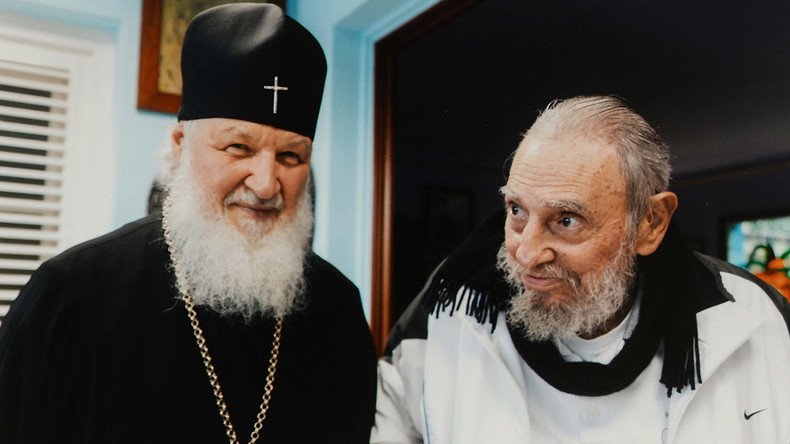
In 2004, Fidel Castro agreed to build an Orthodox cathedral in Havana at state expense and asked Kirill to choose the location. Kirill chose the center of Havana.[16] The cathedral was dedicated as a “monument to Cuban-Russian friendship.”[17]
Castro himself revealed that the site chosen was “the site that Russian and Soviet combatants occupied in the old Havana cemetery.” And during construction, Castro noted, “earth was brought from the place where the remains were laid to rest of the Soviet soldiers who perished in our country during the tens of years they rendered services here.”[18]
Earth from Soviet soldiers’ graves was brought to the cathedral during construction. Soldiers who served an atheist regime that martyred more Orthodox Christians than any force in history were commemorated in the founding of a church dedicated to the Mother of God. This symbolism is deliberate and unmistakable: honoring the Church’s persecutors at an Orthodox temple.
October 2008: The Order of St. Daniel
On October 19, 2008, Metropolitan Kirill consecrated the cathedral in Havana in the presence of Cuban Head of State Raúl Castro.[19] The next day, October 20, Kirill met with Fidel Castro and awarded Raúl Castro the Order of St. Daniel of Moscow and Fidel Castro the Order of “Glory and Honor” on behalf of Patriarch Alexy II, in recognition of their roles in building the first Russian Orthodox Church in Havana.[20]
Both are ecclesiastical honors of the Russian Orthodox Church: the Order of St. Daniel of Moscow (named after a holy saint, established in 1988) recognizes service to the Church, while the Order of “Glory and Honor” recognizes contributions to interreligious dialogue. Kirill presented these church honors to Communist rulers who espoused heretical and blasphemous ideals about Christ and the faith. The Church gave public ecclesiastical recognition to rulers of a state that had persecuted the faithful.
October 2008: Castro’s Testimony (“Identical Ethical Principles”)
Following this meeting, Castro wrote a public column titled “The Russian Orthodox Church” in his Reflections series. In it, a Marxist-Leninist dictator who executed thousands and filled labor camps with prisoners of conscience testified to his ideological alignment with the head of the Russian Orthodox Church.
Castro praised the Russian Church for supporting Stalin during World War II:
At the onset of the Great Russian War, after the treacherous Nazi attack, Stalin turned to her for support to the workers and peasants that the October Revolution had changed into the owners of factories and the land.
— Fidel Castro, “The Russian Orthodox Church,” Reflections, October 21, 2008. http://www.cuba.cu/gobierno/reflexiones/2008/ing/f211008i.html
The martyrs died rather than support Stalin’s regime. Castro praises the Church for doing what the martyrs condemned.
Castro then grouped the head of the Russian Orthodox Church together with Latin America’s revolutionary leaders, claiming they shared the same ideological foundations:
Both draw inspiration from identical ethical principles derived from the preaching of Jesus Christ according to the Gospels, a religious belief they both share.
— Fidel Castro, “The Russian Orthodox Church,” Reflections, October 21, 2008. http://www.cuba.cu/gobierno/reflexiones/2008/ing/f211008i.html
Castro wrote this about Kirill and Hugo Chávez. A Marxist-Leninist dictator who executed thousands and tortured prisoners in labor camps claimed that the Patriarch of Moscow drew inspiration from “identical ethical principles” as revolutionary leaders who idolized Marx and Che Guevara. Castro did not say they found common ground despite philosophical differences. He said their ethical principles were identical.
What were Castro’s “ethical principles”? He had explained them publicly for decades. In his 1985 book-length interview Fidel and Religion, Castro declared:
I’ve always considered Christ to be one of the greatest revolutionaries in the history of humanity.
— Fidel Castro, Fidel and Religion: Conversations with Frei Betto on Marxism and Liberation Theology (1985)
Christ, in Castro’s telling, was not the Son of God, the Second Person of the Holy Trinity, the Logos through whom all things were made. He was a “revolutionary” in the same category as Che Guevara and Marx himself. Castro continued:
Karl Marx could have subscribed to the Sermon on the Mount.
— Fidel Castro, Fidel and Religion: Conversations with Frei Betto on Marxism and Liberation Theology (1985)
Castro told us that the author of dialectical materialism, the man who called religion “the opium of the people,” could have “subscribed” to the words of Christ. Castro claimed there were “ten thousand times more coincidences between Christianity and Communism than between Christianity and capitalism.”[21] And in 2007, Castro declared:
If people call me Christian, not from the standpoint of religion but from the standpoint of social vision, I declare that I am a Christian.
— Fidel Castro, in Ignacio Ramonet, Fidel Castro: My Life: A Spoken Autobiography (New York: Scribner, 2008), p. 156
A man who filled labor camps with prisoners of conscience, banned Christmas for 28 years, and presided over a regime that told religious leaders “there is only one god, Fidel Castro”… then claimed to be a Christian. Not in the sense of believing in Christ as Lord and God, but in the sense of sharing Marx’s “social vision.”
This is what Castro meant by “identical ethical principles.” He believed Christianity and Marxism-Leninism were the same thing. He believed Christ was a proto-Communist. He believed he himself was a “Christian” because he was a Marxist. And he believed Kirill agreed with him.
The sources cited here record no public correction from Patriarch Kirill.
When Castro publicly claimed ideological alignment with the head of the Russian Orthodox Church, and Kirill said nothing, this silence spoke louder than any condemnation could have.
As we established above, St. Paisios teaches: “We have to give them a good kind of uneasiness: we have to tell them that they are in error.” In the public sources cited here, Kirill gave Castro, and thus his followers, comfort rather than this good uneasiness. Castro never came to the Orthodox faith. He died with no public repentance from Marxism-Leninism, while Patriarch Kirill’s public posture emphasized diplomacy and friendship rather than correction. This gave no visible pastoral warning either to Fidel Castro or to those who would view this friendship as affirmation of Castro’s heretical views.
Castro assessed the Church’s institutional role with precision. The opening lines of his column reveal how he understood the Russian Church:
[The Russian Church] is a spiritual force. It played a major role at critical times in the history of Russia. At the onset of the Great Russian War, after the treacherous Nazi attack, Stalin turned to her for support to the workers and peasants that the October Revolution had changed into the owners of factories and the land.
— Fidel Castro, “The Russian Orthodox Church,” Reflections, October 21, 2008. http://www.cuba.cu/gobierno/reflexiones/2008/ing/f211008i.html
Castro understood exactly what the Moscow Patriarchate had become: not the Church of the martyrs who resisted Soviet power, but a “spiritual force” whose “major role” was to serve the state when summoned. His example is Stalin enlisting the Church during World War II, the very accommodation the New Martyrs condemned.
Castro identified the Church as an anti-American ideological ally:
After the demise of the USSR, [the Russian Orthodox] Church was not an ally of imperialism.
— Fidel Castro, “The Russian Orthodox Church,” Reflections, October 21, 2008. http://www.cuba.cu/gobierno/reflexiones/2008/ing/f211008i.html
And then Castro’s most poignant assessment:
His Eminence is not an enemy of socialism and he does not condemn to eternal fire those who struggle for a better world on the basis of Marxism-Leninism.
— Fidel Castro, “The Russian Orthodox Church,” Reflections, October 21, 2008. http://www.cuba.cu/gobierno/reflexiones/2008/ing/f211008i.html; archived at Monthly Review Online: https://mronline.org/2008/10/21/the-russian-orthodox-church/
An enemy of God, praising the Patriarch of Moscow for not condemning him. This is ideological recognition, not simple diplomatic courtesy. What Castro praised as tolerance, St. Maximus identified as hatred towards man.
February 2016: “Viva Cuba!”
Eight years later, Patriarch Kirill returned to Cuba for a trip that would include his meeting with Pope Francis (see Part I, Chapter 1).
The choice of Cuba was not incidental. Cuba sits at the intersection of all three spheres of the KGB’s religious operations: the Russian Orthodox Church, the Vatican, and the Communist international. Declassified KGB documents show that Cuban intelligence cooperated directly with the KGB on religious operations: at the August 1976 WCC assembly, “the KGB and the Special Services of Cuba worked together on a line of behavior to respond to this through our agents.” Cuba was also represented at the February 1975 Warsaw conference where the KGB, together with intelligence services from seven socialist countries, planned operations to infiltrate the Vatican, compromise Catholic clergy, and use ROC agents for intelligence work against Rome.[22] The man trained in the KGB-penetrated DECR chose, of all the places in the world, to meet the Pope in the one country where the KGB’s religious, political, and intelligence operations all converged. On the same trip, he met Fidel Castro, praised him as “a real political leader,” and framed his revolution as having Christian origins. For the full documentation of the DECR’s KGB origins and its operations against the Vatican using ROC agents, see Chapter 13.
On February 13, 2016, at the Palace of the Revolution, Patriarch Kirill was awarded the Order of José Martí. Previous recipients listed by the DECR included Salvador Allende (1972), Nelson Mandela (1991), Hugo Chávez (1999), Alexander Lukashenko (2000), Hu Jintao (2011), and Vladimir Putin (2014).[23] The DECR report describes the Order as a high state decoration granted to Cuban and foreign citizens, heads of state, and heads of government for peace, humanism, and services to culture, science, sport, and creative work. In the recipient list highlighted by the Moscow Patriarchate, Kirill stands not among confessors of Christ, but among the political figures honored by Cuba’s revolutionary state.
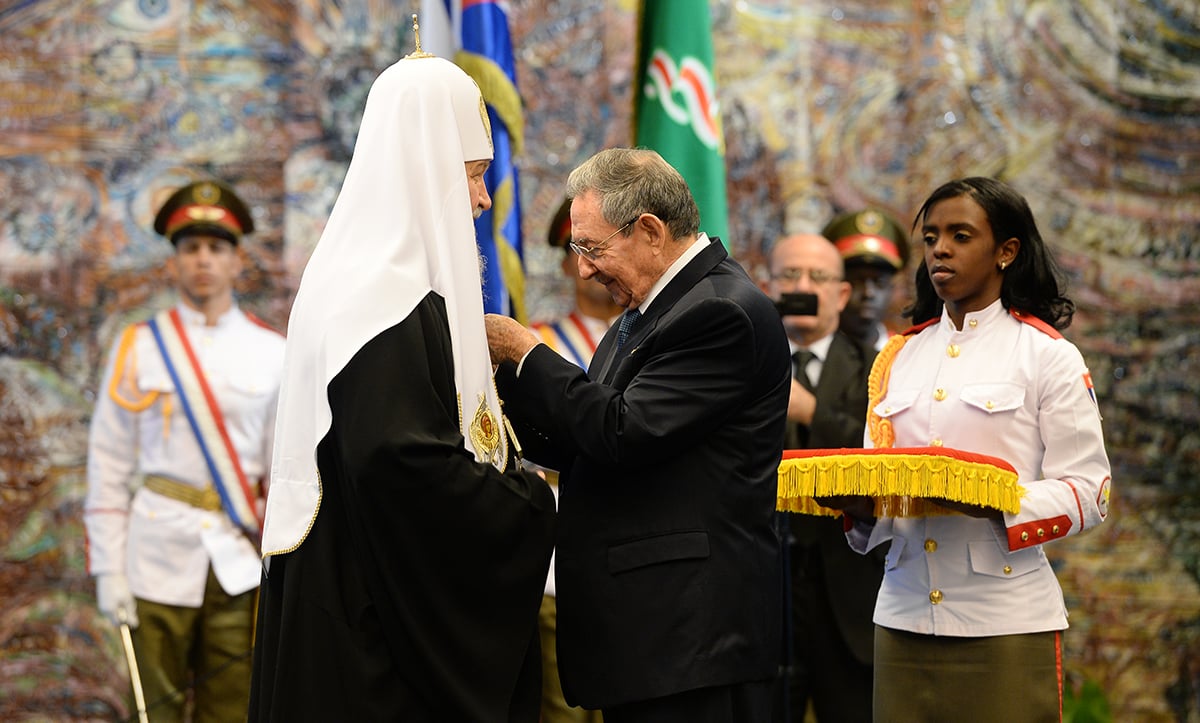
In his acceptance speech, Kirill stated:
Я вспоминаю лозунг, который в моей молодости часто произносили на улицах тогдашнего Ленинграда, особенно когда к нам приезжали высокие гости из Кубы и, в первую очередь, легендарный вождь революции Фидель Кастро Рус — этими словами я бы хотел закончить выражение своей благодарности Вам и кубинскому народу — Вива Куба!
I recall a slogan that was often uttered on the streets of Leningrad in my youth, especially when distinguished guests from Cuba came to us, and first of all the legendary leader of the Revolution, Fidel Castro Ruz. With these words, I would like to conclude my expression of gratitude to you and to the Cuban people: Viva Cuba!
— Patriarch Kirill, acceptance speech for the Order of José Marti, Palace of the Revolution, Havana, February 13, 2016. https://mospat.ru/en/news/49741/
“The legendary leader of the Revolution Fidel Castro Ruz.” “Viva Cuba!” These are the words of the Patriarch of Moscow, spoken from the Palace of the Revolution in a Communist dictatorship.
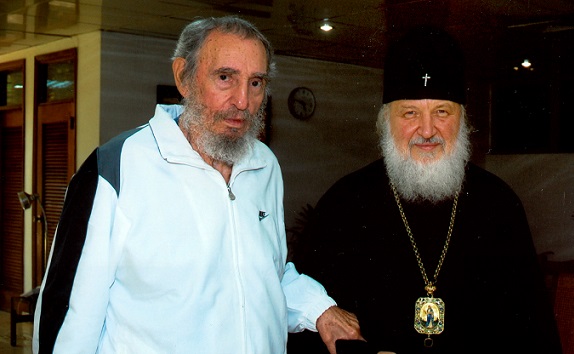
That same day, Patriarch Kirill met privately with Fidel Castro at Castro’s home residence for approximately two hours. According to official Cuban media, Castro and Kirill “exchanged on topics of interest relating to poverty, the fight against discrimination, the preservation of peace and human survival,” and the meeting took place “in a relaxed atmosphere of respect and agreement.”[24] Castro specifically praised Kirill’s ideological work:
During the meeting, Fidel praised the Patriarch for his important contribution to the strengthening of friendship between the Russian and Cuban peoples and the dissemination of the values that unite them.
— Granma (official newspaper of the Communist Party of Cuba), “Patriarch Kirill visits Fidel,” February 14, 2016. https://en.granma.cu/cuba/2016-02-14/patriarch-kirill-visits-fidel
“The dissemination of the values that unite them”: what values unite Communist Cuba and the Russian Orthodox Church under Patriarch Kirill?
February 2016: Castro’s “Gospel” Revolution
Shortly after returning from his Latin America tour, Patriarch Kirill spoke with journalists about his meeting with Fidel Castro. His comments reveal how he views the Castro brothers and their Communist revolution:
«Мне всегда было очень интересно с ним беседовать, тем более что он сам мне рассказал, как после смерти отца они с Раулем стали думать, что делать с их огромной латифундией. Получив воспитание в иезуитском колледже, они решили, что надо поступить так, как говорит Евангелие: раздай все нищим и будешь иметь сокровище на небе (см. Мф. 19:16).»
I always found it very interesting to talk with him, especially since he himself told me how after their father’s death, he and Raul began to think about what to do with their enormous estate. Having received an education at a Jesuit college, they decided that they should do as the Gospel says: give all to the poor and you will have treasure in heaven (see Matt. 19:16).
— Patriarch Kirill, interview with journalists after his Latin America tour, February 22, 2016. http://www.patriarchia.ru/article/97434; mirrored at Pravmir: https://www.pravmir.ru/patriarh-kirill-o-vstrechah-s-papoy-i-kastro-chp-v-samolete-pingvinah-i-drugih-vpechatleniyah-ot-latinskoy-ameriki/
Patriarch Kirill presents the Castro brothers’ Communist revolution as Gospel-motivated. He frames their decision to seize private property and redistribute wealth as obedience to Christ’s command to “give all to the poor.”
The Gospel passage Kirill references (Matthew 19:21) is Christ’s counsel to the rich young man: “If thou wilt be perfect, go and sell that thou hast, and give to the poor, and thou shalt have treasure in heaven.” This is a call to voluntary poverty and almsgiving, not violent revolution. Christ never commanded anyone to seize other people’s property by force, establish labor camps, and execute thousands.
The “estate” Kirill references was real: their father Ángel Castro owned a 25,000-acre sugar plantation.[25] When he died in 1956, the brothers inherited it. But the Castros did not follow the Gospel. Christ told the rich young man to sell what he himself owned and give the proceeds to the poor, freely and voluntarily. The Castros led an armed revolution that seized property by state force. In 1959, they nationalized large landholdings, their own family’s estate included, alienating even their own mother in the process.[26] This was not voluntary almsgiving; it was state confiscation.
Charity drawn from stolen goods is not Christian almsgiving at all. St. John Chrysostom calls it satanical:
These almsgiving are Judaical, or rather they are Satanical. For there are, there are now also they, that take by violence countless things belonging to others, and think that an excuse is made for all if they cast in some ten or a hundred gold pieces. Touching whom also the prophet says, “You covered my altar with tears” (Malachi 2:13). Christ is not willing to be fed by covetousness, He accepts not this food. Why do you insult your Lord, offering Him unclean things? It is better to leave men to pine with hunger, than to feed them from these sources.
— St. John Chrysostom, Homily LXXXV on Matthew, Nicene and Post-Nicene Fathers, 1st Series, Vol. X, p. 509
And what became of the men who supposedly “gave all to the poor”? Lieutenant Colonel Juan Reinaldo Sánchez, who served in Castro’s innermost security ring for seventeen years, documented over twenty mansions, a private island, an 88-foot yacht, and a personal gold mine.[27] On the claim that Castro renounced wealth, Sánchez was unambiguous:
In contradiction to what he always said, Fidel had in no way renounced capitalist comfort or chosen to live in austerity. On the contrary, his way of life resembled that of a capitalist, without any kind of limit. He never believed that his speeches required him to live the austere life of all self-respecting revolutionaries; neither he nor Raúl ever practiced the precepts they preached to their compatriots.
— Juan Reinaldo Sánchez, The Double Life of Fidel Castro, pp. 47-48
“Neither he nor Raúl ever practiced the precepts they preached.” The man whose revolution Patriarch Kirill called Gospel obedience lived like a king while his people starved and drowned fleeing on rafts.[28]
This is the antithesis of the Gospel: theft, coercion, and murder dressed in the language of compassion. Patriarch Kirill knows what Christianity teaches. Presenting Castro’s revolutionary self-account as Gospel obedience was not a harmless anecdote; it functioned as legitimation of Communist dictatorship.
November 2016: Castro’s Death
When Castro died in November 2016, Patriarch Kirill sent condolences to Raúl Castro:
Команданте Фидель был одним из самых известных и выдающихся государственных деятелей современности, снискал международный авторитет и еще при жизни стал легендой… В Русской Православной Церкви имя Фиделя Кастро неизменно произносят с уважением и благодарностью… В моем сердце навсегда сохранится добрая память об этом мужественном и харизматичном человеке, являвшимся искренним другом Русской Православной Церкви.
Comandante Fidel was one of the most famous and outstanding state leaders of today… In the Russian Orthodox Church the name of Fidel Castro is always pronounced with respect and gratitude… I will always cherish in my heart the good memory of this courageous and charismatic man, a sincere friend of the Russian Orthodox Church.
— Patriarch Kirill, condolence message on the death of Fidel Castro, November 26, 2016. https://mospat.ru/en/news/48940/
Fidel Castro was a ruthless dictator whose regime imprisoned, tortured, and executed thousands.[29] His government suppressed religion, confiscated property, and sent prisoners of conscience to labor camps.[30] Yet the Patriarch of Moscow called him an outstanding leader and “a sincere friend of the Russian Orthodox Church.”
Memory Eternal for Soviet Soldiers
The 2016 visit produced something worse than praise for Castro. On February 13, Patriarch Kirill laid a wreath at the Memorial to the Soviet Internationalist Soldier in Havana. He then led Moscow clergy and choir in singing “Memory Eternal” (Вечная память), the Orthodox funeral hymn sung for the faithful departed. According to the Moscow Patriarchate’s own report, the hymn was sung for “the warriors of our Motherland who gave their lives for this country and her people.”[31]
“Memory Eternal” is normally a liturgical prayer for the repose of Orthodox Christian souls. St. John of Shanghai and San Francisco, a ROCOR hierarch glorified for his miracles and uncompromising Orthodoxy, issued a decree forbidding liturgical commemoration of non-Orthodox, with only narrow pastoral exceptions elsewhere in the decree:
Clergy are reminded that only persons belonging to the Orthodox Church are to be commemorated at the Divine Liturgy, inasmuch as such commemoration makes the persons commemorated participants of the divine service, in which only Orthodox Christians may participate.
— St. John of Shanghai and San Francisco, Decree on the Commemoration of the Non-Orthodox, Decree No. 39, Western European Archdiocese of ROCOR, September 23, 1951; https://www.pravmir.com/selected-decrees-and-instructions-of-st-john-of-shanghai-and-san-francisco/
Yet Patriarch Kirill led this prayer for soldiers of an atheist state, deployed not in defense of the faith, but in service of Communist expansion during the Cold War. These were Soviet military personnel who died serving an ideology that martyred more Orthodox Christians than any force in history.
The New Martyrs died rather than allow Orthodox faith and liturgy to become tools of Communist legitimation. Patriarch Kirill flew to Cuba and used the sacred memorial prayer of the Church at a monument to Soviet military personnel who died in the service of that same ideological world.
Thus, Patriarch Kirill performed the very kind of act the New Martyrs resisted: using the sacred prayers of the Church to honor servants of an atheist regime.
C. The Verdict
If St. Maximus teaches that silence before error is “hatred towards man,” if Elder Gabriel teaches that such silence is the third form of atheism, if Geronda Ephraim teaches that Marxism is itself a heresy warranting cessation of commemoration, if Archbishop Averky teaches that Christianity and Marxism are fundamentally incompatible: on what possible basis can Patriarch Kirill’s decades-long public accommodation of Marxist-Leninist rulers, with no public correction found in the sources cited here, be excused?
Castro’s own published testimony, Kirill’s own interviews on patriarchia.ru, the Communist Party’s own newspaper, and the Moscow Patriarchate’s own reports all confirm the pattern: ecclesiastical honors for dictators, liturgical prayers for atheist soldiers, Gospel language for Communist revolution, and silence where correction was required.
If the head of a Marxist-Leninist state that suppressed religion praises Patriarch Kirill as one who does “not condemn” those who struggle on the basis of Marxism-Leninism, then Patriarch Kirill’s public witness has failed at precisely the point where clarity was required.
Some may object that Kirill has criticized Marxism and the Bolshevik Revolution in other contexts, describing the Revolution’s consequences as dramatic and spiritually rooted.[32] But Castro’s testimony reveals the gap between rhetoric and practice. Castro said Kirill “does not condemn to eternal fire those who struggle for a better world on the basis of Marxism-Leninism.” A Communist dictator who persecuted Christians recognized that Kirill’s condemnations do not extend to actual Marxist-Leninists. This makes the accommodation not ignorance, but knowing compromise.
Nor can the relationship be justified as serving the needs of Orthodox Christians in Cuba. The cathedral was dedicated as a “monument to Cuban-Russian friendship”; the ecclesiastical honors went to the dictators, not to the faithful who suffered under them.
The New Martyrs documented in Chapter 9 chose death rather than accommodate Communist ideology. They condemned Metropolitan Sergius for doing the very kind of thing Castro praised Kirill for. In 1927, Sergius declared “your joys are our joys.” Beginning in the late 1990s, Kirill cultivated a relationship with Castro’s Communist dictatorship spanning nearly two decades. The pattern is not identical in every historical detail, but the spiritual logic is the same: Orthodox hierarchy accommodating Communist power, separated by decades, but united in betrayal.
Metropolitan Hilarion of Volokolamsk confirmed at a DECR press conference on February 5, 2016 that “His Holiness Patriarch Kirill already visited Cuba in his previous capacity as metropolitan and chairman of the Department for External Church Relations and met with the leaders of the country.” Documented visits include 1998, 2004, and 2008. Source: https://mospat.ru/en/news/49782/; see also the 2019 Moscow Patriarchate report, which states that Kirill “mentioned his visits to Cuba in 1998, 2004 and 2008,” https://mospat.ru/en/news/45967/; OrthoChristian, “Havana’s Russian Orthodox Cathedral,” https://orthochristian.com/90687.html ↩
Original Greek: “«Μισανθρωπίαν γαρ ορίζομαι έγωγε, και αγάπης θείας χωρισμόν, το τη πλάνη πειράσθαι διδόναι ισχύν εις περισσοτέραν των αυτή προκατειλημμένων φθοράν.»” ↩
Original Greek: “«Πρώτο είδος αθεΐας ο άθεος που λέει δεν υπάρχει Θεός. Δεύτερο είδος αθεΐας ο αιρετικός. Τρίτο είδος αθεΐας όταν η πίστις κινδυνεύει και εγώ δεν μιλάω.»” ↩
Elder Gabriel cites this as St. Theodore the Studite’s teaching in the same video. St. Theodore’s letters contain similar exhortations against silence in the face of heresy; see, e.g., his Epistle II.36, where he warns that “to keep silent when the truth is being attacked is the same as denying it.” ↩
Original Greek: “«Ἄλλοι πάλι ἀπό… “καλωσύνη” λένε: “Στοὺς αἱρετικοὺς μὴ λέτε ὅτι εἶναι στὴν πλάνη, γιὰ νὰ δείξουμε ἀγάπη”. Καὶ ἔτσι τὰ ἰσοπεδώνουν ὅλα. Ἂν ζοῦσαν αὐτοὶ στὰ πρῶτα χρόνια τοῦ Χριστιανισμοῦ, δὲν θὰ εἴχαμε οὔτε ἕναν Ἅγιο.»” ↩
Castro made this declaration publicly and repeated it throughout his rule. The quote appears in numerous sources including documentaries, interviews, and historical accounts. See: “Fidel Castro: 10 Quotes,” This Is Africa, https://thisisafrica.me/politics-and-society/fidel-castro-10-quotes/ ↩
British historian Hugh Thomas estimated “perhaps” 5,000 executions by 1970; see Thomas, Cuba: The Pursuit of Freedom. The Cuba Archive, a database project documenting deaths attributable to the Castro regime, has documented 10,723 deaths including approximately 5,600 by firing squad and 1,200 extrajudicial killings. See: Perry, Mark J., “Counting Victims of the Castro Regime: Nearly 11,000 to Date,” American Enterprise Institute, November 27, 2016, https://www.aei.org/carpe-diem/counting-victims-of-the-castro-regime-nearly-11000-to-date/; Williams, Mary Elizabeth, “Death by Fidel,” Catholic World Report, November 27, 2016, https://www.catholicworldreport.com/2016/11/27/death-by-fidel/ ↩
An Organization of American States (OAS) commission report estimated 75,000 political prisoners at the regime’s peak, representing one out of every 94 Cuban citizens. Human Rights Watch documented that “thousands of Cubans were incarcerated in abysmal prisons” and “entire generations were denied basic political freedoms.” See: Human Rights Watch, “Cuba: Fidel Castro’s Record of Repression,” November 26, 2016, https://www.hrw.org/news/2016/11/26/cuba-fidel-castros-record-repression; Cuba Archive, “How Many Political Prisoners Are There in Cuba?”, October 2018, https://cubaarchive.org/wp-content/uploads/2020/07/How-many-Cuban-political-prisoners.pdf ↩
The Migration Policy Institute documents that approximately 1.4 million Cubans fled the island after 1959, constituting “the largest refugee flow to the United States in history.” Estimates suggest 30,000 to 40,000 drowned attempting the dangerous sea crossing to Florida. See: Eckstein, Susan, “Cuban Migration: A Postrevolution Exodus Ebbs and Flows,” Migration Policy Institute, July 2019, https://www.migrationpolicy.org/article/cuban-migration-postrevolution-exodus-ebbs-and-flows; Library of Congress, “Crossing the Straits,” Immigration and Relocation in U.S. History, https://www.loc.gov/classroom-materials/immigration/puerto-rican-cuban/crossing-the-straits/ ↩
The 1976 Cuban Constitution declared Cuba an atheist state; the 1992 constitutional amendments replaced that designation with a secular one, also adding explicit freedom-of-conscience protections. See: U.S. Commission on International Religious Freedom, “Constitutional Reform and Religious Freedom in Cuba” (2022), https://www.uscirf.gov/sites/default/files/2022-07/2022%20Constitutional%20Reform%20and%20Religious%20Freedom%20in%20Cuba.pdf; “Letter from Cuba: The Religious Revival of a Communist State,” Los Angeles Review of Books, https://lareviewofbooks.org/article/letter-from-cuba-the-religious-revival-of-a-communist-state ↩
Joseph Tahbaz, “Demystifying las UMAP: The Politics of Sugar, Gender, and Religion in 1960s Cuba,” Delaware Review of Latin American Studies, Vol. 14, No. 2 (2013), summarizes former-internee accounts of Jehovah’s Witnesses being beaten, threatened with execution, buried in the ground up to their necks, deprived of food and water, and otherwise abused. Tahbaz specifically cites Llovio’s eyewitness account of “a young Jehovah’s Witness hung by his hands from the top of a flagpole,” whose hands were “raw and bloody” after he was lowered and treated. https://www1.udel.edu/LAS/Vol14-2Tahbaz.html ↩
Armando Valladares was a Cuban poet and human rights activist imprisoned from 1960 to 1982 for refusing to display a sign reading “I’m with Fidel” on his desk at his government job. He was tortured, beaten, and spent years in a wheelchair due to abuse. His memoir Against All Hope (1986) documented the systematic brutality of Castro’s prison system. After his release, he served as U.S. Ambassador to the United Nations Human Rights Commission under President Reagan. In interviews and his book, Valladares described prisoners at La Cabaña going to the firing squad with cries of “Long live Christ the King!” and “Down with Communism!” and noted that “from 1963 on, they were gagged.” See: Valladares, Armando, Against All Hope: A Memoir of Life in Castro’s Gulag (Encounter Books, 2001) ↩
In February and March 2020, Cuban state security arrested and threatened several high-ranking leaders of the Free Yorubas (Yorubas Libres), an independent Santería community. According to Donaida Pérez Paseiro, state officials declared: “There is only one god, Fidel Castro,” using an obscenity about God and the Orishas. See: U.S. Commission on International Religious Freedom, “Santeria in Cuba,” 2021 Factsheet, https://www.uscirf.gov/sites/default/files/2021%20Factsheet%20-%20Santeria%20in%20Cuba.pdf ↩
Castro died on November 25, 2016. His funeral was secular, not religious, despite his Catholic baptism and Jesuit education. Nine days of national mourning featured mass rallies but no Mass of Christian burial. According to the National Catholic Register, “churches on the island have been visited by Communist Party bureaucrats and asked to cancel Mass, Eucharistic adoration and any musical programs” during the mourning period. No priest or religious figure has come forward claiming to have administered sacraments to Castro before his death. His remains were cremated. See: Victor Gaetan, “The Death of a Dictator: Fidel Castro (1926-2016),” National Catholic Register, December 2, 2016, https://www.ncregister.com/news/the-death-of-a-dictator-fidel-castro-1926-2016-0xd0pk77; “Fidel Castro Dies, 9 Days of National Mourning,” Havana Times, November 26, 2016, https://havanatimes.org/news/fidel-castro-dies-9-days-of-national-mourning/ ↩
Throughout the period of Kirill’s relationship with Castro (1998–2016), Cuba remained on the U.S. Commission on International Religious Freedom’s watch lists for ongoing violations, including surveillance of religious communities, harassment of religious leaders, and restrictions on religious education and construction of new churches. See: U.S. Commission on International Religious Freedom, Annual Reports 1999–2016, https://www.uscirf.gov/countries/cuba ↩
RT, “Russian Patriarch Kirill meets Cuba’s Fidel Castro in Havana (VIDEO),” February 17, 2016, https://www.rt.com/news/332800-patriarch-kirill-fidel-castro/. In 2004, “Fidel Castro agreed to the building of an Orthodox church and suggested that Kirill choose the location; Kirill chose the center of Havana and proposed performing a liturgy followed by a religious procession to the groundbreaking site.” ↩
The Our Lady of Kazan Orthodox Cathedral in Havana was constructed entirely at Cuban government expense from 2004–2008. Metropolitan Kirill consecrated it on October 19, 2008, with President Raúl Castro attending. Castro called it “a monument to Cuban-Russian friendship.” Earth from the graves of Soviet soldiers who died in Cuba was incorporated into the construction. Moscow Patriarchate: https://mospat.ru/en/news/63134/; Granma: http://www.granma.cu/granmad/2008/10/19/nacional/artic04.html (archived: http://www.granma.cu/granmad/2008/10/19/nacional/artic04.html) ↩
Fidel Castro, “The Russian Orthodox Church,” Reflections, October 21, 2008, http://www.cuba.cu/gobierno/reflexiones/2008/ing/f211008i.html. Castro wrote: “The place selected was the site that Russian and Soviet combatants occupied in the old Havana cemetery.” ↩
Moscow Patriarchate DECR, “Russian Orthodox Church of Our Lady of Kazan Consecrated in Havana,” October 19, 2008, https://mospat.ru/en/news/63134/. The church was consecrated October 19, 2008 in a ceremony conducted by Metropolitan Kirill in the presence of Head of State Raúl Castro. See also: OrthoChristian.Com, “Havana’s Russian Orthodox cathedral, an exotic jewel on the Caribbean island,” February 14, 2016, https://orthochristian.com/90687.html ↩
Patriarchia.ru, “Fidel and Raúl Castro Awarded High Patriarchal Honors” (Фидель и Рауль Кастро удостоены высоких Патриарших наград), October 20, 2008, https://www.patriarchia.ru/article/23245. A Pravoslavie.ru/Interfax mirror confirms that the diplomas were signed by Patriarch Alexy II and presented by Metropolitan Kirill: https://pravoslavie.ru/27952.html. Raúl Castro was awarded the Order of St. Daniel of Moscow, Third Class, «во внимание к помощи в строительстве Казанского храма в Гаване» (“in recognition of his assistance in the construction of the Kazan church in Havana”). Fidel Castro was awarded the Order of “Glory and Honor” of the Russian Orthodox Church «во внимание к вкладу в укрепление межрелигиозного сотрудничества и в связи с освящением храма Казанской иконы Божией Матери» (“in recognition of his contribution to strengthening interreligious cooperation and in connection with the consecration of the Church of the Kazan Icon of the Mother of God”). The Order of St. Daniel of Moscow is an ecclesiastical decoration of the Russian Orthodox Church established in 1988. ↩
Castro made this claim repeatedly, including in his 1985 interview with Frei Betto and in subsequent statements. Pravmir/Interfax quotes the formula as: “there are ten thousand times more coincidences between Christianity and Communism than between Christianity and Capitalism.” See: “Religion: Castro Looks at Christianity,” TIME, December 30, 1985, https://content.time.com/time/magazine/article/0,9171,960496,00.html; Pravmir, “Patriarch Kirill calls Fidel Castro a sincere friend of the Russian Church,” November 28, 2016, https://www.pravmir.com/patriarch-kirill-calls-fidel-castro-sincere-friend-russian-church/ ↩
KGB-Cuba cooperation on religious operations: Sean Brennan, The KGB and the Vatican: Secrets of the Mitrokhin Files (Catholic Education Press, 2022), p. 84, translating Mitrokhin’s transcription of a KGB report on the August 1976 WCC assembly: “The KGB and the Special Services of Cuba worked together on a line of behavior to respond to this through our agents. They successfully put forward the proposal that the task of reviewing the question of religious freedom was not one for the Central Committee, but rather one of the many points of review for the Church Commission on International Affairs.” Cuba’s participation in the February 1975 Warsaw conference on anti-Vatican operations: Brennan, pp. 80-81, listing participants from “the USSR, Bulgaria, the GDR, Hungary, Poland, Czechoslovakia, and Cuba.” The conference planned coordinated intelligence operations against the Vatican, including placing agents in Vatican institutions and recruiting Vatican emissaries. For the full documentation of KGB operations through the DECR against the Vatican, see Chapter 13. ↩
The DECR’s own report on the award ceremony lists previous recipients: “In different times, the Order of José Martí was awarded to Salvador Allende (1972), Nelson Mandela (1991), Hugo Chavez (1999), Alexander Lukashenko (2000), Hu Tsingtao [Jintao] (2011), and Vladimir Putin (2014).” Source: “Patriarch Kirill awarded the Cuban state Order of José Marti,” Patriarchal Press Service, February 14, 2016, https://mospat.ru/en/news/49741/ ↩
“Patriarch Kirill visits Fidel,” Granma (official newspaper of the Communist Party of Cuba), February 14, 2016, https://en.granma.cu/cuba/2016-02-14/patriarch-kirill-visits-fidel. Also reported in Cubadebate: http://en.cubadebate.cu/news/2016/02/14/patriarch-kirill-visits-fidel/ and Juventud Rebelde: https://www.juventudrebelde.cu/index.php/cuba/2016-02-14/visito-su-santidad-kirill-a-fidel-fotos ↩
Ángel Castro y Argiz was a Spanish immigrant who built a 25,000-acre sugar plantation in Birán, eastern Cuba. He died in 1956, leaving the estate to his children including Fidel and Raúl. See: “Castro Town: Fidel grew up here, but he came back to destroy it,” Washington Post, December 3, 2016, https://www.washingtonpost.com/world/the_americas/castro-town-fidel-grew-up-here-but-he-came-back-to-destroy-it/2016/12/03/51b0f40e-b8d2-11e6-b994-f45a208f7a73_story.html ↩
In May 1959, Castro signed the First Agrarian Reform, setting a cap for landholdings and prohibiting foreign land ownership. The law nationalized large estates including his own family’s property, alienating “Castro’s own mother, whose farmlands were taken.” See: “In Fidel Castro’s home town, family estate a testament to Cuba’s changes,” Orange County Register, December 4, 2016, https://www.ocregister.com/2016/12/04/in-fidel-castros-home-town-family-estate-a-testament-to-cubas-changes/ ↩
Lieutenant Colonel Juan Reinaldo Sánchez served in Castro’s innermost security ring for seventeen years. Other defectors confirmed his position on Castro’s Praetorian Guard. His book The Double Life of Fidel Castro (2014), co-written with French journalist Axel Gyldén of L’Express, documented Castro’s luxury lifestyle in detail: over twenty mansions (pp. 180-182), the private island Cayo Piedra (pp. 33-36), an 88-foot yacht Aquarama II decorated in Angolan exotic wood with engines from Brezhnev (pp. 13-14), a private gold mine on the Isle of Youth that yielded 130-150 pounds of gold ingots (p. 186), personalized milk from each family member’s own numbered cow (pp. 64-65), diamonds from Angola sold on the international market (pp. 184-185), and the secret reserva del Comandante fund replenished with suitcases of cash (pp. 181-184). On Castro’s $900/month salary claim, Sánchez wrote: “Highly comic when you knew, as I did, the reality of his daily lifestyle” (p. 192). Endorsed by Brian Latell, author of After Fidel and Castro’s Secrets. See: Juan Reinaldo Sánchez, The Double Life of Fidel Castro (St. Martin’s Press, 2015) ↩
In 2006, Forbes magazine estimated Castro’s wealth at $900 million, claiming he skimmed profits from state enterprises. Castro responded on Cuban television, calling the claim “repugnant slander” and challenging Forbes: “If they can prove that I have a bank account abroad, with $900 million, with $1 million, $500,000, $100,000 or $1 in it, I will resign.” Forbes never produced evidence. However, Forbes acknowledged their methodology was “more art than science” and that “lines blur between what is owned by the country and what is owned by the individual.” Castro’s denial concerned bank accounts; he did not address the documented lifestyle claims. See: “Castro: I Am Not Rich,” CBS News, https://www.cbsnews.com/news/castro-i-am-not-rich/ ↩
Human Rights Watch has documented thousands of political executions, arbitrary imprisonments, and torture under Castro’s regime. See “Cuba’s Repressive Machinery: Human Rights Forty Years After the Revolution” (1999), https://www.hrw.org/reports/1999/cuba/; see also “Cuba: Fidel Castro’s Record of Repression” (2016), https://www.hrw.org/news/2016/11/26/cuba-fidel-castros-record-repression. The Black Book of Communism estimates 15,000–17,000 executions. Amnesty International documented systematic torture and imprisonment of political dissidents throughout Castro’s rule. ↩
Documentation of religious persecution in Cuba includes: U.S. Commission on International Religious Freedom, multiple annual reports on Cuba; Armando Valladares, Against All Hope: A Memoir of Life in Castro’s Gulag (Encounter Books, 2001), documenting his 22 years as a political prisoner. ↩
Moscow Patriarchate official report, February 13, 2016, https://mospat.ru/en/news/49741/. The Russian-language TASS report confirms: “Патриарх и сопровождающее его духовенство, включая хор Московской епархии, пропели ‘Вечную память’” (The Patriarch and accompanying clergy, including the choir of the Moscow diocese, sang “Eternal Memory”), https://tass.ru/obschestvo/2665840. See also Cuban state media Granma: “Patriarch Kirill of Moscow and All Russia… paid tribute to unknown Soviet internationalist soldiers, at the Havana monument,” February 13, 2016, https://en.granma.cu/cuba/2016-02-13/patriarch-kirill-pays-tribute-to-unknown-soviet-soldiers. ↩
Patriarch Kirill has made public statements condemning aspects of Marxism and the Bolshevik Revolution. In a 2017 report, he said the events of 1917 had “dramatic consequences” and “profound spiritual causes,” rooted in the loss of faith and tradition. In a 2021 interview with Rossiya-1 television, Kirill distinguished between socialism as “moral values” (which he endorsed) and “revolutionary Marxism” (which he rejected), stating that “if socialism is understood as moral values, then we support it, but if we’re talking about revolutionary Marxism, then this is alien to us.” Sources: OrthoChristian, “Spiritual deterioration of Russian people led to Bolshevik Revolution, faith revived at turn of XX and XXI centuries—Patriarch Kirill,” January 30, 2017, https://orthochristian.com/100603.html; Interfax-Religion, “Patriarch Kirill: We support socialism as moral values, but revolutionary Marxism is alien to us,” February 1, 2021. However, as Castro’s testimony reveals, these rhetorical condemnations do not extend to actual Marxist-Leninists who “used Marxism-Leninism as a weapon.” ↩