
Understanding the Ukrainian Churches
The Two Churches: UOC and OCU
Before examining the canonical Ukrainian Orthodox Church’s response to Patriarch Kirill, two facts must be established: there are two bodies that claim to be the Orthodox Church in Ukraine, and they are not the same. Conflating them is the source of most confusion on this topic.
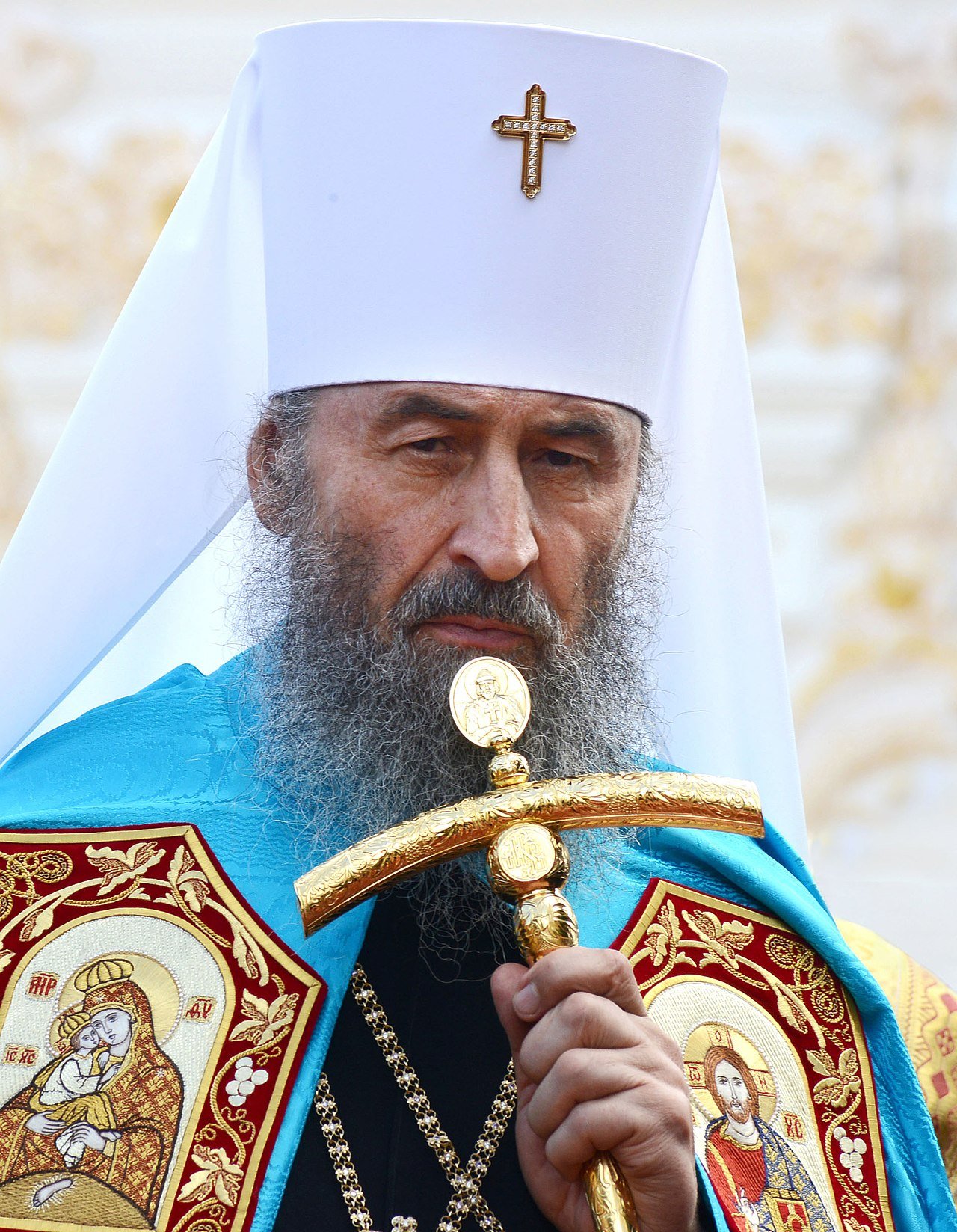
The Ukrainian Orthodox Church (UOC) under Metropolitan Onuphry is the canonical Orthodox Church in Ukraine. For decades, the UOC has operated as a self-governing church under the omophorion (authority) of the Moscow Patriarchate. With 90 bishops, 12,500 parishes, 250 monasteries, and tens of millions of faithful, it is by far the largest Orthodox body in Ukraine.[1] Its bishops were canonically ordained in apostolic succession. Its clergy served validly. Its faithful received the mysteries. Every autocephalous Orthodox Church recognized it as the legitimate Orthodox presence in Ukraine.
The “Orthodox Church of Ukraine” (OCU) is a different body entirely. It was created by a tomos (a formal decree) of autocephaly (full ecclesiastical independence) granted by Patriarch Bartholomew of Constantinople in January 2019. Most local Orthodox Churches have not recognized it.[2] This matters because, in the entire history of the Orthodox Church, there has never been a valid autocephalous church that was not recognized by other autocephalous churches. Recognition by the wider Church has always been essential for establishing legitimate canonical status.
They are two separate bodies with different origins, different canonical status, and different relationships to Patriarch Kirill.
How the OCU Was Created
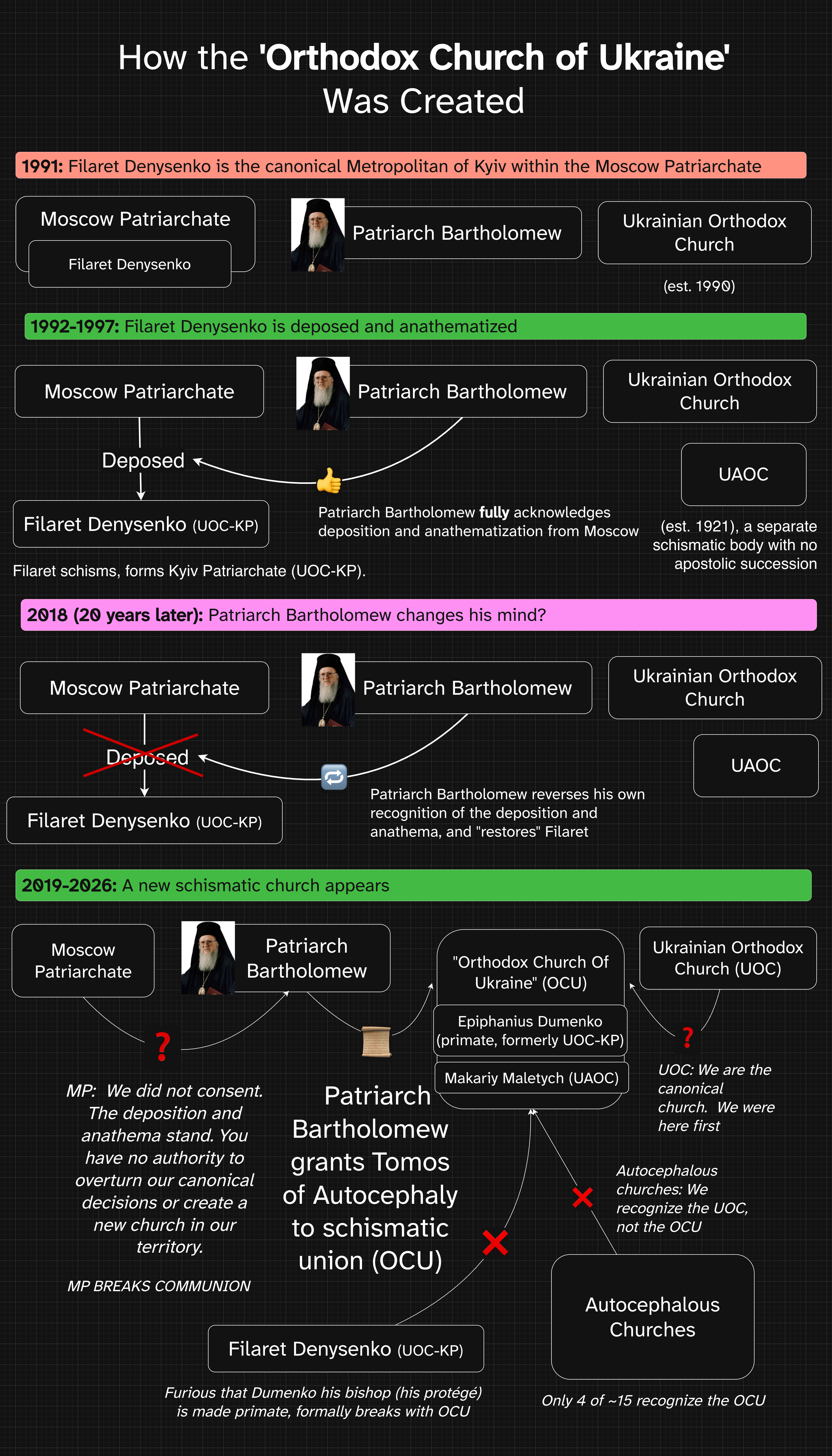
In 2018, Patriarch Bartholomew announced his intention to grant autocephaly to Ukraine. The tomos was not granted to the canonical Ukrainian Orthodox Church under Metropolitan Onuphry. It went to a “unification council” composed of two schismatic groups.[3]
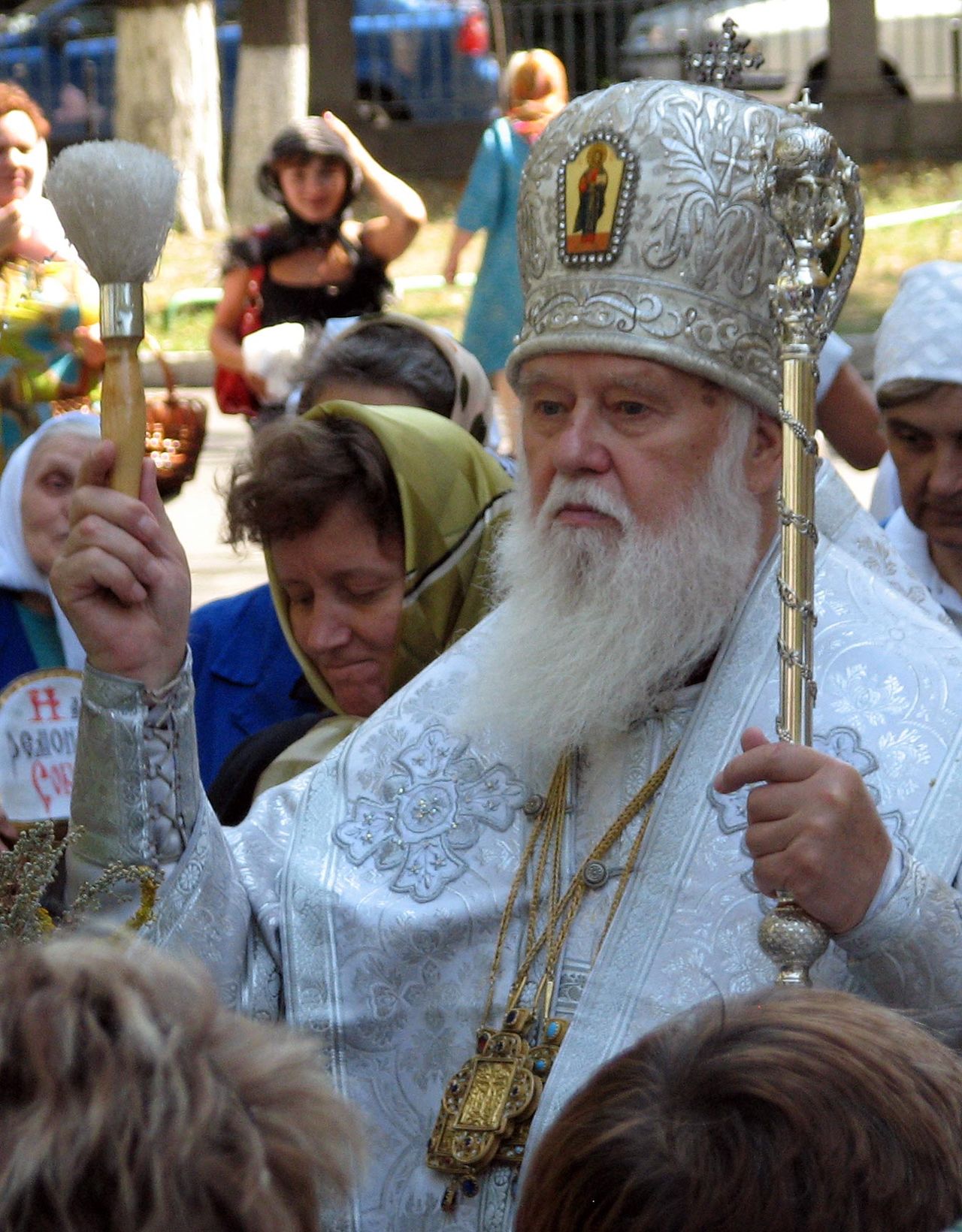
The first group was the “Kyiv Patriarchate” under Filaret Denysenko. Filaret had been the canonical Metropolitan of Kyiv until 1992, when he was suspended by Moscow after a jurisdictional dispute.
In 1997, Moscow formally anathematized him (declared him cut off from the Church entirely, the most severe ecclesiastical penalty) and Patriarch Bartholomew recognized both actions at the time.
In 1992, after Moscow deposed Filaret, Bartholomew wrote to Patriarch Alexy II:
Our Holy Great Church of Christ recognizes the integral and exclusive jurisdiction of the Most Holy Church of Russia under your leadership regarding this issue, and accepts what has been synodically decided about the person in question, not desiring that the above cause any difficulty for our sister Church.
— Patriarch Bartholomew, letter to Patriarch Alexy II, 1992; cited in Metropolitan Nikiforos of Kykkos, The Ecclesial Crisis in Ukraine, p. 7
In plain language: Patriarch Bartholomew recognized Moscow’s exclusive authority over Ukraine and accepted Filaret’s deposition as valid.
In 1997, after Moscow anathematized Filaret, Bartholomew wrote again:
Having received knowledge of the above decision, we will announce it to the Hierarchy of our Ecumenical throne and we will urge that henceforth they have no ecclesiastical communion with those mentioned.
— Patriarch Bartholomew, letter to the Patriarch of Moscow, 1997; cited in Metropolitan Nikiforos of Kykkos, The Ecclesial Crisis in Ukraine, pp. 7–8
In plain language: Bartholomew accepted the anathema and urged his own bishops to cut all contact with Filaret.
Twenty-one years later, in 2018, Bartholomew “restored” this same Filaret to communion without repentance, without canonical process, and granted him recognition as a legitimate hierarch. The sacred canons are explicit about the preconditions for receiving schismatics back into communion: Canon 8 of the First Ecumenical Council and Canons 4 and 7 of the Second Ecumenical Council require repentance, a willingness to return to the church from which they split, and submission to the canonical bishops. None of these conditions were met.[4]
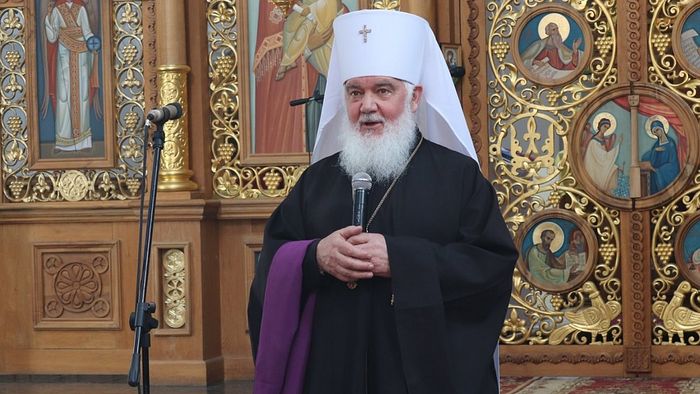
The second group was the “Ukrainian Autocephalous Orthodox Church” (UAOC) under Makary Maletich. This group’s ordinations trace back to Vasyl Lypkivsky, who was “consecrated” in 1921 not by bishops but by presbyters, hierodeacons (monastic deacons), and laypeople who placed their hands on each other’s shoulders in a human chain: “those in the solea on the shoulders of the deacons, the deacons on the priests, and the priests on the candidate for consecration.”[5]
In Orthodox theology, only a bishop can ordain another bishop. This unbroken chain of episcopal ordination stretching back to the apostles is called apostolic succession. Without it, there is no valid clergy. Lypkivsky’s “consecration” by non-bishops broke that chain entirely. No bishop laid hands on him. A crowd did. Makary Maletich is not a bishop. His “clergy” are laypeople performing liturgical theater.
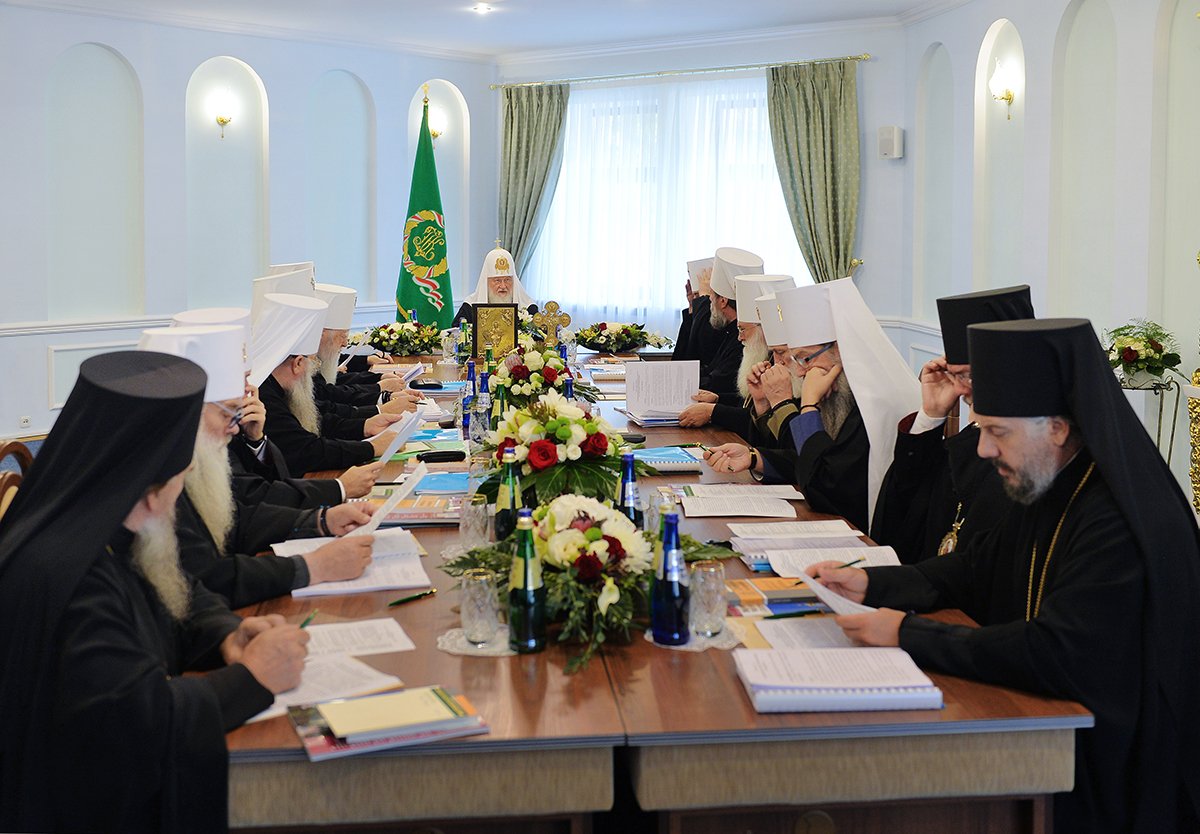
The canonical Ukrainian Orthodox Church under Metropolitan Onuphry refused to participate in the “unification council.” The OCU was created without them and in opposition to them.
The resulting body elected as its primate “Metropolitan” Epiphanius Dumenko, who had been “ordained” by the deposed and anathematized Filaret.[6]
A deposed bishop’s sacramental acts are invalid: ordinations performed after deposition confer nothing. Dumenko’s episcopacy rests on an act that the entire Orthodox world, including Constantinople, had recognized as null.
Even Filaret himself rejected the outcome. The “unification council” granted him the title “Honorary Patriarch,” but he withdrew his agreement and refused to accept the Tomos of Autocephaly because it abolished the “Patriarchate” he had proclaimed. The OCU’s own co-founder repudiated the very document that created it.
This is all a bit confusing, so here is a diagram to better help readers visualize this.
Why This Distinction Matters
Throughout this book, when documenting the canonical Ukrainian Orthodox Church’s response to Patriarch Kirill, the reference is to the canonical body under Metropolitan Onuphry, the UOC: the church that remained loyal to Moscow for decades, that refused to join the OCU, and that nonetheless ceased commemorating Patriarch Kirill in 2022.
Kirill’s defenders will dismiss all Ukrainian criticism as “schismatic OCU propaganda.” By documenting that the canonical UOC also rejected Kirill’s war theology, that escape hatch is completely closed, so this is imperative for people to understand.
OCU supporters will attempt to use this book’s critique of Kirill to vindicate Bartholomew’s intervention. By establishing that the OCU is schismatic in origin, that misuse is foreclosed.
Honest readers need to understand both errors: Kirill’s heresies do not justify joining schismatics, nor does the OCU’s schismatic origin excuse Kirill’s heresies.
The abbreviations OCU and UOC are easily confused as well, which is itself a source of misunderstanding. The distinction matters.
The Bottom Line
The OCU is schismatic in origin. The essential points are:
- For 330+ years, every Orthodox Church recognized Ukraine as belonging to Moscow
- Bartholomew himself recognized this in writing, multiple times
- The tomos was granted to groups Bartholomew himself had recognized as deposed and anathematized
- It was granted without the consent of the Mother Church or pan-Orthodox approval
- It was granted to groups containing “bishops” with no apostolic succession at all
Of the roughly fifteen autocephalous Orthodox Churches, only four have recognized the OCU: Constantinople (which granted the tomos), Alexandria, Greece, and Cyprus. Every other autocephalous church continues to recognize Metropolitan Onuphry’s UOC as the canonical Orthodox Church in Ukraine.[7]
This opposition is not limited to churches with historical ties to Moscow. The late Archbishop Anastasios of Albania, a Greek missionary with no connection to the Moscow Patriarchate, refused to recognize the OCU and did not concelebrate with the Ecumenical Patriarch for the last six years of his life over this question.[8]
The full canonical case, including Bartholomew’s own letters, the 30-year statute of limitations, the apostolic succession problem, and the Chambésy agreements, is documented in Appendix B. Those who encounter OCU apologists should read it in full. Additionally, the most thorough analysis available in English is The Ecclesial Crisis in Ukraine by Metropolitan Nikiforos of Kykkos (Cyprus) and it is a great read on the matter.[9]
What Follows
Part VI (The Case for Cessation) established when cessation of commemoration is permitted: Canon 15, St. Hypatius against Nestorius, the Russian New Martyrs against Sergius. The next chapter documents how the canonical UOC applied exactly that tradition: Kirill’s own words that provoked them, and the council resolutions, diocesan orders, and primate’s declaration that followed.
Thus, their witness stands regardless of one’s position on the tomos or Constantinople. It is concrete testimony from within the canonical Church about why commemorating Patriarch Kirill became spiritually impossible.
Metropolitan Nikiforos of Kykkos, The Ecclesial Crisis in Ukraine. These figures predate the 2022 Russian invasion; wartime seizures of churches and monasteries have since reduced the UOC’s institutional footprint, though most of its faithful remain. ↩
Moscow severed communion with Constantinople in October 2018 over the OCU, invoking the canons against receiving schismatics. Yet in May 2017, Patriarch Kirill had awarded the president of Macedonia, praising the country for “preserving the Orthodox faith,” while the Macedonian Orthodox Church was itself schismatic, having broken from Serbia in 1967 without canonical release. In August 2022, Moscow formally recognized these same Macedonian schismatics as a canonical church. “Statement of the Holy Synod of the Russian Orthodox Church on the restoration of canonical communion with the Macedonian Orthodox Church: Ohrid Archbishopric,” August 25, 2022, https://mospat.ru/en/news/89563/ ↩
In 1991-92, Metropolitan Filaret, then the canonical head of the UOC under Moscow, convened an assembly that formally petitioned the Moscow Patriarchate for autocephaly. Moscow denied it, defrocked Filaret, and the resulting crisis produced the Kyiv Patriarchate schism. ↩
Metropolitan Nikiforos of Kykkos, The Ecclesial Crisis in Ukraine, pp. 45–46. Nikiforos details Canon 8 of the First Ecumenical Council, Canons 4 and 7 of the Second Ecumenical Council, and their application to the Ukrainian situation: “In order for the restoration of ecclesiastical communion with schismatics to be valid: i) There must be an expression of repentance and sorrow on the part of the schismatics. ii) There must be a willingness, on the part of the schismatics, to return to the Church from which they split … iii) As former schismatics, they must be subject to the canonical bishops.” ↩
Metropolitan Nikiforos of Kykkos, The Ecclesial Crisis in Ukraine, p. 27, citing primary sources on Vasyl Lypkivsky’s 1921 “consecration” by presbyters, hierodeacons, and laypeople. ↩
Metropolitan Nikiforos of Kykkos, The Ecclesial Crisis in Ukraine, p. 46. On Makary Maletich’s group: “This is not a doubt about the moral purity of certain individuals, but rather the ontological non-existence of the very innermost core of Episcopacy. We do not have a moral, but rather an ontological ‘contamination’ of the Episcopal Body at a pan-Orthodox level.” ↩
As of early 2025, the autocephalous churches recognizing the OCU are Constantinople, Alexandria, Greece, and Cyprus. All other autocephalous churches maintain communion with Metropolitan Onuphry’s UOC. No church that has refused to recognize the OCU has broken communion with the UOC. ↩
Archbishop Anastasios of Tirana and All Albania, letter to Patriarch Bartholomew, January 14, 2019. Full text: orthodoxalbania.org. His second letter of March 21, 2019, responding point by point to Bartholomew’s reply, is published at mospat.ru. In a 2020 interview, he stated: “The initiatives in Ukraine, after two years already, obviously did not yield the desired therapeutic effect. Neither peace nor unity was achieved for the millions of Ukrainian Orthodox. Instead, controversy and division spread to other local Orthodox Churches.” ↩
Metropolitan Nikiforos of Kykkos and Tillyria, The Ecclesial Crisis in Ukraine and Its Solution According to the Sacred Canons (Unorthodox Media, 2020). ↩