
The World Council of Churches: "The Cradle of a United Church"
Many who participate in ecumenical organizations do so with sincere intentions. The desire to see Christians speak to one another rather than past one another is not wicked. Dialogue, understood as an opportunity to witness to the truth, has patristic precedent. If the WCC were merely a forum for Orthodox to explain their faith to the heterodox, its existence might be defensible.
The question is whether the WCC actually functions this way, or whether it operates on premises that contradict Orthodox ecclesiology.
Patriarch Kirill calls the WCC “our common home” and has declared his “desire to contribute to the development of the ecumenical movement.” He has maintained Moscow’s membership in the WCC for over fifty years. Many defend this as a necessary witness to the heterodox, an opportunity to share the Orthodox faith in a global forum. The saints have something different to say.
Before examining what Patriarch Kirill defends, we must understand what the saints teach about the WCC and what the WCC’s own events reveal.
A. What the Saints Teach About the WCC
The World Council of Churches (WCC) was founded in 1948 with a foundational premise: that all member denominations (including Anglicans, Lutherans, Methodists, Baptists, Reformed/Presbyterians, Mennonites, Quakers, and various Orthodox and Oriental Orthodox churches) are legitimate “churches” whose separation can be overcome through dialogue and cooperation. The WCC claims Christ’s prayer in John 17:21 (“that they may all be one”) as its scriptural mandate. Metropolitan Hierotheos of Nafpaktos identifies the misreading:
We cannot speak of Churches which are separated and struggling to reach the truth and union, but about the Church which is always united with Christ and has never lost the truth, and about people who have broken away from it. … Christ is not referring to a union of the Churches which will come about in the future, but to the union of the Disciples which will come about on the day of Pentecost, when they will receive the Holy Spirit. … Anyone who experiences Pentecost in his personal life attains this unity.
— Metropolitan Hierotheos (Vlachos) of Nafpaktos, The Mind of the Orthodox Church
Christ’s prayer was fulfilled at Pentecost. It describes a spiritual reality already accomplished, not an institutional task awaiting human organization. The WCC inverts the text: it treats unity as something lost and needing restoration through ecumenical dialogue. The WCC’s own “Toronto Statement” (1950) makes this ecclesiological error explicit:
The member churches recognize that the membership of the Church of Christ is more inclusive than the membership of their own church body.
— World Council of Churches, Toronto Statement (1950), Section IV, Point 3. https://oikoumene.org/resources/documents/toronto-statement
This statement treats the Church of Christ as broader than any particular denomination, a mystical reality transcending all visible church structures. According to this view, Protestants outside the Orthodox Church belong aliquo modo (in some manner) to the Church.[1]
The Orthodox Church, on the other hand, confesses in the Creed “One, Holy, Catholic, and Apostolic Church.” The Church’s unity is never lost. Those who depart from Orthodoxy become heretics and schismatics; the Church remains one.
St. John Chrysostom explains why the very name of the Church excludes division:
He calls it, too, the Church of God; showing that it ought to be united. For if it be of God, it is united, and it is one, not in Corinth only, but also in all the world: for the Church’s name (ἐκκλησία) is not a name of separation, but of unity and concord.
— St. John Chrysostom, Homily 3 on 1 Corinthians, §1, on 1 Cor 1:10 (PG 61), cited in Hieromartyr Daniel Sysoev, Why Do Believers Quarrel?, pp. 10-11
St. John of Kronstadt named the specific bodies that severed themselves from the Church:
I am deeply grieved that this holy union has been severed in the West and by the West, by infamous Roman Catholicism, and within it, by Lutheranism and the Reformation, and within us, by schisms and sects. The True Church remains and will be one, indivisible, and sole saving, namely, the Eastern Orthodox Church.
— St. John of Kronstadt, quoted in I. K. Sursky, Saint John of Kronstadt, trans. Holy Transfiguration Monastery (2018), pp. 258–259
He identified the specific dogmatic reason for that severing:
Christ says that the Spirit proceeds from the Father, whereas the Roman Catholics and the Lutherans with the Anglicans say that He proceeds from the Father and the Son. May you finally cease blaspheming the Holy Spirit and raising up a falsehood against Him: those who blaspheme the Holy Spirit will not be forgiven either in this age or in the future age. […] Roman Catholics, Lutherans and the Reformed fell away from the Church of Christ — they are not of one mind with us… they are not with us; they are against us and against Christ.
— St. John of Kronstadt, The Living Ear of Grain, as cited in A. Vladimirov, “The Attitude of Saint John of Kronstadt Toward the Non-Orthodox Confessions,” Orthodox Life, Vol. 46, No. 2 (Mar-Apr 1996), p. 11
St. John of Kronstadt tells us that the Church remains and will always be one.
“They are against us and against Christ.” Which contemporary ecumenist would dare utter these words against the heterodox: the Roman Catholics, the Lutherans, the Baptists? Yet this is not the opinion of a polemicist or a blogger: it is the teaching of a canonized saint, a wonder-worker whose incorrupt relics testify to the truth of his witness. The WCC asks Orthodox Christians to sit at a table with those whom the saints say are against Christ, and to call them partners, out of some misconceived notion of love, as if they have more love than St. John of Kronstadt and the rest of our saints.
The Toronto Statement’s premise that all member bodies belong to the Church implies they possess valid sacraments. St. Cyprian of Carthage, writing centuries before the schism (when “Catholic Church” meant the one Orthodox Church), demonstrates the impossibility of this:
Yes, but that one baptism is in the Catholic Church. And if there is one Church, there can be no baptism outside it. There cannot be two baptisms: if heretics really baptize, then baptism belongs to them. And anyone who on his own authority concedes them this privilege admits, by yielding their claim, that the enemy and adversary of Christ should appear to possess the power of washing, purifying, sanctifying a man.
— St. Cyprian of Carthage, Epistle LXXI.1, cited in Fr. Emmanuel Hatzidakis, The Heavenly Banquet, p. 211
If there is one Church, there can be no sacraments outside it. To recognize other bodies as “churches” possessing grace is to concede the Toronto Statement’s claim that the Church of Christ extends beyond the Orthodox Church.
Orthodox participation in the WCC endorses the branch theory: the idea that the Church is currently divided into “branches” that can be reunited. The WCC premise that unity must be “achieved” through dialogue inverts Orthodox eucharistic theology. The Eucharist expresses unity already possessed, not creating it:
For the Orthodox, the Eucharist is not an instrument or means for achieving Christian unity, but the very sign and crowning of that union based on doctrinal truths and canonical harmony already held and possessed in common.
— Fr. Alkiviadis Calivas, cited in Fr. Emmanuel Hatzidakis, The Heavenly Banquet, p. 204
The Toronto Statement makes WCC membership incompatible with Orthodoxy. But the WCC went further: over the following decades, its published theology moved from ecclesiological error to soteriological apostasy.
In January 1990, the WCC’s Dialogue sub-unit held an official consultation in Baar, Switzerland, producing a statement that escalated far beyond Toronto. Where Toronto claimed “the Church of Christ is more inclusive than any one church,” the Baar Statement declared:
We find ourselves recognizing a need to move beyond a theology which confines salvation to the explicit personal commitment to Jesus Christ.
— World Council of Churches, Baar Statement: Theological Perspectives on Plurality (January 15, 1990), Section III. https://www.oikoumene.org/resources/documents/baar-statement-theological-perspectives-on-plurality
The statement continued:
It may be available to those outside the fold of Christ in ways we cannot understand, as they live faithful and truthful lives in their concrete circumstances and in the framework of the religious traditions which guide and inspire them.
— World Council of Churches, Baar Statement (1990), Section III.
Toronto (1950) said all denominations belong to the Church. Baar (1990) said salvation does not require Christ at all. In forty years, the WCC moved from denying that the Orthodox Church is the one Church to denying that Christ is the one Savior. This was the WCC’s published position one year before Kirill defended it at Canberra.
This trajectory was not accidental. Stanley Jedidiah Samartha, the WCC’s first Director of Dialogue with People of Living Faiths, had laid the theological groundwork:
The Church in history has tended to glorify, exalt and deify Jesus Christ… Christians have sometimes succumbed to the dangers of “a personality cult.”
— S. J. Samartha, “The Quest for Salvation and the Dialogue between Religions,” International Review of Mission (October 1968), p. 429
The WCC’s founding Dialogue Director accused the Church of “Christomonism” and treated the worship of Christ as a problem to be overcome.[2]
The Witness of the Saints
Beyond its published theology, the WCC stands condemned by the saints and elders of the Orthodox Church.
Metropolitan Philaret (Voznesensky) of New York (1903-1985), Third First Hierarch of ROCOR, was a confessor against ecumenism for twenty-one years, whose incorrupt relics testify to his holiness. He addressed the Toronto Statement directly in his Second Sorrowful Epistle (1972).
In our first Sorrowful Epistle, we wrote in detail on how incompatible with our Ecclesiology was the participation of Orthodox in the World Council of Churches, and presented precisely the nature of the violation against Orthodoxy committed in the participation of our Churches in that council. We demonstrated that the basic principles of that council are incompatible with the Orthodox doctrine of the Church. We, therefore, protested against the acceptance of that resolution at the Geneva Pan-Orthodox Conference whereby the Orthodox Church was proclaimed an organic member of the World Council of Churches. Alas! These last few years are richly laden with evidence that, in their dialogues with the heterodox, some Orthodox representatives have adopted a purely Protestant ecclesiology which brings in its wake a Protestant approach to questions of the life of the Church, and from which springs forth the now popular modernism.
— Metropolitan Philaret (Voznesensky), Second Sorrowful Epistle, 1972. http://orthodoxinfo.com/ecumenism/sorrow2.aspx
Metropolitan Philaret compared WCC membership to ancient heresies:
In order to evaluate all this from the point of view of the Orthodox Church, it is sufficient to imagine the reception it would find among the Holy Fathers of the Ecumenical Councils. Can anybody imagine the Orthodox Church of that period declaring itself an organic member of a society uniting Eunomians or Anomoeans, Arians, Semi-Arians, Sabellians, and Apollinarians? Certainly not! On the contrary, Canon I of the Second Ecumenical Council does not call for union with such groups, but anathematizes them.
— Metropolitan Philaret (Voznesensky), First Sorrowful Epistle, July 27, 1969. http://orthodoxinfo.com/ecumenism/sorrow.aspx
The Councils anathematized heretics; they did not join them as “organic members.” Metropolitan Philaret continued:
St. Vincent of Lérins, in his immortal work, writes that “for Christians to declare something which they did not previously accept has never been permitted, is never permitted, and never will be permitted,—but to anathematize those who proclaim something outside of that which was accepted once and for ever, has always been a duty, is always a duty, and always will be a duty.”
— Metropolitan Philaret (Voznesensky), First Sorrowful Epistle, July 27, 1969. http://orthodoxinfo.com/ecumenism/sorrow.aspx
The Church never declared herself part of heretical organizations. She anathematized them. The WCC asks Orthodox to do the opposite: sit as “organic members” alongside the very heresies the Councils condemned.
St. John of Shanghai, a ROCOR hierarch now glorified among the saints, taught the same:
The laws of Christ’s Church are immutable; a Christian must submit to them irrespective of what others think, of how society regards these laws, whether favorably or unfavorably. Those faithful to Christ follow after Him along the path of those laws, those ordinances which the holy Church sacredly preserves.
Those who revile the laws of the Church revile Christ Himself, Who is the Head of the Church, for the laws of the Church were given by the Holy Spirit through the Apostles.
— St. John of Shanghai and San Francisco, Man of God, “Sermon on the Sunday of Orthodoxy,” pp. 158-159
The canons are binding and timeless, “given by the Holy Spirit through the Apostles.” To dismiss them as irrelevant to modern ecumenical relations is to “revile Christ Himself.”
Metropolitan Philaret warned that modern ecumenical “tolerance” is spiritually worse than ancient zealous heresy, invoking Revelation’s condemnation of Laodicean lukewarmness:
Let us grant that modern preachers of heresy are not so belligerent towards the Orthodox Church as the ancient ones were. However, that is not because their doctrines are nearer to Orthodox teaching, but because Protestantism and Ecumenism have built up in them the conviction that there is no One and True Church on earth, but only communities of men who are in varying degrees of error. Such a doctrine kills any zeal in professing what they take to be the truth, and therefore modern heretics appear to be less obdurate than the ancient ones. But such indifference to truth is in many respects worse than the capacity to be zealous in defense of an error mistaken for truth. Pilate, who said “What is truth?” could not be converted; but Saul, the persecutor of Christianity, became the Apostle Paul. That is why we read in the Book of Revelation the menacing words to the Angel of the Church of Laodicea: “I know thy works, that thou art neither cold nor hot: I would thou wert cold or hot. So then because thou art lukewarm, and neither cold nor hot, I will spew thee out of my mouth” (iii. 15-16).
— Metropolitan Philaret (Voznesensky), First Sorrowful Epistle, July 27, 1969. http://orthodoxinfo.com/ecumenism/sorrow.aspx
Saul persecuted the Church because he believed he was defending truth. He was wrong, but his zeal was convertible: when Christ revealed Himself, Saul became Paul. The ecumenist who says “all churches contain truth” cannot be converted this way, because he has abandoned the premise that truth resides in one place. There is nothing for Christ to redirect. Conversion requires something to convert from; Laodicean lukewarmness offers nothing.
Ecumenical indifference to truth receives Christ’s most severe condemnation: “I will spew thee out of my mouth.” The WCC’s premise that “there is no One and True Church on earth” contradicts the Creed’s confession of “One, Holy, Catholic, and Apostolic Church.” Metropolitan Philaret concluded by citing Canon LVII of Carthage:
The LVII (LXVI in the Athens Syntagma) Canon of Carthage says of the Church that she is “the one spoken of as a dove (Song of Songs, vi.9) and sole mother of Christians, in whom all the sanctifying gifts, savingly everlasting and vital are received—which, however, inflict upon those persisting in heresy the great punishment of damnation.”
— Metropolitan Philaret (Voznesensky), First Sorrowful Epistle, July 27, 1969. http://orthodoxinfo.com/ecumenism/sorrow.aspx
The Church is one dove and sole mother of Christians. There is no room for organic membership with heretics in a union that treats all confessions as equally valid branches of a divided Christianity.
The incompatibility is foundational: the WCC’s ecclesiology contradicts Orthodox doctrine on the nature of the Church.
The Heresy the WCC Serves
The WCC does not exist in isolation. It is the organizational expression of a broader heresy: ecumenism, the idea that all Christian bodies are legitimate “branches” of a divided Church. To understand why the saints condemn the WCC so severely, we must understand the heresy it serves.
Archbishop Vitaly of Montreal (later Metropolitan, d. 2006), who succeeded Metropolitan Philaret as First Hierarch of ROCOR, provided the clearest formulation of why ecumenism is uniquely dangerous:
Ecumenism is the heresy of heresies, because until now every separate heresy in the history of the Church has striven itself to stand in the place of the true Church, while the ecumenical movement, having united all heresies, invites them all together to honor themselves as the one true Church.
— Archbishop Vitaly of Montreal and Canada, “Ecumenism,” The Orthodox Word, Vol. 5, No. 4 (July-August 1969), p. 155
Previous heresies at least claimed to be the true Church: Arianism, Nestorianism, and Monophysitism each believed itself correct. Ecumenism makes no such claim. It invites all heresies to sit together as equal “churches,” denying the very existence of the one true Church. The Fathers call it uniquely dangerous because it destroys the concept of truth itself.
St. Gabriel (Urgebadze) of Georgia (†1995), glorified in 2012, places ecumenism in eschatological context:
First there will be chaos and pandemonium, then there will be schism in the Church, and then will come accursed ecumenism. Remember: ecumenism is the heresy of all heresies. It is betrayal of Christ and betrayal of the Truth.
— St. Gabriel (Urgebadze) of Georgia, Great Art Thou, O Lord!, p. 189
St. Paisios the Athonite was deeply troubled by ecumenism:
He was distressed by the various ecumenical movements, which he termed “patchwork of the devil.”
— Saint Paisios the Athonite (Holy Hesychasterion), pp. 427-428[3]
The WCC as Ecumenism’s Organizational Vehicle
With this understanding, the focus returns to the WCC. It functions as ecumenism’s primary institutional instrument, the organization through which the branch theory is practiced and normalized.
Metropolitan Seraphim of Piraeus identifies the WCC’s true nature:
One of the tools used by Ecumenism in order to achieve its aims is Syncretism, that deadly foe of the Christian faith, which is promoted by the so-called “World Council of Churches,” or rather “World Council of Heresies,” as it has rightly been characterized.
— Metropolitan Seraphim of Piraeus, A Letter to Pope Francis, http://orthodoxinfo.com/ecumenism/epistle-to-pope-francis.pdf[4]
“World Council of Heresies.” An organization whose very purpose is the propagation of syncretism.
Geronda (Elder) Ephraim of Arizona exposes the WCC’s strategic target:
This insidious “ecumenical fabrication does not wish to seek out the truth but”, according to Father Haralambos Vasilopoulos, “is a mixture aimed at exterminating the Truth. It is an effort not for those that have been deceived to find the truth but for those that do have it to lose it; that is, those who believe in the One, Holy, Catholic and Apostolic Church.”
— Elder Ephraim of Arizona, A Call from the Holy Mountain, https://www.scribd.com/document/166719693/, p. 43[5]
Ecumenists claim they are “seeking truth together.” Father Haralambos exposes the opposite: the WCC’s mission is to make those who possess the truth lose it.
The Holy Community of Mount Athos itself warned that the WCC’s ecclesiology is altering the “dogmatic conscience” of the faithful.[6]
Geronda Ephraim of Arizona exposes the WCC’s ideological control:
When even the champion of the World Council of Churches, Metropolitan Meliton of Chalcedon, is forced to admit: “It is an undoubted fact that the W.C.C. is 99% under the control of Protestantism and strongly carries its mark,” what more evidence do we Orthodox need to sever relations with them before we crush any hope left in them that the truth really exists unique, intact and lucid to be found in the One, Holy, Orthodox Church of Christ?
— Geronda Ephraim of Arizona, A Call from the Holy Mountain, https://www.scribd.com/document/166719693/, p. 44
We echo these words of Geronda Ephraim of Arizona to our Orthodox Christian brethren: what more evidence to sever relations with the W.C.C? What exactly are we waiting for?
Even Metropolitan Meliton, a WCC champion, admitted Protestant control. Why would Orthodox remain in an organization controlled by heretics?
How Moscow Joined the WCC
The saints’ condemnation is unanimous. But Moscow’s membership in the WCC has its own history, and it is not a theological one.
In 1948, the Moscow Patriarchate itself condemned WCC membership. At the Moscow Conference of Autocephalous Orthodox Churches, the assembled hierarchs issued a formal resolution:
We inform the World Council of Churches, in reply to the invitations received by all of us to take part in the Amsterdam Assembly in the capacity of members of it, that all Local Orthodox Churches participating in the present Meeting are compelled to refuse to participate in the Ecumenical Movement in its present form.
— Resolution of the Moscow Conference of Autocephalous Orthodox Churches (1948), quoted in Archbishop Vitaly of Montreal, “Ecumenism,” The Orthodox Word, Vol. 5, No. 4 (July-August 1969), p. 152
The resolution was signed by the heads of the Russian, Georgian, Serbian, Romanian, Bulgarian, Polish, Albanian, and Czechoslovakian Churches, and by representatives of the Churches of Antioch and Alexandria.[7] A mere thirteen years later, in 1961, the Moscow Patriarchate reversed this position and joined the WCC.
Orthodox ecclesiology had not changed in those thirteen years. What changed was Soviet policy: the Communist Party recognized the WCC as a vehicle for advancing its geopolitical interests and directed the Moscow Patriarchate to join. This is not conjecture: both contemporary émigré documentation and the Moscow Patriarchate’s own later admissions confirm it.
(More will also be said about this in Chapter 13: KGB and the DECR)
A 1961 memorandum from the Russian Orthodox émigré community in West Germany documented the Communist Party’s involvement:
Since the 1958 Conference of the National Council of Christian Churches of the United States spoke out in favor of proposals acceptable to the Communist Party of the Soviet Union, the Party, having recognized, apparently, the possibility of further influencing the World Council of Churches for its own needs, began not only to encourage contacts between officials of the World Council of Churches and the Moscow Patriarchate, but also to form the intention of having representatives of the Moscow Patriarchate guide its policies directly as actual members of the World Council of Churches. So the Moscow Patriarchate, carrying out the Communist Party’s will, applied for membership in the World Council of Churches in 1961.
— Memorandum of the Russian Orthodox Émigré Community in West Germany (1961), Orthodox Life, Vol. 11, No. 6 (1961)
The Moscow Patriarchate has confirmed this. In a 2006 interview, Bishop Hilarion (later Metropolitan and Chairman of the DECR until 2022) admitted that joining the WCC was never a theological decision:
Entering the WCC was an important strategic initiative by the Russian Orthodox Church during this period of sharply-escalating pressure on the Church by the state, headed by the virulent atheist Nikita Khrushchev. Metropolitan Nikolai (Yarushevich) and his successor as Chairman of the DECR, Metropolitan Nikodim (Rotov), saw in the emergence of the Russian Church into the international arena an opportunity to protect her from internal oppression.
— Bishop Hilarion (Alfeyev), Interview, Official Website of the Russian Orthodox Church Outside of Russia, 2006. https://synod.com/synod/en/documents/enart_interviewrocor.html
He then described how this worked in practice:
This was how: a bishop from Russia would travel to a WCC event, and, at the direction of the state, would make the necessary statements on international matters. But in private conversations, with the General Secretary of the WCC, for example, the same bishop would say: “It would be good if you expressed concern over the rumors we hear about the closing of such-and-such monastery…”
— Bishop Hilarion (Alfeyev), Interview (2006), https://synod.com/synod/en/documents/enart_interviewrocor.html
These sources are from the official ROCOR website, in plain sight.
Bishops publicly made “necessary statements on international matters” at the direction of the state, while privately asking the WCC for help. They lied. And if they lied then for strategic reasons, why should we blindly trust them now?
The full documentation of how Soviet pressure, KGB involvement, and institutional deception shaped Moscow’s WCC participation is examined in Chapter 13.[8]
The Moscow Patriarchate has not merely maintained this Soviet-era membership; it has retroactively sanctified the man who engineered it. In 2023, the Journal of the Moscow Patriarchate published a laudatory article titled “Faithful Witness,” celebrating Metropolitan Nikodim’s ecumenical career as a model of church diplomacy. The article praises his WCC work in unqualified terms:
Through his efforts, the entry of the Russian Church into the WCC in 1961 became fruitful, fostering a broad and convincing witness to the truth of Holy Orthodoxy.
— Fr. Ilya Pismenyuk, “Faithful Witness: Metropolitan Nikodim (Rotov) and His Work in the World Council of Churches,” Journal of the Moscow Patriarchate (No. 9, 2023). https://www.patriarchia.ru/article/104828[9]
The article names Kirill as Nikodim’s heir, noting that when Nikodim was elected WCC President in 1975, “his place on the Executive Committee was inherited by the student of Metropolitan Nikodim and future Patriarch… Archimandrite Kirill (Gundyaev).”
What Hilarion admitted was a Soviet-directed “strategic initiative,” the Journal of the Moscow Patriarchate now celebrates as “fruitful” and “a broad and convincing witness.” What began under Communist Party orders has been recast as a sacred lineage: Nikodim the pioneer, Kirill the heir, and the WCC as their shared field of apostolic labor. Nikodim himself died on September 5, 1978, during an audience with the newly elected Pope John Paul I in the Vatican.[10]
St. Gregory the Theologian explained centuries earlier why such contamination is inevitable:
It is easier for one to be infected by iniquity than for him to transmit a virtue; just as it is easier for you to contract a sickness than to have health bestowed on you.
— St. Gregory the Theologian, quoted in Elder Ephraim of Arizona, A Call from the Holy Mountain, p. 44
Association with heretics contaminates more readily than it converts. The naive belief that Orthodox will “witness” to heterodox in the WCC reverses how spiritual infection operates.
Many believe that their efforts to dialogue with the heterodox are what will convert them. St. Paisios identified what actually converts the heterodox, and it is not dialogue:
If, however, we lived patristically, we would all have spiritual health, which even all the heterodox would envy, and they would abandon their sick delusions and be saved without being preached to. Now, however, they are not moved by our holy patristic tradition, because they also want to see the continuation of how we ourselves live our patristic tradition - our true kinship with our saints.
The heterodox are not converted by a romantic, sentimentalistic relationship with our saints, but by true kinship with the saints, displayed by fidelity to our church canons, the consensus patrum, the boundaries of the church, and the laws of the church, as St. John of Shanghai and San Francisco previously explained.
Hieromonk Isaac records that Saint Paisios held the same conviction about the ecumenical dialogues themselves:
Nor did the Saint agree with the “dialogues” that were taking place with the heterodox. Because he had observed that the many Orthodox who were involved with the “dialogues” and “conferences” and “attempts for union” had not been previously united with God themselves, it followed that they could not inform others about leading Orthodox Patristic lives.
— Hieromonk Isaac, Saint Paisios the Athonite, p. 375
The Orthodox participants seeking such dialogue have not been united with God themselves, and so could not inform the heterodox, who likewise lacked a sincere disposition. Both sides failed the precondition for any genuine encounter with the truth. This outer activity and busy work serves as a stumbling block for the multitude.
Fr. Seraphim Rose stated what Orthodoxy has to say to the ecumenical movement, and that to discuss this truth destroys it.
Orthodoxy has one thing to say to the ecumenical movement: here is the truth, join yourself to it; to remain to “discuss” this truth not merely weakens the Orthodox witness, it destroys it. The Protestants long ago were right when they said: If you have the truth, why are you participating in the ecumenical movement, which is a search for an unknown truth.
— Fr. Seraphim Rose, Letter to Fr. David Black, October 30/November 12, 1970, Letters from Father Seraphim (St. Herman of Alaska Brotherhood)
The Protestants understood what Orthodox ecumenists refuse to see: if Orthodoxy possesses the truth, it has no reason to sit in a forum premised on a search for an unknown truth. The very act of participation contradicts Orthodox claims. Dialogue that treats truth as undiscovered destroys the witness of Orthodoxy, which already possesses this truth.
The Protestants themselves understood that Orthodox participation served their agenda, not ours. Protestant leaders openly stated they were using Orthodox participation to achieve their own internal unity first, before approaching Rome.[12]
As Fr. Spyridon Bailey of ROCOR explains, the WCC was financially supported by the Rockefeller Foundation, whose strategy was to replace doctrinal fidelity with social collaboration through the “social gospel,” creating organizational bonds stronger than the content of the faith.[13]
What the WCC Sponsors
The most critical evidence against the WCC comes from its own sponsored events. In 1993, the WCC sponsored the “Re-imagining” conference. Hieromonk Damascene documented what occurred:
In 1993 the first “Re-imagining” conference was held in Minneapolis, Minnesota, in conjunction with the World Council of Churches’ Ecumenical Decade of Churches in Solidarity with Women. The conference was attended by over two thousand participants from twenty-seven countries and fifteen mainline denominations, most prominently the Presbyterian, Methodist, Lutheran, Roman Catholic, United Church of Christ and American Baptist. One third of the participants were clergy. Speaking of the need to “destroy the patriarchal idolatry of Christianity,” the conference speakers rejected and at times ridiculed the Christian dogmas of the Holy Trinity, the Fall of man, the unique incarnation of God in Jesus Christ, and the redemption of man by Christ’s death on the Cross. In place of these articles of faith, the conference promoted pantheism, shamanism, and homosexual rights. The participants took part in a “liturgy” wherein milk and honey were used rather than bread and wine, and the goddess “Sophia” was worshipped rather than Jesus Christ. The chant was repeated: “Our Maker Sophia, we are women in your image … with our warm body fluids we remind the world of its pleasure and sensations.” At a later Re-imagining conference held in 1998, Sophia-worshipping participants also shared biting into large red apples to express their solidarity with Eve, whom they regard as a heroine for having partaken of the forbidden fruit.
— Hieromonk Damascene, Orthodoxy and the Religion of the Future, https://svspress.com/orthodoxy-and-the-religion-of-the-future/, Epilogue
These actions alone would be enough to justify splitting from the WCC. Milk and honey used in a “Liturgy” instead of bread and wine? Sophia worshipped instead of Jesus Christ? This is outright blasphemy. Does nothing faze contemporary Orthodox Christians? Solidarity with Eve for eating the forbidden fruit?
How far would the WCC need to go for people to chastise participation and question the actions of their leaders? Does the WCC need to sacrifice people to wake people up out of their indifference, or will people say that this too is ok, as long as Patriarch Kirill says it’s ok?
These diabolical actions were not a fringe event condemned by the WCC. The WCC sponsored it.
The conference took place November 4-7, 1993 at the Minneapolis Convention Center, “in conjunction with the World Council of Churches’ Ecumenical Decade: Churches in Solidarity with Women.”[14] The milk and honey ritual that “celebrated the goodness of women’s bodies” and the Sophia worship are documented facts. The Presbyterian Church (U.S.A.) itself, which has no connection to the Orthodox Church, conducted an internal investigation, and Christianity Today reported that the conference “ichthus-slapped the church by blaspheming the persons of the Trinity.”[15]
That this was no fringe event is shown by what followed: the woman who coordinated the conference rose to power within the WCC. Mary Ann Lundy served as WCC Deputy General Secretary from 1995-1999, as confirmed by the WCC’s own obituary.[16] The World Council of Churches promoted the conference’s organizer to Deputy General Secretary.
The main coordinator of the 1993 Re-imagining conference, Mary Ann Lundy, is now the Deputy Director of the World Council of Churches. At the 1998 Re-imagining conference, she made clear the agenda of both feminist theology and modern-day ecumenism: “We are learning that to be ecumenical is to move beyond the boundaries of Christianity. You see, yesterday’s heresies are becoming tomorrow’s Book of Order.”
— Hieromonk Damascene, Orthodoxy and the Religion of the Future, https://svspress.com/orthodoxy-and-the-religion-of-the-future/, Epilogue
This is what ecumenism means in practice: the normalization of heresy. The WCC does not hide this. Its leaders proclaim it, and the WCC rewards them with high office.
Geronda Ephraim of Arizona identifies the WCC’s ultimate trajectory:
This pan-heretical alchemy is being inspired through the so-called World Council of Churches. We think that the term is not true to the fact, for it does not concern a World Council of Churches but a World Council of Will Worship. The only god to demand a tribute of worship there will be the fallen Beelzebub who through his representative amongst men, the Antichrist, will try to substitute his own will for the faith and worship of the true God. For in Ecumenism there is no personal God; for consistent ecumenists the doctrine of the Trinitarian God is utterly rejectable.
— Geronda Ephraim of Arizona, A Call from the Holy Mountain, https://www.scribd.com/document/166719693/, p. 42[17]
This is what the saints teach about the World Council of Churches: “pan-heretical alchemy” preparing the way for Antichrist through the worship of false gods, the rejection of the Trinity, and the deliberate transformation of “yesterday’s heresies” into tomorrow’s orthodoxy.
B. The Evidence: Patriarch Kirill and the WCC
In February 1991, the World Council of Churches held its 7th General Assembly in Canberra, Australia. On the second day, Dr. Chung Hyun Kyung, a Presbyterian theologian from South Korea, delivered the plenary keynote on the Assembly’s theme:
“Come, Holy Spirit: Renew the Whole Creation.”
Amid the sound of gongs, drums, and clap sticks, she was joined onstage by young Korean dancers in white and two Australian Aborigines in loincloths and body paint. Reading from a rice-paper scroll, she invoked the spirits of the dead: Hagar, Joan of Arc, victims of the Crusades, Jews killed in the Holocaust, those “smashed by tanks in Kwangju, Tiananmen Square and Lithuania,” and “the spirit of the Amazon rain forest.” She set the scroll aflame and let the ashes drift into the air. In the presentation that followed, she portrayed the Holy Spirit in terms of Kwan Yin, the Buddhist goddess of compassion, stating that her image of the Holy Spirit “comes from the image of Kwan In.”[18]
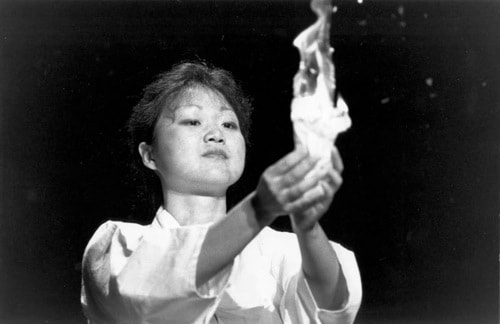
The Assembly had opened with an Aboriginal “smoking ceremony,” a traditional pagan purification rite. This was the plenary session of the world’s largest inter-Christian organization: the same organization the saints call the “World Council of Heresies.”
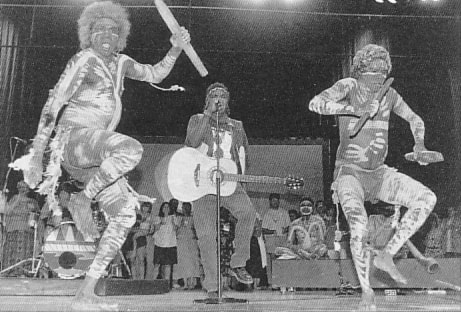
The Orthodox delegates were appalled. Yet Archbishop Kirill Gundyaev (then 44 years old) publicly defended the organization:
Я не хотел бы, чтобы из той критики, которую православные имели в отношении Всемирного совета церквей в Канберре, следовал вывод, что речь идёт о членстве или нечленстве во Всемирном совете церквей. Всемирный совет церквей является для нас общим домом. И тот факт, что православные воспринимают его как свой дом и хотят, чтобы этот дом был колыбелью единой церкви, вот из этого следует их особая ответственность за судьбу Всемирного совета церквей и желание способствовать развитию экуменического движения.
I would not want the criticism that the Orthodox had regarding the World Council of Churches in Canberra to lead to the conclusion that it is about membership or non-membership in the World Council of Churches. The World Council of Churches is a common home for us. And the fact that the Orthodox perceive it as their home and want this home to be the cradle of a united church, from this follows their special responsibility for the fate of the World Council of Churches and their desire to contribute to the development of the ecumenical movement.
— Archbishop Kirill Gundyaev (later Patriarch Kirill), remarks at the 7th General Assembly of the World Council of Churches, Canberra, Australia, February 1991. Video: https://www.youtube.com/watch?v=KR4OkPcUQQY
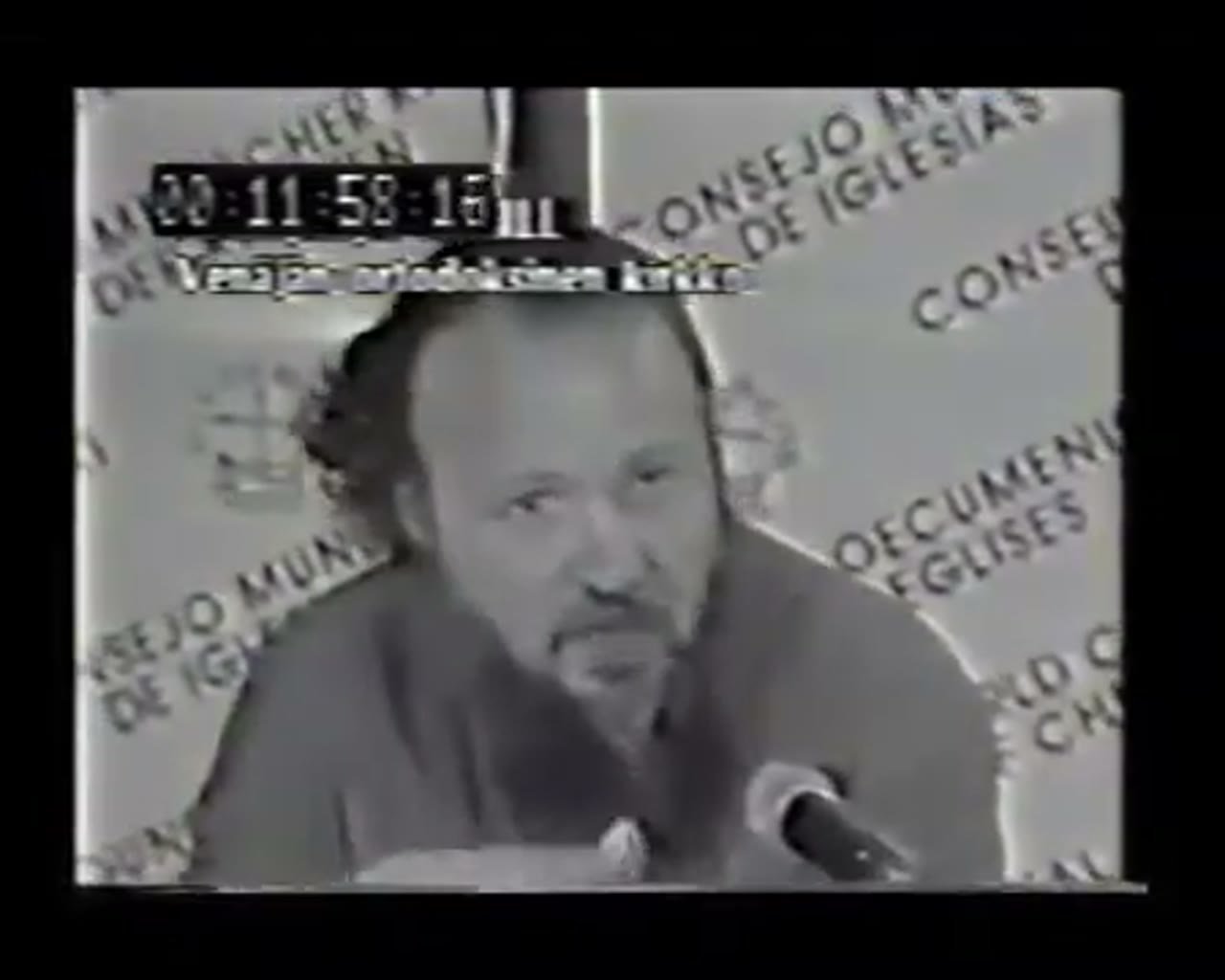
A brief examination of the then young Patriarch Kirill’s statements is in order.
“The WCC is a common home for us” (общим домом)
Our faith holds that there is no “common home” with heretics. The Orthodox Church is the one Church of Christ.
St. Cyprian taught: “You cannot have God for your Father if you have not the Church for your mother.”[19] To call the WCC “our common home” treats Protestant, Anglican, and heterodox bodies as equally valid dwelling places for Orthodox Christians.
“The cradle of a united church” (колыбелью единой церкви)
This is the branch theory: the idea that the Church is currently divided and will be re-united through ecumenical dialogue. The Creed confesses “One, Holy, Catholic, and Apostolic Church.” The Church’s unity is not lost. Those who departed became heretics; the Church remained one.
ROCOR’s 1983 Anathema condemned precisely this:
Those who attack the Church of Christ by teaching that Christ’s Church is divided into so-called “branches” which differ in doctrine and way of life, or that the Church does not exist visibly, but will be formed in the future when all “branches” or sects or denominations, and even religions will be united into one body; and who do not distinguish the priesthood and mysteries of the Church from those of the heretics, but say that the baptism and eucharist of heretics is effectual for salvation; therefore, to those who knowingly have communion with these aforementioned heretics or who advocate, disseminate, or defend their new heresy of Ecumenism under the pretext of brotherly love or the supposed unification of separated Christians, Anathema!
— ROCOR Synod of Bishops, Anathema Against Ecumenism (1983)
Every clause applies to Patriarch Kirill’s career: the branch theory (“cradle of a united church”), treating heterodox sacraments as valid (joint prayer at the Lima liturgy), knowingly communing with heretics (decades of WCC participation), and advocating ecumenism (his DECR tenure).
There is something remarkable about this Anathema: it recorded Patriarch Kirill’s participation in this Assembly by name.
The ROCOR Council of Bishops’ official report on the 1983 Vancouver WCC Assembly documented:
During the Archbishop of Canterbury’s celebration of the Lima liturgy, the Orthodox and the Catholics did not receive communion, but did participate in common prayer. Archbishop Kirill (of the Moscow Patriarchate) pronounced a prayer that “we might soon attain visible unity in the Body of Christ by blessing the bread and cup on this same altar.”
— ROCOR Council of Bishops, Report on the Sixth Assembly of the World Council of Churches, Orthodox Life, Vol. 33, No. 6, 1983
Then-Archbishop Kirill was not merely present at this assembly; he prayed aloud for eucharistic unity with the heterodox at the very event that triggered ROCOR’s Anathema Against Ecumenism, which directly named him.
The Council’s report continues: “Thus we see with grief that the process of the increase in practice of the heresy of Ecumenism among Orthodox Christians, of which we warned our brethren in our Sorrowful Epistles, has not stopped, but is even growing… Our Council has decisively condemned this manifestation and has ordered that an anathema of the heresy of Ecumenism be added to the Rite of Orthodoxy.”
Archbishop Vitaly of Montreal, writing the commentary, stated:
Ecumenism is clearly the most pernicious of heresies, for it has gathered all the heresies that exist or have existed and has called this union a Church: a deed that savors of Antichrist.
— Archbishop Vitaly of Montreal and Canada, “The ROCOR’s Anathema Against Ecumenism,” Orthodox Observer, No. 58 (April 1984). Full text: http://orthodoxinfo.com/ecumenism/ecum_anath.aspx
This most pernicious of heresies is what Patriarch Kirill embraces, as he declared at Canberra:
“Desire to contribute to the development of the ecumenical movement”
Kirill went further than describing the WCC; he committed himself to advancing its mission.
“The churches must take this home” (церкви должны взять)
This echoes the Havana Declaration’s language (see Chapter 2) that Orthodox and Catholics are “united by the mission to preach the Gospel” and that “interreligious dialogue is indispensable.”
Notice the plural: churches. The same error as the Havana Declaration, which speaks of “our Churches in Ukraine” and “martyrs who belong to various Churches.” Kirill has used this language for over three decades.
Kirill contradicted our saints. But he was also contradicting his own Orthodox colleagues at the same assembly, in real time. The Orthodox delegates at Canberra issued a collective protest:
The tendency to marginalize the Basis [of the WCC] in WCC work has created some dangerous trends in the WCC. We miss from many WCC documents the affirmation that Jesus Christ is the world’s Saviour. We perceive a growing departure from biblically-based Christian understandings of: (a) the Trinitarian God; (b) salvation; (c) the “good news” of the gospel itself; (d) human beings as created in the image and likeness of God; and (e) the church.
— Orthodox Participants’ Statement, Seventh Assembly of the WCC, Canberra 1991. In Signs of the Spirit: Official Report, Seventh Assembly, ed. Michael Kinnamon (WCC Publications, 1991), pp. 280-282.
The same statement concluded by asking: “Has the time come for the Orthodox Churches and other member churches to review their relations with the World Council of Churches?” (Signs of the Spirit, p. 282).
Orthodox delegates witnessed the Chung Hyun Kyung invocation and asked whether it was time to leave. Patriarch Kirill witnessed the same thing and called it home.
C. A Pattern Spanning Decades
Some may surmise this was a youthful error. However, Kirill’s involvement with the WCC spans his entire career, and Moscow’s engagement continues to this very day.
Two Churches Leave
In May 1997, Catholicos-Patriarch Ilia II of Georgia wrote to WCC General Secretary Konrad Raiser that a “negative attitude towards the ecumenical movement” had grown in the Georgian Church and “threatened to divide it.” The Holy Synod withdrew from the WCC.[20]
In April 1998, the Bulgarian Orthodox Church followed. Patriarch Maxim wrote to the WCC:
The Holy Synod of the Bulgarian Orthodox Church at their session on the 9th of April 1998, having taken into consideration that the hopes from its membership in the World Council of Churches have not been fully justified, as well as the confusion of the Orthodox Christians in this country with that membership, with a view to safeguard the fullness of our holy Church, have decided to discontinue its membership.
— Patriarch Maxim of Bulgaria, letter to WCC General Secretary Konrad Raiser, November 27, 1998. WCC Eighth Assembly Press Release No. 47, December 13, 1998.[21]
“The confusion of the Orthodox Christians”: this is what the saints warned about. Two autocephalous churches concluded what this chapter concludes.
Patriarch Kirill reached the complete opposite conclusion.
Of course, Patriarch Kirill isn’t just a casual participant in the WCC.
Kirill’s Personal WCC Involvement (1971-Present)
The Moscow Patriarchate’s own official biography on mospat.ru documents Kirill’s WCC career in detail:
From 1971 to 1974, he served as the Moscow Patriarchate’s official representative to the World Council of Churches in Geneva. The biography states that “the three years he spent in Geneva gave to the future Patriarch an opportunity not only to accumulate an immense experience in the area of church diplomacy but also to communicate with Russian clergy and faithful abroad.”[22]
From 1975, he served as a member of both the WCC Central Committee and Executive Committee. The mospat.ru biography records that he participated “in their work without missing a single meeting.”[22]
A 2024 article in the Journal of the Moscow Patriarchate extends the timeline, stating that Kirill remained on these governing bodies “until 1998, without missing a single session”: twenty-three consecutive years of perfect attendance on the WCC executive.[23]
In 1995, when the Orthodox churches held an internal consultation at Chambésy to deliberate whether to continue WCC participation, Kirill was “a key-speaker” who spoke in favor of staying.[22]
During a meeting with Ethiopian Patriarch Matthias on May 17, 2018, Patriarch Kirill himself referenced his involvement dating back to the beginning:
Тогда в Аддис-Абебе проходило заседание Центрального комитета Всемирного совета церквей. Я принимал участие в этом заседании.
A meeting of the Central Committee of the World Council of Churches took place in Addis Ababa, in which I participated.
— Patriarch Kirill, meeting with Ethiopian Patriarch Matthias, May 17, 2018. http://www.patriarchia.ru/article/59140
From representative to committee member to key speaker to patriarch: Kirill’s entire career has been intertwined with the WCC.
ROCOR Condemns the Moscow Patriarchate for Ecumenism (1971)
Twelve years before the 1983 Anathema, the 1971 ROCOR Council of Bishops condemned the Moscow Patriarchate by name for the heresy of ecumenism:
Having in mind this circumstance and the growth today of the heresy of ecumenism, which attempts to eradicate completely the distinction between Orthodoxy and all the heresies, so that the Moscow Patriarchate, in violation of the sacred canons, has even issued a resolution permitting Roman Catholics to receive Communion in certain cases, the Council of Bishops recognizes the necessity of introducing a stricter practice, i.e. that baptism be performed on all heretics who come to the Church.
— ROCOR Council of Bishops Resolution on Baptism of Heretics, September 15/28, 1971, Orthodox Life, Vol. 29, No. 2 (Mar-Apr 1979), p. 42
ROCOR identified the Moscow Patriarchate by name as violating sacred canons through ecumenism. This was ROCOR’s official position for decades. Despite their later re-unification, these stances have never been repented of, and are emboldened today by Patriarch Kirill, as will be seen in the following chapters.
Praying for Eucharistic Unity at Vancouver (1983)
As documented above, the ROCOR Council’s Encyclical Letter records that Archbishop Kirill publicly prayed at the 1983 Vancouver Assembly “that we might soon attain visible unity in the Body of Christ by blessing the bread and cup on this same altar.”[24]
The same year, the same ROCOR Council that documented this prayer ordered the Anathema Against Ecumenism to be added to the Rite of Orthodoxy, condemning precisely this: participation in the “so-called ecumenical Lima liturgy” and any “joint prayer” with non-Orthodox. The Council cited Apostolic Canons 45 and 46, and Canons 32 and 33 of Laodicea, which forbid reception of bread and wine blessed by non-Orthodox clerics and joint prayer with them.[24]
While ROCOR was anathematizing ecumenism, Archbishop Kirill was at the WCC Assembly praying for eucharistic unity with heretics. The Anathema was a direct response to the events at Vancouver. Kirill was a direct participant in those events.
The man whose actions helped trigger the Anathema has never repented of a single one of them: not the joint prayer, not the prayer for eucharistic unity, not his defense of WCC membership, not his call for “the cradle of a united church.”
Eight years later, at Canberra in 1991, he called the WCC “our common home.” In 2006, he pledged to “perhaps even intensify” Moscow’s WCC participation. In 2016, he signed the Havana Declaration with Pope Francis. He holds every position the Anathema condemns, and he has held them continuously for over forty years.
In 2007, ROCOR entered full communion with this same Moscow Patriarchate without requiring any renunciation of these ecumenical activities.
The broader Orthodox Christian community is relatively silent about all of this.
”Theologically Justified” and “Perhaps Even Intensified” (2006)
In 2006, after Georgia and Bulgaria had withdrawn, and while ROCOR was still in separation from Moscow partly over ecumenism, Metropolitan Kirill gave an interview in which he not only defended WCC membership but pledged to deepen it:
Мы намерены продолжать, а может быть, и усилить участие нашей Церкви в работе ВСЦ.
We intend to continue, and perhaps even intensify, our Church’s participation in the work of the WCC.
— Metropolitan Kirill (Gundyaev), interview on the DECR website, August 30, 2006. https://www.patriarchia.ru/article/17219
In the same interview, he gave the WCC’s founding a theological endorsement that contradicts Hilarion’s admission that joining was a “strategic initiative”:
Вступление в ВСЦ именно в 60-е годы было богословски оправдано.
The entry into the WCC in the 1960s was theologically justified.
— Metropolitan Kirill (Gundyaev), interview on the DECR website, August 30, 2006. https://www.patriarchia.ru/article/17219
Hilarion (2006): membership was “an important strategic initiative” to “protect her from internal oppression.” Kirill (2006): membership was “theologically justified.” One frames it as a survival tactic; the other sanctifies it as theology. Both were published in the same year, revealing the underlying logic: what began as political expedience has been retroactively consecrated as doctrinal commitment.
Kirill continued to meet with successive WCC General Secretaries throughout the following decade, each time reaffirming Moscow’s commitment. In 2014, he described the WCC’s work as making “a positive impression” and assigned it “one of the key roles” in inter-Christian dialogue.[25] In January 2019, he praised the WCC’s “unique role” during the Cold War and urged it to reclaim that status, describing shared “faith in the Lord and Savior” as the basis for Orthodox-Protestant cooperation.[26] In 2022, amid international isolation over Ukraine, he thanked the WCC for resisting pressure to expel Moscow and described WCC membership as giving him “confidence in the solidarity and support of the worldwide Christian brotherhood.”[27] In June 2025, even as Metropolitan Antoniy acknowledged the WCC was “rapidly losing its unique role,” Moscow still sent a delegation to the Central Committee session in Johannesburg.[28]
Prayer “Through Different Religious Traditions” (2015)
The WCC’s ecclesiology does not stop at Christian unity; its logical trajectory extends to all religions. In a sermon after Liturgy in Kaliningrad on November 15, 2015, Kirill revealed he has followed this trajectory to its end:
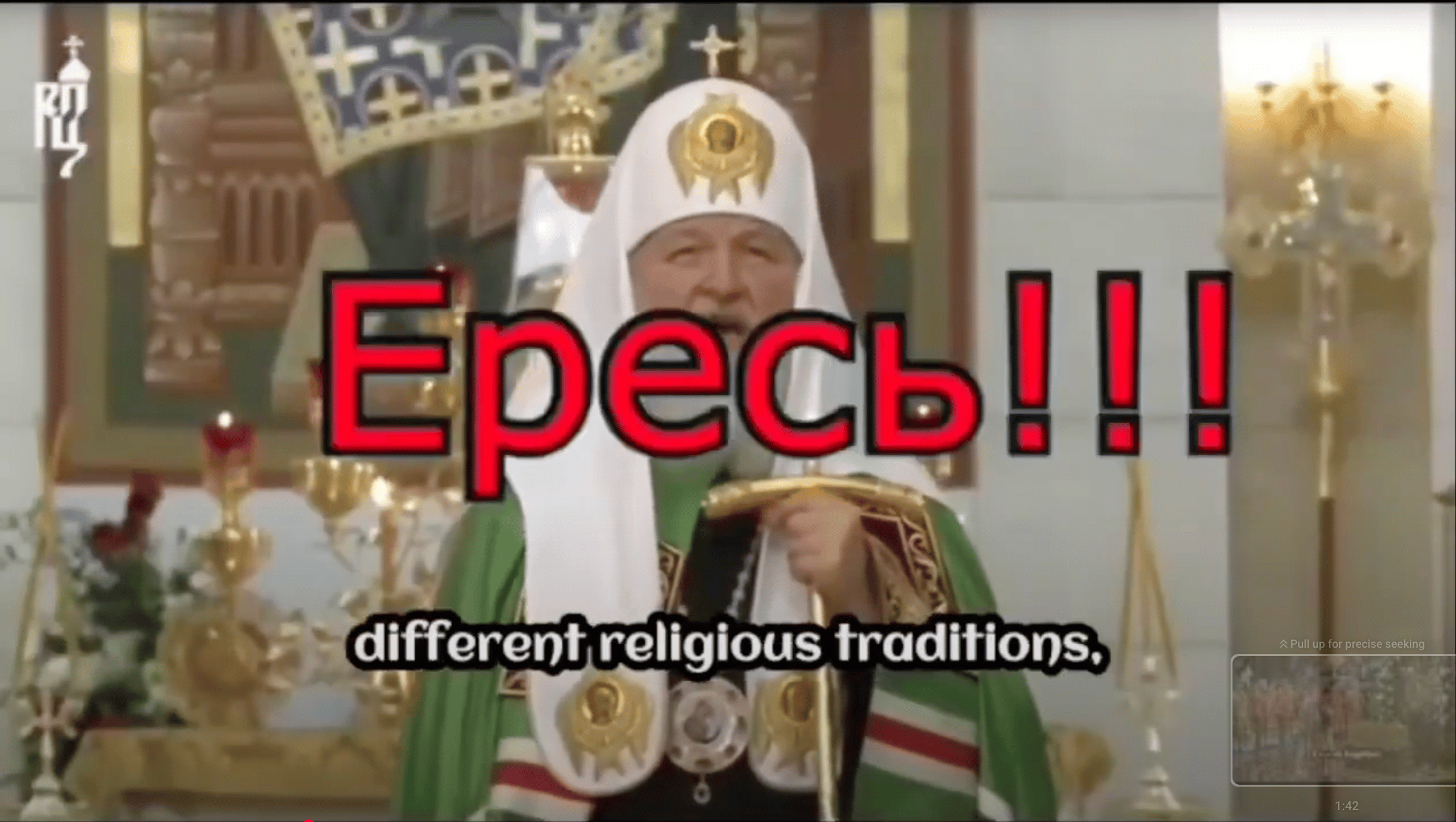
Пусть наша вселенская молитва на разных языках и даже через разные религиозные традиции будет обращена к Богу, чтобы Он приклонил милость Свою к роду человеческому и изъял нас из страшного плена одержимости.
Let our universal prayer in different languages and even through different religious traditions be addressed to God, that He may incline His mercy to the human race and deliver us from the terrible captivity of obsession.
— Patriarch Kirill, sermon after Liturgy in the Cathedral of Christ the Savior in Kaliningrad, November 15, 2015. Transcript: http://www.patriarchia.ru/article/97207. Video compilation: https://www.youtube.com/watch?v=XbExBRJCHkg
If all denominations are “branches” of one Church, why not all religions as “branches” of one divine reality? This is where the WCC’s premises lead: from denying the uniqueness of the Orthodox Church to denying the uniqueness of Christ.
”One Family” With All Religions (2025)
Ten years after that sermon, and three months after ordering Schema-Abbot Gabriel driven away for preaching that Islam is the wrong religion (see Chapter 5), Patriarch Kirill proved this trajectory is not hypothetical. On September 18, 2025, he traveled to Astana, Kazakhstan, for the 8th Congress of World Religious Leaders. There, addressing leaders from multiple religions, he declared:
Очень важно, что религиозные лидеры, руководители, принадлежащие к разным религиям и исповеданиям, сегодня трудились рука об руку как одна семья, что свидетельствует о близости наших позиций, несмотря на богословские различия, которые всегда существовали и вряд ли могут в ближайшее время вообще исчезнуть из нашего дискурса. Но, тем не менее, общие цели, которые сегодня стоят перед нами в связи с угрозами для бытия всего рода человеческого, несомненно, служат стимулом для дальнейшего развития нашей совместной работы.
It is very important that religious leaders belonging to different religions and confessions today work hand in hand as one family, which testifies to the closeness of our positions, despite theological differences that have always existed and are unlikely to disappear from our discourse any time soon. Nevertheless, common goals that face us today in connection with threats to the existence of the entire human race undoubtedly serve as a stimulus for further development of our joint work.
— Patriarch Kirill, closing ceremony of the 8th Congress of World Religious Leaders, Astana, Kazakhstan, September 18, 2025, https://mospat.ru/ru/news/93566/
He concluded by invoking God’s blessing on the entire multi-faith assembly:
Пусть благословение Божие пребывает над всеми нами, укрепляя нас на совместном пути к построению глобального мира и справедливости.
May God’s blessing be upon all of us, strengthening us on our common path towards building global peace and justice.
— Patriarch Kirill, same address, https://mospat.ru/ru/news/93566/
“One family.” “Joint work.” “Common path.” God’s blessing invoked upon adherents of all religions.
In 2015, he called for prayer “through different religious traditions.” In 2025, he stood before leaders of Islam, Buddhism, Judaism, and other religions, called them “one family,” and asked God to bless them on their “common path."
"One of the Priorities in Our Agenda” (2023)
Seven months later, Kirill received the new WCC General Secretary Dr. Jerry Pillai in Moscow. His opening statement left no room for ambiguity:
Отношения со Всемирным советом церквей являются одним из приоритетов в нашей повестке.
Relations with the World Council of Churches are one of the priorities in our agenda.
— Patriarch Kirill, meeting with WCC delegation, May 17, 2023. http://www.patriarchia.ru/article/81443
This is in 2023. So of course, this is not a long-forgotten error.
At this WCC delegation, Patriarch Kirill shared memories of his personal participation beginning at the 1968 Uppsala Assembly, “where the future Patriarch was the youngest participant.” He praised the WCC as a platform that “provides a space for the development of bilateral relations, sometimes with those churches with which it would be rather difficult to establish relations.” He thanked the WCC for its statement defending the Kyiv Caves Lavra monks and noted that Moscow regularly sends students to the WCC’s Bossey Institute, one of the priorities in their agenda.
One month later, Kirill sent an official letter congratulating the WCC on its seventy-fifth anniversary, declaring that “we are obligated to preserve those bridges of communication that were built by us and our predecessors over many decades, not only for our own sake, but for the sake of future generations.”[29]
Kirill frames the organization the saints condemned as a sacred inheritance that must be preserved for posterity.
”No Opposition” (January 2024)
On January 23, 2024, Kirill addressed the XII Christmas Parliamentary Meetings in the Federation Council. In a speech devoted to Western moral decline, he defended Moscow’s WCC membership before Russia’s lawmakers:
Почему мы вступили в 1962 году во Всемирный совет церквей? И никакой оппозиции в России этому шагу не было, потому что развитие отношений с христианами Запада воспринималось как норма, как нечто очень положительное.
Why did we join the World Council of Churches in 1962? There was no opposition in Russia to this step, because the development of relations with Western Christians was perceived as normal, as something very positive.
— Patriarch Kirill, speech at the XII Christmas Parliamentary Meetings, Federation Council, January 23, 2024. http://www.patriarchia.ru/article/105298
“No opposition.”
However, in 1948, the Moscow Patriarchate itself formally rejected WCC membership!
The position was reversed in 1961 under Communist Party direction. Kirill presented membership in the organization the saints call “pan-heretical alchemy” as something Russians unanimously welcomed: “something very positive”, never mentioning the position of the Moscow Patriarchate on the WCC in 1948 that undoubtedly would not have changed if not for Communist influence.
Patriarch Kirill finds absolutely no problem with this position, which is dishonest and deceptive.
The Trajectory Made Explicit
In the same 2006 interview where Bishop Hilarion admitted that WCC membership was a political “strategic initiative” rather than a theological position, he revealed where this trajectory was heading:
What we do need, in my opinion, is a strategic alliance, for the challenge is made to traditional Christianity as such… In this battle, the Orthodox and Catholics could, even in the face of all the differences accumulated over the centuries, form a united front.
— Bishop Hilarion (Alfeyev), Interview on ROCOR official website, 2006. https://synod.com/synod/en/documents/enart_interviewrocor.html
“Strategic alliance” with Rome. A “united front” with those the saints call heretics. Ten years after this interview, Patriarch Kirill met the Pope in Havana and signed a joint declaration. The trajectory Hilarion described in 2006 became reality in 2016. From WCC membership to “strategic alliance” with Rome to joint declarations with the Pope: the destination was always visible to those willing to see.
The Moscow Patriarchate’s Own Diagnosis (2000)
In August 2000, the Jubilee Bishops’ Council of the Russian Orthodox Church adopted “The Basic Principles of the Attitude of the Russian Orthodox Church to Heterodoxy,” the official doctrinal document governing all ecumenical relations.[30] Its appendix on the WCC contains a remarkable admission. The document’s authors, writing under Metropolitan Kirill’s leadership as DECR Chairman, acknowledged that the WCC had become incompatible with Orthodoxy:
In the WCC agenda, topics began to appear over time that turned out to be completely unacceptable to Orthodox Tradition… The tasks declared by the WCC today come into complete contradiction with practice: the gap between the liberalized Protestant majority and the Orthodox minority is becoming ever more obvious. In the end, such development is possible in Protestant churches and in the WCC that Orthodox will no longer be able to agree with on ecclesiological, dogmatic, or moral grounds.
— “Basic Principles of the Attitude of the Russian Orthodox Church to Heterodoxy,” Appendix, Jubilee Bishops’ Council, August 2000, https://mospat.ru/ru/news/85385/[31]
The document went further, warning that the WCC’s trajectory was leading to its own destruction:
Every new step in the direction of strengthening Protestant ecclesiology in the WCC will be spiritual suicide for the WCC… Negative tendencies in the WCC lead to the Russian Orthodox Church facing the necessity of being prepared to change its status in relations with the WCC.
— “Basic Principles,” Appendix, https://mospat.ru/ru/news/85385/[32]
“Completely unacceptable to Orthodox Tradition.” “Complete contradiction with practice.” “Spiritual suicide.” “The necessity of being prepared to change its status.”
This was in the year 2000. The Re-imagining Conference had already happened. The Baar Statement had already denied the necessity of Christ. Georgia and Bulgaria had already left. The Moscow Patriarchate diagnosed the disease, warned of death, and stated it might need to walk away.
Twenty-five years later, every negative trend the document warned about has intensified. Protestant ecclesiology has only strengthened. Moscow, helmed by Patriarch Kirill, stayed in the WCC.
Criminalizing Dissent
Not only does Patriarch Kirill insist that the WCC involvement is beneficial, the “Basic Principles” document, in Section 7.3, addresses those who oppose the hierarchy’s ecumenical activity, threatening punishment upon them for pointing any of this out.
The Church condemns those who, using unreliable information, deliberately distort the tasks of the Orthodox Church’s witness to the heterodox world and consciously slander the Sacred Hierarchy of the Church, accusing it of “treason to Orthodoxy.” Canonical punishments should be applied to such people, who sow seeds of temptation among simple believers.
— “Basic Principles of the Attitude of the Russian Orthodox Church to Heterodoxy,” Section 7.3, Jubilee Bishops’ Council, August 13-16, 2000, https://mospat.ru/ru/news/85385/[33]
The same section approvingly cites the 1998 All-Orthodox Meeting in Thessaloniki:
Over many decades of Orthodox participation in the ecumenical movement, not a single (official) representative of any Local Orthodox Church has ever betrayed Orthodoxy.
— 1998 All-Orthodox Meeting in Thessaloniki, quoted approvingly in “Basic Principles,” Section 7.3, https://mospat.ru/ru/news/85385/[34]
Notice the self-justification here.
According to this statement, over decades of participation in the organization the saints called “pan-heretical alchemy,” not a single one of their representatives has “ever betrayed Orthodoxy.”
The document does not engage with the saints who condemned the WCC. It does not answer Metropolitan Philaret, the 1983 ROCOR Synod, Elder Gabriel, or the seven witnesses examined in this chapter. Instead, it simply prescribes canonical punishment for those who side with the saints.
Kirill himself echoed this threat six years later. In a 2006 interview as DECR Chairman, he characterized all critics of WCC membership as either ignorant or malicious:
Требовать от Русской Православной Церкви самоизоляции могут люди, либо не знающие, что происходит в ВСЦ, и какова реальная роль Русской Церкви во всей сложной системе межхристианских и межрелигиозных отношений, либо те, кто сознательно стремится к ограничению ее влияния.
Those who demand the Russian Orthodox Church’s self-isolation are either people ignorant of what happens in the WCC and what the real role of the Russian Church is in the entire complex system of inter-Christian and inter-religious relations, or those who deliberately seek to limit its influence.
— Metropolitan Kirill (Gundyaev), interview on the DECR website, August 30, 2006. https://www.patriarchia.ru/article/17219
By this flawed logic, the Georgian and Bulgarian Churches “deliberately seek to limit” Moscow’s influence. St. Gabriel of Georgia, who condemned ecumenism as “the heresy of all heresies,” was either ignorant or a saboteur.
There is no third category for the Patriarch. And again, no one says anything about any of this.
This is the same institutional reflex documented in Chapter 5: when Schema-Abbot Gabriel preached that Islam is “the wrong religion,” Patriarch Kirill ordered his clergy to “drive away all those who speak like that.” The pattern is consistent: those who repeat what the saints teach are silenced; the positions the saints condemned however, are enforced.
D. The Verdict
The witness is unanimous. ROCOR hierarchs, Athonite elders, contemporary saints, his own Orthodox colleagues at Canberra, and two autocephalous churches that withdrew entirely: all condemned the WCC. Its foundational ecclesiology contradicts Orthodox doctrine. Its own Baar Statement denies the necessity of Christ for salvation. Its sponsored events reveal its nature. Its leadership rewards those who organize apostasy. Not one glorified saint defended it.
Some will argue that respected Orthodox theologians defended WCC participation. Fr. Georges Florovsky was a founding director of the WCC. Fr. John Meyendorff chaired its Faith and Order Commission. Fr. Alexander Schmemann distinguished “good ecumenism” from “bad ecumenism.” This tradition exists and cannot be dismissed.
But Florovsky himself grew disillusioned. Archbishop Chrysostomos of Etna, who knew Florovsky personally at Princeton, testified that Florovsky described his 1933 essay “The Limits of the Church,” on which much of modern Orthodox ecumenist theology rests, as a “heuristic exercise,” a theologoumenon, not a definitive theological statement. Florovsky never shared the Mysteries with heterodox; Archbishop Chrysostomos testified that he “flatly condemned” intercommunion. In his later writings, Florovsky returned to Cyprianic ecclesiology: “The Orthodox are bound to claim that the Orthodox Church is essentially identical with the Church of all ages… she is not a Church, but the Church” (Aspects of Church History). At a Princeton symposium in 1975, four years before his death, he publicly expressed regrets about his earlier ecumenical views.[35]
Schmemann himself wrote privately in 1962 that “the Orthodox should leave the WCC.” In other words, the very people using Schmemann to justify Ecumenism, himself clearly stated that there is no reason to stay in the WCC.
The WCC’s trajectory after their era, from the Baar Statement to Re-imagining to Chung Hyun Kyung, vindicated the critics, not the defenders.
Metropolitan Hilarion (Alfeyev), Kirill’s own chief ecumenist, made an inadvertent admission in 2013: “The very entry of the Orthodox into dialogue meant a moratorium on the use of the terms ‘heresy’ and ‘heretic’ in relation to the Catholic Church. We mutually refused to classify each other as heretics.”[36]
The abandonment of patristic vocabulary was not a theological development; it was a negotiated precondition for participation. The saints who used the word “heretic” as standard theological vocabulary without apology would not recognize this moratorium. (The patristic meaning of “heresy” and “heretic” is examined in Chapter 24.)
Against this witness stands Patriarch Kirill’s 1991 Canberra defense, examined phrase by phrase, and his five decades of participation without missing a single session for twenty-three years. In 2006, he called WCC membership “theologically justified” and pledged to “perhaps even intensify” it. In 2015, he called for prayer “through different religious traditions.” In 2022, he described WCC members as a “worldwide Christian brotherhood” whose solidarity gives him confidence. In 2023, he declared WCC relations “one of the priorities in our agenda” and pledged to preserve “those bridges… for future generations.” In 2024, he assured Russia’s parliament that WCC membership was “something very positive.”
If the saints are right about what the WCC is, then Patriarch Kirill’s defense of it as “our common home” and “the cradle of a united church” cannot be excused as diplomacy. What the saints condemned, Kirill defends. What Kirill defends, the saints condemned. These positions cannot be reconciled.
Toronto Statement (1950), Section IV, Point 4: “The member churches of the World Council consider the relationship of other churches to the Holy Catholic Church which the Creeds profess as a subject for mutual consideration. Nevertheless, membership does not imply that each church must regard the other member churches as churches in the true and full sense of the word.” The Latin phrase aliquo modo (“in some manner”) appears in the WCC’s own commentary on this point, conceding that the nature of non-Orthodox bodies’ relationship to the Church remains undefined, while insisting they possess it. ↩
S.J. Samartha, “Partners in Community,” Occasional Bulletin 4:2 (April 1980), p. 80; “The Quest for Salvation and the Dialogue between Religions,” International Review of Mission (October 1968), p. 429. Samartha served as the first director of the WCC sub-unit on Dialogue with People of Living Faiths. ↩
Original Greek: “«Πονούσε για τις διάφορες οικουμενιστικές κινήσεις, για τις οποίες έλεγε ότι είναι “κουρελούδες του διαβόλου”.»” ↩
Original Greek: “«Ἕνα ἀπό τά μέσα, πού χρησιμοποιεῖ ὁ Οἰκουμενισμός, γιά νά ἐπιτύχη τούς σκοπούς του, εἶναι ὁ συγκρητισμός, αὐτός ὁ θανάσιμος ἐχθρός της χριστιανικῆς πίστεως, τόν ὁποῖο προωθεῖ τό λεγόμενο «Παγκόσμιο Συμβούλιο Ἐκκλησιῶν» ἤ μᾶλλον τό «Παγκόσμιο Συνονθύλευμα τῶν Αἱρέσεων»»” ↩
Original Greek: “«Αυτό το δόλιο “οικουμενικό” κατασκεύασμα δεν αποσκοπεί στην αναζήτηση της αληθείας… Είναι ένα ανακάτεμα αφανισμού της Αλήθειας.»” ↩
Committee of the Holy Community of Mount Athos on Dogmatics, Memorandum on the Participation of the Orthodox Church in the World Council of Churches (2007): “And today, more than ever, the dogmatic conscience of the plēroma of the Church is in danger of being altered by the ecclesiology being cultivated by the WCC.” http://orthodoxinfo.com/ecumenism/memorandum-on-the-participation-of-the-orthodox-church-in-the-world-council-of-churches.aspx ↩
The full text of the 1948 resolution and the list of signatories is reproduced in Archbishop Vitaly of Montreal, “Ecumenism,” The Orthodox Word, Vol. 5, No. 4 (July-August 1969), pp. 151-152. ↩
Additional sources on Soviet manipulation of WCC membership: Fr. Spyridon Bailey records that “the Soviet State sought to force the Russian Orthodox Church into active membership of the W.C.C. in order to destroy its uniqueness in the minds of the Russian people” (Orthodoxy and the Kingdom of Satan, citing Fr. Seraphim Rose). Canon Michael Bourdeaux of the Keston Institute observed that WCC membership “inaugurated a campaign of misinformation which continued for a quarter of a century” (cited in John and Carol Garrard, Russian Orthodoxy Resurgent, p. 37). The Garrards describe how “gullible and devout pastors from the West attended its meetings and returned home convinced there was no religious persecution in the USSR” (p. 44) and characterize the ROC’s participation as a “false flag operation” in which “[urbane prelates] ran a successful ‘false flag’ operation in the World Council and European Council of Churches, enthusiastically lip-synching the KGB’s peace campaign to justify the church’s existence” (p. 245). ↩
Original Russian: “Его усилиями вступление Русской Церкви в 1961 году во Всемирный Совет Церквей стало плодотворным, способствуя широкому и убедительному свидетельству об истине Святого Православия.” ↩
Metropolitan Nikodim (Rotov) died on September 5, 1978, during an official visit to the Vatican for the intronization of Pope John Paul I. The circumstances are documented in both the 2023 “Faithful Witness” article (patriarchia.ru/article/104828) and the 2024 JMP anniversary article (patriarchia.ru/article/105790). ↩
Original Greek: “«Εάν ζούσαμε πατερικά, θα είχαμε όλοι πνευματική υγεία, την οποία θα ζήλευαν και όλοι οι ετερόδοξοι, και θα άφηναν τις αρρωστημένες τους πλάνες και θα σώζονταν χωρίς κήρυγμα.»” ↩
Methodist Bishop G. Bromley Oxnam, a leading WCC figure, stated in 1953: “The Protestant Churches must pursue the existing fraternal and fruitful collaboration with the Eastern Orthodox Churches until Protestantism is inwardly united. They must then approach the discussion with Rome, and in the end ask forgiveness for the divisions, and uniting in the communion of the bread and wine of the Holy Eucharist, in order to raise themselves in spirit so as to make a reality the Holy Catholic Church, to which all Christians would be able to belong.” Quoted in Archbishop Vitaly of Montreal, “Ecumenism,” The Orthodox Word, Vol. 5, No. 4 (July-August 1969). ↩
Fr. Spyridon Bailey, Orthodoxy and the Kingdom of Satan, Chapter 7: “The establishment of The World Council of Churches was financially supported by the Rockefeller Foundation which first appointed John Foster Dulles to lead the National Council of Churches in America… the Rockefeller plan was to establish a new idea that would speak over theological differences; this was what became known as the ‘social gospel.’ By encouraging Christians to focus primarily on collaboration to help others, it was understood that they would quickly form social and organisational bonds that would become stronger than the content of the faith they professed.” ↩
Susan Cyre, “Fallout Escalates Over ‘Goddess’ Sophia Worship,” Christianity Today, April 4, 1994, https://www.christianitytoday.com/1994/04/theology-fallout-escalates-over-goddess-sophia-worship/. The conference was “held in conjunction with the World Council of Churches’ Decade of Churches in Solidarity” with Women (1988–1998). Participants invoked Sophia and shared milk and honey in what the report describes as “an apparent substitute for the Lord’s Supper.” ↩
Susan Cyre, “Fallout Escalates Over ‘Re-Imagining’ Conference,” Christianity Today, Vol. 38, No. 3, March 7, 1994. Mary Ann Lundy resigned from her Presbyterian post following the General Assembly Council investigation before her appointment to the WCC leadership. ↩
World Council of Churches, “WCC mourns loss, celebrates life of Mary Ann Lundy,” March 2025, https://www.oikoumene.org/news/wcc-mourns-loss-celebrates-life-of-mary-ann-lundy. The WCC’s own obituary states: “Lundy served as WCC deputy general secretary from 1995-1999. In this role, she strengthened partnerships between women’s movements, faith communities, and multilateral institutions.” ↩
Original Greek: “«Αυτή η παναιρετική αλχημεία επιχειρείται δια του λεγομένου Παγκοσμίου Συμβουλίου Εκκλησιών.»” ↩
Peter Steinfels, “WCC split hinted over ‘What is Holy Spirit?’,” Tampa Bay Times, March 23, 1991, https://www.tampabay.com/archive/1991/03/23/wcc-split-hinted-over-what-is-holy-spirit/; Michael Kinnamon, ed., Signs of the Spirit: Official Report, Seventh Assembly (WCC Publications, 1991); “Spirit and ‘Spirits’ at the Canberra Assembly of the World Council of Churches, 1991,” Missiology: An International Review 32, no. 3 (2004). ↩
St. Cyprian of Carthage, De Catholicae Ecclesiae Unitate (On the Unity of the Catholic Church), §6. https://www.newadvent.org/fathers/050701.htm ↩
WCC Press Release, June 10, 1997; WCC country profile for Georgia, https://www.oikoumene.org/resources/documents/country-profile-georgia. Patriarch Ilia II informed WCC General Secretary Konrad Raiser in a May 22, 1997 letter of the Holy Synod’s decision to withdraw. ↩
WCC Eighth Assembly Press Release No. 47, December 13, 1998, http://www.orthodoxresearchinstitute.org/articles/ecumenical/wcc_bulgarian_church.html. The Bulgarian withdrawal was the second after Georgia’s. ↩
Moscow Patriarchate, official biography of Patriarch Kirill, https://mospat.ru/en/patriarch/. ↩
Metropolitan Hilarion (Alfeyev), “To Proclaim Day by Day the Salvation of Our God: On the 55th Anniversary of the Monastic Tonsure and Diaconal Ordination of His Holiness Patriarch Kirill,” Journal of the Moscow Patriarchate (No. 5, 2024). Published on patriarchia.ru, June 14, 2024. https://www.patriarchia.ru/article/105790. The article states: «В 1975 году он стал членом Центрального и Исполнительного комитетов ВСЦ и вплоть до 1998 года участвовал в работе этих руководящих органов Совета, не пропустив ни одного заседания» (“In 1975 he became a member of the Central and Executive Committees of the WCC and until 1998 participated in the work of these governing bodies of the Council, without missing a single session”). ↩
Encyclical Letter of the 1983 Council of Bishops of ROCOR, Orthodox Life, Vol. 33, No. 6 (Nov-Dec 1983), pp. 15-18. The Council states: “Any sort of participation by Orthodox in prayer with non-Orthodox, and in particular participation in common prayer at the so-called ecumenical Lima liturgy, is strictly forbidden for Orthodox according to the 45th and 46th canons of the Holy Apostles, and subjects them to excommunication from the Church.” ↩
Patriarch Kirill, meeting with WCC General Secretary Dr. Olav Fykse Tveit, October 10, 2014. http://www.patriarchia.ru/article/107422. Kirill stated: «Я хотел бы начать нашу беседу c разговора о заседании Центрального комитета ВСЦ, которое состоялось в июне нынешнего года в Женеве. Я посмотрел материалы и должен сказать, что эта работа произвела на меня положительное впечатление… Всемирному совету церквей может быть отведена одна из ключевых ролей в построении такого диалога и координации межхристианского взаимодействия.» (“I would like to begin our discussion with the meeting of the Central Committee of the WCC, which took place in June of this year in Geneva. I looked at the material and I must say that this work has made a positive impression on me… The World Council of Churches can be assigned one of the key roles in building such a dialogue and the coordination of inter-Christian cooperation.”) ↩
Patriarch Kirill, meeting with WCC General Secretary Olav Fykse Tveit, January 30, 2019: “The WCC played a unique role in that situation, because on the basis of faith in the Lord and Savior, representatives of East and West had the opportunity to meet on the WCC platform and, proceeding from their commonality, try to find solutions to difficult situations.” https://www.patriarchia.ru/article/61913. See also the WCC honored alongside the papal representative at Kirill’s 10th anniversary celebration, February 2019. ↩
Patriarch Kirill, meeting with WCC acting General Secretary Fr. Ioan Sauca, October 17, 2022: “WCC membership, dialogues, equal discussions and cooperation with the entire Christian world were not only a manifestation of our service to reconciliation between people, but also gave us confidence in the solidarity and support of the worldwide Christian brotherhood.” He thanked the WCC for resisting pressure to expel Moscow during the Karlsruhe Assembly. See also his March 2022 letter to the WCC: https://www.patriarchia.ru/article/103006. Meeting: http://www.patriarchia.ru/article/78875 ↩
Metropolitan Antoniy of Volokolamsk, interview with RIA Novosti, July 1, 2025. http://www.patriarchia.ru/article/116353. Metropolitan Antoniy stated: “The political bias of certain member churches has reached unprecedented levels, inevitably affecting the overall nature of the WCC’s work. The WCC is rapidly losing its unique role as a platform for inter-Christian dialogue.” Despite this assessment, Moscow maintained its participation. ↩
Patriarch Kirill, Congratulations on the 75th Anniversary of the WCC, June 25, 2023. http://www.patriarchia.ru/article/104610. Full text: «Сердечно поздравляю вас с 75-летием основания Всемирного совета церквей — крупнейшей международной организации, служащей местом встречи и диалога христиан различных традиций. … Убежден, что мы обязаны сохранить те мосты общения, которые строились нами и нашими предшественниками на протяжении многих десятилетий — не только ради нас самих, но и ради будущих поколений. … Надеюсь, что, Богу содействующу, соработничество Русской Православной Церкви с ВСЦ будет и впредь плодотворным.» ↩
“Основные принципы отношения Русской Православной Церкви к инославию” (Basic Principles of the Attitude of the Russian Orthodox Church to Heterodoxy), adopted by the Jubilee Bishops’ Council, Moscow, August 13-16, 2000. Full Russian text: https://mospat.ru/ru/news/85385/. This document, prepared under Metropolitan Kirill’s leadership as DECR Chairman, remains the official governing framework for all ecumenical relations of the Russian Orthodox Church. ↩
Original Russian: “В повестке дня ВСЦ со временем стали появляться такие темы, которые оказались совершенно неприемлемыми для Православного Предания… Задачи декларируемые ВСЦ вступают сегодня в полнейшее противоречие с практикой: все очевиднее становится разрыв сблизившегося на почве либерализации протестантского большинства и православного меньшинства. В итоге возможно такое развитие в протестантских церквах и во Всемирном Совете Церквей, с которым православные уже не смогут согласиться ни по экклезиологическим, ни по догматическим, ни по нравственным соображениям.” ↩
Original Russian: “Всякий новый шаг в направлении усиления протестантской экклезиологии в ВСЦ будет духовным самоубиством ВСЦ… Негативные тенденции в ВСЦ приводят к тому, что Русская Православная Церковь оказывается перед необходимостью быть готовой к изменению своего статуса в отношениях с ВСЦ.” ↩
Original Russian: “Церковь осуждает тех, кто, используя недостоверную информацию, преднамеренно искажает задачи свидетельства Православной Церкви инославному миру и сознательно клевещет на Священноначалие Церкви, обвиняя его в «измене Православию». К таким людям, сеющим семена соблазна среди простых верующих, следует применять канонические прещения.” ↩
Original Russian: “За многие десятилетия православного участия в экуменическом движении ни один из (официальных) представителей той или иной Поместной Православной Церкви никогда не предавал Православие.” ↩
Archbishop Chrysostomos of Etna and Fr. John Abraham, “Further Thoughts on the Ecclesiology of Father George Florovsky,” Orthodox Tradition XIV, 2-3 (1997). Chrysostomos testified that Florovsky described “The Limits of the Church” as “one of his ‘heuristic exercises’” and that he “flatly condemned” intercommunion. Bishop Athanasius (Yevtich) of Zahumlje critiqued the 1933 article as “a product of a young Florovsky, fragmented and lacking clarity.” See also Constantine Cavarnos, Father Georges Florovsky on Ecumenism (Center for Traditionalist Orthodox Studies, 1996), which examines forty years of Florovsky’s writings and concludes that his role in the ecumenical movement “has been seriously misunderstood and deliberately distorted.” ↩
Metropolitan Hilarion (Alfeyev), speech at the Institute of General History, Moscow, December 23, 2013. https://www.patriarchia.ru/article/10396 ↩