
The Heavenly Kingdom: St. Lazar's Choice
On June 15, 1389, Tsar Lazar of Serbia, the sovereign of the Serbian realm, was captured on the Field of Kosovo and brought before his executioner. In his last conscious moment before beheading, he began a prayer for his people. And then, in the middle of that prayer, he interrupted himself to correct a possessive. Not my people. Thy people, O Lord.
A dying Orthodox tsar, at the hour of his death in defense of his nation, refusing to call his own nation his own.
The preceding four chapters measured Patriarch Kirill’s war theology against the patristic consensus and found it wanting on every count. Those chapters are the book’s critique. This chapter is shorter, and its purpose is different. It measures Kirill’s war against a canonized Orthodox ruler whose war met every patristic criterion the Fathers ever set for permissible defense, and who died with that correction on his lips. The argument of this chapter does not replace the arguments of the preceding ones. It gives them a face.
Tsar Lazar, in Brief
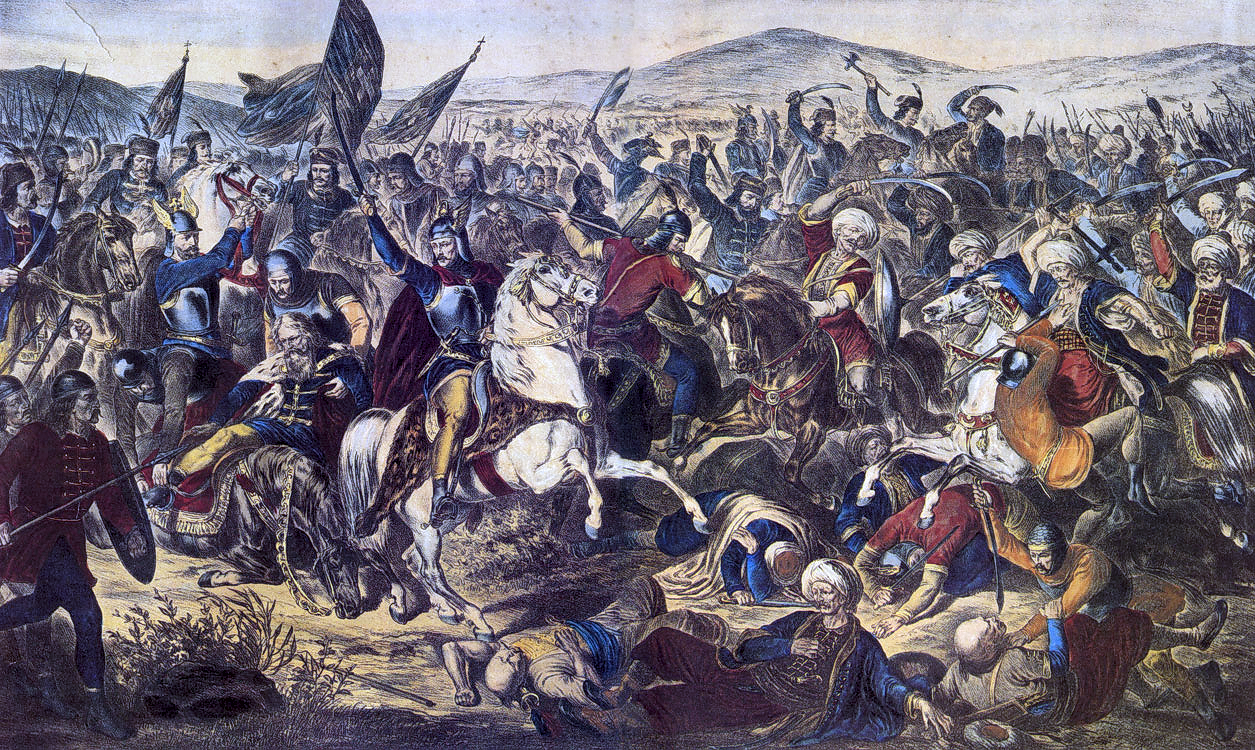
Tsar Lazar Pribac Hrebeljanović (c. 1329–1389) is a glorified saint of the Orthodox Church, commemorated on June 15 / 28. His wife Milica (the schema-nun, i.e. a monastic of the highest rank, Efrosinija) and their eldest son St. Stefan Lazarević are also saints. His relics were found incorrupt (his body preserved from decay, a recognized sign of sanctity) one year after his death and rest today in the Cathedral Church of Beograd. The hagiographic record is ecclesial, not legendary: Patriarch Danilo III of Serbia, Constantine the Philosopher, and the nun Jefimija were all contemporaries whose testimonies St. Justin Popovich assembled into a formal Life in the twentieth century.[1]
His war at Kosovo was the literal textbook case of Orthodox self-defense that St. Basil’s Canon XIII permits (Chapter 19): non-Orthodox invaders attacking Christian lands for the faith, burning monasteries, razing churches, killing Christians for being Christian. St. Justin Popovich himself captures the character of the battle in a single phrase. It was, he writes, “the battle between the baptized and the unbaptized, the Christians and the Mohammedans.” That phrasing is the exact criterion St. Basil’s canon contemplates: Christians defending themselves against non-Christian invaders for the sake of the faith. Patriarch Kirill’s war against the Orthodox Christians of Ukraine does not come close.
Lazar was also neither naive nor bellicose. He had already defeated Sultan Murad I in open battle at Pločnik in 1387, two years before Kosovo, and Murad had fled. In peacetime, he endowed monasteries across the Orthodox world (Ravanica, Hilandar on Mount Athos, St. Panteleimon, Jerusalem, Sinai, Wallachia) and healed a decades-long schism between the Serbian Patriarchate and Constantinople. Constantine the Philosopher records his pattern when he encountered Turkish devastation: “Wherever he passed through any sort of towns or provinces or monasteries or churches of the faithful, where the Turks had been… he set everything right and restored order and calm.” Lazar’s instinct in the face of enemy destruction was restoration, not retaliation.
He took up arms again at Kosovo only when, in St. Justin’s words, he “could no longer stand by and watch the members of his body, which were moreover the members of Christ’s body, being hacked and torn off.”
The full theological apparatus for measuring this kind of war against Patriarch Kirill’s is developed in detail in the preceding chapters (Chapter 17, Chapter 19, Chapter 16). This chapter assumes that work and builds on it.
The Choice of Two Kingdoms
The Serbian Orthodox hagiographic and epic tradition records that before the battle, an angel appeared to Tsar Lazar and offered him a choice. St. Justin writes:
According to general and ancient folk tradition, an Angel of the Lord appeared to the saintly Prince Lazar before this battle and asked him which kingdom he wished to choose: would he choose the earthly kingdom or the Heavenly Kingdom. After prayerfully pondering the question, the Prince, who yearned for heaven, replied to the Angel of God: “If I should choose the earthly kingdom, it is only for a brief time, and is momentary and transitory; but the Heavenly Kingdom lasts always and forever.” Thus the God-loving Serbian ruler decided in favor of the Kingdom of Christ the king in the heavens.
— St. Justin Popovich, Life of St. Lazar, p. 28
St. Justin himself frames this scene as “general and ancient folk tradition,” drawing on the Serbian epic cycle of Kosovo. It is not presented as a contemporary chronicle. But the Serbian Orthodox Church has received it as the theological summary of what Kosovo meant, and every glorified Serbian saint who has interpreted the battle has read it this way.
St. Lazar chose the Heavenly Kingdom.
Consider what this choice means. An Orthodox ruler was offered military victory on earth and refused it in favor of earthly defeat. The offer was not a choice between good and evil. It was a choice between two goods: the preservation of his nation’s earthly sovereignty, which a tsar is ordinarily obliged to defend, and the Kingdom of Heaven, which is higher. Lazar chose the higher good at the cost of the lower one. He chose to lose.
Saint Nikolai Velimirovich, meditating theologically on the scene, puts the angel’s verdict on the choice into words that name what Lazar had just accomplished:
By choosing the heavenly kingdom you have included your people among the immortal and angelic nations of heaven. As a man and as a prince you were not able to bequeath a greater inheritance to your people than to make such a choice and to confirm it with the red seal of your own blood.
— St. Nikolai Velimirovich, The Tsar’s Testament, p. 88
The choice was itself the greatest inheritance a tsar could leave his people. Not a conquest. Not a treaty. Not a territory held. A sainted example, sealed in royal blood.
This is the paradigmatic refutation of every form of ideology that equates the earthly survival of an Orthodox nation with the survival of Orthodoxy itself (Chapter 15, Chapter 14). Lazar demonstrates that Orthodoxy can survive even through earthly defeat, and by the Serbian Church’s own testimony, even triumph through it.
What matters is not whether the Orthodox nation wins its wars but whether the Orthodox Christians in it remain faithful unto death. Six centuries of Serbian Orthodox identity under Ottoman rule are the posterity of that choice.
”Not My People But Thy People, O Lord”
Before he was beheaded, St. Justin Popovich records, Tsar Lazar prayed his last prayer aloud:
O my Creator, who judgest our sins known and unknown, to Thee I cry out and to Thee I pray: forgive me for everything that I have neglected to do according to Thy holy will, and save my people, or to say it more properly, not my people but Thy people, O Lord.
— St. Lazar, final prayer before beheading, quoted in Popovich, Life of St. Lazar, pp. 28–29 (emphasis added)
Notice the self-correction. A dying tsar, the lawful sovereign of his realm, the man around whom his subjects had just died for love of him, begins to pray “save my people.” And then, in his last conscious breath, he interrupts himself to correct the possessive: not my people but Thy people, O Lord. A sovereign at the moment of his death in defense of his nation refusing to call his own nation his own.
It is the most complete theological statement a ruler can make about the relationship between a nation and its God. The nation does not belong to the nation’s ruler. The nation does not belong to the Orthodox Church of the nation. The nation belongs to God. A sovereign who understands his duty rightly is not the owner of his people, not even in the hour of his death in their defense. He is the temporary steward of a flock that belongs to someone else.
The ecclesiology of Russian World ideology, the claim that the Russian nation is the Church, that Russian ethnic identity is itself a form of Orthodox identity, that Holy Rus’ is a political-theological project (Chapter 14), is the direct antithesis of Lazar’s dying prayer. Where Russkiy Mir claims the Orthodox Russian people as its own, Lazar refuses to claim the Orthodox Serbian people as his own. Where Russkiy Mir elevates the Orthodox nation to a theological category, Lazar returns the Orthodox nation to God.
Six centuries before Hieromartyr Daniel Sysoev would articulate the doctrine of uranopolitism, the teaching that “our true homeland is heaven; the Church is our highest allegiance” (Chapter 15), Tsar Lazar lived it at the point of an executioner’s sword. Uranopolitism does not require a theologian. It requires only a ruler willing to say, in his last breath, that his nation is not his.
The Verdict of the Serbian Church
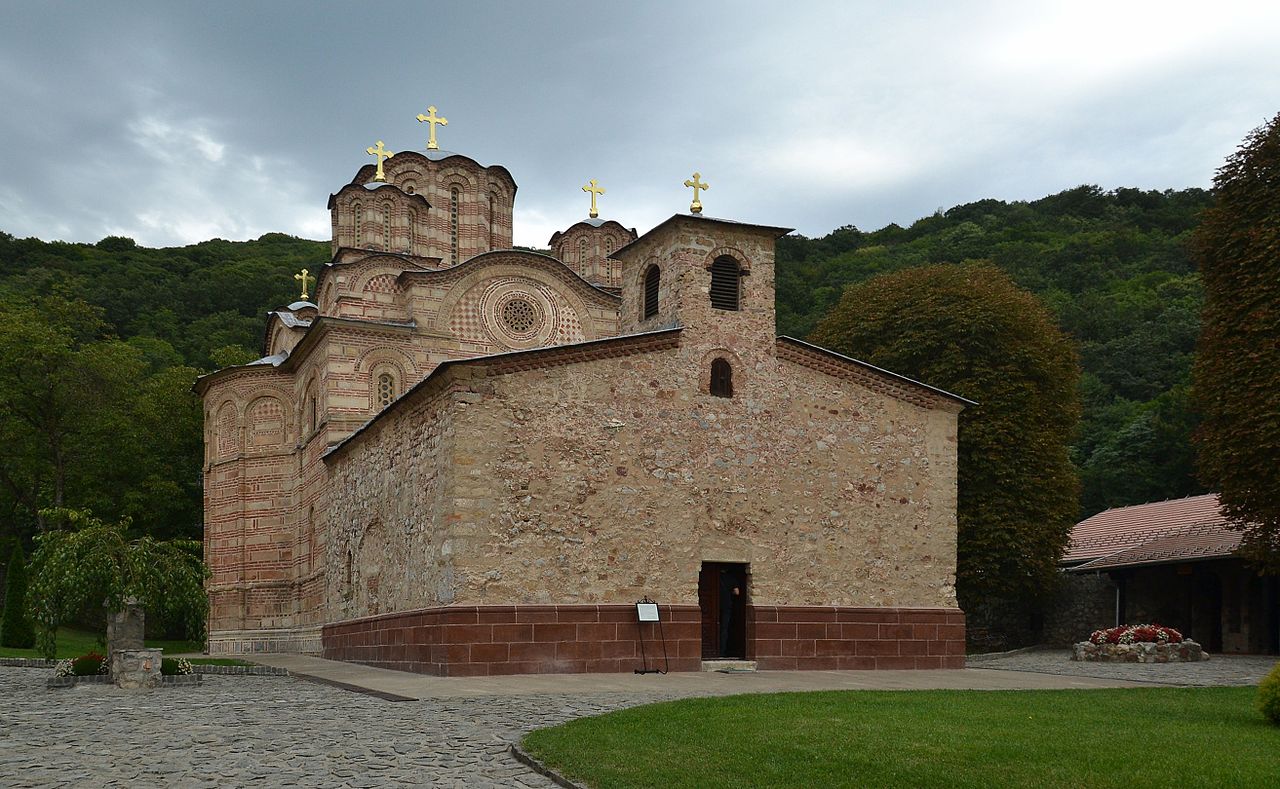
One year after his execution, Lazar’s relics were uncovered incorrupt. The father, the mother, and the eldest son are all glorified by the Orthodox Church as saints. The Serbian nation celebrates Lazar’s death as its highest national holy day. Six centuries later, in the aftermath of the First World War, St. Nikolai Velimirovich, himself a glorified twentieth-century saint of the Serbian Orthodox Church, preached a sermon over the reliquary of St. Lazar at Ravanica Monastery in Srem. His interpretation is the Serbian Church’s canonical reading of what Kosovo meant. St. Nikolai names the puzzle first:
For other nations usually celebrate the days of their victory as their national holidays, and they ask themselves in bewilderment: “Why is it, that the Serbs celebrate the day of their great defeat as their ‘main’ national holy day in the year?”… by celebrating Vidovdan, you are always celebrating not the defeat, but the victory of Lazar.
— Bishop Nikolai Velimirovich, Saint Lazar’s Victory, p. 117[2]
What kind of victory, if not a military one? St. Nikolai’s answer reads as a rebuke of Patriarch Kirill written six centuries in advance:
Lazar’s army fought in defense of Christendom, in defense of the Fatherland, in defense of the Balkans. Murat’s army fought for the imposition of the Islamic faith, for the imposition of suzerainty, for the imposition of a yoke and silencing. Can there be any doubt whatsoever as to whose intention for fighting and whose purpose for suffering was more just? How is it, then, that Lazar was able to be vanquished? But no, he was not vanquished. As his bloody head rolled over Kosovo, it wrote out a death sentence for the alleged victors.
— St. Nikolai Velimirovich, Saint Lazar’s Victory, p. 118
And the principle that explains why the defeat is called a victory:
If you slay someone who has more righteousness than you, you have not slain him but glorified him. By slaying him you have only hastened his fall and his triumph.
— St. Nikolai Velimirovich, Saint Lazar’s Victory, p. 118
The Serbian epic cycle of Kosovo summarizes the whole battle in a single couplet that St. Nikolai quotes as the definitive verdict:
Sve je sveto i čestito bilo, I milome Bogu pristupačno.
All was holy and honorable, And acceptable to gracious God.
— Serbian Kosovo epic cycle, quoted in St. Nikolai’s, Saint Lazar’s Victory, p. 118
“That is,” St. Nikolai explains, “a worthy sacrifice had been offered for a worthy object. Everything had been sacrificed for Christ.”
And St. Nikolai is explicit that this is not merely a historical observation about a long-ago battle. It is a living spiritual tradition whose demand on the present is permanent:
Let us venerate, therefore, the sacrifice of Saint Lazar. His choosing of the heavenly kingdom signifies an entire spiritual tradition. This spiritual tradition of Lazar is as necessary for people today as ever. For truly, it means that with Christ there also comes victory. It means that no sacrifice is too great for God’s justice.
— Bishop Nikolai Velimirovich, Saint Lazar’s Victory, p. 119
This is the measure. And St. Nikolai is not speaking privately. He is speaking as the Church’s own interpreter of what Kosovo meant, preaching over the very reliquary of the saint whose meaning he is declaring. The Serbian Orthodox Church has not revised his reading.
Nor can a reader dismiss this as the parochial witness of a foreign national tradition. Both St. Justin Popovich and St. Nikolai Velimirovich are canonized saints of the Orthodox Church, glorified in 2010 and 2003 respectively, whose canonizations stand uncontested in the Moscow Patriarchate. They speak as universal Orthodox witnesses, not outsiders, and the Russian Church cannot revise their teaching without repudiating figures already on its own liturgical calendar.
The converging witness of Russian tradition itself, that Russia’s own sainted princes are glorified not for what they won in battle but for their piety, their reluctance, and in the paradigmatic case of Ss. Boris and Gleb, the first saints canonized by the Russian Church, their explicit refusal to shed Christian blood even in self-defense, is treated in Chapter 19.
The Measure That Condemns Kirill
Before measuring Kirill’s war against Lazar’s, it is worth naming what Lazar’s instinct of restoration would have met in Ukraine since 2022 (Chapter 22). The Ukrainian Orthodox churches destroyed by Russian fire. The Ukrainian Orthodox priests killed by Russian forces. The villages burned in the Donbas. The seminaries whose walls are no longer standing. The children orphaned by weapons Russian bishops have blessed on camera. Whatever Lazar’s instinct toward enemy destruction would have been, it would not have been this. Lazar restored what the Turks had burned. Patriarch Kirill has blessed the burning of what Lazar would have restored.
St. Lazar, as preserved in hagiography, sermon, and Serbian memory, is the living standard by which Moscow’s war theology can now be measured. By that standard:
Lazar fought the textbook case St. Basil’s Canon XIII contemplates: non-Orthodox invaders attacking Christians for the faith. No patristic writer in the entire tradition ever permitted Orthodox Christians to wage aggressive war against other Orthodox Christians. Lazar’s war met every patristic criterion (Chapter 19); Kirill’s war meets none. The one criterion Lazar met, Kirill’s war cannot even approach.
Lazar’s last conscious words were “save my people, or to say it more properly, not my people but Thy people, O Lord.” A dying tsar refusing to call his own nation his own. Patriarch Kirill has declared Russia the κατέχων (the restrainer of Antichrist), “the world center of Orthodox Christianity” (Chapter 17), and has given his imprimatur to the entire ideology of Russkiy Mir, which treats Russian ethnic and civilizational identity as itself a form of Orthodox identity (Chapter 14). You cannot simultaneously hold the dying words of Tsar Lazar and the ideology of Russian World. The two positions are mutually incompatible.
The full theological indictment of Patriarch Kirill’s sin-washing sermon, his “Holy War” declaration, his katechon claim, and the sacralization of Russia’s nuclear arsenal is carried in the preceding chapters of this book (Chapter 16, Chapter 17, Chapter 19). This chapter does not replace that indictment. It gives it a face, and it gives that face a name.
The Orthodox Church glorified Tsar Lazar, his wife, and his eldest son. An entire family raised to sainthood for choosing the Heavenly Kingdom at the cost of the earthly one. No Orthodox tradition in history has ever proposed glorifying a patriarch for an aggressive war against fellow Orthodox Christians.
Lazar chose the Heavenly Kingdom at the cost of the earthly one. Patriarch Kirill claims the Heavenly Kingdom as a reward for expanding the earthly one. St. Nikolai names this kind of exchange in the Church’s own vocabulary, and the vocabulary does not soften:
Whoever lays down his life for the earthly kingdom, does what the foolish Esau also did — he sells his dignity for a bowl of lentils.
— Bishop Nikolai Velimirovich, The Tsar’s Testament, p. 104[3]
And then St. Nikolai states the principle that measures both positions, plainly, in a single sentence:
It is better to obtain the kingdom of heaven through sacrifice than to obtain the kingdom of this world through wickedness.
— Bishop Nikolai Velimirovich, The Tsar’s Testament, p. 105
Since 2022, Patriarch Kirill has urged Russian soldiers to lay down their lives for the earthly kingdom of the Russian World, and has offered them the Heavenly Kingdom in exchange. By Velimirovich’s own measure, in the Church’s own vocabulary, delivered by a canonized Serbian saint, this is precisely Esau’s exchange. A birthright traded for a bowl of lentils. The lentils are being called “the gates of the Heavenly Kingdom” (Chapter 17), but that renaming does not change the transaction. The birthright is Orthodoxy itself, and the lentils are a war against fellow Orthodox Christians blessed under the banner of a nation.
Only one position in this chapter has been vindicated by incorrupt relics, by the liturgical witness of the Church, and by six centuries of Serbian Orthodox memory. It is Lazar’s, not Kirill’s.
Archimandrite Justin Popovich, The Life of the Holy and Great Martyr Tsar Lazar of Serbia, in The Mystery and Meaning of the Battle of Kosovo, A Treasury of Serbian Orthodox Spirituality, Volume 3 (Grayslake, IL: Serbian Orthodox Metropolitanate of New Gracanica, Diocese of America and Canada, 2nd edition, 1999), pp. 1–44. Translated by Rt. Rev. Todor Mika, S.T.M., and Rev. Stevan Scott, Ph.D. in honor of the 600th anniversary of the Battle of Kosovo. Printed with the blessing of Bishop Longin. All Popovich citations in this chapter are from this edition. The Constantine the Philosopher passage cited is quoted by Popovich at p. 21 from Constantine’s Life of the Despot Stefan. ↩
Bishop Nikolai Velimirovich, Saint Lazar’s Victory, in The Mystery and Meaning of the Battle of Kosovo, pp. 111–121. Delivered as a sermon over the reliquary of St. Lazar at Ravanica Monastery in Srem after the First World War (the translators date the sermon to approximately 1919 based on the internal “five hundred and thirty years” reference). ↩
Bishop Nikolai Velimirovich, The Tsar’s Testament, in The Mystery and Meaning of the Battle of Kosovo, pp. 45–110. Originally published in Serbian as Carev zavet (1933). A theological meditation on Tsar Lazar’s soul at the hour of his death, structured as a vision in which a heavenly angel and the prophet Amos (Lazar’s patron saint) vindicate Lazar’s choice of the heavenly kingdom and explain its meaning for his people. ↩