
The Havana Declaration
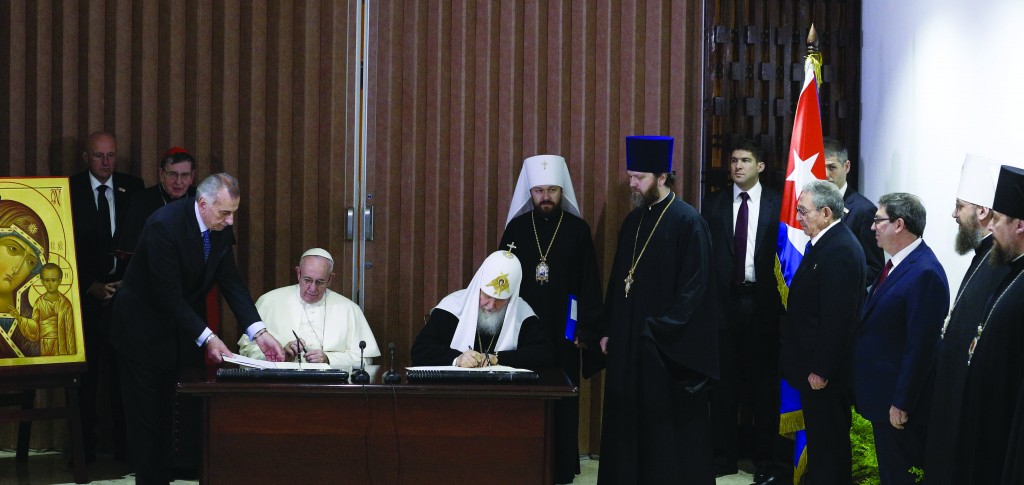
In February 2016, Patriarch Kirill met Pope Francis in Havana, Cuba. They signed a joint declaration. Only five people knew it was being prepared.
But surely this was just diplomacy? “Love, unity, building bridges in a divided world?”
Such language borrows from the vocabulary of the Fathers, only to contradict their actual teaching.
Chapter 1 documented what the saints teach: St. Paisios and the entire Holy Mountain ceased commemorating Patriarch Athenagoras for his dangerous overtures toward Rome, and Athonite elders condemned Patriarch Bartholomew as a “heresiarch” for the same pattern of meetings and gestures. If meeting the Pope warranted cessation of commemoration, what of a joint declaration signed in secret with the Pope?
The full text of this declaration is available on the Vatican website.
Section 1: The Secrecy
Before examining the Declaration’s content, we must note how it was produced. Patriarch Kirill admitted it was prepared in complete secrecy:
Interviewer: А Вас отговаривали от встречи или нет?
Patriarch Kirill: Меня никто не отговаривал, потому что никто не знал. Об этой встрече знали пять человек, не буду называть их святые имена. Почему было так? Потому что подготовить такую встречу в условиях гласности невозможно — слишком много противников. И даже не тех наших милых и добрых православных людей, которые считают, что есть какая-то опасность в самой встрече, — есть мощные силы, которые этого не очень хотят. Поэтому надо было спокойно и в тишине ее готовить, что мы и сделали.
Interviewer: Were you dissuaded from the meeting or not?
Patriarch Kirill: I was not, because no one knew about it. Only five people knew about the meeting; I will not name their holy names. Why was this so? Because it is impossible to prepare such a meeting in conditions of publicity: there are too many opponents. And not even those dear and kind Orthodox people who believe there is some danger in the meeting itself; there are powerful forces that do not really want this. Therefore, it was necessary to prepare it calmly and quietly, which is what we did.
— Patriarch Kirill, Interview on the results of his visit to the countries of Latin America, https://mospat.ru/ru/news/49713/
A declaration making theological claims on behalf of the Russian Orthodox Church should involve consultation with brother bishops. The Patriarch bypassed this entirely. Why would it require such secrecy unless its author knew it would face opposition from faithful Orthodox bishops?
But this procedural concern, grave as it is, pales beside what the Declaration teaches.
Section 2: The Ecclesiology
The Declaration’s first category of error concerns the Church herself.
The Unity of the Church
The Nicene Creed confesses “One, Holy, Catholic, and Apostolic Church.” The Church’s unity cannot be “lost”: those who depart become heretics or schismatics; the Church remains one. Yet the Declaration teaches:
We are pained by the loss of unity, the outcome of human weakness and of sin, which has occurred despite the priestly prayer of Christ the Saviour: ‘So that they may all be one’
— Joint Declaration of Pope Francis and Patriarch Kirill (Havana, Feb 12, 2016), para. 5
Mindful of the persistence of many obstacles, it is our hope that our meeting may contribute to the re-establishment of this unity willed by God
— Joint Declaration of Pope Francis and Patriarch Kirill (Havana, Feb 12, 2016), para. 6
The Declaration claims that unity was “lost” through “human weakness and sin,” and must now be “re-established.” This directly contradicts the Nicene Creed. The Church’s unity was never lost; those who departed into heresy left the Church, but the Church herself remained one. To say otherwise is to say that Christ’s prayer in John 17 failed:
That they all may be one; as thou, Father, art in me, and I in thee, that they also may be one in us: that the world may believe that thou hast sent me.
— John 17:21 (KJV)[1]
All who speak of such “lost unity” deny the very Creed they claim to confess. St. Hilarion Troitsky traces the consequence:
To recognize as valid the mysteries administered outside the Church means to recognize the operation of grace outside the Church, to recognize the possibility of salvation apart from the Church and in hostility towards her; in a word, this means to recognize that the Church is not obligatory, and to cast away the faith in One, Holy, Catholic and Apostolic Church.
— St. Hilarion Troitsky, On the Dogma of the Church, Appendix: “The Unity of the Church and the World Conference of Christian Communities”
The Declaration does what St. Hilarion warns against: it recognizes Rome’s mysteries, which grants Rome grace, which makes the Church “not obligatory,” which casts away the Creed.
St. Maximus the Confessor addressed this reasoning when officials urged him to accept a compromise document “for the sake of peace”:
If now, for the sake of regulating peace, the saving Faith is ill-conceived, this is complete separation from God and not union. For tomorrow, the ill-famed Jews shall say, “Let us arrange a peace amongst us and let us unite. We shall remove circumcision and you shall take away Baptism; only let us no longer have any strife in our midst.”
— St. Maximus the Confessor, in The Great Synaxaristes of the Orthodox Church, trans. Holy Apostles Convent, Vol. 1 (January), p. 855
The Havana Declaration is precisely this: an arrangement of “peace” that sacrifices the Faith. St. Maximus warns that such peace is “complete separation from God and not union.”
Multiple “Churches”
Throughout the Declaration, signed by both Kirill and Francis, the text refers to “Churches” in the plural:
“the mutual relations between the Churches” (para. 1)… “members of the Christian communities” (para. 24)… “our Churches in Ukraine” (para. 26)… “martyrs of our times, who belong to various Churches” (para. 12)
— Joint Declaration of Pope Francis and Patriarch Kirill (Havana, Feb 12, 2016)
There is but one Church: the Orthodox Church. Catholics do not have a “church”; they have a heretical assembly. Using “Churches” grants ecclesiastical reality to heretical organizations. Outside Orthodoxy there are only heresies and schisms, not churches.
St. Symeon of Thessalonica defines the Catholic Church not by geography or institution, but by faithfulness to the apostolic preaching:
The Catholic Church, then, is not Rome or Jerusalem. Neither is it Constantinople, Antioch, or Alexandria. Rather the one, holy, catholic, and apostolic Church is the Church who has her holiness from the Holy Spirit and her apostolicity from the preaching of the apostles. The Church that rightly divides the word of truth, holds fast to the words of the apostles, and possesses the sanctification of the Spirit: she alone is the one, holy, and apostolic Church.
— St. Symeon of Thessalonica, Against All Heresies, Ch. 25 (“On the Second Ecumenical Council”), p. 99
Dogma as Misunderstanding
The Declaration dismisses the doctrinal differences that separate Rome from Orthodoxy as mere historical wounds:
We have been divided by wounds caused by old and recent conflicts, by differences inherited from our ancestors, in the understanding and expression of our faith in God
— Joint Declaration of Pope Francis and Patriarch Kirill (Havana, Feb 12, 2016), para. 5
The dogmatic beliefs that separate Roman Catholics from Orthodoxy are treated not as heresies but as “wounds” upon a single body. This is the “two lungs” theory: the idea that the Catholic Church and the Orthodox Church are two parts of one universal Church.[2][3]
The Fathers taught no such thing. There is one Church. Those who depart from her are heretics, not wounded limbs.
St. Symeon of Thessalonica observed that innovation in faith and corruption of life are inseparable:
They who have innovated in what concerns the faith have also fallen away in what concerns their way of life. For faith and way of life are correlative one to another.
— St. Symeon of Thessalonica, Against All Heresies, Ch. 22: “That We Should Guard Even against Small Errors”, p. 79
The truth of God, the whole, pure, and saving truth, is to be found neither in the Roman Catholics, nor in the Protestants, nor in the Anglicans… It is to be found only in the One True Church, the Orthodox Church. The others may well believe that they possess the truth. In reality, however, they are far from it.
— St. Theophan the Recluse, Preaching Another Christ: An Orthodox View of Evangelicalism (Orthodox Witness, 2011), pp. 19-20
The Filioque, Papal Supremacy, Created Grace, Purgatory, and the Immaculate Conception are not “differences in understanding.” They are heresies. The Fathers called them heresies, and called those who held them heretics. (For the full patristic definition of heresy, and who the Fathers consider a heretic, see Part VI, Chapter 24: On Heresy, Synods, and Right Belief.) To treat these as misunderstandings is to repudiate the witness of the Fathers.
St. Paisius Velichkovsky, the Russian saint whose disciples brought the Philokalia to Russia, wrote to a Uniate priest who had doubts about his confession. His assessment of the Filioque leaves no room for the diplomatic language of the Havana Declaration:
The Uniates’ primary and most significant error lies in the teaching which they have accepted from the Romans, that the Holy Spirit proceeds both from the Father and the Son. This is the primary and most significant of all heresies, for it contains a concept of God, who is one in the Holy Trinity, that is incorrect and against the Holy Scriptures.
— St. Paisius Velichkovsky, letter to the Uniate priest Ioann, in Fr. Sergii Chetverikov, Starets Paisii Velichkovskii: His Life, Teachings, and Influence on Orthodox Monasticism (Nordland Publishing, 1980), p. 250
The primary and most significant of all heresies. Not a “difference in understanding.” Not a “wound” upon one body. A heresy, and the chief one at that.
But the Declaration goes further.
Section 3: The Sacraments
The Declaration implicitly recognizes sacramental grace outside the Orthodox Church.
Shared Baptism and Episcopate
We share the same spiritual Tradition of the first millennium of Christianity
— Joint Declaration of Pope Francis and Patriarch Kirill (Havana, Feb 12, 2016), para. 4
At the signing ceremony, Pope Francis stated: “We have the same Baptism, we are bishops.” Patriarch Kirill stood beside him and offered no correction.
To be a bishop, ordination by a proper bishop is required. Orthodoxy alone has apostolic succession. To be baptized, a priest must administer the sacrament. Priests can only be ordained by bishops. This declaration implies the sacraments exist outside Orthodoxy.
Metropolitan Hilarion (Alfeyev), Kirill’s chief ecumenist and head of the Department for External Church Relations (DECR), has made this explicit:
We effectively have mutual recognition of the Sacraments… if a Roman Catholic priest converts to Orthodoxy, we receive him as a priest, and we do not re-ordain him. And that means that, de facto, we recognize the Mysteries of the Roman Catholic Church.
— Metropolitan Hilarion Alfeyev, “The Church and the World” television program, Russia Channel, October 17, 2009; http://vera.vesti.ru/doc.html?id=237432[4]
Our Orthodox saints taught us that this is heresy. This is not one man’s opinion. The official “Basic Principles” document adopted by the Jubilee Bishops’ Council in 2000 under Kirill’s leadership as DECR Chairman established the theological foundation:[5]
Communities that fell away from unity with Orthodoxy were never viewed as completely deprived of God’s grace.
— “Basic Principles of the Attitude of the Russian Orthodox Church to Heterodoxy,” Section 1.15, Jubilee Bishops’ Council, August 2000, https://mospat.ru/ru/news/85385/[6]
“Never viewed as completely deprived.” The qualifier “completely” does the work: it concedes that grace remains in heterodox communities, creating the doctrinal space for recognizing their sacraments. From this premise, recognizing Catholic baptism, ordination, and episcopacy follows logically.
The ancient Church held otherwise. The Council of Carthage, in the presence of St. Cyprian, decreed that heretical clergy returning to the Church are received as laymen only, their ordinations being void:
If, again, any presbyters or deacons, who either have been before ordained in the Catholic Church, and have subsequently stood forth as traitors and rebels against the Church, or who have been promoted among the heretics by a profane ordination by the hands of false bishops and antichrists contrary to the appointment of Christ, and have attempted to offer, in opposition to the one and divine altar, false and sacrilegious sacrifices without, that these also be received when they return, on this condition, that they communicate as laymen.
— Council of Carthage (256 AD), cited in St. Hilarion Troitsky, On the Dogma of the Church, Fifth Essay
“False bishops and antichrists.” “Profane ordination.” “Communicate as laymen.” Pope Francis declared at the signing ceremony, “We have the same Baptism, we are bishops,” whereas the Council of Carthage declares that heretical bishops are not bishops at all.
The incorrect reception of non-Orthodox into the Orthodox Church by economia has often been weaponized to redefine Orthodox dogma. The saints do not recognize the mysteries of the Roman Catholic Church. St. Nikodemos the Hagiorite, compiler of the Rudder and the standard canonical authority of the Orthodox Church, wrote in his commentary on Canon XLVII of the Holy Apostles:
Note, moreover, that we do not say that we rebaptize the Latins, but that we baptize them. For their baptism belies its name and is not at all a baptism, but only a mere sprinkle.
— St. Nikodemos the Hagiorite, The Rudder (Thessaloniki: B. Regopoulos, 1982), Canon XLVII of the Holy Apostles, p. 76
“Not at all a baptism, but only a mere sprinkle.” Not a deficient baptism, not a partially valid baptism: not a baptism at all. Metropolitan Hilarion contradicts this, stating “de facto, we recognize the Mysteries of the Roman Catholic Church.” The compiler of the Rudder says their baptism “is not at all a baptism.” These two positions cannot coexist.
Reception practices have varied historically: some Orthodox traditions baptize converts from Rome, others receive by chrismation or confession. This variation is real. But variation in how the boundary is applied is not the same as denying the boundary exists. Economia in reception is a pastoral act of mercy toward individuals seeking to enter the Church. The Havana Declaration is not economia. It is a doctrinal claim that Rome possesses valid mysteries as a matter of ecclesiology.
Hilarion himself credited the Second Vatican Council with creating the framework that made this rapprochement possible:
If previously the Orthodox were spoken of as schismatics and heretics, separated from the Church, and the Orthodox Church as a heretical community without valid sacraments, then the Second Vatican Council proposed entirely different formulations. The Orthodox Churches came to be regarded as possessing apostolic succession of hierarchies and valid sacraments, but not in communion with Rome.
— Metropolitan Hilarion (Alfeyev), speech at the Institute of General History, December 23, 2013, https://www.patriarchia.ru/article/10396[7]
Rome changed its language about the Orthodox; the Moscow Patriarchate, under Kirill’s leadership, then adopted that change from Rome as the basis for bilateral relations. The Fathers did not change; Vatican II did. And Vatican II did not change in isolation: a delegation from the Russian Orthodox Church, which included KGB agents operating under cover, attended the Second Vatican Council as observers. Mitrokhin’s transcriptions name at least one by codename: agent “Vladimir.”[8] The “entirely different formulations” that Hilarion celebrates were produced by a council in which intelligence agents of the Soviet state sat as guests of honor.
The mindset behind such errors treats the heterodox not as people in need of conversion, but as allies.
It is very important for Orthodox and Catholic Christians to hear each other so that at a time when the faithful of the Orthodox and the Catholic Churches are facing the same challenges we may learn to act not like competitors, but like allies.
— Metropolitan Hilarion Alfeyev, interview with Russia-24 TV Channel, February 13, 2016, https://mospat.ru/en/news/49744/
This is not a matter of interpreting the Declaration charitably or uncharitably. The recognition of Catholic sacraments and clergy is explicit, official Moscow Patriarchate policy: codified in the “Basic Principles” document that Kirill oversaw as DECR Chairman, publicly defended by his chief ecumenist Hilarion, and now enshrined in this Declaration signed with the Pope. The Havana Declaration is not a diplomatic accident; it is the policy made manifest.[9]
Shared Apostolic Authority
The Declaration teaches that Catholics and Orthodox share the same apostolic mission:
Orthodox and Catholics are united not only by the shared Tradition of the Church of the first millennium, but also by the mission to preach the Gospel of Christ in the world today
— Joint Declaration of Pope Francis and Patriarch Kirill (Havana, Feb 12, 2016), para. 24
Apostolic authority resides in the Orthodox Church alone. Saying Orthodox and Catholics are “united by the mission to preach” implies recognition of Roman Catholic apostolic succession, which the Fathers do not grant outside Orthodoxy. St. Theophan the Recluse addressed this in a letter to an Orthodox Christian whose neighbor had begun attending a heterodox preacher’s meetings.[10]
This preacher, according to the Orthodox Christian, “looks very kind, visits the homes of the rich and poor alike, reads from the Gospel, preaches faith in Christ, and urges everyone to repent.”
St. Theophan’s response is unequivocal:
How can he go about preaching faith in Christ without having been first appointed a preacher by the Church? This is unheard of!
— St. Theophan the Recluse, Preaching Another Christ: An Orthodox View of Evangelicalism (Orthodox Witness, 2011), p. 15
“By the Church” means by the Orthodox Church.
In the same letter, St. Theophan traces the genealogy of Western heresy back to its origin:
The pope of Rome, through sophistries of his own invention, fell away from the Church and the Faith. This constitutes the first degree of the fall into falsehood and darkness.
— St. Theophan the Recluse, Preaching Another Christ (Orthodox Witness, 2011), pp. 19-20.
From Rome came the Protestants (the second degree), from them the Anglicans (the third), and from the Anglicans came the preacher in question (the fourth). Every branch of the tree grows from the same root. Those who departed from the Church cannot claim a mission they forfeited by departing.
St. Justin Popovich, the greatest Serbian theologian of the twentieth century, placed papal claims in their ultimate theological context:
According to the true Church of Christ, that has existed since the advent of Christ the Theanthropos into this world as His theanthropic Body, the dogma of the infallibility of the Pope is not only a heresy, but the ultimate heresy. No other heresy has so radically and so comprehensively risen against Christ the Theanthropos and His Church as papism has through the dogma of the infallibility of the Pope, a man. This is undoubtedly the heresy above all heresies.
— St. Justin Popovich, Orthodox Faith and Life in Christ, trans. Asterios Gerostergios (Institute for Byzantine and Modern Greek Studies, 1994), p. 149
“The ultimate heresy.” “The heresy above all heresies.” These are the words of a glorified saint of the Orthodox Church. The Havana Declaration calls the institution built on this heresy a “sister Church” and declares Orthodox and Catholics “united by the mission to preach.” Patriarch Kirill signed a document that treats as an ally the very institution that St. Justin calls the bearer of the worst heresy in the history of Christianity.
Catholic Martyrs
The Declaration recognizes martyrdom outside the Orthodox Church:
We believe that these martyrs of our times, who belong to various Churches but who are united by their shared suffering, are a pledge of the unity of Christians
— Joint Declaration of Pope Francis and Patriarch Kirill (Havana, Feb 12, 2016), para. 12
The saints, on the other hand, honor only those who died professing the true faith. As the Church taught during the era of persecutions:
For many even of the heretics in the time of persecution and of idolatry showed fortitude even to death, and were called martyrs by those who shared their beliefs. But not even ought Orthodox Christians, I say, to go visiting them, whether it be to pray for them or to honor them or to seek a cure from them for their ailment.
— St. Nikodemos the Hagiorite, Interpretation of Canon IX of the Council of Laodicea, The Rudder, p. 555[11]
Canon 34 of the Laodicean Synod declares:
No Christian shall forsake the martyrs of Christ, and turn to false martyrs, that is, to those of the heretics, or those who formerly were heretics; for they are aliens from God. Let those, therefore, who go after them, be anathema.
— Canon 34, Council of Laodicea, https://www.newadvent.org/fathers/3806.htm[12]
How is Patriarch Kirill not under this anathema when he recognizes, through the document he signed, that martyrdom exists outside the Orthodox Church?[13]
(For a full treatment of why acknowledging Catholic saints and martyrs is problematic, see Part I, Chapter 4: Memory Eternal for Pope Francis. For the ROCOR 1983 Anathema against ecumenism, see Part II, Chapter 5, Section B.)
If they believe that the Pope is a church and has mysteries and we have to unite, they aren’t shepherds but wolves in shepherds clothing.
— Elder Gabriel (disciple of St. Paisios the Athonite) on Patriarch Kirill, https://www.youtube.com/watch?v=HXJ65qfUdGY, 00:00:43-00:00:52[14]
Section 4: The Mission Betrayed
The Declaration’s errors extend to the Orthodox mission itself.
Prohibition of Conversion
This mission entails mutual respect for members of the Christian communities and excludes any form of proselytism
— Joint Declaration of Pope Francis and Patriarch Kirill (Havana, Feb 12, 2016), para. 24
Proselytize means “to preach with the aim of converting.” Orthodox Christians have a divine commandment from Christ Himself to convert everyone outside the faith to Orthodoxy:
Go ye therefore, and teach all nations, baptizing them in the name of the Father, and of the Son, and of the Holy Ghost: teaching them to observe all things whatsoever I have commanded you.
— Matthew 28:19-20[15]
Agreeing not to proselytize Catholics implies that the Catholics already have the true faith and thus need no conversion.
By signing this declaration, Patriarch Kirill asserts that Roman Catholics are already part of the Body of Christ. This is a gravely sinful assertion.
St. Theophan the Recluse warned against this deception:
Is it allowed to speak about Jesus Christ in an unclear and insidious manner? Is it allowed to preach about the path of salvation and lead the listeners to destruction? Is this not what the heretics have always done? How many teachings perverting the truth appeared before the heresiarch Arius and, mainly, after him? They were all rejected and anathematized by the Church. Countless heresies appeared in the West but they were all rejected by Orthodoxy despite the fact that they preached Christ the Savior! Therefore, we must not rush to the conclusion that just because someone preaches Christ, he must necessarily be trustworthy, but we need to ascertain whether or not he preaches the truth about Christ.
— St. Theophan the Recluse, Preaching Another Christ: An Orthodox View of Evangelicalism (Orthodox Witness, 2011), p. 22
The Havana Declaration superficially preaches Christ. It speaks of “the Gospel.” It invokes “shared tradition.” None of this makes it trustworthy, as heretics have always preached Christ. The relevant question is whether they preach the truth about Christ.
All Believers Pray to the Same God
We exhort all Christians and all believers of God to pray fervently to the providential Creator of the world
— Joint Declaration of Pope Francis and Patriarch Kirill (Havana, Feb 12, 2016), para. 11
By calling on “all believers of God” to pray to “the providential Creator,” the Declaration acknowledges that non-Christians have a valid faith directed toward the same God. This aligns with Patriarch Kirill’s repeated statements that Muslims and Christians “appeal to the same God.” (Full treatment in Part II, Chapter 5.)
Ecumenism Declared Indispensable
Interreligious dialogue is indispensable in our disturbing times
— Joint Declaration of Pope Francis and Patriarch Kirill (Havana, Feb 12, 2016), para. 13
The only indispensable dialogue is calling people to Orthodox truth. We do not need ecumenistic dialogue with false religions and heretics; we need their conversion. The Fathers forbade dialogue that treats heresy as a legitimate partner:
The Holy Fathers were right to forbid relations with heretics. Today we hear: “We should pray together, not only with the heretic, but also with the Buddhist, the fire-worshiper, even the demon-worshiper. It is important that the Orthodox participate in conferences and be present at their prayer sessions.” What kind of presence are they talking about? They try to solve everything using logic and end up justifying the unjustifiable.
— St. Paisios the Athonite, Spiritual Counsels, Vol. 1: With Pain and Love for Contemporary Man, p. 386[16]
Many use logical rationale to disagree with the Fathers while claiming they are not doing so, labelling all who disagree as prideful.
Metropolitan Augoustinos Kantiotes of Florina (1907-2010) was a spiritual child of Elder Philotheos Zervakos and was revered by St. Paisios the Athonite. He was one of the most outspoken opponents of ecumenism in the twentieth century. He ceased commemoration of Patriarch Athenagoras in 1970, was forbidden to preach or officiate within the Archdiocese of Athens for his stance, and the government even attempted to have him medically diagnosed as insane to neutralize him.[17]
He gives a biblical commentary on how St. Paul warned Titus not to meet with heretics to dialogue with them, as they would not change their mind.
When the heretics went to Crete, Paul wrote to his disciple Titus, the first bishop of Crete, warning him to be careful and not to waste time meeting with the heretics. He told Titus that even if he were to meet them one or two times, they wouldn’t change their minds. He warned Titus that they were perverse people, and no matter what he said to them, they would not change.
— Metropolitan Augoustinos Kantiotes, Sparks from the Apostles, p. 117
Using love and sentimentalism to justify interreligious dialogue has no basis in the patristic witness of our saints, despite certain people’s efforts to twist Fr. Georges Florovsky’s early writings to justify contemporary ecumenical excesses.[18]
Section 5: The Uniates
The Declaration legitimizes the Uniates:
The ecclesial communities which emerged in these historical circumstances have the right to exist and to undertake all that is necessary to meet the spiritual needs of their faithful
— Joint Declaration of Pope Francis and Patriarch Kirill (Havana, Feb 12, 2016), para. 25
Most contemporary Orthodox Christians do not understand who the Uniates are, so it must be explained first, to understand the gravity of what the Declaration speaks.
The Union of Brest
In 1595, several Orthodox bishops in Ukraine secretly negotiated with Rome while concealing their intentions from the Orthodox clergy and laity. In November 1595, Bishops Cyril (Terletsky) and Hypatius (Potey) traveled to Rome, kissed the Pope’s slipper, and swore allegiance as “repentant schismatics.” Metropolitan Michael Ragoza of Kiev, the highest-ranking Orthodox hierarch in Ukraine at the time, signed the articles of union but did not personally travel to Rome. Upon their return to Ukraine, the bishops “did everything possible to conceal their renunciation of Orthodox teachings,” presenting the union as merely a change of jurisdiction while preserving Orthodox rites.[19]
This meeting is formally known as the Union of Brest, which formed the Unia. Those who form the Unia and their followers became known as Uniates.
The Persecution
After this so-called council, Orthodoxy was effectively suppressed in Ukraine. The Orthodox hierarchy was abolished, leaving the faithful without bishops from 1596 to 1620. Orthodox churches, monasteries, and schools were confiscated and transferred to Uniate control. Orthodox Christians were stripped of legal rights, denied their own churches, and subjected to physical violence. Orthodox clergy were forced into hiding or executed.
Patriarch Macarius III of Antioch, visiting Ukraine in 1656, testified that “seventeen or eighteen thousand followers of Eastern Orthodoxy were killed under hands of the Catholics.”
More than 17,000 Orthodox Christians were killed by the Uniates.
Not just one person. Not ten people. Not a thousand. Not five thousand. Not even fifteen thousand. Seventeen thousand Orthodox Christians were killed by the Uniates.
We have glorified saints who were martyred under this very persecution.
The Martyrs
St. Athanasius of Brest was martyred for refusing the union. Roman Bishop Andrew Gębicki of Lutsk asked St. Athanasius if he opposed the union:
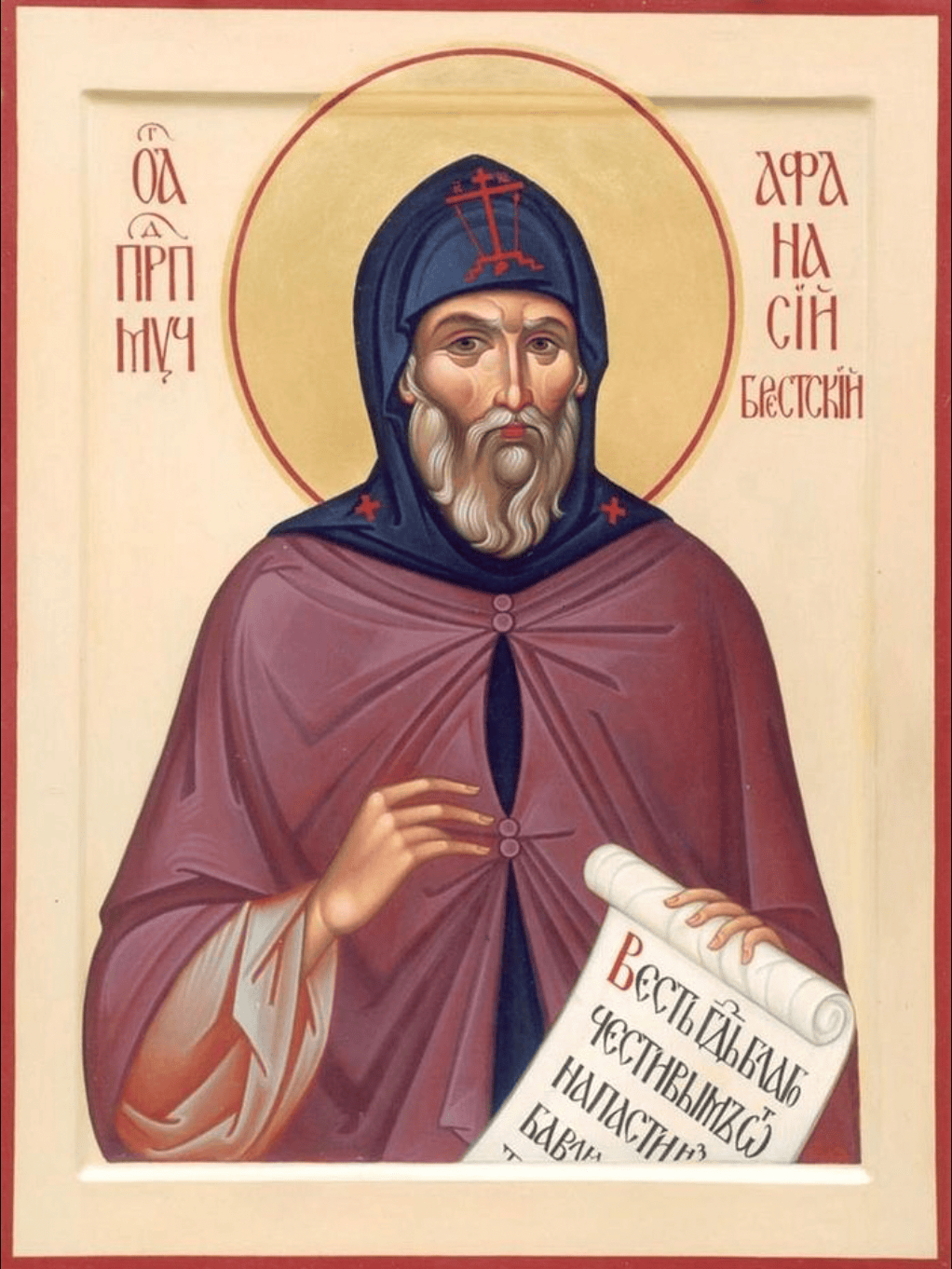
Fr. Athanasius was accused of profaning the Union when he responded that “It is cursed” to the question from Roman Bishop Andrew Gębicki of Lutsk if he opposed the union.
— Saint Athanasius of Bretsk, https://www.johnsanidopoulos.com/2014/09/saint-athanasius-of-bretsk-1648.html
The saint was then executed by the Uniates. He was shot without any official order and left in a forest for eight months without a proper Orthodox burial.
St. Macarius of Kanev spent his life resisting the Unia, enduring repeated attacks on his monasteries by Uniate and Polish forces. When Uniate crusaders tried to persuade him to accept the union, he proclaimed:
What agreements can we have with you? You have rejected the teachings of the Ecumenical Councils, embraced a false tradition, and instead of submitting to the Head of the Church, Jesus Christ, you have deferred to the Pope of Rome.
— St. Macarius of Kanev, A Beacon of Unwavering Faith, https://obitel-minsk.org/en/st-macarius-of-kanev-a-beacon-of-unwavering-faith
The Betrayal
Now consider what Patriarch Kirill has done.
Has he brought these aforementioned matters to light? Has he examined or condemned the crimes committed against Orthodox Christians by the Uniates? The thousands of deaths? The persecution of Orthodoxy? The martyrdom of our saints?
No. He has declared, by signing this declaration drafted in complete secrecy, that these Uniate so-called churches have the right to exist.
The Uniates were formed through episcopal betrayal, state violence, and property theft against Orthodox Christians. They killed Orthodox saints. And Patriarch Kirill, in a document prepared in absolute secrecy, granted them legitimacy.
The history of what the Uniates did to Orthodox Christians is unknown to most, ignored by those who know, or brushed off as irrelevant. The deeper meaning of Patriarch Kirill’s actions goes undetected.
What makes this worse is that the Moscow Patriarchate itself participated in the suppression of the Uniate Church, not through canonical preaching and conversion, but through the secret police. In 1946, the Soviet government staged the “Synod of Lviv”: Uniate bishops were arrested, and the remaining clergy were coerced at gunpoint into “accepting” absorption into the Russian Orthodox Church. The ROC was, in the words of historian Sean Brennan, “a willing accomplice.” Those who refused were imprisoned; Archbishop Slipyj spent eighteen years in labor camps. For the next four decades, the KGB ran operations to infiltrate and destroy the underground Uniate communities, recruiting agents among their clergy and running propaganda campaigns titled “The Uniate Church: An Enemy to Peace and Progress.” The department that coordinated these operations was the DECR, headed first by Nikodim and later by Kirill.[20] The institution that suppressed the Uniates by KGB violence now, through the same department, grants them “the right to exist” in a secret declaration with the Pope.
St. Paisius Velichkovsky, writing to a Uniate priest, commanded him to flee the Unia as Lot fled Sodom:
Forsake and flee the Unia as soon as possible, lest you die while in it, and lest you be counted among the heretics rather than the Christians.
— St. Paisius Velichkovsky, letter to the Uniate priest Ioann, in Fr. Sergii Chetverikov, Starets Paisii Velichkovskii: His Life, Teachings, and Influence on Orthodox Monasticism (Nordland Publishing, 1980), pp. 251-252
The saints commanded flight from the Unia, and declared the Uniates heretics. Patriarch Kirill does no such thing, and simply grants the Unia legitimacy.
Section 6: The Joint Prayer
The Declaration includes a joint prayer invoking the Mother of God:
Let us with hope turn to the Most Holy Mother of God, invoking her with the words of this ancient prayer.
— Joint Declaration of Pope Francis and Patriarch Kirill (Havana, Feb 12, 2016), para. 30
A joint declaration with the Pope, invoking the Theotokos with prayer, is joint prayer, calling both Orthodox Christians and Papists to prayer together.
Such polite and diplomatic gestures do not circumvent our Holy Canons set forth by our God-bearing Fathers, which prescribe excommunication for such prayer:
A bishop or presbyter or deacon who has merely prayed with heretics shall be excommunicated; if he allows them to perform anything as though they were ministers of the Church, he shall be deposed.
— Apostolic Canon 45, https://www.newadvent.org/fathers/3820.htm[21]
St. Nikodemos the Hagiorite, compiler of the Pedalion (Rudder), the authoritative collection of Orthodox canon law, comments on this canon:
We must hate and turn away from heretics, and never pray together with them, nor allow them to perform any ecclesiastical function, either as clergy or as priests.
— St. Nikodemos the Hagiorite, The Rudder (Pedalion), Commentary on Apostolic Canon 45[22]
The Greek of St. Nikodemos is worth examining. His words are μισοῦμεν καὶ ἀποστρεφώμεθα: “we must hate and turn away from.” The verb μισέω (miseō) is the same word Christ uses in Luke 14:26 (“If anyone comes to me and does not hate his father and mother…”).
The hatred here is principled rejection, the deliberate refusal to treat heresy as something that can be tolerated through dialogue or diplomacy. The second verb, ἀποστρέφομαι (apostrephomai), means “to turn one’s back on, to avert oneself from.” It is a physical metaphor: you do not face them, you do not engage, you turn away. Together, these two verbs leave no room for ecumenical dialogue, bridge-building, or joint declarations.
The canon itself uses a revealing word: μόνον (monon), meaning “merely, only.” The Greek reads αἱρετικοῖς συνευξάμενος, μόνον, ἀφοριζέσθω: “having prayed with heretics, merely, let him be excommunicated.” The word μόνον is placed emphatically.
Even if all you did was pray, even without concelebrating, without allowing them to serve, the bare act of joint prayer alone warrants excommunication. The canon does not say “a bishop who enters heresy.” It says “who has merely prayed with heretics.”
If merely praying with heretics warrants excommunication, how much more does signing a joint declaration that includes joint prayer?
Section 7: The Familial Titles
The familial titles Patriarch Kirill used carry theological weight, as Chapter 1 demonstrated. The Declaration continues this pattern:
It is with joy that we have met like brothers in the Christian faith… We are not competitors but brothers… In such a way that our Christian brotherhood may become increasingly evident.
— Joint Declaration of Pope Francis and Patriarch Kirill (Havana, Feb 12, 2016), paras. 1, 24, 27
Archbishop Stylianos of Australia addressed this practice:
By addressing the Pope or Rome, as I have said, with paternal titles full of familiar content we only do harm and conversely we do not benefit the dialogue at all. Very simply, it is a falsehood for us to issue such addresses, a theological falsehood.
— Stylianos, Archbishop of Australia, “The Theological Dialogue between Orthodox and Roman Catholics: Problems and Prospects,” pp. 22-24, as quoted in On Common Prayer with the Heterodox, Uncut Mountain Press
St. John of Kronstadt’s liturgical practice demonstrated the correct Orthodox posture toward the heterodox. During the Divine Liturgy, after reading the Nicene Creed, he would add a personal prayer.[23]
Establish in this Faith, and with this Faith, my heart and the heart of all Orthodox Christians; grant us understanding to live worthily of this Faith and this hope; unite unto this Faith all great Christian societies that have tragically fallen away from the unity of the Holy Orthodox Catholic and Apostolic Church, which is Thy body, and Thou its Head and the Saviour of the body. Cast down the haughtiness and enmity of their teachers and those who follow them. Grant them a heart to understand the truth and the saving doctrines of Thy Church and to diligently unite themselves to it.
— St. John of Kronstadt, quoted in I. K. Sursky, Saint John of Kronstadt, trans. Holy Transfiguration Monastery (2018), pp. 89-90
Note who this prayer addresses: not “brothers,” not “sister Churches,” but “all great Christian societies that have tragically fallen away from the unity of the Holy Orthodox Catholic and Apostolic Church.” And note what it asks for: not dialogue, not re-establishment of unity, but that God would “cast down the haughtiness and enmity of their teachers” and grant them a heart to “diligently unite themselves to it”:
Section 8: The Verdict
We have examined the Havana Declaration paragraph by paragraph. The reader who has followed this examination knows what was signed in that airport room: what the Declaration teaches about the Church, the sacraments, martyrdom, conversion, the Uniates, and the joint prayer it contains. The reader knows it was prepared in absolute secrecy, with only five people aware, because the Patriarch admitted there were “too many opponents,” which he does not elaborate on.
How should we judge these actions? The saints have already given us the standard. When Patriarch Athenagoras met the Pope, the saints condemned it; when Bartholomew continued the same pattern, the condemnation was no less severe, as documented in Chapter 1. The standard they established applies identically here. They did not wait for a joint declaration. They did not parse theological language. The meeting alone was enough.
If the meeting alone was enough, what does the declaration warrant, when that declaration denies the Creed, recognizes heretical sacraments, forbids conversion, legitimizes those who martyred our saints, and includes joint prayer with the Pope?
The Orthodox Response
Fr. Emmanuel Hatzidakis, a priest in ROCOR and author of The Heavenly Banquet, assessed the Havana meeting in stark terms:
With a stroke of a pen, he [Patriarch Kirill] turned his back on one thousand years of Orthodoxy in Russia… The Joint Statement constitutes a betrayal of the Orthodox Faith.
— Fr. Emmanuel Hatzidakis, “The Fall of the Third Rome: Moscow Capitulates to Papism,” https://www.orthodoxwitness.org/the-fall-of-the-third-rome-moscow-capitulates-to-papism/
Bishop Longin of Banchensk became the first Orthodox bishop to cease commemorating Patriarch Kirill after the Havana Declaration, fully in line with Canon XV of the First-Second Council of Constantinople.
(For the full treatment of cessation of commemoration, see Part VI, Chapter 23: The Saints Who Ceased Commemoration.)
Bishop Longin observed:
As we know, this [the Havana Declaration] was prepared secretly, which means there exists a mystery of lawlessness. After the meeting, the Patriarch said that everything was done in secret because he has enemies in Orthodoxy… And today it has become clear that the Pope has become a brother and ‘His Holiness,’ while we, the Orthodox, have become his enemies.
— Bishop Longin (Zhara) of Banchensk, remarks at Holy Ascension Bancheny Monastery, March 10, 2016. https://risu.ua/ru/v-upc-mp-bunt-episkop-longin-zhar-obvinyaet-patriarha-kirilla-v-otstupnichestve-ot-pravoslaviya_n78916[24]
He continued:
These 30 points (the Havana Declaration) are Judas’ thirty pieces of silver… This declaration is a legalization of the teachings of Antichrist.
— Bishop Longin (Zhara) of Banchensk, remarks at Holy Ascension Bancheny Monastery, March 10, 2016. Reported by RISU, March 29, 2016. https://risu.ua/ru/v-upc-mp-bunt-episkop-longin-zhar-obvinyaet-patriarha-kirilla-v-otstupnichestve-ot-pravoslaviya_n78916[25]
Conclusion
Despite the theological weight of this declaration, Patriarch Kirill claimed:
Цель встречи никак не была связана с продвижением каких-то богословских соглашений.
The purpose of the meeting was in no way connected with promoting any theological agreements.
— Patriarch Kirill, Interview on the results of his visit to the countries of Latin America, https://mospat.ru/ru/news/49713/
This is demonstrably false. The Declaration itself contradicts him.
Because of the perception of Patriarch Kirill by many of our brethren, this overview may be hard to stomach, and may appear to be misrepresenting the matter.
To these people, we suggest: go read the Declaration for yourself.
We have provided all exact citations and primary sources. Anyone skeptical of the evidence (but unable to offer a reasonable explanation for that skepticism) should understand they are not being asked to blindly believe what is quoted above. It has been quoted for accessibility and convenience, but one can and should review the Declaration text for themselves. For those who do, there will be no questioning the matter.
The link to the Vatican website with the declaration is here.
Read it. See for yourself whether it adheres to the teaching of the Fathers, or whether it contradicts them on every point that matters.
Original Greek: “ἵνα πάντες ἓν ὦσι, καθὼς σύ, πάτερ, ἐν ἐμοὶ κἀγὼ ἐν σοί, ἵνα καὶ αὐτοὶ ἐν ἡμῖν ἓν ὦσιν, ἵνα ὁ κόσμος πιστεύσῃ ὅτι σύ με ἀπέστειλας.” ↩
The “two lungs” metaphor originates with Russian philosopher Vladimir Solovyov (1853–1900) and poet Vyacheslav Ivanov (1866–1949), both of whom converted to Roman Catholicism. Pope John Paul II popularized the phrase, using it repeatedly to describe Catholic-Orthodox relations as “the two lungs of the one Body of Christ.” See John Paul II, Ut Unum Sint (1995), §54. ↩
In April 2009, a Convention of Orthodox Clergymen and Monks issued a formal “Confession of Faith Against Ecumenism” condemning this theology by name: “Even heresies are now ‘churches’; in fact, many of them, like the Papist one, are now regarded as ‘sister churches’ to which God has entrusted, jointly with us, the care for mankind’s salvation.” The Confession declared ecumenism a “pan-heresy” (citing St. Justin Popovich) and affirmed: “The Orthodox Church is not merely the true Church; She is the only Church.” Signatories included five Greek metropolitans (Seraphim of Piraeus, Kosmas of Etolia and Akarnania, Seraphim of Kythira, Jeremiah of Gortyno, and Panteleimon of Antinoes), Bishop Artemije of Rashka-Prizren (Serbia), five Athos monastery abbots (Koutloumousiou, Xeropotamou, Karakalou, Constamonitou, and Filotheou), Protopresbyter George Metallinos (Professor of Theology, University of Athens), Protopresbyter Theodore Zisis (Professor of Theology, University of Thessaloniki), and hundreds of clergy and monastics from Greece, Serbia, Cyprus, and the Holy Land. See “A Confession of Faith Against Ecumenism,” Convention of Orthodox Clergymen and Monks, April 2009, periodical Theodromia, Thessaloniki. ↩
Original Russian: “У нас фактически существует взаимное признание Таинств… если католический священник обратится в Православие, мы его принимаем как священника, мы не рукополагаем его заново. А это значит, что де-факто мы признаем Таинства Католической церкви.” ↩
“Основные принципы отношения Русской Православной Церкви к инославию” (Basic Principles of the Attitude of the Russian Orthodox Church to Heterodoxy), Section 1.15, adopted by the Jubilee Bishops’ Council, Moscow, August 13-16, 2000. Full Russian text: https://mospat.ru/ru/news/85385/. English: http://orthodoxeurope.org/page/7/5/1.aspx. The document was prepared under Metropolitan Kirill’s leadership as DECR Chairman and remains the official governing framework for all ecumenical relations. The same document calls the Roman Catholic Church “a Church in which the apostolic succession of ordinations is preserved” (Appendix) and threatens canonical punishment for those who accuse the hierarchy of “betrayal of Orthodoxy” through ecumenism (Section 7.3). ↩
Original Russian: “Общины, отпавшие от единства с Православием, никогда не рассматривались как полностью лишенные благодати Божией.” ↩
Original Russian: “Если раньше о православных говорили как о схизматиках и еретиках, отделенных от Церкви, а о Православной Церкви — как еретическом сообществе, в котором нет действительных Таинств, то Второй Ватиканский собор предложил совершенно иные формулировки. Православные Церкви стали рассматривать как обладающие апостольским преемством иерархий и действительными Таинствами, но не находящиеся в общении с Римом.” ↩
Sean Brennan, The KGB and the Vatican: Secrets of the Mitrokhin Files (Catholic Education Press, 2022), p. 73 (agent “Vladimir” named in the Mitrokhin transcriptions as part of the ROC delegation to Vatican II); p. 20 (“With the authorization of the Soviet regime, a delegation from the Russian Orthodox Church, which included several KGB agents, attended the Second Vatican Council as observers”). Independently confirmed in a CIA review: John C. [pseud.], Studies in Intelligence 66, no. 4 (December 2022), p. 45. For the full documentation of KGB penetration of the DECR and its use of the ROC for intelligence operations against the Vatican, see Chapter 13. ↩
The Havana Declaration’s “Sister Churches” ecclesiology was the culmination of three decades of DECR policy. In June 1993, Moscow’s DECR, under Kirill’s chairmanship since 1989, participated in the Balamand Agreement (the 7th Plenary Session of the Joint International Commission for Theological Dialogue between Orthodox and Roman Catholics). Only 9 of the 15 Orthodox Churches attended; Jerusalem, Serbia, Bulgaria, Georgia, Greece, and the Czech and Slovak Republics refused to participate. The agreement declared that “Catholics and Orthodox…are once again discovering each other as Sister Churches” (§12), that “what Christ has entrusted to His Church…cannot be considered the exclusive property of one of our Churches” (§13), and that “any rebaptism must be avoided” (§13). The preparatory Vienna meeting (1990) had already agreed: “In no way should we espouse any kind of soteriological exclusivity.” See St. Gregory Palamas Monastery, The Balamand Union: A Victory of Vatican Diplomacy (Etna, CA: Center for Traditionalist Orthodox Studies, 1993). Metropolitan Hilarion (Alfeyev) himself called the Balamand Agreement “the chief achievement” (главным достижением) of the entire Orthodox-Catholic dialogue (speech at the Institute of General History, December 23, 2013, patriarchia.ru/article/10396). ↩
The full letter is titled “Preaching Another Christ.” St. Theophan identifies the preacher as an evangelical of Anglican lineage, calls him “heretical,” and warns the recipient: “If, as it may actually turn out, he preaches a different faith and you keep listening to him, then you deny your former faith and condemn our holy Church, along with all those who have found salvation in her bosom. That is your second mistake, bigger than the first!” See St. Theophan the Recluse, Preaching Another Christ (Orthodox Witness, 2011), pp. 15-19. ↩
Original Greek: “«πολλοὶ γὰρ καὶ ἀπὸ τῶν αἱρετικῶν ἐν τῷ καιρῷ τοῦ διωγμοῦ καὶ τῆς εἰδωλολατρίας, μέχρι θανάτου ἐκαρτέρησαν, τοὺς ὁποίους μάρτυρας ὠνόμασαν οἱ ἐπάδοχοι αὐτῶν. Ἀλλ’ οὐδὲ οἱ ὀρθόδοξοι, λέγω, χριστιανοὶ, πρέπει νὰ ἠγάγωσιν εἰς αὐτοὺς ἢ διὰ νὰ προσευχηθῶσι, ἢ διὰ θεοσέπειαν, ἤγουν, ἢ διὰ νὰ τοὺς τιμήσωσι, ἢ διὰ νὰ ζητήσωσιν ἰατρείαν ἀπὸ αὐτοὺς εἰς τὰς ἀσθενείας των»” ↩
Original Greek: “«Ὅτι οὐ δεῖ πάντα Χριστιανὸν ἐγκαταλείπειν μάρτυρας Χριστοῦ, καὶ ἀπιέναι πρὸς τοὺς ψευδομάρτυρας, τουτέστιν αἱρετικῶν, ἢ αὐτοὺς πρὸς τοὺς προειρημένους αἱρετικοὺς γενομένους· οὗτοι γὰρ ἀλλότριοι τοῦ Θεοῦ τυγχάνουσιν. Ἔστωσαν οὖν ἀνάθεμα οἱ ἀπερχόμενοι πρὸς αὐτούς.»” ↩
Canon 34 of the Council of Laodicea. Full text: https://www.newadvent.org/fathers/3806.htm ↩
Original Greek: “«Άμα πιστεύουν ότι ο Πάπας είναι Εκκλησία και έχει μυστήρια και πρέπει να ενωθούμε δεν είναι ποιμένες είναι λυκοποιμένες.»” ↩
Original Greek: “πορευθέντες οὖν μαθητεύσατε πάντα τὰ ἔθνη, βαπτίζοντες αὐτοὺς εἰς τὸ ὄνομα τοῦ Πατρὸς καὶ τοῦ Υἱοῦ καὶ τοῦ Ἁγίου Πνεύματος, διδάσκοντες αὐτοὺς τηρεῖν πάντα ὅσα ἐνετειλάμην ὑμῖν·” ↩
Original Greek: “«Οι Άγιοι Πατέρες κάτι ήξεραν και απαγόρευσαν τις σχέσεις με αιρετικό. Σήμερα λένε: “Όχι μόνο με αιρετικό αλλά και με Βουδιστή και με πυρολάτρη και με δαιμονολάτρη να συμπροσευχηθούμε. Πρέπει να βρίσκωνται στις συμπροσευχές τους και στα συνέδρια και οι Ορθόδοξοι. Είναι μία παρουσία”. Τι παρουσία; Τα λύνουν όλα με την λογική και δικαιολογούν τα αδικαιολόγητα.»” ↩
Fr. Augoustinos N. Kantiotes, Metropolitan of Florina: Preacher of the Word of God (Athens, 2015), pp. 80-82, 127. English translation, ISBN 978-618-81910-0-6. ↩
Fr. Georges Florovsky’s early article “The Limits of the Church” (1933) has been systematically misused by ecumenist theologians to justify contemporary excesses. Archbishop Chrysostomos of Etna (a bishop of the Greek Old Calendarist synod, cited here as a personal witness to Florovsky’s views), who knew Florovsky personally at Princeton, testified that Florovsky “NEVER allowed his intellectual vagaries to supplant his absolute fidelity to Holy Tradition,” that Florovsky himself described the 1933 article as merely a “heuristic piece,” and that “those who make more of it than that are guilty of academic dishonesty.” Florovsky never engaged in sharing the Church’s Mysteries with heterodox: “He told me that this was impossible.” For a comprehensive corrective drawn from the full scope of Florovsky’s writings on ecumenism, beyond one early article, see Constantine Cavarnos, Father Georges Florovsky on Ecumenism (Etna, CA: Center for Traditionalist Orthodox Studies, 1992). For the substantive Orthodox teaching on ecclesiology and the boundaries of the Church, see St. Hilarion (Troitsky), The Unity of the Church and the World Conference of Christian Communities, which provides the patristic critique of theories about sacramental “validity” outside the Church. Archbishop Chrysostomos also recommends Fr. George Metallinos, I Confess One Baptism, as reflecting “good scholarship and the thinking of the very witnesses” to traditional Orthodox practice. See also The House of the Father and the collected testimonies about Florovsky at Orthodox Christian Information Center. ↩
“The OCU Project and the Union of Brest: What has been is what will be again,” Union of Orthodox Journalists (SPZH), https://spzh.eu/en/istorija-i-kulytrua/81752-the-ocu-project-and-the-union-of-brest-what-has-been-is-what-will-be-again. ↩
Sean Brennan, The KGB and the Vatican: Secrets of the Mitrokhin Files (Catholic Education Press, 2022), pp. 16-17, 37-38, 58-69. Brennan notes the ROC’s complicity in the 1946 Synod of Lviv: “This was a shameful chapter, not just for the Soviet government but also for the hierarchy of the Russian Orthodox Church in Moscow, which was a willing accomplice” (p. 16, fn 37). The Mitrokhin transcriptions document decades of KGB operations against the underground Uniate Church, including recruitment of agents among Uniate clergy, the compromise and isolation of Uniate leaders Velychovsky and Sterniuk, and the 1981 Politburo directive to conduct propaganda campaigns titled “The Uniate Church: An Enemy to Peace and Progress” (p. 68). For the full documentation of the DECR’s role as a KGB operation, see Chapter 13. ↩
Original Greek: “«Ἐπίσκοπος, ἢ Πρεσβύτερος, ἢ Διάκονος αἱρετικοῖς συνευξάμενος, μόνον, ἀφοριζέσθω· εἰ δὲ ἐπέτρεψεν αὐτοῖς, ὡς Κληρικοῖς ἐνεργῆσαί τι, καθαιρείσθω.»” ↩
Original Greek: “«Πρέπει γὰρ τοὺς αἱρετικοὺς νὰ μισοῦμεν καὶ νὰ ἀποστρεφώμεθα, ἀλλ’ ὄχι ποτὲ καὶ νὰ συμπροσευχώμεθα μὲ αὐτοὺς, ἢ νὰ συγχωροῦμεν εἰς αὐτοὺς νὰ ἐνεργήσουν τι ἐκκλησιαστικὸν λειτούργημα, ἢ ὡς Κληρικοὶ, ἢ ὡς Ἱερεῖς.»” ↩
Sursky introduces this prayer: “After the reading of the Symbol of Faith [the Nicene Creed], Father John would add the following prayer.” The prayer’s subjects are “all great Christian societies that have tragically fallen away from the unity of the Holy Orthodox Catholic and Apostolic Church.” The unquoted continuation removes any doubt about who St. John means: “Join to Thy Holy Church those also who are ailing in the ignorance, deception, and stubbornness of the schism, and by the might of the grace of the Spirit, break their stubbornness and adversity towards Thy truth, that they may not perish cruelly in their opposition as did Kore, Dathan, and Abiron, who opposed Aaron and Moses Thy servants.” See I. K. Sursky, Saint John of Kronstadt, trans. Holy Transfiguration Monastery (2018), pp. 89-90. ↩
Original Russian: “Как мы знаем, это готовилось тайно, значит, существует тайна беззакония. После встречи Патриарх сказал, что все было сделано в тайне, потому что у него есть враги в православии и были бы проблемы. И сегодня стало понятно, что Папа стал братом и святейшим, а мы, православные, стали врагами ему.” ↩
Original Russian: “Эти 30 пунктов (Гаванская декларация) являются 30 серебряниками Иуды… Эта декларация о легализации учения антихриста.” ↩