
"Tell Him His Fault Between You and Him Alone"?
Some will object: criticism of a patriarch should be kept private. “Go to your brother first. Tell him his fault between you and him alone. Do not air the Church’s problems before the world.”
The instinct reflects genuine charity. But the fathers draw a sharp line between private sin and public heresy, and they are unanimous about which demands which response.
Matthew 18:15-16
The case for private correction is well known. The passage most often cited for this reads as follows:
If your brother sins against you, go and tell him his fault between you and him alone. If he listens to you, you have gained your brother. But if he does not listen, take one or two others along with you…
— Matthew 18:15-16[1]
The principle is clear: before public accusation, approach privately. Give the person a chance to hear, to repent, to be reconciled. Only if private correction fails should the matter widen.
Of course, this is a beautiful sentiment.
But Matthew 18 addresses a specific situation. The Lord is describing a graduated procedure for healing a personal offense between two individuals. The passage marks itself as a private procedure in its own vocabulary: “between you and him alone” (μόνον in Greek).
The entire chapter concerns interpersonal reconciliation between specific people. It ends with Peter asking “how many times shall I forgive my brother who sins against me?” The passage then is about healing a relationship between two people, starting privately and widening only if private correction fails.
St. John Chrysostom, the most prolific commentator on Matthew’s Gospel in the patristic tradition, reads the passage exactly this way. In his Homily 60 on Matthew, he glosses “tell him his fault” as: “remind him of his error, tell him what you have suffered at his hand.” He explains that the private approach works because the one “who has been wronged, who has been pained, who has been despitefully used” would be heard more quietly.
The entire procedure, in St. John Chrysostom’s reading, exists to heal a personal injury between two people.
This framework has no natural application to a Patriarch publicly teaching from his own official website to 180 million faithful. The offense is not “against” anyone personally. It is a publicly proclaimed doctrine addressed to the whole Church.
The canonical tradition draws the same line. Theodore Balsamon, the twelfth-century canonist whose commentary on the Canons remains authoritative in the Orthodox Church, addresses this directly in his note on Canon 15 of the First-Second Council (861 AD):
From this wording in the Canon it appears that one should not separate himself from his Bishop if the latter entertains some heresy, but keeps it secret and does not preach it; for it is possible that he will subsequently correct himself of his own accord.
— Theodore Balsamon, Commentary on Canon 15 of the First-Second Council (PG 137:1069A)
The entire force of that permission rests on the word secret. The moment a bishop preaches his error publicly, the logic of private forbearance collapses.
Patriarch Kirill has not kept anything secret. He has published his teaching on his official website and enforced it through ecclesiastical discipline; those who refused to comply were defrocked, and at least one was imprisoned by the state.
The ascetical tradition confirms this. St. Mark the Ascetic, whose writings are preserved in the Philokalia, draws the same distinction:
When the harm caused by one person spreads to the many, then one must not be forbearing, nor should one seek what is in his own interest, but what is in the interest of the many, that they might be saved; for virtue which affects many people is more beneficial than that which affects one person.
— St. Mark the Ascetic, Two Hundred and Twenty-Six Texts Concerning Those Who Think That They Are Justified by Works, §214
St. Nikodemos the Hagiorite cites this very passage in his Christian Morality when arguing that every Christian is obligated to correct a sinning brother, and that the obligation intensifies when the sin is public and spreading.
The principle is this: when harm radiates outward from one person to the many, forbearance ceases to be a virtue and becomes complicity.
The apostolic letters address public doctrinal error differently. St. Paul writes to Timothy:
Those who sin, rebuke before all, so that the rest may also fear.
— 1 Timothy 5:20[2]
The Greek is τοὺς δὲ ἁμαρτάνοντας ἐνώπιον πάντων ἔλεγχε, literally “those sinning, before all, expose/convict.” The verb ἐλέγχω carries the sense of exposing, refuting, and convicting: bringing hidden or tolerated error into the open. The phrase ἐνώπιον πάντων, “before all,” specifies the manner. This is not a permission but a command. Paul does not write “rebuke privately, then publicly if he refuses.” He commands public rebuke of those who sin publicly.
Paul instructs Titus to appoint elders who are able to:
…refute those who contradict sound doctrine. For there are many who are insubordinate, empty talkers and deceivers… they must be silenced. Rebuke them sharply, so that they may be sound in the faith.
— Titus 1:9-13[3]
The Greek of verse 13 commands: ἔλεγχε αὐτοὺς ἀποτόμως: “rebuke them severely,” with a word meaning “to cut.” St. John Chrysostom on this verse: “Give them a stroke that cuts deep.”
The apostolic letters distinguish precisely between private reconciliation (Matthew 18) and public doctrinal error (Titus 1, 1 Timothy 5:20). These are not the same category, and the apostles never treated them as such.
St. John Chrysostom, commenting on 1 Timothy 5:20, adds a warning against the consequences of inaction:
Do not swiftly cut off, but with much exactness investigate thoroughly. And whenever thou hast indeed learned clearly and distinctly, proceed against the offender vigorously, in order that others may be chastened and learn self-control. For as it is harmful and damaging to condemn hastily and rashly, so not to punish manifest offenses is to open the way to others, and embolden them to offend.
— St. John Chrysostom, Homily 15 on 1 Timothy (PG 62:637), https://www.newadvent.org/fathers/230615.htm
“Not to punish manifest offenses is to open the way to others.” This is the cost of misapplied charity: when the faithful insist on private correction for public heresy, they do not protect the offender; they embolden every future offender. The silence that was meant to be merciful becomes the permission that others rely on for their misbehavior.
St. John Chrysostom also anticipates the objection that public rebuke is itself a scandal:
For it is a much greater scandal, that the offense should be known, and not the punishment. For as when sinners go unpunished, many commit crimes; so when they are punished, many are made better. God Himself acted in this manner. He brought forth Pharaoh, and punished him openly. And Nebuchadnezzar too, and many others, both cities and individuals, we see visited with punishment.
— St. John Chrysostom, Homily 15 on 1 Timothy (PG 62:637), https://www.newadvent.org/fathers/230615.htm
The greater scandal is not that someone is rebuked publicly. The greater scandal is that everyone knows the offense and no one says a word.
St. Augustine confronts this exact question. In a sermon devoted entirely to resolving the apparent contradiction between Matthew 18:15 (“rebuke him between you and him alone”) and 1 Timothy 5:20 (“those who sin, rebuke before all”), Augustine poses the apparent contradiction at its sharpest, then gives the answer:
Those sins are to be reproved before all, which are committed before all; they are to be reproved with more secrecy, which are committed more secretly. Distinguish times, and Scripture is in harmony with itself.
— St. Augustine, Sermon 82 (Ben.) on Matthew 18:15, https://www.newadvent.org/fathers/160332.htm
If the sin be in secret, rebuke it in secret. If the sin be public and open, rebuke it publicly that the sinner may be reformed; and “that others also may fear.”
— St. Augustine, Sermon 83 (Ben.) on 1 Timothy 5:20, https://www.newadvent.org/fathers/160333.htm
The mode of correction matches the mode of the offense. St. John Chrysostom stated this principle from the East; St. Augustine formalized it in the West. The Ecumenical Councils applied it without exception.
Those who quote Matthew 18 against a public refutation of public heresy are, with the best of intentions, misapplying Scripture. They are using a passage about private interpersonal reconciliation to shield public doctrinal error from examination. St. Augustine foresaw exactly this confusion and answered it fifteen centuries ago. “Tell him his fault privately” was never what the Fathers taught about public doctrinal error.
St. Paul modeled this himself. In Antioch, Peter had been eating freely with Gentile Christians, until certain Jewish believers arrived from Jerusalem. Peter then withdrew from the Gentiles, out of fear of what these visitors would think, and the other Jewish Christians followed his lead. Paul did not pull him aside. He confronted him in front of everyone:
I opposed him to his face, because he stood condemned. Before them all I said to Cephas: “If you, being a Jew, live like the Gentiles and not like the Jews, how is it that you compel the Gentiles to live like Jews?”
— Galatians 2:11, 14[4]
Paul gave Peter no prior private warning. He confronted him immediately and openly. St. John Chrysostom comments on this passage: Paul “speaks before them all, that the hearers might be alarmed thereby” (Commentary on Galatians, Chapter 2). The public nature of the correction was deliberate: it served to teach the entire church, not only to correct Peter personally.
The Fathers followed the apostolic pattern. In 428 AD, Nestorius became Patriarch of Constantinople and began publicly denying that the Virgin Mary could rightly be called Theotokos (God-bearer). Eusebius of Dorylaeum, a layman and lawyer in Constantinople, stood up during one of Nestorius’s own sermons and publicly refuted him on the spot, then composed a written document (Contestatio) and circulated it throughout the city (Socrates Scholasticus, Ecclesiastical History VII.32; Acts of the Council of Ephesus, Session I). He did not seek a private audience with the Patriarch. He was later ordained bishop and is venerated as a confessor of the faith. The Council of Ephesus (431 AD) vindicated his judgment.
St. Cyril of Alexandria took the same approach. His Twelve Anathemas against Nestorius’s teaching were composed, circulated to the bishops of the East and to Pope Celestine of Rome, and appended to his Third Epistle to Nestorius (PG 77:105-122), all as public documents. Cyril did not send them to Nestorius first for private comment. He published them as a formal theological refutation, and the Council received them as such.
Nowhere in the patristic handling of heresy is Matthew 18 ever invoked. Not in St. John Chrysostom’s homilies on Titus, not in St. Theodore the Studite’s letters against iconoclasm, not in the conciliar canons.
The Third Council of Constantinople (681 AD) anathematized Patriarch Sergius of Constantinople and his successors for the heresy of Monothelitism (the teaching that Christ had only one will), condemning them by name in a formal decree without any preceding graduated private correction. The Council in Trullo (692 AD) confirmed these condemnations. In both cases, the conciliar Fathers treated public doctrinal error as a public matter requiring public judgment.
The complete silence of Matthew 18 across all of this patristic and conciliar literature is itself instructive.
St. Maximus the Confessor encountered this same argument in its most extreme form. At his trial, an official named Troilos took the “tell him privately” logic to its endpoint: not merely private correction, but private belief with no public correction at all. “Believe what thou wilt in thine own heart,” Troilos told him. “No one cares nor forbids thee to do so, only do not foment disturbances.” St. Maximus replied:
Salvation does not depend alone on faith of the heart. Hearken to the words of the Lord: “Whosoever shall deny Me before men, him will I also deny before My Father Who is in the heavens” [Mt. 10:33]. The holy apostle also exhorts us, writing: “For with the heart one believeth unto righteousness, and with the mouth one confesseth unto salvation” [Rom. 10:10]. If God, and the prophets and apostles, command that the great mystery of the Faith, which brings salvation to the world, should be preached, then our salvation and that of others is being hindered when the proclamation of the Faith is prohibited.
— St. Maximus the Confessor, in The Great Synaxaristes of the Orthodox Church, trans. Holy Apostles Convent, Vol. 1 (January), p. 849
This is where the “keep it private” argument terminates: in the demand for silence. Every step down the ladder from “rebuke him publicly” to “tell him privately” to “just believe quietly” leads to the same floor: do not disturb the peace. And St. Maximus shows that this floor is soteriological: “our salvation and that of others is being hindered when the proclamation of the Faith is prohibited.”
When another official then accused St. Maximus of tearing apart the Church by speaking publicly, “Father Maximus denied that the words of sacred Scriptures and the holy fathers tear apart the Church” (Synaxaristes, January, p. 856). The accusation that public correction causes division is the mirror image of the demand for silence: first they say “keep it private,” and when you speak anyway, they say “you are dividing us.” St. Maximus answered both.
“But it is judgmental to assess hierarchs.” As St. John Chrysostom clarified in his Homily 34 on Hebrews, and as established in the Introduction, “Judge not” concerns matters of lifestyle, not matters of faith. Regarding heresy, St. John Chrysostom teaches the opposite: if a leader is corrupt in faith, “flee and avoid him.”
The faithful are forbidden to judge a man’s personal sins and manner of life. They are commanded to identify and flee from heresy. This book does the latter, not the former.
St. John Chrysostom knew from bitter experience that clergy can fail catastrophically. Writing from exile, having been driven out by corrupt bishops and imperial power, he counseled those scandalized by what they had witnessed:
Do not let any of these things scandalize you, neither the priest who has now gone bad and is assaulting the flock more savagely than any wolf, nor those in power who display great cruelty.
— St. John Chrysostom, On the Providence of God, Chapter 20 (St. Herman of Alaska Brotherhood, 2015), p. 132
“You are exposing the Church’s shame.” Some have attempted to silence criticism by invoking the story of Noah and Ham. In 1992, the journal Grad Kitezh, published by the Donskoy Monastery where Patriarch Alexius II was abbot, argued that exposing the Church’s weaknesses is “Hamitic” behavior: just as Ham dishonored his father by exposing his nakedness, so those who expose hierarchical sin dishonor the Church.[5] The editors of Orthodox Life at Holy Trinity Monastery (Jordanville) responded with a crucial distinction:
Noah’s sin was a personal weakness and should of course be covered in the same spirit of love the Lord showed to the woman in the Gospel caught in the act of adultery. The sin of Metropolitan Sergius and all of like mind with him, including the present Patriarch Alexis II, is not only a personal sin but one that involves the life of the Church. The Lord, while not touching upon the personal sins of the religious leaders of his day, was merciless in exposing their distortion of God’s law.
— “Let Not Your Heart Be Troubled,” Orthodox Life, Vol. 42, No. 1 (January-February 1992), pp. 7-8. Holy Trinity Monastery, Jordanville.
The comparison fails: Noah’s drunkenness was a personal weakness. Sergius’s collaboration and Kirill’s documented heresies involve the life of the Church. The Lord covered personal sins but was merciless in exposing distortions of God’s law.
Do not think that I have any intention of hiding human weakness and sin in divine institutions. No! Revealing abuses and sins of men within divine institutions is a sign of reverence for this institution; it is a way to preserve those things given by God to the care of men in their proper state of holiness.
— St. Ignatius Brianchaninov, The Field, p. 253
“But who are you to criticize a patriarch?” The saints answer this question directly.
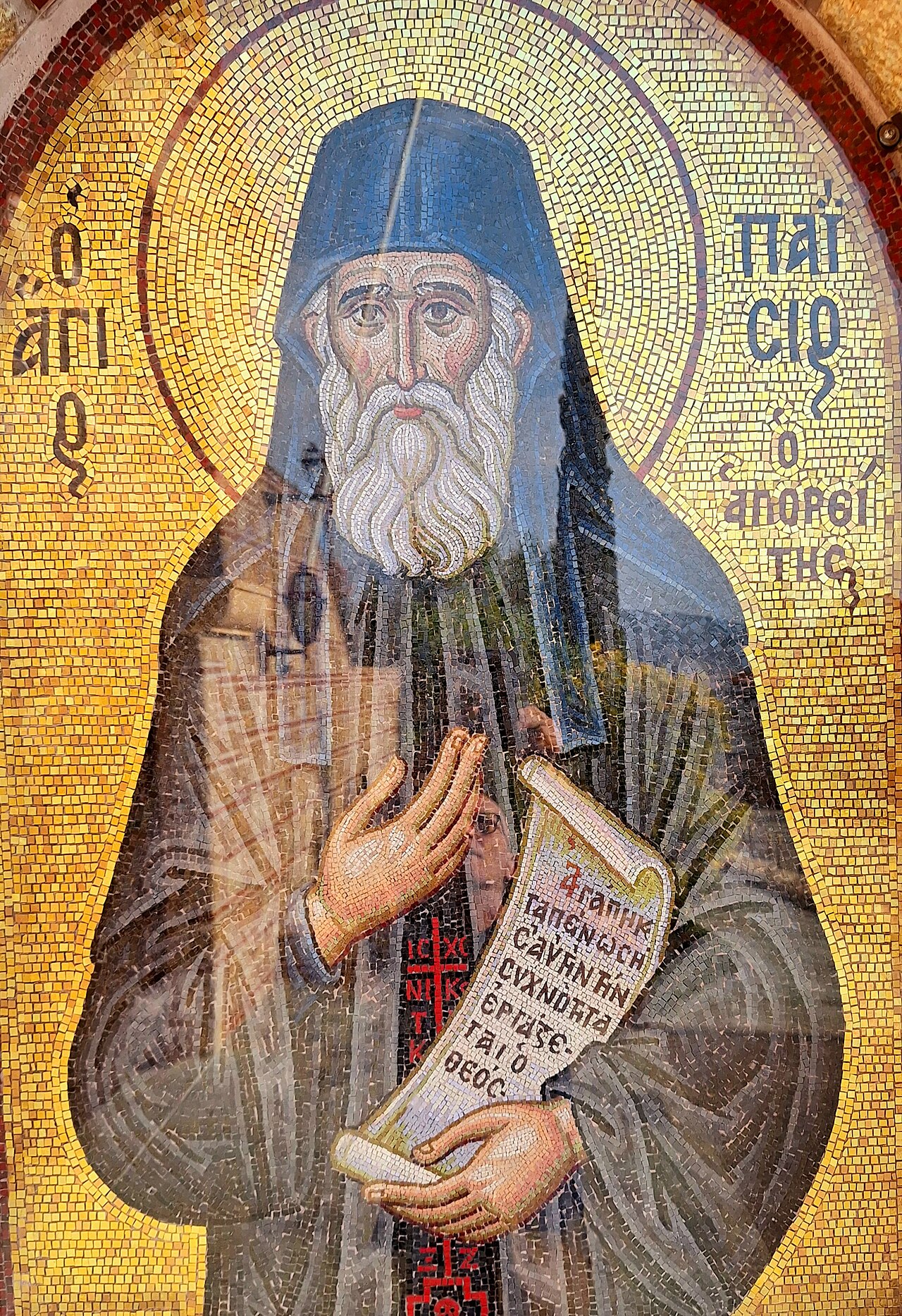
Every person has the right to speak and register his mind; no one should refrain from speaking out of fear in order to flatter a superior or because he wants to be on good terms with the archbishop or the abbot.
— St. Paisios the Athonite, Spiritual Counsels, Vol. 1: With Pain and Love for Contemporary Man, pp. 365-366
In the discussion of truth the dignity of persons is not to be considered.
— St. John Chrysostom, Homily 1 on Galatians
Whenever a hierarch deviates off the track of Orthodoxy and shamelessly, publicly preaches something not in agreement with the Orthodox faith, the populace not only must protest against the deviation.
— Metropolitan Augoustinos Kantiotes, Christians of the Last Times, p. 79
“Let us look after our own souls” is the “violin” of bad spiritual fathers, who have castrated the pious Greek people…
— Metropolitan Augoustinos Kantiotes, Christians of the Last Times, p. 79
Metropolitan Anastassy (Gribanovsky), First Hierarch of the Russian Orthodox Church Outside of Russia from 1936 to 1964, gave this command in 1906:
If you see falsehood and hypocrisy, unmask them before all, even if they are clothed in purple and fine linen.
— Metropolitan Anastassy, Speech at the nomination of the Bishop of Serpukhov (1906), quoted in Professor I.M. Andreyev, Is the Grace of God Present in the Soviet Church?, p. 38
“Purple and fine linen” is the vesture of bishops and patriarchs. Metropolitan Anastassy, who would later lead ROCOR through the darkest years of Soviet persecution, commanded: unmask falsehood even there. No rank grants immunity from exposure.
Private correction assumes ignorance. Patriarch Kirill knows what he said.
This book does not allege secret crimes or rely on disputed secondhand sources. Every central claim is documented from Patriarch Kirill’s own official publications on his own servers. He wrote these words. He published them. He enforced them: priests were defrocked for refusing to read his war prayers, and a hieromonk who condemned the invasion was sentenced to three years in prison by the state. Private correction makes sense when there is something the person does not know and might receive. There is nothing to inform him of. The question is not whether he knows what he taught. The question is whether the faithful do.
Episcopal correction has already been attempted. Metropolitan Onuphry of Kyiv condemned the invasion from day one as “fratricidal war with no justification before God.” Metropolitan Eugene of Estonia, a hierarch of Moscow’s own Patriarchate, publicly contradicted Kirill’s teaching on sin remission for soldiers. The Ukrainian Orthodox Church voted in council to cease his commemoration. These are bishops exercising formal correction in canonical assemblies. The correction has been given, at the highest available level, with no effect.
When episcopal correction has been given and refused, the only remaining recourse is to inform the faithful directly. This book exists because the faithful deserve to know why.
Original Greek: “᾿Εὰν δὲ ἁμαρτήσῃ εἰς σὲ ὁ ἀδελφός σου, ὕπαγε καὶ ἔλεγξον αὐτὸν μεταξὺ σοῦ καὶ αὐτοῦ μόνου· ἐάν σου ἀκούσῃ, ἐκέρδησας τὸν ἀδελφόν σου· ἐὰν δὲ μὴ ἀκούσῃ, παράλαβε μετὰ σοῦ ἔτι ἕνα ἢ δύο, ἵνα ἐπὶ στόματος δύο μαρτύρων ἢ τριῶν σταθῇ πᾶν ῥῆμα.” ↩
Original Greek: “τοὺς ἁμαρτάνοντας ἐνώπιον πάντων ἔλεγχε, ἵνα καὶ οἱ λοιποὶ φόβον ἔχωσι.” ↩
Original Greek: “ἀντεχόμενον τοῦ κατὰ τὴν διδαχὴν πιστοῦ λόγου, ἵνα δυνατὸς ᾖ καὶ παρακαλεῖν ἐν τῇ διδασκαλίᾳ τῇ ὑγιαινούσῃ καὶ τοὺς ἀντιλέγοντας ἐλέγχειν. Εἰσὶ γὰρ πολλοὶ καὶ ἀνυπότακτοι, ματαιολόγοι καὶ φρεναπάται, μάλιστα οἱ ἐκ περιτομῆς, οὓς δεῖ ἐπιστομίζειν, οἵτινες ὅλους οἴκους ἀνατρέπουσι διδάσκοντες ἃ μὴ δεῖ αἰσχροῦ κέρδους χάριν. εἶπέ τις ἐξ αὐτῶν ἴδιος αὐτῶν προφήτης· Κρῆτες ἀεὶ ψεῦσται, κακὰ θηρία, γαστέρες ἀργαί. ἡ μαρτυρία αὕτη ἐστὶν ἀληθής. δι᾽ ἣν αἰτίαν ἔλεγχε αὐτοὺς ἀποτόμως, ἵνα ὑγιαίνωσιν ἐν τῇ πίστει,” ↩
Original Greek: “῞Οτε δὲ ἦλθε Πέτρος εἰς ᾿Αντιόχειαν, κατὰ πρόσωπον αὐτῷ ἀντέστην, ὅτι κατεγνωσμένος ἦν. … ἀλλ᾽ ὅτε εἶδον ὅτι οὐκ ὀρθοποδοῦσι πρὸς τὴν ἀλήθειαν τοῦ εὐαγγελίου, εἶπον τῷ Πέτρῳ ἔμπροσθεν πάντων· εἰ σὺ ᾿Ιουδαῖος ὑπάρχων ἐθνικῶς ζῇς καὶ οὐκ ἰουδαϊκῶς, τί τὰ ἔθνη ἀναγκάζεις ἰουδαΐζειν;” ↩
Hieromonk Tichon, “St. Tichon’s Relics,” Grad Kitezh (Donskoy Monastery, Moscow), Paschal issue, 1992. ↩