
Praying with Monophysites
Patriarch Kirill met with Catholicos Karekin II, head of the Armenian Apostolic Church, a non-Chalcedonian body outside communion with the Orthodox Church after rejecting the Fourth Ecumenical Council. What occurred at that meeting violates canons the Church Fathers considered the strictest.
Can an Orthodox patriarch engage liturgically with those whose communion was severed by an Ecumenical Council?
Some will object that these meetings are mere diplomacy, that no theological compromise occurred. The evidence will show otherwise.
Before examining what occurred, the Orthodox teaching of those condemned by Ecumenical Councils, and those who pray with them, must be established.
A. What the Saints and Canons Teach
Our Apostolic Canons are unambiguous:
Let a bishop, presbyter, or deacon who has only prayed with heretics, be excommunicated: but if he has permitted them to perform any clerical office, let him be deposed.
— Apostolic Canons, Canon 45, in Nicene and Post-Nicene Fathers, Series II, Vol. XIV (online at New Advent). https://www.newadvent.org/fathers/3820.htm[1]
If any clergyman or layman shall enter into a synagogue of Jews or heretics to pray, let the former be deposed and let the latter be excommunicated.
— Apostolic Canons, Canon 64, in Nicene and Post-Nicene Fathers, Series II, Vol. XIV (online at New Advent). https://www.newadvent.org/fathers/3820.htm[2]
If any one shall pray, even in a private house, with an excommunicated person, let him also be excommunicated.
If any clergyman shall join in prayer with a deposed clergyman, as if he were a clergyman, let him also be deposed.
— Apostolic Canons, Canons 10–11, in Nicene and Post-Nicene Fathers, Series II, Vol. XIV (online at New Advent). https://www.newadvent.org/fathers/3820.htm
The Synod of Laodicea confirms:
No one shall join in prayers with heretics or schismatics.
— Synod of Laodicea, Canon 33, in Nicene and Post-Nicene Fathers, Series II, Vol. XIV (online at New Advent). https://www.newadvent.org/fathers/3806.htm[3]
Monophysitism is the belief that Christ has only one nature after the Incarnation, usually with His humanity absorbed into His divinity, whereas the Orthodox Church teaches that Christ is one person in two complete and distinct natures, divine and human, united without confusion, change, division, or separation.
Monophysitism was condemned by the Fourth Ecumenical Council at Chalcedon (451).[4] The Council adopted the Tome of Pope St. Leo the Great as the standard of Orthodoxy. St. Leo condemned both errors equally:
It is just as impious to say that the only-begotten Son of God is from two natures before the incarnation as it is unlawful to assert that after the Word became flesh there is one nature in him.
— Pope St. Leo the Great, Letter 28 (The Tome to Flavian), Section VI, in The Acts of the Council of Chalcedon, trans. Richard Price and Michael Gaddis, vol. 2, p. 23.
St. John of Damascus, writing three centuries after Chalcedon, addressed the Egyptian Monophysites. Despite acknowledging they were “Orthodox in all else,” he identified them as separated from the Orthodox Church over Chalcedon and described their teaching as destroying the mystery of the Incarnation:
The Egyptians, who are also called Schematics and Monophysites, separated from the orthodox Church on the pretext of that document [approved] at Chalcedon [and known as] the Tome… in every other way they are Orthodox… Both of these last denied the mystery of salvation… Although they hold individual substances, they destroy the mystery of the Incarnation.
— St. John of Damascus, On Heresies, Heresy 83. https://catholiclibrary.org/library/view?docId=Synchronized-EN/Damascus.FountKnowledge2.en.html[5]
St. Maximus the Confessor refuted the “Miaphysite” claim that two natures can unite into one composite nature without being destroyed:
If a composite nature is formed from different natures, it cannot be consubstantial with either of the natures from which it is composed… If, therefore, Christ is of one composite nature, He is consubstantial neither with the Father nor with His Mother, but is alien to both.
— St. Maximus the Confessor, Epistle 12 (To John the Cubicularius), PG 91:481-484
St. Symeon of Thessalonica, writing in the fifteenth century, confirmed that those who confuse the two natures of Christ commit no minor error:
It is not a small perversion of faith, therefore, into which they fall who teach a single nature and a single will, as some people senselessly think. Rather, it is the consummate perversion of faith and the fullness of all profanity. For according to them the Word was not actually incarnate, but appeared as an apparition… and thus He was not born of the Virgin, was not baptized, did not live among men, did not suffer for our sake, and was not risen. Therefore neither was our salvation accomplished. Vain, then, are the Gospels, and vain is the whole message that is preached about salvation.
— St. Symeon of Thessalonica, Against All Heresies, Ch. 15: “Against Eutyches and the Akephaloi”, pp. 58-59
“The consummate perversion of faith and the fullness of all profanity.” Not a minor disagreement. Not a semantic misunderstanding. The fullness of all profanity.
The “Miaphysite” Distinction
Some may claim that the Armenian and Coptic churches are “Miaphysite” rather than “Monophysite,” suggesting the distinction is merely semantic and that the Church Fathers at Chalcedon misunderstood them. The traditional Orthodox position recognizes no such distinction:[6]
From the traditional perspective of the Orthodox Church, you are monophysite. This is how the Orthodox Church has always viewed the Coptic Church. In other words, to us your “miaphysitism” is essentially “monophysitism.”
— Orthodox Christian Information Center, “Ecumenism Awareness: Monophysites (Non-Chalcedonians).” http://orthodoxinfo.com/ecumenism/ea_mono.aspx
The non-Chalcedonian churches have not accepted the Fourth through Seventh Ecumenical Councils, nor have they renounced Dioscoros, Severos, and Eutyches, whom the Church has anathematized.[7]
Some believe that our deified fathers and saints misunderstood the Monophysite position, and this is a great error. Our fathers perfectly understood their position, and condemned it anyway.
St. Paisios of Mount Athos addressed those who claim the Monophysites were merely misunderstood. He considered proposals to erase from liturgical books the statements identifying Dioscorus and Severus as heretics to be “a blasphemy against the Holy Fathers”:
They do not say that the Monophysites did not understand the Holy Fathers: they say that the Holy Fathers did not understand them. In other words, they talk as if they are right, and the Fathers misunderstood them.
So many divinely enlightened Holy Fathers who were there at the time did not understand them, took them the wrong way, and now we come along after so many centuries to correct the Holy Fathers? And they do not take the miracle of Saint Euphemia into account? Did she misunderstand the heretics’ tome too?
— St. Paisios of Mount Athos, Saint Paisios of Mount Athos by Hieromonk Isaac, pp. 659-660[8]
The relabeling itself is the sleight of hand. Call them “Miaphysite” instead of “Monophysite,” claim Chalcedon was a “misunderstanding,” and suddenly an Ecumenical Council’s condemnation becomes negotiable. St. Paisios saw through this: the Fathers understood perfectly, and dismissing their judgment is blasphemy against the Holy Fathers. Every modern dialogue built on this relabeling that our Fathers misunderstood, commits this same blasphemy.
A clear modern application of these canons comes from ROCOR’s First Hierarch, Metropolitan Philaret. In 1970, he rebuked the allowance of a Coptic (Monophysite) liturgy at Holy Trinity Monastery (Jordanville), ordered the church to be ritually cleansed according to the Great Book of Needs, and cited Apostolic Canon 45 to forbid any joint prayer with heretics, noting that even mere presence at heretical services requires repentance.[9]
Consecrate the lower church with holy water and read an appropriate prayer suitable for reading in a church defiled by the presence of heretics (The Book of Prayer, Chapter 40 or 41).
— Metropolitan Philaret (ROCOR), Official Memorandum to Archbishop Averky, Nov 14/27, 1970. Published in Vertograd-Inform (English ed. No. 4, Feb 1999, pp. 11–15). http://vertograd-eng.blogspot.com/1998_12_01_archive.html
Metropolitan Philaret also recounted witness from St. John Maximovitch:
Two days ago, His Eminence John [St. John of Shanghai and San Francisco] was the subject of a conversation I had with a person His Eminence had known as far back as Yugoslavia. When the war struck in the Forties, followed by post-war chaos, this man had to travel the world extensively to survive. When he met His Eminence again several years later, he proceeded to tell him about his vicissitudes. One of the things he said was: “For three years, I had to live in a place without an Orthodox temple, so I went to the Copts.” “What? You went to a Coptic church?” asked His Eminence John. Intimidated (so he says) by the strict tone of His Eminence’s voice, the man replied: “Yes, I did, but I never attended any of their liturgies.” “Did you attend their all-night services?” “Yes, I did, Your Eminence.” “Have you repented this?” “No, I haven’t, but the thing is I never prayed during their all-night services; I only attended them.” “Here’s what you must do: next time you go to confession, make sure you repent of having attended a heretical service,” concluded His Eminence John.
— Metropolitan Philaret (ROCOR), private letter to Archbishop Averky, Nov 14/27, 1970. Published in Vertograd-Inform (English ed. No. 4, Feb 1999, pp. 11–15). http://vertograd-eng.blogspot.com/1998_12_01_archive.html
Merely attending a heretical gathering or service is forbidden.
In the same letter, Metropolitan Philaret noted that seminary students who merely bowed during the Coptic elevation had committed “a form of complicity in… the prayers of heretics.” When Archbishop Averky attempted to justify the incident by arguing that “no one observes the canons anymore,” Metropolitan Philaret’s response was devastating:
I don’t know if this regrettable fact may be used as a defensive argument. Wouldn’t it sound very much like that story about a thief charged with thievery… who tells the court in justification of his crime that all his neighbors also steal?
— Metropolitan Philaret (ROCOR), private letter to Archbishop Averky, Nov 14/27, 1970. Published in Vertograd-Inform (English ed. No. 4, Feb 1999, pp. 11–15). http://vertograd-eng.blogspot.com/1998_12_01_archive.html
Metropolitan Philaret also addressed the theological nature of Monophysite services:
Given this state of things, is not a Coptic or Monophysite liturgy but a piece of non-representational nonsense without any real substance or meaning? Indeed, the subject-matter of the mystery of the Eucharist are the Divine Flesh and Blood of Christ - the Flesh that suffered for us, and the Blood that was shed for us. Yet the Flesh and the Blood are appurtenances of the human nature of our Savior: God can neither suffer nor die. If the Monophysites completely deny the human nature of our Savior, what meaning can their liturgy possibly have? Verily their Eucharist is of the kind that our Holy Fathers bluntly referred to as demons’ food. Think what you may, Your Eminence, but I would never allow this blasphemous nonsense in the church or on any other premises.
— Metropolitan Philaret (ROCOR), Official Memorandum to Archbishop Averky, Nov 14/27, 1970. http://vertograd-eng.blogspot.com/1998_12_01_archive.html
“Demons’ food.” This is how a ROCOR First Hierarch whose incorrupt relics testify to his holiness described Monophysite liturgies. Not “valid but illicit.” Not “efficacious but irregular.” Demons’ food.
Metropolitan Philaret then addressed the strictness of the canons:
You know how merciless the holy canons are when it comes to participating in heretical services. The canons that deal with this are the strictest. Thus the Church resolutely safeguards itself against any form of communion with those outside its domain.
— Metropolitan Philaret (ROCOR), Official Memorandum to Archbishop Averky, Nov 14/27, 1970. http://vertograd-eng.blogspot.com/1998_12_01_archive.html
“The strictest.” Not optional guidelines. Not matters of preference. The canons forbidding prayer with heretics are the strictest the Church possesses.
Patriarch Diodoros of Jerusalem stated publicly in 1992 that Jerusalem had broken off dialogue with Anti-Chalcedonians (Monophysites, Miaphysites):
Our most Holy Church of Jerusalem abides steadfastly by the decisions of both the Holy Ecumenical Synod of Chalcedon and the subsequent Holy Ecumenical Synods, and neither setting aside any of the definitions nor subjugating them to fresh inquiry, she has broken off the theological dialogue with them.
The partial acceptance of the teaching of the Orthodox Church, that is, the exception of certain definitions of the Ecumenical Synods, as is being done by the heterodox according to what pleases them and serves their interest, as in this case by the Ante-Chalcedonians, cannot constitute a sign of their contact with our Most Holy Orthodox Church. On the contrary, it will entangle her in vicissitudes and divisions, which will weaken her healthy body.
— Patriarch Diodoros of Jerusalem, Statement at the Patriarchal Council in Constantinople, March 1992. English translation by Patrick Barker, “Let Not Your Heart Be Troubled,” Orthodox Life, Vol. 42, No. 4 (July-August 1992), pp. 8-9. Holy Trinity Monastery, Jordanville.
Jerusalem broke off dialogue with those condemned by Chalcedon. Patriarch Kirill, on the other hand, regularly engages with them.
St. Symeon of Thessalonica reached the only conclusion the patristic evidence permits:
Those, then, who teach that there is a single nature and operation, and a single will in Christ are perverted in their faith and annul the Incarnation of God the Word.
— St. Symeon of Thessalonica, Against All Heresies, Ch. 15: “Against Eutyches and the Akephaloi”, p. 62
Therefore, we must flee from those who hold these doctrines, since they are castaways from God.
— St. Symeon of Thessalonica, Against All Heresies, Ch. 15: “Against Eutyches and the Akephaloi”, p. 60
The saints refused to negotiate with those who denied the faith. They refused to treat heretics as partners or blur the boundaries of the Church.
Further, they called the children of the Church to flee from the Monophysites (Miaphysites). Notice the careful choice of words our saints use. They did not use the word depart as one calmly departs from one place to another. This would already be a harsh correction to those who fraternize with Monophysites. No… they commanded the Orthodox Christians to flee, as one runs and sprints away from danger.
In light of this, what has Patriarch Kirill done?
B. The Evidence
On March 16, 2010, Patriarch Kirill traveled to Echmiadzin, Armenia, to meet with Catholicos Karekin II, head of the Armenian Apostolic Church.[10]
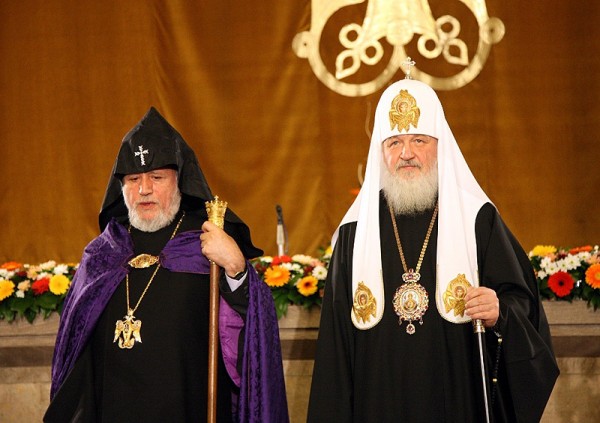
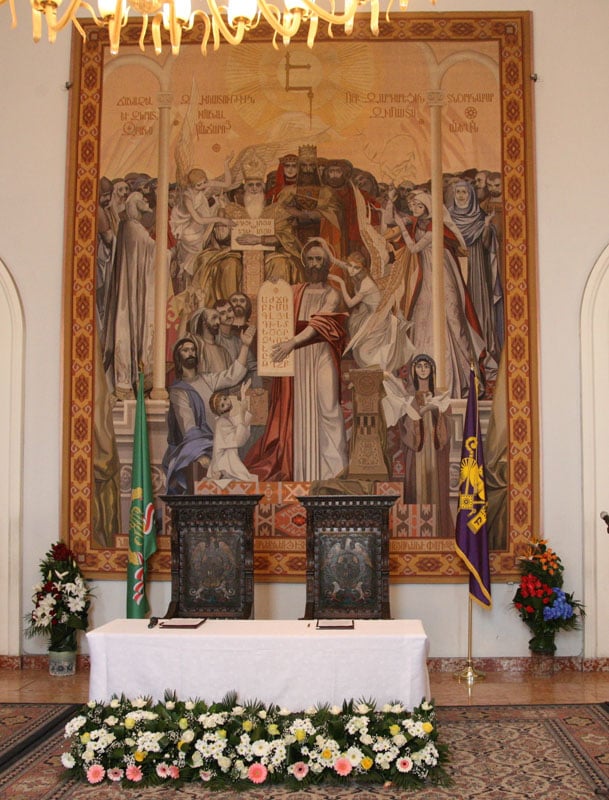
He presided at a joint prayer service with heretics condemned by an Ecumenical Council.
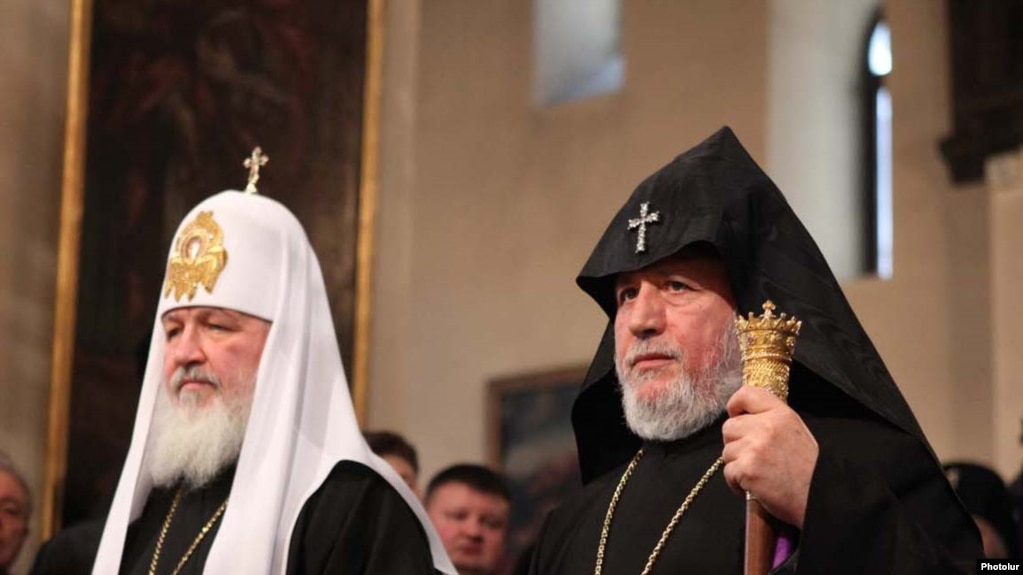
The Monophysites themselves confirmed that this was joint prayer.
Garegin, for his part, spoke of the Armenian people’s “utter love of and warm feelings of gratitude towards the Russian Church, the great Russian people and the Russian state.” “Our joint prayer here is testimony to the righteous unity of the Holy Church of Christ,” he said.
— Azatutyun (RFE/RL Armenian Service), “Russian Church Head Starts First Visit To Armenia,” March 17, 2010. https://www.azatutyun.am/a/1985537.html
Kirill is scheduled to meet President Serzh Sarkisian, inaugurate the start of construction of a new Russian church in Yerevan and preside over a Russian-Armenian ecumenical liturgy together with Garegin on Wednesday and Thursday.
— Azatutyun (RFE/RL Armenian Service), “Russian Church Head Starts First Visit To Armenia,” March 17, 2010. https://www.azatutyun.am/a/1985537.html
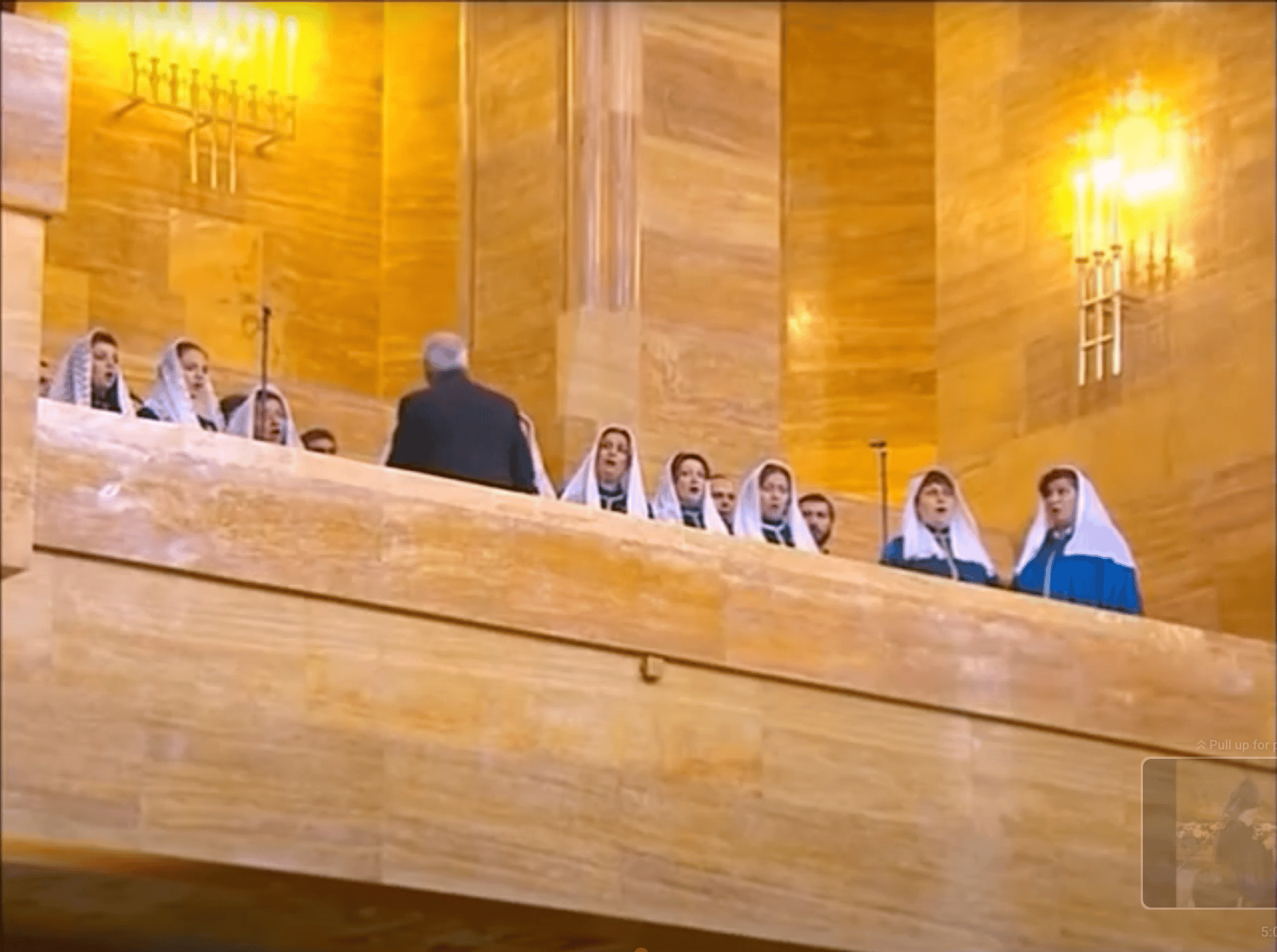
The following frames come from video of the service published by Gregory Decapolite.[11]
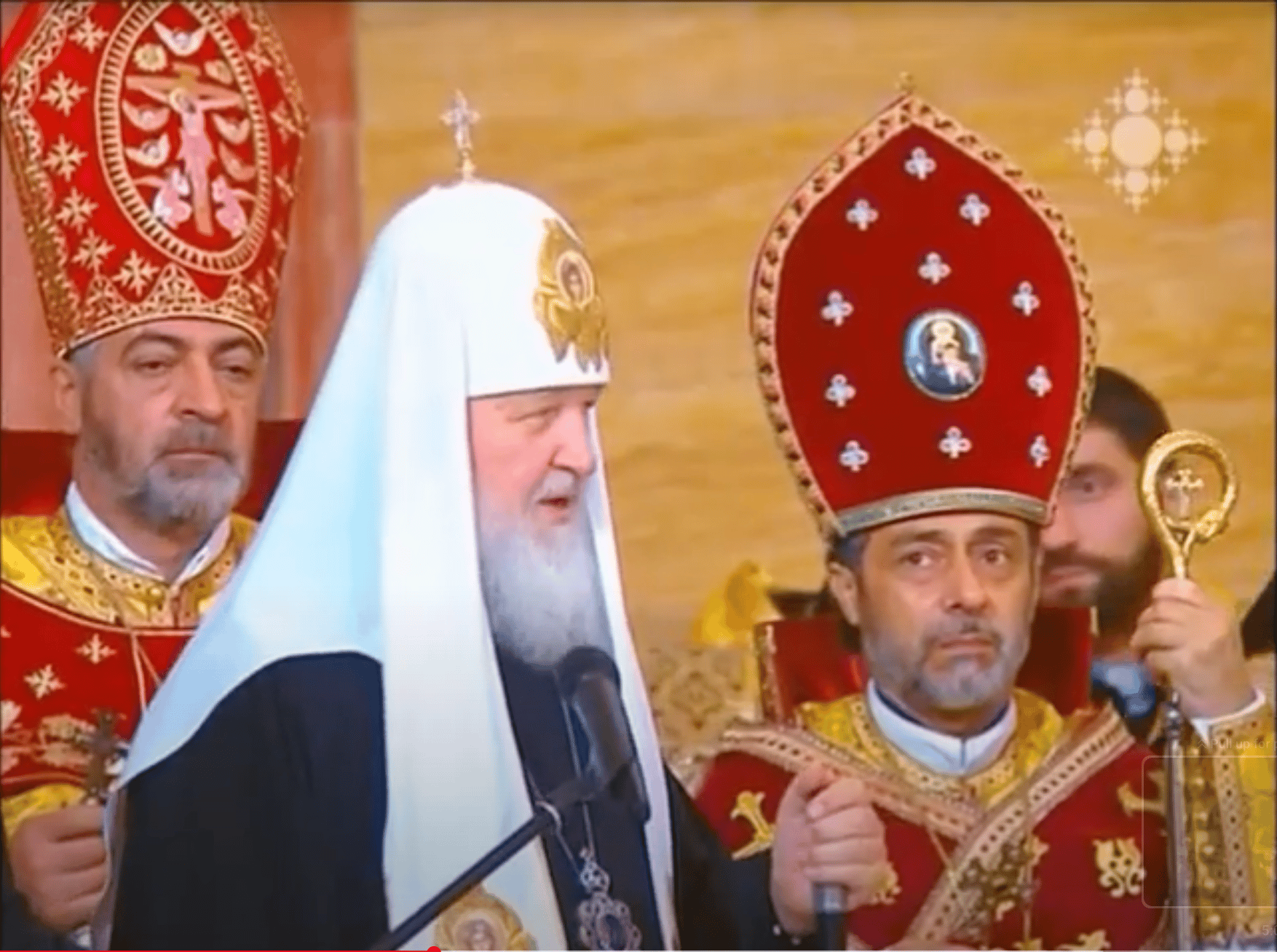
Patriarch Kirill also exchanged the Kiss of Peace with Monophysite heretics. As established in Chapter 1, the Kiss of Peace is forbidden to share with even a catechumen of the Church, much less a heretic.
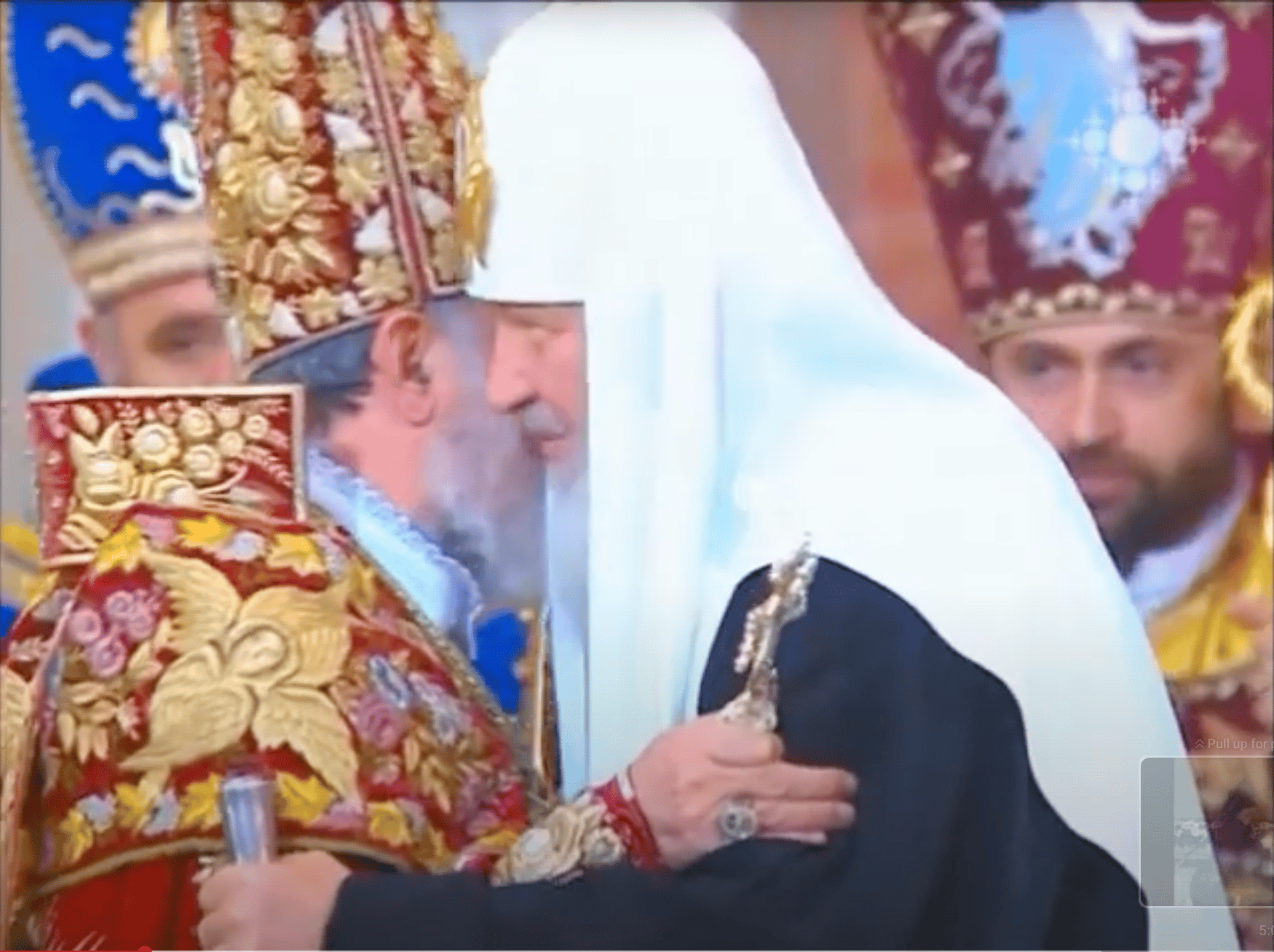
During the joint prayer, Patriarch Kirill held the cross among Monophysite clergy while they prayed:
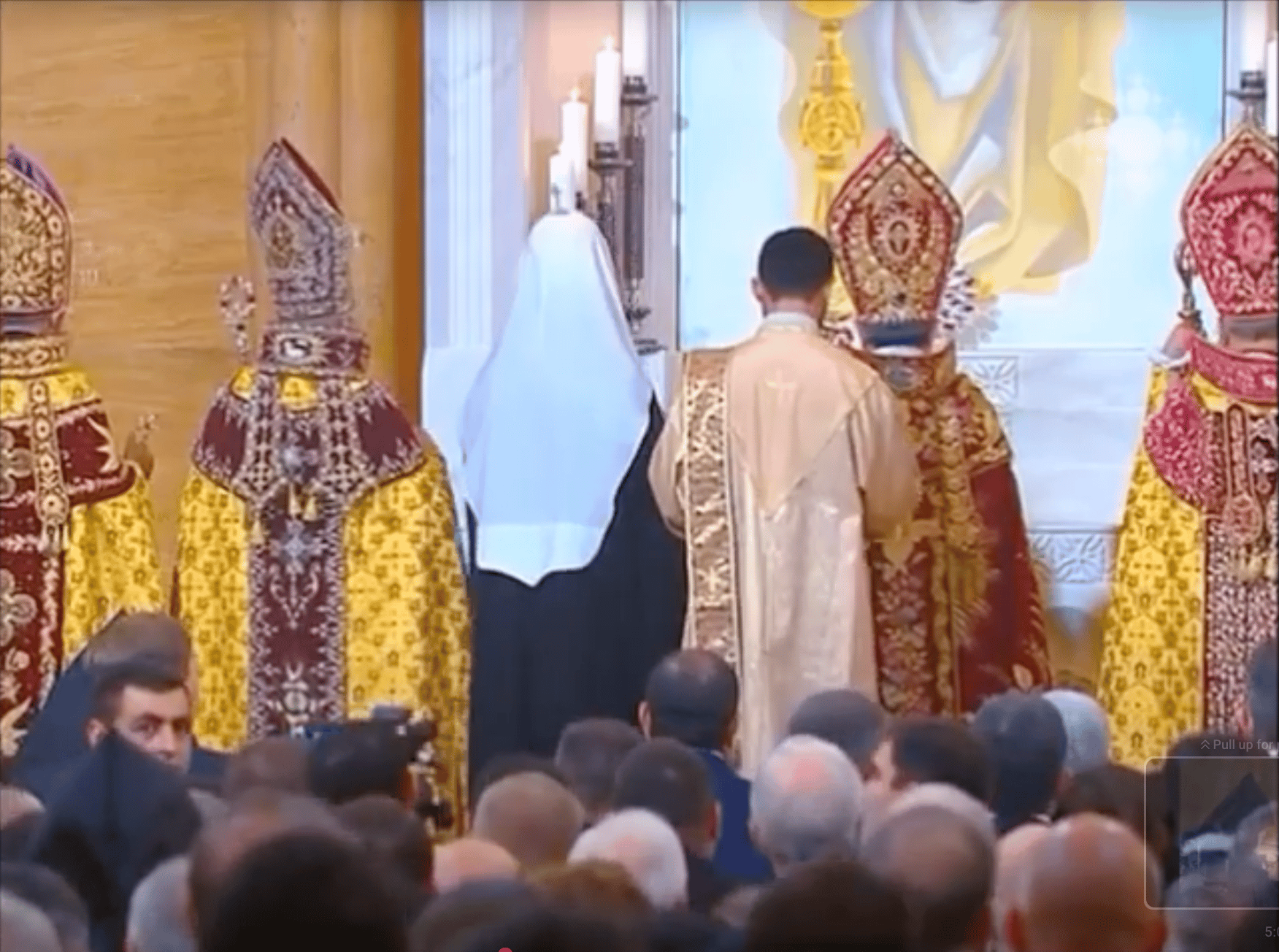
An Armenian Monophysite cleric venerated the cross presented by Patriarch Kirill, an act constituting shared worship:
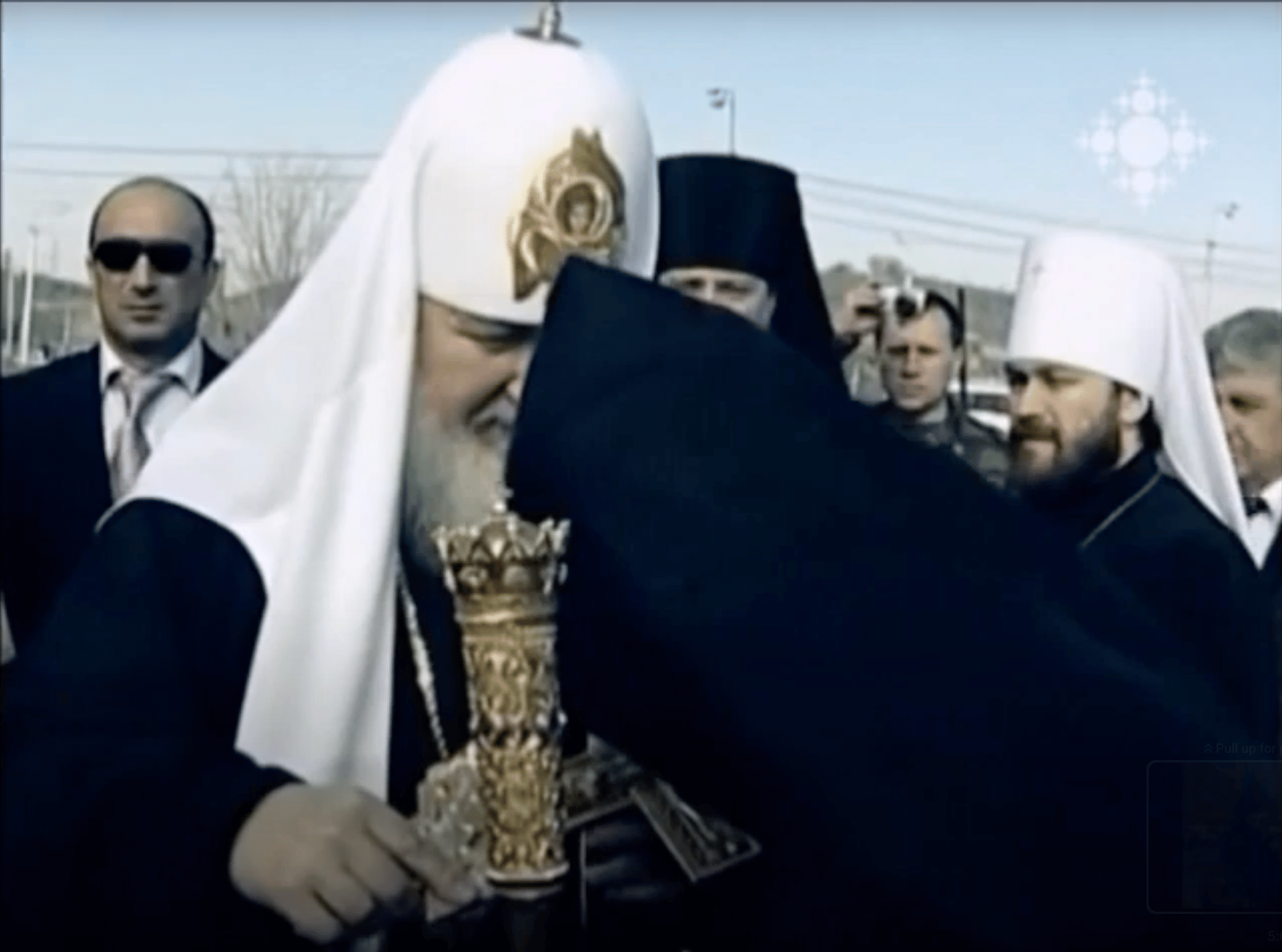
Patriarch Kirill was also present for the chanting.
The joint declarations between Patriarch Kirill and the Monophysites also document joint veneration of relics.[12] This joint veneration also constitutes prayer.
Patriarch Kirill also committed to ongoing theological dialogue:
Наши Церкви продолжат двусторонний диалог по пастырским и богословским вопросам, будут сотрудничать в сфере образования и воспитания молодежи, а также христианского просвещения.
Our two Churches will continue bilateral dialogue on pastoral and theological issues and will cooperate in the sphere of youth education and formation, as well as Christian enlightenment.
— Patriarch Kirill and Catholicos Karekin II, Joint Declaration, March 18, 2010, https://mospat.ru/ru/news/57577/
Theological dialogue with Monophysites, when framed as bilateral church partnership without repentance and reception of Chalcedon, contradicts Orthodox ecclesiology. The Church may call heretics back to the truth; it may not treat the truth resolved at Chalcedon as a negotiable midpoint.
Patriarch Kirill has engaged in similar acts of ecclesial rapprochement with Coptic, Armenian, Ethiopian, Syriac, and Syrian Monophysites, systematically blurring the boundaries of the Church.
A Systematic Pattern
The Echmiadzin joint prayer service was not an isolated incident. Patriarch Kirill has met with the heads of every major Monophysite body: Coptic Patriarch Tawadros II (October 2014),[13] Syriac Orthodox Patriarch Ignatius Aphrem II (November 2015),[14] Ethiopian Patriarch Matthias (May 2018),[15] Armenian Catholicos Karekin II repeatedly, including to discuss the ecclesiastical situation in Ukraine (April 2019),[16] and Catholicos Baselios Marthoma Mathews III of the Malankara Syrian Church of India (September 2023).[17]
When the Malankara primate visited Russia, Kirill greeted him after the Divine Liturgy in the Dormition Cathedral of the Kremlin. His words are revealing:
You represent the ancient Malankara church of India, which was founded in the 1st century by the Apostle Thomas. For thousands of years, the Malankara Church has been serving on Indian soil and has managed to preserve its authenticity, identity, and fidelity to the Apostolic Tradition. You have been and are surrounded by a non-Christian majority, and therefore a special wisdom and at the same time a special piety is required, which would imbue your non-Christian fellow citizens with respect for you, Your Beatitude, and the episcopate and the entire Malankara church. In this sense, you bear a very important testimony to Orthodoxy in one of the most populous countries in the world, where Christianity is not the religion of the majority.
— Patriarch Kirill, greeting Catholicos Baselios Marthoma Mathews III after the Divine Liturgy, September 6, 2023. https://patriarchia.ru/article/82861[18]
Notice how Kirill acknowledges them. He says the Malankara church has preserved “fidelity to the Apostolic Tradition.” He contrasts them with the “non-Christian majority,” thereby identifying them as Christian. He then says they bear “testimony to Orthodoxy.” In other words, Kirill publicly recognizes an anathematized Non-Chalcedonian communion as Christian and Orthodox. He does not speak to the Malankara primate as one outside Chalcedon who must return to the Orthodox confession. He treats a communion condemned by an Ecumenical Council as a bearer of Orthodox witness.
The Malankara Catholicos confirmed the trajectory in his response:
The goal of all our efforts, which we are carrying out today to develop bilateral dialogue, is the hope that someday the day will come when we can pray and receive communion together.
— Catholicos Baselios Marthoma Mathews III, response to Patriarch Kirill, Dormition Cathedral, Moscow, September 6, 2023. https://patriarchia.ru/article/82861
“Pray and receive communion together.” The Monophysite primate stated openly, in the Kremlin’s own cathedral, that the purpose of this dialogue is eucharistic union. Not a return to Chalcedon. Not a renunciation of Dioscoros and Severos. Union before repentance.
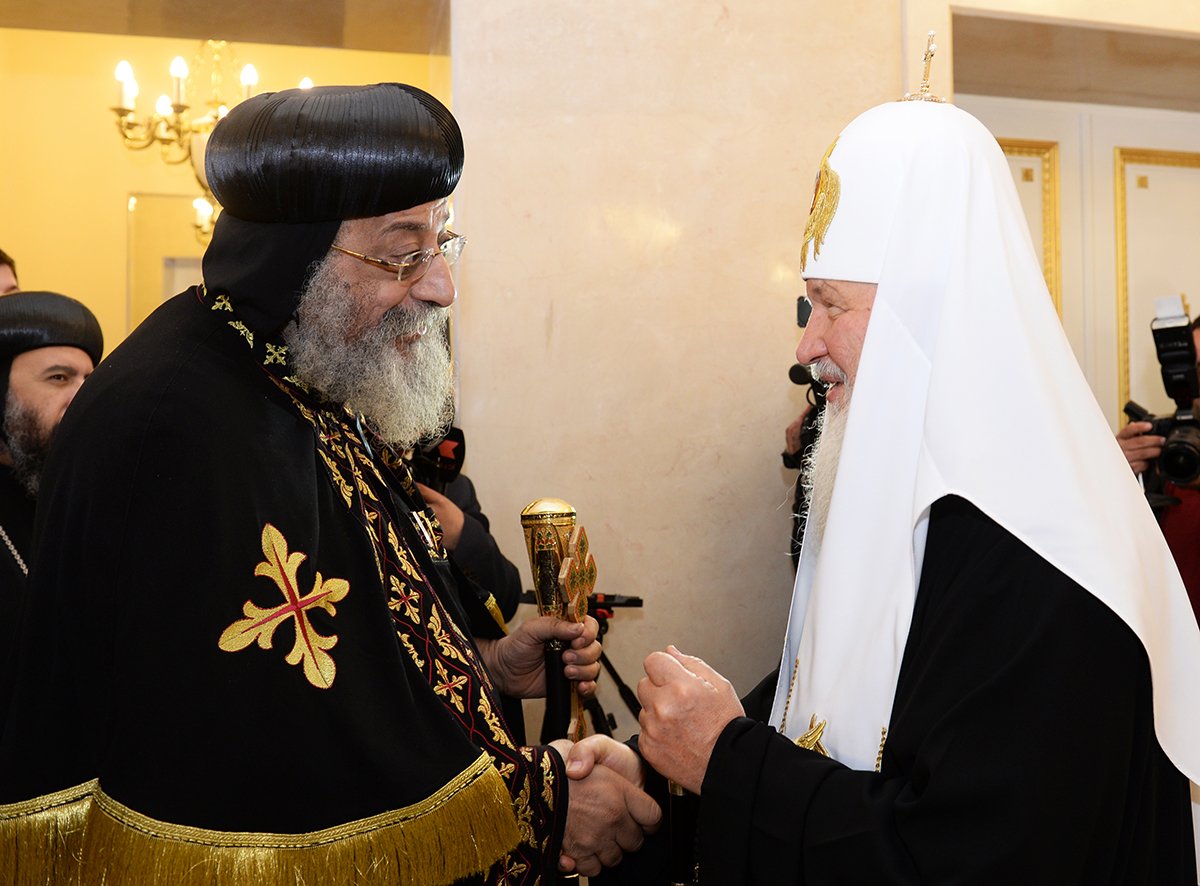
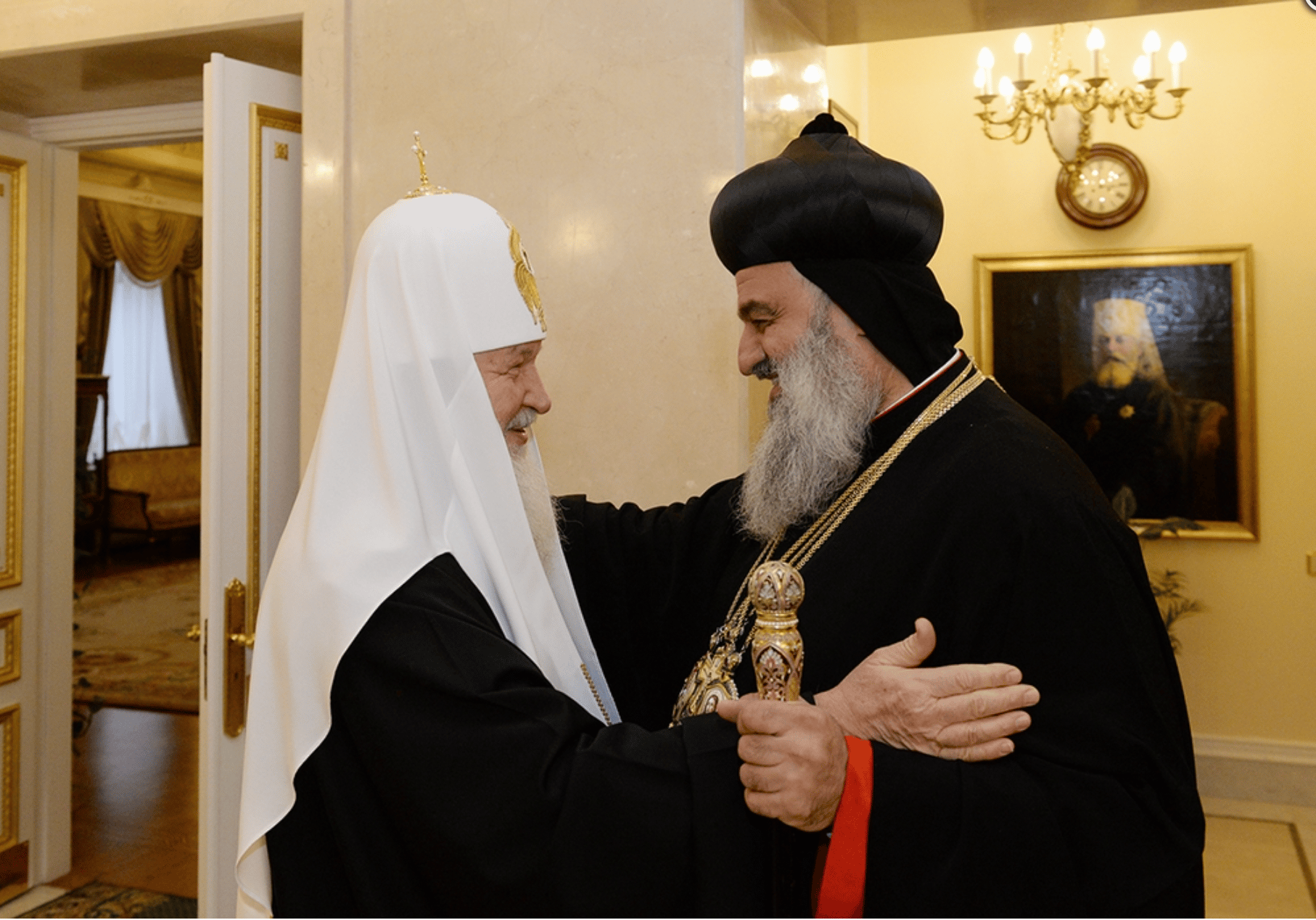
The pattern is institutionalized engagement, well beyond diplomacy. Following the Syriac meeting, a formal Dialogue Committee was established between Moscow and the Syriac Orthodox Church, holding its second session in Lebanon in February 2019 and producing a signed joint memorandum. Kirill described the broader infrastructure to the Ethiopian Patriarch:
В последние годы была попытка провести несколько совещаний, чтобы оживить этот диалог. У нас существует некий порядок проведения заседаний общеправославно-дохалкидонского диалога, в частности, заседания инициируются со стороны православных нашей традиции Константинопольским Патриархатом, а со стороны вашей традиции — Коптским Патриархатом.
In recent years, there has been an attempt to hold several meetings to revive this dialogue. We have a certain procedure for holding sessions of the pan-Orthodox-pre-Chalcedonian dialogue; specifically, sessions are initiated on the part of the Orthodox of our tradition by the Constantinople Patriarchate, and on the part of your tradition by the Coptic Patriarchate.
— Patriarch Kirill, Meeting with Ethiopian Patriarch Matthias, May 17, 2018. http://www.patriarchia.ru/article/59140
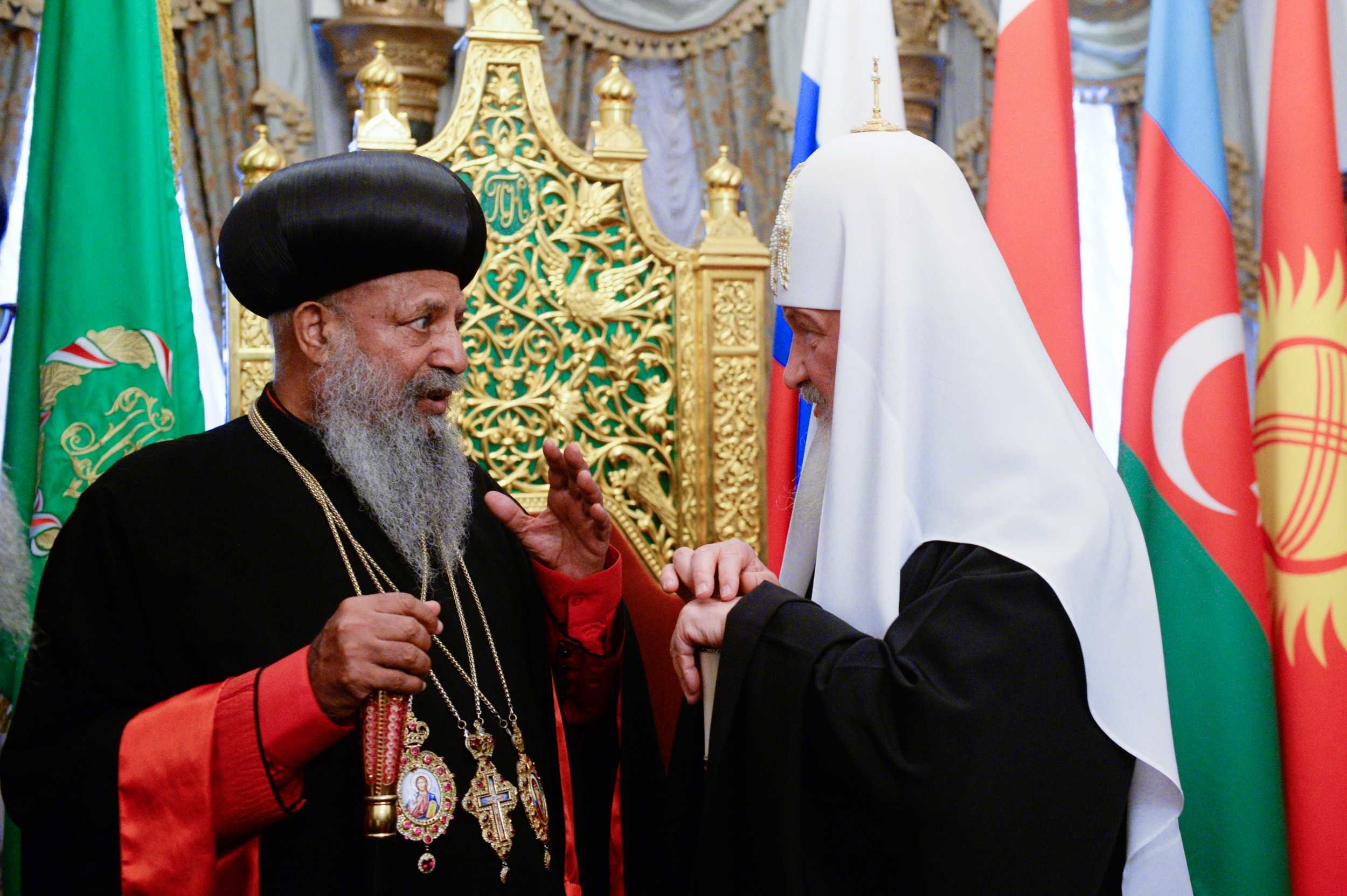
Notice that Patriarch Kirill does not publicly approach Monophysite heretics in these sources by calling them to repentance or defending Chalcedonian Christology. He approaches them as partners, establishes dialogue committees, signs joint memoranda, and consults with them on Orthodox ecclesiastical matters. This systematic engagement treats the Fourth Ecumenical Council’s condemnation of Monophysitism as negotiable.
Metropolitan Augoustinos Kantiotes of Florina, one of the most outspoken opponents of ecumenism in the twentieth century, took the opposite stance. He “reacted strongly to efforts of unification with the Monophysites without their first having denounced their heretical teachings,” and demanded a suspension of all dialogues with non-Orthodox, characterizing them as “fruitless and unprofitable.”[19]
Metropolitan Augoustinos Kantiotes, rightly venerated as a great elder and saint by many, required repentance from the Monophysites before dialogue; Kirill offers partnership and dialogue without it.
Kirill’s engagement with Monophysites is not improvised diplomacy. It is participation in an institutional dialogue process that has been pursuing union without repentance for decades. As Kirill told the Ethiopian Patriarch in 2018, “sessions are initiated on the part of the Orthodox of our tradition by the Constantinople Patriarchate, and on the part of your tradition by the Coptic Patriarchate.”
Patriarch Kirill knows what this dialogue is. He knows where it leads.
As early as 1995, Patriarch Bartholomew visited the Monophysite Patriarch of Ethiopia and called the Monophysites “brothers to brothers in Christ, members of the one, ancient and undivided Eastern Orthodox family,” while dismissing the Ecumenical Councils’ condemnations as “past mistakes.”[20] This is the same blasphemy St. Paisios the Athonite identified. Orthodox Life responded: “The reasons for their condemnation by the Fourth, Fifth, Sixth and Seventh Ecumenical Councils have never been annulled, nor have they repented. That trip’s aim was a traitorous and strong-armed unification.”
Metropolitan Philaret’s Second Sorrowful Epistle (1972) warned that this would happen:
Ecumenists of Orthodox background are willing to undermine even the authority of the Ecumenical Councils in order to achieve communion with heretics. This happened during the dialogue with the Monophysites.
— Metropolitan Philaret (Voznesensky), Second Sorrowful Epistle, Sunday of Orthodoxy, 1972. http://orthodoxinfo.com/ecumenism/sorrow2.aspx
Patriarch Kirill inherited this process, expanded it, and now presides over a Moscow Patriarchate that sends delegations to conferences reporting “no contradictions” between Monophysite practice and Orthodox theology.
”Restoring Full Communion”: The 2024-2025 Escalation
The engagement has since escalated toward an explicit goal: restoring full communion.
In September 2024, a Conference of Local Orthodox and “Ancient Oriental Churches” was held in the Nitrian Desert of Egypt, at Coptic Patriarch Tawadros II’s invitation. The Moscow Patriarchate sent an official delegation. The communiqué adopted at the conference stated that participants “recognized the successful steps of dialogue and simultaneously developed concrete measures necessary for restoring full communion.”[21]
Участники единогласно согласились с тем, что… двое сопредседателей Комиссии посетят Предстоятелей Православных Церквей и Древних Восточных Церквей, чтобы сообщить о положительных результатах диалога и получить их отзывы относительно подписанных Общих заявлений и Предложений.
The participants unanimously agreed that… the two co-chairs of the Commission will visit the Primates of the Orthodox Churches and the Ancient Oriental Churches to report on the positive results of the dialogue and receive their feedback regarding the signed Common Statements and Proposals.
— Joint Communiqué, Conference of Local Orthodox and Ancient Oriental Churches, Nitrian Desert, Egypt, September 16-17, 2024, https://mospat.ru/ru/news/92262/[22]
Two subcommissions on liturgical and pastoral questions reported their finding:
Они проанализировали корпус богослужебных текстов, в первую очередь Божественной литургии, и различные стороны пастырской практики Древних Восточных Церквей, придя к выводу об отсутствии в них противоречий с Православным богословием и традицией.
[The subcommissions] analyzed the corpus of liturgical texts, primarily of the Divine Liturgy, and various aspects of the pastoral practice of the Ancient Oriental Churches, arriving at the conclusion that there are no contradictions with Orthodox theology and tradition.
— Report on the Conference of Local Orthodox and Ancient Oriental Churches, Nitrian Desert, Egypt, September 16-17, 2024, https://mospat.ru/ru/news/92262/[23]
No contradictions with Orthodox theology.[24] The Fathers called Monophysitism “the consummate perversion of faith and the fullness of all profanity.” Metropolitan Philaret called their liturgies “demons’ food.” And subcommissions studying the matter now report they found “no contradictions.”
One year later, in September 2025, Patriarch Kirill met with the Commission for Dialogue between the Russian Orthodox Church and the Coptic Church, at the 10th anniversary of the commission’s founding. His words confirmed the trajectory:
Мы очень положительно относимся к результатам этого диалога, верим, что он может как способствовать во многом сближению наших Церквей в богословском плане, так и укрепить сотрудничество.
We view the results of this dialogue very positively and believe that it can both greatly contribute to bringing our Churches closer in a theological sense and strengthen cooperation.
— Patriarch Kirill, meeting with members of the ROC-Coptic Dialogue Commission, Danilov Monastery, Moscow, September 9, 2025, https://mospat.ru/ru/news/93535/
“Bringing our Churches closer in a theological sense.” What is there to bring closer theologically? Is this not a concession of compromise? There is nothing to “bring closer”, other than repentance and acceptance of Chalcedon, or continued heresy.
Kirill characterized relations with the Coptic Church as “very and very benevolent, fraternal and reliable” (очень и очень доброжелательные, братские и надёжные). He praised the annual monastic exchange visits between Russian and Coptic monasteries, stating that “these testimonies open the hearts of Orthodox people toward your Church, its spirituality, its historical experience.” He then awarded the Coptic delegation Orthodox awards named after Russian saints: the Order of St. Sergius of Radonezh (1st class) to Metropolitan Serapion, the Order of St. Seraphim of Sarov (2nd class) to Bishop Kirill, and the Medal of St. Seraphim of Sarov to the Coptic Patriarch’s adviser.[25]
The orders of St. Sergius and St. Seraphim, two of Russia’s most beloved saints, awarded to representatives of a communion condemned by an Ecumenical Council. The contrast with Metropolitan Philaret’s response to a single Coptic liturgy at Jordanville, ordering the church cleansed of defilement, could not be more stark.
C. The Verdict
An Ecumenical Council condemned Monophysitism. The Apostolic Canons prescribe excommunication for those who merely pray with heretics. The Church Fathers spoke with one voice. St. Paisios defended their judgment against modern revisionism. ROCOR’s First Hierarch applied these canons to the very communion Patriarch Kirill now embraces, calling their liturgies “demons’ food.” The standard is clear.
Against this standard, Patriarch Kirill presided at a joint prayer service with Monophysites, exchanged the Kiss of Peace, held the cross while they prayed, and committed to ongoing “bilateral dialogue on theological issues” with those condemned by an Ecumenical Council. Catholicos Karekin II himself called it “joint prayer” demonstrating “the righteous unity of the Holy Church of Christ.”
Some will note that Patriarch Kirill is not alone in this. Patriarch Bartholomew has engaged in joint prayer with Oriental Orthodox leaders, and the pan-Orthodox theological dialogue with the Oriental Orthodox includes delegations from nearly every jurisdiction. This is true, and those actions deserve the same scrutiny.
However, Kirill’s engagement is qualitatively different in its institutional depth: bilateral dialogue commissions with signed memoranda, annual monastic exchange programs between Russian and Coptic monasteries, awards named after Russian saints conferred on Monophysite clergy, and a subcommission finding “no contradictions with Orthodox theology.” Most jurisdictions participate in the wider pan-Orthodox process. Kirill has built a parallel bilateral infrastructure that moves toward union independently of the collective process. The scope of this book is Patriarch Kirill who leads the Moscow Patriarchate, however the standard the saints established applies equally to all who violate it.
The Fathers who defended Chalcedon, the saints who applied the canons, and the hierarchs who enforced them speak for the Tradition. Patriarch Kirill’s actions cannot be reconciled with theirs. The same Apostolic Canons that condemn praying with heretics extend the penalty to those who maintain communion with the offender:
“If any one shall pray, even in a private house, with an excommunicated person, let him also be excommunicated” (Canon 10).
Original Greek: “«Ἐπίσκοπος, ἢ Πρεσβύτερος, ἢ Διάκονος αἱρετικοῖς συνευξάμενος, μόνον, ἀφοριζέσθω· εἰ δὲ ἐπέτρεψεν αὐτοῖς, ὡς Κληρικοῖς ἐνεργῆσαί τι, καθαιρείσθω.»” ↩
Original Greek: “«Εἴ τις κληρικὸς ἢ λαϊκὸς εἰσέλθοι εἰς συναγωγὴν Ἰουδαίων ἢ αἱρετικῶν προσεύξασθαι, καὶ καθαιρείσθω καὶ ἀφοριζέσθω.»” ↩
Original Greek: “«Ὅτι οὐ δεῖ αἱρετικοῖς ἢ σχισματικοῖς συνεύχεσθαι.»” ↩
Council of Chalcedon (451), doctrinal condemnation of Monophysitism. See the Decree of the Council in the Nicene and Post-Nicene Fathers, Series II, Vol. XIV: https://www.newadvent.org/fathers/3811.htm ↩
Original Greek: “«Αἰγυπτιακοί, οἱ καὶ Σχηματικοί, μονοφυσῖται, οἱ προφάσει τοῦ ἐν Χαλκηδόνι συντάγματος τοῦ τόμου ἀποσχίσαντες τῆς ὀρθοδόξου ἐκκλησίας. Αἰγυπτιακοὶ δὲ προσείρηνται διὰ τὸ πρώτους Αἰγυπτίους κατάρξασθαι τούτου τοῦ σχήματος ἐπὶ Μαρκιανοῦ καὶ Οὐαλεντινιανοῦ τῶν βασιλέων, τὰ δὲ ἄλλα πάντα ὀρθόδοξοι ὑπάρχοντες. Οὗτοι δὲ προσπαθείᾳ τῇ πρὸς τὸν ἐν Ἀλεξανδρείᾳ Διόσκορον ὑπὸ τῆς ἐν Χαλκηδόνι συνόδου καθαιρεθέντα ὡς τῶν Εὐτυχοῦς δογμάτων συνήγορον ἀντεπάθησαν τῇ συνόδῳ καὶ μυρίας τότε ἐπ’ αὐτοῖς μέμψεις κατ’ αὐτῆς ἀνεπλάσαντο, ἃς προλαβόντως ἐν τῇ παρούσῃ βίβλῳ ἱκανῶς διελύσαμεν σκαιοὺς αὐτοὺς καὶ ματαιόφρονας ἀποδείξαντες. Ὧν ἀρχηγοὶ Θεοδόσιος ὁ Ἀλεξανδρεύς, ἐξ οὗ Θεοδοσιανοί, Ἰάκωβος ὁ Σύρος, ἐξ οὗ Ἰακωβῖται. Τούτων δὲ συνίστορες καὶ βεβαιωταὶ καὶ ὑπέρμαχοι Σευῆρος, ὁ τῆς Ἀντιοχέων φθορεύς, καὶ ὁ τὰ μάταια πονέσας Ἰωάννης ὁ Τριθεΐτης, οἱ τὸ τῆς κοινῆς ἀρνούμενοι σωτηρίας μυστήριον. Πολλὰ μὲν τῆς ἐν Χαλκηδόνι θεοπνεύστου τῶν ἑξακοσίων τριάκοντα πατέρων διδασκαλίας κατέγραψαν, πολλὰ δὲ τοῖς ἀπολλυμένοις ἐπολέθρῳ ἑαυτῶν ἐχόμενα τρίβου τεθείκασι σκάνδαλα, καὶ μερικὰς δὲ δογματίζοντες οὐσίας τὸ τῆς οἰκονομίας συγχέουσι μυστήριον.»” ↩
The distinction between “Monophysite” and “Miaphysite” is a modern ecumenical construct not recognized by the Church Fathers. St. John of Damascus explicitly calls the Egyptians “Monophysites” despite acknowledging they were “Orthodox in all else” (On Heresies, Heresy 83). For further reading: Orthodox Christian Information Center, http://orthodoxinfo.com/ecumenism/ea_mono.aspx; “Memorandum of the Sacred Community of Mount Athos Concerning the Dialogue Between the Orthodox and Non-Chalcedonian Churches”: http://orthodoxinfo.com/ecumenism/mono_athos.aspx. ↩
Orthodox Christian Information Center, “Ecumenism Awareness: Monophysites (Non-Chalcedonians),” http://orthodoxinfo.com/ecumenism/ea_mono.aspx. ↩
Original Greek: “«Αυτοί δεν λένε ότι δεν κατάλαβαν τους αγίους Πατέρες, αλλ’ ότι οι άγιοι Πατέρες δεν τους κατάλαβαν. Δηλαδή σαν να έχουν αυτοί δίκαιο και τους παρεξηγήσανε.» «Τόσοι άγιοι Πατέρες που είχαν θείο φωτισμό και ήταν σύγχρονοι δεν τους κατάλαβαν και τους παρεξήγησαν, και ερχόμαστε εμείς μετά από τόσους αιώνες να διορθώσουμε τους αγίους Πατέρες; Αλλά και το θαύμα της αγίας Ευφημίας δεν το υπολογίζουν; Και αυτή παρεξήγησε τον τόμο των αιρετικών;»” ↩
Metropolitan Philaret (ROCOR), two letters to Archbishop Averky concerning a Coptic liturgy at Jordanville, Nov 14/27, 1970. Published in Vertograd-Inform (Russian ed. No. 11, Oct 1998; English ed. No. 4, Feb 1999, pp. 11–15). English online (Vertograd Orthodox Journal archive): http://vertograd-eng.blogspot.com/1998_12_01_archive.html. Contains the official memorandum prescribing cleansing prayers (Great Book of Needs, ch. 40–41) and the private letter in which Philaret recounts St. John Maximovitch’s teaching that one must repent even for mere presence at heretical services, citing Apostolic Canon 45. ↩
Mother See of Holy Etchmiadzin / Armenpress, “Во главе с Католикосом Всех Армян и Патриархом Московским и всея Руси в Первопрестольном Св. Эчмиадзине был отслужен благодарственный молебен,” Mar 16, 2010. https://armenpress.am/ru/article/594600; see also Patriarchia.ru, “Совместная декларация Патриарха Московского и всея Руси Кирилла и Верховного Патриарха и Католикоса всех армян Гарегина II,” Mar 18, 2010, http://www.patriarchia.ru/article/89326 ↩
Gregory Decapolite, YouTube video of the March 2010 Echmiadzin service, https://youtu.be/b1uD-2BCaZA. ↩
The 2010 Joint Declaration states: «Мы поклонились мощам святого равноапостольного Григория Просветителя, покровителя Армянской Апостольской Церкви, почитаемого в лике святых и Русской Православной Церковью» (“We venerated the relics of the holy Equal-to-the-Apostles Gregory the Illuminator, patron of the Armenian Apostolic Church, venerated among the saints also by the Russian Orthodox Church”). Patriarch Kirill and Catholicos Karekin II, Joint Declaration, March 18, 2010, https://mospat.ru/ru/news/57577/ ↩
Patriarch Kirill, Meeting with Coptic Patriarch Tawadros II, October 29, 2014. http://www.patriarchia.ru/article/48208. Kirill stated: «На протяжении всей истории наши отношения были добрыми и сердечными, но особенно активными двусторонние связи стали в последние 30-40 лет, в том числе вследствие нашего совместного участия в работе различного рода межхристианских организаций» (“Throughout history, our relations have been kind and cordial, but bilateral ties have become especially active in the last 30-40 years, including through our joint participation in the work of various inter-Christian organizations”). ↩
Patriarch Kirill, Meeting with Syriac Orthodox Patriarch Ignatius Aphrem II, November 10, 2015. http://www.patriarchia.ru/article/49920. Kirill stated: «Рад сердечно приветствовать Вас и Ваших спутников в Москве… Отношения между двумя Церквами стали активно развиваться во второй половине XX века» (“I am glad to warmly welcome You and Your companions to Moscow… Relations between our two Churches began to develop actively in the second half of the twentieth century”). A formal Dialogue Committee was subsequently established; its second session was held in Lebanon, February 18-22, 2019, producing a signed joint memorandum. See DECR Communication Service, “Second Session of Commission for Bilateral Dialogue between Russian Orthodox Church and Syriac Orthodox Church took place in Lebanon,” Feb 25, 2019, https://mospat.ru/en/news/46607/. ↩
Patriarch Kirill, Meeting with Ethiopian Patriarch Matthias, May 17, 2018. http://www.patriarchia.ru/article/59140 ↩
Moscow Patriarchate, Report on meeting with Catholicos Karekin II, April 2, 2019. https://www.romfea.gr/epikairotita-xronika/27977-patriarxis-mosxas-i-parembasi-stin-oukrania-apodunamose-tin-enotita-tis-orthodojias. Kirill consulted the Monophysite Catholicos on the ecclesiastical situation in Ukraine, treating a hierarch condemned by an Ecumenical Council as a legitimate partner in resolving Orthodox affairs. ↩
Patriarchia.ru, “В день памяти святителя Петра Московского Предстоятель Русской Церкви совершил Литургию в Успенском соборе Московского Кремля,” September 6, 2023, https://patriarchia.ru/article/82861. Contains Kirill’s full address to the Malankara Catholicos and the Catholicos’s response. The Malankara church belongs to the Oriental Orthodox communion, together with the Coptic, Ethiopian, Eritrean, Armenian, and Syriac churches, which reject Chalcedon’s formulation of Christ in two natures. See also: OrthoChristian, “You testify to Orthodoxy in a non-Christian nation,” September 13, 2023, https://orthochristian.com/156039.html. ↩
Original Russian: “Ваше Блаженство! Вы представляете древнюю Маланкарскую Церковь Индии, которая была основана в I веке апостолом Фомой. На протяжении тысячелетий Маланкарская Церковь несла служение на индийской земле и сумела сохранить свою подлинность, идентичность и верность апостольской традиции. Вы находились и находитесь в окружении нехристианского большинства, и потому требуется особая мудрость и одновременно особое благочестие, взирая на которое, ваши нехристианские сограждане проникались бы уважением к Вам, Ваше Блаженство, епископату и ко всей Церкви Маланкарской. В этом смысле Вы несете очень важное свидетельство Православия в одной из самых многонаселенных стран мира, в которых христианство не является религией большинства.” Catholicos’s response: “И, конечно, цель всех наших усилий, которые мы осуществляем сегодня по развитию двустороннего диалога, — это надежда, что когда-нибудь придет день, когда мы сможем и молиться, и причащаться вместе.” ↩
Fr. Augoustinos N. Kantiotes, Metropolitan of Florina: Preacher of the Word of God (Athens, 2015), pp. 80-82, 127. English translation, ISBN 978-618-81910-0-6. ↩
Patriarch Bartholomew, address to Monophysite hierarchs in Ethiopia, reported in Apogeumitini, January 29, 1995. Reprinted with editorial commentary in “Patriarch Bartholomew Attempts to Strong-Arm the Church into Union with the Monophysites,” Orthodox Life, Vol. 45, No. 3, 1995 (from Agios Agathangelos, January-February 1995). Bartholomew also stated: “The large Christian family gathers again, and the Church has come out of her isolation that past mistakes and painful historical circumstances had imposed on her” (Nea, January 21, 1995), characterizing the Ecumenical Councils’ condemnations as “past mistakes.” ↩
DECR Communication Service, “Conference of Local Orthodox and Ancient Oriental Churches held in Egypt,” September 20, 2024, https://mospat.ru/ru/news/92262/. The conference was hosted by Coptic Patriarch Tawadros II in the Monastery of St. Paisius the Great in the Nitrian Desert. Delegations attended from the Constantinopolitan, Alexandrian, Antiochian, Jerusalem, Russian, Romanian, Bulgarian, Cypriot, Greek, Polish, Albanian Orthodox Churches and the Orthodox Church in America, along with representatives of the Coptic, Syriac Orthodox, Armenian Apostolic (Etchmiadzin and Cilician Catholicosates), and Eritrean Churches. ↩
Original Russian: “Участники единогласно согласились с тем, что… двое сопредседателей Комиссии посетят Предстоятелей Православных Церквей и Древних Восточных Церквей, чтобы сообщить о положительных результатах диалога и получить их отзывы относительно подписанных Общих заявлений и Предложений.” ↩
Original Russian: “Они проанализировали корпус богослужебных текстов, в первую очередь Божественной литургии, и различные стороны пастырской практики Древних Восточных Церквей, придя к выводу об отсутствии в них противоречий с Православным богословием и традицией.” ↩
This finding directly contradicts Metropolitan Philaret’s 1970 ruling that Monophysite liturgies are “demons’ food,” since Monophysite denial of the human nature of Christ empties the Eucharist of meaning. ↩
DECR Communication Service, “His Holiness Patriarch Kirill meets with members of the Commission for Dialogue between the Russian Orthodox Church and the Coptic Church,” September 9, 2025, https://mospat.ru/ru/news/93535/. Awards given: Order of St. Sergius of Radonezh (1st class) to Metropolitan Serapion of Los Angeles; Order of St. Seraphim of Sarov (2nd class) to Bishop Kirill; Medal of St. Seraphim of Sarov to Coptic Patriarch’s adviser Dr. Anton Milad. ↩