
Recognition of the Pope
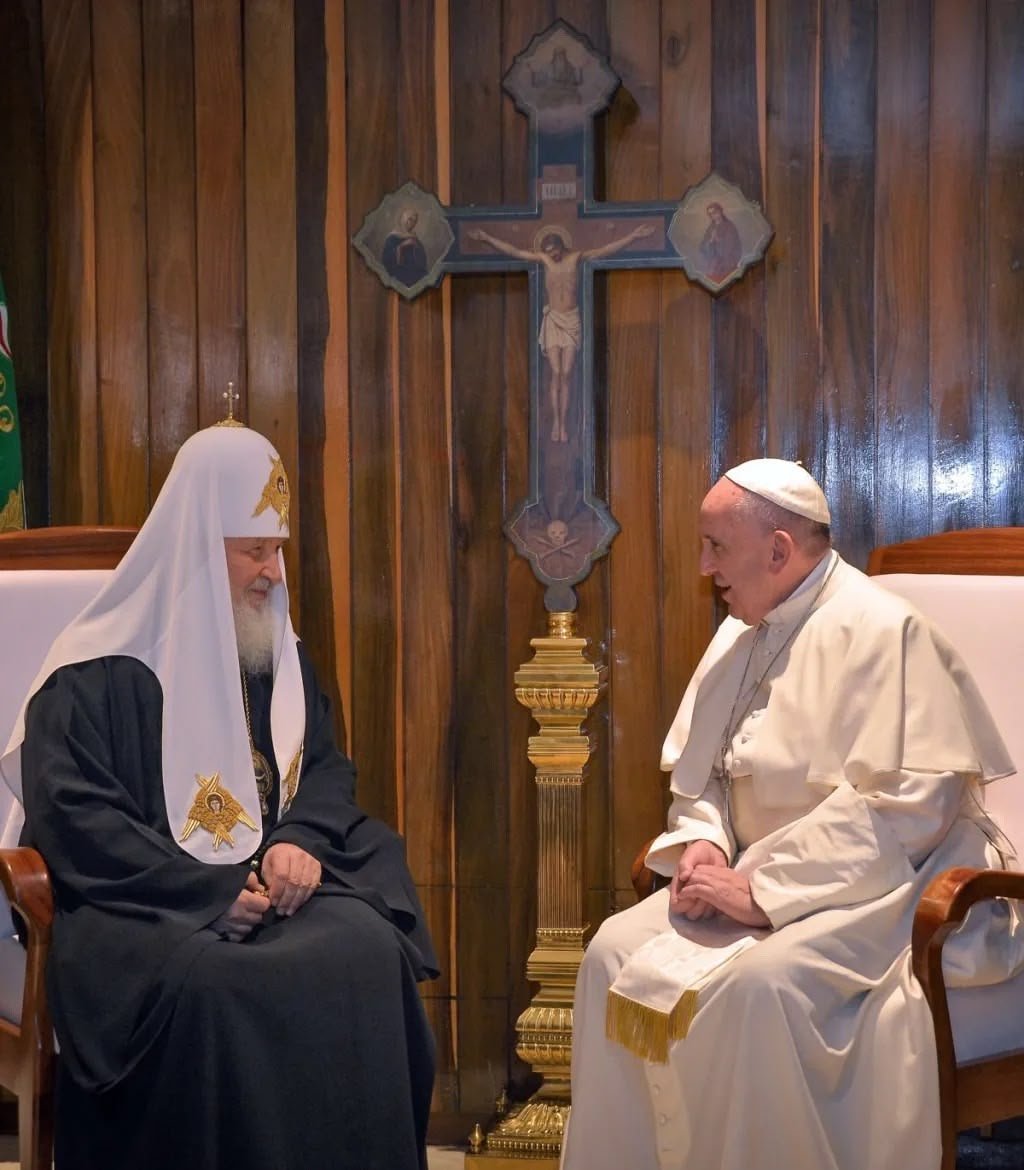
Patriarch Kirill Meets with the Pope
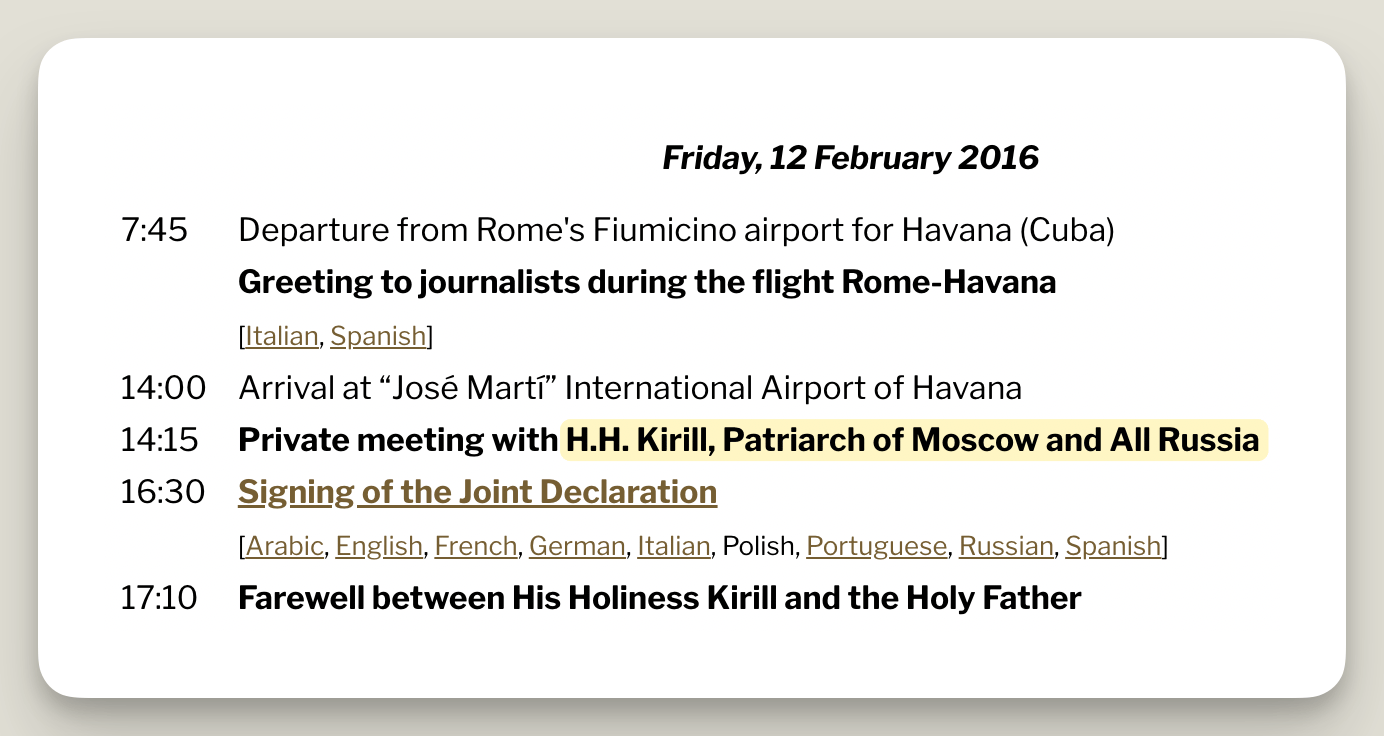
On February 12, 2016, Patriarch Kirill met Pope Francis in Cuba. This was the first meeting between a Pope and Moscow Patriarch in the last 1,000 years.
The Patriarch himself acknowledged this unprecedented break from tradition:
Ваше Святейшество, перед Вашей встречей с Папой у многих — у паствы, у некоторых наблюдателей — были определенные опасения. […] Насколько эти опасения оправданы?
Эти опасения понятны, потому что никогда раньше Патриарх не встречался с Папой.
Your Holiness, before Your meeting with the Pope, many — among the flock and among some observers — had certain concerns. […] To what extent are these concerns justified?
These concerns are understandable, because never before had a Patriarch met with a Pope.
— Patriarch Kirill, Interview on the results of his visit to Latin America, https://mospat.ru/ru/news/49713/
Since the Catholic Church broke communion with the Orthodox Church in 1054, only a handful of Orthodox Patriarchs have chosen to dialogue with the Pope. This small handful, breaking away from our tradition, were met with fierce opposition from the faithful.
Here are some brief examples:
Patriarch Athenagoras of Constantinople, the Ecumenical Patriarch from 1948 to 1972, met the Pope in 1964 and subsequently lifted the 1054 anathemas against Rome. The response from Orthodox Christians was severe.
Patriarch Bartholomew, his successor as Ecumenical Patriarch (1991 to present), continued and intensified such meetings with Rome, and the response was no less severe.
Patriarch Kirill, in meeting the Pope, joins this handful who have broken from tradition.
The Orthodox Precedent: Why Meeting the Pope Is Condemned
Of course, the desire for Christian unity is not itself wrong. The saints themselves prayed for the salvation of all, including those in heresy.
However, unity in the Orthodox Church is through baptism and bringing others to Orthodoxy. Often, meetings with heretics give credence to their error, gaining a superficial unity over bringing them to the faith. This is why this so-called expression of love is warned against and even forbidden by our saints.
St. Paisios and Mount Athos on Patriarch Athenagoras
St. Paisios the Athonite, together with almost the entire Holy Mountain,[1] ceased commemorating Patriarch Athenagoras “in response to his dangerous overtures toward the Roman Catholics,” as Hieromonk Isaac records in his biography[2]. What St. Paisios did is now referred to as “walling off”: cessation of commemoration without schism.
He did it, as witnesses report, “with pain.”
I pray for God to take days away from me and give them to Patriarch Athenagoras, so he can fulfill his repentance.
— St. Paisios the Athonite, Saint Paisios the Athonite by Hieromonk Isaac, p. 659[3]
Almost the entire Holy Mountain acted in concert, recognizing that a patriarch who exchanges liturgical gestures with a heretical Pope has departed from the boundaries of Orthodox practice, even if he has not formally taught heresy.
Many Orthodox Christians are familiar with St. Paisios the Athonite; however, very few are familiar with this particular witness. In our times, we see that certain teachings of the saints are elevated, while others are discarded, deprioritized, ignored, and forgotten.
Papa-Dimitri Gagastathis of Platanos
Fr. Dimitrios Gagastathis (1902-1975), known to his parishioners as “Papa-Dimitri,” was the married parish priest of Platanos, Thessaly, for forty-two consecutive years. His life, published posthumously in Greek and later in English, carries testimonies and endorsements from Elder Philotheos Zervakos of Paros, Elder Amphilochios Makris of Patmos, Priest-Monk Ephraim of Katounakia, and Archimandrite Emilianos (Vafeidis) of Simonos Petra.[4] A section of his autobiographical notes is titled simply “On Heresies”:
At first, when the dignitaries of the foreign churches came to Trikala, I set off to meet them. But then I said to myself: “Papa-Dimitri, get out of here fast and do not even look back.” We must not accept them. I have been following this principle for many years now. In retrospect, my act of refusing the dignitaries was somewhat rude of me—but it is better to ensure being on good terms with God rather than with people.
I would like to know what those clergymen who collaborate with the Pope and the heretics believe… they who work every day in the sanctuary of the Lord. Do they act only in name, and not in reality? It is beyond me.
— Papa-Dimitri Gagastathis, “On Heresies,” Papa-Dimitri: The Man of God (Orthodox Witness, 2009), p. 96
Two features of this witness deserve attention.
First, Papa-Dimitri did not separate from the New Calendar Church of Greece. On the contrary, in the very next section of the same notes he defends the validity of New Calendar sacraments and writes that he consulted Elder Philotheos Zervakos, a well-known New Calendar confessor, and received confirmation of his position.[5] His refusal to meet Roman Catholic and Protestant dignitaries has nothing to do with calendar traditionalism; it is the principled response of a parish priest canonical in the Church of Greece who simply would not lend ecclesial recognition to heterodoxy, regardless of what his own hierarchs permitted. Those who wish to dismiss anti-ecumenist witness as the province of schismatic zealots must reckon with a village priest, blessed by four of the most revered elders of the 20th century, who quietly refused for years to receive non-Orthodox clergy.
Second, his question is not rhetorical. He sincerely asks what “clergymen who collaborate with the Pope and the heretics” believe as they serve the Divine Liturgy every morning: “Do they act only in name, and not in reality? It is beyond me.” The question applies with undiminished force to every hierarch who approaches the altar of Christ and greets the Roman Pontiff as “Your Holiness” in the same week.
St. Justin Popovich of Serbia, now glorified among the saints, condemned Athenagoras’s “neo-papist behavior, both in word and in deed,” and also condemned “recognizing the Supreme Pontiff of Rome”. He publicly declared Patriarch Athenagoras in 1971 as:
…an apostate and heretic.
— St. Justin Popovich (1971), Contacts journal, no. 4 (1971); Orthodoxos Typos, Nov. 1, 1971; cited in The Orthodox Word, Vol. 10, No. 2 (March-April 1974)
A glorified saint of the Orthodox Church used these precise words: “apostate and heretic.” He did not engage in the sort of diplomacy that Orthodox Christian sentimentalists do in our time, dancing around the matter for the sole purpose of man-pleasing. He simply called him an apostate, and a heretic.
Some may find this interesting, as many in our time tell us that one cannot be called a heretic unless a synod decides on this. However, no synod ever condemned Patriarch Athenagoras; he died in 1972 without any form of synodal condemnation.
So, what gives?
A necessary question surfaces: what is heresy? Or who is properly considered heretic? And beyond that, why do even these things matter to me as a believer and a sinner? Many other questions naturally arise.
These questions are examined through extensive consensus patrum in Chapter 24: On Heresy, Synods, and Right Belief.
For now, it suffices to understand: our saints did not wait for synods to identify heresy. They identified it through the patristic standard already received.
Our saints responded harshly to Patriarch Athenagoras meeting with the Pope. This precedent did not end with Athenagoras.
Mount Athos Condemnation of Patriarch Bartholomew
When Patriarch Bartholomew, the Ecumenical Patriarch of Constantinople, continued and intensified ecumenical encounters with Rome, the Holy Community of Mount Athos wrote letters that “bluntly and very effectively exposes the ecclesiological deviations of Patriarch Bartholomew.”[6] The monks were “deeply saddened” by Bartholomew’s ecumenical activities.[6]
The 1980 Mount Athos Statement on Dialogue with Rome
The unified voice of all twenty Athonite monasteries spoke even earlier, in 1980. The Extraordinary Joint Conference of the Sacred Community of the Holy Mount Athos issued a comprehensive statement on relations with Rome that anticipated the very actions Patriarch Kirill would take thirty-six years later:
Theological dialogue must not in any way be linked with prayer in common, or by joint participation in any liturgical or worship services whatsoever; or in other activities which might create the impression that our Orthodox Church accepts, on the one hand, Roman Catholics as part of the fulness of the Church, or, on the other hand, the Pope as the canonical bishop of Rome. Activities such as these mislead both the fulness of the Orthodox people and the Roman Catholics themselves, fostering among them a mistaken notion as to what Orthodoxy thinks of their teaching.
— Extraordinary Joint Conference of the Sacred Community of the Holy Mount Athos, April 9/22, 1980. http://orthodoxinfo.com/ecumenism/athos.aspx
Patriarch Kirill’s meeting with the Pope included precisely the kind of activities the Athonite fathers forbade: those “which might create the impression that our Orthodox Church accepts” Roman Catholics “as part of the fulness of the Church” and “the Pope as the canonical bishop of Rome.”
The Athonite fathers also warned against the pressure being applied to exercise such dialogue:
Hastening the dialogue under such conditions is equivalent to spiritual suicide for the Orthodox. Many facts give the impression that the Roman Catholics are preparing a union on the pattern of a unia. Can it be that the Orthodox who are hastening to the dialogue are conscious of this?
— Extraordinary Joint Conference of the Sacred Community of the Holy Mount Athos, April 9/22, 1980. http://orthodoxinfo.com/ecumenism/athos.aspx
“Spiritual suicide.” This was the judgment of all twenty monasteries, speaking in 1980, thirty-six years before Patriarch Kirill met the Pope in Havana.
Elder Gabriel of Koutloumousiou Monastery, a disciple of St. Paisios the Athonite, wrote the following to Patriarch Bartholomew:
“In fruitless and devious dialogues with heretics,” he writes, “you have betrayed the One Church, Orthodoxy, many times recognizing the ‘diversity’ in the holy teachings of our Church and the ecclesiastical character in the sectarian gatherings of the Monophysites, the Pope, and the Theotokos-deniers, and Protestant iconoclasts.
— Elder Gabriel, http://web.archive.org/web/20251115060720/https://orthochristian.com/125289.html
He criticizes Patriarch Bartholomew simply for meeting with the Pope, which is what Patriarch Kirill has done.
The Patristic Witness: The Pope as Heretic
Why did the saints condemn meeting the Pope? Because the Pope is a heretic.
The pope is the leader of [all] heresies and the head of all heretical teachers, and, according to the Fathers of our Church, the forerunner of the Antichrist.
— Elder Gabriel, disciple of St. Paisios the Athonite, https://www.youtube.com/watch?v=isDV82LVORU
If the Pope is a heretic, then meeting, greeting, and communing with him are all forbidden by the Church’s own canons and patristic teaching. The condemnation is not arbitrary; it flows directly from the Church’s received teaching on who the Pope is. The saints leave no room for ambiguity.
St. Mark of Ephesus refused communion with the Patriarch of Constantinople when that Patriarch accepted a Union declaring the Pope “Head of the whole Church”:
I do not desire, in any manner and absolutely, and do not accept communion with him [The Patriarch] or with those who are with him, not in this life nor after my death, just as (I accept) neither the Union nor Latin dogmas, which he and his adherents have accepted, and for the enforcement of which he has occupied this presiding place, with the aim of overturning the true dogmas of the Church.
— St. Mark of Ephesus, Address of St. Mark of Ephesus on the Day of His Death, http://orthodoxinfo.com/ecumenism/stmark.aspx[7]
The saints go further. They call the Pope an antichrist:[8]
The anti-Christ king is the beginning of the 19th century. The Pope, the anti-Christ, is the middle of the same century.
— St. Justin Popovich, Orthodox Faith and Life in Christ, p. 185
St. Symeon of Thessalonica (†1429), the last Orthodox Archbishop of Thessalonica before the city fell to the Ottomans, stated the Orthodox position plainly:
Let the bishop of Rome only be the successor of the Orthodoxy of Sylvester, Agatho, Leo, Liberius, Martin, and Gregory. Then we will call him apostolic, and the first of all the other bishops. We will even be subordinate to him, not simply as to Peter, but as to the Savior Himself. Yet if he is not a successor to these saints in the faith, then neither is he the successor to their throne. And not only is he not apostolic or first. He is not even a father. Instead he is a hostile opponent and adversary of the apostles.
— St. Symeon of Thessalonica, Against All Heresies, Ch. 23, p. 89[9]
Thus, the Pope of Rome is considered a hostile opponent and adversary.
St. Symeon also recorded a direct exchange with a Latin interlocutor in Constantinople. When the Latin asked why the Orthodox commune with the Eastern patriarchs but reject the Pope, Symeon answered:
Their pope we not only do not hold in communion, but also call a heretic… With the pope of Peter and Linus and Clement, Stephen, Hippolytus, Sylvester, Innocent, Leo, Agapetus, Martin, and Agatho, and all the similar popes and patriarchs, we have unbreakable communion and unity in Christ. And no word will separate us from them.
— St. Symeon of Thessalonica, Dialogue Against All Heresies, PG 155:121A[10]
Symeon then went further:
The so-called pope will never be a pope if he does not hold the faith of Peter… nor will he be a successor unless he possesses the riches of the good confession of the divine Peter and his successors.
— St. Symeon of Thessalonica, Dialogue Against All Heresies, PG 155:121D[11]
The Latin, Symeon reports, was amazed and fell silent (θαυμάσας σεσίγηκε).
According to our saints, the Pope is a heretic, the forerunner of the Antichrist, a hostile opponent and adversary of the apostles. The saints who condemned meeting him simply applied the Church’s own teaching: heretics are outside the Body of Christ, and the faithful are forbidden to commune with them.
St. Ignatius Brianchaninov places the papacy in the same category as Islam: both are masks concealing the same spiritual deception:
What is the papacy! What is Islam! These are only disguises, these are particular operations. The Pope, Muhammad: they serve as prefigurations of the Antichrist.
— St. Ignatius Brianchaninov, Collected Works, Vol. IV (Symphony: “Antichrist”)
Does it then make any sense that an Orthodox Patriarch can meet, befriend, and hold dialogue with someone whom the saints call an antichrist? This is the standard against which Patriarch Kirill’s meeting must be measured.
Saints Who Refused to Meet the Pope
St. Paisios and St. Porphyrios are two of the most venerated saints in these times.
When asked if they would both meet the Pope, they refused.
No, we cannot go. Because the Roman Catholic Church and the Pope are not ready. They have very much egoism. They not only want to subjugate us, but they do not believe we have the truth. There is no need to go. We would better help the situation by our prayers.
— Sts. Paisios and Porphyrios, in response to a papal invitation to the Vatican, https://www.johnsanidopoulos.com/2011/11/invitation-from-pope-to-elders-paisios.html[12]
Many Orthodox Christians rightly love St. Paisios the Athonite and St. Porphyrios of Kafsokalyvia, and many quotes and sayings are shared from them. But noticeably, quotes regarding our relationship to the Pope (and heretics) are conveniently left by the wayside and deemed unimportant by the very people that claim to hold their teachings.
Our supposed love and fidelity to the saints is practiced selectively, while still operating under this guise. While St. Paisios and St. Porphyrios, both holy men, said that they cannot meet the Pope, that they are egoists, that they will only attempt to subjugate Orthodox Christians, yet we see our worldly Patriarchs contradict hundreds of years of tradition and meet with the Pope on the basis of love and unity, as if their Orthodox Christian progenitors lacked such a capacity.
St. John of Shanghai and San Francisco, now glorified among the saints, practiced separation from Rome in daily life:
For a few years I also went to Saint Sophia Catholic school. The nuns there were missionaries, who tried to convert the children to Roman Catholicism, and Vladika struggled against the idea of Russian Orthodox children going there to school. He would come to the school gates at the end of the school day, meet us and bless us. He would sternly tell us that we should not be wearing those uniforms or go to that school, that we had our own, Russian schools.
— Tatiana Kennedy Urusova, “With Vladika Through the Years,” in Man of God: Saint John of Shanghai and San Francisco, comp. Peter Perekrestov (Redding, CA: Nikodemos Orthodox Publication Society, 1994), pp. 58-59
A saint coming to the school gates, sternly telling Orthodox children they “should not be wearing those uniforms.” Not indifference. Not “all Christians are brothers.” Not “unity”. Active, daily struggle to separate Orthodox children from Roman Catholic influence. This is the patristic standard in practice.
What Happened in Havana: The Liturgical Gestures
The precedent is clear: meeting the Pope was condemned when Athenagoras did it, and condemned again when Bartholomew did it. Now, Patriarch Kirill has engaged in the same behavior, and yet he is deemed traditional by his supporters who, either not having read the lives of saints or paid any attention to them, attempt to excuse this behavior.
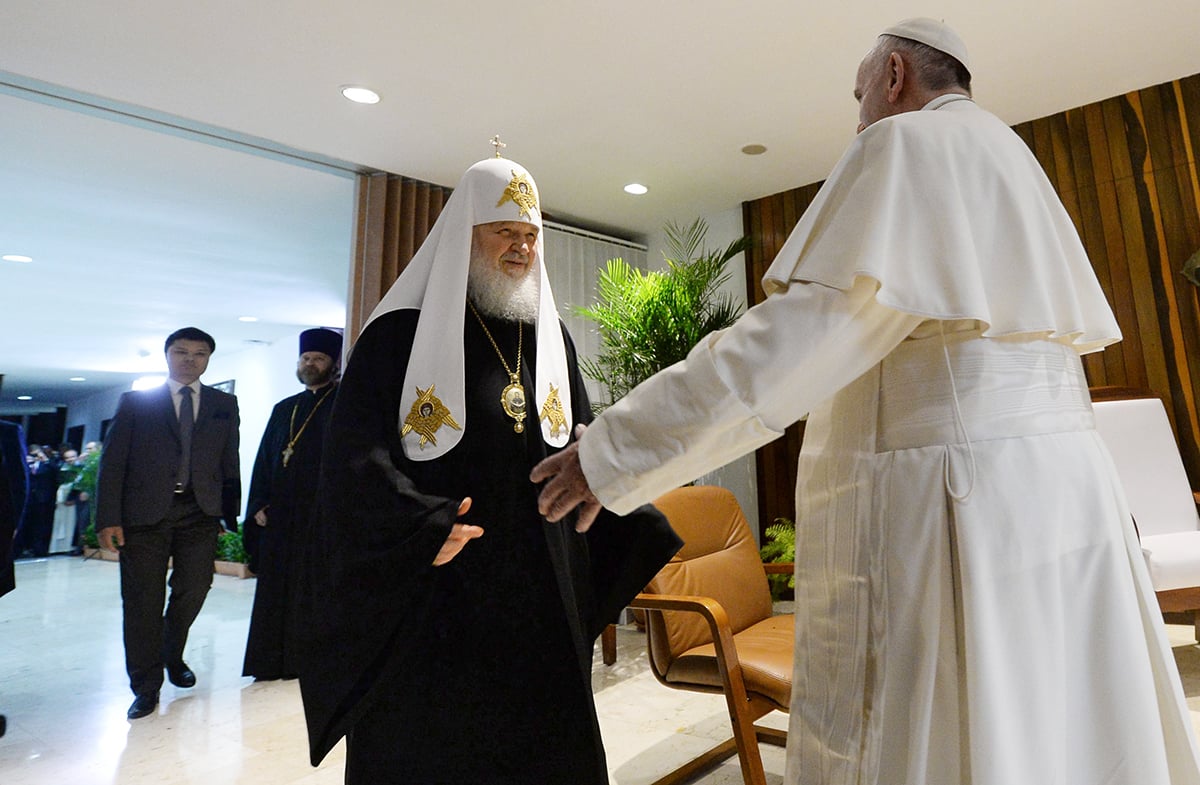
Not only did they meet, they also exchanged a series of gestures, each carrying theological meaning.
The Holy Kiss
The three-kiss greeting exchanged between Orthodox Christians is the “holy kiss” commanded by the Apostles and preserved among the faithful since the time of Christ. It is a Christian greeting, reserved exclusively for fellow believers.
The Apostle Paul commands: “Greet one another with a holy kiss” (Romans 16:16; 1 Corinthians 16:20; 2 Corinthians 13:12; 1 Thessalonians 5:26). The Apostle Peter likewise instructs: “Greet one another with a kiss of love” (1 Peter 5:14). These commands appear in epistles addressed to Christian churches, to baptized members of the Body of Christ.
Scripture however does not say to greet “everyone” with a holy kiss. Scripture (in particular the New Testament) is addressed solely to Orthodox Christians.[13]
The Pope of Rome (after the schism) is not an Orthodox Christian, nor is he a part of the Body of Christ; thus, we cannot twist scripture to apply statements regarding the Body of Christ, to those outside of it.
The early Church understood this boundary clearly. The Apostolic Tradition (traditionally attributed to St. Hippolytus of Rome, but likely misattributed) records that newly baptized Christians receive the holy kiss immediately after baptism, but not before:
From then on they will pray together with all the people. Prior to this they may not pray with the faithful until they have completed all. After they pray, let them give the kiss of peace.
— Apostolic Tradition, 25-26 (traditionally attributed to St. Hippolytus of Rome)
The Kiss of Peace follows baptism. If it was just a nice gesture as some people imagine, then it could be done by Catechumens or inquirers, but as we will see, even this is not correct. Thus, to exchange the Kiss of Peace is to recognize the baptism of that person into the Body of Christ.
Do our saints teach that the Pope is a part of the Body of Christ? Do our saints teach that the Pope has a valid baptism? If a mere Catechumen and inquirer is not given the Kiss of Peace, on what basis can it be exchanged with the Pope?
Tertullian, writing in the second century, speaks of the kiss of peace as exchanged “with their brethren” (cum fratribus):
Another custom has now become increasingly common. Those who are fasting, after engaging in prayer with their brethren, refrain from offering the kiss of peace, which is the seal of prayer… What prayer is complete when divorced from the holy kiss?
— Tertullian, On Prayer (De Oratione), Chapter 18
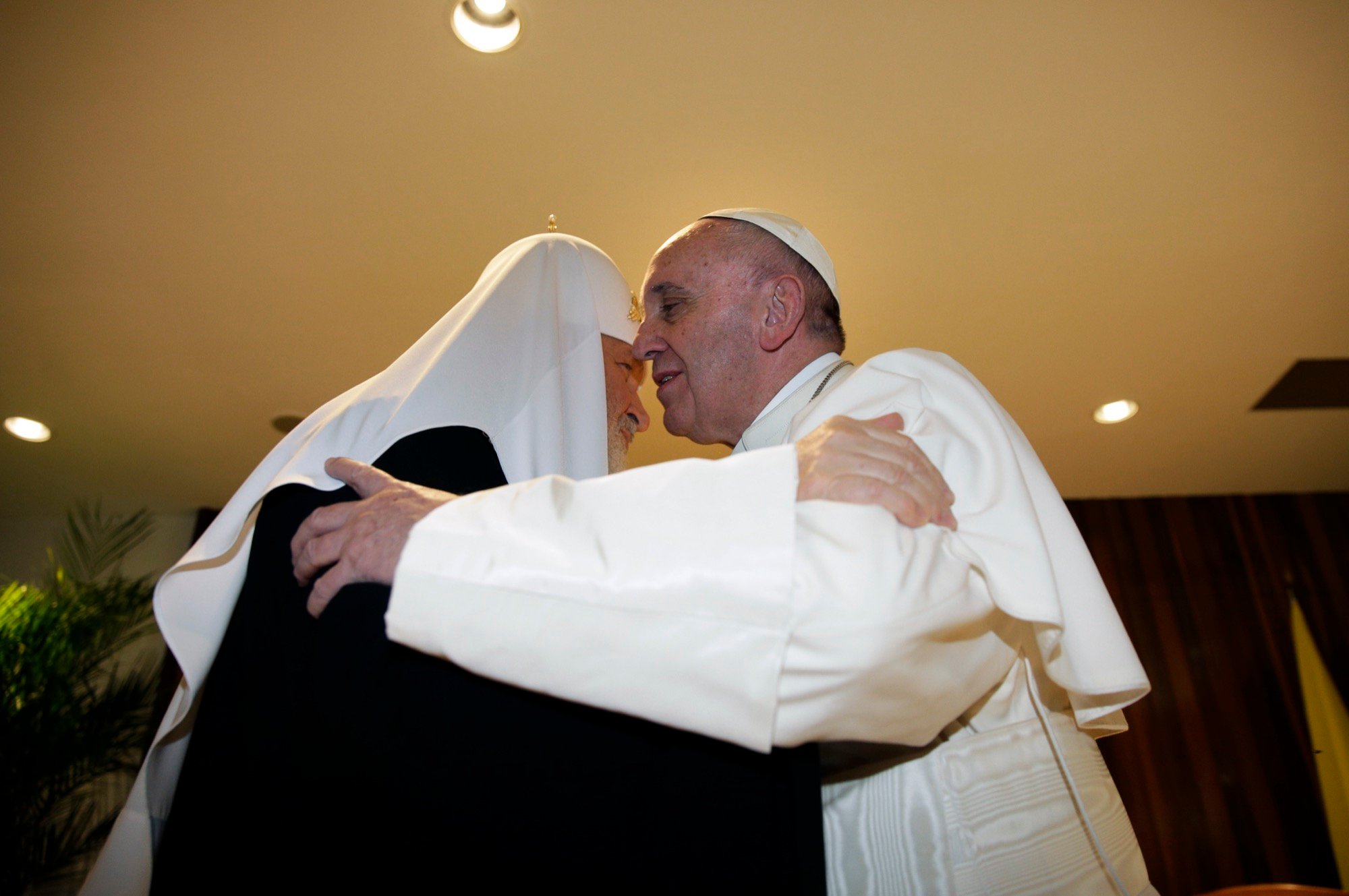
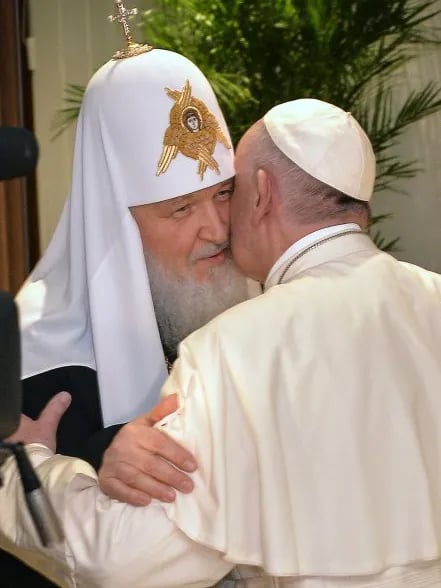
As is customary in Russian Tradition, Patriarch Kirill and Pope Francis greeted each other with 3 kisses on the cheek. It is an embrace that has taken nearly 1000 years to occur.
— News Reporter, https://www.youtube.com/watch?v=HXJ65qfUdGY, 00:05:53
When Patriarch Kirill met with Pope Francis, they greeted each other with three kisses on the cheek. As established above, the Kiss of Peace is not a casual greeting. It is an apostolic act reserved for baptized members of the Body of Christ. The early Church did not extend it even to catechumens. However, Patriarch Kirill extended it to the Pope of Rome.
The Kiss of Peace is an act of recognition: those who exchange it acknowledge each other as members of the Body of Christ. This kiss carries far more weight than any greeting between friends or acquaintances.
Then the Deacon cries aloud, “Receive ye one another; and let us kiss one another.” Think not that this kiss is of the same character with those given in public by common friends. It is not such: but this kiss blends souls one with another, and courts entire forgiveness for them. The kiss therefore is the sign that our souls are mingled together, and banish all remembrance of wrongs… The kiss therefore is reconciliation, and for this reason holy: as the blessed Paul somewhere cried, saying, “Greet ye one another with a holy kiss” (1 Corinthians 16:20); and Peter, “with a kiss of charity” (1 Peter 5:14).
— St. Cyril of Jerusalem, Catechetical Lecture 23 (On the Mysteries V), §3, https://www.newadvent.org/fathers/310123.htm[14]
Protopresbyter Anastasios Gotsopoulos clearly calls out the modernist impulse to downgrade the praxis of the Church to mere acts of politeness.
Is it permissible for us to use the kiss of peace (the ultimate moment of manifesting unity in truth and love) differently than what has been proscribed by our liturgical tradition? That is, by downgrading it to a gesture of social politeness and socialization, on the level of emotion or of ecclesiastical politics?
— Protopresbyter Anastasios K. Gotsopoulos, On Common Prayer with the Heterodox, Chapter IV
We as Orthodox Christians are not permitted to exchange the Kiss of Peace with the Pope.
When a clergyman (whether he be a priest, a bishop or even the primate of an autocephalous church) attending a liturgy in the presence of the Ecumenical Patriarch does not liturgize but prays together in the holy altar, will the officiating Ecumenical Patriarch exchange the kiss of peace with him? Certainly not, in accordance with the liturgical proscriptions, since the kiss of peace pertains only to the serving clergy. How, then, is a kiss given to the Pope? Is the Pope a concelebrant of the Patriarch?
— Protopresbyter Anastasios K. Gotsopoulos, On Common Prayer with the Heterodox, Chapter IV
We are not to exchange the Kiss of Peace with a catechumen. How then can we exchange the Kiss of Peace with the Pope, whom we are not even permitted to greet (termed a heretic by our saints) or welcome into our houses? If catechumens preparing for baptism cannot receive this Christian greeting, how much less should it be given to those outside the Church? How much less to those the Fathers call heretics?
That is why the Kiss was never exchanged with the catechumens, for they were not yet members of that one Body (or, in the words of Hippolytus’ Apostolic Tradition, “their kiss is not yet holy”). Far less would it be exchanged with a heretic, as St. John reveals when he forbids the faithful to give the heretic any greeting—i.e. any liturgical greeting (2 John 10).
— Fr. Lawrence Farley, Commentary on the Divine Liturgy: The Peace and the Creed, https://nootherfoundation.ca/commentary-on-the-divine-liturgy-the-peace-and-the-creed
St. Irenaeus of Lyon, a disciple of St. Polycarp who himself knew the Apostle John, applied the apostle’s prohibition directly against those who depart from the Church:
But John, the disciple of the Lord, intensified their condemnation, wishing that we should not even bid them greeting. For he who bids them greeting, he says, shares in their evil works.
— St. Irenaeus of Lyon, Against Heresies I.16.3, PG 7:162-163[15]
The Greek is precise: κοινωνεῖ, “shares in” or “communes with.” The same root as κοινωνία, communion. To greet a heretic is to commune in his evil works. This is the earliest patristic application of 2 John 10, from a saint within two generations of the Apostle John himself.
Blessed Theophylact of Ochrid, commenting on this same passage (2 John 10-12), explains just how absolute this prohibition is:
If someone should come to you not having this confession, he should not only not receive lodging with you, but should not even be considered worthy of greeting.
— Blessed Theophylact of Ochrid, Collected Commentaries of the Epistles (Virgin Mary of Australia and Oceania, 2025), commentary on 2 John 10-12
Are we to believe that Blessed Theophylact was without love, or didn’t understand the matter?
If one who lacks the Orthodox confession is not even worthy of a simple greeting, how much less is he worthy of the holy kiss, the liturgical expression of unity in the Body of Christ? Patriarch Kirill went beyond greeting the Pope: he exchanged the sacred kiss that the Fathers reserve for fellow members of the one Body.
The mystical character of the kiss of peace during the divine Eucharist always presupposes harmony of faith, ‘Let us love one another that with one mind we may confess.’
— The Announcement of the Extraordinary Joint Conference of the Sacred Community of the Holy Mount Athos, April 9/22, 1980, http://orthodoxinfo.com/ecumenism/athos.aspx
“But this is just Russian piety”
The Apostles commanded the Kiss of Peace for the baptized. The Fathers forbade it for heretics. The canons penalize co-prayer. Mount Athos declared that the kiss “always presupposes harmony of faith.” Setting all of this aside, some will still argue that the three-kiss greeting is simply Russian cultural tradition, not a theological act. The three-kiss embrace is indeed common in Russian custom. But the very people who coordinated the Havana meeting disagree.
A special working group of ceremonial masters from Moscow and the Vatican pre-negotiated the greeting protocol. They rejected Catholic protocol (in which visitors kiss the Pope’s hand), because, as one Russian report noted, “our Patriarch will not do this” (наш Патриарх этого делать не будет). They also rejected a standard diplomatic handshake. Instead, they deliberately chose what they themselves called “Orthodox custom” (по православному обычаю): the threefold kiss (троекратный поцелуй).[16]
Not Russian custom (русский обычай). Not cultural custom. Orthodox custom (православный обычай). In Orthodox practice, the threefold kiss is the Kiss of Peace exchanged between clergy and hierarchs. It is what Patriarch Kirill exchanges with Patriarch Bartholomew and other Orthodox primates. The Moscow Patriarchate’s own protocol team, by their own description, chose to greet the Pope according to the same custom by which Orthodox hierarchs greet one another.
The differential treatment confirms this. When Patriarch Kirill meets the Archbishop of Canterbury, who leads 85 million Anglicans, the greeting is a handshake. When he meets Cardinal Zuppi or Cardinal Koch, senior Vatican officials, the greeting is a handshake. When he meets the Pope, the greeting is the Orthodox hierarchical embrace. The Moscow Patriarchate’s own protocol team placed the Pope in a different category than every other heterodox leader: the same category as Orthodox patriarchs. That is not cultural custom. It is ecclesiological recognition through protocol.
The Love Defense
Many justify such meetings under the guise of diplomacy or love, appropriating the language of the Fathers and saints to then contradict them.
The saints called the Pope a heretic. To say this plainly, that they may be corrected and have a chance to become Orthodox, is a more loving act than lying to be friendly.
To tell the truth is the greatest act of love.
— St. Photius the Great, quoted in Fr. Benjamin Joukoff, “Testimony Concerning Orthodox Faith and Practice Concerning the Anathema Against Ecumenism,” Orthodox Life, Vol. 37, No. 5 (Sep-Oct 1987), p. 37
To not tell the truth (which Patriarch Kirill has not done) and then to publicly support and associate with the Pope, is more akin to hatred than love.
For I define misanthropy and a separation from divine love, to try and strengthen delusion, so that it may bring about even greater ruin to those already predisposed to it.
— St. Maximus the Confessor, Epistle XII, PG 91:465C[17]
If such actions were truly Christian love seeking the Pope’s salvation, where is the witness to truth? St. Paisios the Athonite teaches:
There is no need for us to tell Christians who are not Orthodox that they are going to hell or that they are antichrists; but we also must not tell them that they will be saved, because that’s giving them false reassurance, and we will be judged for it. We have to give them a good kind of uneasiness—we have to tell them that they are in error.
— St. Paisios the Athonite, Hieromonk Isaac, Elder Paisios of Mount Athos, p. 658
Fr. Seraphim Rose observed this same failure across the Orthodox jurisdictions in America:
All of them fraternize and pray with Catholics and Protestants and are ashamed to tell the heterodox that they have wandered far from the Truth, which is only in Orthodoxy.
— Fr. Seraphim Rose, Letter to the Madrid Mission (September 1970), Letters of Fr. Seraphim Rose
“Ashamed to tell the heterodox.” St. Paisios says we must tell them they are in error. Fr. Seraphim Rose says the jurisdictions are ashamed to do so.
No recorded evidence exists of Patriarch Kirill telling Pope Francis he was in error, that he is not Christian, and that he needs to join Orthodoxy. He offered no correction, no witness to the truth, no “good kind of uneasiness.” He gave only superficial unity and affection in giving the kiss he is not allowed to give.
St. Paisios teaches we must give a “good kind of uneasiness,” yet Kirill gave only comfort and false reassurance. By the standard St. Paisios set, Kirill offered the opposite of love.
The saints did not hesitate to state what Kirill would not. St. Theophan the Recluse, one of Russia’s most beloved saints:
The pope of Rome, through sophistries of his own invention, fell away from the Church and the Faith. This constitutes the first degree of the fall into falsehood and darkness.
— St. Theophan the Recluse, Preaching Another Christ: An Orthodox View of Evangelicalism (Orthodox Witness, 2011), p. 18
“Fell away from the Church and the Faith.” Not “a brother in Christ.” Not “His Holiness.” Not a partner for dialogue. A man who fell into falsehood and darkness.
The Familial Titles: “His Holiness” and “Brother”
Additionally, at the signing ceremony for the Havana Declaration, Patriarch Kirill addressed Pope Francis with the title “Your Holiness.” In his public remarks, Kirill began: “Your Holiness, Your Excellencies, Dear Brothers and Sisters, Ladies and Gentlemen.”[18] The Havana Declaration itself repeatedly refers to them as “brothers” and includes a joint prayer invoking the Mother of God.
These are not neutral diplomatic terms. When the Patriarch of Moscow calls the Pope “Your Holiness” and “brother,” he is using language that implies ecclesial recognition. Orthodox hierarchs do not address leaders of heretical bodies with titles reserved for fellow bishops of the One, Holy, Catholic, and Apostolic Church. The theological implications of these titles will be examined in detail in the next chapter.
This was not a one-time diplomatic courtesy. In his official birthday greeting to the Pope in December 2021, published on the Moscow Patriarchate’s own website, Patriarch Kirill used the full formal address:
Его Святейшеству, Святейшему Франциску, Папе Римскому. Ваше Святейшество! Сердечно поздравляю Вас со знаменательной личной датой — 85-летием.
To His Holiness, His Holiness Francis, Pope of Rome. Your Holiness! I warmly congratulate You on a notable personal date, Your 85th birthday.
— Patriarch Kirill, Birthday greeting to Pope Francis, December 17, 2021, https://www.patriarchia.ru/article/102720
“Его Святейшеству, Святейшему Франциску”: “To His Holiness, His Holiness Francis.” Not once but twice in the formal salutation. This is the official form of address from the Moscow Patriarchate to the Pope of Rome, published on patriarchia.ru for the world to see.
In the same letter, Kirill described himself and the Pope as equivalent leaders:
Как Предстоятели двух крупнейших христианских Церквей мира мы несем особую ответственность за судьбы человечества. Эта ответственность имеет глобальное измерение, ярким выражением чего стала наша встреча в Гаване и принятое на ней Совместное заявление.
As Primates of the two largest Christian Churches in the world, we bear a special responsibility for the destinies of humanity. This responsibility has a global dimension, a vivid expression of which was our meeting in Havana and the Joint Statement adopted at it.
— Patriarch Kirill, Birthday greeting to Pope Francis, December 17, 2021, https://www.patriarchia.ru/article/102720
Patriarch Kirill recognizes the Pope as a “Primate,” which is the same title used for heads of autocephalous Orthodox Churches. He closes the letter: “С любовью во Христе Иисусе” (“With love in Christ Jesus”), invoking communion in Christ with the one the saints call the forerunner of the Antichrist.
St. John of Kronstadt identified the root of this error, the primacy that Patriarch Kirill now recognizes by treating the Pope as a fellow “Primate”:
The most harmful thing for Christianity, for this divinely revealed, heavenly religion, is the primacy of man in the Church—for instance, the Pope and his alleged infallibility. It is precisely in his dogma of infallibility that the greatest error is contained, for the Pope is a sinful human being, and it is truly a calamity if he considers himself to be infallible.
The Roman Catholics have devised a new head, having degraded the one true Head of the Church—Christ. The Lutherans have fallen away and remain without the Head, likewise the Anglicans—the Church is not to be found among them, their union with the Head has been severed.
— St. John of Kronstadt, quoted in I. K. Sursky, Saint John of Kronstadt, trans. Holy Transfiguration Monastery (2018), pp. 252, 257
Months earlier, describing the Havana meeting to Cardinal Kurt Koch, Kirill used yet another familial term:
Эта встреча была наполнена, на мой взгляд, глубоким содержанием и проходила в исключительно искренней и братской атмосфере.
This meeting was filled, in my view, with deep content and took place in an exceptionally sincere and fraternal atmosphere.
— Patriarch Kirill, meeting with Cardinal Kurt Koch, November 22, 2016, https://www.patriarchia.ru/article/53442
“Братской”: fraternal, brotherly. The same root as “brother.” To meet a heretic in a “fraternal atmosphere” is to treat him as a brother, not as one who fell away from the faith, not as one whose confession the saints explicitly reject.
At the reception of St. Nicholas’ relics in Christ the Savior Cathedral, Kirill went further, calling the Pope “His Holiness” and crediting their Havana meeting with making the event possible:
Наверное, это замечательное событие никогда бы не стало явью, если бы не моя встреча со Святейшим Франциском, Папой Римским.
This wonderful event would never have become reality if not for my meeting with His Holiness Francis, the Pope of Rome.
— Patriarch Kirill, address at the reception of St. Nicholas’ relics, Christ the Savior Cathedral, May 21, 2017, https://www.patriarchia.ru/article/98453
In the same address, Kirill expressed his belief that St. Nicholas “stands before the Lord, including asking Him to unite the Churches into one” (прося у Него соединить Церкви воедино).
Those who insist Patriarch Kirill has not recognized the Pope must answer a simple question: why is the Patriarch of Moscow calling the one our saints call a heretic “His Holiness”? What greater sign of recognition is there?
Conclusion: Not Diplomacy, But Recognition
Patriarch Kirill’s meeting with the Pope broke 1,000 years of Orthodox tradition. Three escalating actions, each carrying specific theological meaning:
- The meeting itself expressed kinship
- The Kiss of Peace expressed liturgical unity
- The familial titles acknowledged papal authority, addressing him as “His Holiness,” calling him “brother,” and, in official correspondence, declaring Rome and Moscow “the two largest Christian Churches in the world”
Recall the precedent: St. Paisios and almost the entire Holy Mountain ceased commemorating Patriarch Athenagoras simply for his dangerous overtures toward Rome. St. Justin Popovich called him an apostate and heretic. And when Patriarch Bartholomew continued the same pattern of meetings and ecumenical gestures, without lifting any anathemas, Athonite elders called him a “heresiarch.”
Understanding this, on what possible basis can Patriarch Kirill’s identical actions be excused?
Our saints and elders refused to meet the Pope, told us there is no need to go, that the Catholics only wish to subjugate us, and bore witness that the Pope is the forerunner of the Antichrist. Those who would justify Patriarch Kirill must first explain why St. Justin, St. Paisios, St. Porphyrios, the Holy Mountain, and all the previous Moscow Patriarchs who did not feel the need to meet the Pope were wrong.
The saints have spoken. The reader must judge whether Patriarch Kirill’s actions can be reconciled with their witness.
These gestures were codified in a joint declaration, which will be the subject of the next chapter.
Hieromonk Isaac, The Life of Elder Paisios of Mount Athos (Chalkidiki: Holy Monastery of St. John the Theologian, 2012), p. 659: “For a time, together with almost the entire Holy Mountain, he ceased commemoration of Patriarch Athenagoras in response to his dangerous overtures toward the Roman Catholics.” ↩
“Elder Paisios of Mount Athos Against Ecumenism,” Lessons from a Monastery (blog), March 29, 2013, https://lessonsfromamonastery.wordpress.com/2013/03/29/elder-paisios-of-mount-athos-against-ecumenism/. See also Orthodox Ethos, “St. Paisios the Athonite on Ecumenism, Common Prayer with the Heterodox, and the Erroneous Ecumenist,” https://www.orthodoxethos.com/post/st-paisios-the-athonite-on-ecumenism-common-prayer-with-the-heterodox-and-the-erroneous-ecumenist ↩
Original Greek: “«Κάνω προσευχή για να κόβη ο Θεός μέρες από μένα και να τις δίνη στον πατριάρχη Αθηναγόρα, για να ολοκληρώση την μετάνοιά του.»” ↩
Papa-Dimitri: The Man of God (Orthodox Witness, 2009) includes extended testimonies from Elder Philotheos Zervakos (†1980) of Paros (pp. 107-113), a letter from Elder Amphilochios Makris (†1970) of Patmos (pp. 115-117), a letter from Priest-Monk Ephraim of Katounakia (†1962) (pp. 119-120), and an extensive epilogue by Archimandrite Emilianos (Vafeidis) of Simonos Petra (pp. 123ff.). The same volume contains a letter to Papa-Dimitri from the future Bishop Atanasije (Jevtić) of Herzegovina, a spiritual child of St. Justin Popovich (p. 121). ↩
“How do the Old-Calendarists say that our sacraments are invalid?… I wrote to Fr. Philotheos Zervakos and he responded to me correctly about this matter. I too, the unlearned one, believe from my life experience, that thirteen days can neither cast you out from nor place you into the Kingdom of God.” Papa-Dimitri Gagastathis, “On the Calendar Issue,” Papa-Dimitri: The Man of God (Orthodox Witness, 2009), pp. 96-98. Papa-Dimitri’s placement of “On Heresies” and “On the Calendar Issue” side by side in his own notes establishes that the two positions are independent. ↩
Orthodox Christian Information Center, “Letter of the Holy Community of Mt. Athos to Ecumenical Patriarch Bartholomew, Concerning His Compromise of Orthodoxy,” May 11/24, 1999, http://orthodoxinfo.com/ecumenism/athonite_bartholomew.aspx ↩
Original Greek: “«ούτε βούλομαι ούτε δέχομαι την αυτού ή την των αυτού κοινωνίαν το παράπαν, ουδαμώς, ούτε επί της ζωής μου ούτε μετά θάνατον ώσπερ ούτε γεγονυίαν, ένωσιν, και τα Δόγματα τα Λατινικά, άπερ εδέξατο αυτός και οι μετ’ αυτού, και υπέρ του διαφενδεύειν ταύτα, και την προστασίαν ταύτην εμνηστεύσατε επί καταστροφή των Ορθών δογμάτων της Εκκλησίας»” ↩
St. Kosmas Aitolos’s Eighth Teaching includes the passage: “THE ANTICHRISTS ARE: one, the pope, and the other one, the one who stands over our heads” (Nomikos Michael Vaporis, The Life of St. Kosmas Aitolos, Together with His Teaching, Letters & Complete Prophecies, p. 116). The attribution is disputed in modern scholarship. Fr. Irenaios Delidimos’s 2014 analysis at the Monastery of Vlatadon argues this passage was interpolated by Theodoret of Ioannina (c. 1740-1823), an Athonite monk independently documented as having inserted 16 heretical interpolations into St. Nikodemos the Hagiorite’s Rudder. The earliest surviving manuscript (1808) references “the Antichrist” without naming the Pope; the explicit identification appears only in a later 1824 copy. Cosmas scholar John Menounos excluded the relevant homilies from his critical edition. On the other side, Abbess Efthymia of the Monastery of St. Kosmas Aitolos defends authenticity based on complementary manuscript variants, and General Yannis Makrygiannis (†1864) independently attributes “curse the pope” to St. Kosmas’s oral tradition in his Memoirs. No complete critical edition of St. Kosmas’s writings exists. The characterization of the Pope as antichrist is independently attested by other saints cited in this chapter. See also Anastasios Gordios (1654/5–1729), Treatise on Muhammad and Against the Latins (Athens: Agathos Logos Publications, 2017), ch. 26: “Concerning the second persecution of the Church by the Antichrist, who is Muhammad and the Pope.” ↩
Original Greek: “«Ἀς εἶναι μόνον ὁ Ῥώμης Διάδοχος τῆς ὀρθοδοξίας τοῦ Σιλβέρου, καὶ Ἀγάθωνος, τοῦ Λέοντος, καὶ Λιβερίου, καὶ Μαρτίνου, καὶ Γρηγορίου, καὶ ἡμεῖς προθύμως θέλομεν τὸν εἰπεῖν ἀποστολικόν, καὶ πρῶτον τῶν ἄλλων Ἀρχιερέων, καὶ θέλομεν τὸν ἀποδῶσαι τὴν ὑποταγήν, οὐχὶ καθὼς εἰς τὸν Πέτρον, ἀλλὰ καθὼς εἰς αὐτὸν τὸν Σωτῆρα. Εἶδε καὶ δὲν εἶναι Διάδοχος τῶν Ἁγίων ἐκείνων κατὰ τὴν πίστιν, δὲν εἶναι μήτε τοῦ Θρόνου Διάδοχος, καὶ ὅτι μόνον θέλει εἶναι Ἀποστολικος, καὶ πρῶτος Ἀρχιερεύς, ἡ Πατὴρ, ἀλλὰ θέλει εἶναι ἐναντίος, καὶ φοβερός, καὶ ἐχθρὸς τῶν Ἀποστόλων.»” ↩
Original Greek: “τὸν παρ᾽ αὐτοῖς πάππαν οὐ μόνον οὐ κοινωνικὸν ἔχομεν, ἀλλὰ καὶ αἱρετικὸν ἀποκαλοῦμεν… ἡμεῖς μὲ τὸν Πάπαν τὸν Πέτρον, τὸν Λίνον, τὸν Κλήμεντα, τὸν Στέφανον, καὶ Ἱππόλυτον, καὶ Σίλβεστρον, καὶ Ἰννοκέντιον, καὶ Λέοντα, καὶ Ἀγαπητόν, καὶ Μαρτῖνον, καὶ Ἀγάθωνα, καὶ μὲ τοὺς ὁμοίους των Πάπας, καὶ Πατριάρχας ἔχομεν ἐν Χριστῷ κοινωνίαν, καὶ ἕνωσιν ἀχώριστον, καὶ κἀνένας λόγος δὲν θέλει ἰσχύσει νὰ μᾶς ξεχωρίσῃ ἀπὸ αὐτούς.” ↩
Original Greek: “οὐδ᾽ ὁ λεγόμενος πάππας ἔσται πάππας ποτέ, μὴ τὴν πίστιν ἔχων τοῦ Πέτρου… οὐδ᾽ ἔσται διάδοχος, εἰ μὴ πλουτῶν ἔχῃ τὰ τῆς καλῆς ὁμολογίας τοῦ θείου Πέτρου καὶ τῶν ἐκείνου διαδόχων.” ↩
Original Greek: “«Όχι δεν μπορούμε να πάμε. Διότι η Ρωμαιοκαθολική Εκκλησία και ο Πάπας δεν είναι έτοιμοι. Έχουν πολύ εγωισμό. Όχι μόνο θέλουν να μας υποτάξουν, αλλά και δεν πιστεύουν ότι έχουμε την αλήθεια εμείς. Δεν χρειάζεται να πάμε. Καλύτερα θα βοηθήσουμε την υπόθεση με την προσευχή μας».” ↩
Hieromartyr Daniel Sysoev, Why Do Believers Quarrel? Talks on the First and Second Epistles of the Apostle Paul to the Corinthians, Book 1 (New Jersey: Daniel Sysoev Inc, 2016), “The Call to Sanctity,” p. 10. The epistle to the Corinthians is addressed “unto the church of God which is at Corinth, to them that are sanctified in Christ Jesus, called to be saints, with all that in every place call upon the name of Jesus Christ our Lord, both their’s and our’s” (1 Cor. 1:2). Paul and Sosthenes are addressing the Church of God in Corinth. Here we have a matter of great importance. Frequently Protestants and sectarians say that the Bible was written for everyone. This is something we do not find in the Bible. Observe: to whom is the epistle written? It is written for the Church of God in Corinth, and also for all who call upon the name of our Lord Jesus Christ, i.e., for the ecumenical Orthodox Church. The Bible is not addressed to people who are outside the Church. The Bible is the word of God, given to the people of God, the Church of God. Indeed, there is no reason to argue about the Bible with heretics. The Bible is the book of the Church, written for the Church. The text of the Bible itself declared this: “unto the church of God which is at Corinth.” The epistle is not addressed to all the inhabitants of Corinth, not to our Baptist friends, not to the Jehovah’s Witnesses, but to the church of God which is at Corinth, and to those in communion with them. The Church of Corinth exists to this day: it was and remains the Orthodox Church. And the apostle Paul has as his successor the metropolitan of Corinth. ↩
Original Greek: “«Εἶτα βοᾷ ὁ διάκονος· Ἀπολάβετε ἀλλήλους· καὶ ἀλλήλους ἀσπασώμεθα. Μὴ ὑπολάβῃς τὸ φίλημα ἐκεῖνο συνήθες εἶναι τοῖς ἐπ’ ἀγορᾶς γνωρίμοις ὑπὸ τῶν κοινῶν φίλων. Οὐκ ἔστι τοίνυν τοιοῦτον τὸ φίλημα. Ἀνακίρνησι τὰς ψυχὰς, ἄλληλαις, καὶ πᾶσαν ἀμνησικακία αὐταίς μνηστεύετε. Σημεῖον τοῦνιν ἐστὶ το φίλημα τοῦ ἀνακραθῆναι τὰς ψυχὰς καὶ πᾶσαν ἐξορίζει μνησικακίαν. Οὐκοῦν τὸ φίλημα διαλλαγή ἐστι, καὶ διὰ τοῦτο ἄγιον· ὥς ποὺ ὁ μακάριος Παῦλος ἐβόα λέγων· Ἀσπάσασθε ἀλλήλους, ἐν φιλήματι ἁγίῳ· καὶ Πέτρος· Ἐν φιλήματι ἀγάπης.»” ↩
Original Greek: “Ἰωάννης δὲ ὁ τοῦ Κυρίου μαθητὴς ἐπέτεινε τὴν καταδίκην αὐτῶν, μηδὲ χαίρειν αὐτοῖς ὑφ᾽ ἡμῶν λέγεσθαι βουληθείς. Ὁ γὰρ λέγων αὐτοῖς, φησὶ, χαίρειν, κοινωνεῖ τοῖς ἔργοις αὐτῶν τοῖς πονηροῖς.” ↩
The greeting protocol was pre-negotiated by “a special working group of Christian ceremonial masters from Moscow and the Vatican” (специальная рабочая группа, состоящая из христианских церемониймейстеров Москвы и Ватикана). The report states: “The leaders will greet each other according to Orthodox custom: with a threefold kiss” (предстоятели поприветствуют друг друга по православному обычаю: троекратным поцелуем). Catholic protocol requires visitors to kiss the Pope’s hand, but “our Patriarch will not do this” (наш Патриарх этого делать не будет). The Vatican agreed to the Orthodox greeting instead. See “Как Патриарх Кирилл будет целовать Папу Римского: тайны протокола” (“How Patriarch Kirill will kiss the Pope of Rome: protocol secrets”), MK.ru, February 10, 2016, https://www.mk.ru/politics/2016/02/10/kak-patriarkh-kirill-budet-celovat-papu-rimskogo-tayny-protokola.html. By contrast, when Patriarch Kirill met Cardinal Matteo Zuppi (Moscow, June 2023) and Cardinal Kurt Koch, the greeting was a standard diplomatic handshake. ↩
Original Greek: “«Μισανθρωπίαν γαρ ορίζομαι έγωγε, και αγάπης θείας χωρισμόν, το τη πλάνη πειράσθαι διδόναι ισχύν εις περισσοτέραν των αυτή προκατειλημμένων φθοράν.»” ↩
Patriarch Kirill, remarks after signing the Joint Declaration, Havana, February 12, 2016. Vatican text: https://www.vatican.va/content/francesco/en/speeches/2016/february/documents/papa-francesco_20160212_dichiarazione-comune-kirill.html ↩