
KGB and the DECR
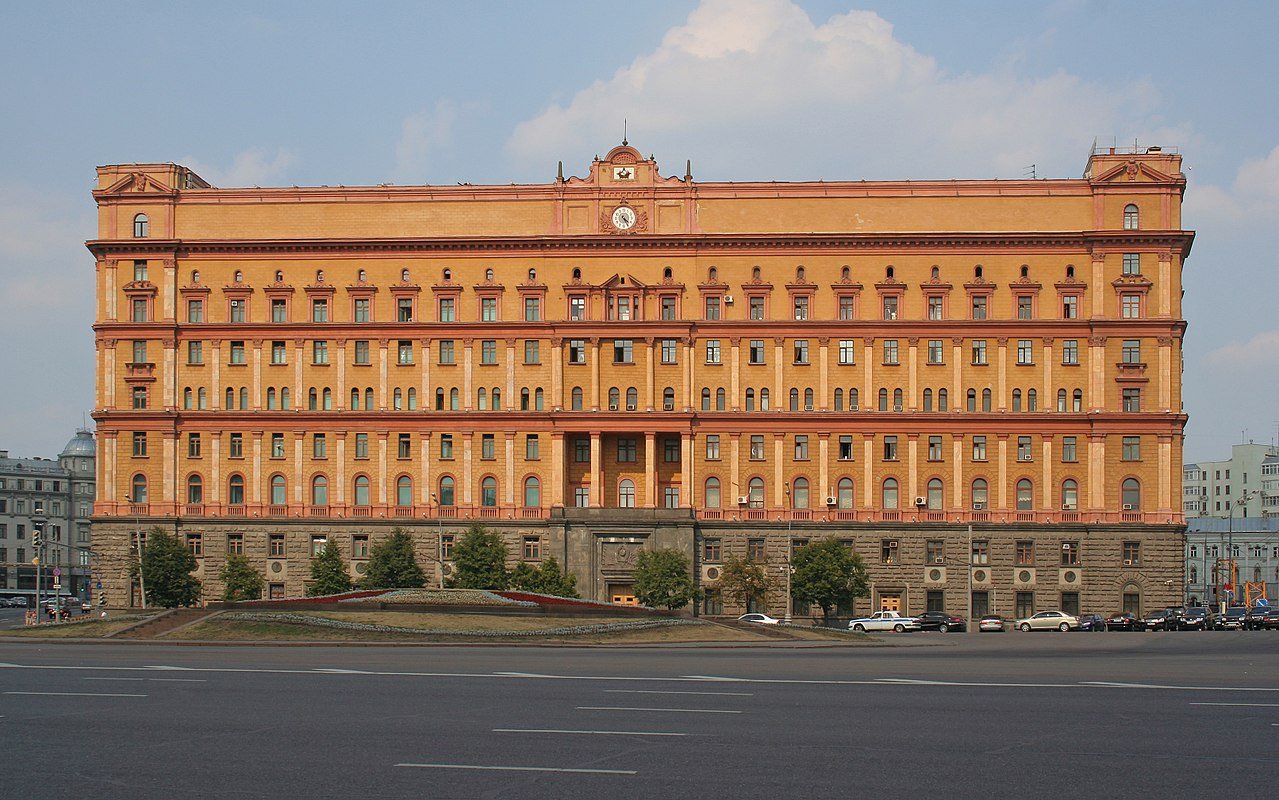
The KGB (Committee for State Security) was the Soviet Union’s intelligence and secret police agency: the enforcement arm of an officially atheist state that destroyed over 20,000 churches, reduced the Orthodox clergy by 80%, imprisoned believers in labor camps, and executed countless faithful. It was the institutional enemy of the Church. To be an agent of the KGB was to serve the apparatus that persecuted, tortured, and killed Orthodox Christians for their faith.
The Soviet secret police changed its name many times throughout its history: Cheka, GPU, NKVD, MGB, and finally KGB, but it was always the same institution, with the same mission, the same methods, and often the same personnel. Today it operates as the FSB and SVR. Its agents called themselves “Chekists” decades after the original Cheka was dissolved; the name changed, but the organism did not.[1]
The department Patriarch Kirill personally led for twenty years has been described by those who worked in it as “a branch of the KGB from top to bottom.” Archives from six countries link him to a KGB codename. A 1992 Russian parliamentary commission found that nine out of ten clerics in the upper echelons of the church worked for the KGB.
Vladimir Kara-Murza, a Russian Orthodox Christian who spent 300 days in solitary confinement for documenting the war Kirill blessed, confirmed this history in 2025:
Credible evidence… emerged in the early 1990s of the direct collaboration of many top hierarchs of the Moscow Patriarchate during the Soviet time with the KGB, with the Soviet security services.
— Vladimir Kara-Murza, Atlantic Council Eurasia Center, September 17, 2025, https://www.youtube.com/watch?v=JSp-10UsoOE&t=2978s
The canonical tradition addresses precisely such clergy: the ancient Church deposed traditores, literally “those who handed over,” the term for clergy who surrendered scriptures, sacred vessels, or the names of fellow Christians to the Roman persecutors. If the evidence is true, and if the canons apply, then Kirill’s episcopal legitimacy is in question.
This will be dismissed as conspiracy theory or Russophobia. But before examining the evidence, a prior question must be answered: Who has the right to judge the leadership of the Moscow Patriarchate? (For the full patristic answer to “judge not” and “you’re not a saint,” see and Chapter 27.)
A. Who May Judge: The Confessors’ Witness
A chancellor of the Metropolia (the Russian Orthodox jurisdiction in America, predecessor to the Orthodox Church in America, or OCA) once offered a criterion:
If such judgement is necessary, then he alone is entitled to make it who has traversed along the road of the martyred Russian Church.
— Metropolia Chancellor, quoted in Archimandrite Seraphim (comp.), A History of the Russian Church Abroad 1917-1971 (Seattle, 1972)
Let us hear, then, from those who traversed that road.
Boris Talantov: “Not Out of Fear But for Conscience’s Sake”
Boris Talantov was an Orthodox layman from Kirov who had suffered under the Soviets and would soon die in prison for his writings. He wrote plainly about Metropolitan Nikodim, the man who would ordain the future Patriarch Kirill and serve as his mentor in the KGB-penetrated Department for External Church Relations:
The activity of the Moscow Patriarchate abroad is a conscious betrayal of the Russian Orthodox Church and the Christian faith… Metropolitan Nikodim is betraying the Church and Christians not out of fear but for conscience’s sake.
— Boris Talantov, “Sergianism, or Adaptation to Atheism (The Leaven of Herod),” written in the USSR, published posthumously (1971)
“Not out of fear but for conscience’s sake.” This is the crucial phrase. Talantov was describing a willing collaborator. Fr. Victor Potapov, the ROCOR priest who would later identify Kirill as agent “Mikhailov,” wrote in Orthodox Life that Talantov was “destroyed by Metropolitan Nikodim of Leningrad, viz. the agent ‘Svyatoslav.’”[2] Kirill’s mentor did not merely betray the Church in the abstract. He destroyed a confessor who told the truth about him.
Feodisiya Varavva: “Bishops Who Have Betrayed Christ”
Feodisiya Varavva was a confessor who spent years imprisoned for her faith under both Nazis and Soviets. She too named Nikodim among the “bishops who have betrayed Christ.”[3]
Zoya Krakhmalnikova: “Para-Orthodox”
Zoya Krakhmalnikova was a Russian Orthodox writer imprisoned by the Soviet regime for publishing Orthodox literature. At a 1992 press conference in Moscow, she offered a theological assessment:
I would call this new ‘Church’ Para-Orthodox. In it the elements of ceremony are preserved, but it is void of the most important aspect of the Gospel: faithfulness to Christ.
— Zoya Krakhmalnikova, testimony at press conference (February 19, 1992), Orthodox Life, Vol. 42, No. 3 (May-June 1992)
She then posed a question that strikes at the heart of apostolic succession, and explained why the Moscow Patriarchate has never properly honored the New Martyrs:
Let us not forget that bishops represent an apostolic service, so can anyone imagine an Apostle being an agent of the KGB? The Holy Spirit cannot abide in those who become apostles through the recommendation of the KGB.
The New Martyrs of Russia rejected this institution that we today call the Church, and in effect this is why this institution rejected the martyrs.
— Zoya Krakhmalnikova, testimony at press conference (February 19, 1992), Orthodox Life, Vol. 42, No. 3 (May-June 1992)
This is the witness of a Russian Orthodox confessor who went to prison for her faith; it cannot be dismissed as “anti-Russian propaganda.” She suffered for the Russian Orthodox faith.
The Inescapable Question
These voices carry weight because they paid for their witness with their freedom and their lives. They accuse the hierarchy of collaboration with persecutors, of serving the atheist state while believers suffered, of denying persecution to the outside world while the faithful were imprisoned. These are grave charges.
What does the canonical tradition say about such clergy?
The Canonical Tradition
The ancient canons address precisely this situation.
The Council of Elvira (313), one of the earliest Church councils, addressed informers directly. Canon 73 decreed:
If any of the faithful was an informer, and through his informing someone was proscribed or killed, it is decreed that he shall not receive communion even at death. If the case was lighter, he may receive communion after five years.
— Council of Elvira, Canon 73 (313 AD), Acta Conciliorum, Tomus I (Parisiis, 1715); supplemental English translation: Strannik Journal, “81 Canons of the Synod of Elvira”; cited in Fr. Victor Potapov, Молчанием предаётся Бог (By Silence God Is Betrayed) (Tolyatti: Лествица, 1992), p. 29
An informer whose denunciation led to death is denied communion even on his deathbed. Not deposed and restored as a layman: denied communion entirely. This is the most severe penalty the ancient Church imposed.
The following year, the Council of Arles (314) addressed the traditores: clergy who handed over scriptures or names of brethren to persecutors. The council decreed that for this, they must be deposed.[4]
Those who worked for the KGB handed over far more than what the traditores did: they provided information about believers to the apparatus that imprisoned, tortured, and killed them.[5]
However, while the ancient Church deposed traditores, the Moscow Patriarchate promoted them.
St. Basil the Great established the general principle:
As to the clergy, the Canons have enjoined without making any distinction that one penalty is assigned for the lapsed: ejection from the ministry.
— St. Basil the Great, Canon 51, Third Canonical Epistle to Amphilochius (c. 375 AD), Nicene and Post-Nicene Fathers, Series II, Vol. 8; https://www.ccel.org/ccel/schaff/npnf208.ix.ccxviii.html[6]
Unlike laity who may be restored through penance, clergy who collaborate with persecutors of the Church face permanent removal from ministry.
Apostolic Canon 62 extends this to denial through action:
If any of the clergy, through fear of men, whether Jew, heathen, or heretic, shall deny the name of Christ, let him be cast out. If he deny the name of a clergyman, let him be deposed. If he repent, let him be received as a layman.
— Apostolic Canon 62, Apostolic Constitutions (c. 380 AD), Ante-Nicene Fathers, Vol. 7; https://www.newadvent.org/fathers/3820.htm[7]
To tell the world that the Church is free while believers rot in camps is to deny Christ before men, for it covers the persecutor’s crimes with the Church’s authority. The penalty is deposition, and even with repentance a clergyman cannot be restored to ministry, but can only be received as a layman.
Therefore, when the confessors call the Moscow Patriarchate “Para-Orthodox” and declare that “the Holy Spirit cannot abide” in bishops appointed through KGB collaboration, they speak in continuity with the ancient canons. Thus, their verdict is tradition.
If they are right, then what does the evidence reveal?
B. The Evidence
1988: A Moscow Patriarchate Priest Speaks
Even before official investigations, Orthodox clergy inside the Soviet Union knew and said openly what the Department for External Church Relations was. In 1988, Fr. George Edelshtein, a priest of the Moscow Patriarchate, published an exposé in Orthodox Life, the journal of the Russian Orthodox Church Outside of Russia (ROCOR), describing the 1982 “peace conference” at the Trinity-St. Sergius Monastery:
The conference… enjoyed the active support of our atheist state and of its “competent organs,” the KGB… The chief of the CRA [Council for Religious Affairs]… occupies his rightful seat in the banquet hall: the place of honor next to the Most Holy Patriarch.
— Fr. George Edelshtein, “How to Plunder the Church,” Orthodox Life, Vol. 38, No. 4 (July-August 1988)
Fr. Edelshtein identified the Church Foreign Relations Department (the same department Kirill would head from 1989 to 2009) directly:
The office is a branch of the Ministry of Foreign Affairs and of the KGB. They created it, nurtured it, and now run it. It is theirs, and so let them finance it.
— Fr. George Edelshtein, “How to Plunder the Church,” Orthodox Life, Vol. 38, No. 4 (July-August 1988)
A Moscow Patriarchate priest, writing from within the Soviet Union, stating as obvious fact what official investigations would later confirm.
Another voice from within the system, published in the same journal, described the result of decades of state control over episcopal appointments:
Almost all the ruling archbishops of the Russian Orthodox Church are government officials, political personalities, persons who represent in themselves a certain state-sanctioned institution, through which the atheistic authority realizes the administration of the religious life of believers. During the course of many years, through various kinds of efforts and intrigues of both a political and moral tone, precisely such a type of religious-political official was being created, a distinct nomenklatura.
— Interview with a Moscow Patriarchate clergyman, Orthodox Life, Vol. 38, No. 5, 1988
“A distinct nomenklatura.” The word means a class of officials appointed and controlled by the party-state apparatus, operating within the Church’s canonical forms. The episcopate was systematically replaced with state functionaries.
Fr. Edelshtein’s witness was not limited to the DECR. In September 1991, weeks after the failed coup briefly opened the KGB archives to investigators, he gave a detailed interview to Argumenty i Fakty, one of Russia’s largest newspapers, with a peak circulation exceeding 30 million. He stated plainly:
One-half of the clergy were overt or covert KGB employees through the end of the Gorbachev era.
— Fr. George Edelshtein, interview in Argumenty i Fakty, No. 36 (September 1991)
He described a system of financial corruption inseparable from the intelligence apparatus: the hierarchy took bribes from priests seeking transfers to wealthy parishes and from candidates for bishoprics. The KGB and the bribery were not separate problems; they were the same system. Appointment to any significant position required both payment and political reliability.
When asked to describe the boundary between Church and state security, Edelshtein gave an answer that became well known in Russian dissident circles:
Do you know where our present-day church ends and the KGB begins? The only difference was that some wore hoods and some had shoulder boards.
— Fr. George Edelshtein, interview in Argumenty i Fakty, No. 36 (September 1991)
Fr. Edelshtein was not a dissident émigré or hostile outsider. He was a serving Moscow Patriarchate priest speaking on the record in Russia’s most-read newspaper. His testimony was never retracted, challenged in court, or formally disputed by the Moscow Patriarchate.[8]
How many priests were agents? Asked this question directly, Fr. Edelshtein estimated 100 percent. Fr. Gleb Yakunin, who later examined the actual KGB files as a member of the Russian parliamentary commission, put the figure at 20 percent. In December 1991, the KGB’s own deputy chairman confirmed that of the Russian Orthodox priests approached by the KGB, only 15 to 20 percent had refused to cooperate, meaning 80 to 85 percent of those approached agreed to work for the security services.[9] Three sources: a serving priest, a parliamentary investigator, and the KGB’s own deputy chairman. Even the most conservative estimate means one in five priests was an agent. The KGB’s own number suggests four in five.
What Is the DECR?
The organization Fr. Edelshtein described is the Department for External Church Relations (DECR), established by the Holy Synod (the governing body of the Russian Orthodox Church) on April 4, 1946, to handle Moscow’s relations with other Orthodox Churches, non-Orthodox churches, governments, and international organizations. The chairman of DECR holds the status of a permanent member of the Holy Synod, making it one of the most powerful positions in the Russian Orthodox Church.[10]
Patriarch Kirill personally chaired the DECR from 1989 to 2009. He was trained for this role by Metropolitan Nikodim (Rotov), who headed DECR from 1960-1972 and personally ordained Kirill. Today, the DECR reports directly to him as Patriarch.
The mospat.ru citations throughout this book, the quotes presented as primary sources, the official records used to document Patriarch Kirill’s own words: they all come from this organization.[11] The organization that Fr. Edelshtein called “a branch of the Ministry of Foreign Affairs and of the KGB.”
The testimony goes further.
1992: Testimony from Inside the DECR
In February 1992, a press conference was held in Moscow with clergy and dissidents who had experienced the Moscow Patriarchate’s collaboration with the KGB firsthand. Their testimonies were published in Orthodox Life later that year. Multiple witnesses confirmed what Fr. Edelshtein had written in 1988: the DECR was “a branch of the KGB from top to bottom.”[12]
The most specific testimony came from Deacon Andrei Ribin, a former employee of the DECR who had openly repented in the Russian press:
The Department of External Affairs was formed in 1946 by Beria [Stalin’s secret police chief]. From the very beginning, the work of the Department has been conducted under strict supervision of the KGB… Nearly all the employees of my Department were agents of the KGB, including myself. I was recruited while I was still a seminarian. It was impossible to land a job in this Department in any other way.
— Deacon Andrei Ribin, testimony at press conference (February 19, 1992), Orthodox Life, Vol. 42, No. 3 (May-June 1992)
“I was recruited while I was still a seminarian.” This was systematic recruitment before ministry began. And “it was impossible to land a job in this Department in any other way.” The DECR was not infiltrated; it was founded and staffed as a KGB operation from the beginning. Journalist Alexander Nezhnyi, who investigated the KGB archives alongside Fr. Yakunin, described the pattern independently: “certain young men who, having completed their KGB education, were sent to study in seminaries here as well as abroad. They advanced in two parallel careers. Thus, there are agents of the KGB in the ranks of the Russian Orthodox Church.”[13] There is also evidence that KGB officers were sent to study at seminaries abroad in order to become priests and serve in the Soviet Union.[14] The pipeline ran in both directions: seminarians were recruited as agents, and agents were trained as seminarians.
The seminary recruitment Ribin described was not improvised. A 1921 memorandum from the VChK (the All-Russian Extraordinary Commission, the original Soviet secret police) Secret Department laid out the strategy that would govern clergy recruitment for the next seven decades:
Their acceptance of money or other material enticements will tie them to us more effectively in another way: they will become eternal slaves of the CheKa, afraid to have their cooperation with us made public.
— V. V. Fortunatov, memorandum of the VChK Secret Department (1921). Central Archive of the FSB of Russia, Ф. 1, Оп. 5, Д. 360, Л. 6
“Eternal slaves.”[15] Permanently compromised men held by the threat of exposure, bound for life. The DECR, founded twenty-five years later, was the mature institutional form of this program.
The strategy was not left to individual officers’ initiative. On July 28, 1970, the KGB leadership formally approved Briefing Paper No. 48s: “On the use by the organs of the KGB of the possibilities of the Russian Orthodox Church in counter-espionage measures within the country and abroad.” The briefing paper was approved at the leadership level of the entire agency. The use of the Church for intelligence purposes was official, documented, institutional KGB policy.[16]
By 1982, the 4th Department of the KGB’s 5th Directorate assessed its own success:
Through leading agents, the ROC, Georgian and Armenian Churches hold firmly to positions of loyalty.
— 4th Department, 5th Directorate, KGB internal assessment (1982)[17]
This was not an accusation from outsiders; it was the KGB congratulating itself in a departmental report never intended for public view.[17]
Ribin also identified the department’s chief ideologist: a KGB officer named Buevsky (codename “Kuznetsov”) who had been writing the patriarch’s public statements and formal addresses to national leaders since 1946.[18] Declassified documents from the FSB (the Federal Security Service, the KGB’s direct successor) independently confirm his agent status, listing “Kuznetsov [Aleksey Buyevsky]” among agents deployed alongside “Mikhailov” to the WCC.[19] The institutional voice of the Moscow Patriarchate was not merely influenced by the KGB; for four decades, it was authored by one.
Another former DECR employee, A. Shushpanov, publicly confessed in the same newspaper and named the KGB colonel permanently stationed inside the department: “Vladimirov,” who “arranged the special assignments for employees in the department.”[20] The DECR did not merely cooperate with the KGB. It had a resident KGB colonel on site, assigning intelligence tasks to church employees.
Shushpanov also described the exact chain of custody for intelligence gathered by DECR staff: “All the translators submitted five copies of each report. The first we left on the desk of the chairperson of the Department for External Relations of the Moscow Patriarchate (formerly Metropolitan Nikodim, later Metropolitan Yuvenalii), a second we sent to the Council for Religious Affairs, which was affiliated with the secret police, and the three remaining copies we provided for the KGB.”[21] The DECR chairman, Kirill’s predecessor and mentor, personally received copies of KGB intelligence reports produced by his own staff. He was not merely aware of the KGB presence; he was in the operational chain of custody.
This is the institution that Patriarch Kirill led for twenty years (1989-2009). An institution created by the secret police of an atheist state that destroyed over 20,000 churches and executed clergy for the crime of believing in God. Every document described above was produced by an agency whose purpose was the persecution and destruction of the Orthodox Church. The men who staffed the DECR answered to that agency. And the man who led the DECR answers to no one.
A Hierarch Confesses
Archbishop Chrysostom (Martishkin) of Vilnius was the most explicit hierarch to publicly confess KGB collaboration. He stated in Rossiyskaya Gazeta No. 52/388 (1992):
Yes, we, at least I, and I say this primarily about myself, collaborated with the KGB. I collaborated, I signed an undertaking, had regular meetings, reported. I have my own pseudonym, a nickname, as they say there: “Restorer.”
— Archbishop Chrysostom (Martishkin) of Vilnius, confession in Rossiyskaya Gazeta No. 52/388 (1992)
Chrysostom did not stop at confessing his own collaboration. In a 1992 interview with Russkaya Mysl’ (Russian Thought), the oldest Russian-language newspaper in Western Europe, he described how the system worked from the inside:
There are in the Church genuine KGB agents who have reached dizzying heights in their career. For example, Metropolitan Methodius of Voronezh [agent “Pavel”]. He is a KGB officer, an atheist, a depraved man, closely tied to the KGB. The Synod was unanimously against such a bishop, but we had to take upon ourselves such a sin; and afterwards, how his career soared!
— Archbishop Chrysostom (Martishkin), interview in Russkaya Mysl’, April 24, 1992
The Holy Synod, the governing body of the Russian Orthodox Church, unanimously opposed a KGB appointment, and the appointment happened anyway. This reveals the true power dynamic: the Synod did not govern the Church; the KGB governed the Church through the Synod.[22]
Nor was Chrysostom’s witness isolated. Patriarch Aleksy II himself, who served as head of the Russian Orthodox Church from 1990 to 2008, offered what the New York Times described as “a striking public apology” in a June 1991 interview with Izvestia, Russia’s newspaper of record. After the newspaper recalled his identification in confidential state documents as one of the more “compliant senior hierarchs,” Aleksy acknowledged that “compromises were made with the Soviet government by bishops of the Moscow Patriarchate, himself included.”[23] In 1988, KGB Chairman Viktor Chebrikov had personally presented an honorary citation to Agent “Drozdov” for “meritorious service,” signifying, as journalist Yevgenia Albats noted, services that went “much beyond the act of ‘pacifying monks.’”[24]
Chrysostom confessed fully. Aleksy II acknowledged “compromises.” When Patriarch Kirill’s (then Metropolitan Kirill) turn came for confession, he instead declared the meetings “morally indifferent.”[25]
A Soviet Official Confirms
The KGB controlled the Church through two channels. The Council for Religious Affairs (CRA) was a Soviet government body that vetted all clergy appointments from the outside; the DECR was the Church’s own department, penetrated from the inside with KGB agents embedded as staff. Both answered to the KGB, but from opposite directions.
Konstantin Kharchev, former chairman of the CRA, confirmed the systematic nature of KGB control:
Not a single candidate for the office of bishop or any other high-ranking office, much less a member of the Holy Synod, went through without confirmation by the Central Committee of the CPSU and the KGB.
— Konstantin Kharchev, former Chairman of the Soviet Council for Religious Affairs, quoted in Yevgenia Albats, The State Within a State: The KGB and Its Hold on Russia (1994)
One of the Moscow Patriarchate’s own senior public spokesmen later described the same pattern from inside the institution:
On KGB agents in cassocks: it is absolutely everybody who served during the Soviet period, because priests were required to get a certificate and permission from the agents of the Council on Religion [the CRA], and these persons were either agents of the intelligence services (KGB) or people subordinated to them.
— Archpriest Vsevolod Chaplin, Secretary for Relations Between the Moscow Patriarchate and Society[26]
This is a senior Moscow Patriarchate spokesman acknowledging that clergy service during the Soviet period was subject to a security-state permission system, mediated through officials connected to or subordinated to the KGB apparatus. This was not some Western outsider.
Western academics have independently confirmed this. The Garrards, writing for Princeton University Press, document:
All senior clerical appointments in the Soviet era were made by the KGB and mediated through the government’s Council for Religious Affairs (the public face of the 4th department of the KGB Fifth Directorate), and many junior appointments besides… Almost all senior leaders of all officially recognized religious faiths, including the Catholics, Baptists, Adventists, Muslims and Buddhists, were recruited KGB agents.
— John and Carol Garrard, Russian Orthodoxy Resurgent: Faith and Power in the New Russia, pp. 181-182
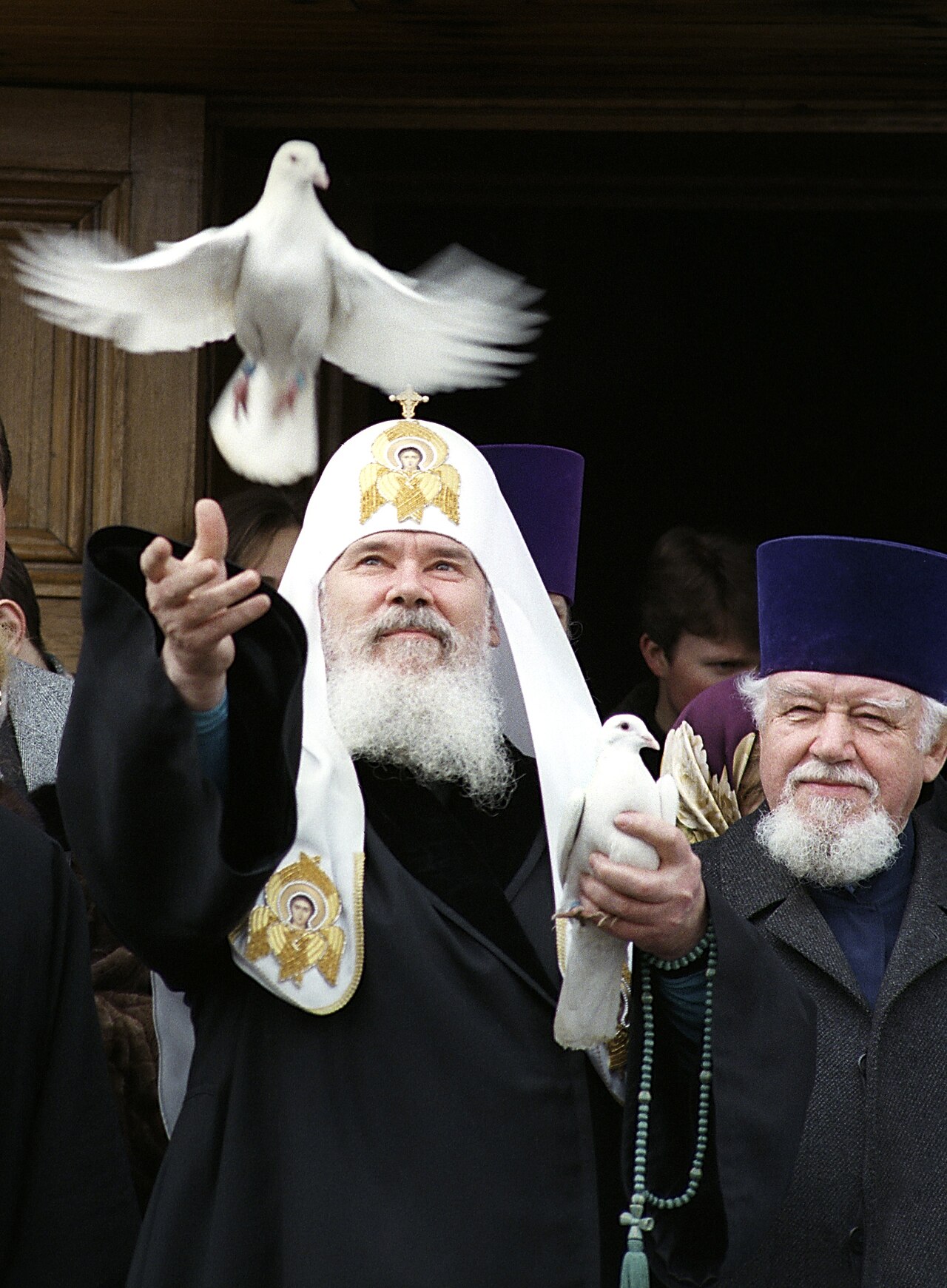
The Garrards also document that Patriarch Aleksy II (Ridiger) was “recruited by the Estonian KGB on 28 February 1958, just days after his 29th birthday” and that “exactly thirty years after his recruitment as an agent, Aleksy was given an award (gramota) by the KGB in recognition of his long service to them.”[27] His code name was “Drozhd” (“Thrush”). This is the same Patriarch who elevated Kirill to Metropolitan and under whom Kirill led the DECR for two decades.
Aleksy’s service to the KGB was not passive compliance. In 1965, as Archbishop of Tallinn, he demanded that Archbishop Hermogen of Kaluga, who was at the time the most courageous bishop in the Moscow Patriarchate, be forced into retirement for signing a protest against the Synod’s complicity in the Soviet government’s campaign of church closures.[28] This is a recurring pattern within this book. Anyone who speaks the truth is immediately punished.
Thus, the future Patriarch Aleksy did not merely tolerate persecution; he enforced it against the one bishop who dared to speak the truth.
In 1990, when the time came to elect a new Patriarch, KGB Chairman Vladimir Kryuchkov dispatched a special encoded telegram to all KGB directorates instructing them to facilitate the election of Aleksy (Ridiger), the Metropolitan of Leningrad, to the Patriarchal throne.[29] The Patriarchal election itself was directed by the head of the KGB. The question Fr. Victor Potapov posed is unanswerable: “Would the KGB operatives within the Church, who were gathered for the Council, have dared to disobey their boss Kryuchkov?”
The Garrards also name Metropolitan Pitirim, editor-in-chief of the Journal of the Moscow Patriarchate, as “one of those ‘agents in cassocks’ the KGB had inserted into the hierarchy.”[30] The official journal of the Moscow Patriarchate was edited by a KGB agent. This was not infiltration of the margins; it was control of the center.
The interlock between the Council for Religious Affairs and the KGB was not informal. According to Prof. John Dunlop, “the deputy head of the Council for Religious Affairs, Furov, held the rank of a general in the KGB.”[31] The same Furov whose 1975 internal report documented comprehensive state control over the Church was himself a KGB general. The agency overseeing the Church was staffed by the agency persecuting believers.
Agent “Aramis” Confesses
A KGB agent with the codename “Aramis,” who worked as a translator in the Department for External Church Relations, publicly confessed in the Russian newspaper Arguments and Facts (No. 8, 1992): “Almost all the employees of the Department for External Church Relations of the Moscow Patriarchate had worked for KGB.”[32]
Why does any of this matter? Because the department repeatedly described by insiders as a KGB operation, the department where agents were recruited as seminarians, where a KGB colonel sat on site assigning intelligence tasks, where the patriarch’s own speeches were ghostwritten by a KGB officer for four decades: from 1989 to 2009, this same department was headed by the current Patriarch Kirill. And today, it reports directly to him.
The 1992 Russian Parliamentary Commission
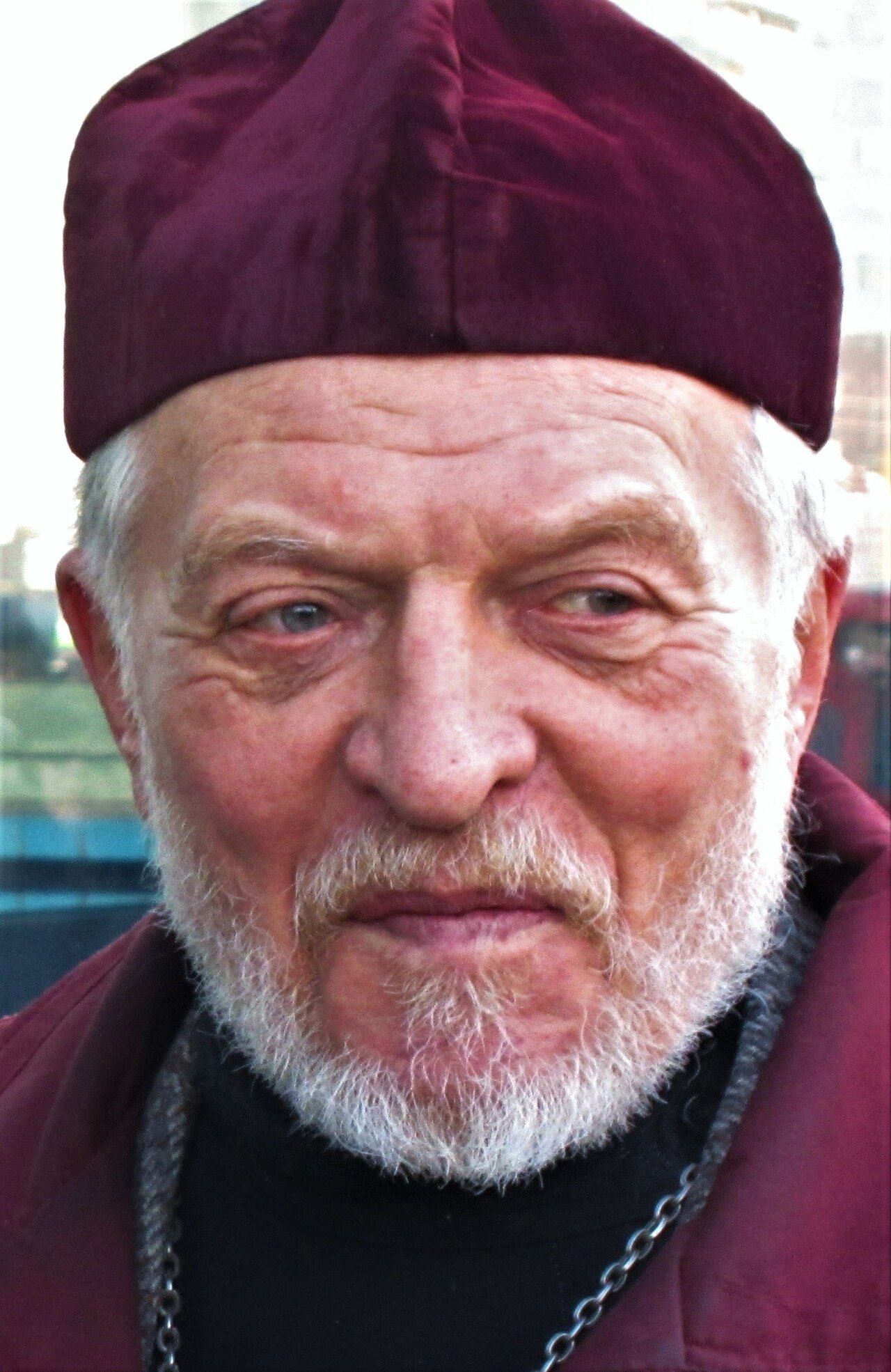
In September 1991, the Russian Supreme Soviet formed a commission to investigate the August coup attempt, with Fr. Gleb Yakunin, a dissident priest who had spent five years in a labor camp for documenting persecution, as key investigator.[33] Many attempt to dismiss this evidence as a foreign investigation or émigré allegation. This was the Russian Federation’s own parliament, using its constitutional authority, examining its own intelligence service’s archives.
The commission gained unprecedented access to KGB archives, specifically the 4th department of the 5th State Security Directorate (the “church department”).
In March 1992, the commission traveled to Washington, D.C., and held a press conference on Capitol Hill where they formally released secret KGB documents to the international press. They read the codenames of 30 of the KGB’s top collaborators among the Russian Orthodox Church’s bishops, which included nearly every member of the church’s ruling Patriarchal Synod. The commission found that in the upper echelons of the church, nine out of ten clerics worked for the KGB. Yakunin stated: “Only the deepest underground unregistered churches were not infiltrated.”
During the August 1991 coup attempt (a three-day effort by hardline Soviet officials to overthrow President Gorbachev and reverse democratic reforms), the hierarchy’s loyalties were laid bare: none of the prominent bishops attending a conference in Moscow on August 19 condemned the coup attempt. Not one. Not one of them came to the White House to bless the defenders of the legal government who faced death protecting Russian democracy from the overthrow attempt.[34]
The commission’s final report, written and signed by chair Lev Ponomarev, documented the full scope of the system. In 1982 alone, “criminal courts had sentenced 229 clergy and sectarians for punishment and sent eighteen others into exile,” while KGB files named “more than 2,500 individuals considered as ‘hostile elements.’” The report described how the KGB ensured that “those members of the clergy most inclined to compromise, servility, or indifference to the fate of the church were assigned to positions of leadership,” where “they became obedient performers of the will and desires of this ‘secret police.’” Ponomarev warned of the danger posed by “the transformation of religious organizations into KGB agent centers.”[35]
The commission also documented that during the August 1991 coup attempt, Metropolitan Pitirim (codename “Abbot”), one of the three most senior bishops in the church and publisher of the Journal of the Moscow Patriarchate, paid a personal visit to one of the coup’s ringleaders, Boris Pugo, in what the commission described as an act that “in effect, proclaimed the state criminal Pugo as the [incoming] President of Russia.”[35]
The commission reported:
KGB agents made trips abroad organized by the DECR, carrying out assignments. The nature of these assignments testifies to its transformation into a covert center of KGB agents among the faithful.
— 1992 Russian Parliamentary Commission, cited in John B. Dunlop, “KGB Subversion of Russian Orthodox Church,” RFE/RL Research Report (March 20, 1992)[36]
The DECR is inextricably linked to the KGB, and the DECR was chaired by both Metropolitan Nikodim and Patriarch Kirill.
One may ask: how did the Russian Orthodox Church respond to these revelations from Russian investigators examining Russian archives?
At the Council of Bishops at the St. Daniel Monastery in late March 1992, Patriarch Aleksy II went so far as to characterize the evidence as “libel” and declared that “the many problems of Church life have to a large degree been artificially created from the outside.”[37]
The Russian Orthodox Church responded as usual, claiming the charges were a “Western” accusation.
The Russian Orthodox Church “has not made one single move” toward removing KGB infiltrators or addressing the allegations, according to Yakunin, in stark contrast to Baptist organizations that actively purged such agents.[38] Instead, the Russian Orthodox Church predictably defrocked Gleb Yakunin in 1993 for exposing the truth.
This pattern of responding to documented evidence with retaliation against the messenger, rather than refutation of the message, continues to this present day.
The testimony of insiders and the findings of Russia’s own parliament establish the pattern. Do foreign archives confirm it?
International Corroboration
Declassified Swiss Federal Police files (released 2023) identify the KGB codename “Mikhailov” as belonging to Patriarch Kirill and describe his Geneva assignment to influence the World Council of Churches (WCC).[39]
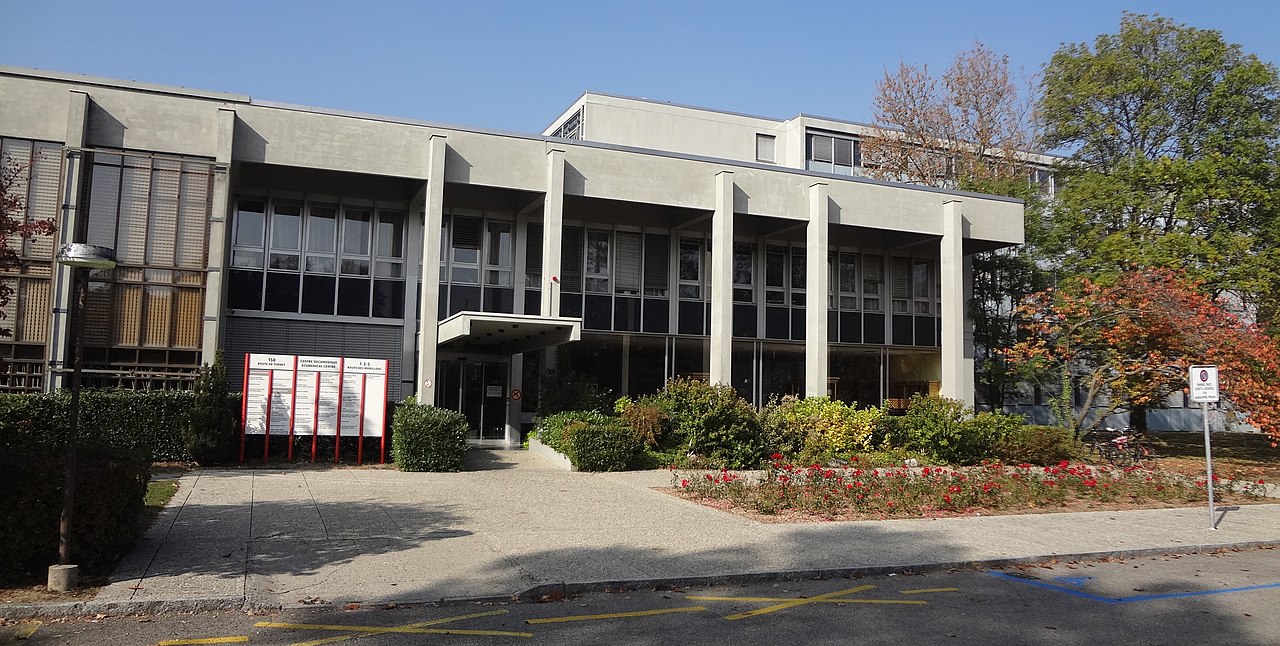
The WCC is the world’s largest ecumenical organization, bringing together over 350 churches representing roughly 580 million Christians. It serves as a global forum where churches speak collectively on matters of faith, justice, and peace. It then makes perfect sense that if your agents control the WCC’s agenda, you control what the world’s churches say about your country, and that is why the KGB invested decades of effort in penetrating it. The KGB itself assessed the result: the entrance of the Russian Orthodox Church into the World Council of Churches “was considered by the KGB and the Council of Religious Affairs as a coup for their diplomacy, as they would use their influence in the WCC to support Soviet foreign policy goals.”[40] (For Kirill’s theological defense of the WCC and the saints’ condemnation of it, see Chapter 7.)
The Mitrokhin Archive
Vasili Mitrokhin was an archivist inside the KGB’s foreign intelligence division who became disgusted with the regime he served. Over the course of a decade, while supervising the physical transfer of classified archives from the KGB’s Lubyanka headquarters to a facility outside Moscow, he made over 25,000 handwritten copies of secret documents and hid them under the floorboards of his house. After the Soviet collapse, he offered the archive to the CIA, which rejected it as possible fakes. British intelligence accepted it, verified its authenticity, and expatriated Mitrokhin and his family to the United Kingdom. Cambridge historian Christopher Andrew was authorized to publish the material. The archive has been independently corroborated by four national archives (Russian, Swiss, Czech, and Estonian). No government or serious scholar has challenged its authenticity.[41]
The reason this is relevant: the Mitrokhin Archive records how the KGB systematically used the Russian Orthodox Church delegates within the WCC to suppress criticism of Soviet religious persecution.
What else do the Mitrokhin documents reveal about the WCC?
As one 1969 report summarized: “Agents ALTAR, SVYATOSLAV, ADAMANT, MAGISTER, ROSHCHIN and ZEMNOGORSKY… took part in the work of the WCC central committee… Agents managed to avert hostile activities.”[42] The leader of the delegation, Metropolitan Nikodim (agent SVYATOSLAV), is also singled out as “the most important of the agents” at the Canterbury meeting.[43]
In 1983, the KGB dispatched 47 agents to attend the WCC General Assembly in Vancouver.[44] The results speak for themselves: the Assembly condemned Western capitalism as “the main source of injustice in the world, responsible for the evils of sexism, racism, cultural captivity, colonialism and neocolonialism.” However, on the Soviet invasion of Afghanistan, the Assembly called for withdrawal only “in the context of an overall political settlement between Afghanistan and the USSR,” conveniently forgetting that the Kabul regime had been installed by the Soviet invaders, and demanded “an end to the supply of arms to opposition groups from outside,” meaning the denial of arms to those resisting the invasion.[45] On Soviet religious persecution, the Assembly said absolutely nothing.
At the July 1989 WCC meeting in Moscow, the KGB reported that “as a result of measures carried out, eight public statements and three official letters were adopted which were in accordance with the political line of socialist countries… Thanks to our agents a positive effect was exercised on the foreigners.”[46]
By 1989, the KGB could boast: “Now the agenda of the WCC is also our agenda.” Patriarch Kirill continues to leverage these same tactics.
As historian Victoria Smolkin documents, Stalin “saw the Orthodox Church as a foreign policy tool on the world stage, a counterweight to the Vatican’s influence in Europe and a diplomatic tool in the emerging Cold War.”[47] The KGB’s use of Church agents extended beyond the WCC to direct operations against the Vatican. The point here is not to defend Rome’s ecclesiology, which this book opposes (see Part I); it is to show that KGB agents wearing the Patriarchate’s vestments were deployed against whatever target Moscow assigned, and the scope of that deployment was total.
Russian Orthodox Church delegates, including undercover KGB agents, had already attended the Second Vatican Council (1962-65) as observers.[48] Mitrokhin’s transcriptions name at least one by codename: “‘Vladimir’ was a part of a delegation of the Russian Orthodox Church who took part in the Second Vatican Council.”[49] Journalist John Koehler identifies two of the delegates by name: Metropolitans Borovoy and Kotlyrov, both KGB agents, whose attendance was permitted by Khrushchev on the condition that “no attacks against communism were made at the conclave.”[50] The price of the ROC’s presence at the council that reshaped Catholic-Orthodox relations was silence about Soviet persecution.
In 1969, KGB Chairman Yuri Andropov approved a strategic document aimed at combating the influence of the Catholic Church. Its aims included gaining influence over members of the Roman Curia, infiltrating Catholic institutions via KGB agents, discrediting Catholic officials, and forcing the Vatican to suspend its support for Catholic activities in the USSR.[48] Andropov’s directive was not a vague policy aspiration; it specified that KGB agents would provide disinformation directly to the Pope. Agent “Adamant” used contacts with “prominent members of the Roman Curia” to convey fabricated claims, while agent “Daktaras” traveled to Rome with a group of bishops and “had a personal meeting with the pope.”[51] Twenty years later, the operational results were documented. A 1989 report from the head of the KGB’s 4th Department (the religion division) states:[52]
The most important journeys were those by the agents “Antonov,” “Ostrovsky,” and “Adamant” to Italy for negotiations with the Pope on questions of future relations between the Vatican and the Russian Orthodox Church, in particular the problems of the Uniates.
— Col. V. Timoshevsky, 4th Department, 5th Directorate report (1989)
These three codenames have been identified as senior metropolitans of the Russian Orthodox Church.[53] The agents sent to negotiate with the Pope were not marginal figures; they were, by the KGB’s own documentation, operational agents carrying out assigned tasks.
The KGB did not stop at negotiations. According to Mitrokhin’s transcriptions, the KGB placed these same ROC agents inside Vatican institutions: “Drozdov” (the future Patriarch Aleksy II), “Sviatoslav” (Metropolitan Nikodim), “Adamant” (Metropolitan Yuvenali), and “Nesterov” were tasked with infiltrating the Congregation for the Eastern Churches, the Secretariat for the Unity of Christians, and the Secretariat for Justice and Peace: the very Vatican bodies responsible for relations with the Orthodox Church.[54]
This is directly relevant to Part I of this book (Chapter 1, Chapter 2): the Moscow Patriarchate’s relationship with the Vatican was not built by churchmen acting in good faith. It was built, in its foundational years, by intelligence agents executing KGB assignments. A 1980 telegram from KGB headquarters to its chief of operations in Poland made this strategy explicit: the KGB planned to use “contacts in the Russian Orthodox Church, as well as the Greek and the Armenian-Gregorian churches, for intelligence work” against the Vatican, and to prevent “any communication between these contacts and the Vatican that was not approved by the KGB.”[55] The institutional relationship that produced the 2016 Havana Declaration was seeded by KGB operations documented in the KGB’s own files.[52]
The Destruction of the Uniates
The KGB’s use of the Russian Orthodox Church against the Vatican had its most violent expression in the suppression of the Ukrainian Greek Catholic (Uniate) Church. The Unia was a heretical institution, born of episcopal betrayal at the Union of Brest (1595), and the Orthodox Church rightly opposes it. But the canonical way to bring heretics to the truth is through preaching, repentance, and conversion, not through the secret police. In 1946, the Soviet government staged the “Synod of Lviv”: all twelve Ukrainian Greek Catholic bishops were arrested, and the remaining clergy were coerced at gunpoint into “accepting” absorption into the Russian Orthodox Church. The ROC hierarchy was, in the words of historian Sean Brennan, “a willing accomplice” in what he calls “a shameful chapter.” Only two of the twelve bishops survived their prison sentences. Thousands of Eastern Rite believers perished in Siberia and Kazakhstan. Archbishop Slipyj, head of the Ukrainian Greek Catholic Church, spent eighteen years in labor camps for refusing to accept the Synod’s legitimacy. Upon his release, he described what the priests faced:
Our priests were given the choice of joining “the Church of the Regime” and thereby renouncing Catholic unity, or enduring at least ten years of the harsh fate of deportation and all the penalties associated with it. The overwhelming majority of priests chose the way of the Soviet Union’s prisons and concentration camps.
— Archbishop Josyf Slipyj, quoted in Sean Brennan, The KGB and the Vatican: Secrets of the Mitrokhin Files (Catholic Education Press, 2022), p. 26; cf. Andrew & Mitrokhin, The Sword and the Shield, p. 498
“The Church of the Regime”: Slipyj’s own name for the Russian Orthodox Church under KGB control. The Uniates were heretics, and Slipyj was no Orthodox saint. But his phrase names what the ROC had become: not a Church that converts heretics through the Gospel, but a regime instrument that absorbs them by force.[56]
The distinction matters: the Uniates were not absorbed because they were heretics who needed to be brought to the truth, but because they were communities the Soviet state considered a threat. The motive was political, not ecclesiastical. Andrew and Mitrokhin confirm this directly:
Fearful at the end of the Second World War that the Uniate Church would provide a focus for Ukrainian nationalism, Stalin set out to terrorize it into submission to Moscow.
— Christopher Andrew & Vasili Mitrokhin, The Sword and the Shield, p. 499
The ROC was chosen as the instrument for this suppression precisely because its structure made it controllable. Ivan Polianskii, a KGB colonel and chairperson of CARC (the Council for the Affairs of Religious Cults), explained why in a 1947 report to the party’s Department of Propaganda and Agitation:
The overwhelming majority of the religiously inclined citizens confess Orthodoxy and therefore are under certain influence of the Russian Orthodox Church, which due to its historically evolved doctrine, never laid claim and does not lay claim to a role of the first-rate political player, but always followed in the trail of state politics. The hierarchical organizational structure of the Orthodox Church is more perfect than the structure of any other cult, which allows us to control and regulate its internal life with greater flexibility and effectiveness.
— Ivan Polianskii, quoted in Victoria Smolkin, A Sacred Space Is Never Empty (Princeton University Press, 2018), p. 86
“More perfect than the structure of any other cult”: in the eyes of the Soviet state, the Moscow Patriarchate’s value was not its Orthodoxy but its obedience. And the consequences of this obedience have outlasted the Soviet Union itself: by suppressing the Uniates through state violence rather than canonical preaching, the ROC handed its enemies a weapon they continue to use. The Uniate priests who chose prison and deportation over compliance are now held up as martyrs of conscience by the very heretical communities the Church opposes. The compliance of the Moscow Patriarchate to the Soviet state produced more weapons for the enemies of Christ in exchange for fewer enemies of the Soviet state.[57]
For the next four decades, the KGB ran systematic operations to infiltrate and destroy the underground Uniate communities that continued to practice in secret. Mitrokhin’s transcriptions document how the KGB recruited agents among Uniate clergy through threats, blackmail, and the exploitation of family members; compromised and isolated Uniate leaders Velychovsky and Sterniuk; and in 1981, the Politburo in Ukraine directed propaganda campaigns titled “The Uniate Church: An Enemy to Peace and Progress.”[56] Even the title of this campaign reveals the pattern: the Uniates were targeted as enemies of peace and progress, not as enemies of the Orthodox faith. The Soviet state opposed the Uniates when they threatened state interests, not when they threatened the Church. The department coordinating these operations against the Uniates was the same DECR that Nikodim headed and Kirill inherited. In 2016, Patriarch Kirill signed the Havana Declaration granting the Uniates “the right to exist” (see Chapter 2, Section 5). The institution that helped destroy them now legitimizes them, through the same department, in a secret declaration with the Pope.
Declassified documents from Ukrainian Security Service (SBU) archives reveal that the 1945 Local Council that elected Patriarch Alexy I was influenced by Soviet intelligence. A September 28, 1944, directive signed by NKVD (the KGB’s predecessor agency) officials ordered that NKGB agents should constitute a majority among delegates to the council.[58] Historian Roman Skakun’s archival research in declassified KGB files documents that agent saturation among bishops in Ukraine reached 90-100% during 1944-1964.[59] This reveals an utterly systematic practice of recruiting episcopal candidates before consecration, distinguishing institutional penetration from mere survival accommodation under persecution.
Bulgarian State Security (DS) archives add a sixth country to the record. DS reports from 1982 and 1984, declassified by the Bulgarian Commission for Disclosing Documents, name “Archbishop Kirill of Vyborg, rector of the Leningrad Spiritual Academy” by real name and title in WCC operations, including his role in securing the election of Emilio Castro as WCC Secretary General. Bulgarian intelligence had no reason to use a Russian KGB codename in their own internal documentation; their identification is independent of the codename question entirely.[60]
These Ukrainian and Bulgarian sources should be evaluated in their respective political contexts, but they corroborate an identical pattern established independently by Russian, British, Swiss, and Czech archives. The convergence now spans six countries with different political interests, different archival systems, and different reasons to investigate: Russia (FSB Central Archive), the United Kingdom (Mitrokhin Papers, Churchill Archives Centre), Switzerland (Federal Police declassified files), the Czech Republic (Security Services Archive), Bulgaria (Commission for Disclosing Documents), and Ukraine (SBU archives). Add to this a United States federal court conviction with sworn KGB testimony, an FBI security warning distributed to American parishes, and the Moscow Patriarchate’s own spokesman confirming “absolutely everybody.”
To dismiss all of this requires dismissing a convergence of six sovereign nations with profoundly different political interests, plus the US federal judiciary and the FBI, all pointing toward the same institutional pattern and the same recurring names.
The evidence reviewed here points to the same conclusion: systematic institutional penetration from the 1945 Patriarch election through the DECR under Nikodim to Patriarch Kirill’s leadership today.
The Archival Record
The evidence goes further than press reports. Felix Corley, editor of Forum 18 News Service and author of Religion in the Soviet Union: An Archival Reader (1996), compiled every known reference to “Mikhailov” in publicly available KGB materials.[19] The documents span fourteen years and come from the FSB Central Archive (FSB is the KGB’s successor agency) in Moscow, the Mitrokhin Papers at Churchill Archives Centre in Cambridge, and the Czech Security Services Archive in Prague. The earliest known mention dates from February 1972, when Kirill was twenty-five:
To New Zealand and Australia went the agents “Svyatoslav” [Metropolitan Nikodim Rotov] and “Mikhailov” to the meeting of the WCC Central Committee.
— KGB operational report (February 1972), cited in Felix Corley, “The Mikhailov Files: Patriarch Kirill and the KGB” (2018)
This is the earliest known document linking the codename “Mikhailov” to WCC activities.[61] By January 1973, the KGB’s own internal reports assessed his performance:
The agents of the organs of the KGB “Magistr” [Archbishop Antoni Melnikov] and “Mikhailov” were sent to Thailand and India to take part in the work of the WCC. The agents exerted a good influence on the work of the Council and provided information of operational interest on the situation in the WCC and information on the personal character of individual figures.
— KGB operational report (January 1973), cited in Felix Corley, “The Mikhailov Files: Patriarch Kirill and the KGB” (2018)
In the KGB’s own words, “Mikhailov” informed on the people he worked with at the WCC.[62] The KGB considered this “a good influence.” If this is true, this would make Patriarch Kirill a traditore and liable to deposition.
Those who would dismiss the KGB archives as conspiracy theory or fabrication should consider what Kirill’s own website tells us. His official biography on mospat.ru confirms he was appointed the Moscow Patriarchate’s representative to the WCC in Geneva in October 1971 and attended WCC events continuously from that date. The KGB’s January 1973 report says “Mikhailov” was sent to Thailand for WCC work. The WCC’s own records show its major “Salvation Today” conference opened in Bangkok at the end of December 1972 and continued into January 1973. Archimandrite Kirill, as the Patriarchate’s WCC representative, would have attended.
The KGB says “Mikhailov” was in Thailand for the WCC in January 1973. Kirill’s own biography says he was the WCC representative. The WCC says it held a major conference in Thailand in January 1973. Three independent sources, one conclusion. This is not a conspiracy theory. It is a one-to-one match between the KGB’s classified operational reports and the publicly available record of Kirill’s own career.[63]
What defense remains? The archives are fabricated? Then why does Kirill’s own biography place him at the same events? The codename belongs to someone else? Then who was the other “Mikhailov” serving as the Patriarchate’s WCC representative in Geneva at the same time as Kirill?
The coincidence defense becomes difficult to sustain.
Mitrokhin’s own transcriptions, published in Sean Brennan’s translation of the archive, provide one further detail. In a report on the recruitment of a Jesuit rector at Gregorian University in Rome (codename “Sportsman”), the KGB noted that “Sportsman” corresponded with two agents:
He engaged in correspondence with an agent of the Dnepropetrovsk Region codenamed “Luch” and an agent of the KGB in Leningrad codenamed “Mikhailov.” “Luch” is a priest, and a teacher at the school of Scientific Atheism; “Mikhailov” is also a Church worker.
— KGB report, transcribed in Vasili Mitrokhin, The KGB vs. Vatican City, published in Sean Brennan, The KGB and the Vatican: Secrets of the Mitrokhin Files (Catholic Education Press, 2022), p. 85
The KGB’s own files identify “Mikhailov” as a “Church worker” based in Leningrad. Kirill was a Church worker based in Leningrad. The codename, the city, the profession, and the WCC timeline all converge on the same person.[64]
These are not allegations from hostile outsiders. They are the KGB’s own operational reports, filed in their own archives, describing what their own agent did for them. These files were examined by researchers when the archives were briefly opened after the failed August 1991 coup.
The Archives Are Sealed
In January 1992, the head of Russian foreign intelligence and Patriarch Aleksy II, both named in the KGB files, personally lobbied to terminate the commission’s access to the archives.[65]
They helped ensure that the evidence was sealed.
This was not improvised. Even in 1989, at the height of glasnost (Gorbachev’s policy of political openness), KGB Chairman Vladimir Kryuchkov had addressed the question of agent protection at a meeting of secretaries of party organizations within the central KGB apparatus:
It is important to display the greatest concern for our helpers. They must be absolutely certain that they will not find themselves in an awkward position thanks to our fault, and that concern for them, and for their families, is our duty.
— KGB Chairman Vladimir Kryuchkov, meeting of secretaries of party organizations, April 15, 1989
“Our helpers.” “Their families.” “Our duty.” This is a policy directive from the head of the KGB to his own senior staff, published in Sbornik KGB SSSR, the agency’s internal journal, never intended for public view. The KGB considered the protection of its Church agents a matter of institutional obligation. When the archives were sealed again, it was the fulfillment of a standing commitment articulated by the KGB Chairman himself.[66]
To date, I have found no public Moscow Patriarchate response that squarely opens these archives for independent review and refutes the documentary record item by item.
If these documents were fabricated or misrepresented, the Moscow Patriarchate could call for the archives to be reopened for independent review. Transparency never hurts innocent parties and our saints encouraged such investigations. Instead of following the example of our saints, two of the men implicated in them helped shut down the investigation, and no defense of Kirill cited in this chapter demands the archives’ release.
The documents also reveal active agent management. In 1983, “Mikhailov” underwent two “control meetings,” sessions where agents were questioned by KGB officers above the level of their usual handler:
Control meetings were held with agents: “Adamant” – [Nikolai Nikolaevich] Romanov, Fitsev. “Mikhailov” (UKGB for LR [Leningrad Region]) – Komarov.
— KGB internal report (1983), cited in Felix Corley, “The Mikhailov Files: Patriarch Kirill and the KGB” (2018)
The September 1983 control meeting was conducted by the head of the KGB’s church affairs division.[67] As late as 1983, the documents still list “Mikhailov” as subordinate to the Leningrad regional KGB, not yet transferred to the central directorate. The KGB reviewed him periodically through senior officers, not his usual handler. This was active management of an operational agent.
The Czech Security Services Archive in Prague independently corroborates these records. A November 1978 joint plan between the KGB Fifth Directorate and the Czechoslovak StB (the Czechoslovak secret police) named “Mikhailov” among agents tasked with “agent penetration of the Vatican, the World Council of Churches and other reactionary church organisations.” An October 1986 joint plan named “DROZDOV” [the future Patriarch Aleksy II] and “MIKHAILOV” together as agents expected to control the Conference of European Churches. Both documents are publicly accessible at the Czech Security Services Archive.[68]
Active Espionage: The Trofimoff Conviction
These KGB church agents were not merely passive informants.
The case of Metropolitan Iriney of Vienna (codename “Icarus”) demonstrates that ROC hierarchs served as active intelligence recruiters. Iriney recruited his foster brother, US Army Colonel George Trofimoff, who became the highest-ranking American military officer ever convicted of espionage. At trial, KGB General Oleg Kalugin testified under oath that Iriney “did good work, particularly in recruiting Markiz.” Trofimoff was sentenced to life imprisonment.
This is not journalism or allegation; it is a criminal conviction in a United States federal court, with evidence tested through cross-examination and rules of evidence. The U.S. Department of Justice stated in its indictment that the KGB had “several similar collaborators among Moscow Patriarchate clergy, both inside and outside of the USSR.”[69]
Metropolitan Nikodim: The Mentor
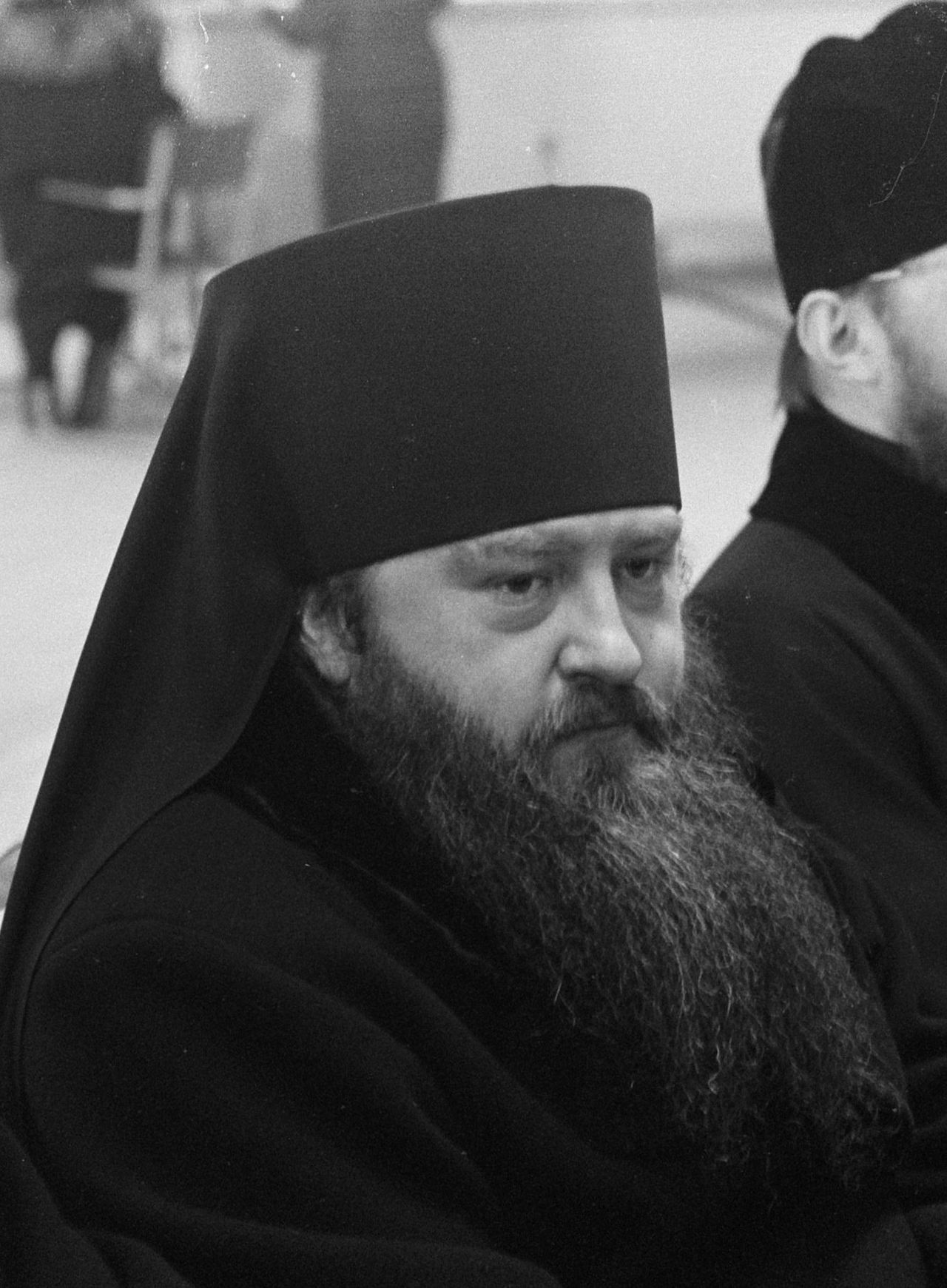
Metropolitan Nikodim personally mentored Patriarch Kirill. In 1966, Nikodim appointed the young Vladimir Gundyaev (future Patriarch Kirill) as his personal secretary. In 1969, Nikodim ordained him as deacon and priest. The Moscow Patriarchate’s own biography describes Nikodim, who headed the DECR from 1960 to 1972, as Kirill’s “teacher and mentor” and notes that Kirill saw Nikodim’s leadership of the DECR as “an example.”[70] Kirill began working in external church relations in 1968 under Nikodim’s direct guidance and later chaired the same DECR department from 1989 to 2009.
Nikodim’s problems extended beyond KGB collaboration: Orthodox conservatives charged him with “possible heresy” and linked him to “the schismatic Living Church,” the Soviet-backed movement that competed with Patriarch Tikhon.[71] On September 5, 1978, during an audience with Pope John Paul I, Nikodim suffered a heart attack and died, according to one account “literally in the arms of the Pope”; the first prayers for his repose were performed by Roman Catholic clergy.[72] This was Kirill’s mentor and ordaining bishop: not only agent SVYATOSLAV, but a man suspected of heresy and of continuing the spirit of Soviet-backed schism, whose final act was a meeting with the Roman Pope.
And yet, in 2009, Patriarch Kirill called Nikodim a “confessor” (исповедник), the formal hagiographic title for one who suffers for the Orthodox faith:
Его жизнь была жизнью исповедника, который отдал самое дорогое, что у него было — собственную жизнь, для того чтобы, может быть, наступила та эпоха, в которую нам с вами приходится трудиться.
His life was the life of a confessor who gave the most precious thing he had: his own life, so that perhaps the era in which we now labor might come to pass.
— Patriarch Kirill, speech at the conference “The Theological Legacy of Metropolitan Nikodim,” October 12, 2009. https://www.patriarchia.ru/article/89716
The Mitrokhin Archive says agent SVYATOSLAV. Kirill says “confessor.” This is the same word Patriarch Kirill uses for Metropolitan Sergius (Chapter 9), the man the saints called a blasphemer and a traitor worse than Nestorius. Thus, the pattern emerges: Patriarch Kirill applies the title of the saints to the KGB collaborators, sympathizers, and other related communists and Marxists such as Fidel Castro (Chapter 11: "Viva Cuba!" Kirill, Cuba, and Fidel Castro).
In the same speech, he defended Nikodim’s strategy of working within the Soviet system as heroic resistance:
Владыка был первым человеком, который изнутри системы стал эту совершенно неправильную схему отношений Церкви и государства разрушать.
The bishop was the first person who, from inside the system, began to destroy this completely incorrect scheme of Church-state relations.
— Patriarch Kirill, speech at the conference “The Theological Legacy of Metropolitan Nikodim,” October 12, 2009, https://www.patriarchia.ru/article/89716
Boris Talantov, who died in prison for telling the truth, called Nikodim one who “betrayed the Church not out of fear but out of conscience.” Kirill calls him a confessor who worked on the inside.[73]
Nikodim Placed Kirill at the WCC
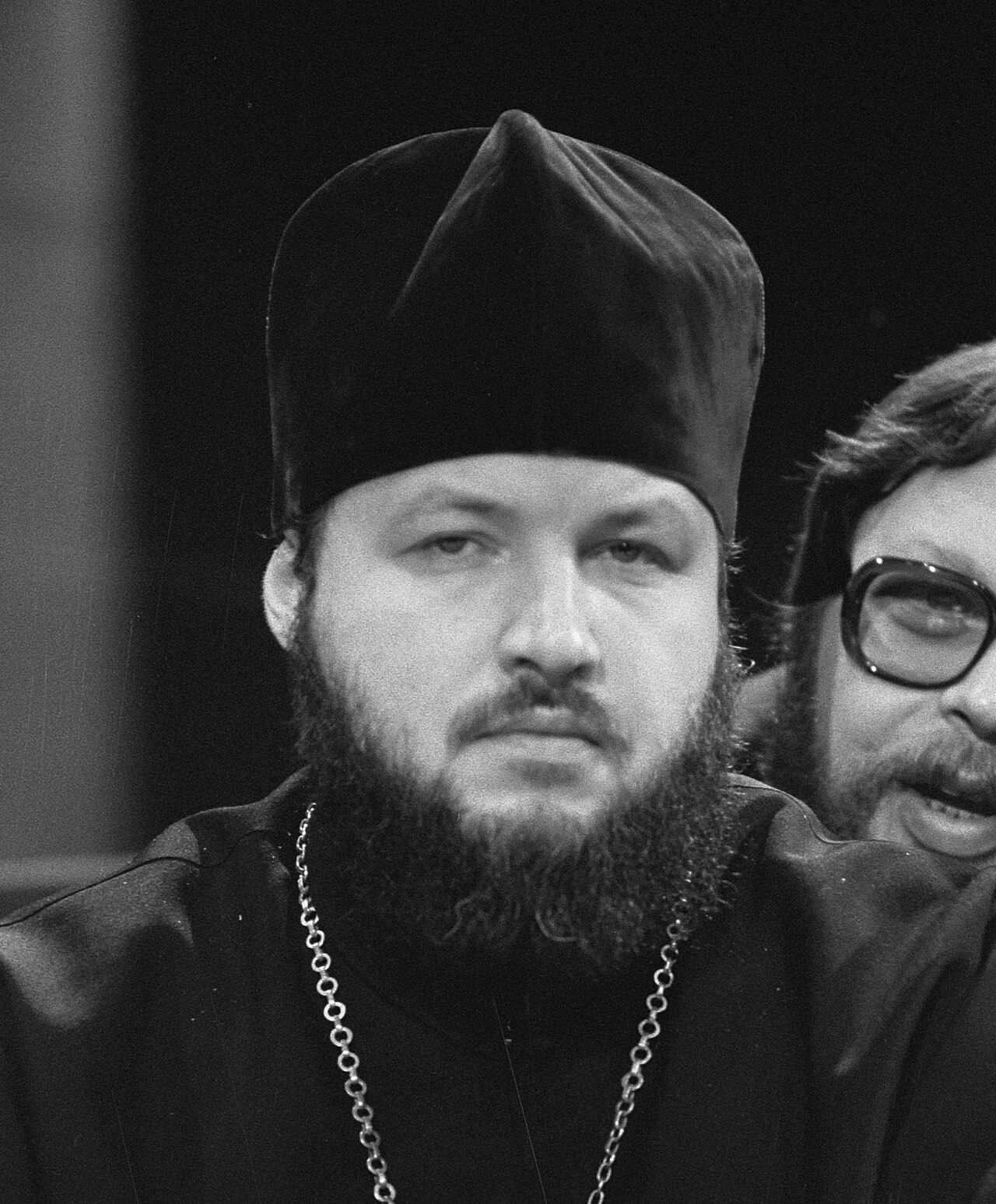
Nikodim personally placed Kirill at the World Council of Churches. As a student in 1968, Kirill attended the WCC Assembly in Uppsala. After Nikodim ordained him in 1969 and appointed him as personal secretary (1970-1971), Kirill moved to Geneva in 1971 to represent the Russian Orthodox Church at the WCC at age 24. He was elected to the WCC Central and Executive Committees in 1975, serving until 1998. From 1976 to 1978, he served as Deputy Patriarchal Exarch of Western Europe under Metropolitan Nikodim.[74] This means Kirill was Nikodim’s WCC protégé during the exact period (1971-1978) when the Mitrokhin Archive alleges KGB agents used the WCC to suppress criticism of Soviet persecution. Kirill spent 27 years (1971-1998) at this institution.
Nairobi 1975: Kirill’s First Public Betrayal
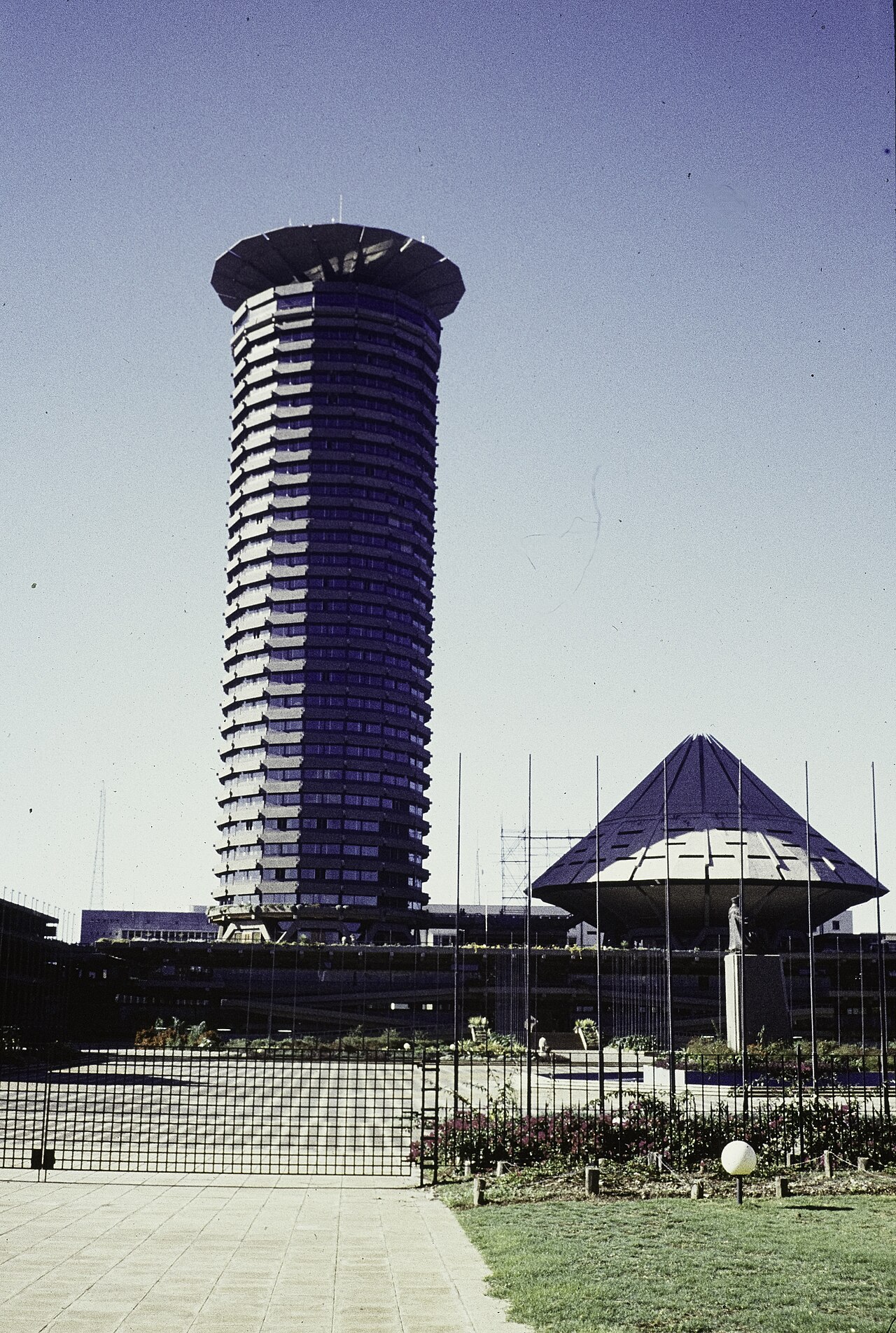
Before examining what 27 years at the WCC produced, consider what Kirill did in his first major WCC role.
At the Fifth Assembly of the World Council of Churches in Nairobi (November-December 1975), two Russian Orthodox Christians submitted a letter to the Assembly documenting religious persecution in the Soviet Union. They appealed for solidarity with believers suffering “ill-treatment” in “psychiatric clinics and nursing homes.”[75]
The authors were Fr. Gleb Yakunin and Lev Regelson. Regelson was a physicist and mathematician from Moscow University who converted to Orthodoxy from a Communist family. He became a respected church historian whose scholarship would later be cited by Jordanville’s own Orthodox Life.[76] These were not political agitators. They were serious Orthodox believers documenting what the Soviet state was doing to the Church.
The Russian delegation’s response, in which young Archimandrite Kirill participated, was described by observers as a “vigorous defence of their own government’s and church’s concept of human freedom, and their total rejection” of the dissidents’ letter. One scholar called this “a warning to all at Nairobi.”[75]
Kirill did more than participate. According to multiple sources, he “publicly denied that there were religious persecutions in the USSR.”[77] He condemned Yakunin’s letter exposing persecution. He defended the Soviet government against the testimony of believers who were suffering. A Western delegate named the dynamic at work:
I have observed there is an unwritten rule operating that says that the USSR must never be castigated in public. Nevertheless it is well known that the USSR is in the forefront of human rights violations. I think this tradition should end.
— Reverend Richard Holloway, Scottish Episcopal Church, speaking at the Nairobi Assembly (1975)[78]
Was Patriarch Kirill telling the truth when he denied that there were religious persecutions in the USSR?
No. He was lying. And we have proof from Soviet documents themselves.
The Furov Report, written that same year (1975) by the vice-chairman of the Soviet Council for Religious Affairs and later smuggled to the West, documented:[79]
- The Holy Synod was “under the control” of the Council for Religious Affairs, with its membership, agenda, and decisions coordinated in advance with the Soviet state body controlling religion
- Bishops were categorized by their political loyalty to the Soviet state
- In a public lecture that same period, Furov acknowledged that Orthodox churches had declined from 77,676 before the 1917 Revolution to 7,500 by 1976, with only 5,900 priests for those churches
The persecution was real. Orthodox churches had been reduced to less than one-tenth of their pre-revolutionary number. This was happening in real time while Kirill stood at Nairobi telling the world there were no “violations of rights of believers.”
What happened to Fr. Gleb Yakunin, the man who dared to document the persecution that Kirill denied?
In 1976, Yakunin founded the Christian Committee for the Defense of Believers’ Rights. He collected over 400 documents proving the persecution Kirill denied. In 1979, he was arrested. In 1980, he was sentenced to five years in a harsh-regime labor camp followed by five years exile. He endured Lefortovo prison and the notorious Perm-37 camp, then exile in Yakutia, 4,800 kilometers from Moscow.[80]
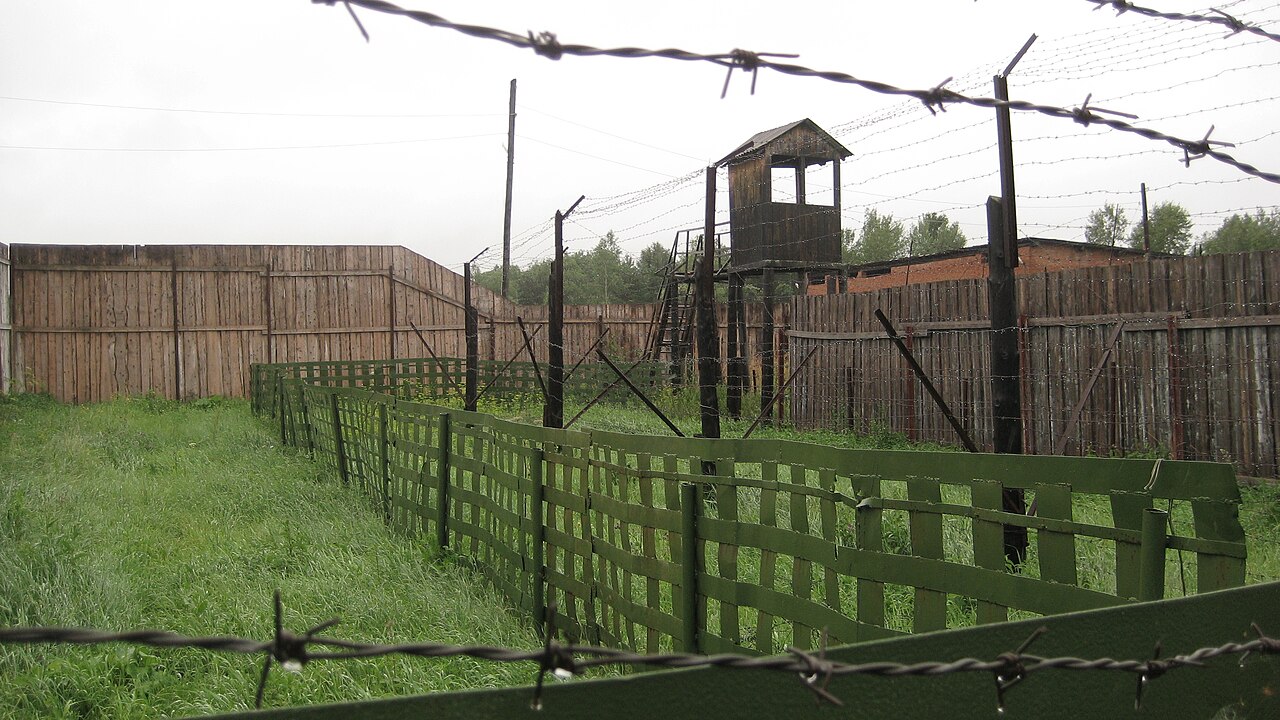
Yakunin suffered for telling the truth. Kirill advanced his career by lying.
Kirill himself later admitted what he denied in 1975. In a message to the World Council of Churches, he acknowledged what he had previously denied:
Мы с благодарностью вспоминаем ту солидарность, которую проявили вместе с нами братья и сестры в стремлении преодолеть ограничения религиозной свободы, ставшие следствием государственной политики, сформированной идеологией воинствующего атеизма.
We gratefully remember the solidarity that our brothers and sisters showed together with us in the desire to overcome the restrictions of religious freedom that came as a consequence of the state policy formed by the ideology of militant atheism.
— Patriarch Kirill, congratulatory message on the 70th anniversary of the World Council of Churches, June 22, 2018, https://www.patriarchia.ru/article/99348
He admits now what he denied then.[81] There were “restrictions of religious freedom.” There was a “state policy” of “militant atheism.” In 1975, he called this a lie. Decades later, he is grateful for solidarity against it. This is a man who says whatever the moment requires: denial when it serves the state, gratitude when it serves his reputation.
This is Sergianism in action: lying for the Soviet state while believers suffered. The man who condemned Yakunin’s letter in 1975 would later lead the institution that defrocked Yakunin in 1993 for exposing KGB infiltration. The pattern is consistent across decades: retaliation against truth-tellers, protection of the lie.
Kirill’s lie at Nairobi was not an isolated act. It was the application of a pattern established decades earlier, known as Sergianism. ROCOR’s October 1991 Council of Bishops, signed by Metropolitan Vitaly and 16 bishops, defined it precisely:
“Sergianism” is, in brief, the policy of ingratiating oneself with the atheistic regime, a policy which has brought the Sergianists so low as to serve memorial services for those who have persecuted the Church and the faith, and to utter such falsehoods as their statements alleging that no one has ever been persecuted for the faith in the Soviet Union.
— Epistle of the Council of Bishops of the Russian Orthodox Church Outside of Russia (October 1991), Orthodox Life, Vol. 41, No. 6, p. 10
This is exactly what Kirill did at Nairobi in 1975. ROCOR’s own Council of Bishops, sixteen years after Nairobi, defined Sergianism in terms that describe Kirill’s actions precisely.
What did 27 years of institutional loyalty produce? In February 1991, Metropolitan Kirill publicly defended the WCC at the Canberra Assembly, calling it “our common home” and “the cradle of a united church” and pledging to “contribute to the development of the ecumenical movement.”[82] His defense of the WCC against the saints who condemned it is examined in detail in Chapter 7.
In 2009, Kirill confirmed how far Nikodim’s influence reached:
Я могу назвать конкретные имена людей, которые, наверное, не стали бы никогда архиереями, если бы не владыка Никодим. В первую очередь, это покойный Святейший Патриарх Алексий… Ко времени перестройки, ко времени перемены церковно-государственных отношений те люди, которые стали архиереями благодаря владыке, приняли на себя весь груз управления Церковью. Практически весь Синод состоял из них, кого владыка Никодим тем или иным способом привел к архиерейскому служению.
I can name specific people who would probably never have become bishops were it not for Metropolitan Nikodim. First and foremost, the late Patriarch Alexy… By the time of perestroika [Gorbachev’s political and economic reforms], by the time Church-state relations changed, the people who became bishops thanks to the Metropolitan took upon themselves the entire burden of governing the Church. Practically the entire Synod consisted of those whom Metropolitan Nikodim had in one way or another brought to episcopal service.
— Patriarch Kirill, speech at the conference “The Theological Legacy of Metropolitan Nikodim,” October 12, 2009. https://www.patriarchia.ru/article/89716
Kirill says “Practically the entire Synod” was elevated by Metropolitan Nikodim with pride. Nikodim, the same man the Mitrokhin Archive identifies as KGB agent SVYATOSLAV hand-picked the leadership of the Russian Orthodox Church. Kirill is among them, and he praises this as a legacy to be celebrated.
Four years later, Metropolitan Hilarion (Alfeyev), Kirill’s successor as head of the DECR, independently confirmed the lineage. Speaking at the Institute of General History in December 2013, he named only two DECR chairmen as historically outstanding:
The most outstanding among them are rightly considered Metropolitan Nikodim (Rotov) of Leningrad and Novgorod, and the current Primate of the Russian Orthodox Church, His Holiness Patriarch Kirill.
— Metropolitan Hilarion (Alfeyev), speech at the Institute of General History, December 23, 2013, https://www.patriarchia.ru/article/10396[83]
In the same speech, Hilarion explained the mechanism: Nikodim convinced Soviet authorities that international ecumenical conferences required young, educated bishops to represent the Church; these bishops were ordained, sent abroad, and then returned to fill diocesan vacancies. Two witnesses, four years apart, describing the same system with pride.
The institutional through-line is undeniable. Nikodim placed Kirill at the WCC in 1971. He trained there for 27 years. In 1991, he defended the WCC against the saints who condemned it. In 2017, he glorified Nikodim’s mentor Sergius.
Thus, Patriarch Kirill’s veneration of Metropolitan Sergius is not mysterious (see Chapter 9). It is institutional loyalty to the man who made this entire apparatus possible.
Metropolitan Sergius capitulated to the Soviet Union, and thus the KGB. Metropolitan Nikodim, Sergius’s institutional successor, allegedly served as KGB agent SVYATOSLAV while heading the DECR and using the WCC for Soviet purposes. Patriarch Kirill was Nikodim’s personal protégé, ordained by him, trained by him at the DECR, and later chaired the same department for two decades. This is systematic institutional succession.
The Post-Soviet Continuation
Some may argue that whatever compromises occurred under Soviet pressure ended with the Soviet collapse. The evidence shows otherwise.
The preceding sections documented the Soviet-era penetration: a department founded by the secret police, staffed with recruited agents, run by a resident KGB colonel, with a ghostwriter authoring the Patriarch’s speeches for four decades. The question is whether this intelligence relationship ended in 1991 or continued under Kirill’s leadership. The answer is documented by the same convergence of sources: the Petrovsky memorandum (2009) formalizing cooperation with three intelligence agencies simultaneously, requiring the Patriarch’s personal approval for SVR operations; the SVR medal awarded to a Moscow Patriarchate priest in Sweden (2023); the Swedish Security Service publicly naming the Moscow Patriarchate as “a platform for intelligence gathering” (2024); five NATO/EU governments independently expelling or restricting Moscow Patriarchate clergy on security grounds; and Kirill’s own restructuring of seminaries to train military chaplains. The institution did not change. The methods did not change. Only the name of the intelligence service changed.
Patriarch Kirill inherited an institution penetrated by the KGB and actively rebuilt the church-state alliance in the post-Soviet era, positioning the ROC as an instrument of state power.[84]
Dmitry Adamsky, professor at the Lauder School of Government at IDC Herzliya, documents this transformation in Russian Nuclear Orthodoxy (Stanford University Press, 2019). In January 1992, weeks after the Soviet dissolution, approximately five thousand senior military commanders gathered in the Kremlin. Among the keynote speakers was Metropolitan Kirill:
An address by a high-ranking cleric to such a senior military audience was unheard of. Kirill’s speech, however, was perfectly tailored to resonate with the burning problems in the military’s hearts and minds. Kirill positioned himself as someone deeply concerned with the implications of the collapse for the military and the ROC as its reliable political-social ally. His address was historical; it gave the initial impulse to a monumental restoration of military-church relations.
— Dmitry Adamsky, Russian Nuclear Orthodoxy: Religion, Politics, and Strategy (Stanford University Press, 2019), p. 19
Kirill outlined the ROC’s strategic goal: “reviving the institution of the military clergy” and achieving “maximum churching of the armed forces.”[85] He positioned church and military as “brothers in arms,” both perceiving themselves “as the main defenders of the Motherland.”[86] The ROC would provide moral legitimacy, and the state would provide power. The collaboration did not end with the Soviet collapse; it was rebuilt voluntarily.
A decade later, the relationship was ceremonially formalized. In March 2002, Patriarch Aleksy II personally consecrated a restored Orthodox church in central Moscow as the parish church of the FSB, the KGB’s successor agency. The head of the FSB and the Patriarch exchanged gifts at the altar. Christopher Andrew, the Cambridge historian who authenticated the Mitrokhin Archive, called it “the mystical marriage of the Orthodox Church and the state security apparatus.”[87]
The symbolism was unmistakable. The Patriarch gave the FSB Director two icons, “the possession of which would formerly have been a sufficiently grave offence to cost any KGB officer his job.” The agency that destroyed 20,000 churches now had its own parish, consecrated by the man the KGB recruited as agent “Drozdov.”
2023: An SVR Medal for a Moscow Patriarchate Priest
The cooperation extends to the present day. In November 2023, Fr. Makarenko Pavel Georgievich, a priest of the Moscow Patriarchate serving in Sweden, was awarded the SVR Medal “For Cooperation” (No. 4023-ПН) by order of SVR Director Sergei Naryshkin. The medal, according to the SVR’s own statute, is awarded to individuals who have “provided significant assistance to the Foreign Intelligence Service of the Russian Federation in carrying out the tasks assigned to it.”[88]
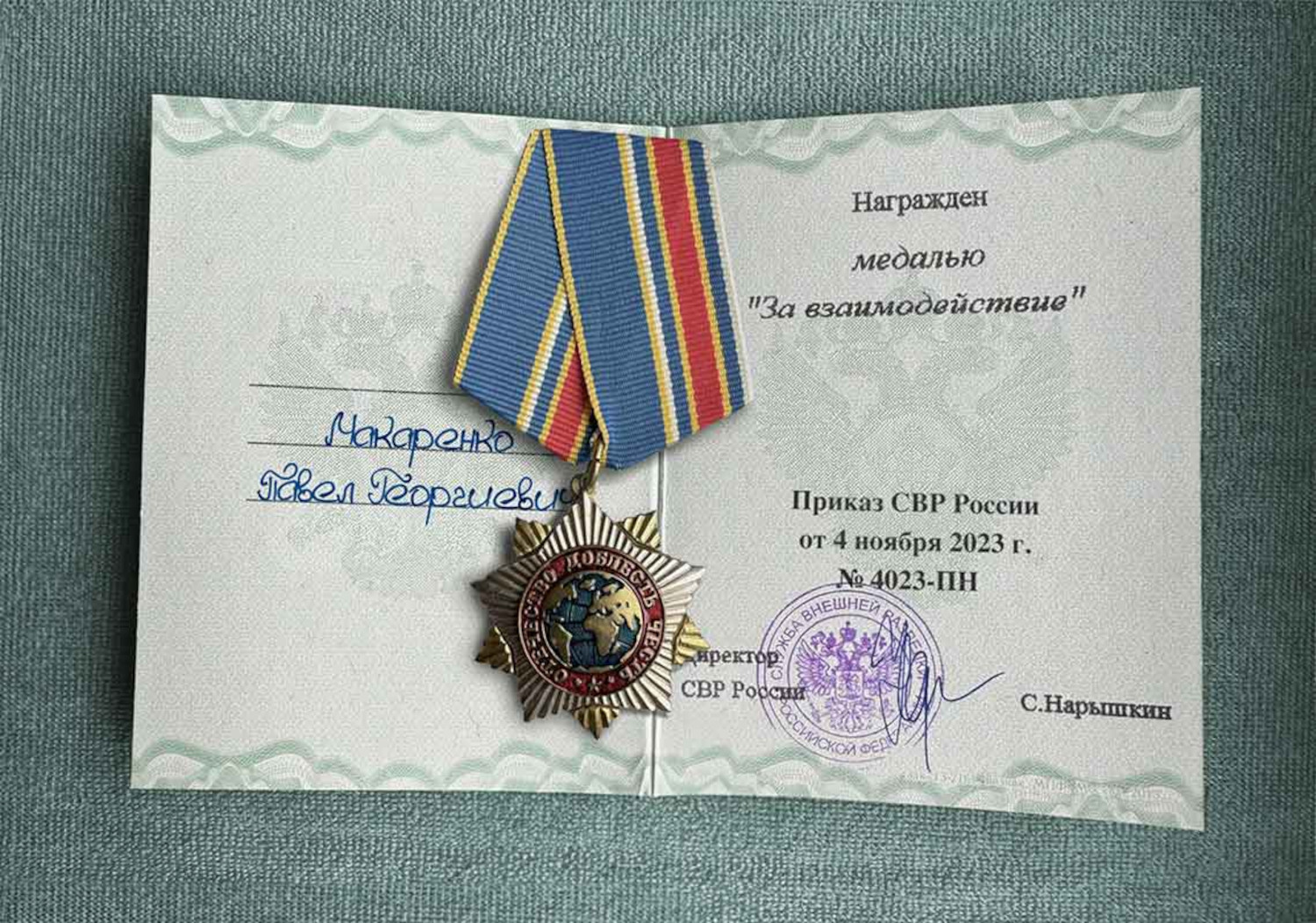
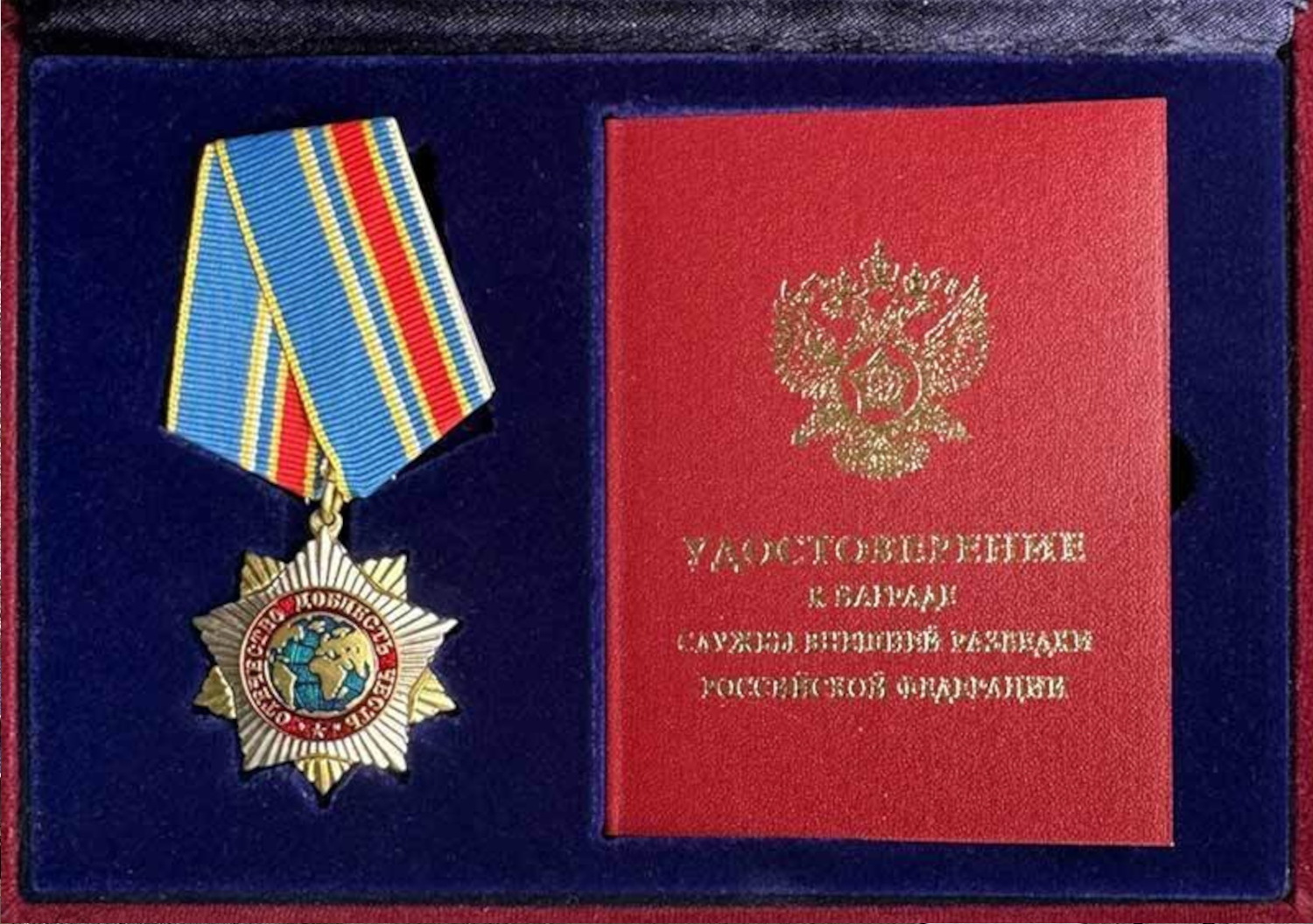
The award was presented by Metropolitan Anthony of Volokolamsk, chairman of the DECR: the same department Patriarch Kirill led for twenty years, the same department that Deacon Ribin called a KGB operation “from the very beginning.” The ceremony was photographed and published on the World Russian People’s Council’s website before being removed.[89]
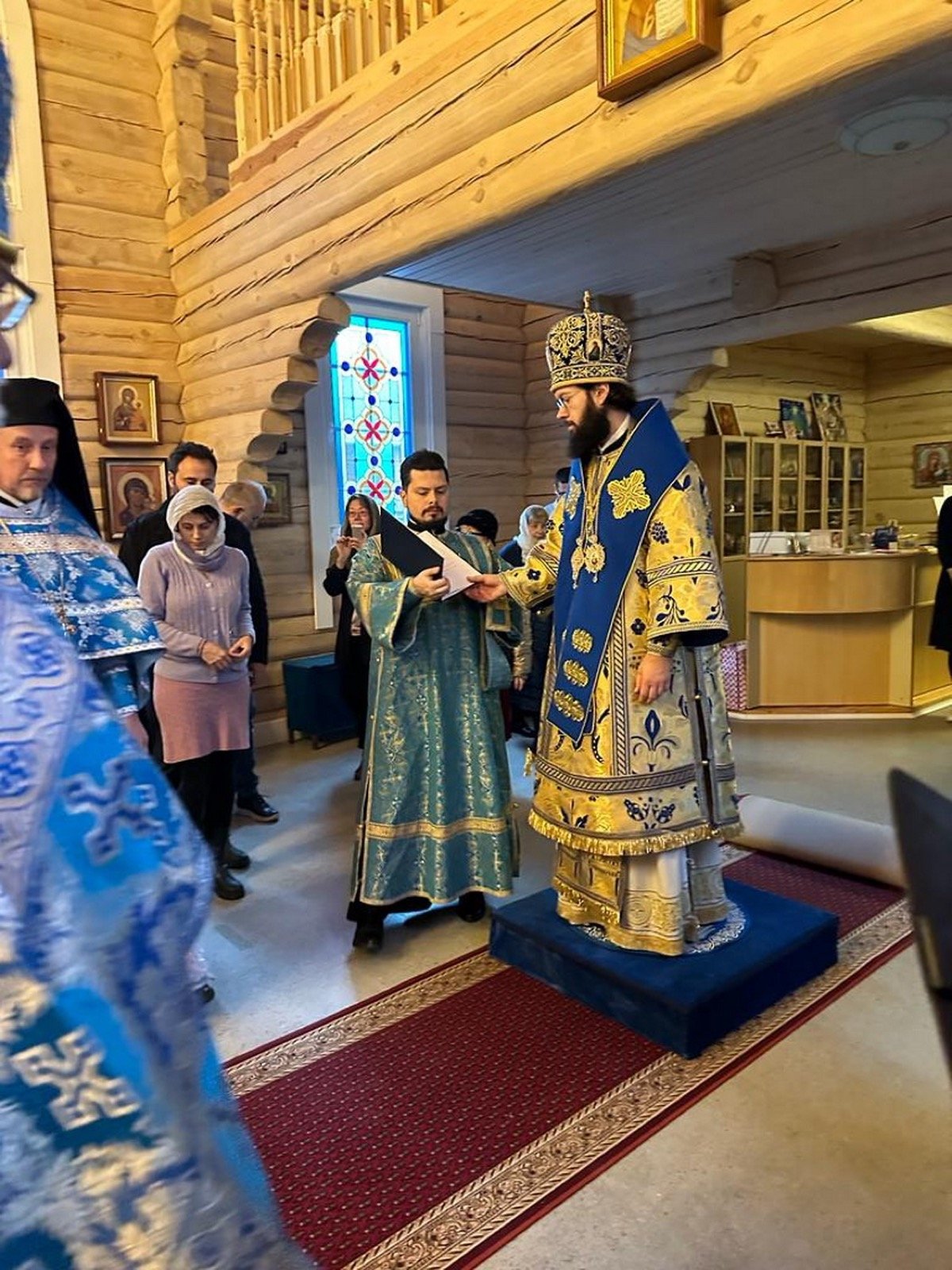
A France 24 investigation subsequently examined the Swedish parish as a possible platform for espionage.[90]
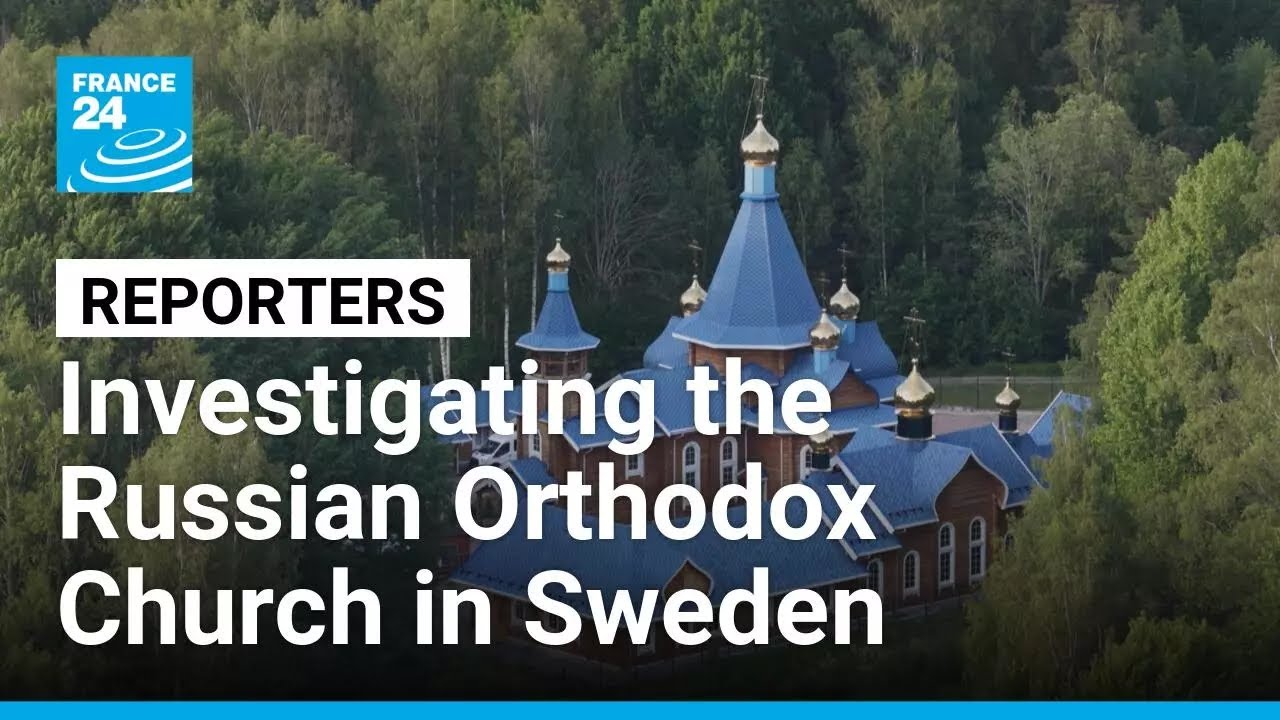
Fr. Edelshtein said the DECR was “a branch of the Ministry of Foreign Affairs and of the KGB.” Thirty-five years later, the current DECR chairman personally delivers an SVR intelligence medal to a parish priest.
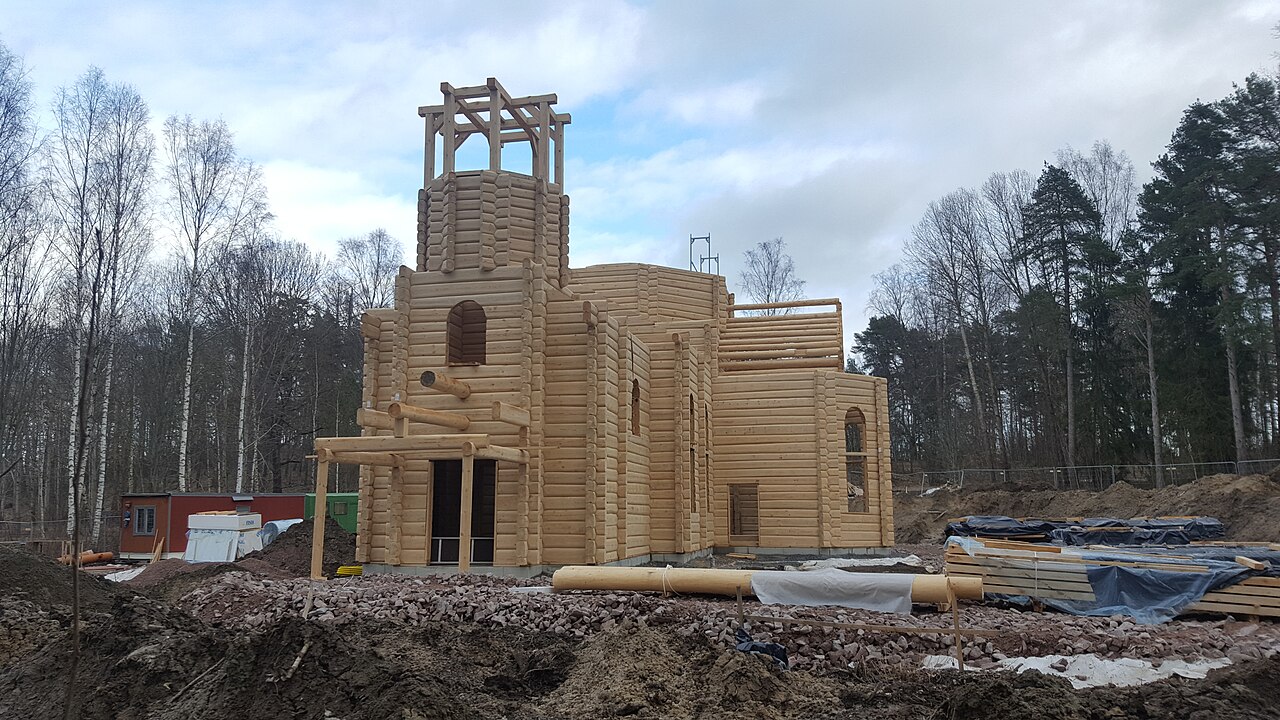
In February 2024, the Swedish Security Service (Säpo) made its assessment official: “the Russian state is using the Russian Orthodox Church of the Moscow Patriarchate in Sweden as a platform for the purpose of conducting intelligence gathering and other security-threatening activities.” Sweden subsequently cut all state funding to the Russian Orthodox Church.[91] Säpo is Sweden’s equivalent of MI5 or the FBI’s counterintelligence division. When a NATO security service publicly names a religious institution as an intelligence platform, it has completed a formal intelligence assessment and legal review. A government does not defund a religious community on speculation.
Sweden is not alone. Between 2022 and 2025, five NATO and EU member states (the Western military and political alliances that represent the security architecture of the Western world) took security action against Moscow Patriarchate clergy: Bulgaria expelled Archimandrite Vassian (Zmeev), the Russian Orthodox Church’s representative in Sofia, and two Belarusian priests on national security grounds (September 2023). The Czech Republic expelled Nikolai Lishchenyuk, a former Orthodox priest in Karlovy Vary; Czech Foreign Minister Jan Lipavský stated: “I do not consider the Russian Orthodox Church of the Moscow Patriarchate to be a legitimate church, nor its representatives to be true clergymen. It is a part of the Kremlin’s repressive apparatus, involved in Russia’s influence operations.” Estonia’s Internal Security Service revoked the residence permit of Metropolitan Eugene (Reshetnikov), head of the Estonian Orthodox Church under the Moscow Patriarchate, for activities posing “a threat to national security” (January 2024). Finland closed an ROC church near the Pansio naval base in Turku (August 2022).[92]
Five governments with different political interests, different legal systems, and different reasons to investigate, independently concluded that Moscow Patriarchate clergy or institutions in their countries posed a security threat. These findings should be weighed critically, since governments have interests, but they cannot simply be waved away as one coordinated anti-Orthodox fabrication.
Some will object that Western governments serve their own interests, that NATO institutions are not neutral arbiters, and that geopolitical hostility toward Russia taints any accusation originating from these sources. This is a fair observation: Western governments are not disinterested parties. But acknowledging that Western institutions have their own biases does not make every accusation against Russia fabricated. The evidence in this chapter comes not only from Western intelligence agencies but from Russian parliamentary investigations, Russian priests who served inside the system, confessors who went to Soviet prisons, and the Moscow Patriarchate’s own employees. When Russian, Western, and ecclesial sources independently converge on the same conclusion, dismissing them all as anti-Orthodox conspiracy requires a far greater act of faith than examining the evidence.
The Petrovsky Memorandum
The most decisive evidence that the intelligence relationship is not merely inherited but actively maintained came in 2023, when the FBI distributed a six-page notification to Orthodox parishes across the United States titled “Russian Intelligence Services Victimize Russian Orthodox Church and other Eastern Orthodox Churches.” The notification identified Dmitry Petrovsky, an employee of the Moscow Patriarchate’s DECR, as a suspected “Russian Intelligence Officer operating under non-official cover.” When U.S. Customs and Border Protection stopped Petrovsky in May 2021, his computer contained a confidential memorandum outlining a formal “system of cooperation” between the Russian Orthodox Church and three intelligence agencies simultaneously: the SVR (Russia’s foreign intelligence service, the successor to the KGB’s First Chief Directorate), the GRU (military intelligence, responsible for covert operations abroad), and the FSB (the domestic security service, the direct successor to the KGB itself).[93]
The memorandum specified that church personnel would be brought into SVR “operational activities” “exclusively at the direct approval from the Patriarch.” The GRU was described as “ready to expand the cooperation” to include “real field activity.” FBI metadata analysis dates the memorandum to late March 2009, weeks after Kirill became Patriarch in February 2009. According to Foreign Affairs, Patriarchate insiders confirmed it was drafted at Kirill’s direct request.[93]
The FBI does not distribute security warnings to religious communities unless it has assessed a credible threat. CBP seized the document under federal authority, from a device belonging to the Moscow Patriarchate’s own employee. This is not journalism or academic interpretation; it is a U.S. federal law enforcement finding.
The memorandum proves that Kirill did not merely inherit a Soviet-era intelligence relationship. Upon taking office, he personally formalized a system of cooperation with three intelligence agencies simultaneously, requiring his personal approval for SVR operational activities conducted through the Church.
Thus, the institution has not changed. The methods have not changed. Only the name of the intelligence service has changed.
The Theology of the Fusion
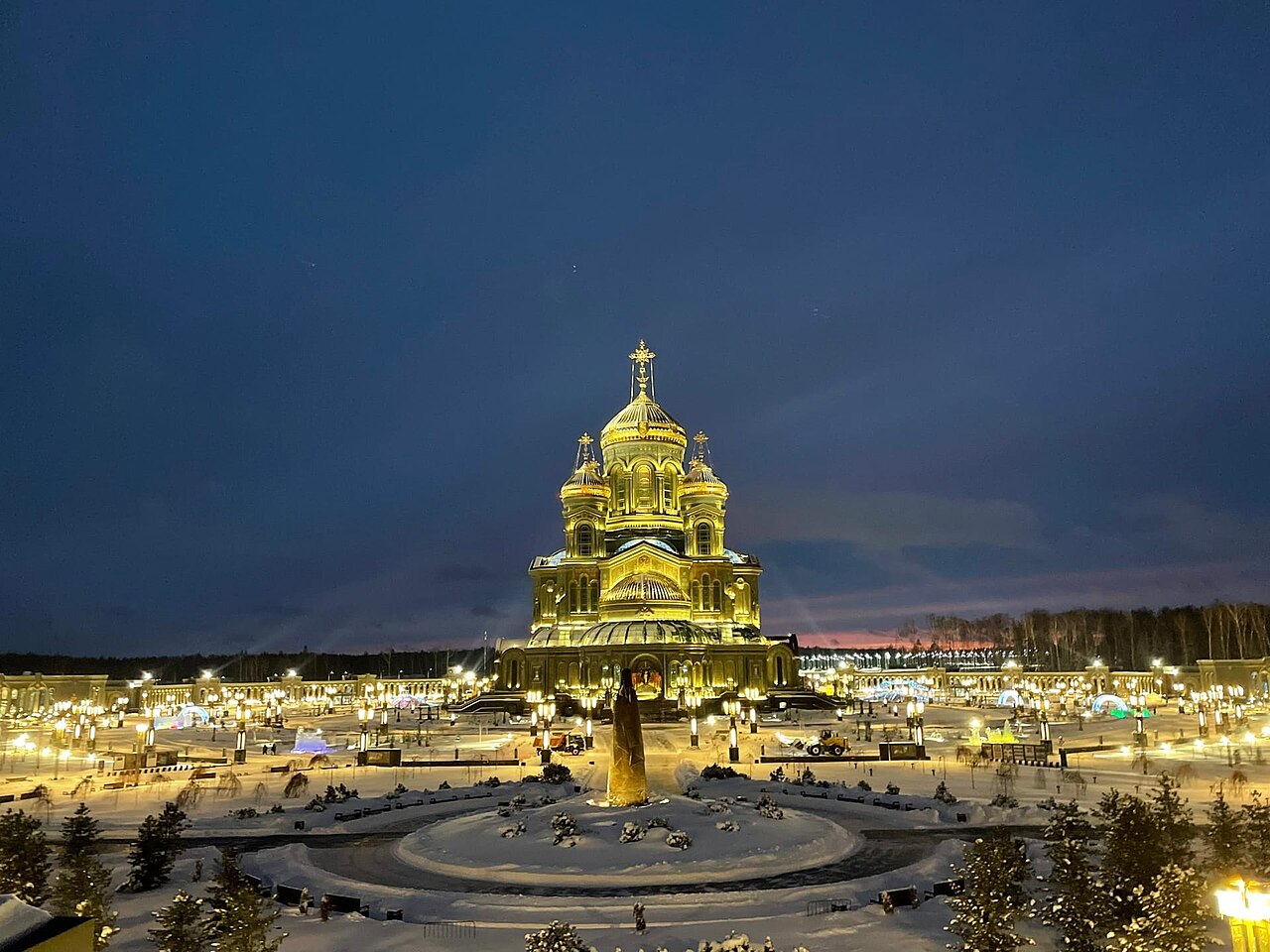
The post-Soviet collaboration is not merely institutional; Kirill has given it a theological foundation. He does not merely tolerate the intertwining of monasteries and military power. He celebrates it as divine providence. In 2016, speaking at the laying of the Dormition Cathedral in the Sarov Monastery, the monastery where St. Seraphim of Sarov labored in ascesis, Kirill addressed the fact that the Soviets destroyed the monastery and built the nuclear weapons facility (Arzamas-16) on its grounds:
В силу прагматических соображений, не имевших, казалось бы, никакой связи с духовным наследием нашего народа, здесь было заложено основание того самого учреждения, которое создало ядерный щит нашего Отечества. Благодаря ученым, инженерам, техникам, рабочим, которые трудились здесь, в обители преподобного Серафима, никак не связывая себя с великой духовной традицией, дурные поступки обратились к добрым последствиям. Силой благодати Божией свершилось так, что именно в обители преподобного Серафима возникла сила, которая оградила страну нашу и весь мир от страшной термоядерной войны.
Due to pragmatic considerations that seemed to have no connection with the spiritual heritage of our people, here was laid the foundation of the very institution that created the nuclear shield of our Fatherland. Thanks to the scientists, engineers, technicians, and workers who labored here, in the monastery of St. Seraphim, without in any way connecting themselves with the great spiritual tradition, bad deeds were turned to good consequences. By the power of God’s grace it came to pass that it was precisely in the monastery of St. Seraphim that the force arose which shielded our country and the whole world from a terrible thermonuclear war.
— Patriarch Kirill, speech at the laying of the Dormition Cathedral, Sarov Monastery, August 1, 2016. https://www.patriarchia.ru/article/97812
The Soviets razed a saint’s monastery and built thermonuclear weapons on the ruins. Kirill calls this “bad deeds turned to good consequences” by “the power of God’s grace.” He does not lament the destruction. He does not mourn the desecration. He theologizes it as providence. The monastery of St. Seraphim becoming a nuclear weapons facility is, in his telling, not a tragedy but a fulfillment.
A 2023 report by the Royal United Services Institute found that in the current war, “the one body of ideologically committed agents supporting the invasion was the Russian Orthodox Church” and that “its priests were widely recruited and run by the Russian special services and their monasteries and churches used as safe houses for equipment and personnel.”[94] This is the practical consequence of the theology Kirill articulated at Sarov: when a patriarch celebrates the fusion of monasteries and military power as God’s will, the use of churches as intelligence safe houses is not an aberration. It is the application of a principle.
The Sarov speech was not an isolated remark. In October 2025, Kirill served the Divine Liturgy in the newly consecrated main church of the Southern Military District, the command responsible for the Ukraine front. The Holy Synod later recorded that the Deputy Defense Minister, generals, and the head of the Donetsk People’s Republic were present.[95] In his sermon, Kirill declared:
Всегда на протяжении всей истории России Вооруженные силы и Церковь были как один единый организм.
Throughout the entire history of Russia, the Armed Forces and the Church were like one single organism.
— Patriarch Kirill, consecration of the Church of the Southern Military District, October 19, 2025. https://www.patriarchia.ru/article/117846
He called Putin «православный Президент, главнокомандующий Вооруженными силами» (“the Orthodox President, Commander-in-Chief of the Armed Forces”). Eight months earlier, at the Tomb of the Unknown Soldier, he made the exclusivity explicit:
Церковь молится за наши Вооруженные силы на каждом богослужении. Ни об одной другой профессии Церковь не молится.
The Church prays for our Armed Forces at every service. The Church prays for no other profession.
— Patriarch Kirill, February 23, 2025. https://www.patriarchia.ru/article/114493
The trajectory is clear. At Sarov in 2016, Kirill theologized the fusion of monastery and military as divine providence. In 2025, he declared the Church and the Armed Forces “one single organism” and stated that no other profession receives the Church’s liturgical intercession. This is not a patriarch who tolerates the state’s encroachment on the Church. This is a patriarch who has made the encroachment into a theology.
Kirill’s Response
Against all of this evidence, what has Patriarch Kirill said?
While the parliamentary commission was revealing codenames and the Church was preparing to silence Yakunin, Metropolitan Kirill offered his only substantive response. At a student assembly at Moscow State University in 1992, he declared:
Факт встречи духовенства с представителями КГБ нравственно безразличен.
The fact of clergy meeting with KGB representatives is morally indifferent.
— Metropolitan Kirill, student assembly at Moscow State University (1992), reported in Pryamoy Put’, no. 1-2, 1992
He did not deny that the meetings took place. He denied that they carried moral weight. Fr. Victor Potapov, the ROCOR priest who recorded this statement, identified Kirill in the same passage as «он же агент “Михайлов”»: “he is also agent ‘Mikhailov.’”[96]
Archives from six countries. A United States federal court conviction. The FBI. Five NATO/EU governments. The KGB’s own deputy chairman. A senior Moscow Patriarchate spokesman. And Kirill’s recorded response to clergy meetings with KGB representatives was that this was “morally indifferent.”
Consider what “morally indifferent” means in context. The KGB was the enforcement arm of a state that destroyed over 20,000 churches. It executed clergy for the crime of believing in God. It imprisoned confessors in labor camps where they died in the snows of Siberia. It recruited seminarians as “eternal slaves” held by the threat of exposure. It embedded a colonel inside the DECR to assign intelligence tasks to church employees. It ghostwrote the Patriarch’s speeches for four decades. It dispatched agents to the WCC to suppress criticism of the very persecution it was conducting. And the man who led the department that insiders called “a branch of the KGB from top to bottom” says that meeting with representatives of this apparatus carries no moral weight.
“Morally indifferent.” The ancient Church denied communion even at death to informers whose denunciations led to persecution. St. Basil decreed permanent ejection from ministry for the lapsed. The Council of Arles deposed traditores who merely handed over scriptures. And Kirill calls the clergy’s collaboration with the apparatus that tortured and killed Orthodox Christians “morally indifferent.” This is a confession, expressed as indifference.
When Swiss Federal Police declassified archives in 2023 corroborating the allegations, the Moscow Patriarchate refused to comment. The Russian Embassy in Bern responded:
[The evidence is] another example of “Russophobia” spreading in Switzerland.
— Russian Embassy in Bern, response to Swiss declassified KGB archives, February 2023
This is the modern rhetorical tactic documented throughout this book[97]: when confronted with documented evidence, to simply claim discrimination and Russophobia, rather than refute the evidence. The closest thing to an official family response came from Kirill’s nephew Mikhail Goundiaev, who said his uncle “was not an agent, even if he was subject to the KGB’s ‘strict control.’” The concession is revealing: even the family’s denial admits that Kirill operated under direct KGB control.
No formal refutation from the Moscow Patriarchate has been issued from 1992 to the present day. (For the full theological response to the “Russophobia” objection, including St. Seraphim of Sarov’s prophecy about Russian hierarchs falling away from Orthodoxy, see Chapter 15.)
C. The Verdict
The confessors who traversed the road of the martyred Russian Church, who paid for their witness with imprisonment, exile, and death, pronounced their verdict on the institution Patriarch Kirill led. The evidence from Russian witnesses, Russian parliamentary investigations, and declassified archives from six countries confirms what they said. The post-Soviet era proves this was not survival under duress: the alliance was rebuilt by choice. The man who told the truth went to prison; the man who lied became Patriarch.
To date, I have found no credible public defense by the ROC, ROCOR, or Patriarch Kirill that refutes these findings point by point. No institutional repentance has been made in any capacity, nor is any being asked for by our shepherds.
ROCOR’s Own Assessment (1992)
What did ROCOR itself say about the Moscow Patriarchate at the time these facts were being revealed?
Igumen Luke, Managing Editor of Orthodox Life (the official English-language publication of Holy Trinity Monastery, Jordanville), wrote in January 1992, immediately after the Soviet collapse:
Do not be deceived. The old wine exists, but it is found only in the old vessel, the ALTERNATIVE CHURCH, of those who remained faithful to the traditions of the Apostles and Fathers. The new wine is found in the new vessel.
— Igumen Luke, “The Church in 1991,” Orthodox Life, Vol. 42, No. 1 (January-February 1992), p. 52
In ROCOR’s own editorial judgment, the Moscow Patriarchate was the “new wine”: a novel institution that had departed from the Apostolic tradition. ROCOR identified itself as the faithful remnant, the “old wine” preserved in the “alternative church” of those who refused to compromise. This assessment came from ROCOR’s own publishing house, the same institution that trained many current ROCOR clergy. It cannot be dismissed as “Western propaganda” or “anti-Russian bias.” It was ROCOR’s considered theological judgment at the moment the Soviet archives were opening.
This is the same ROCOR that reunified with Moscow in 2007 without requiring any formal repentance for Sergianism, ecumenism, or KGB collaboration.
The author of this 1992 assessment is now Bishop Luke of Syracuse and abbot of Holy Trinity Monastery and was appointed to the Joint Commission negotiating reunion. He was present at the 2007 signing ceremony at Christ the Savior Cathedral.
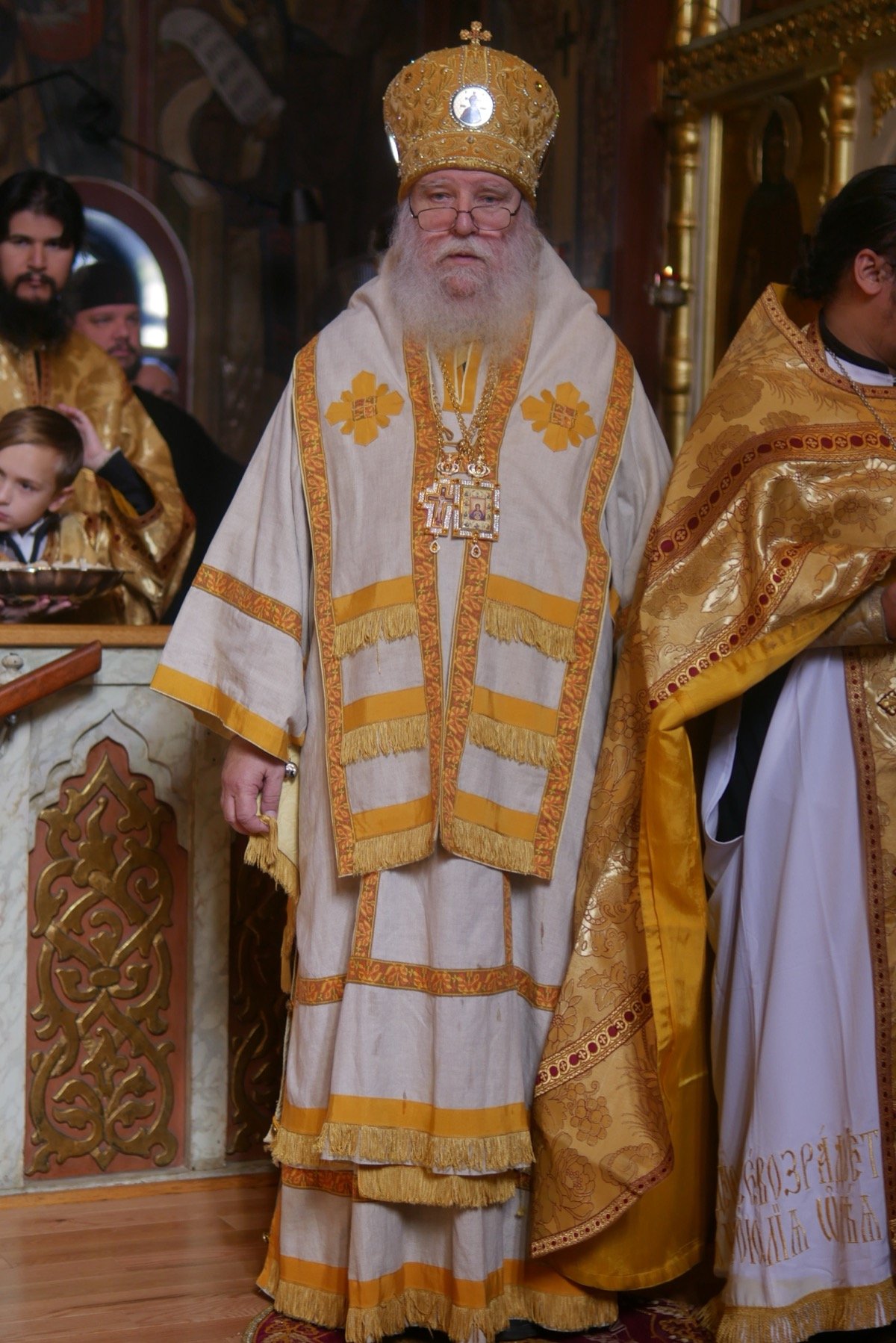
In other words, Bishop Luke, the man who wrote that ROCOR was the faithful remnant and the Moscow Patriarchate the “new wine,” personally helped negotiate and sign the Act of Canonical Communion with that same institution.
Thus, what changed was not Moscow, but ROCOR’s willingness to overlook what it once condemned.
No Lustration, No Repentance
“Lustration” is the process by which post-Communist countries reviewed the records of their former secret police to identify individuals who collaborated, and then barred them from public office, required public disclosure, or initiated institutional accountability. It is the Western world’s answer to the question: what do you do when you discover your institutions were run by agents of a regime that persecuted its own people?
After the Soviet collapse, every Eastern European country subject to Soviet-style secret police infiltration faced this question: what to do with the collaborators? The answers varied, but every country except Russia attempted some form of accountability.
In Poland, the Institute of National Remembrance (IPN) opened the archives of the communist-era secret police (SB). The results were immediate: in January 2007, Archbishop-designate Stanisław Wielgus, appointed to lead the Warsaw Archdiocese, resigned on the day of his formal installation after a Catholic Church commission confirmed he had “consciously and willingly collaborated” with the SB. The Catholic Church itself investigated, using state archives, and acted within weeks of disclosure.[98] The Czech Republic opened its StB archives and barred former agents from public office. Germany created the Stasi Records Agency and processed over seven million individual requests for access to files. In Bulgaria, the Commission for Disclosing Documents revealed in January 2012 that 12 of 15 metropolitan bishops on the Bulgarian Orthodox Church’s Holy Synod were former DS (State Security) collaborators. Historian Momchil Metodiev called the finding “beyond all expectations.”[99] In Romania, Metropolitan Nicolae Corneanu publicly called collaboration “the Church’s prostitution with the Communist régime.”[100]
Russia did none of this. It was not for lack of trying. In 1992 and again in 1997, Galina Starovoitova, a democratic reformer and People’s Deputy, introduced a lustration bill that would have banned former KGB agents from public office for five to ten years. Had the bill passed, Vladimir Putin would not have been permitted to serve as a city official in St. Petersburg, let alone as FSB chief and president. The bill failed both times. Starovoitova was assassinated in November 1998. As she herself had observed: “Even our ‘Nuremberg,’ the trial on the crime of the CPSU, was unsuccessful and nobody was punished as a result.”[101]
And yet, many who take great offense at Russia and its leaders being critiqued have nothing to say about a Russian woman ruthlessly assassinated for attempting to hold the KGB accountable.
No lustration law was passed. No truth and reconciliation process was initiated. The 1992 Russian Law on Security provided “legal and social protection for citizens and organizations that assist in ensuring security,” a provision that, combined with the closure of the KGB archives, allowed successor agencies to maintain both old and new agent networks by force of law.[102] The FSB retained its personnel, its archives, and its institutional relationships. And the Moscow Patriarchate, unlike Baptist organizations in Russia that actively purged collaborators, undertook no process of examination, repentance, or cleansing.
In April 1992, the Council of Bishops convened a commission to investigate KGB ties, but, as Fr. Victor Potapov documented, it consisted entirely of recently consecrated bishops who had been ordained after perestroika and had no authority or standing to investigate the old guard. No ancient canons against informers were invoked. The commission produced no public findings, no depositions, no requirements for repentance.
The contrast is stark; in Poland, an Archbishop-designate resigned the day of his installation when archives proved collaboration. In Bulgaria, a government commission identified 80% of the synod as former agents. In Romania, a metropolitan used the word “prostitution.” Even the most compromised churches in the former Soviet bloc submitted to some form of investigation. The Moscow Patriarchate remains the only major church in the former Eastern Bloc that has neither acknowledged collaboration nor permitted independent review of its archives.[103]
Kirill himself has provided the theological justification for this silence. In a 2011 speech in Kiev, he declared:
Тогда систему ценностей атеистическая идеология хотела переформатировать, но на мораль не посягала. Возьмите тот же «Кодекс строителя коммунизма» — он же был списан с Евангелия. Без Бога, но та же самая мораль.
At that time, the atheistic ideology wanted to reformat the system of values, but it did not encroach on morality. Take the same “Moral Code of the Builder of Communism”: it was copied from the Gospel. Without God, but the same morality.
— Patriarch Kirill, speech at the National Cancer Institute, Kiev, April 26, 2011, https://www.patriarchia.ru/article/92071
Most egregiously, in the same speech he called Soviet atheists “rudimentarily Orthodox Christians”:
Неверующие люди советского времени рудиментарно были православными христианами — они оставались в той же самой системе ценностей.
The unbelieving people of the Soviet era were rudimentarily Orthodox Christians: they remained within the same system of values.
— Patriarch Kirill, speech at the National Cancer Institute, Kiev, April 26, 2011, https://www.patriarchia.ru/article/92071
If the Soviet moral system was functionally Christian, then what was wrong with collaborating? This theological dissolution of the boundary between persecutor and persecuted is examined in Chapter 9.
Some will surmise that collaboration was simply the price of survival, that “everyone had to compromise.” This is the same argument Metropolitan Sergius made in 1927, and it was condemned by the canonized New Martyrs and Confessors who chose prison, exile, and death over accommodation with the persecutors.
St. John of Shanghai and San Francisco, one of the most universally venerated saints of our time, stated plainly that Sergius’s capitulation “brought no benefit to the Church” and that “the persecutions not only did not cease; they were intensified.” To defend Kirill’s collaboration as unavoidable is to make the same error Sergius made, and to disagree with St. John of Shanghai and the saints the Church has canonized for refusing to do what Kirill did. Their witness, and the full theological case against the “survival” defense, is examined in Chapter 9.
Even if every KGB allegation here were dismissed as propaganda, Kirill’s glorification of Metropolitan Sergius, against the explicit witness of the New Martyrs, already places him at odds with the saints. The KGB evidence strengthens the pattern; it is not the sole pillar of this argument. The saints have already rendered their verdict.
The evidence is documented, cross-corroborated across six countries, unrefuted, and met with nothing but complaints of discrimination.
This exaltation of state power and compromise sets the stage for a broader ideology: ethnophyletism under the banner of the Russian World.
The Soviet secret police operated under many names: the Cheka (All-Russian Extraordinary Commission, 1917-1922), GPU (Main Political Directorate, 1922-1934), NKVD (People’s Commissariat of Internal Affairs, 1934-1946), MGB/MVD (Ministry of State Security / Ministry of Internal Affairs, 1946-1954), and finally KGB (Committee for State Security, 1954-1991). After the Soviet collapse it was reorganized as the FSB (Federal Security Service) for domestic operations and SVR (Foreign Intelligence Service) for foreign intelligence. Despite these changes of name, agents were still referred to as “Chekists” by the Soviet population, “and they often referred to themselves by this name as well.” Following the convention of scholars of Soviet intelligence such as Christopher Andrew, Harvey Klehr, and John Earl Haynes, this chapter uses “KGB” as a general term for all iterations of the Soviet secret police. Sources: Sean Brennan, The KGB and the Vatican: Secrets of the Mitrokhin Files (Catholic Education Press, 2022), pp. 2, 57. ↩
Fr. Victor Potapov, “False Is Corrupt,” Orthodox Life, Vol. 42, No. 5 (September-October 1992), p. 44 (Holy Trinity Monastery, Jordanville, NY). Potapov writes: “The professor has obviously forgotten the tragic biography of Boris Talantov, a confessor of our times, who was destroyed by Metropolitan Nikodim of Leningrad, viz. the agent ‘Svyatoslav.’” This is one of the earliest published identifications of Nikodim’s KGB codename in a ROCOR publication. Talantov was arrested in 1969 and died in prison in January 1971. ↩
Feodisiya Varavva, testimony published in A History of the Russian Church Abroad 1917-1971, Seattle, 1972. Varavva spent years imprisoned under both Nazi and Soviet regimes for her Orthodox faith. Her naming of Nikodim among those who “betrayed Christ” carries the weight of a confessor’s witness. ↩
Council of Arles, Canon 13 (314 AD). The council addressed the traditores controversy following the Diocletian persecution. Canon 13 decreed that clergy who surrendered scriptures, sacred vessels, or names of brethren to persecutors must be deposed, though their sacramental acts remained valid. This canon was central to the Donatist controversy. Source: Fourth Century Christianity, https://www.fourthcentury.com/arles-314-canons/ ↩
Council of Elvira, Canon 73 (313 AD). The Council of Elvira (held in Hispania, modern-day Granada) is one of the earliest Church councils. Canon 73 addresses informers (delatores) whose denunciations led to the persecution or death of fellow Christians. The penalty is the most severe the ancient Church imposed: denial of communion even at death (nec in finem accipiat communionem). If the case was less severe (the informing did not lead to death), communion is permitted after five years of penance. Fr. Victor Potapov, Молчанием предаётся Бог (By Silence God Is Betrayed) (Tolyatti: Лествица, 1992), p. 29, draws the direct parallel to KGB informers among the clergy: “The Church already introduced such a law (canon) into its life more than 1,600 years ago.” Latin text: Acta Conciliorum, Tomus I (Parisiis, 1715). ↩
Original Greek: “Τὰ κατὰ Κληρικοὺς ἀδιαφόρως οἱ Κανόνες ἐξέθεντο, κελεύσαντες μίαν ἐπὶ τοῖς παραπεσοῦσιν ὁρίζεσθαι τιμωρίαν, τὴν ἐκπτώσιν τῆς ὑπηρεσίας.” ↩
Original Greek: “Εἴ τις κληρικὸς διὰ φόβον ἀνθρώπινον, Ἰουδαίου ἢ Ἕλληνος ἢ αἱρετικοῦ, ἀρνήσεται, εἰ μὲν τὸ ὄνομα τοῦ Χριστοῦ, ἀποβαλλέσθω· εἰ δὲ τὸ ὄνομα τοῦ κληρικοῦ, καθαιρείσθω· μετανοήσας δέ, ὡς λαϊκὸς δεχθήτω.” ↩
Fr. George Edelshtein, interview in Argumenty i Fakty, No. 36 (September 1991), p. 7. Argumenty i Fakty is a mainstream Russian newspaper with peak circulation exceeding 30 million, not a dissident or émigré publication. Also cited in Keith Armes, “Chekists in Cassocks: The Orthodox Church and the KGB,” Demokratizatsiya 1, no. 4 (Boston University, 1993), p. 75. Edelstein gave nearly identical testimony at the February 19, 1992 Moscow press conference, published in Orthodox Life, Vol. 42, No. 3 (May-June 1992), pp. 30-31 (Holy Trinity Monastery, Jordanville, NY), ROCOR’s own journal. ↩
Anatoli Oleinikov, the last deputy chairman of the KGB, stated in a December 1991 interview that of the Russian Orthodox priests approached by the KGB, 15 to 20 percent had refused to work for it. Christopher Andrew and Vasili Mitrokhin, The Sword and the Shield: The Mitrokhin Archive and the Secret History of the KGB (Basic Books, 1999), p. 490. The “courageous minority who resisted all KGB pressure were inevitably denied advancement. The section of the Orthodox Church most compromised by its association with the KGB was its hierarchy.” ↩
The DECR should not be confused with the Council for Religious Affairs (CRA) also mentioned in Fr. Edelshtein’s testimony. The CRA was a Soviet state body that controlled religion domestically; the DECR is the Church’s own department for international relations. Both were under KGB influence, but from different directions: the CRA controlled the Church from outside as a government agency; the DECR was penetrated from inside as a church institution staffed by KGB agents. ↩
The Russian name is ОВЦС (Отдел внешних церковных связей). Multiple English translations are used interchangeably for the same department: “Department for External Church Relations” (official, mospat.ru), “Department of External Affairs” (Vatican News, 2022), and “Department for External Relations” (various). Vatican News describes Metropolitan Antonij as “president of the Department of External Affairs of the Moscow Patriarchate,” referring to the same DECR that Patriarch Kirill chaired from 1989-2009. See: Vatican News, “Pope Francis meets with Russian Orthodox Metropolitan Antonij,” Aug 2022, https://www.vaticannews.va/en/pope/news/2022-08/metropolitan-antonij-of-moscow-patriarchiate-visits-pope-francis.html; TADviser, “DECR (Department for External Church Relations of the Moscow Patriarchate),” https://tadviser.com/index.php/Company:DECR_(Department_for_External_Church_Relations_of_the_Moscow_Patriarchate); mospat.ru official biography of Patriarch Kirill, https://mospat.ru/en/patriarch/. ↩
Multiple witnesses at the February 19, 1992 Moscow press conference confirmed the KGB penetration of the DECR, including an anonymous Moscow Patriarchate priest who stated: “We priests were ordained by officers of the KGB. This we all knew. Can anyone really say that they did not know that from top to bottom the Department of External Affairs was a branch of the KGB?” Fr. George Edelstein gave nearly identical testimony. Published in Orthodox Life, Vol. 42, No. 3 (May-June 1992), pp. 30-33. Holy Trinity Monastery, Jordanville, NY. ↩
Alexander Nezhnyi, testimony at press conference (February 19, 1992), published in Orthodox Life, Vol. 42, No. 3 (May-June 1992), p. 31 (Holy Trinity Monastery, Jordanville, NY). Nezhnyi was a journalist who investigated KGB-Church corruption alongside Fr. Gleb Yakunin using documents from the Communist Party and KGB archives. His description of the “two parallel careers” pattern independently corroborates Deacon Ribin’s testimony about seminary recruitment from the same press conference. ↩
Keith Armes, “Chekists in Cassocks: The Orthodox Church and the KGB,” Demokratizatsiya 1, no. 4 (Boston University, 1993), p. 74: “There is evidence that KGB officers were sent to study at seminaries abroad in order to become priests and serve in the Soviet Union.” ↩
Memorandum by V. V. Fortunatov, Assistant to the Authorized Representative of the VII Section, Secret Department of the VChK, 1921. Central Archive of the FSB of Russia, Ф. 1, Оп. 5, Д. 360, Л. 6. Published as Document No. 13 in M. Yu. Krapivin, “Агентурно-осведомительная работа органов ЧК в среде православного духовенства (по материалам секретного делопроизводства ВЧК, 1921 г.),” Noveyshaya Istoriya Rossii 12, no. 2 (2022), pp. 524-538. Krapivin (Doctor of Historical Sciences, Saint Petersburg State University) independently located and published this document from the same archival source, confirming its authenticity. ↩
KGB Briefing Paper No. 48s, “On the use by the organs of the KGB of the possibilities of the Russian Orthodox Church in counter-espionage measures within the country and abroad,” approved July 28, 1970. Cited in Felix Corley, “The Mikhailov Files: Patriarch Kirill and the KGB” (2018). This is an internal KGB document approved at the agency’s leadership level. ↩
4th Department, 5th Directorate report, 1982. Cited in Felix Corley, “The Mikhailov Files: Patriarch Kirill and the KGB” (2018). This is an internal KGB departmental assessment, not produced for public consumption. ↩
Information provided by Deacon Andrei Ribin, a former DECR employee who publicly repented. Published in Orthodox Life, Vol. 42, No. 3 (May-June 1992), p. 33. See also Keith Armes, “Chekists in Cassocks: The Orthodox Church and the KGB,” Demokratizatsiya 1, no. 4 (1993), p. 74. The codename “Kuznetsov” = Aleksey Buyevsky is confirmed by FSB Central Archive documents compiled in Felix Corley, “The Mikhailov Files” (2018): f. 6, op. 7/16, por. No. 24, d. U-175, t. 4, p. 122 (July 1984 report listing “Kuznetsov [Aleksey Buyevsky]” as a KGB agent at the WCC). The Moscow Patriarchate’s own obituary of Buevsky (2009) confirms he joined the DECR as its first employee in May 1946. ↩
Felix Corley, “The Mikhailov Files: Patriarch Kirill and the KGB” (2018). Corley is editor of Forum 18 News Service, a Norwegian human rights organization that monitors religious freedom across the former Soviet Union and Eastern Europe. His earlier work, Religion in the Soviet Union: An Archival Reader (Macmillan, 1996), draws on previously classified KGB, Central Committee, and Council for Religious Affairs documents. The Mikhailov Files document compiles all known references to Patriarch Kirill (codename “Mikhailov”) across four archives: FSB Central Archive (Moscow), Mitrokhin Papers at Churchill Archives Centre (Cambridge), Czech Security Services Archive (Prague), and Bulgarian DS archive. Reliability: archival primary sources cross-corroborated across four independent national archives. ↩
A. Shushpanov, “Ispoved’ byvshego agenta” (Confession of a Former Agent), interview by P. Luk’ianchenko, Argumenty i fakty, No. 8, February 26, 1992. Shushpanov, a former DECR employee, publicly identified Colonel “Vladimirov” (real name Aleksei Alekseevich Pogodin) as the KGB officer permanently stationed inside the DECR who arranged intelligence assignments for department employees. Cited in Daniel, Freedom and the Captive Mind (2024), p. 307 n.69. ↩
Same Shushpanov interview (Argumenty i fakty, No. 8, February 26, 1992). Shushpanov described the chain of custody: five copies of each intelligence report, distributed to the DECR chairman, the Council for Religious Affairs, and the KGB. Cited in Daniel, Freedom and the Captive Mind (2024), p. 307 n.68. ↩
Archbishop Chrysostom (Martishkin), interview in Russkaya Mysl’ (Russian Thought), April 24, 1992, p. 8. Russkaya Mysl’ (founded 1880) is the oldest Russian-language newspaper in Western Europe, published in Paris. Metropolitan Methodius (Nemtsov) of Voronezh and Lipetsk served from 1982 to 2003. ↩
Izvestia, June 10, 1991, No. 137, “I Take upon Myself Responsibility for All that Happened” (Я беру на себя ответственность за все, что произошло). Aleksy II acknowledged “compromises” by church leaders including himself. Reported in the New York Times, “St. Petersburg Journal; Patriarch’s Church Revives, but Will Spirituality?” November 9, 1991. The Times described the Patriarch’s statement as “a striking public apology.” See also Wilson Center, “Allegations of Collaboration with Secret Police Fail to Tarnish the Russian Church’s Charisma.” ↩
In 1988, KGB Chairman Viktor Chebrikov personally presented an honorary citation (gramota) to Agent “Drozdov” (Aleksy II) for “meritorious service.” Yevgenia Albats noted this signified services “much beyond the act of ‘pacifying monks.’” Sources: Alexander Nezhnyi, “Kamo griadeshi,” Ogonek (May 1992), p. 13; Yevgenia Albats, The State Within a State: The KGB and Its Hold on Russia (Farrar, Straus & Giroux, 1994), p. 46. Cited in Daniel, Freedom and the Captive Mind (2024), pp. 202-203. ↩
These three responses are documented separately: Archbishop Chrysostom’s full confession in Rossiyskaya Gazeta No. 52/388 (1992); Patriarch Aleksy II’s admission of “compromises” in Izvestia, June 10, 1991; and Metropolitan Kirill’s “morally indifferent” statement at Moscow State University, reported in Pryamoy Put’, no. 1-2, 1992. ↩
Archpriest Vsevolod Chaplin, Secretary for Relations Between the Moscow Patriarchate and Society, quoted in Olga Ackerly-Dolskaja, High Treason: The Luring of the Russian Orthodox Church Abroad to the Moscow Patriarchate (Orthodox Traditionalist Publications, 2023), p. 52. Chaplin served as the Moscow Patriarchate’s primary public spokesman on church-society relations. ↩
John and Carol Garrard, Russian Orthodoxy Resurgent: Faith and Power in the New Russia (Princeton University Press, 2008), pp. 20, 36-37. The Garrards document that “The position of patriarch was on the KGB’s nomenklatura list, meaning that the generals had the privilege of signing off on the occupant” (p. 20). Aleksey Ridiger was “recruited by the Estonian KGB on 28 February 1958, just days after his 29th birthday” and his code name was “Drozhd” (Thrush). “Exactly thirty years after his recruitment as an agent, Aleksy was given an award (gramota) by the KGB in recognition of his long service to them” (pp. 20, 36-37). Research is from Keston Institute at Oxford. ↩
Keith Armes, “Chekists in Cassocks,” Demokratizatsiya 1, no. 4 (1993), p. 75. Archbishop Hermogen of Kaluga signed a protest against the Holy Synod’s complicity in the Soviet government’s campaign of church closures. Aleksy, then Archbishop of Tallinn, demanded Hermogen’s forced retirement. Hermogen was “undoubtedly the most courageous of all the bishops of the Moscow Patriarchate” at the time. ↩
Fr. Victor Potapov, Молчанием предаётся Бог (By Silence God Is Betrayed) (Tolyatti: Лествица, 1992), p. 38. Potapov cites newly uncovered documents showing that in 1990, KGB Chairman Kryuchkov “dispatched a special encoded telegram to all directorates of the KGB, suggesting that they facilitate the election of Alexis (Ridiger), the Metropolitan of Leningrad, to the Patriarchal throne.” Kryuchkov was also a participant in the failed August 1991 coup d’état. ↩
John and Carol Garrard, Russian Orthodoxy Resurgent: Faith and Power in the New Russia (Princeton University Press, 2008), p. 263, footnote 5. Metropolitan Pitirim served as editor-in-chief of the Journal of the Moscow Patriarchate (Журнал Московской Патриархии), the official publication of the Russian Orthodox Church. ↩
John B. Dunlop, The Faces of Contemporary Russian Nationalism (Princeton University Press, 1983), p. 179, as reviewed in Orthodox Life, Vol. 38, No. 1 (January-February 1988), pp. 36-48. V. Furov was deputy chairman of the Council for Religious Affairs. His 1975 internal report to the CPSU Central Committee, later smuggled to the West, documented comprehensive state control over the Church. ↩
A KGB agent with the codename “Aramis,” who worked as a translator in the Department for External Church Relations (DECR) of the Moscow Patriarchate, publicly confessed in the Russian newspaper Argumenty i Fakty (Arguments and Facts), No. 8, 1992. According to his confession: “Almost all the employees of the Department for External Church Relations of the Moscow Patriarchate had worked for KGB.” From 1989 to 2009, the DECR was headed by current Patriarch Kirill (Vladimir Gundyaev). Sources: Newslanc, “Russian Orthodox Church and KGB,” https://newslanc.com/russian-orthodox-church-and-kgb/; LiveJournal archive, “Russian Orthodox Church and KGB,” https://lorddreadnought.livejournal.com/35504.html; ACT Files, “KGB Agents in Cassocks of the Russian Orthodox Church, Pt. 1,” https://actfiles.org/kgb-agents-in-cassocks-of-the-russian-orthodox-church-pt-1/. ↩
The commission was formed in September 1991 to investigate the August coup attempt and was chaired by Lev Aleksandrovich Ponomarev (physicist, human rights activist, People’s Deputy) with key investigator Gleb Yakunin (dissident Russian Orthodox priest turned parliamentarian). The commission gained unprecedented access to KGB archives, specifically files from the 4th department of the 5th State Security Directorate (the “church department”). In March 1992, Ponomarev and Yakunin traveled to Washington, D.C., and held a Capitol Hill press conference where they formally released secret KGB documents. They read the codenames of 30 of the KGB’s top collaborators among the Russian Orthodox Church’s bishops, revealing that in the upper echelons of the church, nine out of ten clerics worked for the KGB. Yakunin: “Only the deepest underground unregistered churches were not infiltrated.” The commission’s Russian report was published in «Московские новости», № 42 (октябрь 1992), с. 8. English coverage: Christianity Today, “The KGB Files: Inside the Church,” Apr 27, 1992, https://www.christianitytoday.com/ct/1992/april-27/kgb-files-inside-church.html; CSMonitor, “The KGB’s Agents in Cassocks,” Apr 28, 1992, https://www.csmonitor.com/1992/0428/28191.html; related Ukrainian coverage of Filaret and the UOC: The Ukrainian Weekly, No. 31 (Aug. 2, 1992), PDF: https://archive.ukrweekly.com/wp-content/uploads/The_Ukrainian_Weekly_1992-31.pdf; Cornell University Press, “Freedom and the Captive Mind,” ch. 9 “Lifting the Cover,” https://cornellpress.manifoldapp.org/read/freedom-and-the-captive-mind/section/9f67476a-cd26-42ec-9282-01b4c63bd1a7. ↩
Keith Armes, “Chekists in Cassocks,” Demokratizatsiya 1, no. 4 (1993), p. 75: “Significantly, none of the prominent bishops attending a conference in Moscow on 19 August 1991, condemned the putsch. Not one came to the White House to bless its defenders who faced death protecting the legal government of Russia from the overthrow attempt by military forces.” ↩
Direct quotations from the final report of the Russian Parliamentary Commission, written and signed by commission chair Lev Ponomarev. Typewritten copies held at the Keston Center for Religion, Politics, and Society, Baylor University, Waco, Texas (SU Ort: Yakunin, Fr. Gleb [1989-1993], box 50, folder 4). Cited in Daniel, Freedom and the Captive Mind (2024), pp. 213-215. The commission had constitutional authority granted by the Russian Supreme Soviet and unprecedented access to KGB archives. The report was signed by the commission’s chair and represents an official finding of the Russian Federation’s own parliament. ↩
Original Russian: “Агенты КГБ… совершали поездки за границу, организованные ОВЦС, выполняя задания… Характер этих поручений свидетельствует… о превращении его в скрытый центр агентов КГБ среди верующих.” ↩
Fr. Victor Potapov, By Silence God Is Betrayed, p. 38. At the Council of Bishops at the St. Daniel Monastery (late March - early April 1992), Patriarch Aleksy II characterized the parliamentary commission’s evidence of hierarchical collaboration with the KGB as “libel” and claimed that church problems were “artificially created from the outside.” Potapov notes that “not a single ‘Drozdov,’ ‘Antonov,’ ‘Abbot,’ ‘Mikhailov,’ ‘Adamant,’ ‘Ostrovsky,’ and others as yet undisclosed — not one of these ‘agents in cassocks’ has provided an example of repentance… NOT A SINGLE ONE!” ↩
According to Gleb Yakunin’s testimony at the March 1992 Washington press conference, while many religions, notably the Baptists, were actively purging their organizations of KGB infiltrators, the Russian Orthodox Church “has not made one single move” in that direction. The Russian Orthodox Church defrocked Gleb Yakunin in 1993 for exposing KGB infiltration of the church hierarchy. This represents institutional retaliation against the whistleblower rather than investigation of the allegations. Sources: Christianity Today, “The KGB Files: Inside the Church,” Apr 27, 1992, https://www.christianitytoday.com/ct/1992/april-27/kgb-files-inside-church.html; Orthodox Christian Laity, “Remembering the Russian Priest Who Fought the Orthodox Church: Father Gleb Yakunin,” https://ocl.org/remembering-russian-priest-fought-orthodox-church-father-gleb-yakunin/. ↩
RFE/RL, “Reports: Russian Patriarch Kirill Spied In Switzerland For The KGB In The 1970s,” Feb. 6, 2023, https://www.rferl.org/a/russia-patriarch-kirill-switzerland-spied-kgb/32257512.html; The Moscow Times, “Russian Patriarch Kirill Spied in Switzerland for KGB in 70s – Media,” Feb. 6, 2023, https://www.themoscowtimes.com/2023/02/06/russian-patriarch-kirill-spied-in-switzerland-for-kgb-in-70s-media-a80151; Euronews, “Patriarch Kirill Worked for the KGB in the 1970s, Swiss Media Reports,” Feb. 6, 2023, https://www.euronews.com/2023/02/06/patriarch-kirill-worked-for-the-kgb-in-the-1970s-swiss-media-reports. ↩
Sean Brennan, The KGB and the Vatican: Secrets of the Mitrokhin Files (Catholic Education Press, 2022), p. 74, fn. 60, translating Mitrokhin’s transcription of KGB records. The KGB also “considered the active participation of the Russian Orthodox Church in the World Council of Churches as a useful asset” (p. 30, fn. 61). ↩
Vasili Nikitich Mitrokhin (1922-2004) served in the KGB’s First Chief Directorate (foreign intelligence) archive from 1956 to 1984. He grew disillusioned with the Soviet regime after witnessing the persecution of Boris Pasternak; he wrote an anonymous protest letter to the Writers’ Union newspaper in his left hand so his KGB colleagues would not recognize his handwriting. Between 1972 and 1984, he hand-copied classified documents from the archive, smuggling his notes home in his shoes and clothing. From 1974 to 1982, while supervising the physical transfer of KGB-PGU archives from the Lubyanka headquarters to the Moscow suburb of Yasanevo, he made over 25,000 copies of documents, hiding them under the floorboards of his house. After the Soviet collapse, Mitrokhin first offered the archive to the American CIA, which rejected the documents as possible fakes. He then turned to British intelligence: in March 1992, he brought samples to the MI6 station at the British embassy in Riga, Latvia. MI6 assessed and verified the archive, then arranged to have Mitrokhin, his family, and his documents expatriated to the United Kingdom. Cambridge University historian Christopher Andrew was authorized to publish the material, resulting in The Sword and the Shield (Basic Books, 1999) and The Mitrokhin Archive II: The KGB and the World (2005). The edited typescript notes were opened to public research at Churchill Archives Centre, Churchill College, Cambridge, in July 2014. The collection is accessible by appointment (archives@chu.cam.ac.uk). Volume MITN 2/1, titled “The Church,” covers KGB operations against religious institutions. Selected documents are available online at the Wilson Center Digital Archive (digitalarchive.wilsoncenter.org). No government or intelligence service has challenged the authenticity of the Mitrokhin materials. The Keston Institute (Oxford), after reviewing the documents, concluded that “long-standing allegations that the Patriarch and other senior bishops of the Russian Orthodox Church collaborated with the KGB are based on fact.” Biographical details from Sean Brennan, The KGB and the Vatican: Secrets of the Mitrokhin Files (Catholic Education Press, 2022), pp. 2-6; Christopher Andrew, “Vasili Mitrokhin,” The Guardian, February 3, 2004, https://www.theguardian.com/news/2004/feb/04/guardianobituaries.russia. ↩
Andrew & Mitrokhin, The Sword and the Shield (Basic Books, 1999), pp. 486–487 (1969 WCC central committee: agents ALTAR, SVYATOSLAV, ADAMANT, MAGISTER, ROSHCHIN, ZEMNOGORSKY; agents “averted hostile activities”). Three specific entries in Mitrokhin’s archived notes at the Churchill Archives Centre corroborate the identification of “Mikhailov” as Kirill: MITN 2/1, p. 33 (1975: “‘Mikhailov,’ representative of the Moscow Patriarchate at the World Council of Churches in Geneva. KGB agent”); MITN 2/1, p. 15 (late 1970s: “agent ‘Mikhailov’ of Leningrad UKGB”); MITN 2/1, p. 124 (1980: Kirill’s visit to the Baden-Baden parish under KGB agent “Icarus”). ↩
Metropolitan Nikodim’s KGB codename was SVYATOSLAV, not ADAMANT. ADAMANT was Metropolitan Yuvenaly (Poyarkov), Nikodim’s deputy. See: “The Svyatoslav Files: Metropolitan Nikodim and the KGB” (Academia.edu), https://www.academia.edu/37223006/The_Svyatoslav_Files_Metropolitan_Nikodim_and_the_KGB, which compiles all known KGB references to Nikodim under codename SVYATOSLAV. Andrew & Mitrokhin, The Sword and the Shield (Basic Books, 1999), pp. 487–488, identifies Nikodim as “the most important of the agents” at the Canterbury meeting. Some secondary sources confuse the codenames because Nikodim and Yuvenaly frequently operated together. ↩
Keith Armes, “Chekists in Cassocks,” Demokratizatsiya 1, no. 4 (1993), p. 73: “In 1983, the KGB dispatched 47 [sic] agents to attend the WCC General Assembly in Vancouver.” The number comes from KGB operational reports examined by the 1992 Parliamentary Commission. ↩
Christopher Andrew, The World Was Going Our Way: The KGB and the Battle for the Third World (Basic Books, 2005), p. 480. Andrew is the Cambridge historian who co-authored the authorized Mitrokhin Archive publications. His characterization of the Vancouver Assembly resolutions is based on the official WCC Assembly documents cross-referenced with KGB operational records. ↩
Keith Armes, “Chekists in Cassocks,” Demokratizatsiya 1, no. 4 (1993), p. 73, citing KGB internal reports on the July 1989 WCC meeting in Moscow: “As a result of measures carried out, eight public statements and three official letters were adopted which were in accordance with the political line of socialist countries… Thanks to our agents a positive effect was exercised on the foreigners, and additional ideological and personality data were obtained.” ↩
Victoria Smolkin, A Sacred Space Is Never Empty: A History of Soviet Atheism (Princeton University Press, 2018), p. 86. Smolkin documents that Stalin “also saw the Orthodox Church as a foreign policy tool on the world stage, a counterweight to the Vatican’s influence in Europe and a diplomatic tool in the emerging Cold War.” She notes that “Stalin dissolved and outlawed the Ukrainian Greek Catholic Church and transferred its property to the Orthodox Church shortly after the war” as part of this strategy. ↩
Mitrokhin’s own notes on KGB anti-Vatican operations are publicly accessible: “The KGB vs. Vatican City. Folder 29. The Chekist Anthology,” Wilson Center Digital Archive, document 110705, https://digitalarchive.wilsoncenter.org/document/110705. The original Russian transcript with name/codename index runs 49 pages. According to Mitrokhin, “in 1969 KGB chairman Yuri Andropov ordered the KGB to overcome all Vatican officials’ plans towards the Soviet Republics.” The same year, “the Central Committee of the Communist Party of the Soviet Union (CC CPSU) ordered the establishment of a special KGB subunit whose mission would be preventing ideological sabotage.” The document includes a complete list of agents, codenames, and targets. Analyzed in Sean Brennan, The KGB and the Vatican: Secrets of the Mitrokhin Files (Catholic Education Press, 2022). Reviewed by John C. [pseud.], a targeting officer in CIA’s Directorate of Operations, in Studies in Intelligence 66, no. 4 (December 2022), pp. 43-45, https://www.cia.gov/resources/csi/studies-in-intelligence/volume-66-no-4-december-2022/review-the-kgb-and-the-vatican-secrets-of-the-mitrokhin-files/. On ROC agents at Vatican II: “A delegation of clerics from the Russian Orthodox Church, which included several (undercover) KGB agents, were invited to attend the Second Vatican Council as observers” (p. 45). ↩
Sean Brennan, The KGB and the Vatican: Secrets of the Mitrokhin Files (Catholic Education Press, 2022), p. 73, translating Mitrokhin’s transcription. Brennan’s introduction confirms: “With the authorization of the Soviet regime, a delegation from the Russian Orthodox Church, which included several KGB agents, attended the Second Vatican Council as observers” (p. 20). The CIA’s own Studies in Intelligence review of Brennan’s book corroborates: “A delegation of clerics from the Russian Orthodox Church, which included several (undercover) KGB agents, were invited to attend the Second Vatican Council as observers” (John C. [pseud.], Studies in Intelligence 66, no. 4 [December 2022], p. 45). ↩
John Koehler, Spies in the Vatican: The Soviet Union’s Cold War Against the Catholic Church (Pegasus Books, 2009), p. 20. Koehler, a veteran intelligence journalist, writes: “Pope John agreed to accept an offer by Khrushchev to allow the attendance of two Orthodox prelates, Metropolitans Borovoy and Kotlyrov, both of whom were KGB agents, if no attacks against communism were made at the conclave.” His source is Malachi Martin, The Keys of This Blood (Touchstone, 1991). The condition of silence about persecution is independently corroborated by the pattern documented throughout this chapter: the ROC’s institutional function was to deny persecution to the outside world. ↩
Sean Brennan, The KGB and the Vatican: Secrets of the Mitrokhin Files (Catholic Education Press, 2022), pp. 62-63, translating Mitrokhin’s transcription of Andropov’s April 4, 1969 directive. Point 5 of the directive specifies: “This disinformation was provided to the Vatican by agent ‘Adamant,’ making use of contacts with prominent members of the Roman Curia, as well as agent ‘Daktaras’ who, in October, traveled to Rome with a large group of bishops and had a personal meeting with the pope.” “Adamant” has been identified as Metropolitan Yuvenali (Poyarkov) of Krutitsk and Kolomna, a member of the Holy Synod. ↩
Keith Armes, “Chekists in Cassocks: The Orthodox Church and the KGB,” Demokratizatsiya 1, no. 4 (Boston University, 1993), citing Col. V. Timoshevsky, head of the 4th Department, 5th Directorate (religion), report to KGB leadership (1989). Demokratizatsiya is a peer-reviewed academic journal. The codenames were independently confirmed by the 1992 Russian Parliamentary Commission. ↩
“Antonov” is Metropolitan Philaret of Kiev. “Ostrovsky” is Metropolitan Filaret Vakhromeev, later Patriarchal Exarch of All Belarus. “Adamant” is Metropolitan Yuvenali (Poyarkov) of Krutitsk and Kolomna. All three were members of the Holy Synod. ↩
Sean Brennan, The KGB and the Vatican: Secrets of the Mitrokhin Files (Catholic Education Press, 2022), p. 63, translating Mitrokhin’s transcription. Point 9 of the Andropov-era operational plan: “The KGB placed agents in several Vatican organizations, drawing from influential figures who had engaged in previous operations within the Russian Orthodox Church (‘Drozdov,’ ‘Sviatoslav,’ ‘Adamant,’ and ‘Nesterov’). Their task was to infiltrate different Vatican organizations: the Congregation for the Eastern Churches, the Secretariat for the Unity of Christians, and the Secretariat for Justice and Peace, all of which prioritize the establishment of closer relations with the Russian Orthodox Church.” The codenames are identified elsewhere in this chapter: “Drozdov” = Patriarch Aleksy II; “Sviatoslav” = Metropolitan Nikodim (Kirill’s mentor); “Adamant” = Metropolitan Yuvenali (Poyarkov). ↩
Sean Brennan, The KGB and the Vatican: Secrets of the Mitrokhin Files (Catholic Education Press, 2022), pp. 31, 40-41, translating Mitrokhin’s transcription of a June 16, 1980 telegram from KGB headquarters (“the Center”) to the head of KGB operations in Poland. The telegram outlined plans to use “KGB contacts in the Russian Orthodox Church, as well as the Greek and the Armenian-Gregorian churches, for intelligence work” against the Vatican, and to prevent “any communication between these contacts and the Vatican that was not approved by the KGB.” The long-term goals included “deepening of the schism between the Vatican and the USA, Israel, and other countries; increasing internal schisms within the Vatican; and implementing measures to prevent the strengthening of monasteries and religious institutions in socialist countries.” ↩
Sean Brennan, The KGB and the Vatican: Secrets of the Mitrokhin Files (Catholic Education Press, 2022). On the ROC’s role in the 1946 Synod of Lviv: “This was a shameful chapter, not just for the Soviet government but also for the hierarchy of the Russian Orthodox Church in Moscow, which was a willing accomplice” (p. 16, fn. 37). On Slipyj’s imprisonment: pp. 16-17, 37. On KGB operations against underground Uniates, including recruitment of agents “Serafim,” “Polina,” “Irinei,” and others, the compromise of Velychovsky and Sterniuk, and the use of family threats as coercion: pp. 58-69. On the 1981 Politburo directive for propaganda campaigns: p. 68. Brennan’s source is the Mitrokhin transcriptions of KGB operational documents. For Ukrainian archival corroboration, see the SBU documents cited in fn
nkvd-1944-directiveandskakun-researchbelow. ↩Victoria Smolkin, A Sacred Space Is Never Empty: A History of Soviet Atheism (Princeton University Press, 2018), p. 86. Polianskii was a KGB colonel appointed chairperson of CARC (Council for the Affairs of Religious Cults) in 1946, the same year as the Lviv Synod. Smolkin notes that “the new Soviet model of church-state relations had more than a family resemblance to church-state relations under the imperial order,” and that Polianskii “explicitly referenced what he understood to be the Orthodox Church’s traditional relationship as a junior partner to the state.” On the same page, Smolkin writes that “Stalin found himself with a new religious problem at home, and he saw the Orthodox Church as a tool for regaining control over the western borderlands, where Soviet power was most tenuous, and even buttressed it to weaken the locally dominant confessions, such as Lithuanian Catholics and Ukrainian Greek Catholics.” ↩
NKVD directive dated September 28, 1944, signed by Fedotov (Chief of 2nd Division, NKVD USSR) and Karpov (Chief of 5th Division, 2nd Directorate), directing that NKGB agents should constitute the majority of delegates to the 1945 Local Council that would elect the Patriarch. Quote from the directive: “It is important to ensure that among the nominated candidates the NKGB agents were prevailing to pursue our strategy at the Council.” Delegates were to be selected from “persons who enjoy religious authority among the clergy and believers, and at the same time are the persons proven in the intelligence or patriotic work.” Source: SBU (Ukrainian Security Service) Archives, 9th Archive Fund, Kyiv. Discovered by historian Roman Skakun (Ukrainian Catholic University). The 1945 Local Council elected Patriarch Alexy I (Simansky) and adopted the church’s current organizational structure. Reported in RISU, “Moscow Patriarchate created by NKVD agents, according to SBU documents,” Dec. 12, 2017, https://risu.ua/en/moscow-patriarchate-created-by-nkvd-agents-according-to-sbu-documents_n88167. While these Ukrainian archival sources must be evaluated in their contemporary political context (Ukraine-Russia conflict), they corroborate patterns already established by Russian sources (1992 parliamentary commission, agent “Aramis” confession), British sources (Mitrokhin Archive), and Swiss sources (2023 declassified archives). ↩
Roman Skakun, deputy director of the Institute of Church History at Ukrainian Catholic University, “The NKVD–MGB–KGB Agent Network in the Orthodox Episcopate of Ukraine (1939–1964): Formation, Functions, Models of Behavior” (Lviv: Ukrainian Catholic University Press, 2025), 360 pp. Based on declassified archives from the former KGB of the Ukrainian SSR, Skakun documents systematic KGB infiltration of the Orthodox episcopate. Key findings: In 1945, at least 8 out of 11 Ukrainian bishops were agents of the NKDB-MDB (p. 68). By 1946, all 15 Ukrainian bishops were agents (p. 69). As of November 21, 1947, the Ukrainian Exarchate of the ROC had 17 bishops, of whom 15 were agents (p. 174). Overall agent saturation among bishops reached 90-100% between 1944-1964 (p. 274). The research demonstrates that from 1944-1952, the prevailing directive was to maximize saturation of all Soviet society, including church bodies, with agents. The practice of preliminary recruitment by the NKVD-MGB-KGB of potential candidates for episcopal office emerged specifically in 1944-45, with recruitment results directly determining future careers of church dignitaries. Review and summary: RISU, “Secret Services Agents among Orthodox Bishops: From the Stalin Concordat to the Khrushchev Purge,” Dec. 2, 2025, https://risu.ua/en/secret-services-agents-among-orthodox-bishops-from-the-stalin-concordat-to-the-khrushchev-purge_n160687. Skakun’s research is based on archival documentary evidence rather than testimonial accounts. As with all Ukrainian sources during the Ukraine-Russia conflict, these findings should be evaluated alongside independent corroborating sources from other countries. ↩
Bulgarian Commission for Disclosing Documents (Комисия за разкриване на документите), DS (State Security) reports from 1982 and 1984. Compiled in Felix Corley, “The Mikhailov Files: Patriarch Kirill and the KGB” (2018). The Bulgarian documents name Kirill by real name and title (“Archbishop Kirill of Vyborg, rector of the Leningrad Spiritual Academy”), not by KGB codename, providing identification independent of the codename question. ↩
FSB Central Archive, f. 5, op. 19, por. No. 273, d. E62, p. 90. Cited in Felix Corley, “The Mikhailov Files: Patriarch Kirill and the KGB” (2018). This is the earliest known document linking the codename “Mikhailov” to WCC activities, dating from February 1972. ↩
FSB Central Archive, f. 5, op. 20, por. No. 304, d. Zh64, p. 32. Cited in Felix Corley, “The Mikhailov Files: Patriarch Kirill and the KGB” (2018). The WCC’s “Salvation Today” conference opened in Bangkok, Thailand, at the end of December 1972 and continued into January 1973. ↩
The WCC Commission on World Mission and Evangelism (CWME) held its “Salvation Today” conference in Bangkok, Thailand, from late December 1972 into January 1973. Contemporary notices give the conference dates as December 29, 1972, to January 8 or 9, 1973, while the WCC’s published assembly minutes cover December 31, 1972, and January 9-12, 1973. This was a major WCC event with several hundred participants from nearly 70 countries. The KGB’s January 1973 report placing “Mikhailov” in Thailand for WCC work matches this conference exactly. Kirill’s official biography on mospat.ru confirms he was serving as the Moscow Patriarchate’s WCC representative in Geneva from October 1971 and attended WCC events as part of his duties. Sources: WCC CWME Bangkok Conference records, https://archive.org/details/wccmissionconf048; Patriarch Kirill biography, https://mospat.ru/en/patriarch/. ↩
Sean Brennan, The KGB and the Vatican: Secrets of the Mitrokhin Files (Catholic Education Press, 2022), p. 85. The report describes the recruitment of “Sportsman” (Eduard Huber, rector of Gregorian University in Rome) by the Fourth Department of the Fifth Directorate. In the same passage, “Mikhailov” is identified as “an agent of the KGB in Leningrad” and “a Church worker.” Brennan’s footnote explains that the Fourth and Fifth Departments of the Fifth Directorate oversaw monitoring religious dissidence to the Soviet regime, both at home and abroad. This identification is independent of the Corley files and the Swiss Federal Police archives, providing a third source confirming the codename, location, and profession. ↩
Keith Armes, “Chekists in Cassocks: The Orthodox Church and the KGB,” Demokratizatsiya 1, no. 4 (1993), p. 75, citing interviews of Fr. Gleb Yakunin and Fr. Vyacheslav Polosin by Kent R. Hill in Russian Pluralism: Now Irreversible?, ed. Uri Ra’anan et al. (New York: St. Martin’s Press, 1992), pp. 181-182; and Lev Ponomarev in Ogonek, no. 18-19 (May 1992), p. 12. Independently confirmed: Christian Science Monitor, “The KGB’s Agents in Cassocks,” April 28, 1992, https://www.csmonitor.com/1992/0428/28191.html; J. Michael Waller, Secret Empire: The KGB in Russia Today (Westview Press, 1994). ↩
KGB Chairman Vladimir Kryuchkov, meeting of secretaries of party organizations of the central apparatus of the KGB, April 15, 1989. Published in Sbornik KGB SSSR (Сборник КГБ СССР), No. 133, 1989, p. 18. Sbornik KGB SSSR is an internal KGB publication not produced for public consumption. ↩
FSB Central Archive, f. 6, op. 6/16, por. No. 24, d. T-175, pp. 163-4. Cited in Felix Corley, “The Mikhailov Files: Patriarch Kirill and the KGB” (2018). The September 1983 control meeting was conducted by Colonel N.N. Romanov, head of the 4th Department of the KGB’s 5th Directorate. ↩
Czech Security Services Archive, Prague. 1978 joint KGB-StB plan (signed by KGB Lt. Gen. F.D. Bobkov and StB Maj. Gen. V. Starek): https://www.ustrcr.cz/data/pdf/projekty/mezinarodni-spoluprace/sssr/spoluprace33ru.pdf. 1986 joint KGB-StB operational measures: https://www.ustrcr.cz/data/pdf/clanky/stb-kgb-spoluprace2.pdf. The Czech Institute for the Study of Totalitarian Regimes (ÚSTR) maintains these archives as a public research resource. Both PDFs are accessible as of March 2026. ↩
United States v. George Trofimoff, U.S. District Court, Middle District of Florida, Tampa Division. Trofimoff was convicted of espionage on June 26, 2001, and sentenced to life imprisonment on September 27, 2001. He was the highest-ranking U.S. military officer ever convicted of espionage. His handler and recruiter was his foster brother Igor Susemihl, ROC Metropolitan Iriney of Vienna (codename “Icarus”). KGB General Oleg Kalugin testified under oath at trial. Iriney stated at his 1994 arrest: “The KGB was everywhere, also in the Church.” The U.S. indictment stated: “The KGB possessed several similar collaborators among Moscow Patriarchate clergy, both inside and outside of the USSR.” See also Felix Corley, “The Mikhailov Files” (2018), p. 2, regarding Iriney’s codename “Icarus.” ↩
Patriarch Kirill’s official biography, Moscow Patriarchate: “In the beginning of 1966, Metropolitan Nikodim appointed Vladimir as his personal secretary. The 36 years-old Metropolitan Nikodim was an example for him as, along with administering one of the largest Russian dioceses, he also headed the Department for External Church Relations, the DECR, which actually became in those years the center for decision making in the Church’s internal and external policy.” Source: https://mospat.ru/en/patriarch/. On April 3, 1969, Metropolitan Nikodim tonsured Vladimir with the name Kirill, and ordained him as deacon on April 7 and as priest on June 1 of the same year. Metropolitan Nikodim is described as Kirill’s “teacher and mentor.” From 1960 to 1972 the DECR was headed by Metropolitan Nikodim. Kirill’s involvement in external church relations began in 1968 under Nikodim’s guidance. See also: Patriarch Kirill’s address on the 75th anniversary of the DECR, https://mospat.ru/en/news/87352/. ↩
John B. Dunlop, The Faces of Contemporary Russian Nationalism (Princeton University Press, 1983), as reviewed in Orthodox Life, Vol. 38, No. 1 (January-February 1988), pp. 36-48. Prof. Dunlop, of the Hoover Institution at Stanford, was a renowned scholar of Russian nationalism who advised Radio Free Europe/Radio Liberty on these issues. The Living Church (Obnovlentsy or “Renovationists”) was a Soviet-backed schismatic movement that emerged in 1922, collaborated with the Bolsheviks, and competed with Patriarch Tikhon’s canonical Church. It was eventually absorbed back into the Moscow Patriarchate under Stalin in the 1940s. ↩
Metropolitan Nikodim (Rotov) suffered a heart attack during an audience with Pope John Paul I on September 5, 1978 and died, according to Ivan Andreyev, “literally in the arms of the Pope, and the first prayers for his repose were performed by Roman Catholic clergy.” Pope John Paul I himself died twenty-three days later, on September 28, 1978. Sources: Ivan Andreyev, Russia’s Catacomb Saints (Platina, CA: St. Herman of Alaska Brotherhood, 1982), p. 484; Sean Brennan, The KGB and the Vatican: Secrets of the Mitrokhin Files (Catholic Education Press, 2022), p. 74, fn. 59. The Mitrokhin Archive identifies Nikodim as KGB agent SVYATOSLAV, “the most important of the agents” at WCC meetings (Andrew & Mitrokhin, The Sword and the Shield, pp. 487-488). ↩
Patriarch Kirill, speech at the conference “Богословское наследие митрополита Ленинградского и Новгородского Никодима” (The Theological Legacy of Metropolitan Nikodim of Leningrad and Novgorod), October 12, 2009. In the same speech, Kirill described how Nikodim worked from within the Soviet system to gradually wrest control of episcopal appointments away from the state, calling him “the first person who, from inside the system, began to destroy this completely incorrect scheme of Church-state relations” («владыка был первым человеком, который изнутри системы стал эту совершенно неправильную схему отношений Церкви и государства разрушать»). He also described Nikodim as a “maximalist” whose lack of a fatigue response led to his death from a seventh heart attack at age 48. Full Russian text: https://www.patriarchia.ru/article/89716 ↩
Patriarch Kirill’s biography documents his WCC involvement: “In his student years in July 1968, he participated in the IV Assembly of the World Council of Churches (WCC) in Uppsala. In 1971, 24-year-old Gundyaev was granted permission to move to Geneva to represent the Russian Orthodox Church at the World Council of Churches. In December 1975 he was elected a member of the Central and Executive Committees of the WCC, and from 1975 to 1998 he served as member of the Central and Executive Committees of the World Council of Churches. From November 18, 1976 to October 12, 1978 he served as Deputy Patriarchal Exarch of Western Europe under Metropolitan Nikodim.” Sources: https://mospat.ru/en/patriarch/; https://exarchate-africa.ru/en/patriarch-kirill/. He attended the V WCC General Assembly in Nairobi, Kenya in 1975 as a delegate. See also: https://novayagazeta.eu/articles/2023/02/05/media-russias-church-leader-patriarch-kirill-spied-for-kgb-in-geneva-in-1970s-en-news for context on Geneva assignment. ↩
The Fifth Assembly of the World Council of Churches met in Nairobi, Kenya from November 23 to December 10, 1975, with 664 delegates from 286 churches. Fr. Gleb Yakunin and Lev Regelson submitted their letter documenting religious persecution as an unofficial document. The Russian delegation’s response was described as a “vigorous defence of their own government’s and church’s concept of human freedom, and their total rejection of a letter to the Assembly by two dissident Orthodox members appealing against the ill-treatment of religious prisoners in psychiatric clinics and nursing homes.” One scholar called this “a warning to all at Nairobi.” Sources: Andrew Chandler, “Nairobi 1975: a crisis of faith for the WCC,” Themelios (1976), https://www.thegospelcoalition.org/themelios/article/nairobi-1975-a-crisis-of-faith-for-the-wcc/; Nigel Bouwman, “Nairobi, 1975,” Online Atlas on the History of Humanitarianism and Human Rights (2023), https://hhr-atlas.ieg-mainz.de/articles/bouwman-nairobi; Michael Bourdeaux et al., eds., Religious Liberty in the Soviet Union: The WCC and the USSR, a Post-Nairobi Documentation (Keston College, 1976), pp. 40-53 for full letter text. ↩
Lev Regelson (born 1939) was a physicist and mathematician who graduated from Moscow University. Born into a Communist family, he studied Nietzsche, Freud, and Berdyaev before converting to Orthodoxy. He became a respected church historian whose work was cited in Orthodox Life (Jordanville) in reviews of Pospielovsky’s history of the Russian Church. With Fr. Gleb Yakunin, he co-founded the Christian Committee for the Defense of Believers’ Rights in the USSR (1976). His 1975 appeal to the WCC was considered “an outstanding example of samizdat protest literature.” Sources: Orthodox Life, Vol. 42, No. 1 (January-February 1992), pp. 45-52 (review of Pospielovsky citing Regelson as “a contemporary Soviet church historian”); Chronicle of Current Events, “Regelson & Yakunin letter, March 1976,” https://chronicle-of-current-events.com/2021/01/07/a-letter-by-regelson-and-yakunin-march-1976-41-3/. ↩
“Kirill himself participated as a young ‘Soviet’ bishop at the assembly of Nairobi in 1975, publicly denying that there were religious persecutions in the USSR; they were complicated times of ecclesiastical diplomacy and Vatican Ostpolitik, when Soviet leaders were allowed to use ecclesiastical propaganda to conceal religious persecution.” AsiaNews, “Patriarch Kirill praises the World Council of Churches,” June 27, 2018, https://www.asianews.it/news-en/Patriarch-Kirill-praises-the-World-Council-of-Churches-44279.html. For context on Kirill’s presence at Nairobi as a delegate: his official biography confirms he “was elected a member of the Central and Executive Committees of the WCC” in December 1975 at this assembly. ↩
Reverend Richard Holloway of the Scottish Episcopal Church, speaking at the Nairobi Assembly of the WCC, November-December 1975. Quoted in Andrew and Mitrokhin, The Sword and the Shield (1999), p. 489. Holloway was describing the effect of KGB agent operations within the WCC: the systematic suppression of any public criticism of Soviet religious persecution. ↩
V. Furov, deputy chairman of the Soviet Council for Religious Affairs (CRA), wrote a confidential report to the CPSU Central Committee circa 1974-1975, later smuggled to the West. The report documented comprehensive state control over the Russian Orthodox Church. A review in Orthodox Life summarizes the report: the ruling Holy Synod was “under the control” of the Council for Religious Affairs; the makeup and assignment of Synod members was “entirely” in the Council’s hands; Synod agendas and decisions were coordinated “in advance” with the Council; and Furov categorized bishops by loyalty to the Soviet state. Source for the report: “Sergianism: Its Roots and Fruits,” Orthodox Life, Vol. 38, No. 1 (January-February 1988), pp. 36-48. For Furov’s public lecture and contemporary statistics, see A Chronicle of Current Events, No. 41.2, “Religion in the USSR, A Lecture by Vasily Furov, May 1976,” https://chronicle-of-current-events.com/2021/01/07/religion-in-the-ussr-lecture-by-furov-may-1976-41-2/, which reports 5,900 Orthodox priests and 7,500 Orthodox churches in the USSR in 1976. ↩
Fr. Gleb Yakunin founded the Christian Committee for the Defense of Believers’ Rights in the USSR on December 30, 1976. The committee collected over 400 documents detailing religious persecution across multiple denominations. Yakunin was arrested November 1, 1979 and tried August 25-28, 1980 at the Moscow City Court. He was sentenced to five years in a harsh-regime labor camp plus five years internal exile for “anti-Soviet agitation and propaganda.” He served time in KGB Lefortovo prison (1979-1985), Perm-37 labor camp, and exile in Yakutia (4,800 km northeast of Moscow). He was released under Gorbachev’s amnesty in March 1987. Sources: East-West Church Report, “Obituary: Father Gleb Yakunin (1934-2014),” https://www.eastwestreport.org/830-obituary-father-gleb-yakunin-1934-2014; “Trial of Gleb Yakunin, August 1980,” Chronicle of Current Events No. 58.3, https://chronicle-of-current-events.com/2016/01/12/58-3-the-trial-of-gleb-yakunin/. ↩
In a message to the World Council of Churches, Patriarch Kirill thanked the WCC “for the solidarity that our brothers and sisters shared with us in the desire to overcome the restrictions of religious freedom as a consequence of the state policy formed by the ideology of militant atheism.” This statement implicitly admits that religious persecution existed under the Soviet regime, contradicting his 1975 Nairobi denials that there were any “violations of rights of believers.” Source: AsiaNews, “Patriarch Kirill praises the World Council of Churches,” June 27, 2018, https://www.asianews.it/news-en/Patriarch-Kirill-praises-the-World-Council-of-Churches-44279.html. ↩
Metropolitan Kirill Gundyaev (later Patriarch Kirill), remarks at the 7th General Assembly of the World Council of Churches, Canberra, Australia, February 1991. Full quote in Russian: “Я не хотел бы, чтобы из той критики, которую православные имели в отношении Всемирного совета церквей в Канберре, следовал вывод, что речь идёт о членстве или нечленстве во Всемирном совете церквей. Всемирный совет церквей является для нас общим домом. И тот факт, что православные воспринимают его как свой дом и хотят, чтобы этот дом был колыбелью единой церкви, вот из этого следует их особая ответственность за судьбу Всемирного совета церквей и желание способствовать развитию экуменического движения.” English translation: “I would not want the criticism that the Orthodox had regarding the World Council of Churches in Canberra to lead to the conclusion that it is about membership or non-membership in the World Council of Churches. The World Council of Churches is a common home for us. And the fact that the Orthodox perceive it as their home and want this home to be the cradle of a united church, from this follows their special responsibility for the fate of the World Council of Churches and their desire to contribute to the development of the ecumenical movement.” Video: https://www.youtube.com/watch?v=KR4OkPcUQQY. This statement is analyzed in detail in Chapter 7. ↩
Original Russian: “Самыми выдающимися среди них по праву считаются митрополит Ленинградский и Новгородский Никодим (Ротов) и нынешний Предстоятель Русской Православной Церкви Святейший Патриарх Московский и всея Руси Кирилл.” ↩
Mark Galeotti, quoted in Taras Kuzio, Russian Nationalism and the Russian-Ukrainian War: Autocracy-Orthodoxy-Nationality (Routledge, 2022), p. 204: “It has been under Vladimir Putin and, especially, Metropolitan Kirill, who was elected in 2009, that the Kremlin-Church alliance has been most striking.” ↩
Dmitry Adamsky, Russian Nuclear Orthodoxy: Religion, Politics, and Strategy (Stanford University Press, 2019), pp. 23-24. Kirill stated his strategic goal was “reviving the institution of the military clergy” and achieving “maximum churching of the armed forces.” ↩
Adamsky, Russian Nuclear Orthodoxy, p. 23. Kirill “positioned the church and the military as ‘brothers in arms.’ He presented both as central institutions excluded from political life; both perceiving themselves, due to their similar spiritual-ethical values, as the main defenders of the Motherland.” ↩
Christopher Andrew, The World Was Going Our Way: The KGB and the Battle for the Third World (Basic Books, 2005), pp. 487-488. Andrew describes the FSB’s adoption of “spiritual security” as an operational concept, noting that “spirituality has become a common theme in FSB public relations materials.” The “National Security Concept” of the Russian Federation explicitly includes “defence of the cultural and spiritual-moral inheritance, historical traditions and norms of social life.” ↩
The Medal “For Cooperation” (Медаль «За взаимодействие») is a departmental medal of the Foreign Intelligence Service of the Russian Federation (SVR), established by SVR order in November 2004. According to its statute, the medal is awarded to individuals who have “provided significant assistance to the Foreign Intelligence Service of the Russian Federation in carrying out the tasks assigned to it.” Russian: «Медалью СВР “За взаимодействие”, учрежденной в 2004 году, награждают лиц, оказавших существенное содействие Службе внешней разведки Российской Федерации в выполнении возложенных на нее задач». Source: SVR official website, https://web.archive.org/web/20250812025344/http://www.svr.gov.ru/smi/2023/02/spetskor-ria-novosti-poluchil-medal-svr-za-publikatsii-o-vneshney-razvedke.htm ↩
“An Orthodox church was consecrated in the city of Westeros” (В городе Вестерос освящен православный храм), World Russian People’s Council (VRNS), accessed November 19, 2025. The original post included photographs of Metropolitan Anthony of the DECR presenting the SVR medal to Fr. Makarenko Pavel Georgievich. The post was subsequently removed from the VRNS website. Archived version: https://web.archive.org/web/20250423161057/https://vrns.ru/news/v-gorode-vesteros-osvyashchen-pravoslavnyj-hram/?sphrase_id=6435. The award text reads: “Awarded with the medal ‘For Cooperation’ / Order of the SVR of Russia / Dated November 4, 2023 / No. 4023-ПН / [Fr.] Makarenko Pavel Georgievich / Director of the SVR of Russia / (signature) / S. Naryshkin.” ↩
“Exclusive investigation: Is the Russian Orthodox Church in Sweden a platform for espionage?” France 24 English, https://www.youtube.com/watch?v=GfKgIREraKQ ↩
The Swedish Security Service (Säkerhetspolisen/Säpo) official statement, February 2024: “the Russian state is using the Russian Orthodox Church of the Moscow Patriarchate in Sweden as a platform for the purpose of conducting intelligence gathering and other security-threatening activities in the form of influence against Sweden.” Following this assessment, the Swedish Agency for Support to Religious Communities cut all funding to the Russian Orthodox Church. Sources: The Moscow Times, “Sweden Cuts Support for Russian Church After Intelligence Warnings,” February 29, 2024, https://www.themoscowtimes.com/2024/02/29/sweden-cuts-support-for-russian-church-after-intelligence-warnings-a84296; Kyiv Post, February 29, 2024, https://www.kyivpost.com/post/28838; Politico, “New Russian church raises suspicions in Swedish town,” November 2024, https://www.politico.eu/article/new-russian-orthodox-church-suspicion-sweden-town-vasteras/; NOEK, “Sweden cuts funding to Russian Orthodox Church after it’s deemed a security threat,” https://noek.info/nachrichten/osteuropa/russland/3258-sweden-cuts-funding-to-russian-orthodox-church-after-its-deemed-a-security-threat. ↩
Bulgaria: Archimandrite Vassian (Nikolai Zmeev), the Russian Orthodox Church’s representative in Sofia, and two Belarusian priests were expelled by Bulgaria’s State Agency for National Security (DANS), September 21, 2023. DANS stated activities were “directed against national security and the interests of the Republic of Bulgaria” as part of “Russia’s hybrid strategy.” Source: RFE/RL, “Bulgaria Expels Russian Orthodox Priest, Two Belarusian Priests,” September 21, 2023, https://www.rferl.org/a/bulgaria-expels-russian-orthodox-vassian/32603287.html. Czech Republic: Nikolai Lishchenyuk, a former Orthodox priest at the Church of Saints Peter and Paul in Karlovy Vary, was expelled from Czechia in 2024 over suspicions of hostile activities, including support for separatist movements within the EU. Sources: Radio Prague International, “Karlovy Vary revoke honorary citizenship of Russian priest expelled from Czechia,” January 28, 2025, https://english.radio.cz/karlovy-vary-revoke-honorary-citizenship-russian-priest-expelled-czechia-8841212; Orthodox Times, “Czech Republic Secret Services target Moscow Patriarchate’s activities,” August 23, 2024, https://orthodoxtimes.com/czech-republic-secret-services-target-moscow-patriarchates-activities/. Foreign Minister Jan Lipavský stated: “I do not consider the Russian Orthodox Church of the Moscow Patriarchate to be a legitimate church, nor its representatives to be true clergymen. It is a part of the Kremlin’s repressive apparatus, involved in Russia’s influence operations.” Estonia: Metropolitan Eugene (Reshetnikov), head of the Estonian Orthodox Church (Moscow Patriarchate), had his residence permit non-renewed by Estonia’s Internal Security Service, January 2024. Source: The Moscow Times, “Estonia Banishes Russian Orthodox Leader as ‘Security Risk’ — Police,” January 18, 2024, https://www.themoscowtimes.com/2024/01/18/estonia-banishes-russian-orthodox-leader-as-security-risk-police-a83765. Finland: ROC Church of the Dormition near Pansio naval base, Turku, closed August 2022. See also Marek Kohv, “Church is a Body of … State? How the Kremlin Wields Religion as a Weapon,” International Centre for Defence and Security, October 3, 2025, https://icds.ee/en/church-is-a-body-of-state-how-the-kremlin-wields-religion-as-a-weapon/. ↩
In spring 2023, the FBI distributed a six-page notification to U.S. Orthodox parishes titled “Russian Intelligence Services Victimize Russian Orthodox Church and other Eastern Orthodox Churches,” identifying Dmitry Petrovsky, a DECR employee, as a suspected Russian intelligence officer under non-official cover. When U.S. Customs and Border Protection stopped Petrovsky in May 2021, his computer contained a memorandum outlining cooperation between the ROC and SVR, GRU, and FSB. FBI metadata dates the memorandum to late March 2009, weeks after Kirill became Patriarch. First reported by Andrei Soldatov and Irina Borogan, “Putin’s Useful Priests,” Foreign Affairs (Council on Foreign Relations), September 14, 2023, https://www.foreignaffairs.com/ukraine/putins-useful-priests-russia-church-influence-campaign. Also reported by Meduza and Agentura.ru, https://agentura.ru/en/new-nobility/putins-useful-priests/. The scholarly consensus now treats the “Mikhailov” codename as established fact: see Kristina Stoeckl, “The Pact of the Old Guard: Religion, Law, and Politics for a Russia at War,” Journal of Law and Religion 39, no. 3 (September 2024), Cambridge University Press (Open Access), https://www.cambridge.org/core/journals/journal-of-law-and-religion/article/pact-of-the-old-guard-religion-law-and-politics-for-a-russia-at-war/939648BE1590CA95F141B1FDC658FB65. ↩
Jack Watling, Oleksandr V. Danylyuk, and Nick Reynolds, Preliminary Lessons from Russia’s Unconventional Operations During the Russo-Ukrainian War, February 2022–February 2023 (Royal United Services Institute, 29 March 2023), pp. 11–12. The report notes that the ROC’s use creates a protective barrier because of “political sensitivities of state targeting of religious institutions,” which complicates counterintelligence responses. https://static.rusi.org/202303-SR-Unconventional-Operations-Russo-Ukrainian-War-web-final.pdf.pdf ↩
Patriarch Kirill, “Патриаршая проповедь после Литургии в храме великомученика Георгия Победоносца г. Ростова-на-Дону” (Patriarchal Sermon after the Liturgy in the Church of the Great-Martyr George the Victorious in Rostov-on-Don), October 19, 2025, https://www.patriarchia.ru/article/117846. The Synod journal of October 30, 2025, records that on October 19 the Patriarch “performed the rite of great consecration” of the church and the Divine Liturgy in the newly consecrated church, and lists those present, including V.V. Ustinov, Y.B. Slyusar, D.V. Pushilin, Deputy Defense Minister General V.P. Goremykin, Southern Military District commander Colonel-General A.S. Sanchik, and Lieutenant-General O.Y. Veselkov. See https://www.patriarchia.ru/article/118012. ↩
Bulletin Pryamoy Put’ (Прямой путь), Moscow, no. 1-2, 1992; cited in Fr. Victor Potapov, Молчанием предаётся Бог (By Silence God Is Betrayed) (Tolyatti: Лествица, 1992), p. 28. Potapov’s text identifies Kirill by codename in the same sentence: «митрополит Смоленский и Калининградский Кирилл (он же агент “Михайлов”) заявил, что факт встречи духовенства с представителями КГБ “нравственно безразличен”» — “Metropolitan of Smolensk and Kaliningrad Kirill (he is also agent ‘Mikhailov’) declared that the fact of clergy meeting with KGB representatives is ‘morally indifferent.’” This is one of the earliest published identifications of Kirill as agent “Mikhailov,” appearing in 1992, predating the Swiss and Czech archival releases by decades. The quote has been independently cited by multiple Russian media outlets: The New Times, “Божественные голоса,” 2009, https://newtimes.ru/articles/detail/3187/; Compromat.ru biographical dossier, http://www.compromat.ru/page_32401.htm; Chayka, 2012, https://www.chayka.org/node/2214. ↩
When Swiss Federal Police declassified archives in February 2023 confirming KGB allegations, the Moscow Patriarchate “refused to comment” according to multiple news sources. The Russian Embassy in Bern called the evidence “another example of ‘Russophobia’ spreading in Switzerland.” Patriarch Kirill’s nephew Mikhail Goundiaev (not an official MP spokesman) said his uncle “was not an agent, even if he was subject to the KGB’s ‘strict control.’” Sources: The Moscow Times, “Russian Patriarch Kirill Spied in Switzerland for KGB in 70s – Media,” Feb 6, 2023, https://www.themoscowtimes.com/2023/02/06/russian-patriarch-kirill-spied-in-switzerland-for-kgb-in-70s-media-a80151; Euronews, “Patriarch Kirill worked for the KGB in the 1970s, Swiss media reports,” Feb 6, 2023, https://www.euronews.com/2023/02/06/patriarch-kirill-worked-for-the-kgb-in-the-1970s-swiss-media-reports; Odessa Journal, “Swiss media found confirmation that Moscow Patriarch Kirill was a KGB spy,” https://odessa-journal.com/public/swiss-media-found-confirmation-that-moscow-patriarch-kirill-was-a-kgb-spy. No formal official statement from the Moscow Patriarchate refuting the allegations has been issued from 1992 to 2023. ↩
Archbishop-designate Stanisław Wielgus resigned as Archbishop of Warsaw on January 7, 2007, the day of his formal installation, after a Catholic Church commission confirmed he had “consciously and willingly collaborated” with the SB (communist-era secret police). His file was held by the Institute of National Remembrance (IPN), Warsaw. Sources: Newsweek, “Lessons from an Archbishop’s Fall,” https://www.newsweek.com/lessons-archbishops-fall-98535; George Weigel, “The Archbishop and the Secret Police,” Ethics and Public Policy Center, https://www.georgeweigel.com/the-archbishop-and-the-secret-police/; VOA News, “Warsaw’s New Archbishop Resigns Amid Communist-Era Spying Scandal,” updated November 1, 2009, https://www.voanews.com/a/a-13-2007-01-07-voa9/336143.html. ↩
In January 2012, the Bulgarian Commission for Disclosing Documents revealed that 12 of 15 metropolitan bishops on the Holy Synod of the Bulgarian Orthodox Church were former DS (State Security/Държавна сигурност) collaborators. Historian Momchil Metodiev of the Commission called the finding “beyond all expectations.” The Bulgarian Orthodox Church has refused to cooperate with the Commission. Source: Momchil Metodiev, cited in Lucian Turcescu and Lavinia Stan, eds., Churches, Memory and Justice in Post-Communism (Palgrave Macmillan, 2021). ↩
Metropolitan Nicolae Corneanu of the Romanian Orthodox Church, quoted in Lavinia Stan and Lucian Turcescu, “The Devil’s Confessors: Priests, Communists, Spies, and Informers,” East European Politics and Societies 19, no. 4 (2005). Corneanu publicly described clergy collaboration with the Securitate as “the Church’s prostitution with the Communist régime.” ↩
Galina Starovoitova drafted a bill envisaging a ban on former KGB agents, officers, and CPSU officials from public office for 5 to 10 years. The bill failed in the Russian parliament in 1992 and 1997. Starovoitova was assassinated on November 20, 1998 in St. Petersburg. On the “Nuremberg” comparison: Galina Starovoitova, 1992, O zaprete na professii dlia provodnikov politiki totalitarnogo rezhima (On the Ban on Professions for the Conductors of the Policy of the Totalitarian Regime), National Security Archive, George Washington University. For the legislative history and its implications for Putin’s career: Sanshiro Hosaka, “Unfinished Business: 1991 as the End of the CPSU but Not of the KGB,” Demokratizatsiya: The Journal of Post-Soviet Democratization 30, no. 4 (Fall 2022), pp. 5-6, https://www.researchgate.net/publication/367384355_Unfinished_Business_1991_as_the_End_of_the_CPSU_but_Not_of_the_KGB. ↩
The 1992 Russian Law on Security defined “security,” “vital interest,” and “threat” in terms vague enough to grant KGB successor agencies broad political police functions. Article 8 expanded the “security system” to include citizens and public organizations. Article 2 provided “legal and social protection for citizens, social and other organizations and associations which assist in ensuring security in accordance with the law.” J. Michael Waller, “Russia’s Legal Foundations for Civil Repression,” Demokratizatsiya 1, no. 3 (1993), pp. 111-112, https://jmichaelwaller.com/wp-content/uploads/2016/08/DEM-Russia-Legal-Found-Repression-01-3.pdf; Hosaka, “Unfinished Business,” Demokratizatsiya 30, no. 4 (Fall 2022), pp. 8-9. ↩
For Poland: Institute of National Remembrance (Instytut Pamięci Narodowej), established 1998. For Czech Republic: Lustration Act, 1991; Security Services Archive opened to public. For Germany: Stasi Records Agency (BStU), established 1991, processing over 7 million individual requests. For Bulgaria: Commission for Disclosing Documents, established in 2007 under a law adopted in December 2006. For the Moscow Patriarchate’s failure to act: Fr. Victor Potapov, Молчанием предаётся Бог (By Silence God Is Betrayed) (Tolyatti: Лествица, 1992); Keith Armes, “Chekists in Cassocks,” Demokratizatsiya 1, no. 4 (1993). The comparison between Baptist organizations that purged collaborators and the Moscow Patriarchate that did not is documented in Fr. Gleb Yakunin’s 1992 Washington testimony. For the comprehensive comparative treatment across 12 countries, see Lucian Turcescu and Lavinia Stan, eds., Churches, Memory and Justice in Post-Communism (Palgrave Macmillan, 2021). ↩