
Joe Wilson
Just as the enemies could do nothing with the Lord Jesus Christ and His Disciples as long as there was not found a traitor among them, so also no persecutions from outside are frightful to the Church, as long as there are no traitors among the shepherds.
— Anonymous Catacomb Epistle (1962), in Ivan Andreyev, Russia’s Catacomb Saints (St. Herman of Alaska Brotherhood, 1982), p. 515
The faithful mobilize quickly when the world insults the Church. The question is whether they mobilize at all when the Church insults the faith.
In May 2024, Patriarch Kirill issued a formal pastoral letter to the entire Church calling Metropolitan Sergius a confessor standing on “the immovable rock of faith,” placing him equal to St. Tikhon of Moscow, insulting the memory of the glorified Russian New Martyrs who died in their resistance of him. Patriarch Kirill further insulted the Russian New Martyrs and those who venerate them, by citing all criticism of Sergius as “anti-Russian political aims” driven by “western sovietological circles” (Chapter 9: Glorifying Sergianism and the KGB Church).
What was the response to this?
No ROCOR hierarch responded. No ROCOR clergyman responded. No official statements were issued. None of the faithful, knowing next to nothing about what their Patriarch says, nor caring, gave any meaningful response.
Some may think: what does Kirill’s heresy have to do with me? St. John Chrysostom traced this response to its origin:
And please do not say to me: “What do I care about these things?” Fear him who first uttered these words. For “Am I my brother’s keeper?” tends to the same point as this. This is the source from which all our woes are engendered, that we reckon the concerns of our body to be foreign to us.
— St. John Chrysostom, Homily XLIV on 1 Corinthians, §4 (PG 61:378-379), quoted in St. Nikodemos the Hagiorite, Christian Morality, p. 418; cf. New Advent.[1]
Cain was the first to say “What do I care about my brother?” The faithful who shrug at their patriarch’s heresy echo him.
On the other hand, in 2025, a U.S. congressman dared to insult the Russian Orthodox Church. The response to him wasn’t nearly as indifferent as it is to Patriarch Kirill.
The results were swift and ruthless.
The Background
In November 2025, Rep. Joe Wilson accused the Russian Orthodox Church Outside of Russia (ROCOR) of ties to Russian intelligence and asked the Attorney General to investigate.[2]
The Russian Orthodox Church is not a separate religious organization but an extension of the Russian state. Evangelizing is illegal in Russia and Christians are targeted and killed in Ukraine. Members should not entertain this intelligence operation.
— Joe Wilson (@RepJoeWilson), November 17th, 2025, 1:49 PM, https://x.com/RepJoeWilson/status/1990522621671453086
The next day, he issued a clarification:
My comments pertain ONLY to the leadership of the Russian Orthodox Church Outside of Russia (ROCOR) operating under the umbrella of the Moscow Patriarchate. Patriarch Kirill has advocated for mass murder and persecution of Christians and served decades as KGB. Most Orthodox churches are NOT affiliated with Moscow.
— Joe Wilson (@RepJoeWilson), November 18th, 2025, https://x.com/RepJoeWilson/status/1990842577524781422
Before this chapter proceeds, one thing must be established beyond dispute: criticizing “the Russian Orthodox Church” is not criticizing the Russian people or the Russian faithful.
Vladimir Kara-Murza, a Pulitzer Prize-winning journalist, Russian Orthodox Christian, and dual British-Russian citizen, made this very distinction. The Kremlin tried to kill him twice: he was poisoned in 2015 and again in 2017, nearly dying both times. Three weeks after the invasion of Ukraine, he stood before the Arizona House of Representatives and described “cluster bombs on residential areas, the bombings of maternity wards, hospitals, and schools.” He could have stayed in America. Instead he returned to Russia, was arrested, charged with treason, and sentenced to twenty-five years: the harshest political sentence since Stalin. He spent 330 days in solitary confinement. The United Nations classifies solitary confinement exceeding fifteen consecutive days as torture.[3] He endured twenty-two times that threshold; he was tortured excessively (Chapter 23: What Did Patriarch Kirill Bless?).
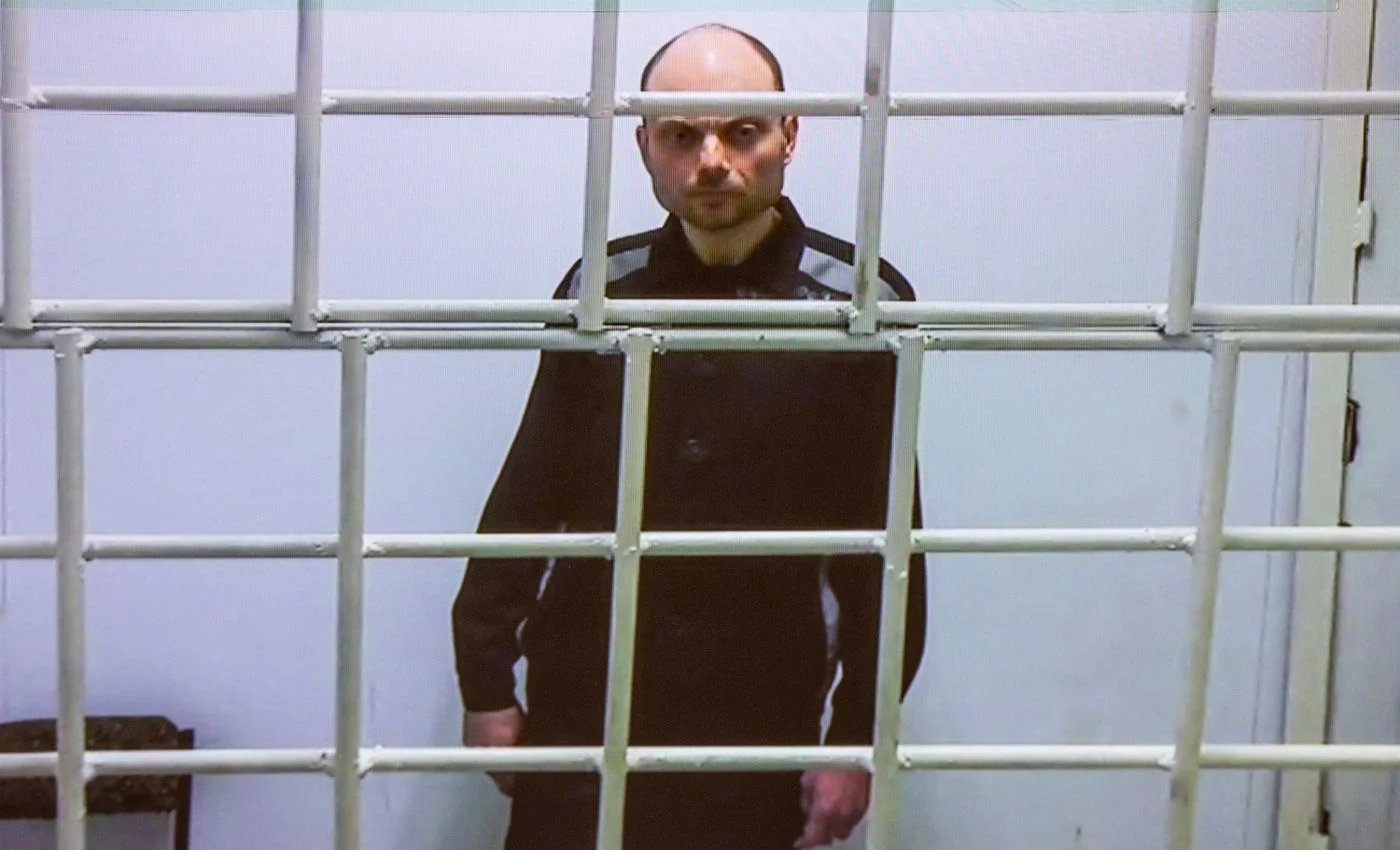
The only reason he survived is a prisoner exchange: sixteen dissidents traded for eight Russian operatives, including an FSB assassin Putin personally embraced on the tarmac.
After his release, Kara-Murza stated at an Atlantic Council panel:
When we are talking about the position of the Russian Orthodox Church… we are of course talking about the position of the official hierarchy. We’re not talking about faith. We’re not talking about the collective body of the church, which includes tens of millions of faithful, of believers, many of whom are totally against this war just as we are. So when we use the shorthand “Russian Orthodox Church,” we’re talking about the official administrative structure. Those people who are the faces… whose faces we very often see on television, on Russian state television lately, blessing the missiles and praising the war.
— Vladimir Kara-Murza, Atlantic Council Eurasia Center panel, September 17, 2025, https://www.youtube.com/watch?v=JSp-10UsoOE, 15:09
This is the same distinction Joe Wilson made. The same one. Now consider: would those who attacked Wilson say the same things to Vladimir Kara-Murza?
Would they call him ignorant? Accuse him of Russophobia? Demand he retract? He is Russian. He is Orthodox. He loved his country enough to go back to it knowing what it would cost him. He drew the exact same line Wilson drew: the hierarchy is not the faithful.
Then why did they feel so free to attack Wilson? Because he is an American politician. Because he is not Orthodox. Because he was easy to dismiss. They did not weigh the truth of what he said; they judged the man who said it. A congressman they could mock, swear at, and demand retractions from. A Russian dissident who was poisoned, imprisoned, and nearly killed for speaking the same truths: him, they cannot touch.
This is what the response to Wilson reveals. It was never about whether his claims were true. It was about who was saying them. When the speaker is easy to dismiss, they dismiss him. When the speaker is impossible to dismiss, they fall silent. The truth did not change. Only the speaker changed. And if the distinction between hierarchy and faithful is valid when spoken by a man who was traded for an assassin, it does not become invalid because a congressman tweeted it.
However, this is not how Joe Wilson’s comments were received. The response to Wilson’s tweets was immediate and drew widespread ire from Orthodox Christians.
The Response
Bishop Luke (Murianka) of Syracuse, Abbot of Holy Trinity Monastery in Jordanville and Rector of Holy Trinity Seminary, wrote to Wilson the following letter three days after his tweet, with an official Jordanville letterhead:
November 20th, 2025
The Honourable Addison “Joe” Wilson
Congressman for the 2nd District of SC,
Washington, DC Office
1436 Longworth House Office Building
Washington, DC 20515Dear Congressman Wilson,
I am writing to you, as an elected representative, to express my deep horror and dismay at your recent X Tweet, and subsequent follow-up X Tweet, accusing the Bishops of ROCOR, of which I am
one, of being agents for the Kremlin and KGB (an organization that no longer exists). (copies attached).As one of the members of the commission representing ROCOR in the talks leading up to the signing of the Act of Canonical Communion in 2007, I can assert without any hesitation that we are in fact under no influence whatsoever from the Moscow Patriarchate. Any suggestion of collaboration or espionage by ROCOR on behalf of the MP or the Kremlin is libelous, and I insist that you issue a full retraction of your Tweet and issue a public apology to the Bishops of ROCOR.
May God grant you the wisdom and courage to take this action.
In Christ,
— Bishop Luke
Bishop Luke of Syracuse,
Vicar Bishop of the Eastern American Diocese of ROCOR,
Abbot of Holy Trinity Monastery,
Rector of Holy Trinity Seminary
Notice the shape of Bishop Luke’s response. He did not first answer the substance of Wilson’s concern. He objected to the tweet, called the allegation libelous, demanded a full retraction and public apology, and inserted a parenthetical that the KGB is “an organization that no longer exists.” We will return to that point, because the parenthetical is revealing.
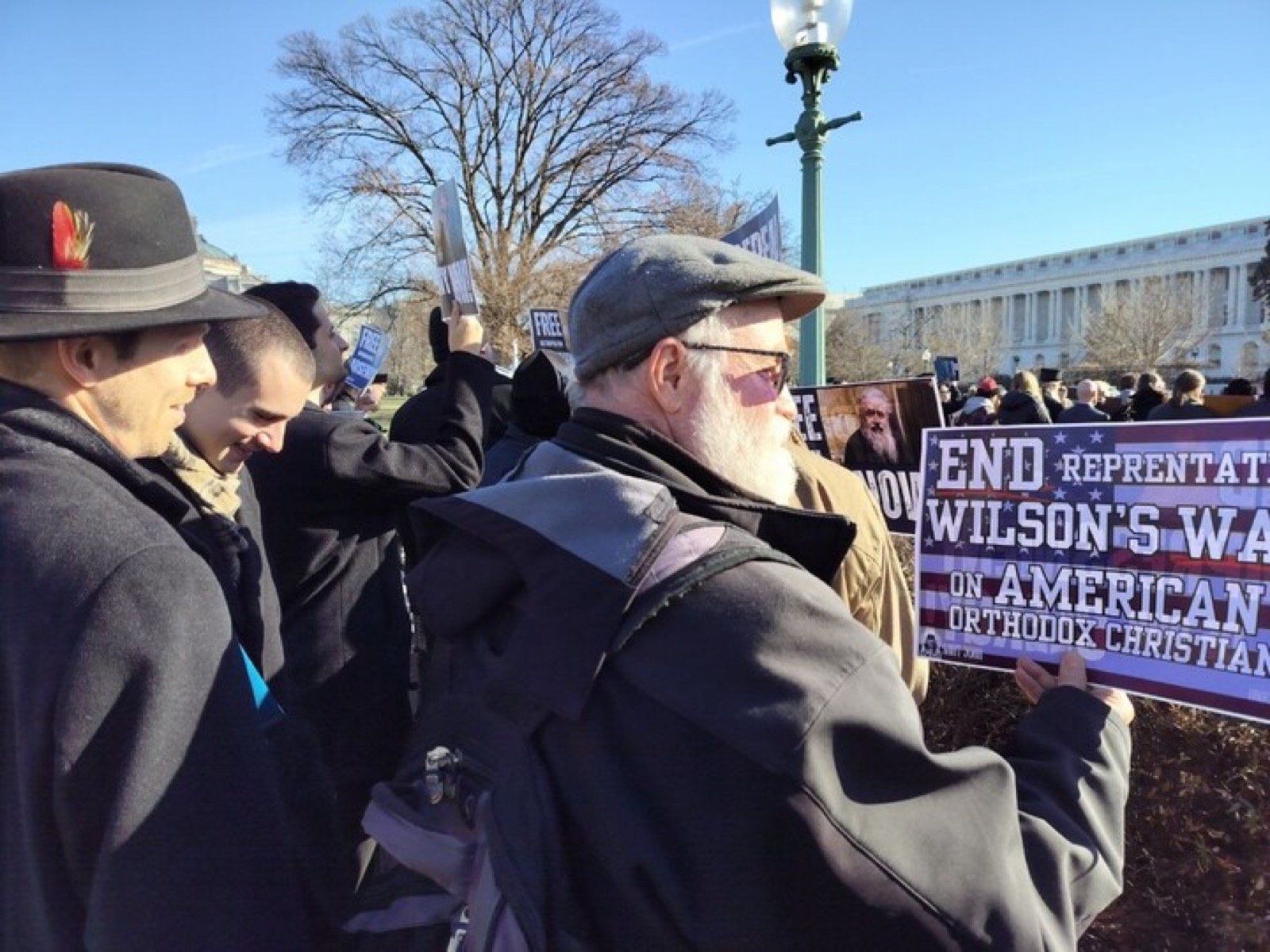
The responses were wide and varied. An Orthodox advocacy organization formed within days of Wilson’s messages.[4] A priest in the OCA (Orthodox Church of America) called for leaving the Assembly of Canonical Orthodox Bishops entirely over the insult.[5] By December, the effort had grown to nearly 200 participants from four jurisdictions conducting 80 congressional meetings, culminating with a press conference on the Capitol steps.
The Instinct Was Not Wrong
The instinct to defend the Church from external attack is not wrong. The delegation demonstrated something the Church genuinely needs: the capacity for collective action across the jurisdictional lines that normally function as walls. These faithful showed that they love their Church enough to act. That love is real, and this chapter does not question it.
St. John Chrysostom observed that one zealous person is enough to correct a whole city:
One man, inflamed with zeal, is sufficient to set an entire city aright. Yet when not one, or two, or three, but so great a multitude is capable of taking in hand the correction of the careless, it is from no other source than our own laziness, and not our weakness, that the majority are perishing and falling.
— St. John Chrysostom, Homily I On the Statues, §12 (PG 49:33-34), quoted in St. Nikodemos the Hagiorite, Christian Morality, p. 430; cf. New Advent.
The question is why that capacity is selective. The same organizational infrastructure that materialized within days for a congressman’s tweet has never produced a single coordinated statement about a patriarch who called Metropolitan Sergius a “confessor standing on the immovable rock of faith” (Chapter 9: Glorifying Sergianism and the KGB Church), who promised soldiers that battlefield death washes away all sins (Chapter 17: Does Dying in War Wash Away All Our Sins?), whose mandatory wartime prayer became the basis for priests being defrocked when they refused or altered it (Chapter 22: What Happens to Priests Who Pray for Peace?), and who declared this war “sacred” and its opponents servants of the Antichrist (Chapter 23: What Did Patriarch Kirill Bless?). The outpouring of response for Representative Joe Wilson shows that the capacity exists. What is missing is the willingness to apply the same standard to threats from within that was applied to a threat from without.
The prophet Elijah did not mock Israel for their zeal, but redirected it: “How long halt ye between two opinions? If the Lord be God, follow Him: but if Baal, then follow him” (1 Kings 18:21). The zeal was real; it was the object that needed correcting.
What follows in this chapter is an examination of what the response to Wilson reveals about our priorities, measured against the priorities of the saints, and a call for the faithful to redirect their zeal.
Was Wilson Wrong?
Patriarch Kirill has advocated for mass murder and persecution of Christians and served decades as KGB. Most Orthodox churches are NOT affiliated with Moscow.
— Joe Wilson (@RepJoeWilson), November 17th, 2025, https://x.com/RepJoeWilson/status/1990842577524781422
Representative Joe Wilson is a Presbyterian, and so of course his understanding of Orthodox church structure is not going to be exact. Many of our own Orthodox Christian brethren also do not understand these matters perfectly either, as has been previously outlined in numerous chapters.
However, outside of the imprecise understanding of the canonical structure of the Russian Orthodox Church, is the substance of Joe Wilson’s comment really wrong?
Regarding Patriarch Kirill’s service in the KGB, this book has documented Kirill’s KGB codename across fifty pages of primary sources (Chapter 13: KGB and the DECR). It has documented his war theology and the persecution it has inflicted on the canonical Ukrainian Orthodox Church (Chapter 23: What Did Patriarch Kirill Bless?). Wilson, though speaking in the blunt language of a social-media post, simply said what the aforementioned evidence overwhelmingly demonstrates.
No one even attempted to engage with this evidence.
Consider Who Is Watching
Let us return to Joe Wilson’s first tweet: “Christians are targeted and killed in Ukraine.”
The faithful called him a moron for this. The response of most was not representative of the calling of Orthodox Christians. Many with Orthodox crosses in their display names swore at him with profanity. They called him a “persecutor of Christ.” They organized against him within days. They demanded retractions and apologies.
However, at those same press conferences and in those same 80 Congressional meetings, they presented the persecution of the Ukrainian Orthodox Church that the representative presented as their own cause. They used the very suffering Wilson had explicitly named as the centerpiece of their advocacy.
Now, consider the Ukrainians from Kyiv, Mariupol, and all of the occupied territories where UOC priests sit in Russian prisons (Chapter 23: What Did Patriarch Kirill Bless?). What must it look like when their American Orthodox Christian brethren use their suffering to make a case while attacking the very politician who tried to name it, while maintaining communion with Patriarch Kirill whose war theology created it (Chapter 17: Does Dying in War Wash Away All Our Sins?), after they themselves immediately ceased commemoration of Patriarch Kirill? (Chapter 29: The UOC Ceases Commemoration)
The responses to Wilson’s tweets revealed the divide plainly.
Ukrainian respondents overwhelmingly thanked him for naming their persecution. American Orthodox respondents, by contrast, overwhelmingly attacked him. Thousands of American Orthodox Christians across social media consumed the tweets, shared the outrage, and took the insult personally, and then lashed out, swearing at him and calling him a moron.
However, there is quite a bit of cognitive dissonance here.
If calling Wilson a moron for saying “Christians are targeted and killed in Ukraine” is justified, then everyone who agrees with that statement is also a moron.
- The Ukrainians who thanked him are morons.
- Metropolitan Onuphry, the leader of the sole canonical church in Ukraine (UOC), who condemned the war and Patriarch Kirill on day one, is a moron (Chapter 29: The UOC Ceases Commemoration).
- The 437 Ukrainian priests who asked the ancient patriarchates to judge Kirill for his actions thoroughly documented in this book are morons, along with the archpriest who assembled it and was defrocked for it.
- The faithful in Mariupol who prayed for deliverance from the Russian army are also morons.
That is what the response to Wilson implies. And many attempted to dismiss a man’s words while claiming to champion the people who agreed with him.
And yet they will engage with Wilson, a politician who doesn’t know the ins and outs of Orthodox Christianity, who they can dismiss and rebuke without consequence or rebuttal. However, they will not engage with Metropolitan Onuphry in any way possible, but simply pass over this in silence.
In every defense offered by the faithful, the same pattern appears: the congressman is addressed, dismissed, and mocked. The canonical Ukrainian primate who made the same exact judgment is never mentioned. Not because his position is unknown, but because engaging with it honestly would require examining why he ceased commemoration (Chapter 29: The UOC Ceases Commemoration), what patristic and canonical grounds he cited (Chapter 24: The Saints Who Ceased Commemoration), and what conclusion that examination produces. Wilson can be easily dismissed as ignorant, and so is an easy target for the mob to descend upon. Metropolitan Onuphry, a canonical metropolitan whose authority they recognize, is not an easy target. His judgment carries weight. His reasons are patristic. He is an authority figure they respect. And so he is simply not discussed or mentioned by these individuals, because the discussion leads somewhere they cannot afford to go, lest their position be immediately called into question.
The UOC declared itself no longer part of the Moscow Patriarchate, fifteen dioceses issued cessation orders, and the archpriest who organized the 437 priests’ appeal was defrocked for it (Chapter 29: The UOC Ceases Commemoration).
Important Question: did any member of the delegation or those who showed outrage to Joe Wilson, consult with the Ukrainian Orthodox Church before claiming to advocate on its behalf? Did they speak with Metropolitan Onuphry? Did they contact any of those priests who risked everything to call for Kirill’s judgment? Did they ask a single UOC clergyman in occupied territory, where priests sit in Russian prisons for refusing to transfer their parishes to Moscow-created dioceses, what they think of the patriarch they no longer commemorate?
The delegation spoke for Ukraine without speaking to Ukraine. It organized press conferences about Ukrainian suffering from the comfort of America, where they can whimsically exercise their free speech, unlike the archpriest who organized the 437-priest appeal, who received credible threats of being murdered and was forced to flee Ukraine entirely. Did anyone once ask the Ukrainians in the canonical Ukrainian Orthodox Church what they actually need, what they actually think, or who they believe is to blame?
Of course this can’t be done, because then it would immediately be clear that Patriarch Kirill whom they commemorate, has done exactly what Wilson described.
Again: who is actually listening to the Ukrainians in all of this?
And so we have American Orthodox Christian faithful who rally against an American congressman who isn’t even Orthodox Christian, but can barely name a single Ukrainian Orthodox priest.
Not one of those who crossed state lines for a congressman’s insult has even crossed the street for a patriarch’s heresy.
Consider Who Participated
Those who wrathfully responded to Joe Wilson were not anonymous internet commenters.
Bishops wrote letters on official letterheads. Priests organized across jurisdictional lines. The voices that Orthodox Christians in America look to for spiritual guidance, the ones whose opinions are sought, who create podcasts and have faithful followings, whose social media posts are shared as if they carry the weight of patristic teaching: these are the ones who called a congressman a moron for naming Ukrainian persecution.
When a layperson is rude to a politician online, that is a failure of personal virtue. However, when bishops and priests and the respected voices of American Orthodoxy organize a delegation to confront a congressman while saying nothing to a patriarch who blesses the bombing of Orthodox churches (Chapter 23: What Did Patriarch Kirill Bless?), is this not a failure of shepherding?
The Fathers of our church hold shepherds to a higher standard than others, not a lower one. St. John Chrysostom warned that the sins of priests “require greater punishment than those of their people, since a man who has been entrusted with the steering of a whole congregation, if he is not able to properly protect it… what pardon shall he find?”[6]
Therefore, why the silence toward the patriarch and the boldness toward the congressman?
St. John Chrysostom diagnosed this exact pattern: persons who rebuke freely where it costs nothing, but fall silent where it costs everything:
…doing so beyond reason with the humble while no one dares so much as to open his lips against those who wield power.
— St. John Chrysostom, On the Priesthood, Book III, §9, trans. Graham Neville, p. 78; cf. New Advent.[7]
Wilson has no authority over the Church. He cannot defrock anyone. He cannot excommunicate anyone. He cannot transfer a parish, deny communion, or remove a bishop. Confronting him costs nothing.
Patriarch Kirill wields power. He presides over an institution in which 17 priests were defrocked for refusing or altering his mandatory wartime prayer, a hieromonk was imprisoned for three years, and Fr. Maksimov was sent to a labor camp for 14 years. Confronting him costs something. The faithful rebuked Wilson “beyond reason.” Against the patriarch, no one dared so much as to open their lips.
This is not zeal. It is the fear of man. Scripture names it plainly: “The fear of man bringeth a snare: but whoso putteth his trust in the Lord shall be safe” (Proverbs 29:25). The Apostle Paul asks: “Do I now persuade men, or God? Or do I seek to please men? For if I yet pleased men, I should not be the servant of Christ” (Galatians 1:10).
The New Martyrs were not afraid. The 437 Ukrainian priests were not afraid. They chose to fear God, rather than man. The faithful who organized against Wilson feared man, not God. The direction of their courage tells us whom they serve.
Is ROCOR Under No Influence from the Moscow Patriarchate?
Recall Bishop Luke in his letter to Representative Joe Wilson, where he claimed that ROCOR is “under no influence whatsoever from the Moscow Patriarchate.”
However, The Act of Canonical Communion says otherwise.
In 2007, after 87 years of separation, ROCOR reunified with the Moscow Patriarchate under the Act of Canonical Communion. Bishop Luke served on the commission that negotiated this Act.
The supreme instances of ecclesiastical authority for the Russian Orthodox Church Outside of Russia are the Local Council and the Council of Bishops of the Russian Orthodox Church.
— Article 9, Act of Canonical Communion (signed May 17, 2007), https://synod.com/synod/engdocuments/enmat_akt.html
Article 9 of the Act of Canonical Communion, which restored the relationship between ROCOR and the Moscow Patriarchate, says Moscow’s councils are the supreme instances of ecclesiastical authority.
Why would Bishop Luke say that Moscow has no authority (ergo influence) over ROCOR?
Patriarch Kirill personally confirmed Bishop Luke’s own election as Bishop of Syracuse on December 28, 2018. The bishop who insists ROCOR is “under no influence whatsoever” holds his title at the confirmation of the patriarch whose influence he denies.
“Under no influence whatsoever” is contradicted by multiple provisions of the Act Bishop Luke helped negotiate (Chapter 13: KGB and the DECR). ROCOR’s independence follows a pattern: it appears on matters Moscow does not care about, and vanishes on every matter Moscow does.
ROCOR broke communion with Constantinople when Moscow did, refuses to recognize the OCU as Moscow does, and continues commemorating Patriarch Kirill despite internal pressure to stop. On every structural question that matters to Moscow, ROCOR is fully aligned. That is not independence, but the boundary of its permission.
What Wilson Actually Accused Them Of
Now, many people will egregiously cite the example of St. Nicholas slapping Arius, and say that this gives them the right to swear at, belittle, and curse against someone who critiques their hierarchy.
These people need to be reminded that Arius was a heretic, and engaged in heresy. All the examples of our saints fiercely speaking against their opponents, were almost always because they were speaking heresy and blasphemy.
Now, let the reader deeply consider what Wilson actually said.
Did he accuse the Orthodox Church of heresy? No. Did he question the Creed, the sacraments or the faith? No. Did he blaspheme against the Theotokos? No. He simply asked the Attorney General to investigate “whether the Russian Federation or its intelligence services have sought to recruit, leverage, influence or otherwise compromise” ROCOR and other Russian Orthodox Church institutions.
That is only a question about institutional compromise. Those who read the saints should not be surprised of this, as such compromise has always existed within the church. The main thing is that this doesn’t in any way represent a question about the Orthodox Faith, and it is far from a reason for people to take to the streets.
In regard to this question, Chapter 13: KGB and the DECR of this book presents the evidence: Russian parliamentary investigations, declassified archives from six countries, confessions from those who worked inside the institution, and testimony published by ROCOR’s own monastery. It is certainly much easier to be outraged and offended than for one to calmly examine this evidence.
Representative Joe Wilson’s clarification message specifically named “Patriarch Kirill has advocated for mass murder and persecution of Christians and served decades as KGB.”[8] The delegation demanded Wilson retract; however, this claim is true, and has been elaborated in this study at length.
Here Bishop Luke’s parenthetical must be recalled. In his letter, he answered Wilson’s reference to the KGB by saying that the KGB is “an organization that no longer exists.” That is true only in the narrow legal sense.
It is true that the Soviet KGB no longer exists under that name; however, its foreign intelligence directorate became the SVR, and its domestic and counterintelligence missions were inherited and consolidated by the FSB.[9] The FSB’s own official history traces the same lineage through the KGB RSFSR, AFB, Ministry of Security, FSK, and FSB.[10]
Sean Brennan, author of The KGB and the Vatican, notes that the Soviet political police operated under many names, from Cheka to GPU to NKVD. He writes in his introduction that, “for simplicity,” and “following the example” of Soviet intelligence scholars Christopher Andrew, Harvey Klehr, and John Earl Haynes, he uses “KGB” throughout.[11]
So even according to scholars of Soviet intelligence, using “KGB” as shorthand for the Russian security apparatus is a defensible and well-established convention. This is even clearer when one understands that Russia did not go through a period of lustration: the public vetting and removal of former communist officials and secret-police collaborators from positions of power, usually accompanied by opening archives so the old networks can be named and dismantled. There was no such reckoning. The Soviet security organs were reorganized and renamed, while retaining their personnel networks, archives, and institutional relationships (Chapter 13: KGB and the DECR).
Therefore, to say that the KGB “no longer exists” is, at best, imprecision, and contradicts the way scholars speak about the same apparatus. Should a ROCOR bishop writing on official letterhead not understand this before lambasting someone else for imprecision?
Having answered the technical objection, we can return to what Wilson actually asked for.
The letter
Wilson’s formal letter to the Attorney General, co-signed by two other congressmen, runs three pages.[12] The faithful were exposed to his summary messages (tweets). But how many of the faithful actually read his full letter, or were even given the opportunity to read his full letter?
I write to respectfully request that the Department of Justice initiate a formal review, and, if warranted, a full investigation, into whether the Russian Federation or its intelligence services have sought to recruit, leverage, influence, or otherwise compromise the independence of Russian Orthodox Church institutions operating within the United States, including the Russian Orthodox Church Outside Russia (ROCOR).
[…]
The Parliamentary Assembly of the Council of Europe adopted Resolution 2540, urging member states to recognize the ROC as an extension of President Putin’s regime and complicit in war crimes.
— Rep. Joe Wilson (Chairman, U.S. Helsinki Commission), Rep. Don Bacon, and Rep. Austin Scott, letter to Attorney General Pam Bondi, November 2025
Representative Joe Wilson was not a random congressman with an opinion, as he was portrayed. He was writing as Chairman of the U.S. Helsinki Commission, the body Congress created in 1976 to hold the Soviet government accountable for persecuting religious believers, including Orthodox Christians. He named Patriarch Kirill by his KGB codename “Mikhailov,” cited investigations by the United Kingdom, Czech Republic, and Sweden, and closed by citing “mass murder of civilians and kidnapping of children.”
In all of the outrage and hatred towards Joe Wilson, none of his core claims were substantively responded to.
Of course, Wilson’s letter is not without problems. Representative Joe Wilson may not fully understand the canonical complexities between the ROC and ROCOR after the 2007 reunification, and some of his claims about ROCOR’s operational relationship with Moscow may overstate the case. But the underlying concern, rooted in Patriarch Kirill’s own documented words and actions, is not unfounded. The letter was not the ranting of an ignorant politician. It was a formal request from the Chairman of the U.S. Helsinki Commission, the bipartisan congressional body created in 1976 to monitor compliance with the Helsinki Final Act and hold governments accountable for human rights and religious liberty violations, citing sources from five countries.
Every substantive claim in Wilson’s letter is documented in this book. Kirill’s KGB codename (Chapter 13: KGB and the DECR). His war theology (Chapter 17: Does Dying in War Wash Away All Our Sins?; Chapter 23: What Did Patriarch Kirill Bless?; Chapter 32: The COVID Orders). The Council of Europe’s Resolution 2540, declaring Kirill “complicit in war crimes and crimes against humanity.”[13] Formal investigations by the United Kingdom,[14] Czech Republic,[15] and Sweden.[16] Religious persecution in Russian-occupied Ukraine: over 600 religious buildings destroyed, clergy detained and tortured, over 50 Moscow Patriarchate clergy indicted for collaboration (Chapter 29: The UOC Ceases Commemoration).[17] The deportation of children: ICC arrest warrants for Putin, 58 church institutions serving as accommodation centers, all fundraising requiring Kirill’s personal approval, approximately 700,000 Ukrainian minors “transferred,” approximately 2,000 returned (Chapter 23: What Did Patriarch Kirill Bless?).
While all of this was documented and ongoing, Patriarch Kirill stood before the World Russian People’s Council in November 2025 and declared that Russia enjoys “full freedom: freedom of religion, freedom of thought, freedom of the press.” At that moment, Fr. Kostiantyn Maksimov, a priest under the Moscow Patriarchate, was serving 14 years in a Saratov labor camp for refusing to transfer his parish to Russian-created dioceses (Chapter 22: What Happens to Priests Who Pray for Peace?).
And while all of this happens, many Orthodox Christians swear at representative Joe Wilson, call him a moron, and demand a retraction from him.
Wilson’s letter also made three formal requests to the Department of Justice: first, to assess whether Russian intelligence services have sought to recruit or compromise ROCOR-affiliated institutions in the United States; second, to determine whether any ROCOR clergy or staff maintain operational or financial relationships with the Russian state; and third, to evaluate whether hierarchical, financial, or property ties between the Moscow Patriarchate and U.S.-based Russian Orthodox entities create vulnerabilities to coercion, sanctions evasion, or state-directed influence.
The third request is not speculative. When ROCOR reunified with Moscow in 2007, it accepted canonical subordination to a patriarchate that the Council of Europe has since declared “complicit in war crimes,” whose DECR (Department for External Church Relations) the 1992 Russian parliamentary commission found to be a KGB front (Chapter 13: KGB and the DECR), and whose current head personally decorates generals at the front (Chapter 23: What Did Patriarch Kirill Bless?).
The hierarchical tie is the vulnerability. Whether it has been exploited is the question Wilson asked the Attorney General to investigate.
The fusion Wilson described is not alleged; it is published on patriarchia.ru. At the XXVII World Russian People’s Council in November 2025, Russian Foreign Ministry spokesperson Maria Zakharova sat alongside the DECR chairman and declared: “There’s nothing to discuss anymore. This is already open combat.”[18] This is why it matters: a senior Foreign Ministry official and a senior Patriarchate official sharing a stage, using the same language of war, at a church-organized council chaired by the patriarch. The MFA and the Moscow Patriarchate have jointly produced two official reports on Ukraine. The state and the church do not merely cooperate. They share a platform, a vocabulary, and a mission. Wilson asked the Attorney General whether the Russian state has sought to “influence or otherwise compromise” Russian Orthodox institutions in America. The answer is published on the Patriarchate’s own website.
One further detail is worth noting. Patriarchia.ru, the Moscow Patriarchate’s official news outlet, at the time of this publication, has published zero coverage of either the Wilson incident or Resolution 2540: not the tweets, not the delegation, not the Capitol event, not the letter to the Attorney General, and not the unanimous Council of Europe resolution declaring Kirill “complicit in war crimes.”[19] [20] The mobilization that consumed Orthodox media for weeks and produced a bishop’s formal demand on monastery letterhead did not even register on the patriarch’s own website. Moscow did not ask the delegation to defend it. Moscow did not acknowledge the defense. The faithful who mobilized did so for an institution that does not appear to have even noticed.
What the Delegation Said Instead
The delegation was not silent about Ukraine. It spoke about Ukraine constantly. Bishop Theodosius of Seattle described in detail what the Ukrainian government has done to the canonical Church:
The government in Ukraine closed the caves in the Lavra Monastery where the relics of dozens of universally revered saints are kept, designating the sacred remains instead as “museum exhibits”… they assault bishops whilst seizing cathedrals, attack priests as churches are being confiscated, and forcibly evict monks and nuns from appropriated monasteries.
— Bishop Theodosius of Seattle, Address at Capitol Hill press conference (Dec 16, 2025), https://eadiocese.org/news_251219_4
Representative Luna declared that “American tax dollars should never support a government that is actively persecuting our brothers and sisters in Christ.” Catherine Whiteford told the press: “We are here for one reason only, to defend the universal principle of religious liberty and to speak plainly when that principle is abandoned, even by governments we otherwise support.”[21]
Every word of this is true. Churches have been seized. Clergy have been beaten. The Lavra’s relics have been reclassified as museum exhibits. But in the entirety of Bishop Theodosius’s address, the word “Kirill” does not appear. The word “war” does not appear. No speaker at the press conference named the patriarch whose blessing of the invasion (Chapter 17: Does Dying in War Wash Away All Our Sins?) created the political conditions for every persecution they described. They named Zelensky. They named the Ukrainian government. They named Law 3894. They named Constantinople. They never named Kirill.
The pattern is that our contemporary Orthodox Christians will correct the world, but stay silent about their own. There is a word for this. The Orthodox tradition calls it hypocrisy. Our Lord reserved His harshest words for it:
Woe unto you, scribes and Pharisees, hypocrites! for ye are like unto whited sepulchres, which indeed appear beautiful outward, but are within full of dead men’s bones, and of all uncleanness.
— Matthew 23:27[22]
When the delegation did engage theologically, they misidentified the issue entirely.
A spokesperson offered a theological defense: Patriarch Kirill is not a Pope; his words do not bind every Orthodox Christian; Orthodoxy is governed by councils, not papal fiat. The Orthodox ecclesiology here is correct but misidentifies the issue; the question is not whether Kirill’s words bind. The question is: if Kirill teaches heresy, why has he not been deposed, and why do the faithful remain in communion with him? Canon 15 of the First-Second Council of Constantinople answers directly: those who cease commemorating a bishop who “preaches heresy publicly and with bared head in the Church” are not schismatics but defenders of the faith (Chapter 25: On Heresy, Synods, and Right Belief).
The canonical Ukrainian Orthodox Church, whose faithful are the ones actually suffering the persecution the delegation documents (Chapter 15: Russian World Ethnophyletism), made this judgment: they ceased commemorating Patriarch Kirill (Chapter 29: The UOC Ceases Commemoration). The delegation documents the UOC’s persecution extensively but draws absolutely zero conclusion from the UOC’s own judgment on the patriarch they commemorate.
What did the delegation and outpouring of Orthodox Christians say? They reframed the conversation. Wilson wrote about KGB codenames, war theology, Resolution 2540, European intelligence investigations, and the deportation of children. The delegation answered about Ukraine’s Law 3894, Metropolitan Arseny’s detention, and the impressment of clergy. These are real concerns. But they are not what Wilson wrote about. Not a single substantive claim in Wilson’s letter was addressed.
The delegation also explicitly disclaimed any pro-Russia military position: they were not seeking to end aid to Ukraine. This makes their silence on Kirill’s war theology all the more revealing; they can disown the war but cannot address the patriarch who blesses it (Chapter 17: Does Dying in War Wash Away All Our Sins?), whose mandatory wartime prayer became the basis for disciplining priests who refused it or altered “victory” to “peace”.
In the reporting period that included the delegation’s Capitol visit, 92 clergy of the patriarch they commemorate made 180 deployments totaling 2,007 days embedded with Russian military units in the war zone.[23]
A subdeacon from Wilson’s own district called on the congressman to “repent of the false witness that you have borne against your own constituents.”[21] He cited that “not one of the bishops of ROCOR is Russian born” and that ROCOR includes “military veterans, U.S. Armed Forces chaplains, and Ukrainian refugees.”
This is all true, but irrelevant. Wilson’s letter was not about birthplace or military service. It is about whether the institution to which ROCOR is canonically subordinate functions as an extension of the Russian state. The delegation offered biographical defenses against a structural accusation.
The 2007 Act of Canonical Communion was cited in ROCOR’s defense: ROCOR is “independent in pastoral, educational, administrative, economic, real estate and civil affairs.” What was not cited was the same document’s other clause: ROCOR is “an indissoluble, self-governing part of the Local Russian Orthodox Church.”[24] It is both independent and indissoluble.
The delegation cited the autonomy; Wilson cited the bond.
The Assembly of Canonical Orthodox Bishops of the United States has issued one statement relevant to this situation. It was not about Patriarch Kirill’s war theology (Chapter 17: Does Dying in War Wash Away All Our Sins?). It was not about the defrocking of priests who prayed for peace. It was not about his pastoral letter calling Metropolitan Sergius a “confessor.” The one statement, issued September 15, 2024, concerned Ukraine’s Law 3894: the law that restricts religious organizations with ties to the Moscow Patriarchate.[25] The Assembly has defended Moscow’s institutional interests in Ukraine. It has never addressed Moscow’s theological departures from the faith.
Voices among the faithful threatened to leave the Assembly over Wilson’s tweet. No one has threatened to leave the Assembly over Kirill’s heresy.
In almost none of the coverage were Wilson’s actual words presented in full. The faithful were given a caricature: an ignorant congressman attacking innocent Christians. They were not given the letter from the Chairman of the Helsinki Commission that named the patriarch’s KGB codename and cited investigations from five countries. Rather than choosing to understand his concerns, many Orthodox Christians, uninformed themselves, chose to split hairs and chastise him for not correctly understanding the nuances in the organization of the Russian Church. Those who mobilized in outrage were never shown what they were mobilizing against. Most of the Orthodox sources who reported on this matter did not fully and honestly present Representative Joe Wilson’s concerns in a truthful light, scandalizing their followers into slandering him by presenting an inaccurate picture of his position.
Yet the response treated Wilson’s question as though it were an attack on Orthodoxy itself.
The rhetorical frame of “Russophobia” was also familiar (Chapter 15: Russian World Ethnophyletism).
Patriarch Kirill himself deployed that word on patriarchia.ru just fifteen days after the invasion began, writing to the World Council of Churches on March 11, 2022 that “Russophobia is spreading through the Western world at an unprecedented pace.”[26] The frame was set from day one: any criticism of the patriarch or the war is not evidence to be answered but bigotry to be rejected. The delegation at the Capitol used the same playbook. When the patriarch they commemorate actually attacks the faith, the response is silence, but when he is spoken against, immediately the “Russophobia” card is played.
Archbishop Averky of Jordanville, writing from the same Holy Trinity Monastery that issued Bishop Luke’s demand for retraction, taught that a Christian “is obligated to forgive personal offenses.” He warned against precisely the spirit on display at the Capitol steps:
“How dare he say that to me?” “How did he dare to look at me like that?” “How dare he turn his back to me?” These are the most common and widespread causes in our day of personal offenses that are never forgiven and give rise to vindictive feelings and actions.
— Archbishop Averky (Taushev), The Struggle for Virtue (Holy Trinity Publications, 2014), Chapter 8: “Resisting Evil,” p. 101
Archbishop Averky taught that only a “good soldier of Jesus Christ” who “does not get tangled up in any type of personal interests or obsessions, but one who thinks only of defending God’s desecrated truth” can successfully battle evil. A battle rooted in institutional pride rather than defense of God’s truth, Abp. Averky warned, “will not bring good to anyone.”
St. Tikhon of Zadonsk is even more direct about how Christians must relate to civil authorities. He teaches that citizens owe loyalty to the governing authorities and must follow their just laws “with zeal and without murmuring.” Of those who fail in this duty, he writes: “People work shamelessly and lawlessly when they compose evil plots and arise against the authorities, which have been lawfully ordained. They are nothing other than the sons of perdition and the enemies of the fatherland.”[27] Wilson is a lawfully ordained authority. The response was to call his tweet a “declaration of war,” organize against him from the steps of the Capitol, and demand retractions. St. Tikhon says pray for rulers, even imperfect ones. They organized a campaign against one and slandered him.
If the faithful had gathered on the Capitol steps and, instead of expressing outrage, had chanted, held icons, and spoken about the Orthodox faith to the assembled press, that would have been a witness. They had the platform. They had the people. They had the media’s attention. They could have used that moment to show America what Orthodoxy actually is.
Instead, they held up signs about their grievance, demanded apologies, and displayed the very worldly spirit the saints warn against.
A question: what does institutional outrage accomplish for the salvation of anyone? Is this Orthodox phronema, the mindset of the faith, at work? Or is it the spirit of the world dressed in ecclesial clothing?
The Saints’ Priorities
The response to Wilson revealed priorities. Now consider what the saints’ priorities actually were.
The early Christian apologists answered the world’s accusations, but they answered them by explaining what Christians actually believe. St. Justin Martyr wrote to Emperor Antoninus Pius not to demand a retraction, but to correct a misunderstanding about the faith.
It was always matters of the Orthodox faith that moved the saints to action. Crude personal insults from governments and politicians did not.
Let us now evaluate this from the lens of the saints and their holy lives; where do we find a holy bishop writing to a secular ruler with such a demand, asking for a retraction over an insult that isn’t regarding matters of Orthodox faith? Where do we find in our church history the faithful rallying over a simple matter of insult?
Again, Wilson did not espouse heresy. He did not blaspheme the Theotokos. He did not insult the saints. He asked for a Church institution to be investigated.
Scripture tells us plainly that truth has nothing to fear from scrutiny:
For nothing is secret, that shall not be made manifest; neither any thing hid, that shall not be known and come abroad.
— Luke 8:17[28]
But all things that are reproved are made manifest by the light: for whatsoever doth make manifest is light.
— Ephesians 5:13[29]
If the institution is pure and free of political influence, what is there to fear from an investigation? Is there then not only gain?
The saints did not resist scrutiny; they welcomed it.
St. Nektarios of Aegina was slandered by rivals within the Patriarchate of Alexandria and expelled from his position as Metropolitan of Pentapolis in 1890. He was dismissed without a hearing, without explanation, and without the opportunity to defend himself. When told that the archimandrites were plotting against him, his response was: “It does not matter, Galinos. I love them, and that is enough for me to keep my inner peace.”[30] Upon receiving the letter of dismissal, he prayed: “Lord, do as Thy will… Thy will be done.” He attempted four times to see the patriarch and was turned away each time. Clergymen insulted him openly in the courtyard. His response to the patriarch who destroyed his career:
Oh, Patriarch Sophronios, Your Most Holiness, no matter how much you kill my spirit, I shall always love you. I will never forget that you stood by me as my spiritual father, my benefactor, my supporter and naturally I shall pray for you as long as I live. It doesn’t matter what you have done to me, may your years be long and happy. As for me, whatever the Lord wills.
— Sotos Chondropoulos, Saint Nektarios: The Saint of Our Century, p. 24
He did not organize a delegation. He did not demand retractions. He did not hold a press conference. He prayed for the man who expelled him and trusted in God’s vindication. Thirteen years later, still seeking only to clear his name, he wrote to the Ecumenical Patriarch that he had been “sent away without a trial or an explanation.” He never retaliated. The Church then glorified him.
Wilson asked for an investigation. The faithful responded as though the request itself were an attack. But an investigation is not persecution; it is light. Those who have nothing to hide welcome it. Those who resist it invite the very suspicion they claim to reject.
But the patristic standard goes further than mere acceptance. If the Church is truly spotless, the faithful should not merely tolerate an investigation; they should welcome it. They should open every door, provide every document, and call the investigators themselves. King David did not resist God’s examination; he invited it:
Search me, O God, and know my heart: try me, and know my thoughts: and see if there be any wicked way in me, and lead me in the way everlasting.
— Psalm 139:23–24[31]
This is not an isolated sentiment. It is a patristic pattern. St. Basil the Great, when slandered by the Neocaesareans, did not demand retractions. He demanded investigation:
Ἀλλ’ εἰσὶν ἐπίσκοποι· κληθῶσιν εἰς ἀκρόασιν. Ἔστι κλῆρος κατὰ πᾶσαν τοῦ Θεοῦ παροικίαν· συναχθήτωσαν οἱ δοκιμώτατοι. Λεγέτω μετὰ παρρησίας ὁ βουλόμενος, ἵνα ἔλεγχος ᾖ τὸ γινόμενον καὶ μὴ λοιδορία…. πάλιν ἴσον καὶ κοινὸν κριτήριον καθισάτω· ἀναγνωσθήτω τὸ ἔγκλημα· δοκιμασθήτω…Ὑμῖν γὰρ ἐπιτρέπω, ποθεινότατοι ἀδελφοί, ἐφ’ ἑαυτῶν ποιήσασθαι τῶν ἐγκαλουμένων ἡμῖν τὴν ἐξέτασιν. Πάντως δὲ παντὶ τρόπῳ σπουδάσατε μὴ ἀνεξέταστα ταῦτα καταλιπεῖν.
— Βασιλείου Καισαρείας τοῦ Μεγάλου, Ἄπαντα τὰ ἔργα, 3, Ἐπιστολαὶ Γ’, σελ.166-168.
There are bishops; let appeal be made to them. There is a clergy in each of God’s dioceses; let the most eminent be assembled. Let whoever will, speak freely, that I may have to deal with a charge, not a slander…. Let a fair and impartial inquiry be appointed. Let the accusation be read; let it be brought to the test… I put it into your hands, dearest brethren, to investigate for yourselves the points alleged against me. Take all kinds of pains that nothing may be left unsifted.
— St. Basil the Great, Letter 204 to the Neocaesareans, §§4–5 (NPNF Series 2, Vol. 8)[32]
“Nothing left unsifted.” This is a canonized Father of the Church throwing open the doors and saying: come, examine me, you will find nothing.
St. John of Shanghai, the very saint the delegation invoked, was himself falsely accused and submitted to civil court scrutiny rather than resist it, as will be discussed below.[33]
St. Nektarios, thirteen years after his expulsion, actively wrote to three patriarchs requesting examination.[30] He pursued investigation because he knew the truth would vindicate him.
Where do we see those in the Orthodox Church pursuing investigation in this way? Rather, they organize protests and rallies, not on behalf of the Orthodox Christian faith, but to defend institutional pride.
Transparency is not a concession to the world; it is confidence in the truth. A Church that has nothing to hide has nothing to fear from scrutiny, and everything to gain from it. How else would the institution be found spotless? The demand for retractions accomplished the opposite of what the faithful intended: it told the world that the institution fears examination more than it trusts its own innocence.
When Swiss Federal Police declassified archives in 2023 corroborating the KGB allegations against Patriarch Kirill, the Moscow Patriarchate refused to comment and the Russian Embassy called it “Russophobia” (Chapter 13: KGB and the DECR). The simplest way to disprove the allegations would be to open the archives. Instead, the institution dismissed the evidence and moved to silence any and all evidence. The faithful’s response to Wilson followed the same pattern: resist scrutiny rather than welcome it.
The Desert Fathers on Worldly Accusation
The saints welcomed scrutiny. But they also drew a sharper distinction: between accusations that wound our pride and accusations that wound our faith.
The Desert Fathers settled this question long ago. In the Paradise of the Fathers, the holy ascetic Abba Agathon was accused of being a fornicator, prideful, a chatterbox, and a defamer. He received each and every accusation with thanksgiving. But when accused of being a heretic, he did not tolerate it, and responded to his accusers: “I am not a heretic.” When asked why he accepted every other insult but rejected this one, he said: “The first ones I ascribe to myself, for this is beneficial for my soul; but heretic means to be cut off from God.”[34]
St. Nikodemos the Hagiorite cites this story in his own Confession of Faith, written when he himself was accused of theological error. He understood the patristic order of concern: accept every worldly accusation as medicine for the soul, but fight with everything you have against the charge of heresy, because heresy severs you from God.
Being called “Russian spies” or “agents of the Kremlin” is a worldly accusation; Abba Agathon would have accepted it with thanksgiving. Being in communion with a patriarch who teaches heresy is the charge the saints would have fought against.
St. Isaac the Syrian describes the standard even more starkly:
A man who is truly humble, is not troubled when he is wronged and he says nothing to justify himself against the injustice, but he accepts slander as truth; he does not attempt to persuade men that he is calumniated, but he begs forgiveness.
— St. Isaac the Syrian, The Ascetical Homilies, Homily 71 (via Hieromonk Isaac, Saint Paisios the Athonite, p. 133)
The faithful organized to persuade men that they were calumniated. St. Isaac says the humble man does not attempt this.
The Scandal Given to the World
And yet baptized Orthodox Christians, who stand reverently in services for hours, who beg the Lord for mercy continually, who commune of the Body and Blood of our Lord Jesus Christ, descended upon this man’s messages within hours. Some on a Monday, the very day after communing of the Holy Mysteries, with the Blood of Christ having just been on their lips, cursing at him, swearing at him, belittling him, and slandering him.
This was the poor example of Orthodox Christianity they gave to the world, supplying cause for the world to blaspheme their faith. St. Sophrony, the disciple of St. Silouan the Athonite, observed this pattern plainly:
A great many people talk lightly about love of Christ but their actions are a scandal to the world and so what they say has no life-giving force.
— St. Sophrony (Sakharov), Saint Silouan the Athonite, p. 129
Thou that makest thy boast of the law, through breaking the law dishonourest thou God? For the name of God is blasphemed among the Gentiles through you, as it is written.
— Romans 2:23–24[35]
St. John Chrysostom expands the Apostle’s warning:
Beware lest we who glory in the correctness of our faith dishonor God by our failure to exhibit a life concordant with our faith, thus causing Him to be blasphemed; for it is God’s will that the Christian be a teacher of the inhabited earth, its leaven, salt, and light. And what is light? A resplendent life that has no element of darkness.
— St. John Chrysostom, Homily LII on the Gospel of St. John, §4 (PG 59:292), quoted in St. Nikodemos the Hagiorite, Christian Morality, p. 293; cf. New Advent.
The faithful gloried in the correctness of the faith. The delegation held icons on the Capitol steps; the broader response invoked canonical independence; all spoke the language of Orthodoxy fluently. The life, however, was not concordant: outrage, selective attention, silence on heresy.
Wilson’s ignorance of Orthodox church structure is more justifiable than that of those to whom God has entrusted the fullness of the faith:
For unto whomsoever much is given, of him shall be much required: and to whom men have committed much, of him they will ask the more.
— Luke 12:48[36]
The preoccupation with worldly news we see amongst contemporary Orthodox Christians is itself further cause for lamentation. St. Silouan addressed this directly:
We must not be inquisitive; we should not read newspapers or secular books which lay waste the soul and bring about faint-heartedness and confusion.
— St. Silouan the Athonite, Saint Silouan the Athonite (by St. Sophrony), p. 414
St. John of Kronstadt warned of the same spirit:
The majority of Christians are filled with the spirit of the world, the spirit of magazines, newspapers, and worldly writers in general, who have rather a pagan, not a Christian spirit.
— St. John of Kronstadt, My Life in Christ, Part Two
Does reading a congressman’s tweets and descending upon them within 24 hours help our salvation? How does monitoring his Twitter accounts, organizing against his words, and spending months preoccupied with what he said bring a single soul closer to God? Or rather, what lives does it save, compared to the war being waged by Russia, the war which the very Patriarch they commemorate actively blesses? (Chapter 17: Does Dying in War Wash Away All Our Sins?; Chapter 23: What Did Patriarch Kirill Bless?)
And so we see that our brethren care more for the news than they do about matters of our faith. A sitting patriarch declares that Muslims and Orthodox Christians “appeal to the same God the Creator” (Chapter 5: Muslims and Orthodox Pray to the Same God), and no one says or does a single thing about it. Our saints who didn’t tolerate such actions in any way would lament. The faithful spent months consumed with rage over a congressman’s tweets: not even his formal letter to the Attorney General, which cited investigations from five countries and a unanimous Council of Europe resolution, but his tweets, which were merely summaries of that letter.
Bishop Luke’s own letter confirms this: he wrote on monastery letterhead about “your recent X Tweet, and subsequent follow-up X Tweet.” The formal letter to the Attorney General is not even mentioned.
This also reveals how effective the Orthodox media coverage was in burying Wilson’s actual letter. A bishop of the Church, writing a formal demand for retraction, did not even know about or chose not to engage with the substantive document.
Treating Those We Hate with Love
Our contemporary Orthodox Christians, succumbing to worldly sentimentality, have much to say about love and charity. But the lack of love on display in the response to Wilson shows us to have a convenient love: charity toward those who agree with us, warmth toward those who treat us well, and malice and hatred to those who treat us wrongly. St. Paisios observed that this inversion defines our age. Picking up a seashell to illustrate the point, he told the pilgrims gathered around him:
Here; the Saints are like this seashell; rough and bumpy on the outside, because they gave no heed to the externals. Nevertheless, they were smooth on the inside, and had lovely colours, because they did refined, inner work on themselves. Nowadays, we are the complete opposite. We are lovely on the outside, but inside, we are rough, like the outer shell of the pinna.
— St. Paisios the Athonite, in Hieromonk Isaac, Saint Paisios the Athonite, p. 471
Lovely on the outside: organized, charitable to those who agree, fluent in the language of faith. Rough on the inside: cursing a congressman with the Blood of Christ still on their lips, while saying nothing to a patriarch who teaches heresy. It is love towards our enemies that uniquely demonstrates our faith, and yet, contempt and bitterness were all that were shown to Joe Wilson.
St. Silouan the Athonite, a Russian monk of St. Panteleimon’s Monastery on Mount Athos, taught that this love is not merely a commandment but the very test of authentic Orthodox faith. St. Sophrony, his disciple, writes:
Rationalists may, therefore, find it strange that Blessed Staretz Silouan should regard the presence of love for enemies as the criterion of true faith, of true communion with God, and a sign of the real action of grace.
— St. Sophrony (Sakharov), Saint Silouan the Athonite, pp. 113-114
St. Sophrony further insists:
I know of no one who so steadfastly, with such truly apostolic conviction, would have insisted that love for one’s enemies is the sole authentic criterion of truth… the criterion indicated by the Staretz can be termed universal because it affords everyone the possibility not only to determine our spiritual state, to know whether our individual path is true or false, but to distinguish the teaching of the True Church from everything alien and perverse.
— St. Sophrony (Sakharov), Saint Silouan the Athonite, pp. 229-230
The Staretz himself said plainly:
Divine love does not dwell in him who does not love his enemies.
— St. Silouan the Athonite, as recorded by St. Sophrony in Saint Silouan the Athonite, p. 228
Our Lord tells us plainly that anything less is not counted at all:
For if you love those who love you, what reward have you? do not even the publicans the same? And if ye salute your brethren only, what do ye more than others? do not even the publicans so?
— Matthew 5:46–47[37]
And when the world reviles us, the Lord does not say to demand retractions. He says to rejoice:
Blessed are ye, when men shall revile you, and persecute you, and shall say all manner of evil against you falsely, for My sake. Rejoice and be exceeding glad: for great is your reward in heaven
— Matthew 5:11–12[38]
Wilson said all manner of evil against the institution, and the Lord said to rejoice. But no rejoicing was to be found.
We would ask that anyone who spoke hatefully to Joe Wilson to pray for him and pray to God that he does not hold a grudge against Orthodox Christians on your account, and that he would join himself to the saving faith, paying no attention to the sinners inside of it.
The saints were meek in the face of insult and fierce when the matters of the Orthodox faith were being distorted and corrupted. We Orthodox Christians have this completely inverted.
The patristic standard has been laid out: welcome scrutiny, accept worldly accusation, love those who revile you, give no scandal to the world. By every measure, the response to Wilson fails. But there is one more test, and it is the most generous one possible.
Even If He Were Wrong
Grant the delegation its entire premise. Assume Wilson was wrong about every claim.
Nothing he said, right or wrong, can be accused of heresy. Period.
Nothing he wrote threatens anyone’s salvation. The patriarch they never once organized against teaches that dying in war washes away all sins, glorifies the architect of Soviet collaboration as a confessor, and imposes the wartime prayer that priests were defrocked for refusing. That is very clearly heresy, and that is what the saints would have organized against.
St. Nikodemos the Hagiorite, the compiler of the Pedalion, devotes an entire discourse of his Christian Morality to this question. He measures scandal not by what was done, but by the rank of the one who does it. Let us see what he says about the effect of a scandal when it is caused by a Patriarch of the church:
The same sin of fornication, if committed openly by an ordinary person and private individual, is a small scandal; if committed by a monk, it is a great scandal; if committed by a Hierodeacon, it is a greater scandal; if committed by a Priest, by a spiritual Father, by an Abbot, it is an even greater scandal; if committed by a Hierarch, it is a very great scandal; if committed by a Patriarch, it is the greatest scandal of all. The scandal caused by an ordinary person is like a small rock or pebble that is found in the middle of a road, and many people stumble at it; the scandal caused by a monk is like a large rock, at which many people stumble; the scandal caused by a Deacon is like a larger rock; the scandal caused by a Priest is like an even larger rock. The scandal caused by a Hierarch is like an enormous stone, at which everyone stumbles — clergy and laity, men and women, unimportant persons and important persons — and they are either crushed beneath this obstacle or themselves imitate the same sin; or, at the very least, their hearts become lukewarm and they are deterred from the path of virtue. The scandal that a Patriarch would cause resembles a mountain which completely blocks the path of virtue and does not allow anyone to pass. The greater the scandal, the greater, consequently, the punishment that those who cause it will receive.
— St. Nikodemos the Hagiorite, Christian Morality, p. 379
A congressman’s tweet is a pebble on the road. A patriarch’s heresy is a mountain. The faithful mobilized to clear the pebble, while the mountain they regarded as an irrelevant backdrop.
Consider the count. Retractions demanded from Wilson. Retractions demanded from the Archons of the Ecumenical Patriarchate.[39] An apology demanded from Archbishop Elpidophoros. The Assembly of Bishops to be abandoned over the insult. A bishop’s formal demand for retraction on monastery letterhead. A subdeacon calling Wilson to repentance from the Capitol steps.[21] For a congressman’s tweet: six demands. For Patriarch Kirill’s pastoral letter glorifying Sergius as a confessor and dismissing the New Martyrs’ resistance as a Western political operation: zero demands. Not one.
Now consider the other count. The patriarch whose honor the faithful defended imposed the mandatory wartime prayer that priests were punished for disobeying. Fr. Ioann Koval: defrocked for replacing one word in the mandatory prayer, “victory” with “peace.” Archpriest Alexei Uminsky: defrocked for refusing the Prayer for Holy Rus’. Fr. Ioann Burdin: his ecclesiastical court formally declared pacifism a heresy. Hieromonk Ioann Kurmoyarov: imprisoned for three years. Fr. Andrei Kudrin: defrocked for praying for “reconciliation” between Russians and Ukrainians. In total, 38 Orthodox clergy faced ecclesiastical trials, 17 were defrocked, 14 suspended, and 7 forced into retirement for opposing the war (Chapter 23: What Did Patriarch Kirill Bless?; Chapter 22: What Happens to Priests Who Pray for Peace?). Six demands for a congressman’s tweet. Seventeen defrockings for disobeying or opposing the war prayer and praying for peace.
The institutional machinery works… it just works for the things the institution cares about. And heresy unfortunately is not one of those things that is important to them.
The irony is that the answer to Wilson’s accusation was the lives of the saints, not a press conference. If ROCOR’s communion with the Moscow Patriarchate were truly a matter of faithfulness to God rather than institutional inertia, the most powerful refutation of Wilson’s charge would have been visible zeal for the faith: publicly rejecting Kirill’s heresies, defending the New Martyrs he maligned, demonstrating that ROCOR’s loyalty is to Christ and not to Moscow.
Even Julian the Apostate, who despised Christianity and sought to destroy it, was forced to admit that Christian charity to the poor, both Christian and pagan, shamed the pagans who did nothing comparable.[40] The Church’s life was its own defense. If the faithful had ceased communion with a patriarch who teaches heresy and demonstrated the faith through their lives, Wilson would have had no ground to stand on. Instead, the mobilization confirmed exactly what he suspected: that the institution’s relationship with Moscow matters more than anything else. When Moscow’s patriarch blasphemes the saints, ROCOR is silent. When a congressman questions Moscow’s influence, ROCOR is outraged. Wilson drew the wrong conclusion from the right observation.
The New Martyrs
The New Martyrs of the Soviet period died rather than accept Metropolitan Sergius’s accommodation with the atheist state. They were shot. They starved in camps. They were tortured. ROCOR glorified them (Chapter 9: Glorifying Sergianism and the KGB Church). Their witness was the theological foundation of ROCOR’s 87-year separation from Moscow: the accommodation was a betrayal, and those who refused it unto death were saints.
In 2007, ROCOR reunified with the patriarchate that never renounced that accommodation. No repentance was required. In 2024, the patriarch ROCOR now commemorates called Sergius a “confessor.” ROCOR issued no response. The institution that existed for 87 years because of anti-Sergianism published no statement when the patriarch it now commemorates rehabilitated Sergius as a confessor. In June 2025, the ROCOR Synod issued a statement warning against “a return to a false, God-opposing ideology” in Russia, citing Stalin statues and the Lenin mausoleum. But the statement did not name Patriarch Kirill. It did not address his war theology. It did not mention the defrocking of peace priests. It did not mention the glorification of Sergius. ROCOR can criticize Soviet nostalgia in the abstract. It cannot name the patriarch.
The New Martyrs died rather than accept Sergius. The patriarch calls him a confessor. ROCOR canonized the martyrs and commemorates the patriarch. Both cannot be right. Either the New Martyrs died for the truth and the patriarch blasphemes their memory, or the patriarch is right and the New Martyrs died for nothing. There is no middle position, and ROCOR has not chosen one. It has chosen not to look. The saints who lived through the accommodation did not have this luxury: they called Sergius “guilty of blasphemy against the Holy Spirit” and placed him “next to Nestorius” (Chapter 9: Glorifying Sergianism and the KGB Church).
The Fathers do not treat this silence as neutral. St. Nikodemos, in Discourse XI of Christian Morality, lists ten ways a person shares in the sin of another. Three apply directly:
(7) By assent, acquiescence, and approval, that is, when one willingly takes pleasure in a sin that someone else commits, even though he is not himself committing it. (8) By permission, when someone in authority has the power to impede or chastise a sinner, but leaves him be and neither impedes nor chastises him. Thus, all of those Patriarchs and Hierarchs sin who, though capable of preventing many evils that occur in their dioceses through canonical discipline and excommunication from the Mysteries, nonetheless neglect to do so and permit these things to occur. (9) By silence, when, knowing that his brother is sinning, one remains silent and does not report it discreetly to the Hierarch, so that he might correct the sinner.
— St. Nikodemos the Hagiorite, Christian Morality, p. 436[41]
And St. Basil, whom Nikodemos cites in the same discourse, is blunter still:
To collaborate in concealing a sin is to contribute to causing the death [of the sinner].
— St. Basil the Great, Long Rules, Resp. 46, cited in Christian Morality, p. 431
ROCOR’s Own Saint
Many Orthodox Christians can recite the details of Wilson’s tweet from memory but could not tell you a single thing St. John of Shanghai and San Francisco actually taught. They know his name. They venerate his icon. They may have visited his relics. But do they know his positions on ecumenism, on clergy in politics, on submission to Moscow, on forgiveness, on worldly reputation? They are fluent in the news cycle and illiterate in the saint. St. Paisios warned against exactly this:
Neither is it profitable for you to simply like to read and merely remain in admiration of the saints. Worldly people do as much when they read the new adventures of Tarzan with a feeling of suspense and are entertained. Our purpose, however, is spiritual; little by little, we must compel ourselves by struggling to follow the life of the Holy Fathers.
— St. Paisios the Athonite, Epistles, p. 48
The delegation invoked St. John of Shanghai and San Francisco while contradicting every position he held.
What follows is what the saint actually taught, how he lived, and what he stood for. His words will serve as the standard by which the response of the faithful is measured. Not our standard; his.
St. John Maximovitch spent his entire life correcting two things: heresy and Orthodox Christian practice. He wrote a formal essay against Bulgakov’s Sophiology and secured the Synod’s condemnation. He named three Ecumenical Patriarchs’ canonical failures in a report to the All-Diaspora Sobor. He forbade ecumenist participation. He corrected lax clergy so ruthlessly that someone tried to poison him. He corrected a woman wearing heavy makeup by pouring cabbage soup into his own beard at dinner, staring at her until she understood, “with a total absence of words.”
All of it, from the Synod condemnation to the cabbage on his mustache, was the faith and the practice of the faith. He never corrected anything outside the consensus patrum, the consensus of the Fathers: heresy and the right practice of the faith. He never corrected a secular authority for insulting the Church. He never organized Orthodox Christians to demand a retraction from a politician. He never treated the world’s opinion of the Church as something that needed correcting. The world’s opinion was irrelevant to him.
The delegation invoked his name as a banner for a political mobilization while ignoring the very things he spent his entire life correcting.
Ruthless Towards Lax Clergy
Fr. Herman Podmoshensky, who was personally summoned to San Francisco by St. John Maximovitch and co-authored the book instrumental in his canonization, wrote:
“While being unconcerned with matters of jurisdictions, Archbishop John was ruthless and intolerant towards Clergy who were lax and indifferent in matters of spiritual integrity. For this he was hated to such an extent that there was even an attempt to poison him during Pascha, and he barely survived.”
— Fr. Herman (Podmoshensky), https://pravoslavie.ru/71942.html
He was poisoned for his strictness and kept serving. ROCOR clergy remain silent while communing with a patriarch who teaches that military death washes away sins, that Muslims and Christians worship the same God, and that the New Martyrs’ resistance was misguided. No poison. No persecution. Just silence.
Meek Under Personal Attack
From Blessed John the Wonderworker:
The repulsive attack that Russians in America waged against Blessed John when he was placed on the seat of the accused in an American court, the shameless accusations, threats and slanders — these evoked only a meek smile from the guileless righteous man, who was being ‘crucified’ and morally tormented by his own Russian people, even by his brother bishops, to whom he had never done any harm, only good!
— Fr. Seraphim Rose and Abbot Herman, Blessed John the Wonderworker, p. 345
A priest once stood in his own cathedral and publicly called the bishop “a snake, a scorpion, a toad, a hypocrite,” pointing his finger at him while he spoke. The bishop “continued to stand in his place, showing no reaction to these irrational attacks.” People asked him to punish the priest. St. John of Shanghai and San Francisco refused, “stating that it was a “personal matter”. What holy lack of malice! And in general no one ever heard a single word of condemnation towards anybody coming from the lips of this Righteous One.”[42]
St. Paisios the Athonite, when slandered to his bishop and facing the bishop’s displeasure, wrote:
If you think that I am at fault, you may impose a penance upon me, and I am ready to endure it. If you want me to stop the charitable work, I will stop it. If you want someone else to take up the charitable work and for me to help him, I am again ready to abide by your will. If you want to send me away, that too may be done.
— Hieromonk Isaac, Saint Paisios the Athonite, p. 190[43]
The bishop realized the accusation had been a slander and told him to continue his work. Forty years later, even his accusers recognized his pure disposition. St. Paisios did not demand retractions. He submitted to the authority above him and let his life answer the charge.
Wilson called them agents of Russian intelligence. Bishop Luke demanded a full retraction and public apology.
Forgiveness
St. John of Shanghai and San Francisco taught:
At the beginning of the Great Fast let us hasten to forgive each other all hurts and offences. Let us ever hear the words of the Gospel of Forgiveness Sunday: ‘If ye forgive men their trespasses, your heavenly Father will also forgive you. But if ye forgive not men their trespasses, neither will your Father forgive your trespasses.’
— St. John Maximovitch, Sermons & Writings of Saint John, Vol. 4, pp. 6-7
The saint taught forgiveness. The bishop demanded retractions.
He Refused to Submit to Moscow
At the end of the Second World War, pressure was brought to bear on Russian clergy everywhere to submit to the newly elected head of the Soviet Church. Of the six hierarchs in the Russian Church Abroad in the Far East, five submitted. Only one refused:
All the Russian Church Abroad hierarchs in the Far East capitulated to this demand except for Archbishop John, who said that he would do so only when someone proved to him that it was right for one to abandon vows.
— Fr. Herman (Podmoshensky), https://pravoslavie.ru/71942.html
St. John’s standard was simple: prove it on the merits. He would not submit to Moscow unless someone could demonstrate that doing so was right. He was the only one of six who held this position. The evidence for ceasing communion with Patriarch Kirill has been presented at length in this book: the Havana Declaration with Rome (Chapter 2: The Havana Declaration), his war theology (Chapter 17: Does Dying in War Wash Away All Our Sins?), glorifying Metropolitan Sergius as a confessor (Chapter 9: Glorifying Sergianism and the KGB Church), praying with monophysites, those who deny Christ’s two natures (Chapter 8: Praying with Monophysites), recognizing Roman Catholic saints (Chapter 6: Recognizing Roman Catholic Saints and Sacred Spaces). If St. John Maximovitch demanded proof before he would submit to Moscow, what would he say about those who submit without examining the evidence?
Clergy Must Not Be Politicians
St. John Maximovitch wrote an article titled “The Participation of Clergy in Public Life” that reads like a prophecy of the congressional delegation:
Those who have been given the gift of the priesthood have as their main purpose the regeneration of human souls and leading them to the eternal Kingdom of God… Therefore, a priest must not dare to become distracted from his duties and become occupied with even beneficial worldly affairs, remembering that he is the guardian of human souls and will give an answer at the Dread Judgment of God for every sheep which perished through his negligence. […] The Church canons strictly forbid the clergy to be occupied with worldly concerns and undertake public duties.
— St. John Maximovitch, “The Participation of Clergy in Public Life,” Sermons & Writings of Saint John, Vol. 4, p. 11
A priest cannot make himself into a public figure or a politician, forgetting the essential character of his ministry and its goal. Christ’s Kingdom is not of this world (John 18:36), and Christ did not establish an earthly kingdom.
— St. John Maximovitch, Sermons & Writings of Saint John, Vol. 1, p. 58
Three bishops and multiple clergy led the congressional delegation. Bishop Luke wrote a formal demand for retraction on Holy Trinity Monastery letterhead. Clergy from multiple jurisdictions stood at a podium on the Capitol steps. St. John Maximovitch said a priest “must not dare to become distracted.” The canons “strictly forbid” it. The delegation organized exactly what he and the canons forbade.
Public Display and Worldly Cares
St. John of Shanghai and San Francisco told the parable of a condemned prince, ordered by his father the king to carry a vessel of oil through the city streets; soldiers followed with instructions to behead him if he spilled a single drop. He walked through the city and returned safely. The king asked: “What did you see as you were walking through the city?”
“I saw nothing. I didn’t notice any of that. All my attention was focused on the oil in the vessel. I was afraid to spill a drop and thereby lose my life.”
The king answered:
“Keep this lesson in mind for the rest of your life. Be as vigilant over your soul as you were today over the oil in the vessel. Turn your thoughts away from what will soon pass away, and keep them focused on what is eternal. You will be followed not by armed soldiers but by death to which we are brought closer by every day.”
— St. John Maximovitch, “Watch!,” Sermons & Writings of Saint John, Vol. 4, pp. 42-44
Wilson’s tweet will soon pass away. Patriarch Kirill’s heresy against the saints will not. The faithful focused their entire attention on what will soon pass away. They spilled the oil.
Anti-Ecumenism
From Blessed John the Wonderworker:
“He staunchly defended the Church (Julian) Calendar against new-calendar innovators. He forbade his clergy to participate in ‘Pan-Orthodox’ services because of the dubious canonicity of some participants; and the activities of Orthodox ‘ecumenists’ caused him to shake his head in disbelief. He was strictest of all with regard to the holy doctrine of Orthodoxy.”
— Fr. Seraphim Rose and Abbot Herman, Blessed John the Wonderworker, pp. 56-57
“No one who has seen will soon forget Vladika’s fierce look while lowering the pontifical candlesticks at the proclamation of the Anathemas against heretics on the Sunday of Orthodoxy — here he was one with the Church in excluding from her bosom all who reject the full and saving Orthodox faith.”
— Fr. Seraphim Rose and Abbot Herman, Blessed John the Wonderworker, pp. 56-57
ROCOR communes with a patriarch who prayed for eucharistic unity with heterodox at the World Council of Churches (Chapter 7: The World Council of Churches: "The Cradle of a United Church"), signed a joint declaration with the Pope calling Rome a “sister Church” (Chapter 2: The Havana Declaration), and called the WCC “our common home” and “the cradle of a united Church” (Chapter 7: The World Council of Churches: "The Cradle of a United Church"). The saint they invoked in St. John of Shanghai and San Francisco lowered the candlesticks against heretics with a fierce look. Not one of these positions is reflected in the communion they maintain.
He Named Names
“While he was still a young bishop in Shanghai his critical essay on the ‘Sophiology’ of Archpriest S.N. Bulgakov was instrumental in the Synod’s condemnation of the latter’s heresy in 1936.”
— Fr. Seraphim Rose and Abbot Herman, Blessed John the Wonderworker, pp. 56-57
In his report on Constantinople to the Second All-Diaspora Sobor, St. John named Patriarch Meletius IV for arranging the Pan-Orthodox Congress that introduced the New Calendar, Patriarch Gregory VII for recognizing the Living Church’s deposition of Patriarch Tikhon and entering communion with the Renovationists (the Soviet-backed schismatic movement that attempted to replace the canonical Russian Church), and Patriarch Photius for accepting Metropolitan Eulogius into his jurisdiction.[44] He named specific patriarchs of the most ancient see in the Orthodox world. He documented their specific failures. He delivered the report to a formal church council.
Those who say “you cannot criticize a patriarch” or “who are you to judge?” (Chapter 27: "You're Not a Saint") have not read St. John of Shanghai and San Francisco, the saint whose name they invoked, who wrote a formal report naming three Ecumenical Patriarchs and documenting their departures from the faith. He did not ask permission. He did not soften his language. He called it what it was.
Not a single one of his positions is reflected in the actions of those who invoked his name. He was ruthless towards lax clergy; they are silent. He was meek under personal attack; they demand retractions. He refused Moscow until someone proved it right; they reunified without examining the evidence. He forbade clergy from political involvement; they organized clergy-led congressional meetings. He taught that public display reflects shallowness of feeling; they held a press conference on the Capitol steps. He forbade Pan-Orthodox services; they commune with ecumenists. He named heretics by name; they object to naming Kirill’s heresies. They corrected a congressman’s tweet with six institutional statements, 200 people across four jurisdictions, and a press conference on the steps of the United States Capitol.
Original Greek: “τί δέ μοι μέλει τούτων; Φοβήθητι τὸν πρῶτον εἰρηκότα τοῦτο τὸ ῥῆμα. Τὸ γάρ, «Μὴ φύλαξ εἰμὶ τοῦ ἀδελφοῦ μου;» εἰς ταυτὸν φέρει τούτῳ. Ἐντεῦθεν τὰ κακὰ τίκτεται πάντα, ὅτι τὰ τοῦ σώματος τοῦ ἡμετέρου ἀλλότρια ἡγούμεθα εἶναι.” —Ιωάννου Χρυσοστόμου, Ἄπαντα τὰ ἔργα, 18Α, Ὑπόμνημα εἰς Α’ πρὸς Κορινθίους, σελ.758. ↩
Rep. Joe Wilson (R-SC), letter to Attorney General Pam Bondi, November 18, 2025. Wilson requested that the DOJ “initiate a review and consider an investigation into whether the Russian Federation or its intelligence services have sought to recruit, leverage, influence or otherwise compromise” ROCOR and other Russian Orthodox Church institutions operating in the United States. Senator Chuck Grassley (R-IA) supported the inquiry from the Senate floor, calling the Moscow Patriarchate “KGB-controlled.” Coverage: https://thehill.com/policy/international/5609325-russian-orthodox-church-white-house-capitol-hill/ ↩
United Nations Standard Minimum Rules for the Treatment of Prisoners (the Nelson Mandela Rules), adopted by the UN General Assembly, Resolution 70/175, December 17, 2015. Rule 44 defines “prolonged solitary confinement” as exceeding fifteen consecutive days. Rule 43(1)(b) prohibits it. The UN Special Rapporteur on Torture has stated that prolonged solitary confinement amounts to torture or cruel, inhuman, or degrading treatment. https://www.unodc.org/documents/justice-and-prison-reform/Nelson_Mandela_Rules-E-ebook.pdf ↩
An Orthodox advocacy organization formed in November 2025 in response to Rep. Joe Wilson’s letter. The November 18-19 delegation included Metropolitan Nicholas (ROCOR First Hierarch). The December 16 “Legislative Day of Action” included nearly 200 participants from ROCOR, OCA, Antiochian, and Serbian jurisdictions, conducting 80 congressional meetings and holding a press conference on the Capitol steps. Coverage: https://wordandway.org/2025/11/24/orthodox-christian-clergys-visits-with-us-officials-draw-accusations-of-russian-influence/; https://thehill.com/homenews/house/5657677-orthodox-christian-delegation-capitol-hill-russia-ukraine/ ↩
Fr. Thomas Soroka (OCA), public statement, November 2025. Soroka said he was “absolutely appalled” at the characterization of Orthodox delegates as foreign agents and urged the OCA Holy Synod to “give serious consideration to suspend your participation in the so-called ‘Assembly of Bishops,’ if not leave it entirely.” He warned that hierarchs “are being played for fools” and called for them to “register your displeasure about the extremely disgusting accusations made against these good and sincere people.” Coverage: https://uoj.news/en/news/85661-fr-thomas-soroka-calls-for-oca-to-suspend-acob-membership ↩
St. John Chrysostom, On the Priesthood, Book VI, §1. The full passage addresses the greater judgment that falls on priests who fail to protect their flocks: “what then will they one day suffer, what kind of penalty will they pay, who destroy not one only, or two, or three, but so many multitudes?” English translation: https://www.newadvent.org/fathers/19226.htm ↩
Original Greek: “…ἢ μᾶλλον χρῆσις ὑπερβολικῶν ἐλέγχων ἐναντίον τῶν ταπεινῶν καὶ σφράγισμα τῶν χειλέων πρὸ τῶν ἀξιωματούχων.” ↩
Rep. Joe Wilson (@RepJoeWilson), X, November 18, 2025. https://x.com/repjoewilson/status/1990842577524781422 ↩
Congressional Research Service, “Russia’s Foreign Intelligence Services,” December 3, 2025: “The First Chief Directorate in charge of foreign intelligence, considered an elite unit within the KGB, was renamed the Foreign Intelligence Service (SVR)” and “Many of the KGB’s domestic and counterintelligence missions were divided among several agencies and eventually consolidated into the Federal Security Service (FSB).” https://www.everycrsreport.com/reports/IF12865.html. See also Encyclopaedia Britannica, “Federal Security Service (FSB),” describing the FSB as “one of the successor agencies of the Soviet-era KGB” and noting that it occupies the former KGB headquarters on Lubyanka Square. https://www.britannica.com/topic/Federal-Security-Service ↩
Federal Security Service of the Russian Federation, “История создания” (History of Creation). The FSB’s official chronology states that the Soviet KGB was abolished in December 1991, then traces the Russian state security succession through the KGB RSFSR, Agency of Federal Security, Ministry of Security, Federal Counterintelligence Service, and FSB. http://www.fsb.ru/fsb/history.htm ↩
Sean Brennan, ed. and trans., The KGB and the Vatican: Secrets of the Mitrokhin Files (Washington, DC: The Catholic University of America Press, 2022), introduction, p. 2 n.1: “The political police were called by many names during the years of Bolshevik rule over Russia, from the GPU … to the NKVD… For simplicity—and following the example of scholars of Soviet intelligence such as Christopher Andrew, Harvey Klehr, and John Earl Haynes—I use the term KGB throughout this introduction.” ↩
Rep. Joe Wilson (R-SC), Rep. Don Bacon (R-NE), and Rep. Austin Scott (R-GA), letter to Attorney General Pam Bondi, November 2025. The three-page letter cites Radio Free Europe/Radio Liberty (Kirill’s “washes away all sins” statement), Hudson Institute and CSIS (persecution in occupied territories), U.S. State Department religious freedom reports, Council of Europe Resolution 2540, RUSI/Kyiv Post/Moscow Times (UK, Czech, and Swedish investigations), and CBS News (Col. George Trofimoff espionage case). Coverage: https://thehill.com/policy/international/5609325-russian-orthodox-church-white-house-capitol-hill/ ↩
Parliamentary Assembly of the Council of Europe, Resolution 2540 (2024), “Alexei Navalny’s death and the need to counter Vladimir Putin’s totalitarian regime and its war on democracy,” adopted 17 April 2024. Paragraph 13: “The Assembly calls on all States to treat Patriarch Kirill and the Russian Orthodox hierarchy as an ideological extension of Vladimir Putin’s regime complicit in war crimes and crimes against humanity.” Paragraph 26.14 calls on member states to “recognise that the Russian Orthodox Church is in fact being used as an instrument of Russian influence and propaganda by the Kremlin regime and has nothing to do with the freedom of religion.” Full text: https://pace.coe.int/en/files/33511/html ↩
Jack Watling, Oleksandr V. Danylyuk, and Nick Reynolds, Preliminary Lessons from Russia’s Unconventional Operations During the Russo-Ukrainian War, February 2022–February 2023 (Royal United Services Institute, 29 March 2023), pp. 10–11. https://static.rusi.org/202303-SR-Unconventional-Operations-Russo-Ukrainian-War-web-final.pdf.pdf ↩
Jan Lipavsky, Czech Foreign Minister, August 2024. The Czech Senate Security Committee directed intelligence services to investigate whether the Moscow Patriarchate uses the Orthodox Church in the Czech Republic to disseminate Russian propaganda. Senate Security Committee Chairman Pavel Fischer: “The Russian Orthodox Church in the Czech Republic is effectively a branch of the Moscow Patriarchate, which is closely tied to the Russian government.” The Czech government sanctioned Patriarch Kirill in April 2023. Coverage: Kyiv Post, 25 August 2024, https://www.kyivpost.com/post/37903 ↩
Sweden’s Agency for Support for Faith Communities withdrew financial support from the Moscow Patriarchate in Sweden after the Swedish Security Service (Säpo) warned that “representatives of the religious community have had contact with people who work for Russian security and intelligence services.” Agency director Isak Reichel cited the church’s failure to meet Sweden’s “democracy criteria.” The Moscow Times, 29 February 2024, https://www.themoscowtimes.com/2024/02/29/sweden-cuts-support-for-russian-church-after-intelligence-warnings-a84296 ↩
Nina Shea, “Russia Is Persecuting Christian Churches in Occupied Ukraine,” Hudson Institute, 11 April 2024, https://www.hudson.org/religious-freedom/russia-persecuting-christian-churches-occupied-ukraine-nina-shea; Center for Strategic and International Studies, “Russia’s Religious Persecution and Misinformation in Ukraine,” 29 February 2024, https://www.csis.org/analysis/russias-religious-persecution-and-misinformation-ukraine. The CSIS panel noted over 50 Moscow Patriarchate clergy indicted for collaboration with occupying forces and that priests who spoke for peace were defrocked. ↩
Maria Zakharova, Director of the Information and Press Department of the Russian MFA, at the section “Diplomacy and Law in Defense of Russian Orthodoxy,” XXVII World Russian People’s Council, November 18, 2025. Zakharova sat alongside DECR Chairman Metropolitan Anthony and stated: «Что здесь уже дискутировать? Нечего уже дискутировать, тут уже открытый бой, и нет возможности к отступлению и только вперед, а обсуждать тут нечего уже.» (“What is there to discuss? There’s nothing to discuss, this is already open combat, and there is no possibility of retreat, only forward, and there is nothing left to discuss.”) The MFA and ROC jointly produced two specialized reports on “persecution of Orthodoxy in Ukraine.” https://www.patriarchia.ru/article/118356 ↩
As of March 2026, a search of patriarchia.ru for “Wilson” returns zero relevant results. The Moscow Patriarchate’s official news outlet published no coverage of Rep. Wilson’s tweets, the ROCOR delegation to Congress, the Capitol event, or the letter to the Attorney General. The mobilization that consumed Orthodox media in the United States for weeks produced no acknowledgment from the institution it was designed to defend. ↩
As of March 2026, patriarchia.ru has published zero articles mentioning PACE Resolution 2540, the resolution that called Patriarch Kirill “complicit in war crimes and crimes against humanity,” adopted unanimously by 324 parliamentarians from 46 countries. The Moscow Patriarchate’s official news outlet simply does not acknowledge the resolution’s existence. ↩
“Pan-Orthodox group gathers in DC to support the persecuted Ukrainian Orthodox Church,” OrthoChristian.com, December 2025. Nearly 200 participants held 80 Congressional meetings and a press conference on the Capitol steps. Subdeacon Gregory Levitsky called on Wilson to “repent of the false witness that you have borne against your own constituents.” https://orthochristian.com/174601.html ↩
Original Greek: “Οὐαὶ ὑμῖν, γραμματεῖς καὶ Φαρισαῖοι ὑποκριταί, ὅτι παρομοιάζετε τάφοις κεκονιαμένοις, οἵτινες ἔξωθεν μὲν φαίνονται ὡραῖοι, ἔσωθεν δὲ γέμουσιν ὀστέων νεκρῶν καὶ πάσης ἀκαθαρσίας.” ↩
Archiepiscopal Council report, Moscow Patriarchate, March 2026 (patriarchia.ru article 119986). In the reporting period, 92 clergy made 180 deployments totaling 2,007 days in the war zone, visiting 35+ military units. “Spiritual care of military personnel in the SVO zone” remains a “priority direction.” The first-ever All-Russian Congress of Military Clergy serving the National Guard (Rosgvardia) was held November 27–28, 2025 (articles 118523/118528), with Patriarch Kirill’s personal message. ↩
Act of Canonical Communion, signed May 17, 2007. Article 1: “The Russian Orthodox Church Outside of Russia… is an indissoluble, self-governing part of the Local Russian Orthodox Church.” Article 5: “The Russian Orthodox Church Outside of Russia is independent in pastoral, educational, administrative, economic, real estate and civil affairs.” The delegation and its defenders consistently cite Article 5 while omitting Article 1. ↩
Assembly of Canonical Orthodox Bishops of the United States of America, “Statement on Ukrainian Law 3894 and a Call for Peace,” September 15, 2024. https://www.assemblyofbishops.org/news/2024/uk-law-3894-peace. The statement expresses concern over the law banning religious organizations with ties to the Moscow Patriarchate and calls for “an immediate cessation of hostilities.” It does not mention Patriarch Kirill’s war theology, his declaration that battlefield death “washes away all sins,” the mandatory victory prayer, the defrocking of peace priests, the glorification of Metropolitan Sergius, PACE Resolution 2540, or any of the theological issues documented in this book. As of March 2026, the Assembly has issued no statement addressing any of these topics. ↩
Patriarch Kirill, letter to Acting General Secretary of the World Council of Churches Fr. Ioan Sauca, March 11, 2022: «Невиданными темпами распространяется по западному миру русофобия.» (“Russophobia is spreading through the Western world at an unprecedented pace.”) The letter, written fifteen days after the invasion began, frames the conflict entirely as Western aggression against Russia, makes no mention of civilian casualties, and requests the WCC’s solidarity with the Russian Orthodox Church. https://www.patriarchia.ru/article/103006 ↩
Saint Tikhon of Zadonsk, On True Christianity, Vol. VI, pp. 149-156. St. Tikhon teaches that citizens owe loyalty to the governing authorities, must follow their just laws “with zeal and without murmuring,” and must pay taxes “cheerfully and without delay.” He continues: “People work shamelessly and lawlessly when they compose evil plots and arise against the authorities, which have been lawfully ordained. They are nothing other than the sons of perdition and the enemies of the fatherland, as well as of the general prosperity. They need to fear that terrible judgment of God which overtook Korah, Dathan, and Abiram, who arose against Moses and Aaron.” ↩
Original Greek: “οὐ γάρ ἐστι κρυπτὸν ὃ οὐ φανερὸν γενήσεται, οὐδὲ ἀπόκρυφον ὃ οὐ γνωσθήσεται καὶ εἰς φανερὸν ἔλθῃ.” ↩
Original Greek: “τὰ δὲ πάντα ἐλεγχόμενα ὑπὸ τοῦ φωτὸς φανεροῦται· πᾶν γὰρ τὸ φανερούμενον φῶς ἐστι.” ↩
St. Nektarios of Aegina (1846–1920) served as Metropolitan of Pentapolis under the Patriarchate of Alexandria. Jealousy over his popularity with the faithful led to slander and his expulsion from Alexandria in 1890 by Patriarch Sophronios IV. He was relieved of his duties without a hearing or explanation. He attempted four times to see the patriarch and was refused each time. Thirteen years later, he wrote to the Ecumenical Patriarch that he had been “relieved… discharged… and sent me away without a trial or an explanation” (p. 150). He moved to Greece, served in obscurity, founded the Holy Trinity Convent on Aegina, and was canonized by the Ecumenical Patriarchate in 1961. All quotes: Sotos Chondropoulos, Saint Nektarios: The Saint of Our Century, trans. Peter and Aliki Los (Athens: Kainourgia Gi, 2023), pp. 16, 20–25, 150–152. ↩
Original Greek: “δοκίμασόν με, ὁ θεός, καὶ γνῶθι τὴν καρδίαν μου, ἔτασόν με καὶ γνῶθι τὰς τρίβους μου· καὶ ἰδὲ εἰ ὁδὸς ἀνομίας ἐν ἐμοί, καὶ ὁδήγησόν με ἐν ὁδῷ αἰωνίᾳ.” ↩
Original Greek: “Ἀλλ’ εἰσὶν ἐπίσκοποι· κληθῶσιν εἰς ἀκρόασιν. Ἔστι κλῆρος κατὰ πᾶσαν τοῦ Θεοῦ παροικίαν· συναχθήτωσαν οἱ δοκιμώτατοι. Λεγέτω μετὰ παρρησίας ὁ βουλόμενος, ἵνα ἔλεγχος ᾖ τὸ γινόμενον καὶ μὴ λοιδορία…. πάλιν ἴσον καὶ κοινὸν κριτήριον καθισάτω· ἀναγνωσθήτω τὸ ἔγκλημα· δοκιμασθήτω…Ὑμῖν γὰρ ἐπιτρέπω, ποθεινότατοι ἀδελφοί, ἐφ’ ἑαυτῶν ποιήσασθαι τῶν ἐγκαλουμένων ἡμῖν τὴν ἐξέτασιν.” — Βασιλείου Καισαρείας τοῦ Μεγάλου, Ἄπαντα τὰ ἔργα, 3, Ἐπιστολαὶ Γ’, σελ.166-168. ↩
Fr. Seraphim Rose and Abbot Herman, Blessed John the Wonderworker (Platina: St. Herman Brotherhood, 1987). Archbishop John was accused by factions within his own cathedral community of mishandling construction funds for the Cathedral of the Mother of God “Joy of All Who Sorrow” in San Francisco. He appeared voluntarily in the American civil court, welcomed investigation of the financial records, and was fully exonerated. He died in 1966 shortly after his exoneration and was glorified in 1994. ↩
Paradise of the Fathers, compiled by Palladios, Bishop of Helenoupolis. Cited by St. Nikodemos the Hagiorite in his Confession of Faith (Conclusion). The full account: Abba Agathon was accused of being a fornicator, prideful, a chatterbox, and a defamer, and received each accusation with thanksgiving. But when accused of being a heretic, he rejected the charge, explaining: “The first ones I ascribe to myself, for this is beneficial for my soul; but heretic means to be cut off from God.” ↩
Original Greek: “ὃς ἐν νόμῳ καυχᾶσαι, διὰ τῆς παραβάσεως τοῦ νόμου τὸν Θεὸν ἀτιμάζεις; τὸ γὰρ ὄνομα τοῦ Θεοῦ δι᾿ ὑμᾶς βλασφημεῖται ἐν τοῖς ἔθνεσι, καθὼς γέγραπται.” ↩
Original Greek: “ὁ δὲ μὴ γνούς, ποιήσας δὲ ἄξια πληγῶν, δαρήσεται ὀλίγας. παντὶ δὲ ᾧ ἐδόθη πολύ, πολὺ ζητηθήσεται παρ᾿ αὐτοῦ, καὶ ᾧ παρέθεντο πολύ, περισσότερον αἰτήσουσιν αὐτόν.” ↩
Original Greek: “ἐὰν γὰρ ἀγαπήσητε τοὺς ἀγαπῶντας ὑμᾶς, τίνα μισθὸν ἔχετε; οὐχὶ καὶ οἱ τελῶναι τὸ αὐτὸ ποιοῦσι; καὶ ἐὰν ἀσπάσησθε τοὺς φίλους ὑμῶν μόνον, τί περισσὸν ποιεῖτε; οὐχὶ καὶ οἱ τελῶναι οὕτω ποιοῦσιν;” ↩
Original Greek: “μακάριοί ἐστε ὅταν ὀνειδίσωσιν ὑμᾶς καὶ διώξωσι καὶ εἴπωσι πᾶν πονηρὸν ῥῆμα καθ᾿ ὑμῶν ψευδόμενοι ἕνεκεν ἐμοῦ. χαίρετε καὶ ἀγαλλιᾶσθε, ὅτι ὁ μισθὸς ὑμῶν πολὺς ἐν τοῖς οὐρανοῖς· οὕτω γὰρ ἐδίωξαν τοὺς προφήτας τοὺς πρὸ ὑμῶν.” ↩
Archons of the Ecumenical Patriarchate, statement, November 19, 2025. They characterized the delegation as “essentially Russian state agents” and asked the Trump administration to cancel meetings. The delegation demanded the Archons retract and Archbishop Elpidophoros issue a public apology. Coverage: https://orthodoxyinamerica.org/2025/11/19/archons-condemn-russian-orthodox-delegation-to-the-white-house/ ↩
Julian the Apostate, Epistle 22 (to Arsacius, High Priest of Galatia), 362 AD. Julian wrote: “Why do we not observe that it is their benevolence to strangers, their care for the graves of the dead, and the pretended holiness of their lives that have done most to increase atheism [i.e. Christianity]? … For it is disgraceful that, when no Jew ever has to beg, and the impious Galileans support not only their own poor but ours as well, all men see that our people lack aid from us.” Julian’s frustrated admission that Christian charity to non-Christians shamed the pagan establishment is preserved in the Loeb Classical Library edition of Julian’s works (Vol. III, Letters). ↩
Original Greek: “(ζ’) μὲ συγκατάθεσιν καὶ συναρέσκειαν καὶ εὐδόκησιν, ὅταν δηλαδή τινὰς θέλῃ καὶ ἀρέσκεται εἰς τὴν ἁμαρτίαν, ὁποῦ κάμνει ὁ ἄλλος, κἂν καὶ αὐτὸς δὲν τὴν κάμνῃ· (η’) μὲ συγχώρησιν, ὅταν τινὰς ἐξουσιαστὴς ἔχων τὴν δύναμιν νὰ ἐμποδίσῃ, ἢ νὰ παιδεύσῃ τὸν ἁμαρτάνοντα, τὸν ἀφίνει ὅμως, καὶ οὔτε τὸν ἐμποδίζει, οὔτε τὸν παιδεύει· ἔτσι ἁμαρτάνουσιν ὅλοι οἱ ἄρχοντες καὶ κριταί, ὅταν φοροῦσι τὴν μάχαιραν εἰκῇ, καὶ δὲν γίνονται Θεοῦ διάκονοι, καθὼς τοὺς ὀνομάζει ὁ Παῦλος, οὐδὲ γίνονται ἔκδικοι εἰς ὀργὴν τῷ τὸ κακὸν πράσσοντι (Ῥωμ. ιγ’. 4.). ἔτσι ἁμαρτάνουσι καὶ ὅλοι οἱ Πατριάρχαι καὶ Ἀρχιερεῖς, οἵ τινες δυνάμενοι νὰ ἐμποδίσουν πολλὰ κακά, ὁποῦ γίνονται εἰς τὰς ἐπαρχίας των, μὲ τὰ ἐπιτίμια καὶ τοὺς ἀφορισμοὺς των μυστηρίων, ἀμελοῦσιν ὅμως, καὶ ἀφίνουσι ταῦτα νὰ γίνωνται. (θ’) μὲ τὴν σιωπήν, ὅταν τινὰς ἠξεύρωντας πῶς ἁμαρτάνει ὁ ἀδελφός του, σιωπᾷ καὶ δὲν τὸ φανερώνει μυστικῶς εἰς τὸν Ἀρχιερέα, διὰ νὰ τὸν διορθώσῃ, καθὼς ἀνωτέρω εἴπωμεν περὶ τούτου μὲ τὸν μέγαν Βασίλειον.” — Ἁγίου Νικοδήμου τοῦ Ἁγιορείτου, Χρηστοήθεια, Ερμούπολις 1838, σελ. 248-249. ↩
Blessed John the Wonderworker, p. 307. ↩
Hieromonk Isaac, Saint Paisios the Athonite (Chalkidiki: Holy Monastery of Saint John the Theologian, Souroti), p. 190. When Father Paisios learned the bishop was displeased with him due to slander, he wrote offering complete submission. The bishop realized the accusation was false and told him to continue. Forty years later, even his accusers recognized his pure disposition: one wrote that Paisios “was indeed a man with an abundant and sincere love and self-sacrifice for all.” ↩
St. John Maximovitch, report on Constantinople to the Second All-Diaspora Sobor (1938), Sermons & Writings of Saint John, Vol. 3, pp. 56-57. ↩