
In Defense of the Moscow Patriarchate Saints
Several holy figures associated with the Moscow Patriarchate held positions on Sergianism and the 1927 Declaration that contradict the witness of the New Martyrs cited throughout this book. This chapter examines their errors honestly, and explains why they remain saints and holy men.
In 1998, a young Moscow deacon wrote that ROCOR’s (Russian Orthodox Church Outside of Russia) sacraments were graceless, that Metropolitan Anthony (Khrapovitsky) founded a “cross-fighting heresy,” and that Christians traveling abroad “cannot enter into Eucharistic communion with the foreigners.”[1]
Eleven years later, that same man was murdered for Christ. He had converted more than eighty Muslims, including a Pakistani who had been training to be a suicide bomber.[2] When the masked killer entered his church, he walked straight toward him. Patriarch Kirill himself wrote that the Lord had granted Fr. Daniel “an opportunity to become a confessor of faith and martyr for the cause of preaching the gospel.”[3]
Hieromartyr Daniel Sysoev defended Sergianism: the position that Metropolitan Sergius (Stragorodsky)‘s 1927 Declaration, which pledged the Church’s loyalty to the Soviet state and required all clergy to publicly express that loyalty as a condition of continued ministry, was canonically legitimate and necessary. He was also a martyr.
Elder John Krestiankin called the Catacomb Church “a schismatic organization” that he did “not even dare to call a Church.”[4] He also spent five years in the Gulag, where his sermons had drawn too many to Christ for the NKVD (KGB)‘s liking.[5]
St. Luke of Crimea called the Josephites “schismatic.” He also endured eleven years in Soviet prisons, refused to renounce his faith under torture, and healed thousands through his prayers.
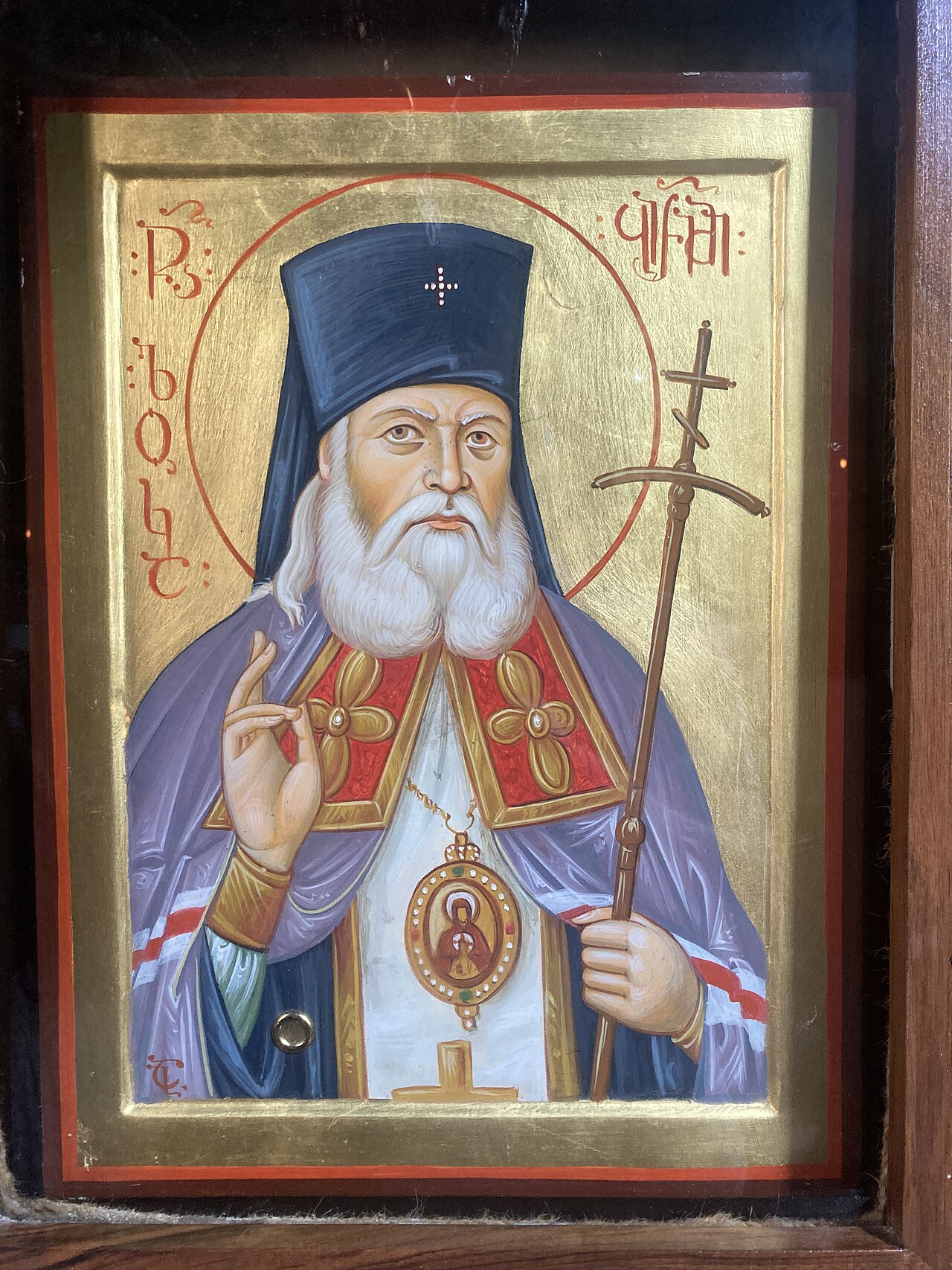
How can saints be holy, and also make mistakes?
Why This Examination Is Necessary
The Orthodox tradition teaches that we should cover the failings of the saints, not unearth them. The instinct of the Church is to honor, not to dissect.
We ask forgiveness for what follows. This examination would not be necessary if two impieties did not force it.
The first impiety comes from the Old Calendarist polemicists who use the errors of Moscow Patriarchate saints to deny their sanctity altogether. They point to Hieromartyr Daniel Sysoev’s defense of Sergianism and conclude he cannot be holy. They point to St. Luke of Crimea’s support for Metropolitan Sergius and conclude he was a “confessor of Bolshevism.” They tear apart the saints of the twentieth century the way their predecessors tore apart Blessed Augustine, and like an Old Calendarist abbess once tried to tear apart St. Nectarios of Pentapolis.
These critics must hear: the saints erred, and they remain saints. However, their errors do not cancel their martyrdom or their holiness. The Church has always held both truths simultaneously.
The second impiety comes from the opposite direction: those who use the saints’ errors as authority. Because Hieromartyr Daniel defended Sergianism, some conclude that Sergianism must be defensible. Because St. Luke supported Metropolitan Sergius, some conclude that the 1927 Declaration must have been acceptable. Because these men were holier than we are, some argue that we are obligated to follow their positions on these questions.
This reasoning is foreign to Orthodox tradition. If sanctity conferred infallibility, Blessed Augustine’s errors on predestination and the filioque would be binding doctrine. They are not. If a saint’s opinion on a disputed question carried the force of dogma simply because he was a saint, the Church would never have needed Ecumenical Councils. St. Gregory of Nyssa taught the apokatastasis. He was holier than any of us, and still, no Orthodox Christian is obligated to follow him into this error, and the Church formally condemned it.
The principle is simple: we follow the consensus patrum (see Appendix A), not the isolated opinion of any individual saint, no matter how holy. When one saint contradicts the convergent witness of the other saints and confessors who addressed the same question, we follow the consensus, not the exception.
The canonized New Martyrs cited in this book who directly addressed the 1927 Declaration condemned it. Hieromartyr Daniel Sysoev, Elder John Krestiankin, and St. Luke of Crimea defended it or the institution built on it. The cited witness is against them on this question. We honor them. We do not follow them where they erred.
To do otherwise would be to make sanctity a substitute for truth. The saints themselves would reject this.
The Patristic Framework: How Saints Can Err
Saints Inherit Error from Their Teachers
St. Barsanuphius the Great (6th century) was asked directly: “Why do saints sometimes err in particular understandings and contradict one another?” His answer:
Saints, having been made teachers… received support from above and exposited a new teaching, but simultaneously preserved what they took from their former teachers, i.e., the incorrect teaching… The opinions of their teachers got mixed up with their own teaching, and these saints sometimes said that which they learned from their teachers and sometimes the good which was suggested to them by their intellect… They did not pray to God that He might reveal whether what their teachers taught them was from the Holy Spirit… and therefore the opinions of their teachers got mixed up with their own teaching.
— St. Barsanuphius the Great, Sts. Barsanuphius and John: Questions and Answers[6]
Saints can inherit false teachings from their mentors. Saints do not always inquire of God about every position they hold. Not everything a saint says carries divine confirmation.
We Honor Saints Who Erred, but We Do Not Follow Their Errors
St. Photius the Great (Patriarch of Constantinople) addressed this directly when Latin theologians tried to use Western Fathers’ errors against the Church:
Have there not been complicated conditions which have forced many Fathers in part to express themselves imprecisely, in part to speak with adaptation to circumstances under the attacks of enemies, and at times out of human ignorance to which they also were subject?… If some have spoken imprecisely, or for some reason not known to us, even deviated from the right path, but no question was put to them nor did anyone challenge them to learn the truth: we admit them to the list of Fathers, just as if they had not said it, because of their righteousness of life and distinguished virtue and their faith, faultless in other respects. We do not, however, follow their teaching in which they stray from the path of truth… We, though, who know that some of our Holy Fathers and teachers strayed from the faith of true dogmas, do not take as doctrine those areas in which they strayed, but we embrace the men.
— St. Photius the Great, Letter to the Patriarch of Aquileia[7]
St. Mark of Ephesus, when pressed by Latin theologians at the Council of Florence who argued that Fathers who erred should be “cast out together with the heretics,” gave the Orthodox answer:
It is possible for one to be a Teacher and all the same not say everything absolutely correctly, for what need then would the Fathers have had for Ecumenical Councils?
— St. Mark of Ephesus, Second Homily on Purgatorial Fire[8]
At that same Council, St. Mark cited Blessed Augustine himself on this principle:
We should not hold the judgment of a man, even though this man might have been orthodox and had a high reputation, as the same kind of authority as the canonical Scriptures, to the extent of considering it inadmissable for us, out of the reverence we owe such men, to disapprove and reject something in their writing if we should happen to discover that they taught other than the truth which, with God’s help, has been attained by others or by ourselves. This is how I am with regard to the writings of other men; and I desire that the reader will act thus with regard to my writings also.
— Blessed Augustine of Hippo (quoted by St. Mark of Ephesus at the Council of Florence)
This is why the consensus patrum matters. As Appendix A explains, when saints across centuries and continents, each having attained theoria independently, teach the same thing on a matter of faith, the Holy Spirit is speaking through them collectively. Their agreement filters out individual error and confirms what the Church has received from the apostles.
Individual saints can err; the collective witness (consensus patrum) corrects them.
Applied: The MP Saints and the New Martyrs
When Hieromartyr Daniel Sysoev erred on Sergianism, the consensus of the New Martyrs who directly addressed the 1927 Declaration, every single one of whom condemned it, corrects him. We follow the consensus, not the isolated error.
Fr. Seraphim Rose addressed this very question in his study of Blessed Augustine’s relationship to St. John Cassian:
The important thing to bear in mind here is that the disagreement between Cassian and Augustine was not one between Orthodox Father and heretic (as was, for example, the disagreement between Augustine and Pelagius), but rather one between two Orthodox Fathers who disagreed only in the details of their presentation of one and the same doctrine. Both St. Cassian and Blessed Augustine were attempting to teach the Orthodox doctrine of grace and free will as against the heresy of Pelagius; but one did so with the full depth of the Eastern theological tradition, while the other was led into a certain distortion of this same teaching owing to his overly-logical approach to it.
— Fr. Seraphim Rose, “The Place of Blessed Augustine in the Orthodox Church,” The Orthodox Word, Vol. 14, No. 2 (March-April 1978), p. 70
Hieromartyr Daniel and the New Martyrs were both fighting Soviet atheism. Both were Orthodox. But the New Martyrs witnessed “with the full depth” of those who directly faced the situation. Sysoev “was led into a certain distortion” owing to his inherited institutional framework. In neither case does the disagreement make either side heretical. Both remain Orthodox witnesses.
Let it be known that even Apostles erred. St. Peter denied Christ three times. Paul and Barnabas had a “sharp disagreement” over John Mark (Acts 15:39).
Sanctity means set apart for God, sanctified by grace. It does not mean intellectually infallible or theologically perfect. To be a saint is to have achieved theosis, to have genuine love for Christ demonstrated by one’s life, and to correctly hold the core dogmas of the faith. Saints are not guaranteed to correctly understand every historical situation, to have perfect political judgment, or to be immune from institutional pressures.
With this framework established, let us examine the specific cases.
Hieromartyr Daniel Sysoev
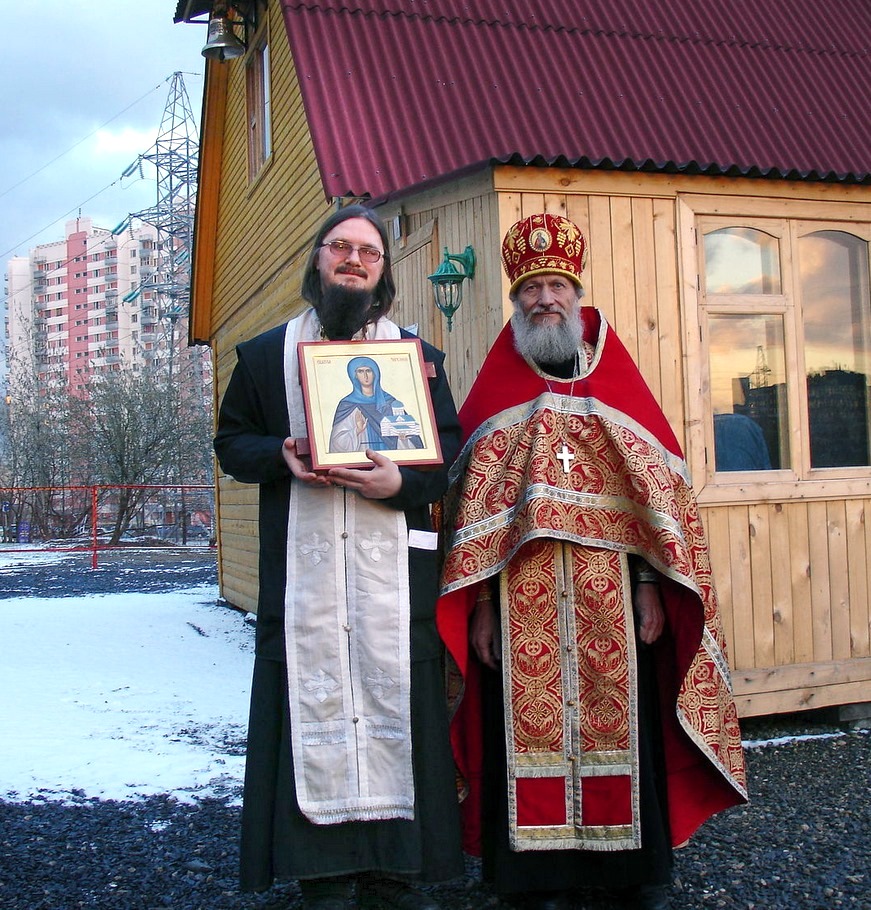
In his writings, Sysoev argued that Metropolitan Sergius’s Declaration was canonically legitimate, condemned the Catacomb Church as schismatic, and wrote extensively against ROCOR, accusing them of schism and heresy.[1]
However, he was only 24 years old and still a deacon when he wrote his most polemical work in 1998, formed in the 1990s in Moscow where the New Martyrs’ writings were largely unavailable. The Moscow Patriarchate did not canonize the New Martyrs until 2000, two years after his article. He was never called before a synod to answer for his position, and never presented with the New Martyrs’ arguments.[9] He may very well have changed his mind.
A striking detail reveals the depth of his cognitive dissonance. His widow Yulia reveals in Неизвестный Даниил (2012) that while preparing his anti-ROCOR polemic, Sysoev was simultaneously “in awe” of the ROCOR miracle of the Montreal Myrrh-streaming Iveron Icon and “very much wanted to see” it. Brother José Muñoz-Cortes, the icon’s keeper, was later glorified as a saint by ROCOR. Sysoev recognized grace in ROCOR while preparing to attack them as graceless.
His trajectory tells the rest of the story. After the 2007 MP-ROCOR reunion, Sysoev personally traveled to New York with Deacon George Maximov to meet Metropolitan Hilarion (Kapral), facilitating a schismatic group’s reception into ROCOR. This means that the man who called ROCOR graceless in 1998 was, by 2009, actively bringing people into ROCOR’s sacramental life. He never published a formal retraction; his very actions were the retraction.[10] And yet the schismatic Old Calendarists leave off these details because it hurts their narrative.
St. Luke of Crimea
St. Luke supported Metropolitan Sergius, served on his Holy Synod after the 1943 Council, and explicitly called the Josephite opposition a “ruinous schism.” Yet unlike Sysoev, he never wrote a theological defense of the 1927 Declaration itself. His autobiography makes no mention of it. His support was institutional, not apologetic.[11]
His life refuted Sergianism more eloquently than his pen ever defended it. He endured eleven years in Soviet prisons, refused to remove his cassock or the icon of the Theotokos from his operating room, told the GPU (KGB) he was “definitely not your friend” because they persecuted Christ, donated his entire Stalin Prize to war orphans, and wrote to his children: “Be ready even for martyrdom, since you are sailing against the current.” He chose exile, suffering, and confession, while supporting a metropolitan who chose accommodation. He understood that “the Church itself did not become mighty and strong by means of its prudent and sensible followers, but through its martyrs, anchorites and ‘Christ’s fools’, who defied logic and every natural instinct and desire.” He lived this principle. He chose the opposite of what Sergianism teaches.
Fr. Seraphim Rose, whom the Old Calendarists themselves venerate, cited St. Luke as an authoritative witness on creation in Genesis, Creation and Early Man, his thousand-page magnum opus on the patristic doctrine of creation (p. 809; see Chapter 14: Embracing Evolution & Charles Darwin). Rose did not merely tolerate St. Luke as a compromised figure; he treated him as a credible theological voice worth quoting.
Following St. Photius: “We leave them among the fathers… but we do not follow those words where they erred.”
Elder John Krestiankin
Elder John Krestiankin (1910-2006), one of the most beloved spiritual fathers of late Soviet and post-Soviet Russia, spent five years in the Gulag for “anti-Soviet agitation,” which in the language of the NKVD (KGB) meant that his sermons had drawn too many to the Faith. After his release, he endured eleven years of continual reassignment through six Riazan parishes before entering the Pskov-Caves Monastery in 1967, where he served for nearly forty years as one of the most sought-after confessors in Russia.[5]
In his collected letters, published by the Pskov-Caves Monastery and translated into English as May God Give You Wisdom!, he defended the Moscow Patriarchate with the same inherited framework as Sysoev and St. Luke. He called the Catacomb Church “a schismatic organization” he did “not even dare to call a Church” and dismissed those who followed the post-Tikhon Catacomb movement as having “degenerated into a sect.”[4] In a postscript to a letter to a bishop, he affectionately recommended a book about Metropolitan Sergius (Stragorodsky) “for your consolation and inspiration.”[12] And on the general question of the Moscow Patriarchate’s compromises, Krestiankin articulated the precise framework on which Sergianism relies: that human mistakes, “yours, mine, the synod members’, the Patriarch’s,” are all before God’s judgment, and that “what seems to the inflamed mind to be a mistake is shown in God’s good time to be a holy work.”[13]
Krestiankin’s stance toward ROCOR, however, was notably more moderate than Sysoev’s. He accepted ROCOR communion for Russians living abroad and explicitly prayed for “the Lord [to] break down the wall of enmity between us and the Church Abroad.”[14] The translators of the English edition append two contextual notes which the Old Calendarist polemicists who quote him always omit: that Krestiankin’s sharpest anti-ROCOR statements were responding pastorally to the specific anomaly of ROCOR establishing a parallel jurisdiction on Russian soil during the 1990s, not to ROCOR-in-general or to the historical New Martyrs, and that by the time of the English edition “communication has opened between the Moscow Patriarchate and the Russian Church Abroad, and Eucharistic communion is being restored.”[15] Like Sysoev, his trajectory bent toward the 2007 reunion he had prayed for.
Yet the underlying framework remained Sergianist. Krestiankin inherited his position from teachers rather than originating it, and never engaged the New Martyrs’ writings on their own terms. A striking juxtaposition in his correspondence illustrates the depth of this cognitive dissonance: the very letter in which Krestiankin recommends the Sergius book is immediately followed in the collection by another letter, titled “New Martyrs,” in which he praises those same saints as “particularly penetrating” teachers whose “circumstances of life” mirror our own day’s spiritual war.[16] The two letters sit adjacent on the page, separated only by a subheading. In a later letter to another priest, Elder John Krestiankin went further, calling the New Martyrs “a living witness as to how to stand in the Truth, how to relate to politics, how not to sink into the controversies so antagonistic to the spirit of Christianity,” and urging the correspondent to “draw the living waters from these holy springs.”[17] Krestiankin venerated both sides of the Sergianist question without apparently recognizing that many of the New Martyrs he praised had been martyred precisely because they refused Sergius’s 1927 compromise. His childhood spiritual father, Archbishop Seraphim (Ostroumov) of Orel, was himself canonized by the Moscow Patriarchate in 2000 as one of the Russian New Martyrs: the very saints whose position Krestiankin later contradicted were the ones who had formed him from the age of thirteen. And in a providence too striking to ignore, Krestiankin reposed on February 5, 2006, the very feast day of the Holy New Martyrs and Confessors of Russia, as though, in the words of the book’s introduction, “these saints, some of whom he personally knew, hereby revealed their kinship with this long-suffering soul.”[18]
The Old Calendarist Exploitation
Fr. Seraphim Rose, whom many Old Calendarists themselves venerate, addressed exactly their method of attacking saints. In his study of Blessed Augustine, Rose warned:
At the least, it is impolite and presumptuous to speak disrespectfully of a Father whom the Church and her Fathers have loved and glorified. Our ‘correctness,’ even if it is really as ‘correct’ as we may think it is, can be no excuse for such disrespect… let those who are more ‘correct’ than they in their understanding fear to lose this grace through pride.
— Fr. Seraphim Rose, “The Place of Blessed Augustine in the Orthodox Church,” The Orthodox Word, Vol. 14, No. 2 (March-April 1978), p. vii
Rose gives a concrete example: “the unfortunate recent attempt in Greece to deny the sanctity of St. Nectarios of Pentapolis, a great wonderworker of our own century, because he has supposedly taught incorrectly on some doctrinal points.”
In 1975, an Old Calendarist abbess named Magdalena published a book attacking the great wonderworker with “absurd and base accusations.” Elder Philotheos Zervakos published a book refuting her fantasies; the incident was one of the reasons he concluded that reconciliation with the radical Old Calendarists was impossible.[19]
They did it to St. Nectarios, and now they do it to Hieromartyr Daniel. The pattern is always the same: find an error, however minor, and use it to tear down a saint.
The Old Calendarists who attack Hieromartyr Daniel specialize in tearing to pieces a man who was martyred for Christ, who converted suicide bombers, who converted numerous Muslims to Orthodoxy, who walked straight toward his killer. They exaggerate his faults rather than excusing them. Thus, they lack the humility and wisdom that St. Photius displayed when he said “we embrace the men” even while not following their errors.
The Weight of Direct Witness
There is a pattern in the Sergianist question that must be stated plainly: the dividing line between holy witnesses who condemned the 1927 Declaration and the holy figures treated in this chapter who defended it is not simply chronological. It is also institutional. The cited saints outside the Moscow Patriarchate opposed Sergianism, whether they lived during Sergius’s time or decades later. The defenders treated here were formed within the Moscow Patriarchate.
Every canonized New Martyr who directly addressed Metropolitan Sergius’s capitulation did so as a contemporary, witnessing the betrayal of the Church’s freedom in real time. St. Joseph of Petrograd, St. Cyril of Kazan, St. Victor of Glazov, St. Andrew of Ufa: these men watched Sergius pledge the Church’s loyalty to the Soviet state, watched their brother bishops arrested for refusing to comply, and they said no. They paid for it with exile, imprisonment, and death.
The opposition did not end with their generation. Saints outside the Moscow Patriarchate continued to condemn the Declaration decades later. St. John of Shanghai and San Francisco (d. 1966) testified that Sergius’s Declaration “brought no benefit to the Church” (see Chapter 9: Glorifying Sergianism and the KGB Church). Metropolitan Philaret of ROCOR (d. 1985) maintained the separation for his entire tenure as First Hierarch. Fr. Seraphim Rose (d. 1982), born seven years after the Declaration, opposed Sergianism from the 1960s until his death. These men lived thirty, forty, fifty years after 1927, and they opposed Sergianism as firmly as the New Martyrs who witnessed it firsthand. The passage of time did not soften their judgment, because they were not formed inside the institution that depended on the Declaration for its existence.
The saints who defended Sergianism came from a different world. St. Luke of Crimea was a contemporary of Sergius, but his support was institutional, not theological: he served on Sergius’s Synod after the 1943 Council while never writing a single theological defense of the Declaration itself. Elder John Krestiankin was born in 1910. Hieromartyr Daniel Sysoev was born in 1974, two full generations removed from the original controversy, in a 1990s Moscow where the New Martyrs’ writings were largely unavailable and the Catacomb Church had faded into legend. None of them witnessed what Sergius’s capitulation looked like in real time; they inherited the institution that emerged from it.
This is not unique to the Church, but simply a universal human pattern: the generation that watches a regime seize power resists it, and the generation born under that regime accepts it as the only world they have ever known. The Russians who remembered life before 1917 never stopped grieving what was lost. Their grandchildren, raised on Soviet textbooks and Soviet holidays, could not imagine anything else. The Moscow Patriarchate’s Sergianist framework followed the same trajectory: the bishops who witnessed 1927 recognized it as a capitulation; the priests born decades later accepted the compromised institution as simply “the Church.” By the time Krestiankin was forming his views, the Declaration was not a living controversy but settled history. By the time Sysoev was writing, the Catacomb Church was not a rival witness but a fading legend.
This is exactly the dynamic St. Barsanuphius the Great warned of (quoted above): saints can inherit teachings from their mentors without inquiring of God whether those teachings are true. “The opinions of their teachers got mixed up with their own teaching.” The MP saints’ defense of Sergianism was inherited, not independently verified. They accepted what they were taught, like anyone raised in a house who never questions the foundation because he never saw it being laid.
Sysoev, Krestiankin, St. Luke: every one of them holds the same position on Sergianism. Not one dissents. Not one questions the Declaration on its own terms. Meanwhile, the source trail examined in this book has not produced a canonical Orthodox witness outside the Soviet sphere affirming that pledging the Church’s loyalty to an atheist state was theologically defensible. When members of a single institution arrive at the same conclusion on a question that directly concerns that institution’s legitimacy, while the cited witness outside that institution points the other way, we are not witnessing consensus patrum. We are witnessing the voice of an institution speaking through the men it formed. These holy men absorbed their position from their spiritual environment. Any one of us, raised in the same milieu, would likely have held the same views. We have the benefit of distance; they did not.
Even St. John of Shanghai was temporarily confused. In 1945, when post-war Soviet pressure led almost every Russian bishop in China to submit, St. John briefly commemorated Patriarch Alexis of Moscow. He stopped the moment he received word that ROCOR’s Synod was still operating, and he was the only bishop in China to do so.[20] Later, he condemned Sergianism unambiguously: the Declaration “brought no benefit to the Church,” and the hierarchy that administered it was indistinguishable from the Soviet government itself (see Chapter 9: Glorifying Sergianism and the KGB Church).
St. John’s trajectory exposes both sides. The Old Calendarists who attack the sanctity of Hieromartyr Daniel and Elder Krestiankin fully accept the sanctity of St. John. They do not say, “St. John commemorated Patriarch Alexis in 1945, therefore he cannot be holy.” They recognize that a saint can be temporarily confused and remain a saint.
Why, then, do they refuse the same recognition to the MP saints? St. John’s circumstances allowed him to reconsider; theirs did not. That is not a difference in holiness.
And for those who appeal to the MP saints’ endorsement of Sergianism as authority: St. John of Shanghai is a fellow native Russian, born in Adamovka in the Kharkov Governorate. He lived through the Revolution, fled the Bolsheviks, and spent his life in exile. He is not a foreigner who misunderstood Russian conditions. Since the 2007 reunion, he is your saint too, venerated in your churches, impossible to dismiss as an émigré polemicist or an Old Calendarist extremist.
His witness is powerful precisely because he once held the opposite position and then rejected it. He had to overcome his own prior commitment. His “no” is an informed “no.”
St. John was afforded the benefit of being outside the Soviet Union, where he could hear both sides freely. He heard both sides. He reconsidered. And he reached the same conclusion as every other Orthodox voice outside the Soviet sphere.
If you venerate this Russian saint who was free from Soviet pressure, is his change of mind not worth considering?
Both audiences already know the principle. They simply fail to apply it consistently. If St. John’s temporary confusion does not invalidate his sanctity, neither does Sysoev’s or Krestiankin’s. If St. John’s temporary confusion does not prove Sergianism is acceptable, neither does theirs.
Fr. Seraphim Rose himself understood this dynamic. When Greek clergy in ROCOR attacked him for publishing material on Elder Tavrion, a Catacomb Church member who had joined the Moscow Patriarchate to serve scattered believers, Rose defended both positions simultaneously. He affirmed that ROCOR was right not to commune with the Soviet Church, but he also affirmed that genuine Orthodox life existed within it: “our Russian Church Outside of Russia has never taught” that the Soviet Church has no grace, he wrote; “this is an opinion which has been introduced into you by some converts who think their opinion rather than our bishops.”[21] Metropolitan Philaret of ROCOR personally sent the Tavrion material to Rose for publication, calling Tavrion a “wise and pious elder” who “belonged at first to the Catacomb Church” but “joined the official church” seeing “how the believing people were scattered like sheep without a shepherd.”[22]
The Tavrion example illuminates the nuance that both extremes miss. The MP saints were genuinely holy men living genuine Orthodox lives inside a compromised institution. Their holiness is not in question. But their acceptance of that institution’s founding compromise does not carry the same weight as the direct testimony of the saints who witnessed the compromise being made and refused it. One group saw the betrayal. The other group was raised in its aftermath.
This is the principle that governs how we read these saints: we follow the consensus that crosses institutional boundaries. When the cited witnesses who addressed the question from outside the institution answer it the same way, when the Catacomb saints, the ROCOR saints, and the wider anti-Sergianist Orthodox witness all condemn Sergianism, and the dissenting voices treated here are formed within the institution that depended on the Declaration for its legal existence, the consensus is not ambiguous. We follow the witnesses who had nothing to gain from their position.
Why These Errors Differ from Kirill’s Pattern
Some will object: “If Hieromartyr Daniel defended Sergianism, why do you chastise Kirill for venerating Sergius but overlook the martyr who held a similar stance?”
St. John’s trajectory answers this. He changed his mind when he received information from outside the Soviet sphere. Patriarch Kirill has received far more: the canonization of the New Martyrs in 2000, the reunion with ROCOR in 2007, the published writings of every saint who condemned the Declaration. He has not changed. He has hardened.
The difference lies in the nature of the error and the posture toward correction.
The deepest distinction is between making a mistake and being stiff-necked. Hieromartyr Daniel believed the Josephites were schismatics. He was wrong. But he held this belief in good conscience, having inherited it from his teachers, and he lived an Orthodox life of prayer, fasting, missionary zeal, and ultimately martyrdom. His error did not proceed from rebellion against the Church but from trusting the wrong teachers on a question he never deeply examined.[9]
Even St. Cyril of Kazan, one of the most prominent New Martyrs who condemned Sergius, allowed for this distinction when addressing Sergius directly in 1933:
I am compelled to do this, addressing it to you who brazenly affirm yourself to be the Chief Bishop of the country, perhaps out of sincere error, and, in any case, with the tacit allowance of a part of the brother bishops, who are now guilty together with you of the violation of the canonical good order of the Orthodox Russian Church.
— St. Cyril of Kazan, Letter to Metropolitan Sergius (July 15/28, 1933), published in The Orthodox Word, Vol. 13, No. 4 (July-August 1977), p. 185
If the canonized New Martyr who called Sergius a usurper could extend this charitable interpretation to Sergius himself (at least before a certain point), how much more should we extend it to Hieromartyr Daniel, who inherited his position from teachers rather than originating it?
Contrast this with Patriarch Kirill. He actively promotes Sergianism as official church policy. He annually venerates Sergius as a “confessor.” He explicitly dismisses the canonized New Martyrs as people who “observed from afar, in conditions of complete personal safety” and spread “false accusations.” When confronted with the witness of St. Joseph of Petrograd, St. Andrew of Ufa, St. Cyril of Kazan, St. Victor of Glazov, and St. John of Shanghai, Kirill does not reconsider. He dismisses them.
As Chapter 9 documents, St. John of Shanghai testified that Sergius’s Declaration “brought no benefit to the Church” and that the hierarchy which administered it was indistinguishable from the Soviet government itself. Kirill calls that hierarchy’s architect a “confessor.” The canonized saints call it a capitulation.
Active rebellion against the consensus of canonized saints, not inherited error held in good conscience.
The timeline makes the contrast starker. Sysoev wrote his polemic in 1998, before the 2000 canonization, before the 2007 reunion. Kirill speaks after both, with full access to the writings of every canonized New Martyr. These are glorified saints of his own Church. And he still dismisses them.
And where Sysoev’s trajectory moved toward reconciliation, personally traveling to New York to bring people into ROCOR, Kirill’s moves in the opposite direction: from ecumenical compromise to war theology, from “dialogue” to blessing missiles. Sysoev’s errors softened with time. Kirill’s have hardened.
One is wheat mixed with chaff. The other is tares.
The Resolution
We can believe Hieromartyr Daniel Sysoev was holy and wrong about Sergianism. We can believe Elder John Krestiankin was holy and wrong about Sergianism. We can believe St. Luke of Crimea was holy and wrong about Sergianism. We can honor their sufferings and learn from their virtues while not following them where they erred.
This is the Orthodox way. We receive the wheat. We leave the chaff. We remember that “we have this treasure in earthen vessels” (2 Cor 4:7).
Follow Sysoev’s missionary courage. Follow Krestiankin’s patience in the Gulag and his forty years of pastoral care. Follow St. Luke’s steadfastness under persecution. Reject the Sergianist position. Honor their confessions. Trust the consensus of the New Martyrs they contradicted. Do not tear down holy men on account of a few mistakes and deem them graceless or question their sanctity, as Fr. Seraphim Rose teaches us.
Hieromartyr Daniel Sysoev, Elder John Krestiankin, Holy Hierarch Luke of Crimea, pray to God for us.
In his article “The Church Abroad: Schism or Heresy?” (c. 1998), Sysoev accused Metropolitan Anthony (Khrapovitsky) of founding a “cross-fighting heresy” (stavroclasm) that allegedly denied the sacrificial nature of Christ’s death. He alleged ROCOR collaborated with fascism (through 1921 negotiations with Hitler, Metropolitan Anastasy’s 1938 letter), with the CIA, and with Freemasonry (claiming Fr. George Grabbe was a Mason and Metropolitan Vitaly’s father was “buried according to Masonic ritual”). He questioned Metropolitan Vitaly’s apostolic succession based on Archbishop Seraphim (Lyade)‘s Renovationist origins. He called ROCOR’s sacraments graceless and its clergy invalid, writing that “there is no grace in schism” and that “the sacraments are not performed among the Russians Abroad.” He also wrote that Christians leaving Russia “cannot enter into Eucharistic communion with those abroad.” These accusations relied on contested historical claims and conspiracy-adjacent reasoning. Local source packet: Priest Daniel Sysoev, “The Church Abroad: Schism or Heresy?” [written c. 1998], Synaxis-indexed PDF
Church Abroad, Schism or Heresy.pdf, pp. 12-13. ↩OrthoChristian, “Fr. Daniel Sysoev, Priest, Missionary, and Martyr,” Nov. 20, 2018, reports that Fr. Daniel personally baptized eighty former Muslims: https://orthochristian.com/117356.html. In a pre-martyrdom interview with Komsomolskaya Pravda, Fr. Daniel said, “За последние два года в нашем храме мы покрестили более 80 мусульман” [“In the last two years in our church we baptized more than eighty Muslims”] and identified among the converts “пакистанец из ваххабитов” who “учился на шахида” [a Pakistani from the Wahhabis who was studying/training to be a shahid]: “Батюшку убили за проповеди среди мусульман?” Komsomolskaya Pravda, Nov. 20, 2009, https://www.kp.ru/daily/24397/574542/. A later English translation of a Serbian interview similarly says Fr. Daniel “managed to turn to Christ a number of Wahhabis, including one Pakistani, who planned on becoming a suicide-bomber”: Facing Islam Blog, “Serbian Conversations: Interview with Fr. Daniil Sysoev, Pt 1,” Nov. 18, 2013, https://facingislam.blogspot.com/2013/11/serbian-conversations-interview-with-fr.html. ↩
Patriarch Kirill, condolences to Yulia Sysoeva, family, clergy, and parishioners of St. Thomas’s, Nov. 2009, official DECR English translation: “The Lord called His faithful servant to Himself, granting him an opportunity to become a confessor of faith and martyr for the cause of preaching the gospel.”
mospat_fetcharticle58169, https://mospat.ru/en/news/58169/. ↩Elder John Krestiankin, May God Give You Wisdom! The Letters of Fr. John Krestiankin (Wildwood, CA: St. Xenia Skete, first English edition), pp. 308, 494. The first quote, in full: “My dear, this is the beginning of the road to your destruction. Lies, falsehood, and deceit are penetrating into the Church these days, rending Christ’s garment. The Catacomb Church is a schismatic organization. I do not even dare to call it a Church. Salvation is only in the Holy Orthodox Church” (p. 308). The second, in a letter to a priest: “Remember the price paid by Holy Patriarch Tikhon to preserve the Church and under what conditions, when it was under pressure without, and troubled from within. What happened to those who followed after the ‘spirit-bearing’ catacomb church which has now degenerated into a sect? Meanwhile, the Church still lives and does its saving work in the world” (p. 494). ↩
Introduction to May God Give You Wisdom! The Letters of Fr. John Krestiankin (Wildwood, CA: St. Xenia Skete, first English edition), pp. 7-12. Krestiankin was arrested April 29, 1950 by the NKVD (KGB), transferred from Liubyanka to Lefortovo to Butyrsky to the lumber works of the Russian far north from 1950 to 1953, released February 15, 1955 (the feast of the Meeting of the Lord), and entered the Pskov-Caves Monastery of the Dormition on March 5, 1967 after eleven years of continual reassignment through six Riazan parishes (a tactic designed by the Soviet authorities to prevent him developing a following). He was raised to Archimandrite in 1973 and reposed on February 5, 2006. ↩
Original Greek: “«Ἐπιτηδεύσαντες οὖν εἶναι διδάσκαλοι…… καὶ καινὰ δόγματα πληροφορηθέντες συνέθηκαν, ἅμα δὲ ἔμειναν ἔχοντες τὰς παραδόσεις τῶν διδασκάλων αὐτῶν, μαθήματα μὴ ὀρθῶς ἔχοντα….ἀλλ’, ἔχοντες αὐτοὺς σοφοὺς καὶ γνωστικοὺς, οὐ διέκριναν τοὺς λόγους αὐτῶν· καὶ λοιπὸν συνεμίγησαν αἱ διδασκαλίαι τῶν διδασκάλων αὐτῶν ἐν ταῖς αὐτῶν διδασκαλίαις, καὶ ἐλάλουν ποτὲ μὲν ἀπὸ τῆς διδασκαλίας ἧς ἔμαθον παρ’ αὐτῶν, ποτὲ δὲ ἀπὸ τῆς εὐφυΐας τοῦ ἰδίου νοὸς… μὴ διακρίνοντες τοὺς λόγους, εἰ ὀφείλουσι πληροφορηθῆναι ὑπὸ τοῦ Θεοῦ διὰ δεήσεως καὶ ἐντεύξεως εἰ ἀληθῆ εἰσι. Καὶ συνεμήνισαν αἱ διδασκαλίαι…»” ↩
Original Greek: ”«…Πόσαι δε περιστάσεις πραγμάτων πολλούς εξεβιάζοντο, τα μεν παραφθέγξασθαι, τα δε προς οικονομίαν ειπείν, τα δε και των απειθούντων επαναστάντων, τα δε και αγνοία, οία δη περιολισθήσαι ανθρώπινον… Ει δε παρεφθέξαντο μεν ή διά τινα αιτίαν νυν αγνοουμένην ημίν της ευθύτητος εξετράπησαν, ουδεμία δε ζήτησις αυτοις προσενήνεκται, ουδ’ εις μάθησιν της αληθείας ουδείς αυτούς παρακάλεσε, πατέρας μεν ουδέν ελλάτον αυτούς, ει και μη τούτο είπον, επιγραφόμεθα… τοις λόγοις τούτων, εν οις παρηνέχθησαν, ουχ εψόμεθα…»” ↩
Original Greek: “ἔστι γὰρ τὸν αὐτὸν καὶ διδάσκαλον εἶναι καὶ μὴ πάντα πρὸς ἀκρίβειαν λέγειν· ἢ τίνος χάριν συνόδων οἰκουμενικῶν ἐδέησε τοῖς πατράσιν, εἰ μηδαμοῦ τῆς ἀληθείας ἕκαστος ἐκπίπτειν ἔμελλε;” ↩
Sysoev was never called before a Synod of bishops to defend his Sergianist writings. He was never formally questioned, never asked to reconsider, never presented with the New Martyrs’ arguments and asked to respond. He died before any such examination could occur. We cannot condemn a man for holding an error he was never given the opportunity to correct. He was formed in the 1990s in Moscow, where the New Martyrs’ writings condemning Sergius were largely unavailable, unstudied, or dismissed as “émigré polemics.” ↩
Fr. George Maximov, “Father Daniel Sysoev and the Foreign Mission,” Pravoslavie.ru (2015), available in English at OrthoChristian.com, https://orthochristian.com/91360.html. Maximov was Sysoev’s close collaborator. He says that Fr. Daniel persuaded a schismatic group in the United States to join ROCOR, that “to facilitate this conversion we went to the meeting with Metropolitan Hilarion of New York,” and that the group joined ROCOR after Fr. Daniel’s death. ↩
For St. Luke’s participation in the 1943 Council and permanent membership on the Holy Synod: George C. Papageorgiou, From Crimea to the Stars (Sebastian Press, 2010), p. 116; also Metropolitan of Argolis Nectarios (Antonopoulos), Archbishop Luke, trans. Daniel J. Sahas, pp. 343-348, with photographs. For his characterization of the Josephite opposition as a “ruinous schism”: Protodeacon Vasily Marushchak, Svyatitel-Khirurg [The Hierarch-Surgeon] (2007), p. 59 (Russian edition): “St. Luke was deeply convinced that the church opposition of Metropolitan Kirill (Smirnov) and the schism caused by Metropolitan Joseph (Petrovykh) were ruinous both for them and for their tempted flock.” Marushchak also notes that despite this conviction, “the Saint’s mercy moved him to provide material assistance to these two metropolitans when they found themselves in exile.” ↩
May God Give You Wisdom!, p. 409. The postscript occurs in a letter to a bishop (“Your Grace, dear Vladyka K.!”) about administering a difficult metropolitanate during the revival of Russian Church life: “P. S. I am sending you a book about Patriarch Sergius for your consolation and inspiration.” ↩
May God Give You Wisdom!, p. 360. The full passage: “Everyone saves himself in his own field. Human mistakes—yours, mine, the synod members’, the Patriarch’s—are all before God’s judgment. But God’s judgment and man’s judgment are not the same. How often it happens that what seems to the inflamed mind to be a mistake is shown in God’s good time to be a holy work, and the laborer is crowned with a wreath.” ↩
May God Give You Wisdom!, p. 208. The full letter, titled “The Church Abroad”: “If there is no church of our jurisdiction in the area where your son lives, then he can pray and be in communion with the Church Abroad. We have no canonical differences between us, other than confusion of a political character, which is exacerbated by certain forces warring against Orthodoxy. But when your son is in Russia, where there is a God-blessed Patriarch, he must not commune with the Church Abroad. They sin seriously in Russia by forming a schism. We pray that the Lord would break down the wall of enmity between us and the Church Abroad.” ↩
Two translator’s notes appear in May God Give You Wisdom! The first, appended to the letter on p. 208: “At the time of this English translation, communication has opened between the Moscow Patriarchate and the Russian Church Abroad, and Eucharistic communion is being restored [trans.].” The second, appended to a related letter on p. 307 in which Krestiankin told a layman that praying in ROCOR’s Russian parishes would make him “a schismatic”: “This was written during a time when the Russian Church Abroad was establishing parishes and monasteries in Russia under its own jurisdiction, and not permitting its adherents to be in communion with the Moscow Patriarchate [trans.].” ↩
May God Give You Wisdom!, pp. 409-410. The letter, addressed “Dear Fr. L.” and titled “New Martyrs,” begins: “Well, the bright January feasts have passed, and again I have the opportunity to take up correspondence… I think that the thoughts, sayings, and example of the life of the New Martyrs could be particularly penetrating. They are close to us in time and circumstances of life—after all, the spiritual war continues in a more sophisticated form; it is encroaching upon the final frontiers, within the Church itself.” The letter follows immediately after the P.S. to the previous letter in which Krestiankin recommends a book about Patriarch Sergius, separated in the printed volume only by the subheading “New Martyrs.” ↩
May God Give You Wisdom!, p. 413. The letter, titled “‘Lord, how could you have allowed me to live to such a time?’,” appears to be a continuation of the same Fr. L. correspondence. The full passage: “Very often nowadays I run up against the modern conceptions of Christianity, and I bitterly sigh the words of St. Polycarp of Smyrna: ‘Lord, how could you have allowed me to live to such a time?’ But since I have lived to this time, I must labor, pray, and call for help to the Heavenly Church. Again I repeat—the lives and written testimonies of the lives of the New Martyrs of Russia are a living witness as to how to stand in the Truth, how to relate to politics, how not to sink into the controversies so antagonistic to the spirit of Christianity. This is more than enough for one calendar. How recent this was to our times! Draw the living waters from these holy springs.” ↩
May God Give You Wisdom!, Introduction, p. 12. The full passage: “Archimandrite John Krestiankin reposed in the Lord at the age of ninety-five, on February 5, 2006. On this day the Russian Orthodox Church celebrated the memory of the Holy New Martyrs and Confessors of Russia, who suffered persecutions for their faith in prisons and exile, just as Fr. John did. It was as if these saints, some of whom he personally knew, hereby revealed their kinship with this long-suffering soul, who gave his whole life unstintingly to God’s service and confession of the true Faith.” ↩
“How the Greek Old Calendarists Became Radicalized and What the Result Has Been,” Moscow Patriarchate, https://mospat.ru/en/authors-analytics/87148/ ↩
“St. John of Shanghai and Commemoration of the Patriarch of Moscow,” ROCOR Studies, July 31, 2024, https://www.rocorstudies.org/2024/07/31/st-john-of-shanghai-and-commemoration-of-the-patriarch-of-moscow/. ↩
Fr. Seraphim Rose, Letter #311 to Dr. Johnstone (August 13/26, 1981), in Letters of Fr. Seraphim Rose, pp. 595-596. Rose wrote in defense of The Orthodox Word no. 96, which featured Elder Tavrion. He continued: “I am sorry that you were given the wrong meaning of our Church’s not having communion with the Soviet Church: that we stay free of politics and do not lend ourselves to bishops who are not free and who are often forced to betray the truth. But to state that this church has no grace is a presumption our bishops have never dared to make.” ↩
Metropolitan Philaret (Voznesensky) of ROCOR, letter to Fr. Seraphim Rose (c. 1981), quoted in Hieromonk Damascene (Christensen), Father Seraphim Rose: His Life and Works (Platina: St. Herman of Alaska Brotherhood, 2003). Philaret sent the Tavrion material to The Orthodox Word “specifically for publication.” The ROCOR Synod subsequently issued a formal decision supporting the publication and warning against the danger of “schism” from those who insisted the Moscow Patriarchate was entirely graceless. ↩