
On Heresy, Synods, and Right Belief
This is the second of four chapters comprising Part VI: The Case for Cessation. Chapter 23 established through fifteen patristic witnesses and six cases of lay action that cessation of commemoration is canonically permitted before any synodal condemnation. This chapter examines what heresy is, how it is defined, and why councils do not create but confirm condemnations. Chapter 25 addresses why communion with heresy requires separation. Chapter 26 answers the major objections.
Councils do not discover heresy: they are convoked to defend against them
As the historical witnesses in the preceding chapter demonstrate, the saints consistently acted against heresy before any synod ruled. Nowhere in the writings of the fathers and saints do they treat heresy as something that requires a synod to exist. A synod is required to formally anathematize and excommunicate someone on account of heresy, but it is still heresy long before that.
The idea that heresy exists only after a council condemns it is not true, as Fr. Seraphim Rose carefully explains:
Just the other day I read an astute comment on the iconoclastic crisis of the 7th-8th centuries. Before the Seventh Ecumenical Council the Orthodox Church did not have any explicit “doctrine on icons,” and so one could argue that the Iconoclasts were not heretics at all, and the dispute was one over the secondary issue of “rite” or “practice.” Nonetheless, the Church (in the person of Her champions, the leading icon- venerators) felt She was fighting a heresy, something destructive to the Church Herself; and after Her champions had suffered and died for this Orthodox sensitivity, and Her theologians had finally managed to put down explicitly the doctrine She already knew in Her heart — then the cause of Orthodoxy triumphed at the Seventh Ecumenical Council, and the Iconoclasts were clearly singled out as heretics.
I suspect that the very same thing, only much vaster and more complicated, is happening today: that those who feel Orthodoxy (through living its life of grace and being exposed to and raised on its basic treasures — lives of saints, Patristic writings, etc.) are battling together against an enemy, a heresy, that has not yet been fully defined or manifested. Separate aspects or manifestations of it (chiliasm, social Gospel, renovationism, ecumenism) may be identified and fought, but the battle is largely instinctive as yet, and those who do not feel Orthodoxy in their heart and bones (e.g., those who are brought up on “Concern” and “Young Life”* instead of lives of saints!) do not really know what you’re talking about and they can’t understand how you can become so excited over something which no council has ever identified as a heresy.
— Fr. Seraphim Rose, His Life and Works, https://www.holycross.org/products/father-seraphim-rose-his-life-and-works, Chapter 52: Zealots of Orthodoxy
To say that iconoclasm was not a heresy before the 7th Ecumenical Synod, is to say that our martyrs who defended these icons and were glorified for it, died for nothing. Many canons were created specifically to justify and codify what the illumined faithful already understood from Scripture and the consensus of the Fathers. Canon XV of the First-Second Council, for instance, was created to justify the numerous saints who had already ceased commemoration long before any canon explicitly permitted it. Our canons are the proper interpretation of Scripture and consensus patrum; they formalize boundaries that the faithful already recognized.
Our Ecumenical synods are not, as some imagine, a bunch of long bearded clergymen assembling every couple of hundred years to devise new and arbitrary rules for us to follow. These councils were convened in response to the church and her unchanging dogmas and revelation being attacked by heretics.
To then frame these councils as the sole means by which heresy is determined is an inversion of logic. It is heresy itself, that prompted the convocation of all our Ecumenical synods, and it is easy to show this:
The 9th Ecumenical Synod (1341, 1347, 1351, otherwise known as the Palamite Synods) primarily defended against the attack on Hesychasm by Barlaam. The 8th Ecumenical Synod primarily defended the Creed against the attack of the Filioque and the Roman Catholics. The 7th Ecumenical Synod primarily defended against Iconoclasm by the Iconoclasts. The 6th Ecumenical Synod primarily defended against the attack of Monothelites that sought to define that Christ has one will instead of two.
And so on, for every single other of our accepted synods, without stint. If a new synod is convoked in the future, it will almost certainly be to address other prominent heresies of our time, which attack the church from within, and without. The entire basis of these councils was to formally condemn what the faithful already understood as heresy, not to “establish” something as heresy.
Protopresbyter James Thornton, in his study of the Ecumenical Synods, articulates precisely this Orthodox understanding of where authority rests:
The ultimate authority in questions relating to Orthodox dogmatic teaching resides in what is known as “consensus Patrum”… and not, as popular misconception has it, in the Ecumenical Synods as such.
— Protopresbyter James Thornton, The Ecumenical Synods of the Orthodox Church: A Concise History, Center for Traditionalist Orthodox Studies, 2007, p. 16
Authority rests in consensus patrum. This framework of consensus patrum is the very framework upon which this book sits, and attempts to cater to.
The Holy Fathers of the councils did not convene to discover new truth, but to defend existing revelation against innovation:
The Holy Fathers of the Great Synods “did not seek to find the truth, making conjectures by reasoning and imagination, but in order to confront the heretics they attempted to formulate in words the already existing revealed Truth…”
— Protopresbyter James Thornton, The Ecumenical Synods of the Orthodox Church: A Concise History, Center for Traditionalist Orthodox Studies, 2007, pp. 21-22
Fr. Georges Florovsky, whom Thornton cites extensively (and whom even the Ecumenists acknowledge), makes this even more explicit:
Strictly speaking, to be able to recognize and express catholic truth we need no ecumenical, universal assembly and vote; we even need no “Ecumenical Council.”
— Fr. Georges Florovsky, cited in Thornton, The Ecumenical Synods, pp. 17-18
This clearly echoes the sentiments by Fr. Seraphim Rose. The Ecumenical Council is not needed to recognize truth. Why then do people profess that a synod is needed to identify and act against heresy?
The faithful who opposed iconoclasm and died for it did not have any formalized canon whatsoever, but were posthumously justified, while those who engaged in iconoclasm, without any canons existing for it, were condemned.
This is why St. Maximos the Confessor taught that councils themselves are judged by the faith, not the reverse:
The right faith validates the meetings that have taken place, and again, the correctness of the dogmas judges the meetings.
— St. Maximos the Confessor, cited in Thornton, The Ecumenical Synods, p. 24
Fr. Michael Pomazansky (whose work Fr. Seraphim Rose translated) confirms this understanding:
True councils, those which express Orthodox truth, are accepted by the Church’s catholic consciousness; false councils, those which teach heresy or reject some aspect of the Church’s Tradition, are rejected by the same catholic consciousness.
— Fr. Michael Pomazansky, Orthodox Dogmatic Theology, trans. Fr. Seraphim Rose, cited in Thornton, The Ecumenical Synods, pp. 22-23
This is why “robber councils” exist: councils that claimed ecumenical authority but were rejected by the pleroma (πλήρωμα, the fullness of the Church, clergy and laity together). The Robber Council of Ephesus (449) defended the heretic Eutyches and was attended by bishops. Does this make it correct? No, because the Church rejected it. It is the pleroma and consensus patrum that ultimately decides whether a synod expresses Orthodox truth or not.
The Seventh Ecumenical Council itself pronounced anathema on those who would break with this tradition:
If anyone rejects any ecclesiastical tradition, written or unwritten, let him be anathema.
— Seventh Ecumenical Council (Nicaea II, 787 AD), Richard Price, trans., The Acts of the Second Council of Nicaea (787), vol. 2 (Liverpool, UK: Liverpool University Press, 2018), p. 660.
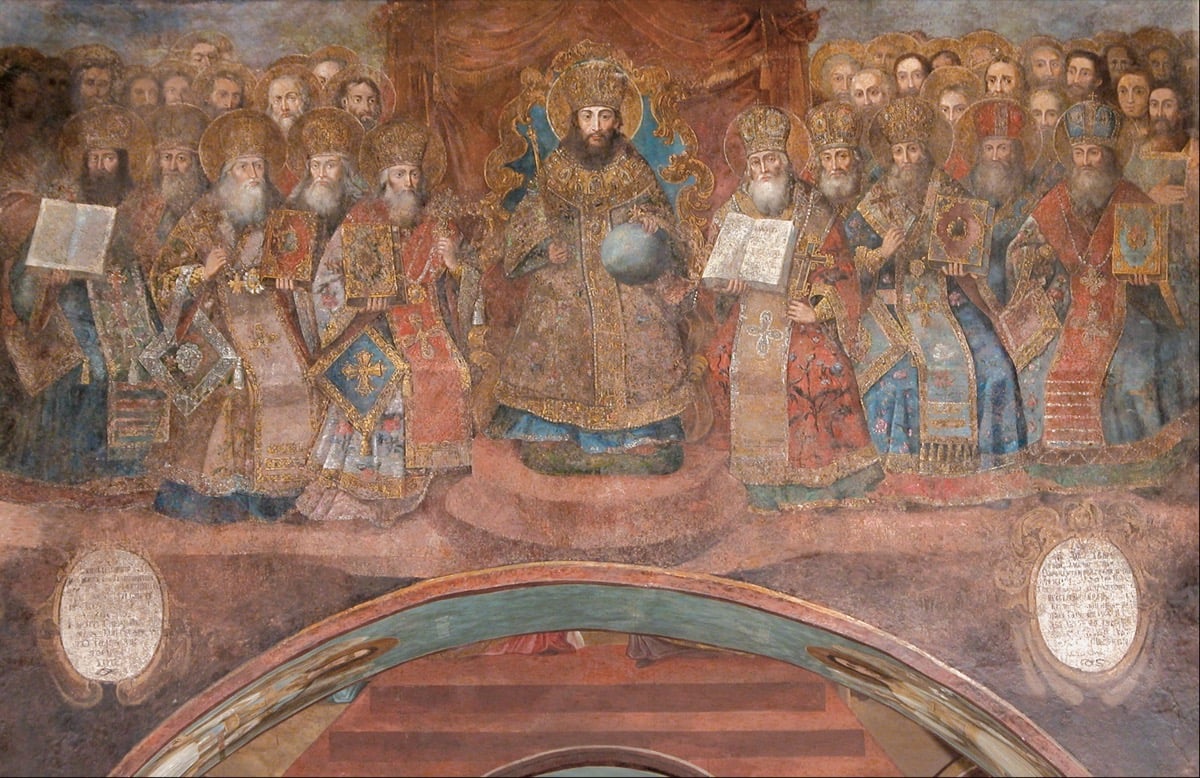
This patristic understanding is demonstrated by historical fact. In every case, local hierarchs and the faithful recognized and condemned heresy BEFORE an ecumenical council formally acted:
- The Meletian Schism: Between 300 and 311 AD, St. Peter of Alexandria broke communion with Meletios of Lykopolis by letter, separating him from the Church. As the Genuine Acts of Peter record: “the blessed Peter, fearing lest the plague of heresy should spread over the whole flock committed to his care, and knowing that there is no fellowship with light and darkness, and no concord betwixt Christ and Belial, by letter separated the Meletians from the communion of the Church.”[1] This occurred fourteen to twenty-five years before the First Ecumenical Council at Nicaea (325 AD). No council. No waiting. One archbishop recognized the danger and acted.
- Arianism: St. Alexander I of Alexandria called a local Synod that condemned Arius several years before the First Ecumenical Council at Nicaea (325 AD) (Thornton, p. 25).
- Nestorianism: When Nestorius attacked the term “Theotokos,” the laity of Constantinople immediately recognized his heresy. “The people of Constantinople were deeply shocked at his words, outraged, in fact… ordinary believers sometimes heckled Nestorios during his sermons” (Thornton, pp. 54-55). St. Celestine of Rome and St. Cyril of Alexandria both condemned Nestorius before the Council of Ephesus (431 AD).
- Constantinopolitan Creed: Fr. Florovsky notes that the Second Ecumenical Council “confirmed rather than produced the Creed” (Thornton, pp. 48-49).
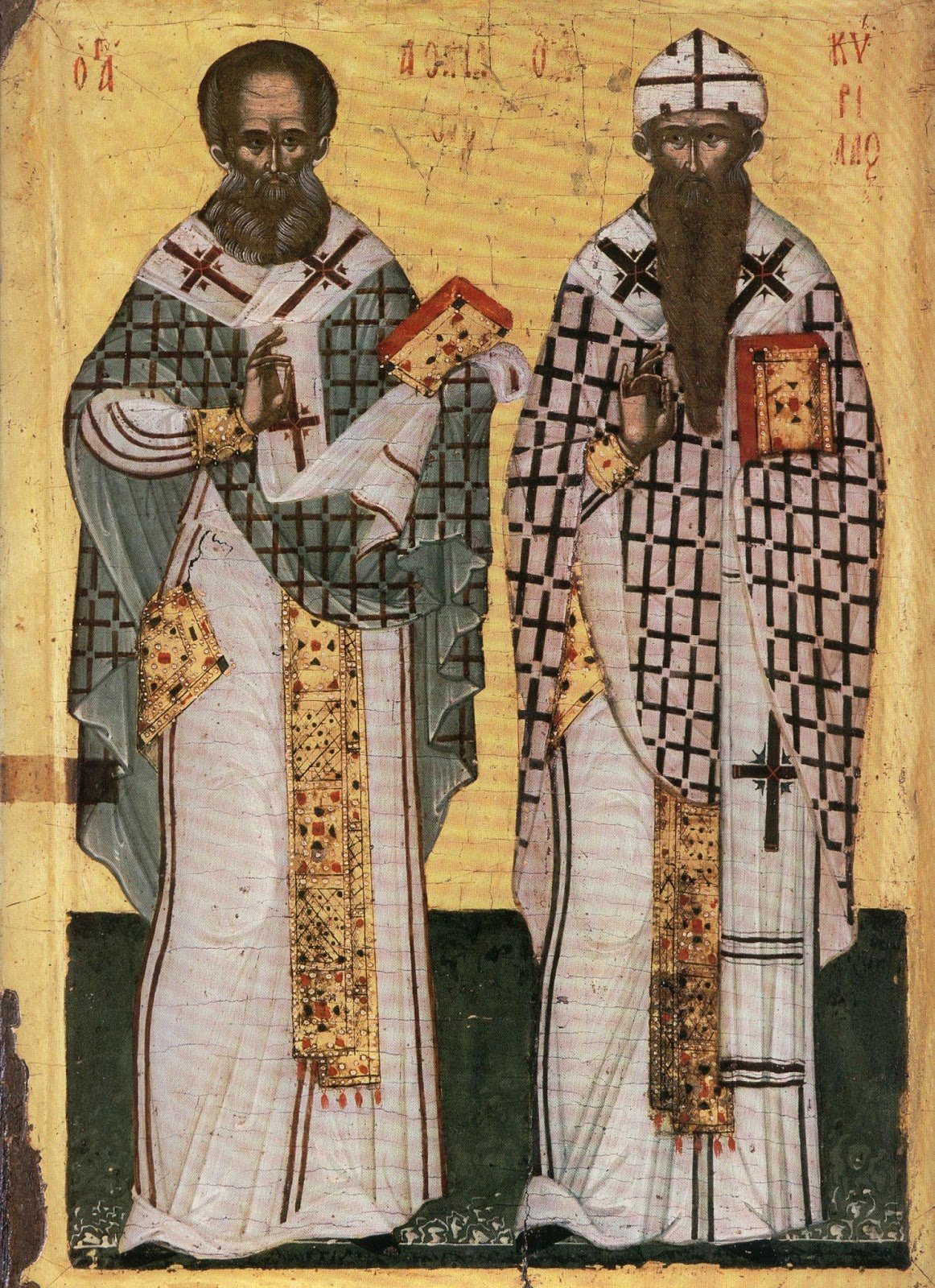
The exchange between St. Cyril and St. Celestine of Rome over Nestorius shows how this process worked in detail. After fraternal correction by letter produced nothing, St. Cyril wrote to St. Celestine seeking counsel on whether communion with Nestorius should continue:
But we do not throw off communion with him openly until we have communicated with you these matters to your reverence. Wherefore deign to specify what seems best, and whether it is necessary to be in communion with him sometimes, or to forbid henceforward openly because no one is in communion with [one] who thinks and teaches such things.
— St. Cyril of Alexandria, Letter to Pope Celestine, in John I. McEnerney, The Fathers of the Church: St. Cyril of Alexandria, Letters 1-50, The Catholic University of America Press, 1987, p. 63
St. Celestine’s response was unequivocal:
We ought to remove this shepherd from the fold of the lambs if we do not correct him, as we desire… But let there be an open judgment against him if he continues, for such a wound must be cut out, by which not one limb is injured, but the whole body of the Church is wounded… Within ten days, counting from the day of this warning, he should either condemn his evil teachings by a written confession… or, if he should not do this, your holiness, because of care for that Church, should immediately understand that he must be removed from our body in every way.
— St. Celestine of Rome, Letter to St. Cyril of Alexandria, in John I. McEnerney, The Fathers of the Church: St. Cyril of Alexandria, Letters 1-50, The Catholic University of America Press, 1987
No synod / council convened. Two patriarchs simply consulted, agreed on the diagnosis, and issued a ten-day deadline. The Council of Ephesus came later, to formalize what was already known and acted upon.
The pattern is consistent throughout Church history: heresy appears, the faithful recognize it, local hierarchs condemn it, and finally an Ecumenical Council formalizes what the truly faithful in the Church already knew. The synod serves as the capstone which formally recognizes heresy. The council does not create the condemnation; it confirms what the Holy Spirit had already revealed to the Body of Christ.
This is not to say that our Holy Synods are unimportant, God forbid. Synods are a formal action to confirm what was already understood by the faithful, and this formal acknowledgment is very beneficial to the Church.
The Laity’s Obligation to Vigilance
Elder Athanasius Mitilinaios taught that this vigilance is not optional for the laity. In a homily on the pan-heresy of ecumenism, he declared that the people of God have not merely the right but the obligation to know what their pastors teach and who their pastors are. He cited Aquila and Priscilla (Acts 18:26), laypeople who corrected the teaching of Apollos, as the scriptural model: first, correct the erring pastor politely; but if he persists in heretical things, the sheep must flee. “Not only the right but also the obligation has the people of God to be vigilant in matters of Faith and the spiritual life” (from a homily on ecumenism; Greek transcription, original video no longer available).
Metropolitan Hierotheos of Nafpaktos identifies the proper relationship between councils and the Fathers:
It is the great Fathers that attained enlightenment and deification who gave validity and authority to the Synods, rather than the Synods validating the Fathers.
— Metropolitan Hierotheos Vlachos, The Mind of the Orthodox Church, cited in Thornton, The Ecumenical Synods, pp. 16-17
In Empirical Dogmatics, Metropolitan Hierotheos further explains this orientation.
The divine inspiration of the Ecumenical Councils is connected with the presence at them of Fathers who were divinely inspired. The Council is not divinely inspired as an institution, but because glorified people take part in it… If we had one hundred and fifty bishops who were not divinely inspired before they went to the Council, would those who were not inspired before the Council become divinely inspired after the inaugural prayer of the Council?
— Metropolitan Hierotheos Vlachos, Empirical Dogmatics of the Orthodox Catholic Church, Vol. 1, Part 3: The Bearers of Revelation, Chapter 5: Fathers
Because the Fathers already possessed the same experience of God, they already agreed before any council was convened:
The holy Fathers lived in various parts of the world, but through the Holy Spirit they had acquired experience of God, and when they gathered in Ecumenical Councils they also acquired a common terminology. Without there being any Pope of Rome among the Fathers to dictate what the dogmas were, all the Fathers together completely spontaneously always supported the same truth. These were people who were separated by vast geographical distances… As they had the same experience, however, they reached common decisions.
— Metropolitan Hierotheos Vlachos, Empirical Dogmatics of the Orthodox Catholic Church, Vol. 1, Part 3: The Bearers of Revelation, Chapter 5: Fathers
When glorified Fathers convened in a Council, the truth was not in question:
Since the glorified are authoritative teachers, when they assemble in Local and Ecumenical Councils they formulate the teaching of the Church unerringly and with divine inspiration… When these people convened in a Council they knew at once what the teaching of the Church is.
— Metropolitan Hierotheos Vlachos, Empirical Dogmatics of the Orthodox Catholic Church, Vol. 2, Part 5: The Church as the Body of Christ and a Community of Glorification, Chapter 7: Heresies
The modern notion then, that a Council exists for the Church to discover its own teaching is therefore a complete inversion:
The modern ‘Orthodox’ view, that the Council is convened in order for the Church to find out what it is teaching, or to decide what it should teach, is nonsense. Absolute nonsense. It bears no relation at all to the reality.
— Metropolitan Hierotheos Vlachos, Empirical Dogmatics of the Orthodox Catholic Church, Vol. 2, Part 5: The Church as the Body of Christ and a Community of Glorification, Chapter 7: Heresies
The councils did not invent criteria; they applied the patristic standard already received. Again, this is why those who defended icons in the times of iconoclasm could understand right from wrong, prior to any formal council being held.
St. Maximus the Confessor demonstrated that this standard is not reserved for councils. At his trial, after demolishing the Monothelite position from Scripture and the synods, he issued a challenge to the innovators:
We ought not, therefore, to invent novelties and use formulas ungrounded in Scripture and the words of the Fathers. Find me any father who enters into the meaning of what thou hast spoken and those of like mind.
— St. Maximus the Confessor, in The Great Synaxaristes of the Orthodox Church, trans. Holy Apostles Convent, Vol. 1 (January), p. 844
“Find me any father.”
Notice that St. Maximus the Confessor does not say to “find me any saint”. This is not an appeal to whether someone has personal experience of God, but an appeal to the Holy Fathers, which St. Maximus often did. The Synaxaristes records that he “would often refute heresies (Apollinarian, Nestorian) by enlisting the help of Saint Gregory the Theologian and Saint Irenaeos” (p. 828), that he “frequently agrees in his treatises with the writings of Saint Gregory the Theologian and Saint Dionysios the Areopagite” (p. 829), and that at his disputation with Pyrrhos he demonstrated the two wills of Christ by “basing his proofs on Scripture and the holy fathers” (p. 830). Before his trial, he declared: “I will never renounce the doctrines of the Gospels and the apostles, nor the traditions of the holy fathers, even if I am threatened with execution” (p. 833). This was not a one-time rhetorical device. Appealing to the Fathers was his consistent method, from his earliest treatises to his final confession before mutilation and exile.
Anyone who can read the Fathers can verify whether a teaching has patristic support or not. The consensus patrum is not hidden knowledge accessible only to the glorified; it is the common inheritance of the Church, written down, preserved, and available to every baptized Christian. Thus the common retort, “you are not a saint like St. Maximus the Confessor,” is not a patristic argument; it is not even the argument St. Maximus himself made. He did not say “I am a saint, therefore believe me.” He said “find me any father”: go read the written record and show me where the Fathers support your position. His authority rested not on his personal holiness but on the Fathers he cited, and anyone who can read can do the same (see Appendix A: On Consensus Patrum for the full framework; see also Chapter 26: "You're Not a Saint" on why sainthood is not a prerequisite for confessing the faith).
This is why Fr. Florovsky describes councils not as legislative institutions but as occasional charismatic events:
The Councils of the ancient Church were never regarded as a canonical institution, but rather as occasional charismatic events.
— Fr. Georges Florovsky, cited in Thornton, The Ecumenical Synods, pp. 18-19
Metropolitan Hierotheos confirms this:
The institution of the Ecumenical Councils is a charismatic institution, not an institutionalised institution. Although there are rules determining how often a Local Council should meet, there are no Canons about convening Ecumenical Councils. Ecumenical Councils were only convoked in response to circumstances, according to the needs of the Church.
— Metropolitan Hierotheos Vlachos, Empirical Dogmatics of the Orthodox Catholic Church, Vol. 2, Part 5: The Church as the Body of Christ and a Community of Glorification, Chapter 7: Heresies
This method is demonstrated vividly at the Fourth Ecumenical Council (Chalcedon). When Pope Leo’s Tome was presented, the Fathers did not accept it simply because a Pope had written it. They tested it against the existing patristic standard:
While the Tome was ultimately accepted, the Fathers took time to examine it to assure its complete Orthodoxy by comparing it to Saint Cyril’s letters. It is very important to emphasize, here, that the Tome was not accepted by the Fathers of the Fourth Synod simply because it was written by a Pope of Rome.
— Protopresbyter James Thornton, The Ecumenical Synods of the Orthodox Church, pp. 67-68
Fr. John Romanides confirms this testing:
In spite of its obvious deficiencies the Tome of Leo is adequately Orthodox, definitely not Nestorian, and was accepted only as a document against Eutyches, but again only in the light of and in subordination to the synodical letters (especially the Twelve Chapters) of Cyril to Nestorius and John of Antioch.
— Fr. John Romanides, cited in Thornton, The Ecumenical Synods, p. 68
The Pope’s document was subordinated to St. Cyril’s existing formulations. The council tested against what the Church already possessed. This is the universal patristic method, summarized by St. Vincent of Lerins:
That faith which has been believed everywhere, always, by all.
— St. Vincent of Lerins, Commonitorium, Ch. II, §6
This “Vincentian Canon” expresses the Orthodox principle: what the Church has always believed, everywhere and by all, is the measure by which councils operate. Councils apply this standard; they do not create it.
From the time when the Church was first founded various heresies appeared, and the Church dealt with them by means of Councils.
— Metropolitan Hierotheos Vlachos, Empirical Dogmatics Vol. II, https://archangelsbooks.com/products/empirical-dogmatics-volume-2-by-metropolitan-hierotheos-of-nafpaktos-theological-studies-book, Part 5: The Church as the Body of Christ and a Community of Glorification, Chapter 7: Heresies
Again, the heresy is recognized before the Council. The Council itself is convoked to deal with the heresy.
The early Church dealt with heresies on a personal level and through Councils. St Paul in his Epistles confronts many such false teachings, but the Church also convened the Apostolic Council in Jerusalem to deal with the manner in which [Gentiles] wishing to be baptised should enter the Church (Acts 15:6-29). This first Apostolic Council became the model for all the other Councils that were convened later in the Church.
— Metropolitan Hierotheos Vlachos, Empirical Dogmatics Vol. II, https://archangelsbooks.com/products/empirical-dogmatics-volume-2-by-metropolitan-hierotheos-of-nafpaktos-theological-studies-book, Part 5: The Church as the Body of Christ and a Community of Glorification, Chapter 7: Heresies
As Fr. Seraphim Rose bears witness to in the beginning of this chapter, the faithful of the Church especially in the personage of saintly men and women, through praying, humility, fasting, reading of scripture, lives of the saints, and partaking of the Holy Body of Christ, acquire the Holy Spirit which helps them to recognize the manifestation of heresy.
The formulation of new canons therefore does not represent new teachings, but simply serves to dispel new foreign, and innovative ideas formed by egotists who came along and contradicted the existing Catholic and unchanging teachings of the Church, seeking first not the opinions of the fathers, but their own new discoveries.
…heretics teach ideas which are contrary to the Holy Scriptures and our Sacred Tradition. Heretics, egotists that they are, interpret the Holy Scriptures as they wish and think they have discovered something new.
— Metropolitan Augoustinos Kantiotes, On the Divine Liturgy, Vol. 2, https://churchsupplies.jordanville.org/products/on-the-divine-liturgy-orthodox-homilies-vol-2, p. 140
Hieromartyr Daniel Sysoev illustrates this method with a vivid example from the acts of the Ecumenical Councils:
I recently reread the acts of the Ecumenical Councils. These contain an account of the interrogation of the heretic Eutyches, founder of the monophysite heresy. He taught that Christ is true God, but not true man, and that His divinity allegedly swallowed up His humanity. At one point he was asked, “Do you acknowledge two natures in Christ, the divine and the human?” He replied, “I believe only what is said in Holy Scripture, and even if I am shown this in the writings of the holy fathers I will not believe, since Scripture is more important than the fathers.” In other words, this person rejected the Church’s universal understanding of the truth in favor of his own understanding of Scripture.
— Hieromartyr Daniel Sysoev, Explanation of Selected Psalms. In Four Parts. Part 1: Blessed is the Man, pp. 74-75
This is the precise method by which every heresy is produced: whatever does not accord with the heretic’s own opinion, he finds grounds to eliminate.
Once this is understood, the purpose of these synods becomes clear: they are to defend against heretical teachings and to anathematize troublemakers (Barlaam, Arius, Nestorius, Origen, Eutyches) who dared to contradict what the Catholic (Universal) Orthodox Church had believed and expressed.
St. Maximus the Confessor stated this principle with devastating precision when Bishop Theodosios claimed that only synods convened by imperial decree had authority. St. Maximus listed seven false synods convened by imperial summons (Tyre, Antioch, Seleukeia, Constantinople under Evdoxios, Nike of Thrace, Sirmium, and Ephesus under Dioscoros), all of which were later rejected and anathematized.[2] He then pointed to the synod that condemned Paul of Samosata, which had no imperial summons at all, yet whose resolutions “are irrefutable.” His conclusion:
The Orthodox Church recognizes those synods which profess true dogmas.
— St. Maximus the Confessor, in The Great Synaxaristes of the Orthodox Church, trans. Holy Apostles Convent, Vol. 1 (January), p. 843
The corollary is equally important: synods that do not profess true dogmas are not recognized, regardless of who convened them. The Robber Council of Ephesus (449) defended Eutyches. The Council of Hieria (754) condemned the holy icons. And in 1990, the Moscow Patriarchate’s own Bishops’ Council declared that the 1927 Declaration of Metropolitan Sergius “contains nothing that would be contrary to the Word of God, that would contain heresy.”[3] The saints who were tortured and shot for refusing that Declaration are, by this conciliar verdict, overruled. Thus, a council can be an instrument of institutional self-justification.
This is why Geronda Ephraim can deem Marxism a heresy, without any pre-existing condemnation of Marxism in council, and rightly claims that this alone is sufficient to cease commemoration. This is also how we can understand why people died for the dogma of our Church regarding icons before a Synod was convened: they did not need a council to identify heresy. Many who did not possess the phronema of the Church did need these synods however, and these synods ultimately help the faithful against complete lawlessness occurring in the Church.
The contemporary understanding that cessation of commemoration must always follow the convocation of a synod is demonstrably false and has no patristic bearing whatsoever, though it is repeated ad nauseam and accepted by those who are uninformed.
All of this has direct application to the situation facing ROCOR and the Orthodox world today.
ROCOR correctly ceased commemorating Metropolitan Sergius for accommodating Soviet state violence, a separation that lasted 80 years (1927-2007). ROCOR’s 1971 Council explicitly condemned the Moscow Patriarchate by name for the heresy of ecumenism (Chapter 7). Their 1983 Anathema condemned ecumenism as a category of error. Metropolitan Anastassy’s Last Will and Testament (1957) demanded “not any canonical, liturgical or even simply external communion” with those cooperating with godless power (Chapter 9). St. Justin Popovich declared that the Moscow Patriarchate delegations “put the things of Caesar before the things of God.”
All of these are documented in their respective chapters. Together they establish a standard: accommodation with state violence that contradicts the Gospel warrants separation until repentance occurs. The canonical Ukrainian Orthodox Church applied this standard in May 2022 by ceasing commemoration of Patriarch Kirill; Chapter 28 documents this witness in full.
ROCOR: The Unanswered Question
ROCOR has not applied the same standard to Patriarch Kirill that they applied previously to the Moscow Patriarchate under Soviet influence.
To their credit, some in ROCOR have not remained silent. Metropolitan Mark of Berlin called the war “a crime” and “fratricide” between “brother peoples” in March 2022.[4] The ROCOR Chancellor stated in 2023 that ROCOR “has not supported Russia’s invasion of Ukraine and does not support the war now.”[5] Individual bishops, including Bishop Irenei of London, have called for cessation of hostilities.[6] ROCOR has expressed support for Metropolitan Onuphry and the canonical UOC, and has provided humanitarian aid to war refugees.[7]
Yet ROCOR has not issued an official Synod statement condemning Patriarch Kirill’s March 27, 2024 “Holy War” declaration.[8] It has not addressed whether Kirill’s teachings constitute heresy under Canon 15. It has not responded to the February 2024 open letter from its own clergy demanding action.[9] It has not allowed parishes to cease commemorating Kirill. It has not publicly reconciled its 80-year separation from Moscow, over Soviet violence collusion, with its present communion, despite Kirill’s blessing of fratricidal war.
ROCOR continues to commemorate Patriarch Kirill liturgically. This is the patriarch who declared the war a “Holy War,”[8] taught that battlefield death “washes away all the sins,”[10] enforces the mandatory “Prayer for Holy Rus’” and defrocks priests who substitute “peace” for “victory,”[11] and repeatedly asserts Russians and Ukrainians are “one people,” denying Ukrainian identity.[12]
The question ROCOR has not officially addressed: What is the canonical difference between Metropolitan Sergius accommodating Soviet state violence (which warranted 80 years of separation) and Patriarch Kirill blessing fratricidal war against Orthodox Christians (which apparently warrants continued communion)?
Both hierarchs accommodated state violence that contradicted the Gospel. Both persecuted clergy who opposed their accommodation. Both claimed their actions served the Church’s interests. Both were recognized as holding legitimate patriarchal authority. Both had defenders who said “we must maintain unity” and “he is our canonical primate.”
ROCOR’s 1983 Anathema condemned those who “advocate, disseminate, or defend” ecumenism, and those who “knowingly have communion” with heretics who teach branch theory or deny the visible unity of the Church.
Consider Patriarch Kirill’s actions, as documented throughout this book: he exchanged the Kiss of Peace with Pope Francis and signed the Havana Declaration (Chapters 1-5), defended the World Council of Churches as “our common home” against Orthodox condemnation (Chapter 7), declared the war “Holy War,” and taught that killing washes away sins (Part V).
This is not a case of retroactive application. Kirill was personally present at the very WCC Assembly that triggered the Anathema. At the 1983 Vancouver Assembly of the World Council of Churches, ROCOR’s own Council documented that “Archbishop Kirill (of the Moscow Patriarchate) pronounced a prayer that ‘we might soon attain visible unity in the Body of Christ by blessing the bread and cup on this same altar’” (Orthodox Life, Vol. 33, No. 6, 1983). That same Council ordered the Anathema Against Ecumenism added to the Rite of Orthodoxy.
The man who prayed for eucharistic unity with the heterodox at Vancouver in 1983 is the same man who called the WCC “the cradle of a united church” in Canberra in 1991, the same man who signed the Havana Declaration in 2016, the same man who is now Patriarch.
He has never repented of any of it. He has never renounced the positions that provoked the Anathema. He holds every one of them today.
ROCOR’s 1983 Anathema condemns ecumenism, which Patriarch Kirill openly practices and has practiced since before the Anathema was written. His accommodation of state violence falls squarely under the precedent that justified ROCOR’s 80-year separation from Sergius. Two independent grounds, both from ROCOR’s own tradition, condemn what Patriarch Kirill does today.
ROCOR’s 80-year witness against Sergianism was correct. The Russian New Martyrs who refused communion with Sergius were saints. Geronda Ephraim was right to say their cessation was “justified by the Canons.” This is an appeal to ROCOR to apply their own principles, not an attack.
If the canonical UOC cannot commemorate Kirill, if ROCOR correctly separated from Sergius for 80 years, if Canon 15 permits cessation when a hierarch publicly teaches error, and if ROCOR’s own 1983 Anathema condemned ecumenism, and ROCOR’s own 80-year separation established that accommodation of state violence warrants breaking communion: then what is ROCOR’s answer to the question that will not go away? Why do you continue commemorating Patriarch Kirill? The question is canonical. It arises from ROCOR’s own precedent and the patristic tradition they claim to defend. Thus, until ROCOR addresses it officially, their silence speaks.
Our canons clearly state that normally, those who do not commemorate their bishop are deposed. But we now understand the exception to this:
DEPOSITION (REASONS FOR): A clergyman is canonized (i.e., sanctioned) with deposition when he does any of the following:
[…]
…does not commemorate his bishop in the Divine Liturgy; the same applies to the bishop who does not commemorate his metropolitan and to the metropolitan who does not commemorate his patriarch (c. 13, 14, 15 Constantinople I-II). The noncommemoration can be accepted only if the superior fell into heresy.
— Protopresbyter Vasile Mihai, Orthodox Canon Law: Reference Book, https://archangelsbooks.com/products/orthodox-canon-law-reference-book, p. 159
Since cessation requires heresy, and since conciliar condemnation is not a prerequisite for identifying heresy, we must now examine what the fathers mean by this word.
What is heresy? And why should I care?
We have covered much of Canon XV of the First-Second Council of Constantinople, which allows for cessation of commemoration in matters of heresy. We have shown clearly that what our saints called heresy and split over, would certainly apply to Patriarch Kirill’s actions. Many shepherds in our times refuse to define heresy, or even use the word.
The fathers defined it precisely.
Heresy is recognized by our saints as blasphemy and mortal sin.
Heresy is a mortal sin; it contains blasphemy in itself and infects the one who is far from true faith in Christ with blasphemy.
— St. Ignatius Brianchaninov, The Field, Chapter 8: “Faith and Works,” p. 57
Through falsehood, delusion and heresy, one does not worship God, but blasphemes Him. That is why we are not “fanatics” when we do not tolerate heretical people [who try to impart their spiritual toxins on us]. Heresy does not glorify God; it is not sacrifice or worship. It is blasphemous and an element to be rejected.
— Elder Athanasius Mitilinaios, Revelation: The Triumph of the Lamb, Vol. 5, https://www.zoepress.us/all-books-cds/revelation-5, Lesson 95
St. Ignatius Brianchaninov explains why heresy is uniquely destructive:
What is the reason for such an action of heresy? The reason lies in the fact that this terrible sin, which contains within itself blasphemy against the Holy Spirit, completely estranges man from God and, having estranged him from God, hands him over to the power of Satan.
— St. Ignatius Brianchaninov, https://azbyka.ru/otechnik/Ignatij_Brjanchaninov/ponjatie-o-eresi-i-raskole/, Part 3: “Heresy is the Hidden Rejection of Christianity”
Note that St. Ignatius refers to heresy as blasphemy of the Holy Spirit. Of important note is our Holy Scripture which says that blasphemy against the Holy Spirit, if not repented of, is unforgiveable. Thus, heresy, if one does not turn away from it, is not forgiven by God.
We know that the gravest sin is the sin of heresy. It is born of pridefulness of mind, and it leads to monstrous crimes.
— Hieromartyr Daniel Sysoev, Explanation of Selected Psalms. In Four Parts. Part 1: Blessed is the Man, pp. 76-77
Those who persevere in false teachings are on the surest path to hell because of nothing less than the mortal sin of heresy.
— Hieromartyr Daniel Sysoev, Instructions For The Fisher Of Men, https://mission-shop.com/product/instruction-for-the-fisher-of-men/, p. 63
The Apostolic Church always considered heresy to be a mortal sin, always recognized that man, infected by the terrible disease of heresy, to have a dead soul, a stranger to blessings and salvation, to be in communion with the devil and his fall.
— St. Ignatius Brianchaninov, Harbor for Our Hope, p. 116
Heresy is a mortal sin. One may see the gravity then of heresy, by examining the other sins which are also mortal sins:
Mortal sins for a Christian include the following: heresy, schism, blasphemy against God, black magic, suicide, unlawful sexual intercourse, adultery, sexual perversions, incest, drunkenness, sacrilege, murder, thievery, and any cruel, inhuman violence.
— St. Ignatius Brianchaninov, The Threshold, “A Homily on Death: Mortal Sin,” p. 133
Heresy is as foul as things like incest, murder, and suicide. We often understand that God hates these latter elements, but often have an attitude of indifference toward heresy, which our saints considered to be in the very same category.
Do we recoil at heresy the same way we recoil at incest?
The Desert Fathers, who insisted more than anyone on the prohibition against judging, carved out one explicit exception:
Into whatever grave sin a brother may fall in your presence, do not condemn him; but have the assurance in your heart that you sin more than he, even if he be a layman — excepting those cases in which he utters a blasphemy belonging to heresy.
— The Desert Fathers, in St. Ignatius Brianchaninov, The Otechnik, “Non-Condemnation of Neighbors”
Every other sin receives the benefit of the doubt. Every other sin calls for the presumption that “you sin more than he.” Heresy alone is excepted, because heresy alone is not a personal failing but a public assault on the faith itself.
St. Nikodemos the Hagiorite teaches the following of mortal sin:
…mortal sins are those voluntary sins which either corrupt the love for God alone, or the love for neighbor and for God, and which render again the one committing them an enemy of God and liable to the eternal death of hell.
— St. Nicodemos the Hagiorite, The Exomologetarion, https://uncutmountainpress.com/products/exomologetarion-a-manual-of-confession
And what is the significance of mortal sins? St. Ignatius Brianchaninov further clarifies this for us.
Every one of these is a mortal sin—that is, they result in the death of the soul—and after them comes eternal perdition, eternal sufferings in the pits of hell.
— St. Ignatius Brianchaninov, The Field, Chapter 8: “Faith and Works,” p. 57
Heresy is also considered by the fathers to be a violation of the 7th Commandment, “Do not commit adultery”:
Those monastics who fornicate or marry also err in this commandment, as do those who fall into spiritual adultery, that is, into heresy and dogmatic error.
— St. Nicodemos the Hagiorite, The Exomologetarion, https://uncutmountainpress.com/products/exomologetarion-a-manual-of-confession
Heresies are a form of fornication which defiles the doctrine of Christ.
St. Irenaeus and Tertullian envision and condemn heresy first and foremost specifically as false doctrine, as a decimation of the truth. Heresies defile by fornication the virginal doctrine conveyed by Christ, and by corrupting doctrine they inflict harm upon the Church.
— St. Hilarion Troitsky, On The Dogma Of The Church, https://uncutmountainpress.com/products/overview-of-the-dogma-concerning-the-church, Third Essay
We are taught from the Fathers that repentance is impossible if we are not free from heresy, and of course, without repentance then, there can be no salvation:
To this we must add that repentance is only possible if a person has a correct, even if simple, understanding of the Orthodox Christian Faith, free of any heresy or false wisdom.
— St. Ignatius Brianchaninov, The Threshold, “A Homily on Death,” pp. 91-92
Without repentance of heresy, there is no forgiveness of sins. So this of course is not a secondary matter.
But what is the greatness of his error, and what the depth of his blindness, who says that remission of sins can be granted in the synagogues of heretics, and does not abide on the foundation of the one Church which was once based by Christ upon the rock.
— St. Firmilian of Caesarea, Epistle 74 to Cyprian (A.D. 256). https://www.newadvent.org/fathers/050674.htm
There are many manifestations of heresy and some wish to measure them to attempt to deem some heresy as inconsequential. But all heresy degrades Christianity:
All heresy — theological, moral or social—degrades Christianity.
— Elder Athanasius Mitilinaios, Revelation: The Triumph of the Lamb, Vol. 5, https://www.zoepress.us/all-books-cds/revelation-5, Lesson 95
St. John of Kronstadt, speaking to his fellow pastors, compared the spiritual condition of his own era to the great heresies of the past:
The present times are no better than those of Arius and Macedonia, or the whole century of the iconoclastic heresy of old, on account of which many holy Fathers of the Church gloriously and victoriously suffered, whose glory is unfading and replete with eternal exaltation and joy. Neither let us fear those who in our times rail against the Faith and the Church, for Christ, our Setter of the Contest and Almighty Head, is ever with us, and shall be unto the end of the world, and the present time of trouble shall serve only for the greater glory of the Church of God.
— St. John of Kronstadt, quoted in I. K. Sursky, Saint John of Kronstadt, trans. Holy Transfiguration Monastery (2018), p. 262
If the times of St. John of Kronstadt, a century before the Moscow Patriarchate’s formal entry into the WCC, were already “no better than those of Arius,” what of our own times?
How is heresy defined?
A heretic is one who does not agree with the teaching of our Lord Jesus Christ, as taught by the holy apostles, as taught by the great Fathers of the Church, and as interpreted by the Ecumenical Councils in the Holy Spirit. All those who do not agree with the teaching of the Orthodox Church are called heretics.
— Metropolitan Augoustinos Kantiotes, Excerpt from a speech by Metropolitan of Florina, Father Augustine Kantiotes, Athens, 14.10.1962, augoustinos-kantiotis.gr
In the writings of the fathers, heresy and false doctrine are one and the same concept.
Indeed, in almost every epistle, when enjoining on us (the duty) of avoiding false doctrines, he sharply condemns heresies. Of these the practical effects are false doctrines, called in Greek heresies.
— Tertullian, Prescription Against Heretics, https://www.newadvent.org/fathers/0311.htm, Chapter 6
The fathers formulated a short statement of the most fundamental of all dogmas (teachings); the Holy Trinity. It is to these fathers and teachers of the Church that we owe eternal gratitude. The heretics of every century blaspheme them, but the Orthodox Church glorifies them…
— Augoustinos Kantiotes, On the Divine Liturgy, Vol. 2, https://churchsupplies.jordanville.org/products/on-the-divine-liturgy-orthodox-homilies-vol-2, p. 115
Heresy with regard to the dogmatic teaching of the Orthodox Church is usually a false teaching that is articulated and formulated through other dogmas.
— Metropolitan Hierotheos Vlachos, Empirical Dogmatics, https://archangelsbooks.com/products/empirical-dogmatics-volume-2-by-metropolitan-hierotheos-of-nafpaktos-theological-studies-book
Heresy is usually limited to theoretical teaching, and someone who deviates from the declared dogmas of the Church is regarded as a heretic.
— Metropolitan Hierotheos Vlachos, Empirical Dogmatics, https://archangelsbooks.com/products/empirical-dogmatics-volume-2-by-metropolitan-hierotheos-of-nafpaktos-theological-studies-book
In general, heresy is a deviation from the teaching of the Prophets, Apostles and Fathers; a deviation from the decisions of the Local and Ecumenical Councils, but also a change in the presuppositions of Orthodox dogma, which are holy hesychasm and the degrees of spiritual perfection, namely, purification, illumination and glorification, or praxis and theoria.
— Metropolitan Hierotheos Vlachos, Empirical Dogmatics, https://archangelsbooks.com/products/empirical-dogmatics-volume-2-by-metropolitan-hierotheos-of-nafpaktos-theological-studies-book
If anyone walks according to a strange doctrine, he has no share in the Passion of Christ.
— St. Ignatius of Antioch, Epistle to the Philadelphians, https://www.newadvent.org/fathers/0108.htm, 3–4
Hieromartyr Daniel Sysoev identifies the essential distinction:
This is what distinguishes a heretic from an Orthodox person. The Orthodox person seeks true revelation, while the heretic seeks his own teaching, his own truth.
— Hieromartyr Daniel Sysoev, Explanation of Selected Psalms. In Four Parts. Part 1: Blessed is the Man, p. 74
A heretic then, is simply one who holds false doctrine, or heresy. This of course is not how numerous contemporary and modern academics define it, but this is most certainly how our saints and fathers defined it.
The error of heresy is so evil that it completely invalidates martyrdom, unlike every other mortal sin. Heresy therefore, is graver than even fornication, adultery, and even murder, which martyrdom does wash away.
A martyr’s death washes away all sins except for heresy and schism. All other sins – fornication, murder, adultery – are washed away.
— Hieromartyr Daniel Sysoev, Instructions for the Immortal, Or What to Do if You Still Die, https://mission-shop.com/product/instructions-for-the-immortal-or-what-to-do-if-you-still-die/, p. 27
Heresy need not be strictly Christological or theological either; violation of the ecclesiastical tradition also constitutes heresy.
Such as are all heresies; the doctrines that do not deny Christianity per se but rather reject works of faith, or the moral, evangelical, and ecclesiastical tradition.
— St. Ignatius Brianchaninov, The Arena, p. 196
St. Isidore of Pelusium, a father of the fifth century, articulated why this inseparability of faith and practice is not optional but definitive:
If right faith has primacy and preeminence, it has nonetheless need of right living in order that good repute may be proved perfect and consummate. Divine Scripture confirms this when it says: “Faith without works is dead.” Therefore, let us compel ourselves with all of our might to integrity of life, in order that, overcoming our adversaries in every way, we might, even if silent, stop their mouths when they dare to gainsay us.
— St. Isidore of Pelusium, Epistle IV.226: “To Paul,” PG 78:1321AB[13]
Right faith has primacy. But right faith without right living is incomplete, and right living without right faith is dead.
The Kollyvades Fathers of the eighteenth century, a movement of Greek monks who championed frequent communion and strict adherence to liturgical tradition, led by St. Nicodemos the Hagiorite, built their entire movement on this principle: that deviation from Orthodox practice constitutes a sacrifice of Orthodox belief. Archbishop Chrysostomos, summarizing their position, writes that they saw any such deviation as “a sacrifice of Orthodox belief by way of a deviation from Orthodox practice: a breach between the perfect harmony of law and spirit and of symbol and spiritual reality.”[14]
Having established that heresy exists before councils formally condemn it, and having defined what heresy is, we must now define precisely who qualifies as a heretic, so that these terms cannot be dismissed as mere rhetoric.
The Rudder establishes this principle with canonical precision. In his commentary on St. Basil’s Canon 1, St. Nikodemos the Hagiorite compiles four authorities on what qualifies as heresy, closing every attempt to minimize doctrinal deviation.
Who then, is a heretic?
George Scholarios (Gennadius II), the last Patriarch of Constantinople before its fall, helps us understand that very simply, a heretic is one who deviates from the Orthodox faith.
A heretic is anyone who either directly or indirectly (ἢ κατ᾽ εὐθεῖαν, ἢ πλαγίως) errs regarding any article of the faith (περί τι τῶν ἄρθρων τῆς πίστεως).
— George Scholarios (Gennadius II), Against Simony, cited in The Rudder (Pedalion), Canon 1 of St. Basil the Great[15]
The civil law of the Roman Empire:
A heretic, and subject to the laws against heretics, is he who deviates even slightly (ὁ μικρὸν γοῦν τι… παρεκκλίνων) from the right faith.
— Roman imperial law, cited in The Rudder (Pedalion), Canon 1 of St. Basil the Great
Patriarch Tarasius, at the First Session of the Seventh Ecumenical Council:
To err in dogmas whether small or great is the same thing (εἴτε μικροῖς εἴτε μεγάλοις… ταὐτόν ἐστι), for from both the law of God is transgressed.
— Patriarch Tarasius, First Session of the Seventh Ecumenical Council, cited in The Rudder (Pedalion), Canon 1 of St. Basil the Great
And St. Photius the Great, writing to Pope Nicholas of Rome:
It is necessary for all to keep all things, and above all those concerning the faith, where even to deviate a little is to sin a sin unto death (τὸ παρεκκλίναι μικρόν, ἁμαρτεῖν ἐστιν ἁμαρτίαν τὴν πρὸς θάνατον).
— St. Photius the Great, Letter to Pope Nicholas of Rome, cited in The Rudder (Pedalion), Canon 1 of St. Basil the Great
Four authorities: a Patriarch, an Ecumenical Council, the civil law of the Christian Empire, and a saint. All compiled by St. Nikodemos in a single footnote of the Rudder. The “articles of the faith” (ἄρθρα τῆς πίστεως) are the dogmatic teachings of the Church: the clauses of the Creed, the definitions of the Ecumenical Councils, the established consensus of the Fathers. To deviate from any of them, whether directly or indirectly, whether greatly or slightly, is heresy, and makes one a heretic.
The modern discomfort with the word “heretic”
Many modern Orthodox Christians recoil from the word “heretic,” treating it as an insult rather than a precise theological term. This discomfort is understandable in a culture that values niceness above precision. But the discomfort itself is the problem: if the word the canons use cannot be spoken, then how can canons themselves ever be applied? What follows demonstrates that the saints used this word without apology, and that the modern reluctance to do so has no patristic basis.
St. Nikodemos himself used the word “heretics” for the Latins as a matter of course, not as a polemic but as a given theological fact, while simultaneously demonstrating the balanced discernment that defines the Orthodox approach:
The heterodox convictions and unlawful customs of the Latins and other heretics we must abhor and turn away from; but whatever is to be found in them to be correct and confirmed by the Canons of the Holy Synods, this we should not abhor or turn away from, lest we unwittingly abhor and turn away from those Canons.
— St. Nicodemos the Hagiorite, Heortodromion (Venice: 1836), p. 584, n. 1
This is the compiler of the Rudder, the most learned Orthodox canonist of his era, a saint fluent in Latin, Italian, and French,[16] who freely drew on good material from Western sources. He was no ignorant bigot. Yet he called the Latins “heretics” without qualification, without apology, and without treating it as a controversial claim. It was simply the Orthodox position.
In the same Canon 1 commentary, St. Basil establishes a threefold taxonomy: Heretics (Αἱρετικοί) are those whose difference is “immediately about the faith in God itself” (εὐθὺς περὶ αὐτῆς τῆς εἰς Θεὸν πίστεώς ἐστιν ἡ διαφορά); Schismatics (Σχισματικοί) are those who disagree over “ecclesiastical causes and healable questions” (δι᾽ αἰτίας τινὰς ἐκκλησιαστικὰς καὶ ζητήματα ἰάσιμα); Parasynagogues (Παρασυναγωγοί) are insubordinate clergy who were deposed but refused to submit and gathered assemblies on their own.
Some may appeal to this taxonomy to argue that ecumenism is merely “schism” rather than heresy. St. Nikodemos closes this escape in his footnote, citing Patriarch Dositheos and Blessed Augustine. Dositheos states that even the parasynagogue, the mildest category, “badly remaining, turns into heresy” (εἰς αἴρεσιν μεταγίνεται). Augustine is more emphatic:
There is no schism unless it first fabricates a heresy, so that it may seem rightly to have separated from the Church.
— Blessed Augustine, Epistle 141, cited in The Rudder (Pedalion), Commentary on Canon 1 of St. Basil the Great[17]
And again:
Schism badly remaining becomes heresy, or falls into heresy.
— Blessed Augustine, Commentary on Matthew ch. 14, cited in The Rudder (Pedalion), Commentary on Canon 1 of St. Basil the Great[18]
Canon 6 of the Fourth Ecumenical Council confirms this: it numbers even those with sound faith who have separated among the heretics. Separation itself, prolonged and unhealed, produces heresy. St. Nikodemos draws out the ecclesiological principle:
Just as when a limb is cut from the body, it immediately dies because the vital force is no longer communicated to it, so too those who were once separated from the body of the Church were immediately deadened, and lost the spiritual grace and energy of the Holy Spirit, since this is no longer communicated to them.
— St. Nikodemos the Hagiorite, The Rudder (Pedalion), Commentary on Canon 1 of St. Basil the Great[19]
Thus, the distinction between “heresy” and “mere schism” offers no shelter. Schism that persists becomes heresy. And all who separate from the Church lose the grace of the Holy Spirit, regardless of which category they occupy.
Heresy defined broadly, consequences applied precisely
A necessary clarification. The definition of heresy is broad: any deviation, however slight, on any article of the faith. But the canonical consequences do not fall on every person who holds a confused opinion. The canons distinguish between ignorance and public teaching. A layperson who misunderstands a point of doctrine can be corrected through instruction. A theologian who privately holds an erroneous view can be admonished. The full weight of canonical action falls on those who preach heresy publicly from a position of authority: this is the precise language of Canon 15 of the First-Second Council, which specifies those who preach heresy “publicly” (δημοσίᾳ), “with bare head” (γυμνῇ τῇ κεφαλῇ), “with boldness” (παρρησίᾳ). The broad definition tells us what heresy is. The canonical framework tells us when the Church acts.
Patriarch Kirill does not hold a private confusion about ecclesiology. He has publicly preached ecumenism for five decades from the highest office of the Russian Church. The definition and the consequences converge on him without ambiguity.
The key, as I stated earlier, is the Tradition of the Church provided in the teaching of the early Church Fathers. This is how the Church interprets. If you insist on interpreting the way you want, due to your demonic arrogance, then you will most certainly fail. You will become a heretic, since heresy is nothing other than the logical interpretation of dogma.
— Elder Athanasius Mitilinaios, Revelation: The Seven Golden Lampstands, Volume I, https://churchsupplies.jordanville.org/products/revelation-vol-1-the-seven-golden-lampstands, Lesson 3, Revelation 1:1-4
Notice that these patristic quotes never make any mention of a synod or a council. There is no attached notion of a council being needed to determine heresy. The claim that a council is required comes from modern contemporary theologians and academic scholars who present their arguments without any substantial witness of the fathers and saints.
This erroneous teaching, that heresy requires conciliar condemnation before it can be identified as such, has been popularized in modern Orthodox theology largely through the influence of the ecumenist movement, which undermines the very concept of heresy and the necessity of separation from it.
St. Jerome affirms this patristic consensus:
Anyone who understands Holy Scripture differently from the way the Holy Spirit intends, under whose guidance it was written, can be called a heretic…
— Saint Jerome, Commentary on Galatians, PL 26:417A
Most importantly, heresy is not a secondary matter. Heresy cuts us off from Christ.
Guard yourselves from soul-destroying heresy, communion with which is alienation from Christ.
— St. Theodore the Studite (PG 99:1216)
Heresy is separation from God, and I do not wish to be separated from God.
— St. Agathon, Apophthegmata Patrum, Alphabetical Collection, “Agathon” 5 (PG 65:137C–D).[20]
St. Gregory Palamas applies this principle directly to hierarchs who claim authority while departing from the truth:
Those who belong to the Church of Christ dwell in the truth, so those who don’t have the truth, don’t belong to the Church of Christ, no matter how much they proclaim lies when they call themselves holy shepherds and hierarchs and are called this way by others. Because we remember that Christianity is not defined by external appearance, but by the truth and exactness of the faith.
— St. Gregory Palamas, Rejection of the Epistle of the Patriarch of Antioch, PG 150, 1045BC[21][22]
“No matter how much they call themselves holy shepherds.” Rank does not sanctify error. The title “Patriarch” does not make heterodoxy into Orthodoxy. Christianity is defined by “the truth and exactness of the faith,” not by the external trappings of ecclesiastical office.
Why this matters more than anything else
The reader who has absorbed the preceding witnesses may now understand why the fathers spoke with such severity. But many Orthodox Christians today still treat heresy as an academic category, something theologians argue about, a relic of ancient councils with no bearing on daily spiritual life. They believe that what defines Orthodoxy is prayer, fasting, the Divine Liturgy, the Jesus Prayer, the sacraments, the beauty of the icons. All of these things are good and true.
But none of them are what makes Orthodoxy Orthodoxy.
Really?
Consider: you can find Old Calendarist schismatics who celebrate the full Divine Liturgy in its ancient form and commune daily. You can find Monophysites with unbroken apostolic succession and monastics who pray the Jesus Prayer ceaselessly. You can find Roman Catholics with saints, sacraments, icons, and monasteries. You can find zealot monasteries that fast with great rigor, and secular people who fast for health.
None of these things, by themselves, have anything whatsoever to do with Orthodoxy.
Hieromartyr Daniel Sysoev, after spending time with Pentecostals, made a striking observation:
People think, in error, that the sects are easier than the Orthodox. Recently, I had a chance to socialize with Pentecostals. I learned that it is their practice to pray five hours during the day. What Orthodox Christian prays for five hours a day?
— Hieromartyr Daniel Sysoev, “The Blood of the Martyrs Is the Seed of the Church: The Life and Martyric Death of a Righteous Missionary, Father Daniel Sysoev,” The Orthodox Word, No. 268, September-October 2009, pp. 213-215
How many Orthodox Christians are praying five hours a day? In these latter times, not even every monk prays without ceasing, let alone the laity.
Who then would dare to say that Pentecostals, simply by praying five hours, are Orthodox? Such an implication is blasphemous and shameful. Prayer is a defining trait of Orthodoxy, but it is not what makes one Orthodox. If that were true, then Pentecostals and many other heretics would be considered Orthodox.
Some say that what matters is prayer, not dogma. St. Paisios the Athonite showed them what that looks like when tested. Two Catholics visited his kalyvi and asked him to pray the Lord’s Prayer with them.
This is the Lord’s Prayer; the most basic, the most universal, the most uncontroversial prayer in all of Christianity. St. Paisios the Athonite refused:
Once, two Catholics came to my kalyvi. One was a journalist and the other a secretary at the Vatican. “Let’s first say the Lord’s Prayer, Our Father,” they told me. “To say the Lord’s Prayer,” I said, “we must also agree in our doctrinal faith. For between you and us there is a great chasm.”
— St. Paisios the Athonite, Spiritual Counsels Vol. 5: Passions and Virtues, p. 289-290
St. Paisios would not pray the Lord’s Prayer with Catholics. Not because the prayer was wrong. The prayer was perfectly fine. He would not pray it with them because they do not share the same faith.
Prayer is established within right belief; it does not replace it. Where faith differs, even the most fitting prayer becomes impossible. St. Paisios tells us that it is better not to pray at all when our faith differs, than to pray as though the chasm does not exist.
St. John Chrysostom warned precisely against this: that love itself can become the vehicle by which false doctrine enters.
For there is danger, lest anyone be corrupted by the love of the heretics… “That ye may be sincere,” is said to you, that you receive no spurious doctrine under the cloak of love. “Be at peace with all men” [Rom. 12:18], but love not so as to be injured by that friendship.
— St. John Chrysostom, Homily on Philippians 1:10, cited in The Praxapostolos: Acts and Epistles, trans. Holy Apostles Convent (Buena Vista, CO: Holy Apostles Convent, 2019), p. 322
“Under the cloak of love.” This is the precise mechanism by which ecumenism operates: love, unity, bridge-building, fraternal dialogue. The cloak is real; the doctrine underneath it is spurious.
St. Ignatius Brianchaninov, the most authoritative Russian saint on the subject of prayer, states this as the opening sentence of his treatise on the Jesus Prayer:
The correct practice of the Jesus Prayer proceeds naturally from correct notions about God, about the most holy name of the Lord Jesus, and about man’s relationship to God.
— St. Ignatius Brianchaninov, Ascetic Essays, Vol. 1, “On Practicing the Jesus Prayer,” https://azbyka.ru/otechnik/Ignatij_Brjanchaninov/tom1_asketicheskie_opyty/28[23]
“Proceeds naturally from.” The most central prayer practice in Orthodox asceticism, the prayer that every monk prays, the prayer that the entire Philokalia exists to teach, proceeds from correct notions about God. If there are no correct notions about God, there is no correct prayer.
This is not one saint’s opinion. The Church herself declares it in her own liturgical voice, read aloud in every Orthodox parish on the second Sunday of Great Lent, every year:
Since works without right faith avail nothing, we set Orthodoxy of faith as the foundation of all that we accomplish during the Fast.
— Synaxarion for the Sunday of St. Gregory Palamas, The Lenten Triodion; also cited in The Lives of the Pillars of Orthodoxy, Holy Apostles Convent, 1990
Works without right faith avail nothing. Not “avail less.” Nothing. The Church sets right faith as the foundation of all that is accomplished during the Fast: prayer, fasting, repentance, almsgiving. Without it, they avail nothing.[24]
If an Orthodox Christian claims “prayer is what matters, not dogma,” the Triodion they hear every Lent says the complete opposite.
Every Orthodox Christian knows that faith without works is dead (James 2:26). Fewer have considered the reverse. Scripture teaches it just as clearly: works without faith are nothing. The Apostle writes: “χωρὶς δὲ πίστεως ἀδύνατον εὐαρεστῆσαι,” “without faith it is impossible to please God” (Heb. 11:6). Not difficult. ἀδύνατον: impossible. And again: “πᾶν δὲ ὃ οὐκ ἐκ πίστεως ἁμαρτία ἐστίν,” “whatever is not from faith is sin” (Rom. 14:23). Everything. Not some things. πᾶν: everything not proceeding from faith is sin.
What “faith” means in the Greek
But what does “faith” mean here? English-speaking Christians almost universally read the word as a subjective feeling: personal trust in God, an inner confidence, a warm sense of belief.
However, this is not what the Greek says.
The word πίστις in the New Testament does not mean only subjective trust.[25] It also means, and in many passages primarily means, the objective content of the apostolic teaching: “the faith” as a body of doctrine.
Here is the proof:
It can be delivered: “τῇ ἅπαξ παραδοθείσῃ τοῖς ἁγίοις πίστει,” “the faith once for all delivered to the saints” (Jude 1:3). It can be departed from: “ἀποστήσονταί τινες τῆς πίστεως,” “some will depart from the faith, giving heed to deceiving spirits and doctrines of demons” (1 Tim. 4:1). It can be guarded: “τὴν πίστιν τετήρηκα,” “I have kept the faith” (2 Tim. 4:7). It can be destroyed: “τὴν πίστιν ἥν ποτε ἐπόρθει,” “the faith which he once tried to destroy” (Gal. 1:23).
You cannot deliver, depart from, guard, or destroy a subjective feeling. You can deliver, depart from, guard, and destroy a body of doctrine. That body of doctrine is what the Church calls Orthodoxy: ὀρθοδοξία, right belief. When Scripture says “without πίστις it is impossible to please God,” and when the Synaxarion says “works without right faith avail nothing,” they are saying the same thing.
Evagrius Ponticus, whose writings on prayer form the backbone of the Philokalia, sealed the connection in a single sentence:
If you are a theologian, you will pray truly. And if you pray truly, you are a theologian.
True prayer and right belief are not parallel tracks that happen to overlap. They generate each other. Separate them and both die.
Therefore, the one thing that separates Orthodoxy from every other group is not prayer, not fasting, and not profession of love for Christ, but right belief. That is what the word Orthodoxy means: ortho-doxia, correct glory, correct belief. It is solely right belief (ὀρθοδοξία, orthodoxia) that gives birth to prayer, fasting, and a love of Christ that is pleasing to God, and only within orthodoxia (ὀρθοδοξία) are prayer, fasting, love for Christ, and other virtues such as repentance, even properly oriented. Outside of it, they have no meaning and do not assist one in salvation at all, as our saints and holy fathers teach. Why then, does heresy matter so much to us?
Heresy is the negation of this right belief.
Heresy then, is not a footnote to the faith; it is the category boundary of the faith itself. When someone professes a different belief about God, about Christ, about the Church, they are professing a different faith entirely. As the fathers just told us: they are worshipping a different God, they are blaspheming, they are committing spiritual adultery, and are thus separated from Christ.
If this is true, and the unanimous witness of the fathers tells us it is, then let us consider what it means to call heresy a “secondary matter,” as so many in our times do. The previously cited fathers have told us that heresy contains blasphemy against the Holy Spirit, the one sin that Scripture tells us is unforgivable. They placed it in the same category as incest, murder, and black magic. They told us it is the one sin so grave that even martyrdom cannot wash it away: a man may die for Christ and have every other sin forgiven, but if he dies in heresy, even his martyrdom avails him nothing.
Who, having heard all of this, would dare to call heresy a secondary matter and contradict our saints? To say that heresy is secondary is to say that blasphemy against the Holy Spirit is secondary. It is to say that the one sin which estranges man from God and delivers him to Satan is not worth concerning ourselves with.
The person who holds this position has, whether they realize it or not, renounced the very meaning of the word Orthodoxy. They have taken the sole defining boundary of their own faith, right belief, and declared it unimportant. They have elevated prayer, fasting, and the externals of worship above the one thing that gives these practices their meaning, while schismatics commune daily, heretics fast constantly, and Pentecostals pray five hours a day, all outside of that boundary.
This is not a secondary matter. This is the only matter.
Hieromartyr Daniel Sysoev diagnosed why so many cannot see this:
People do not know God or how salvation takes place; and all of their time is taken up with completely unimportant matters such as the minutiae of this or that rite, the details of this or that church policy, or one regional view or another.
— Hieromartyr Daniel Sysoev, “The Ideological Rigor Mortis of the Church,” The Orthodox Word, No. 268, September-October 2009, pp. 213-215
People do not know how salvation takes place. They have been catechized in rite and custom rather than in faith and dogma, and so when they are told that heresy is the gravest of all sins, it sounds extreme to them. They look at heresy and just see a theological disagreement. The fathers however looked at heresy and saw the death of the soul.
St. John of Damascus, whose Exact Exposition of the Orthodox Faith is the most authoritative systematic theology in Orthodox tradition, states this plainly:
For he who does not believe in accordance with the tradition of the [Orthodox] Catholic Church or who through untoward works holds communion with the devil is without faith.
— St. John of Damascus, Exact Exposition of the Orthodox Faith, Book IV, Chapter 10: On Faith, p. 212
Without faith. St. John of Damascus himself ties back the meaning of faith to represent the tradition and teachings of the Orthodox Church.
The one who does not believe in accordance with the tradition of the Catholic Church, regardless of how much he prays or fasts or gives alms or goes to church, “holds communion with the devil” and “is without faith.” Not “less faithful.” Not “on a different path.” Without faith entirely. This is the dogmatic teaching of a Father of the Church.
And let us always remember what the very word Orthodox means: ὀρθοδοξία, right belief, correct glory. The name of our faith is itself a declaration that right belief is the thing that defines what it means to be Orthodox. It is right in the name, lest we forget, though we often do.
To be Orthodox is to believe correctly. To believe incorrectly then, is to be, by definition, something other than Orthodox, regardless of how we, disobedient children of the saints, choose to redefine the definitions set down by our church fathers and saints.
This is why heresy and schism are the things that separate the heterodox from salvation, not the absence of prayer or fasting or liturgical beauty.
In fact, some Catholic churches borrow heavily from the Orthodox externals, and even pray the Jesus Prayer, and yet none of this matters without the Orthodox faith, its traditions, and its dogma.
Those who say “heresy doesn’t really matter, what matters is that we pray and love Christ” have, without realizing it, erased the very thing that makes them Orthodox. If right belief is not the defining factor, then there is no reason to be Orthodox rather than Monophysite, or Roman Catholic, or Old Calendarist. They all pray. They all fast. They all claim to love Christ.
To treat heresy as a footnote is to betray the very essence of what Orthodoxy is. The fathers did not treat it as a footnote. They called it mortal sin, blasphemy against the Holy Spirit, spiritual adultery, the gravest of all sins, the one sin that even martyrdom cannot wash away. They understood that right belief is what everything else depends on: without it, prayer becomes the prayer of a schismatic, fasting becomes the fasting of a heretic, and the sacraments become, as St. Theodore the Studite will show us, defiled.
“But using the word heretic is mean…”
It is around this point that some object to the usage of the word heretic and say that we should not go around calling people heretics. This is a strawman and focused on the wrong thing.
Of course, our saints did not go around antagonizing people and calling them heretics … unless they were actively attacking the faith. However, they most certainly used this word in their writings and labeled people as heretics within them, without the apprehension and timidness that the Orthodox Christians of our times wish everyone to have.
The words “heresy” and “heretic” have inexplicably become something of swear words in contemporary Orthodox Christian lexicon.
“Read the saints,” we are told. “Take heed to their lives and their words. Keep their holy words on your lips. But be careful with the words heresy and heretic”, behaving as if these were swear words, which would naturally imply that only the saints may swear and curse, which is a ridiculous position to have.
Regardless of whether those who hold this position like this metaphor or not (they won’t), this is the implication and where their logic leads, even if they may not realize it.
Why preserving the word heretic matters
The word heretic (in Greek, αἱρετικός, hairetikos) derives from the word αἱρέω (haireo), meaning “choice”, which derives from the verb αἱρέομαι (haireomai) which means “to choose”.
Heresy is a choice, which is the meaning of the Greek word αἵρεσις. The effect of heresy is specifically perversion of the faith (adulterae doctrinae), and by perversion of the faith the apostle Paul specifically means heresies.
— St. Hilarion Troitsky, On The Dogma Of The Church, https://uncutmountainpress.com/products/overview-of-the-dogma-concerning-the-church, Third Essay
Heresy is doctrine contaminated with poison. All heretics have fallen from the truth. And the heretics bring strange fire to the altar of God. They rise up in opposition to the truth, and exhort others against the Church of God.
— St. Hilarion Troitsky, On The Dogma Of The Church, https://uncutmountainpress.com/products/overview-of-the-dogma-concerning-the-church, Third Essay
The word heresy simply expresses a choice to create or accept a doctrine foreign to the fathers and saints of the Church. A heretic is one who makes such a choice by putting forth their own opinion against the fathers and saints.
Each author of heresies “introduced privately and separately his own peculiar opinion (ἰδίως καὶ ἑτέρως ἰδίαν δόξαν).”
— St. Hilarion Troitsky, On The Dogma Of The Church, https://uncutmountainpress.com/products/overview-of-the-dogma-concerning-the-church, Third Essay
The word heretic then is no more insulting than simply saying that one puts forth their own choices and opinions.
No one would take great issue with saying that one is coming to their own opinions. Yet the moment one uses the Greek word that denotes precisely this, people then take great offense, even though what has been expressed is materially the same thing.
We as Orthodox Christians believe we have the one true faith. Those who do not accept our faith and dogma, whether inside or outside the Church, have either introduced or accepted peculiar opinions that were not expressed or believed universally by the Church.
When expressed this way, no one becomes angry.
But when the very words that map to these concepts are used, people become inexplicably perturbed and flustered, as though something offensive has been said, when nothing has changed but the vocabulary, even though the underlying concepts remain the same.
The main cause of this has to do with a general lack of understanding of what heresy and heretic mean by many in our time. Unfortunately, those who don’t understand what these words mean, then proceed to critique those who do understand them.
The secondary cause of this reticence around these words has to do with the very harsh and uncompromising critiques our Church Fathers and saints leveled at heresy and at heretics. These words have become bad words in modern lexicon not because they are bad words, but because our saints and fathers spoke so strongly about heretics that in our diplomatic and sensitive times, even using such a word, even if it definitionally applies, is no longer tolerated whatsoever.
And so to avoid the discomfort we feel from how our saints spoke about heretics, we reach for different words to describe them, such as heterodox, meaning “other opinion”, which is supposedly a more polite term. However, “an opinion other than the correct one” and “incorrect choice” functionally mean the same exact thing, do they not? Thus we see a sort of mental and rational sickness that doesn’t quite make any sense.
The Greek components make this equivalence undeniable. Αἱρετικός (hairetikos) comes from αἵρεσις (hairesis), meaning “choice”: one who has chosen something other than the Orthodox faith. Ἑτερόδοξος (heterodoxos) comes from ἕτερος (heteros), “other,” and δόξα (doxa), “belief”: one who holds a belief other than the Orthodox faith. And ὀρθόδοξος (orthodoxos) comes from ὀρθός (orthos), “correct,” and δόξα: one who holds the correct belief. If ὀρθόδοξος means “correct belief,” then ἑτερόδοξος means “other than correct belief.”
What then is choosing a belief other than the correct one? That is αἵρεσις, a wrong choice.
This may be confusing, but the point is that the words then fundamentally describe the same exact reality from two angles: one names the act (choosing wrongly), the other names the state (holding a different belief). The fathers used αἱρετικός. We then invented ἑτερόδοξος as a euphemism. A footnote in Elder Athanasius Mitilinaios’s commentary on Revelation confirms this directly:
The word heretic today has been replaced by the word heterodox in our efforts to comply with the tenets of ecumenism and political correctness.
— Elder Athanasius Mitilinaios, Revelation: The Seven Trumpets & The Antichrist, Vol. 3, https://www.zoepress.us/revelation-the-books/revelation-the-seven-trumpets-amp-the-antichrist-volume-3, footnote
Hieromartyr Daniel Sysoev, who was martyred for preaching Orthodoxy in 2009, demonstrated what it looks like when a saint uses the word as the fathers intended. He applied the patristic standard to Protestants directly, grounding his conclusion in the Apostle Paul:
Do the Protestants, who have distorted the teaching on salvation, who teach wrongly about baptism, the Eucharist, and the Church, and some of whom preach unconditional predetermination, do they rightly glorify God? No. Hence, according to Galatians they are heretics, and consequently are at risk of perishing eternally.
— Hieromartyr Daniel Sysoev, Letters, https://mission-shop.com/product/letters/, Letter 89, p. 101
This is a Russian figure, whom many believe to be and already venerate as saint. He also lived in the 21st century, lest we think this word is no longer applicable to our times.
Notice that when he uses this word, there is no hedging, no euphemism, no substitution of “heterodox” for “heretic.” He simply examined the doctrinal content, measured it against the apostolic standard, and stated the conclusion, using the word heretic without shying away from the matter.
This is what the patristic method looks like when it has not been filtered through ecumenist and worldly sensibilities.
St. Nicodemos the Hagiorite demonstrated this interchangeability in a single sentence when he wrote: “The heterodox convictions and unlawful customs of the Latins and other heretics we must abhor and turn away from.”[27] He applies “heterodox” to their convictions and “heretics” to the people holding them, in the same exact breath, without any indication that one word is softer or more polite than the other. For the compiler of the Rudder, these were simply two words describing the same reality. However, we attempt to split these words up to soften the fathers and saints.
Hieromartyr Daniel Sysoev was not alone.
Clement of Alexandria writes of doctrines “introduced by certain of the heterodox, that is, the followers of the heresy of Prodicus,” explicitly glossing ἑτερόδοξος with αἵρεσις in one breath. Eusebius of Caesarea describes the “heterodoxy of Novatian” in one chapter and the “heresy” of the same groups elsewhere in the same book of his Ecclesiastical History.[28]
Both αἱρετικός and ἑτερόδοξος are adjectives in Greek; every major lexicon, from Liddell-Scott-Jones to BDAG to Thayer’s, classifies them this way.[29] The Fathers used them interchangeably. But one fact of canonical history matters: when the Church legislates consequences for heresy, the word in the canons is αἱρετικός. Not because it carries a different meaning from ἑτερόδοξος, but because it is the word the canonical tradition adopted for its legislation. This asymmetry of usage, not of meaning, creates an opening that modern ecumenism has exploited.
The canons make this undeniable. The Apostolic Canons forbid praying with αἱρετικοῖς (Canon 45) and accepting baptism from αἱρετικῶν (Canon 46). The Council of Laodicea forbids permitting αἱρετικοῖς to enter the house of God (Canon 6), receiving blessings from αἱρετικῶν (Canon 32), and praying with αἱρετικοῖς or σχισματικοῖς (Canon 33). The Quinisext Council forbids marriage with αἱρετικός persons (Canon 72). Across every canonical corpus, the word is αἱρετικός. Ἑτερόδοξος appears exactly once in conciliar legislation: Canon 14 of Chalcedon, which forbids taking a ἑτερόδοξον wife, and even there the same canon immediately switches to αἱρετικοῖς when discussing baptism and further marriages.
The word the canons use when legislating consequences is αἱρετικός, without exception.
The Chalcedon and Trullo canons, taken together, prove the point beyond dispute. Chalcedon Canon 14 (451) forbids clerics from marrying ἑτερόδοξον women. Trullo Canon 72 (692), legislating the same prohibition two centuries later, forbids an Orthodox man from being joined to an αἱρετικῇ (heretical) woman and an Orthodox woman from being yoked to an αἱρετικῷ (heretical) man. Same prohibition, same canonical force, different word.
If these words carried different levels of severity, the Chalcedon-Trullo equivalence would be impossible: a council would not use a “softer” term for the exact prohibition that a later council expressed with the “harsher” term. The councils used them interchangeably because they meant the same thing.[30]
Metropolitan Hierotheos (Vlachos) of Nafpaktos, one of the most learned theologians in contemporary Greek Orthodoxy, confirmed this at the 2016 Council of Crete. He objected to the phrase “heterodox Churches” as a contradiction in terms, insisting:
The word heterodox in relation with the Orthodox Church means heretics.
— Metropolitan Hierotheos (Vlachos) of Nafpaktos, Intervention in the Hierarchy of the Church of Greece (November 2016), Ekklisiastiki Paremvasi
He drew out the ecclesiological consequence: since “heterodox” means heretical, the phrase “heterodox Church” is a contradiction in terms. “Either there is Church without heretical teachings or there is an existing heretical group that cannot be called Church.” He noted that the 17th-century Councils condemned the very idea that the Church can err in doctrine, and that calling a heretical group a “Church” imports the Protestant theory of the invisible and visible Church, which he characterized as “a Nestorian ecclesiology.”
He cited the 1848 Patriarchal Encyclical, which called Western Christianity “Papism” and “heresy,” and the 1484 Synod, which distinguished “Orthodox Catholic Church” from “Latin heresy,” not “Latin heterodoxy.”
For Metropolitan Hierotheos Vlachos, there is no gap between the words. “Heterodox” simply means “heretic,” and pretending otherwise departs from Orthodox tradition.
St. Athanasios the Great identified this tactic in his own era:
There are many heresies which use the words only, but not in a right sense,…nor with sound faith.
— St. Athanasios the Great, Against the Arians, Second Discourse, Ch. XVIII(43), cited in The Praxapostolos: Acts and Epistles, trans. Holy Apostles Convent (Buena Vista, CO: Holy Apostles Convent, 2019), p. 301
“Use the words only, but not in a right sense.” What modern ecumenism has done is what thinkers call a war of concepts: they took the word ἑτερόδοξος, which the Fathers used as an ordinary synonym for αἱρετικός, and filled it with new content. They kept the frame of the word but replaced its meaning. Where the Fathers meant “one who holds heretical teaching,” the ecumenists made it mean “one who holds a different but respectable opinion.” Then, having invented this softer meaning, they projected it backwards onto the Fathers, who are now judged by a standard they never held.[31]
Let us imagine, telling St. Symeon of Thessalonica, who declared of the Pope “we call him a heretic” (αἱρετικὸν ἀποκαλοῦμεν), that he should have said “heterodox” instead. He would not understand what you mean. He used αἱρετικός because that is the word the Church uses. The suggestion that a different, softer word was available and should have been preferred would be unintelligible to him, because no such distinction existed in his language, in his theology, or in his Church. We invented it. We invented a problem and then invented a solution to it, and now we act as though the fathers were the ones being imprecise.
The practical consequence of this war of concepts is not merely cosmetic. Because the canons use αἱρετικός when prescribing consequences, and because ecumenists have redefined ἑτερόδοξος to mean something less severe, the substitution effectively disarms the entire canonical framework.
When Canon 15 of the First-Second Council says αἱρετικοί, it prescribes cessation of commemoration. When the Apostolic Canons say αἱρετικοῖς, they prescribe no communion (Canon 45), no baptism (Canon 46), no prayer (Canon 10). When the Council of Laodicea says αἱρετικοῖς, it forbids them from even entering the house of God (Canon 6). Every one of these canons uses αἱρετικός, not ἑτερόδοξος. Under the ecumenist redefinition then, a bishop can be called “heterodox” indefinitely without triggering a single canonical consequence, because the word has been emptied of the meaning the Fathers gave it. If you call him a heretic, the word the canons actually use, then Canon 15 demands a response.
This is precisely why the ecumenist movement cannot tolerate the word heretic. The word presupposes that the Orthodox Church is the one true Church and that those who depart from her teaching have departed from the faith. This is the exclusive ecclesiology that every ecumenical council, every major father, and every canon assumes. Ecumenism requires the opposite: that non-Orthodox communities are in some sense “churches,” that their faith is in some sense valid, that dialogue between them as equals is in some sense possible. One cannot call one’s dialogue partners heretics and continue the dialogue. The word “heretic” and the phrase “sister church” cannot coexist in the same ecclesiology. One had to be eliminated, and it was not ecumenism.
St. Gregory Palamas explains exactly why such silence is catastrophic, not merely unfortunate:
If however you pass over even one dogmatic teaching in silence, the dogmatic enclosure of our church is destroyed: because dogma is like an enclosure, and if the enclosure is destroyed, then we lose everything… the poison of heretical teaching breaks in.
— St. Gregory Palamas, Letter to Monk Dionysios[32]
Dogma is a wall. Every dogmatic teaching that is passed over in silence is a stone removed from that wall. Remove enough stones and the wall collapses; heretical poison floods in. This is not a metaphor the ecumenist program can absorb: the “moratorium” on the word “heretic” is itself a breach in the enclosure.
This nullification of the canons is not merely a theory. The Moscow Patriarchate’s own chief ecumenist has confirmed it.
In December 2013, Metropolitan Hilarion (Alfeyev), then head of the Department for External Church Relations, stated publicly at the Institute of General History in Moscow:
The very entry of the Orthodox into dialogue (and all the Local Orthodox Churches entered it) meant a moratorium on the use of the terms “heresy” and “heretic” in relation to the Catholic Church. We mutually refused to classify each other as heretics.
— Metropolitan Hilarion (Alfeyev), speech at the Institute of General History, December 23, 2013, https://www.patriarchia.ru/article/10396[33][34]
A moratorium. An agreed cessation. Not gradual cultural drift, not pastoral sensitivity: a negotiated precondition for dialogue. The Fathers called the Latins heretics (St. Mark of Ephesus, St. Nikodemos, St. Symeon of Thessalonica). The Patriarchs called them heretics (Encyclical of 1848, Synod of 1484). The canonical terminology is αἱρετικός. And the Moscow Patriarchate agreed, as the price of admission to dialogue, to stop using it.
In the same speech, Hilarion confirmed what the patristic sources already prove:
Until the 19th century, the Russian Orthodox Church and the Roman Catholic Church considered each other heretical, which also implies the absence of liturgical communion.
— Metropolitan Hilarion (Alfeyev), speech at the Institute of General History, December 23, 2013, https://www.patriarchia.ru/article/10396[35]
“Until the 19th century.” That is to say: for eighteen centuries, the universal position was what this chapter has documented. The departure coincides precisely with the rise of the ecumenist movement. Hilarion unwittingly dates the break.
The result is a final irony. Those who exclude the word “heretic” on the grounds that it is exclusionary are themselves excluding the patristic usage, the canonical terminology, the Synodikon of Orthodoxy (which anathematizes heretics by name every year on the Sunday of Orthodoxy), and every saint who used the word without apology. Their inclusivity toward the non-Orthodox requires exclusivity toward the Orthodox tradition, meaning, they include the heterodox by choosing to exclude the fathers.
Thus, to refuse to use the word heretic or even to explain its definition, is nothing other than splitting hairs based on contemporary sentimentalist whims.
It is a mark of our times that someone supposedly cannot be told they hold the wrong opinion about God and the Church, which is simply what the word heretic means, without being told that they are giving offense. Our saints had strong words for such people, and now it is somehow our fault for using the vocabulary that accurately describes the matter appropriately. The coddling language of “other opinion” (ἑτεροδοξία, heterodoxia) does not soften the reality; it only obscures it, and in Orthodoxy, an “other” opinion about God is of course a wrong opinion about God.
We are simply choosing different words to convey the same exact meaning, on account of those who neither know nor care what our saints say being offended.
The real argument is not about antagonism
Of course, due to the overwhelming sensitivity of our times, we do not brazenly go around antagonizing people by calling them a heretic to their face. This aforementioned explanation does not argue that one should be engaging in this behavior, calling people heretics indiscriminately.
However, this is mostly a straw man, because what is being argued is not the permission to go around antagonizing people needlessly. What is being put forth is that one should not deny the meaning of these words in matters of dogmatic precision, such as when our canons should be appropriately applied.
Most people on this topic are conflating two matters: one, that we should not needlessly antagonize people, and two, that we somehow cannot use these words even in dogmatic writing, even when applying the canons, even when our saints use them. That when the fathers say “heretic,” we must pretend the word means something other than what it means. That when the canons prescribe action against heresy, we must soften the language until the prescription loses its force. This is nonsense.
Fr. Seraphim Rose on the word “heretic”
One of the modern arguments against using the word heretic, interestingly, comes from Fr. Seraphim Rose.
In a letter to an inquirer who was troubled by the use of “heretic” among Orthodox Christians (published in the Pravmir collection “Christ is in our midst!”), he wrote:
The word “heretic” is indeed used too frequently nowadays. It has a definite meaning and function, to distinguish new teachings from the Orthodox teaching; but few of the non-Orthodox Christians today are consciously “heretics,” and it really does no good to call them that.
And further:
A harsh, polemical attitude is called for only when the non-Orthodox are trying to take away our flocks or change our teaching.
— Fr. Seraphim Rose, Letter to an inquirer, cited in “Christ is in our midst!” (Pravmir)
There are a great deal of people who invoke this letter to silence all who would dare to use the word “heretic”. However, they have not read this letter carefully.
Fr. Seraphim does not deny the word’s meaning; he affirms it: “a definite meaning and function, to distinguish new teachings from Orthodox teaching.”
His concern is pastoral, not dogmatic. He is speaking about ordinary non-Orthodox people, people who simply do not know about Orthodoxy, a catechumen’s Protestant relatives, a neighbor who has never set foot in an Orthodox church. He is saying: do not throw the word at people who are simply ignorant of Orthodoxy. This is of course the same exact concession this text has already made.
But notice his own caveat: a harsh, polemical attitude is called for “when the non-Orthodox are trying to take away our flocks or change our teaching.”
This is not a hypothetical scenario in the context of this book. It is the documented reality. Patriarch Kirill is not a Protestant in the American South who has never heard of Orthodoxy. He is the Patriarch of the largest Orthodox Church in the world, and the preceding chapters have documented, with his own words, that he is changing the teaching. He has prayed with heretics, declared the Roman Catholic Church a “sister church,” called the Monophysites “churches of God,” blessed a war as a “holy struggle,” and altered the ecclesiological teaching of the Church to accommodate ecumenism. Fr. Seraphim’s own standard, applied consistently, would demand that these teachings be identified for what they are, which is heresy. To invoke Fr. Seraphim Rose’s pastoral gentleness toward an inquirer’s Protestant grandmother as grounds for refusing to call a patriarch’s public heresies by their proper name, is to entirely misuse his words in precisely the way he would have objected to.
Fr. Seraphim’s own writings make the misuse indefensible, as his own letters contain him calling other people heretics (again, without a synod having been called).
He calls Patriarch Athenagoras a heretic by name. He labels the ecumenism of Archbishop Iakovos “the ecumenist heresy.” He describes the preaching of the Moscow hierarchs as “outright heresy.”[36] He calls Communism “a very powerful heresy.” He calls Albert Schweitzer “a pernicious heretic.” He speaks of the Russian Church Abroad standing “in the midst of heretics” and telling them “straightforwardly that Orthodoxy is not merely one other denomination but the Church of Christ.” And he invokes the canonical obligation to “depart from a heretical bishop even before he is officially condemned.”[37]
Of Patriarch Athenagoras, the chief Orthodox ecumenist of his generation, he wrote parenthetically in a letter of 1970:
Fr. Meyendorff states that anyone outside of communion with Athenagoras (I believe you realize he is a heretic?) is outside the Orthodox Church.
— Fr. Seraphim Rose, Letter 67 (Oct. 30/Nov. 12, 1970)
As such, Fr. Seraphim Rose did not forbid the use of “heretic”, but simply cautioned against its misapplication to the ignorant, especially in an unnecessary and antagonistic way. However, when the situation called for precision, he named heresies and heretics without hesitation and without apology.
Unfortunately, the very people who commonly quote Fr. Seraphim Rose often do so, cherry picking his comments while ignoring his nuance and his overall position on things. However, we cannot impiously treat the saints as a buffet, picking and choosing the sayings that find favor within us, and discarding the rest.
To those who protest the word heretic
The important matter of the preservation of the language of our saints is this: how is one supposed to reject a heretic after the 1st and 2nd admonition, if no one teaches them what this word means and simply regards it as some sort of swear word?
A man that is an heretic after the first and second admonition reject; Knowing that he that is such is subverted, and sinneth, being condemned of himself.
— Titus 3:10-11[38]
Blessed Theophylact of Ochrid explains the meaning of “condemned of himself”:
Reject a divisive person after the first and second admonition… he refers to an incorrigible heretic: one who is entirely corrupt and condemned by his own judgment.
— Blessed Theophylact of Ochrid, Collected Commentaries of the Epistles (Virgin Mary of Australia and Oceania, 2025), commentary on Titus 3:10-11
The heretic is “condemned by his own judgment.” Notice that no external tribunal is required. No synod is required for this. The heretic’s own words and actions constitute his condemnation. This is precisely why we document Patriarch Kirill’s statements so carefully: his own words, from his own website, in his own voice, are his self-condemnation.
Some in our times hold that no one can properly be called a heretic until they have been informed by a “proper authority” of their theological error, until they have demonstrated that they understand what they are teaching, and until they persist in teaching it despite this correction.
This formula has no basis in the fathers. As we have already seen, Scholarios defines a heretic simply as anyone who “directly or indirectly errs regarding any article of the faith.”
The civil law: “he who deviates even slightly from the right faith.” St. Jerome: “anyone who understands Holy Scripture differently from the way the Holy Spirit intends.” None of these definitions require notification by a “proper authority” or a demonstration of the heretic’s self-awareness. Heresy is defined by its content, not by the heretic’s understanding of it.
A necessary distinction must be made here. Not every theological imprecision constitutes heresy. Fr. Seraphim Rose, writing to Bishop Laurus in 1973, warned against those who are “not capable of distinguishing between small failings such as any great theologian might have, and great theological errors.”[39] Blessed Augustine had “theological errors or at least wrong emphases,” yet he remains a saint. Metropolitan Philaret of Moscow may have had points influenced by Western theology, yet he was a great champion of Orthodoxy. The Church has always known the difference between an isolated imprecision and a systematic departure from the faith.
What this book documents in Patriarch Kirill’s case is not an isolated imprecision. It is not a wrong emphasis on a secondary question. It is the public, sustained, repeated contradiction of Orthodox dogma across multiple articles of the faith, maintained over five decades: the recognition of the Pope as a legitimate hierarch (Part II), the declaration that Muslims and Orthodox “pray to the same God” (Chapter 5), the defense of the WCC as “our common home” and “the cradle of a united church” (Chapter 7), the teaching that battlefield death “washes away all sins” (Part V). Each of these is documented from Kirill’s own words on his own official platforms. This is not the kind of failing Fr. Seraphim had in mind. This is the kind of thing the definitions above were written to identify.
This formula also conflates two distinct things: the identification of a heretic and the pastoral response to one. Titus 3:10-11 does command admonition before rejection. But the text says “a man that is a heretic after the first and second admonition reject”: the man is already a heretic before the admonition begins. The admonition is an act of charity before breaking communion. It does not determine whether someone is a heretic; it determines whether they will repent of being one. And the criterion that the heretic must “understand” their error creates an unfalsifiable defense: any heretic (or their champions) can simply claim not to understand, and then word can never attach. By this logic, not even the Pope of Rome could be called a heretic, so long as people claim him not to understand Holy Orthodoxy, but this would contradict our saints, who did call him a heretic (see Chapter 1).
The practical consequence is equally absurd: if one must personally confront the Patriarch of Moscow, in his own language, and verify that he subjectively “understands” the error before Canon 15 can be invoked, then the canon is a dead letter. No layperson, no foreign clergyman, no monastic on Mount Athos could ever exercise the right the canon grants.
The fathers who drafted Canon 15 did not attach such conditions, and for good reason.
As Blessed Theophylact teaches (examined in full in Chapter 26: "You're Not a Saint"), when someone errs from ignorance, we correct them; when someone sins willfully, we flee. Patriarch Kirill has been publicly practicing ecumenism for over fifty years. He has not been personally corrected by us, but he cannot claim ignorance: saints (St. Paisios, Elder Gabriel), hierarchs (Metropolitan Philaret, the Athonite fathers), and councils (ROCOR’s 1983 Anathema) have all publicly condemned the very practices he continues. He has not erred from ignorance. He has persisted willfully. The patristic response is clear: flee.
Why is this important
If one does not understand the meaning of the words our Church Fathers and saints used, one cannot obey the saints who use these words in their commands to us Christians.
Canon XV of the First-Second Council of Constantinople calls for cessation of commemoration if the bishop or hierarch teaches heresy. Because people treat “heresy” and “heretic” as swear words that cannot be uttered or examined, and because the faithful are not catechized on what these words mean, confusion reigns over what a Holy Canon of the Church calls people to do. Refusing to teach these definitions and refusing to use these words then, promotes disobedience to our Holy Canons and to our saints, which is precisely what is happening in our times.
The Value of Understanding the Greek Language
It is no mistake that some of our best Orthodox Christian preachers and teachers have familiarity with Greek and explain the Greek terms as used in the New Testament and in the writings of the fathers. St. Paisius Velichkovsky, among the most venerated of Russian saints, devoted decades to mastering the Greek originals, and in our times of great heresy, where everyone wishes to interpret Orthodoxy through the lens of their own opinion and pass it off as Orthodox, we must return to the embracing of this language, the very language of our Holy and Great New Testament.
The better we can understand the intention of our fathers, the better we can obey them. The modern misunderstanding around words such as “heresy” and “heretic” only serves to guarantee disobedience to our saints who expressed these words with great intentionality.
May we hear them.
The Witness of St. Paisius Velichkovsky on Translation and Precision
St. Paisius Velichkovsky (1722-1794), the Russian saint whose disciples brought the Philokalia to Russia and sparked the entire Optina monastic tradition, devoted decades of his life to translating the Greek Fathers into Slavonic. What he discovered in the process bears directly on what follows. After years of attempting to correct Slavonic translations by comparing them against other Slavonic texts, he reached a definitive conclusion:
I lost all hope of finding any translations among Slavonic texts that would be as correct and accurate in meaning as the Hellenic Greek originals.
— St. Paisius Velichkovsky, in Fr. Sergii Chetverikov, Starets Paisii Velichkovskii: His Life, Teachings, and Influence on Orthodox Monasticism (Nordland Publishing, 1980), pp. 122-123
The reason, he explained, is that Greek possesses a depth that no translation can fully convey:
Greek surpassed all other languages in its universal wisdom, beauty, depth, and its abundance and richness of expressions, so that even native Greeks themselves can hardly comprehend its depth.
— St. Paisius Velichkovsky, in Chetverikov, p. 145
All of the books in Greek convey the grammatical sense much more clearly than the Slavonic translations… Although Slavonic surpasses many languages in its great beauty and richness of vocabulary, and is the closest of all languages to Greek… it loses much, however, from the absence of these explanatory particles.
— St. Paisius Velichkovsky, in Chetverikov, pp. 228-229
A Russian saint, universally venerated in the Russian Orthodox Church, testifying that one must go to the Greek originals to understand what the Fathers actually said.
With this in mind, let us look directly at what Canon 15 of the First-Second Council says in the Greek, as interpreted by St. Nikodemos the Hagiorite in the Rudder:
The same rules as were prescribed in the above Canons with regard to bishops and Metropolitans, are prescribed, and so much the more so, by the present Canon with regard to Patriarchs… But these provisions are of effect if presbyters separate from their bishops, or bishops separate from their Metropolitans, or Metropolitans separate from their Patriarchs, on account of certain criminal charges, of fornication, say, of sacrilege, and of other serious crimes. If, however, the said presidents are heretics, and are preaching their heresy openly, and on this account those subject to them separate themselves, and even though it be before there has been any conciliar or synodal trial concerning the heresy, they are even deemed to deserve fitting honor as Orthodox Christians, since not only have they caused no schism in the Church on account of their separation, but have rather freed the Church from the schism and heresy of their pseudo-bishops.
— The Rudder (Pedalion), Canon 15 of the First-Second Council of Constantinople[40]
The Rudder (Pedalion), through the holy witness of St. Nikodemos and the many saints he bears witness to, is instrumental for our time.
One does not need a conciliar or synodal trial for the particular heresy, as many today confess. One cannot cease commemoration on account of other mortal sins such as fornication. The only exception is heresy, and those who separate are not to be seen as black sheep, but are deemed to deserve fitting honor.
Two phrases in this canon deserve close attention.
First: the canon applies to heresy condemned “by holy Councils, or Fathers.” The Greek text uses the disjunctive ἤ (“or”), not the conjunctive καί (“and”). This is not an accident. The Fathers who drafted this canon under St. Photios the Great provided two independent bases for cessation: conciliar condemnation, or patristic condemnation. Either alone suffices.
Ecumenism has been condemned as “pan-heresy” by St. Justin Popovich (glorified 2010), opposed through cessation of commemoration by St. Paisios of Mount Athos (glorified 2015), and anathematized by the ROCOR Synod (1983). Not a single glorified (canonized) Orthodox saint has ever taught that ecumenism is compatible with Orthodoxy. The patristic condition is overwhelmingly met for invocation of the canon.
Second: the canon describes the heretical bishop as “preaching the heresy publicly, and teaching it bare-headed (γυμνῇ τῇ κεφαλῇ) in church.” The phrase γυμνῇ τῇ κεφαλῇ is a Greek idiom meaning “openly, without concealment, shamelessly,” not “from a pulpit.” The Liddell-Scott-Jones lexicon defines γυμνός in its metaphorical sense as “open, exposed, manifest.” The canon does not require formal theological lectures from the ambon. It requires that the heresy be practiced openly rather than secretly. When Patriarch Kirill exchanges the Kiss of Peace with the Pope and calls him “Your Holiness” and “brother,” when he defends the WCC as “our common home” and “the cradle of a united church,” when he declares that soldiers dying in Ukraine have their sins “washed away,” when he tells Muslims that “we pray to the same God,” he is teaching heresy openly, publicly, and without concealment, by definition. The condition is met.
Three additional details in the Greek text deserve attention, because they dismantle common objections.
τὸν καλούμενον Ἐπίσκοπον: The canon text does not say “separating from their bishop” (τὸν Ἐπίσκοπον). It says separating from τὸν καλούμενον Ἐπίσκοπον: “the so-called bishop.” The participle καλούμενον (from καλέω, “to call, to name”) means “the one who goes by the name of bishop,” “the one being called bishop.” The canon itself, in the very act of protecting those who separate, strips the heretical bishop of his title. He is not a bishop. He is merely called one. St. Nikodemos makes this explicit in his commentary: those who separate have not condemned Ἐπισκόπων (bishops) but ψευδεπισκόπων καὶ ψευδοδιδασκάλων (pseudo-bishops and pseudo-teachers).
This answers the objection “But he hasn’t been formally deposed by a council!” The canon’s own language shows that a bishop who publicly preaches heresy has already forfeited the reality of the title. A synod simply confirms what is already the case.
παρρησίᾳ: St. Nikodemos, in his commentary, uses the word παρρησίᾳ (parrēsia) to describe how the heretical presidents preach their heresy: κηρύττουσι παρρησίᾳ. This word does not simply mean “publicly” in the sense of “in a public place.” In Greek, παρρησία means “with boldness, with frankness, without shame, freely.” It carries the connotation of someone speaking confidently and without apology. When Patriarch Kirill defends the WCC at Canberra, exchanges the Kiss of Peace with the Pope, or declares that soldiers’ sins are “washed away,” he does not do so reluctantly or under duress. He does it παρρησίᾳ: boldly, freely, without shame.
ἠλευθέρωσαν τὴν Ἐκκλησίαν: St. Nikodemos concludes his commentary with a remarkable phrase. Those who separate from heretical bishops ἠλευθέρωσαν τὴν Ἐκκλησίαν ἀπὸ τὸ σχίσμα καὶ τὴν αἵρεσιν τῶν ψευδοεπισκόπων αὐτῶν: “freed the Church from the schism and heresy of their pseudo-bishops.” The verb ἐλευθερόω (eleutheroō) is the verb used for freeing slaves, liberating a besieged city, delivering from bondage (Liddell-Scott-Jones, s.v. ἐλευθερόω: “set free, deliver”; cf. BDAG: “to cause someone to be freed from domination”). Those who cease commemorating a heretical patriarch are not causing division. They are performing an act of liberation. The Church was in bondage to the heretic; those who separated set her free. This is the language St. Nikodemos chose, and it is the language the Church has received.
Metropolitan Philaret of New York, a recent holy and zealous confessor of the faith, who was found to be incorrupt, also affirms this position of ceasing commemoration as appropriate in the case of heresy. In a statement to Patriarch Athenagoras (1966), he writes:
From the Holy Fathers we have inherited the testament that in the Church of God all is done according to canonical order, in unity of mind and in agreement with ancient traditions. If, however, any from among the Bishops or even from among the representatives of autocephalous Churches should do anything not in agreement with what the whole Church teaches, each member of the Church may declare his protest. The 15th Rule of the Double Council of Constantinople in 861 acknowledges as worthy of “the honor befitting an Orthodox Christian” those Bishops or clergy who withdraw from communion even with their Patriarch, if he should publicly preach heresy or teach such openly in the Church. Thus we are all guardians of the Church’s truth, which has always been defended by concern that nothing possessing significance for the whole Church be done without the agreement of all.
— Metropolitan Philaret of New York, Statement to Patriarch Athenagoras on the Lifting of Anathemas (1966), The Orthodox Word 2, no. 1, pp. 27-30. https://www.orthodoxethos.com/post/a-statement-of-metropolitan-philaret-of-new-york-to-athenagoras-of-constantinople-1966
We cease commemoration only when a bishop publicly professes heresy, never on account of a heretical teaching held privately. St. Nikodemos the Hagiorite in The Rudder, tells us the following:
From these words in the Canon it appears that one ought not to separate from his bishop, according to Balsamon, in case he entertains any heresy, but keeps it hidden away in secret. For it is possible that he may thereafter correct himself of his own accord.
— St. Nikodemos the Hagiorite, The Rudder (Pedalion), commentary on Canon XV of the First-Second Council of Constantinople
The Ancient Witness: St. Sophronios of Jerusalem
Some accuse those who cease commemorating a heretical hierarch of “schism” or “Old Calendarist behavior.” This conflates two distinct concepts: diagnostic recognition of heresy and juridical deposition.
The right to wall off predates Canon 15 by over two centuries. St. Sophronios of Jerusalem (†637), the fellow-struggler of St. Maximus the Confessor against Monothelitism, taught:
If any should separate themselves from someone, not on the pretext of an offense, but on account of a heresy that has been condemned by a Synod or by the Holy Fathers, they are worthy of honor and approbation, for they are the Orthodox.
Notice the elements:[41] separation must be “on account of heresy” (not personal offense), the heresy must be “condemned by a Synod or by the Holy Fathers,” and those who separate are “worthy of honor” and ARE “the Orthodox.”
St. Justin Popovich, writing on the First-Second Council of Constantinople, summarizes Canon 15 with striking clarity:
In regard to this matter it decreed that should a bishop publicly confess some heresy already condemned by the Holy Fathers and previous councils, one who ceases to commemorate such a bishop even before conciliar condemnation not only is not to be censured, but should be praised as condemning a false bishop. In so doing, moreover, he is not dividing the Church, but struggling for the unity of the Faith.
— St. Justin Popovich, “The Life of St. Photios the Great,” in On the Mystagogy of the Holy Spirit (Holy Transfiguration Monastery, 1983)
“Not dividing the Church, but struggling for the unity of the Faith.” This is the patristic understanding. Those who cease commemorating a heretical bishop are not causing schism. They are fighting for unity by refusing to pretend that communion with heresy constitutes genuine unity.
The same source notes that the Council made a crucial distinction:
The holy Council, however, did distinguish between unreasonable rebellion and laudable resistance for the defense of the faith, which it encouraged.
— St. Justin Popovich, “The Life of St. Photios the Great,” in On the Mystagogy of the Holy Spirit (Holy Transfiguration Monastery, 1983)
There is rebellion, and there is resistance. The Council condemned the former and encouraged the latter. Those who resist heretical hierarchs for the defense of the faith are not rebels; they are doing what the Council itself called “laudable.”
The canonical tradition distinguishes between what the faithful may do and what requires synodal action. The characterization of a shepherd as a “pseudo-bishop” prior to synodal decision is diagnostic in nature: the doctor ascertains the disease. Juridical action is different: the doctor determines the ailing member is incurable and decides to amputate it. Both are legitimate, but they are not the same act.
The Rudder itself, in its commentary on the Third Apostolic Canon, establishes this distinction with precision:
The Canons command the council of living bishops to depose the priests, or to excommunicate them, or to anathematize laymen who violate the canons. Yet, if the council does not actually effect the deposition of the priests, or the excommunication, or the anathematization of laymen, these priests and laymen are neither actually deposed, nor excommunicated, nor anathematized. They are liable to stand trial, however, judicially, here as touching deposition, excommunication, or anathematization, but there as touching divine vengeance.
— The Rudder (Pedalion), Third Apostolic Canon, footnote 1
Those who cite this passage to argue that “the canons are not self-acting” quote only the first half: that without a council’s action, the penalty “remains unexecuted.” They stop before the second half: that the violator remains “liable to divine vengeance.” The Rudder does not say that nothing happens without a synod. It says that the formal juridical penalty requires synodal action, but the person’s liability before God is immediate and real.
St. Cyril of Alexandria demonstrates this distinction. Before the Third Ecumenical Council, he called the heresiarch Nestorius “the Most Reverend Bishop Nestorius” while simultaneously characterizing him diagnostically as a “wolf.” The formal title acknowledged juridical status; the diagnosis recognized heresy. After synodal condemnation, the same Nestorius became “most impious.” The diagnostic recognition preceded the juridical confirmation.
The Fifth Ecumenical Council itself affirmed this principle. When challenged for anathematizing Theodore of Mopsuestia after his death, the fathers responded:
Don’t they know, or maybe they know but feign ignorance, that the anathematization is nothing else but separation from God? Even if the wicked did not receive it from somebody through words, he proclaims anathema against himself through the deed, separating himself through his wickedness from the true life.
— Fifth Ecumenical Council (Constantinople II, 553 AD), Session VIII[42]
Separation from God occurs through the heresy itself, not through the formal pronouncement. The anathema recognizes what has already happened. St. Theophan the Recluse, in the same sermon on the Sunday of Orthodoxy from which we quoted earlier, makes this explicit:
Whether or not is pronounced anathema against your teaching and your name, you are already under it when you philosophize against the Church and persist in this philosophy.
— St. Theophan the Recluse, “What is an Anathema? Word on the Sunday of Orthodoxy,” Manuscripts from the Cell
The Seventh Ecumenical Council confirmed this principle in its very first session. When Patriarch Tarasius asked how the council should regard the iconoclast heresy, the answer was immediate and unanimous:
His Holiness, Patriarch Tarasius, said: “How should we regard this heresy, that has appeared again in our days?” John, the most reverend deputy of the apostolic see in the east, said: “Heresy separates any man from the Church.” The Holy Council said: “That’s obvious.”
— Seventh Ecumenical Council (Nicaea II, 787 AD), Act I[43]
“That’s obvious.” The Council did not debate the proposition. It did not qualify it. It declared it self-evident: heresy separates. Not condemnation. Heresy itself.
St. Nikephoros the Confessor, Patriarch of Constantinople, who was deposed and exiled for defending the icons against the second wave of iconoclasm in 815, applied this principle to the iconoclasts of his own day:
When they rejected our glorious and pure faith, they departed themselves from the great and indivisible body of Church as rotten and tainted members and recklessly joined the assembly of the heterodox.
— St. Nikephoros the Confessor, In Defence of the Universal Church Regarding the New Dispute about the Holy Icons[44]
“They departed themselves.” Not: they were expelled. Not: a council cast them out. They departed themselves by rejecting the faith. These iconoclasts had not been condemned by name; the second iconoclasm had no council against it yet (the Triumph of Orthodoxy would not come until 843, fifteen years after Nikephoros’s death). Yet the Confessor-Patriarch did not hesitate: they were already “rotten and tainted members” who had “recklessly joined the assembly of the heterodox.” The separation was accomplished by the heresy, not by the condemnation that would follow.
The faithful who diagnose heresy and separate from it are not acting in advance of the Church; they are responding to what has already occurred.
Metropolitan Philaret of New York and the ROCOR Synod applied this same diagnostic language to the ecumenist patriarchs of their day. When criticized for this, The Orthodox Word defended them:
Father Schmemann refuses to call ecumenism a heresy or those ‘Orthodox’ who have become an organic part of the WCC, apostates. He is content to denounce Metropolitan Philaret and the Synod for calling Archbishop Iakovos and Patriarch Athenagoras pseudo-bishops.
— The Orthodox Word, Vol. 6, No. 3 (May-June 1970), p. 138
Metropolitan Philaret led ROCOR during its most uncompromising period against ecumenism. His relics were found incorrupt, a sign of sanctity that the Church understands as confirmation of his Orthodox phronema: the rightness of his confession and his way of life. The Synod’s diagnostic characterization of Athenagoras and Iakovos as “pseudo-bishops” was a formal ecclesiastical act, a direct application of the canonical language of Canon 15.
Walling off is diagnostic. It carries no penalties: on the contrary, it “invites honors and commendations.” Those who wall off are not claiming the hierarch is “automatically deposed” or that his sacraments are definitively invalid. They are exercising an ancient right that St. Sophronios affirmed 200 years before Canon 15 was written.
The documented grounds in Patriarch Kirill’s case
Canon 15 requires that the bishop “preach heresy publicly.” Parts I through V of this book document Patriarch Kirill doing precisely this, across several distinct and independent categories. What follows is a summary; each item is documented in full with primary sources in the referenced chapters.
Communion with Rome and recognition of papal authority (Chapters 1–4, 6): Meeting with Pope Francis in Havana (2016), signing a joint declaration treating Catholic heresies as “wounds,” exchanging the Kiss of Peace, calling the Pope “brother” and “Your Holiness,” offering “Memory Eternal” for Pope Francis upon his death, and formally recognizing Roman Catholic sacred spaces.
“Muslims and Orthodox pray to the same God” (Chapter 5): Publicly teaching that Islam and Orthodoxy worship the same God, contradicting the Trinitarian dogma of the faith.
The World Council of Churches (Chapter 7): Defending the WCC as “our common home” and “the cradle of a united church,” an organization whose foundational documents presuppose that the Church of Christ is divided and must be reunited through ecumenical dialogue.
Joint prayer with Monophysites (Chapter 8): Presiding at joint prayer services with Armenian Apostolic clergy, whose Christology was condemned at the Fourth Ecumenical Council (Chalcedon, 451 AD).
Russian World ethnophyletism (Chapters 15–16): Teaching that Orthodox unity is grounded in ethnic and civilizational identity rather than the apostolic faith, a teaching condemned as heresy by an international assembly of Orthodox hierarchs in 2022.
War theology: a soteriological heresy (Chapters 17–20): Publicly teaching that soldiers dying in Ukraine have their sins “washed away” by death in battle and that the war is a “holy struggle,” contradicting the Orthodox teaching on repentance, baptism, and the remission of sins.
Each of these categories, standing alone, constitutes public preaching of heresy in the sense Canon 15 requires. They are not one accusation but six independent grounds. The reader who has not yet examined Parts I through V is strongly encouraged to do so before weighing in.
The preceding two chapters have established that cessation of commemoration is permitted, what heresy is, and why councils do not create but merely confirm the recognition of heresy. The question that now presses is this: why must one actually separate from communion with heresy? Is it merely a canonical option, or does communion with heresy carry spiritual consequences? Chapter 25: Why Communion with Heresy Requires Separation answers this question through the unanimous witness of the Fathers, Scripture, and the conciliar tradition.
Anastasius Bibliothecarius, Genuine Acts of Peter (9th century). The First Meletian Schism arose when Meletios of Lykopolis ordained bishops outside his jurisdiction during the Diocletian persecution, contrary to Gospel teaching (Matt. 10:23). St. Peter of Alexandria broke communion with him by letter between 300-311 AD. Full text at New Advent: https://www.newadvent.org/fathers/0619.htm ↩
The Great Synaxaristes of the Orthodox Church, trans. Holy Apostles Convent, Vol. 1 (January), pp. 842-843. The exchange occurs during St. Maximus’s disputation with Bishop Theodosios, who claimed that only imperially summoned synods possess authority. ↩
Declaration of the Bishops’ Council of the Russian Orthodox Church, 1990. “Воззвание Архиерейского Собора Русской Православной Церкви.” Full text at https://www.patriarchia.ru/article/99601. The declaration was issued in response to ROCOR’s May 1990 Masonville Council. ↩
European Bishops of ROCOR (Metropolitan Mark, Bishop Irenei, Bishop Alexander, Bishop Job), “Statement on the Situation in Eastern Ukraine” (February 22, 2022), ROCOR Diocese of Europe official website, https://orthodox-europe.org/content/statement-on-conflicts-in-ukraine/. Called for prayer to “save the world from fratricide.” Metropolitan Mark subsequently stated “I consider this war a crime” in a June 2022 interview with the Redaktionsnetzwerk Deutschland, summarized at https://orthochristian.com/146493.html. ↩
ROCOR Chancellor, Letter to Foreign Affairs (2023): “The Russian Orthodox Church Outside of Russia (ROCOR)… has not supported Russia’s invasion of Ukraine and does not support the war now.” Published in Foreign Affairs, March 2023. https://www.foreignaffairs.com/letter-editor-russian-orthodox-church-abroad-and-war-ukraine ↩
Bishop Irenei of London and Western Europe, “We Stand Wholly Against the War and Call for Its End” (2022). Official statement: “Since the outset of the war in Ukraine, the Diocese has prayed and worked — and continues to do so — for the immediate end to unjust hostilities, warfare and persecutions.” Special prayers for cessation of hostilities read at every Liturgy in every parish. https://orthodox-europe.org/content/we-stand-wholly-against-the-war-and-call-for-its-end-a-statement-on-the-war-in-ukraine/ ↩
ROCOR sent over $85,000 to help refugees and the Ukrainian Church, with donations transmitted directly to Metropolitan Onuphry’s charitable foundation. Bishop Irenei’s diocese additionally operated food banks for Ukrainian refugees, assisted with housing and relocation, ran a summer camp for Ukrainian refugee children, and welcomed refugee priests into parishes. Sources: https://orthochristian.com/145574.html; https://orthodox-europe.org/content/ukraine-relief-update/ ↩
World Russian People’s Council (WRPC), “Nakaz (Decree),” March 27, 2024, Moscow. Published under Patriarch Kirill’s chairmanship, declaring the conflict a “Holy War,” asserting Ukraine under Russia’s “exclusive influence,” and invoking Russia as the eschatological katechon. Primary sources: https://www.patriarchia.ru/article/105523; https://vrns.ru/documents/nakaz-xxv-vsemirnogo-russkogo-narodnogo-sobora/. See Part V for full text and analysis. ↩
Open letter from ROCOR clergy (February 23, 2024) requesting ROCOR Synod officially address Patriarch Kirill’s “Holy War” theology and provide guidance on commemoration. As of December 2025, no official Synod response has been issued. Orthodox Life documented this letter: https://orthodoxlife.org/contemporary-issues/ukraine-rocor-bishops/ ↩
Patriarch Kirill, homily (September 25, 2022): “Many who die in the performance of this duty wash away all their sins with their blood.” See Part V for full quotation and patristic response. ↩
Fr. Ioann Koval, Moscow Archdiocese priest, defrocked (May 2023) after substituting “peace” for “victory” in the mandated “Prayer for Holy Rus’.” See Part V for documentation and prayer text. Coverage: Inside the Vatican, “Defrocking — a weapon against dissent” (Jul 22, 2024); National Catholic Reporter, “These Russian clergy who said ‘no’ to Putin’s war in Ukraine are paying the price” (Jul 19, 2025). ↩
Patriarch Kirill, sermon (March 9, 2022): “We are practically one people, bound by historical destiny; we all came together from the Kiev baptismal font; we are united by faith, by our saints…” Patriarchia.ru, http://www.patriarchia.ru/article/103021. See Part VI for analysis of this identity-denial rhetoric. Coverage: Washington Post, https://www.washingtonpost.com/religion/2022/03/21/russia-ukraine-putin-kirill/ ↩
Original Greek: “«Εἰ γὰρ καὶ προηγουμένως ἐστι καὶ κεφαλαιωδέστερον ἡ εὐσέβεια, ἀλλ’ οὖν ἔχει χρείαν καὶ τῆς ὀρθῆς πολιτείας, ἵνα τελειοτάτη καὶ ἄκρατος ἡ εὐδόκιμος ἀποφανθῇ. Καὶ τούτοις ἐπιψηφίζεται ἡ θεία Γραφή, λέγουσα· “Ἡ πίστις χωρὶς τῶν ἔργων νεκρά ἐστι.” Παντὶ τοίνυν σθενεῖ εἰς τὴν τῆς πολιτείας ἀκρίβειαν ἑαυτοὺς συνελασόμενοι, ἵνα, κατὰ πάντα νικῶντες, καὶ σιγῶντες τοὺς ἀντιπάλους λόγῳ τολμώμεθα ἐπιστομίσαι.»” ↩
Archbishop Chrysostomos, “Introduction,” in St. Nicodemos the Hagiorite, Christian Morality (Belmont, MA: Institute for Byzantine and Modern Greek Studies, 2012), p. xxxii. ↩
Greek originals from St. Nikodemos’s footnote on Canon 1 of St. Basil the Great (Ἱερὸν Πηδάλιον, Athens, 1841). Scholarios: «Αἱρετικός εἶναι κάθε ἕνας ὁποῦ ἢ κατ᾽ εὐθεῖαν, ἢ πλαγίως πλανᾶται περί τι τῶν ἄρθρων τῆς πίστεως.» Civil law: «Αἱρετικός ἐστι, καὶ τοῖς τῶν αἱρετικῶν ὑπόκειται νόμοις, ὁ μικρὸν γοῦν τι τῆς ὀρθῆς πίστεως παρεκκλίνων.» Tarasius: «Τὸ ἐπὶ δόγμασιν εἴτε μικροῖς εἴτε μεγάλοις ἁμαρτάνειν, ταὐτόν ἐστι· ἐξ ἀμφοτέρων γὰρ ὁ νόμος τοῦ Θεοῦ ἀθετεῖται.» Photius: «πᾶσιν ἅπαντα φυλάττειν ἐπάναγκες, καὶ πρό γε τῶν ἄλλων τὰ περὶ πίστεως, ἔνθα καὶ τὸ παρεκκλίναι μικρόν, ἁμαρτεῖν ἐστιν ἁμαρτίαν τὴν πρὸς θάνατον.» ↩
Monk Gerasimos Micragiannanitis, “Life of St. Nicodemos,” abridged English translation in Constantine Cavarnos, St. Nicodemos the Hagiorite (Belmont, MA: Institute for Byzantine and Modern Greek Studies, 1979), p. 69. He studied Latin, Italian, and French at the Evangelike Schole (Evangelical School) in Smyrna. The original biography by Hieromonk Euthymios, a contemporary of Nicodemos, is the primary source for this detail. Also cited in Archbishop Chrysostomos, “Introduction,” in St. Nicodemos the Hagiorite, Christian Morality (Belmont, MA: Institute for Byzantine and Modern Greek Studies, 2012), p. xiv. ↩
Original Greek: “δὲν εἶναι κανὲν σχίσμα, εἰμὴ πρότερον αἴρεσιν ἀναπλάσῃ, ἵνα ὀρθῶς δόξῃ τῆς Ἐκκλησίας χωρισθῆναι.” ↩
Original Greek: “Τὸ σχίσμα κακῶς διαμένον, γίνεται αἴρεσις, ἢ καταφέρεται εἰς αἴρεσιν.” ↩
Original Greek: “Καθὼς ὅταν ἓν μέλος κοπῇ ἀπὸ τὸ σῶμα, νεκροῦται παρευθὺς μὲ τὸ νὰ μὴ μεταδίδεται πλέον εἰς αὐτὸ ζωτικὴ δύναμις, τοιουτοτρόπως καὶ αὐτοὶ ἀφ᾽ οὗ μίαν φορὰν ἐσχίσθησαν ἀπὸ τὸ σῶμα τῆς Ἐκκλησίας, ἐνεκρώθησαν παρευθὺς καὶ τὴν πνευματικὴν χάριν καὶ ἐνέργειαν τοῦ Ἁγίου Πνεύματος ἔχασαν, μὴ μεταδιδομένης ταύτης εἰς αὐτούς.” ↩
Original Greek: “«Ἡ αἵρεσις χωρισμός ἐστι Θεοῦ· ἐγὼ δὲ χωρισθῆναι Θεοῦ οὐ βούλομαι.»” ↩
St. Gregory Palamas, “Rejection of the Epistle of the Patriarch of Antioch,” PG 150, 1045BC. Also cited in The Pillars of Orthodoxy: The Life and Struggles of Our Father Among the Saints Gregory Palamas, Archbishop of Thessalonica (Egumenița, 2006), p. 82. ↩
Original Greek: “Καί γάρ οἱ τῆς Χριστοῦ ἐκκλησίας τῆς ἀληθείας εἰσί· καί οἱ μή τῆς ἀληθείας ὄντες οὐδέ τῆς τοῦ Χριστοῦ ἐκκλησίας εἰσί, καί τοσοῦτο μᾶλλον, ὅσον ἄν καί σφῶν αὐτῶν καταψεύδοιντο, ποιμένας καί ἀρχιποιμένας ἱερούς ἑαυτούς καλοῦντες καί ὑπ’ἀλλήλων καλούμενοι· μηδέ γάρ προσώποις τόν Χριστιανισμόν, ἀλλ’ ἀληθείᾳ καί ἀκριβείᾳ πίστεως χαρακτηρίζεσθαι μεμυήμεθα».” — Ἁγίου Γρηγορίου τοῦ Παλαμᾶ. Συγγράμματα Τόμ. Β’, σελ. 627. ↩
Original Russian: “Правильное упражнение молитвою Иисусовою вытекает само собою из правильных понятий о Боге, о всесвятом имени Господа Иисуса и об отношении человека к Богу.” ↩
Archbishop Vitaly of Montreal and Canada elaborated on this principle in his report to the Sobor of Bishops of the Russian Orthodox Church Outside of Russia (1967): “The prayer-imbued power of our faith in dogmatic truth is a genuine source for us of moral power which comes out from each dogma… Thus from each dogmatic truth we prayerfully receive the gifts of the Holy Spirit. In other words, upon a correct labor of faith and prayer depends a correct life, life in Christ, life in the Church.” Published in The Orthodox Word, Vol. 5, No. 4, 1969. ↩
The three standard Greek lexicons of the New Testament all recognize this dual sense. BDAG (A Greek-English Lexicon of the New Testament and Other Early Christian Literature, 3rd ed.) lists three semantic categories for πίστις, the third being “that which is believed, body of faith/belief/teaching,” citing thirteen New Testament passages. Thayer’s Greek-English Lexicon of the New Testament defines the word as including “by extension, the system of religious (Gospel) truth itself.” Strong’s Concordance (G4102) concurs: “by extension, the system of religious (Gospel) truth itself.” This is not a contested reading; it is the established lexical range of the word. ↩
Original Greek: “Εἰ θεολόγος εἶ, προσεύξῃ ἀληθῶς· καὶ εἰ ἀληθῶς προσεύχῃ, θεολόγος ἔση.” ↩
St. Nicodemos the Hagiorite, Heortodromion (Venice: 1836), p. 584, n. 1. The full passage reads: “The heterodox convictions and unlawful customs of the Latins and other heretics we must abhor and turn away from; but whatever is to be found in them to be correct and confirmed by the Canons of the Holy Synods, this we should not abhor or turn away from, lest we unwittingly abhor and turn away from those Canons.” ↩
Clement of Alexandria, Stromata VII: “the doctrines about there being no necessity to pray, introduced by certain of the heterodox, that is, the followers of the heresy of Prodicus.” Full text at http://www.earlychristianwritings.com/text/clement-stromata-book7.html. Eusebius of Caesarea, Ecclesiastical History VII.8: “On the heterodoxy (ἑτεροδοξίας) of Novatian”; VII.31: “the perverse heterodoxy (ἑτεροδοξίας) of the Manicheans.” In the same book, Eusebius uses αἵρεσις (heresy) for these same groups without distinction. Full text at https://www.newadvent.org/fathers/250107.htm. St. John Chrysostom, in his commentary on Titus 3:10, shifts naturally from the adjectival construction of the biblical text (αἱρετικὸν ἄνθρωπον, “a heretical man”) to the substantive plural (τοὺς αἱρετικούς, “the heretics”) within the same homily, treating the shift as completely unremarkable. Full text at https://www.newadvent.org/fathers/23086.htm. ↩
LSJ classifies αἱρετικός (ή, όν) as an adjective: primary sense “able to choose” (Plato, Definitions 412a), secondary sense “factious” (Titus 3:10). Entry at https://lsj.gr/wiki/αἱρετικός. LSJ classifies ἑτερόδοξος (ον) as an adjective: “differing in opinion” (Lucian, Philo, Arrian). Entry at https://lsj.gr/wiki/ἑτερόδοξος. BDAG (A Greek-English Lexicon of the New Testament, 3rd ed.) defines αἱρετικός as “pertaining to causing divisions, factious, division-making.” Thayer’s Greek-English Lexicon classifies it (ή, όν) as “fitted or able to take or choose a thing.” TDNT (Schlier, Vol. I, p. 184): “In Christianity, it seems to have been used technically from the very first, and denotes the ‘adherent of a heresy’” because “Ekklesia and hairesis are material opposites.” ↩
Chalcedon Canon 14 (451): “μὴ ἐξεῖναί τινι αὐτῶν ἑτερόδοξον γυναῖκα λαμβάνειν” (“it is not permitted for any of them to take a heterodox wife”). Later in the same canon: children must not be baptized “παρὰ τοῖς αἱρετικοῖς” (“among the heretics”) nor given in marriage “αἱρετικῷ, ἢ Ἰουδαίῳ, ἢ Ἕλληνι” (“to a heretic, or a Jew, or a Greek”). Greek text at https://earlychurchtexts.com/main/chalcedon/canons_of_chalcedon_02.shtml. Trullo Canon 72 (692): “Μὴ ἐξέστω ὀρθόδοξον ἄνδρα αἱρετικῇ συνάπτεσθαι γυναικί, μήτε μὴν αἱρετικῷ ἀνδρὶ γυναῖκα ὀρθόδοξον ζεύγνυσθαι” (“It is not permitted for an Orthodox man to be joined to a heretical woman, nor for an Orthodox woman to be yoked to a heretical man”). Greek text at https://shs.cairn.info/revue-etudes-balkaniques-cahiers-pierre-belon-2003-1-page-107?lang=fr. ↩
The claim that “heterodox” denotes a lesser or gentler category than “heretic” is ubiquitous in contemporary Orthodox writing but absent from patristic literature. Representative examples include Fr. Andrew Stephen Damick, Orthodoxy and Heterodoxy (Ancient Faith Publishing, 2nd ed. 2017), which treats “heterodox” as the broad umbrella term for all non-Orthodox Christians; the OrthodoxWiki article “Heresy,” which defines a heretic as one whose error has been condemned by “an authoritative body of the church, most especially an ecumenical council,” implying that without such condemnation one is merely heterodox; and parish-level catechetical materials such as the Saint John the Evangelist Orthodox Church article “The Difference Between Heterodox and Heretic,” which frames the distinction as a matter of culpability (willful persistence vs. innocent ignorance). None of these sources cites a single Church Father or canon establishing this distinction. ↩
St. Gregory Palamas, Letter to Monk Dionysios. Cited in Elder Savvas of Mount Athos, lecture at Holy Trinity Monastery (2023), and in multiple scholarly sources on Palamite theology. The letter addresses the obligation of the faithful to confess every dogmatic truth without exception. ↩
Metropolitan Hilarion (Alfeyev), “Chairman of the DECR spoke to staff of the Institute of General History about the external activities of the Russian Orthodox Church,” December 23, 2013, https://www.patriarchia.ru/article/10396. Hilarion was head of the DECR from 2009 to 2022 and Patriarch Kirill’s chief ecumenist during this period. ↩
Original Russian: “Само вступление православных в диалог (причем в него вступили все Поместные Православные Церкви) означал мораторий на использование термина «ересь», «еретик» в отношении Католической Церкви. Мы взаимно отказались от классификации друг друга в качестве еретиков.” ↩
Original Russian: “До XIX столетия Русская Православная Церковь и Римско-Католическая Церковь считали друг друга еретическими, что в том числе подразумевает отсутствие богослужебного общения.” ↩
“Examine the printed sermons of the Moscow hierarchs: again and again one finds the same theme of the coming of the ‘Kingdom of God on earth’ through the spread of Communism. This is outright heresy, or perhaps something even worse: the turning aside of the Church from its very purpose — the saving of souls for eternal life — and giving them over to the devil’s kingdom, promising a false blessedness on earth and condemning them to everlasting damnation.” Fr. Seraphim Rose, cited in Hieromonk Damascene, Father Seraphim Rose: His Life and Works, Ch. 52: Zealots of Orthodoxy. ↩
“If every Orthodox Christian is commanded by the canons to depart from a heretical bishop even before he is officially condemned, or be guilty also of his heresy, how much more must we depart from those who are worse (and more unfortunate) than heretics, because they openly serve the cause of Antichrist?” Fr. Seraphim Rose, Letter 40 (Apr. 23/May 6, 1970). ↩
Original Greek: “αἱρετικὸν ἄνθρωπον μετὰ μίαν καὶ δευτέραν νουθεσίαν παραιτοῦ, εἰδὼς ὅτι ἐξέστραπται ὁ τοιοῦτος καὶ ἁμαρτάνει ὢν αὐτοκατάκριτος.” ↩
Fr. Seraphim Rose, Letter 130 (May 27/June 9, 1973), to Bishop Laurus. In Letters, published by the St. Herman of Alaska Brotherhood. Fr. Seraphim warns against those who are “not capable of distinguishing between small failings such as any great theologian might have, and great theological errors,” and notes that Blessed Augustine had “theological errors or at least wrong emphases” without this preventing his veneration as a saint. ↩
Greek original of St. Nikodemos’s commentary (Ἱερὸν Πηδάλιον, Athens, 1841): «Ἐὰν δὲ οἱ ῥηθέντες πρόεδροι ἦναι αἱρετικοὶ, καὶ τὴν αἵρεσιν αὐτῶν κηρύττουσι παρρησίᾳ, καὶ διὰ τοῦτο χωρίζονται οἱ εἰς αὐτοὺς ὑποκείμενοι καὶ πρὸ τοῦ νὰ γένῃ ἀκόμη συνοδικὴ κρίσις περὶ τῆς αἱρέσεως ταύτης, οἱ χωριζόμενοι αὐτοὶ, ὄχι μόνον διὰ τὸν χωρισμὸν δὲν καταδικάζονται, ἀλλὰ καὶ τιμῆς τῆς πρεπούσης, ὡς ὀρθόδοξοι, εἶναι ἄξιοι, ἐπειδὴ, ὄχι σχίσμα ἐπροξένησαν εἰς τὴν Ἐκκλησίαν μὲ τὸν χωρισμὸν αὐτόν, ἀλλὰ μᾶλλον ἠλευθέρωσαν τὴν Ἐκκλησίαν ἀπὸ τὸ σχίσμα καὶ τὴν αἵρεσιν τῶν ψευδοεπισκόπων αὐτῶν.» ↩
Attributed to St. Sophronios of Jerusalem (†637), cited in canonical commentaries on the First-Second Council of Constantinople (861). St. Sophronios was Patriarch of Jerusalem during the Monothelite controversy and the teacher of St. Maximus the Confessor. ↩
Fifth Ecumenical Council (Constantinople II, 553 AD), Session VIII. English translation from Acts of the Ecumenical Synods, Vol. 5 (Kazan, 1913). The Council was responding to the objection that Theodore of Mopsuestia could not be anathematized after death. ↩
Seventh Ecumenical Council (Nicaea II, 787 AD), Act I. English translation from Acts of the Ecumenical Synods, Vol. 7 (Kazan, 1909). The exchange occurs during the reception of repentant iconoclast bishops. ↩
St. Nikephoros the Confessor, In Defence of the Universal Church Regarding the New Dispute about the Holy Icons. English translation from Breaking Communion with Heretics and the 15th Canon of the I-II Council of Constantinople (Kishinau, 2017), p. 9. Nikephoros served as Patriarch of Constantinople from 806 to 815, when he was deposed by the iconoclast Emperor Leo V. He died in exile in 828. The Triumph of Orthodoxy, which definitively ended iconoclasm, did not come until 843. ↩