
Glorifying Sergianism and the KGB Church
Patriarch Kirill regularly commemorates Metropolitan Sergius, calling him “a confessor” who “worthily passed his way of the cross.” He has dedicated statues to him, defended his legacy as “salvific,” and dismissed those who condemned him as spreading “false accusations.” But who was Metropolitan Sergius? And what do the saints say about him?
Some defend Metropolitan Sergius as a pragmatic leader who “saved the Church” by accommodating Soviet power. They argue he had no choice, that capitulation was necessary for survival. However, the saints who were tortured and shot for refusing to submit to Sergius used different words. To them, Metropolitan Sergius was:
- An apostate who committed a betrayal of the Church of Christ and a most painful renunciation of one’s own salvation, a renunciation of our Lord and Saviour Himself, according to St. Victor [Ostrovidov], Bishop of Glazov[1]
- A traitor whose name should be placed next to Nestorius, Dioscurus and the other terrible traitors against Orthodoxy, according to St. Andrew, Archbishop of Ufa[2]
- An apostate who committed falling away from the Faith, and departure from God, according to St. Paul, Bishop of Yalta[3]
- A usurper who inflicted schism and destroyed the Church’s freedom, according to St. Joseph, Metropolitan of Petrograd[4]
- Beyond correction, having departed from that Orthodox Church which the Holy Patriarch Tikhon entrusted to us to guard, according to St. Cyril, Metropolitan of Kazan[5]
- A despot who had gone beyond all limits of absolute, despotic rule, according to the same St. Cyril, who urged Sergius directly: “Disband your Synod while there is still time”[6]
- A failure, whose Declaration “brought no benefit to the Church” while “the persecutions not only did not cease; they were intensified,” according to St. John of Shanghai and San Francisco[7]
- In a bloc with the Antichrist, having committed “cowardice and cunning tantamount to apostasy from Christ,” according to Holy New Martyr Archbishop Nektary (Trezvinsky) of Yaransk[8]
- So dangerous that “even martyrdom will not save” anyone who deviates into the Sergianist heresy, which “recognizes the power of the Antichrist as a power ‘from God,’” according to Holy New Martyr Archpriest Simeon Mogilev[9]
These are glorified saints and holy bishops who were tortured and shot, who placed Metropolitan Sergius’s name alongside the greatest heresiarchs in Church history. What could Metropolitan Sergius have possibly done to provoke such universal condemnation? And why does Patriarch Kirill dismiss their witness as “false accusations”?
The core of Sergianism is the suppression of the Church’s confession for the sake of institutional survival. St. Maximus the Confessor identified this as the ultimate betrayal: “Suppression of the Faith is a denial of it” (Synaxaristes, January, p. 848). Metropolitan Sergius suppressed the Church’s confession of truth to preserve its buildings and bureaucracy. By St. Maximus’s standard, this was not preservation; it was denial.
Brief History
Even before the Declaration, the Optina Elders discerned the danger. St. Nectarius of Optina, one of the last and most revered ascetics of that monastery, warned about Metropolitan Sergius: “Even though he repented, the poison remains within him.”[10]
In 1927, Metropolitan Sergius issued a Declaration pledging the Russian Orthodox Church’s loyalty to the Soviet regime. This chapter will outline this declaration in full later. All the reader needs to understand now, is that this declaration proclaimed the Soviet Regime’s (the atheist Communist government that ruled Russia from 1917 to 1991) “joys and successes are our joys and successes, and whose failures are our failures.” But this was the same Soviet regime that the All-Russian Council had anathematized just nine years earlier, in 1918.
The question then: how can someone express such a sentiment of acceptance to that which our Church anathematized?
To understand why the saints condemned Sergius so severely, we must first examine what anathema means, what the Church anathematized exactly in 1918, and what it means to contradict this anathema.
A. What the Saints and Canons Teach
What Anathema Means
In the acts of the Councils and the further course of the New Testament Church of Christ, the word “anathema” came to mean complete separation from the Church… those given over to anathema are considered completely torn from the Church until they repent.
— St. John Maximovitch, “The Word ‘Anathema’ and Its Meaning,” Orthodox Life, Vol. 27, Mar-Apr 1977. https://preachersinstitute.com/2010/02/19/anathema-the-word-and-its-meaning-st-john-maximovitch/
St. Theophan the Recluse, the great 19th-century Russian theologian, put it bluntly:
An anathema is precisely separation from the Church, or the exclusion from her midst of those who do not fulfill the conditions of unity with her and begin to think differently from the way she does… When it is said, “Anathema to so-and-so,” that means the same thing as, “So-and-so: out of here.”
— St. Theophan the Recluse, “What is an Anathema?” Pravoslavnaya Rus, No. 4, 1974. https://orthodox.net/redeemingthetime/2010/02/21/what-is-an-anathema-bishop-theophan-the-recluse/
Hieromartyr Seraphim (Chichagov) of Petrograd, martyred by the Soviets in 1937, described the consequences:
The proclamation of anathema means excommunication from the Church; that is, from the society of believers, and the loss of the blessing of God, the blessings of the Kingdom of Heaven.
— Hieromartyr Seraphim (Chichagov), “On the Rite of the Anathemas.” https://orthochristian.com/167892.html
The 1918 Anathema Against Soviet Power
In 1918, the All-Russian Council anathematized the Soviet regime. Not a Western or anti-Russian one, but an All-Russian council.[11]
Why does this matter?
In 1918, the Orthodox Church anathematized the Soviet regime and declared it cut off from Christ. Nine years later, Sergius declared that this same Soviet regime’s “joys and successes are our joys and successes.” By 1927, those so-called “joys” included: over 28 bishops executed, more than 1,200 priests shot, thousands of monasteries closed, churches looted and demolished, and a concentration camp filling with monks and nuns.
This is what the Orthodox Church anathematized.
At this juncture, some may object: “The 1918 anathema was against individual persecutors, not the Soviet government as such.”
Here is how their argument goes: they state that the text of Patriarch Tikhon’s January 1918 epistle never explicitly names “Bolsheviks,” “Communists,” “Soviet government,” or “Lenin.” Instead, they say, it addresses «безумцы» (madmen) and «изверги рода человеческого» (outcasts of the human race). They say the anathema was conditional on behavior: persecuting the Church, killing clergy, seizing property.
From a strictly formal reading, they argue the anathema targeted criminal acts, not an institution. They say that Patriarch Tikhon himself tried to be “moral rather than political,” refusing to bless the White movement. Thus, their argument is that the Church condemned murders and sacrilege, not a political system, and therefore the 1918 anathema was not against the Soviet government.
This interpretation, while clever, is incorrect. Why? Because Patriarch Tikhon himself explained what he meant, so we don’t have to interpret it.
In June 1923, while under arrest and facing a show trial, Patriarch Tikhon submitted a statement to the Supreme Court of the RSFSR (Russian Soviet Federative Socialist Republic), listing his “anti-Soviet actions” and identifying one of them as the anathematization of the Soviet Power itself:
Having been raised in a monarchist society and being until my very arrest under the influence of anti-Soviet persons, I was indeed hostile to Soviet Power, and this hostility from a passive state at times passed into active actions such as: the statement regarding the Brest peace in 1918, the anathematizing in that same year of the Power, and finally the appeal against the decree on the confiscation of church valuables in 1922.
— Patriarch Tikhon, Statement to the Supreme Court of the RSFSR, June 16, 1923. Published in Известия ВЦИК, July 1, 1923. Full text: https://ru.wikisource.org/wiki/Заявление_патриарха_Тихона_в_Верховный_Суд_РСФСР._16_июня_1923_г.. Also in: Архивы Кремля. Кн. 1: Политбюро и церковь, 1922-1925 гг. (Moscow: РОССПЭН, 1997), pp. 285-286.[12]
The key phrase is unmistakable: «анафемствование в том же году Власти» (“the anathematizing in that same year of the Power”). St. Tikhon did not say he anathematized “individual persecutors” or “madmen” or “criminals.” He said he anathematized «Власти», the Power, the Authority: the Soviet government itself.
This was not a coerced confession putting words in his mouth. St. Tikhon was listing his own actions from his own perspective, explaining why the Soviets considered him an enemy. He understood what he had done in 1918, and he called it the anathematization of the Power.
Corroborating Evidence
The Renovationist Council of 1923, the schismatic pro-Soviet council that defrocked Patriarch Tikhon, also understood exactly what the 1918 anathema meant. On May 3, 1923, they passed a resolution «об отмене анафематствования Советской власти» (“about the annulment of the anathematization of Soviet Power”).[13]
The Council adopted a resolution supporting Soviet power… [and] repudiated the anathematization by Patriarch Tikhon in 1918.
— Resolution of the Renovationist Council (“II All-Russian Council”), May 3, 1923. https://dvagrada.ru/wiki/Обновленческий_собор_1923_года[14]
This resolution has no canonical authority, but it demonstrates how the anathema was understood at the time: as the anathematization of the Soviet Power itself.
Nearly fifty years later, ROCOR (the Russian Orthodox Church Outside of Russia) confirmed and extended the 1918 anathema. In January 1970, the Synod of Bishops issued Decree #107, explicitly anathematizing «Владимир Ленин и прочие гонители Церкви Христовой» (“Vladimir Lenin and other persecutors of the Church of Christ”) and mandating prayer services with readings from Tikhon’s original 1918 message.[15]
Thus, the 1918 anathema was against the Soviet Power («Власти»), as Tikhon himself admitted. The schismatic Renovationists understood this and sought to annul it. ROCOR understood it and confirmed it by name.
Vladimir Lenin and other persecutors of the Church of Christ, wicked apostates who raised their hands against the Anointed of God, killing clergy, trampling holy sites, destroying the temples of God, torturing our brethren and defiling our Fatherland, anathema.
— ROCOR Synod of Bishops, Decree #107, January 9/22, 1970. Chairman: Metropolitan Filaret. Secretary: Bishop Laurus. Issued as a protest against the celebration of Lenin’s birth centennial. Source: https://amilovidov.ru/en/lyubv/anafema-sovetskoi-vlasti-patriarh-tihon-stoit-v-ryadu-velichaishih.html.[16]
The decree mandated that all ROCOR churches hold prayer services during Holy Cross week with readings from Patriarch Tikhon’s original 1918 message. ROCOR understood the 1918 anathema as targeting the Bolshevik leadership, and they explicitly named Lenin to make clear what had always been implicit.
For reference, here is the key portion of the original 1918 anathema:
By the authority given to us by God, we forbid you to approach the Mysteries of Christ; we anathematize you, if only you still bear Christian names and although by birth you belong to the Orthodox Church.
We adjure all of you, faithful children of the Orthodox Church of Christ, not to enter into any communion whatsoever with such outcasts of the human race: “Remove the evil one from among you” (1 Cor. 5:13).
— Patriarch Tikhon, Epistle of January 19, 1918.[17] Full Russian text: https://azbyka.ru/otechnik/Tihon_Belavin/poslanie-patriarha-tihona-s-anafemoj-bezbozhnikam/. Original publication: Богословский Вестник, Сергиев Посад, 1918, Том I, Январь-Февраль, pp. 74-76.
With this established, the question turns to Sergius himself. He knew what the Church had anathematized. He knew what the Renovationists had tried to annul. And he issued a Declaration pledging the Church’s loyalty to the very power the Church had cut off. The saints who confronted him asked the only question that mattered.
”Then What is Christ For?”
But could one argue that Sergius was simply being practical? Wasn’t such capitulation necessary to preserve the Church?
Hieromartyr Metropolitan Benjamin of Petrograd, martyred in 1922 before Sergius’s declaration, now glorified as a saint, anticipated and rejected this logic. From prison, he wrote:
Strange are the considerations of some pastors, perhaps even believing ones […] that we must keep our forces alive; that is to say, to give in to anyone for this end. Then what is Christ for? It is not the Platonovs, Benjamins and so on who save the Church, but Christ. The point on which they are trying to make a stand is perdition for the Church. For the sake of the Church one must be unsparing with oneself — not sacrifice the Church for oneself.
— Hieromartyr Metropolitan Benjamin of Petrograd, letter from prison, 1922. https://www.holynewmartyrs.org/veniamin_petrogradskii. Also quoted in “Panegyric to the New Hieromartyrs,” Orthodox Life, Vol. 27, No. 1 (January-February 1977), pp. 40-41
Christ promised the gates of hell would not prevail against His Church. To argue that the Church must capitulate to survive is to deny Christ’s promise. It places institutional survival above faithfulness to Christ.
The Church had faced this temptation before.
The Precedent of the Libellatici
In the third century, during the Decian persecution, some Christians obtained false certificates (libelli) claiming they had sacrificed to Roman gods, hoping to preserve their lives without actually committing idolatry. Of course, the libellatici had not sacrificed; they merely obtained documents falsely claiming they had.
However, the Church condemned the libellatici, and required penance before readmission to the Church. Thus, even for the purposes of saving the lives of ourselves or others, renouncing our faith is forbidden for Christians.
This is a critical point; even if one does not violate the tenets of our Orthodox faith, but simply misleads others into believing that they, of their own free will, have denied God before men.
It doesn’t matter what the reason one gives for this either. We do not deny our faith even for the purposes of saving our own lives.
Christ Himself warned:
Whosoever shall deny me before men, him will I also deny before my Father which is in heaven.
— Matt. 10:33 (KJV)[18]
Of course, if it is prohibited to even superficially claim to renounce our faith for the preservation of life (in the case of the libellatici), all the more is it forbidden to renounce our faith for any other purpose, even if that may be preserving our churches, preserving our ability to go to church, to partake of the sacraments, etc. Certainly our saints never compromised in this way, nor did they advocate for anyone to do this.
This is why it is critical for Orthodox Christians to understand their history and tradition, so as not to contradict the Church they believe they have submitted themselves to. We often hear in our times that compromises in matters of faith need to be made for reasons that don’t even come close to the preservation of life.
Understanding all of this, we must now understand that Metropolitan Sergius went further than the libellatici: he did not merely claim loyalty while secretly resisting; he publicly pledged the Church’s allegiance to its persecutors and enforced compliance. However, the principle was established more than a thousand years ago: you cannot preserve yourself or the Church through accommodation to persecutors. The Church has already emphatically condemned this.
This is what Metropolitan Sergius did, and what Patriarch Kirill praises, as we shall soon see.
Metropolitan Sergius was not being practical as Patriarch Kirill will claim. He was, according to our saints, an apostate for these actions. And Patriarch Kirill, contradicting our saints, calls this apostate a “confessor”, which is an interesting name for an apostate.
Not understanding this, Metropolitan Sergius thought his capitulation was saving the Church, and expressed as much.
In November 1927, a delegation from Petrograd led by Bishop Dimitry of Gdov traveled to Moscow to confront Metropolitan Sergius and plead for the retraction of his Declaration. Professor Ivan Andreyev, a Solovki confessor and eyewitness participant, recorded the exchange:
“Truth is not always where the majority is,” remarked Archpriest Dobronravov; “otherwise the Saviour would not have spoken of the ‘little flock.’ And the head of a Church has not always turned out to be on the side of Truth. It is sufficient to recall the time of Maximus the Confessor.”
“By my new church policy I am saving the Church,” Metropolitan Sergius replied deliberately.
“What are you saying, Vladika!” all members of the Delegation exclaimed with one voice. “The Church does not have need of salvation,” added Archpriest Dobronravov; “the gates of hell shall not prevail against it. You yourself, Vladika, have need of salvation through the Church.”
— Professor I.M. Andreyev, eyewitness account of the Petrograd delegation’s meeting with Metropolitan Sergius, November 27, 1927. Source: Ivan Andreyev, Russia’s Catacomb Saints (St. Herman of Alaska Brotherhood, 1982), p. 99
“I am saving the Church.” This is the logic of accommodation of the libellatici laid bare. Sergius, being faithless and doubting the words of Christ, believed that without his capitulation, the Church would perish. Fr. Victorin Dobronravov, who would be arrested and shot for his refusal, gave the only answer the Gospel permits: the Church does not need you, Metropolitan Sergius, to save it. Christ saves the Church. You, Metropolitan Sergius, need the Church to save you.
Boris Talantov, who died in a Soviet prison for exposing the Moscow Patriarchate’s betrayal, delivered the historical verdict decades later:
And what did Metropolitan Sergius save by his Adaptation and monstrous lie? At the beginning of the Second World War in every region, out of many hundreds of churches there remained five or ten, the majority of priests and almost all the bishops had been martyred in concentration camps. Thus Metropolitan Sergius by his Adaptation and lying saved no one and nothing except his own person.
— Boris Talantov, “Sergianism, or Adaptation to Atheism (The Leaven of Herod),” The Orthodox Word, Vol. 7, No. 6 (November-December 1971). Source: Ivan Andreyev, Russia’s Catacomb Saints (St. Herman of Alaska Brotherhood, 1982), p. 468
Notice that just as the libellatici were liars, Metropolitan Sergius is rightly called a liar, because that is what he was.
Sergius claimed to be saving the Church. However, the Church survived despite the actions of Metropolitan Sergius, which continue to hurt the Church till this day.
Thus, according to Boris Talantov, Metropolitan Sergius, the liar, saved nothing but himself.
The Witness of the New Martyrs Against Sergius
Let us now examine the saints who went to their deaths rather than submit to what Sergius had done.
St. Paul of Yalta, writing from prison in May 1928, described what the Sergianist church had become:
In the given church-historical situation every “legal” Church inevitably becomes the whore of Babylonian apostasy from God. I cannot help being shocked and pained at the sight of the crimsonly adulterous Church, because I myself, being adulterous and a great sinner, have great need of the Church that makes us chaste: the Virgin wearing the white clothes of chastity and the completely pure, immaculate Bride of Christ, who can save me, the great sinner. Since the sergianist church has put on the crimson garments of the whore, through this she has become guilty and criminal in everything.
— St. Paul of Yalta, “Concerning the Modernized Church, or Concerning Sergian ‘Orthodoxy’,” May 1928. Source: Russia’s Catacomb Saints chronology and Orthodox.net’s translated anti-Sergianist epistle page for Bishop Paul. https://www.orthodox.net/russiannm/bishop-and-hieroconfessor-paul-of-starobela.html
St. Paul wrote these words from prison and died in Soviet captivity, having refused to the end any compromise with the Sergianist church.
Notice that St. Paul called himself “a great sinner” who had “great need of the Church.” Yet he still was outspoken against church leaders, and this is a great lesson for Orthodox Christians today, who believe that their sinfulness prevents them from speaking.
St. Paul of Yalta, believing himself to be adulterous and a great sinner, still spoke and called out these errors.
He needed the pure Bride of Christ, not the “crimsonly adulterous Church” of Sergianism. Those who say “focus on your own sins and stay silent” have it backwards. St. Paul focused on his sins, and that is precisely why he could not stay silent.
Many spiritual fathers and confessors today misunderstand this matter, and advise the faithful to be silent in the face of such apostasy and simply look after their own sins. The words of the holy Metropolitan Augoustinos thunder in response:
Because unfortunately the spiritual fathers and confessors have taken a wrong turn. They say: We need to look after our own souls. What the deacon in church does, what the priest does, what the bishop does…silence (Fr. Augustinos raises his index finger to his lips).
I consider that saying satanic.
— Metropolitan Augoustinos Kantiotes, Christians of the Last Times, pp. 77–78
St. Paisios reveals why they give such advice: the shepherds themselves are asleep.
Once I asked a Spiritual Father who was active in society and had many spiritual children, “What do you know about a blasphemous movie?” “I know nothing about it,” he told me. He knew nothing about it and yet was guiding so many people in a big city. People are being lulled to sleep. They want people in the dark, carefree and having a good time.
— St. Paisios the Athonite, Spiritual Counsels, Vol. 2: Spiritual Awakening, p. 51[19]
A spiritual father guiding people in a major city did not even know what was happening under his nose. He was not counseling silence out of discernment; he was counseling it out of ignorance.
How many spiritual fathers today are equally unaware of the ecumenism, the war theology, and the heretical declarations documented in this book? Or worse, work to silence and censor these things, so as to have their spiritual children and followers “in the dark, carefree and having a good time”?
The Fundamental Error
St. Victor of Glazov diagnosed the fundamental error: the transformation of the Church from a vessel of salvation into a tool of the state:
The apostates have converted the Church of God from a union of grace-given salvation for man from sin and eternal perdition into a political organization, which they have joined to the organization of the civil authority in the service of this world which lies in evil (1 John 5:19). The Church of Christ by her very nature can never be any kind of political organization, or else it ceases to be the Church of Christ, the Church of God, the Church of eternal salvation.
— St. Victor of Glazov, letter to pastors, Feb 28/Mar 12, 1928. Source: Ivan Andreyev, Russia’s Catacomb Saints (St. Herman Press, 1982), pp. 149, 144
St. Victor was sent to the Solovki concentration camp. He died in exile in 1934, never having submitted to Sergius.
Sergius’s Public Lies
On February 15, 1930, Metropolitan Sergius made a statement to foreign reporters that “in Russia the Church is not persecuted and that the churches are closed on the request of the faithful themselves, but not by force.”[20]
This was more falsehood from Metropolitan Sergius, who was comfortable with lying. Churches were indeed being destroyed. Believers were being shot. Clergy were being sent to concentration camps. Sergius knew all of this and said the opposite.
Boris Talantov documented this lie in his work “Sergianism, the Leaven of Herod”:
In the Theophany Cathedral in Moscow, with a cross in his hands, he came out with a declaration that there was no persecution at all against believers and their organizations in the Soviet Union, and there never had been any… Such a declaration was not only a monstrous lie, but also a base betrayal of the Church and believers. By this declaration Metropolitan Sergius covered up the monstrous crimes of J. Stalin and became an obedient tool in his hands.
— Boris Talantov, “Sergianism, the Leaven of Herod,” The Orthodox Word, Vol. 7, No. 6 (November-December 1971), p. 277
A Catacomb document from the same period captured the logic of this betrayal with devastating simplicity:
While the governmental authority openly announces its battle against faith and the Church, the Patriarchate gives the appearance of not noticing this, and even more, it strives to convince everyone of the contrary. From the most general point of view of a man who believes in Christ and the Church, the Body of Christ, what can one call this if not an evident betrayal of the Christian Faith?! … In order to perform a betrayal of Christ, one need not declare oneself His enemy; one need not even slander Him. A kiss is sufficient.
— “Russia and the Church Today,” anonymous catacomb document, The Orthodox Word, Vol. 8, No. 3 (May-June 1972)
“A kiss is sufficient.” The Catacomb Christians understood what defenders of accommodation refuse to see: Sergius did not denounce Christ, but by merely embracing the persecutors, resembled Judas. The betrayal was performed not through open opposition to the Gospel, but through the appearance of loyalty to the Church while serving its destroyers.
As persecution always finds the true servants of Christ, Boris Talantov, who spoke fiercely against Sergianism, was arrested on June 12, 1969, and sentenced to two years in prison for “anti-Soviet activities.” This is the same rhetoric we see today. Anyone who speaks against impiety among our leaders, is immediately called “anti”. Now that the Soviet era has passed, people are accused of being “anti-Russian” for speaking against evil.
Talantov died in prison on January 4, 1971, never recanting his witness. His definition of Sergianism remains definitive: “Adaptation is little faith, lack of faith in the power and Providence of God. Adaptation is incompatible with true Christianity, because at its foundation there is a lie.”
St. Andrew of Ufa condemned not only Sergius but all who followed him:
Все последователи лживого митр. Сергия — сами преисполнены лжи и лукавства и отпали от правды Христовой, отпали от Христовой Церкви.
All the followers of the lying Metropolitan Sergius are themselves filled with lies and cunning and have fallen away from the truth of Christ: have fallen away from the Church of Christ.
— St. Andrew of Ufa, epistle of 1930 (responding to Sergius’s TASS interview). Source: M.L. Zelenogorsky, Жизнь и труды архиепископа Андрея (князя Ухтомского) (The Life and Works of Archbishop Andrew (Prince Ukhtomsky)); English text also at Orthodox.net, “Hieromartyr Andrew, Archbishop of Ufa”
In the same epistle, he placed Sergius among the great heresiarchs of Church history:
Святая Церковь будет с ужасом вспоминать о грехах Сергия и его сподвижников, поставив его имя рядом с именами вселенских лжепатриархов – Нестория, Диоскара и других страшных изменников православия. Когда был изгнан со своей кафедры – еретическим императором – святитель Афанасий Александрийский, то, разумеется, нашлись архиереи, которые с полной готовностью исполнили все беззаконные веления царя. – Этих архиереев св. Афанасий называл не епископами, а катаскопами (т.е. царскими шпионами), лишенными всяких благодатных даров. Таковы и наши современные катаскопы, разрушители Божиих храмов и вообще церковной жизни. Таков митр. Сергий.
The Holy Church will recall the sins of Sergius and his co-strugglers with horror, placing his name next to the names of the ecumenical false-patriarchs: Nestorius, Dioscurus and the other terrible traitors against Orthodoxy. When the hierarch Athanasius of Alexandria was expelled from his see by an heretical emperor, then, of course, hierarchs were found who readily carried out all the unlawful commands of the tsar. These hierarchs were called by St. Athanasius, not episkopoi [bishops], but kataskopoi (i.e. tsarist spies) deprived of all the gifts of grace. Such are our contemporary kataskopoi; they are destroyers of the churches of God and of Church life in general. Such is Metropolitan Sergius.
— St. Andrew of Ufa, same epistle. Source: M.L. Zelenogorsky, Жизнь и труды архиепископа Андрея (князя Ухтомского), p. 216; English text also at Orthodox.net, “Hieromartyr Andrew, Archbishop of Ufa”
In a 1932 letter, St. Andrew classified Sergianism as a specific heresy under the canons of the Ecumenical Councils:
Вообще грехи Сергия и его безчестного Синода вполне явны и в общей сложности являются “нечестивой ересью клеветников на христианство” (VII Всел. Собора пр. 7); это ересь злейшая, чем ересь клеветы на св. иконы (иконоборчество). Это некая новая уния с неверием, сопряженная с учреждением совершенно антицерковных катаскопов. Это скрытая форма арианства — политического.
In general, the sins of Sergius and his dishonorable Synod are quite obvious and, taken as a whole, constitute the “impious heresy of slanderers of Christianity” (Seventh Ecumenical Council, Canon 7); this heresy is more evil than the heresy of slandering holy icons (iconoclasm). This is a kind of new union with unbelief, coupled with the establishment of completely anti-church kataskopoi. This is a hidden form of Arianism: political.
— St. Andrew of Ufa, letter to Archbishop Meletius, October 4, 1932. Source: M.L. Zelenogorsky, Жизнь и труды архиепископа Андрея (князя Ухтомского) (Moscow: Mosty kultury, 2011), p. 225
Arianism denied the divinity of Christ; by calling Sergianism “a hidden form of Arianism,” St. Andrew states that submission to the atheist state constituted a practical denial of Christ’s lordship over all things, including politics.
St. Andrew was shot on September 4, 1937. He went to his death confessing that Sergius was a traitor to Christ. He stated that the church would remember the sins of Metropolitan Sergius. Could he have imagined a Russian Patriarch in the personage of Patriarch Kirill, who not only refuses to remember these sins, but even honors Metropolitan Sergius, whom he called a traitor?
Metropolitan Joseph of Petrograd, one of the most prominent hierarchs to reject Sergius’s Declaration, wrote before he was shot by the Soviets on November 20, 1937:
Metropolitan Sergius has shown himself to be such a schismatic, for he has far exceeded his authority and has rejected and scorned the voice of many hierarchs, in whose midst the pure truth has been preserved… I am not at all a schismatic, and I call not to a schism.
We will not give the Church as a sacrifice over to the mercy of the betrayers and foul politicians and agents of atheism and destruction… It is not we who go into schism by not submitting to Metropolitan Sergius, but rather you who are obedient to him go with him into the abyss of the Church’s condemnation.
— St. Joseph of Petrograd, in Ivan Andreyev, Russia’s Catacomb Saints (St. Herman Press, 1982), p. 127
In his December 1927 condemnation, he wrote:
In order to condemn and counteract the latest actions of Metropolitan Sergius, which are contrary to the spirit and the good of the Holy Church of Christ, under present conditions we have no other means apart from a decisive departure from him and an ignoring of his orders. Let these orders be accepted henceforth only by the paper they are written on, which tolerates anything, and by the unfeeling air which contains everything—but not by the living souls of the faithful children of Christ’s Church. In separating from Metropolitan Sergius and his acts, we do not separate from our lawful Chief Hierarch, Metropolitan Peter, nor from the Council.
— Metropolitan Joseph of Petrograd, in Ivan Andreyev, Russia’s Catacomb Saints (St. Herman Press, 1982), p. 124
Metropolitan Joseph was compared to St. Mark of Ephesus, who “fearlessly condemned the impious Council and pseudo-Union of Florence.” He became the most vocal leader of the Catacomb Church and was glorified by ROCOR in 1981.[21]
Metropolitan Cyril (Smirnov) of Kazan had been secretly elected Patriarch by 72 bishops in 1926, though the Soviet government never recognized the election. When he heard Sergius’s Declaration, he immediately rejected it and broke communion. In his epistles to Sergius, Metropolitan Cyril attempted to bring him to repentance, but was unsuccessful. He wrote with precision about the spiritual danger of Sergianist sacraments:
The Mysteries performed by Sergianists who are correctly ordained and not prohibited to serve as priests, are undoubtedly saving Mysteries for those who receive them with faith, in simplicity… [but] they serve for judgment and condemnation for the very performers of them and for those who approach them well understanding the untruth that exists in Sergianism, and by their lack of opposition to it reveal a criminal indifference towards the mocking of the Church. This is why it is essential for an Orthodox Bishop or priest to refrain from communion with Sergianists in prayer. The same thing is essential for laymen who have a conscious attitude to all the details of church life.
— Metropolitan Cyril of Kazan, Epistles (1929), in Ivan Andreyev, Russia’s Catacomb Saints (St. Herman Press, 1982), p. 257
Notice what Metropolitan Cyril demands of laymen: a “conscious attitude to all the details of church life.” He declares this essential. Not optional. Not reserved for clergy. Essential for laymen.
In March 1937, shortly before his martyrdom, Metropolitan Cyril wrote:
With regard to your perplexities concerning Sergianism, I can say that the very same questions in almost the same form were addressed to me from Kazan ten years ago, and then I replied affirmatively to them, because I considered everything that Metropolitan Sergius had done as a mistake which he himself was conscious of and wished to correct.
— St. Cyril of Kazan, Epistles (March 1937), Orthodox Christian Information Center: http://orthodoxinfo.com/ecumenism/cat_cyril.aspx
Those hopes proved unfounded. Metropolitan Sergius never corrected his course. On November 20, 1937, Metropolitan Cyril was shot alongside Metropolitan Joseph by the same regime Metropolitan Sergius embraced. Both were glorified by ROCOR in 1981.[22]
Shortly before his execution, Metropolitan Cyril rendered his final verdict. Professor Ivan Andreyev, a Solovki confessor who personally refused Sergius’s Declaration and participated in the Catacomb Church, recorded Cyril’s conclusion:
Metropolitan Cyril of Kazan had initially counseled caution in separating from Metropolitan Sergius. In the late 1930’s, shortly before his execution, he wrote in a letter that since enough time had passed since the Declaration and Metropolitan Sergius had shown no sign of repenting, “the Orthodox can have no part or lot with him.”
— Professor I.M. Andreyev, Is the Grace of God Present in the Soviet Church? (translated from the Russian originally published in Jordanville, 1948), Introduction, p. 14
Metropolitan Cyril had waited. He had hoped for repentance. Ten years passed. None came. His final word before martyrdom: The Orthodox can have no part or lot with Sergius.
What of the faithful who simply remained under Sergianist pastors? Holy New Martyr Bishop Damascene of Glukhov, who wrote approximately 150 anti-Sergianist epistles before his martyrdom in 1937, addressed this directly:
[The masses], by clinging to their pastors, who do not break communion with you, are unwitting accomplices in your sin.
— Holy New Martyr Bishop Damascene of Glukhov, letter to Metropolitan Sergius, March 29, 1929. Source: Ivan Andreyev, Russia’s Catacomb Saints (St. Herman Press, 1982)
Unwitting accomplices in sin.
Archpriest Valentin Sventitsky, a confessor who died in exile in 1931, explained why Sergius’s form of renovationism was worse than the others:
You are the founder of the most dangerous of its forms, because while renouncing ecclesiastical freedom, at the same time You preserve the fiction of canonicity and Orthodoxy. This is worse than the violation of separate canons.
— Archpriest Valentin Sventitsky, Separation Document (December 1927), The Orthodox Word, Vol. 6, No. 6 (November-December 1970), p. 285
The “fiction of canonicity” is what defenders of compromised hierarchs invoke today. They point to unbroken apostolic succession, valid ordinations, and technically correct liturgical forms as though these prove authenticity. Sventitsky saw through this in 1927: external correctness while “renouncing ecclesiastical freedom” is even worse than open heresy, because it deceives the faithful into thinking they remain in the true Church.
Metropolitan Joseph of Petrograd, in his 1928 epistle to an archimandrite who urged him to submit for the sake of unity, exposed the absurdity of this logic:
I am going into schism?! Submission to Sergius is a battle for the independence of the Church?! My dear! Any old lady in Leningrad will laugh that out of town!
— St. Joseph of Petrograd, Epistle to an Archimandrite of Petrograd (1928). Source: Protopresbyter M. Polsky, Russia’s New Martyrs, vol. 2 (Jordanville, NY, 1957), pp. 1–10
Holy New Martyr Mikhail Novoselov, the underground theologian secretly consecrated as Bishop Mark of Sergiev in 1923, identified why this “fiction of canonicity” deceives so effectively:
Sergianism escapes the charge of heresy for many precisely because they look for some particular heresy, but here we have the very soul of all heresies: a tearing away from the true Church and an estrangement from authentic faith in her mystical nature; here is a sin against the mystical body of the Church.
— Holy New Martyr Mikhail (Bishop Mark) Novoselov, Apology for Those Who Have Departed from Metropolitan Sergius (1928)[23][24]
Defenders insist: “Show us the doctrinal error.” Novoselov answers: this is not one heresy among others. It is the very soul of all heresies, because it does not distort a single teaching; it distorts the Church itself, replacing the mystical body of Christ with an institution that serves the state.
Fr. Seraphim Rose reached the same conclusion from a different angle:
The heart of Sergianism is bound up with the common problem of all the Orthodox Churches today: the losing of the savor of Orthodoxy, taking the Church for granted, taking the “organization” for the Body of Christ, trusting that Grace and the Mysteries are somehow “automatic.” Logic and reasonable behavior are not going to get us over these rocks; much suffering and experience are required, and few will understand.
— Fr. Seraphim Rose, Not of This World: The Life and Teaching of Fr. Seraphim Rose (Fr. Damascene Christensen, St. Herman of Alaska Brotherhood)
Novoselov diagnosed the soul of all heresies; Rose diagnosed its beating heart. Sergianism is not merely a Soviet-era compromise. It is the living spiritual disease of treating the institutional Church as though it were automatically the Body of Christ, regardless of whether its leaders confess the truth. This disease did not die with the Soviet Union. It is alive wherever bishops invoke canonical authority while departing from the faith the canons exist to protect, which has reached its absolute height in our times, thus the heresy of Sergianism is alive and well.
Writing in the same period, Rose drew the sharpest possible line between canonical correctness and spiritual faithfulness:
The significance of the Catacomb Church does not lie in its “correctness”; it lies in its preservation of the true spirit of Orthodoxy, the spirit of freedom in Christ. Sergianism was not merely “wrong” in its choice of church policy, it was something far worse: it was a betrayal of Christ based on agreement with the spirit of this world. It is the inevitable result when church policy is guided by earthly logic and not by the mind of Christ.
— Fr. Seraphim Rose, “Fifty Years of the Catacomb Church,” The Orthodox Word, Vol. 13, No. 1 (January-February 1977), p. 7
Rose saw the eventual outcome clearly. Writing in the same article, he predicted what would happen when the external conditions that sustained the Sergianist arrangement finally collapsed:
The realization will perhaps not dawn until the downfall of the godless regime; but when it does, the Sergianist church organization and its whole philosophy of being will crumble to dust.
— Fr. Seraphim Rose, “Fifty Years of the Catacomb Church,” The Orthodox Word, Vol. 13, No. 1 (January-February 1977), p. 7
Sergius as Instrument of Soviet Terror
Sergius did not merely lie to foreign reporters. During the Second World War, he actively served as an instrument of Soviet state terror against his own clergy.
In his “Encyclical to the Children of Our Orthodox Russian Church in Lithuania, Latvia, and Estonia” (September 22, 1942), Sergius publicly accused his fellow bishops in the German-occupied Baltic of a “fascist turn”: Metropolitan Sergii Voskresenskii, Archbishop Iakob Karps, Bishop Pavel Dmitrovskii, and Bishop Daniel of Kovno, later Archbishop Daniil (Iuzvʹiuk) of Pinsk. In his “Encyclical to the Orthodox Flock in Rostov-on-Don and Rostov Diocese” (March 20, 1943), he slandered the ruling bishop and honored archpriests of the Rostov diocese, accusing Archbishop Nikolai of Amassia, Archpriest Ioann Nagovskii, and Archpriest Viacheslav Serikov of working “at the Germans’ behest.”[25]
These were not abstract theological disputes. In the Stalinist USSR, public denunciation was a driving belt for mass repressions. When a major religious leader publicly accused someone of a “fascist turn,” the Soviet security services treated it as authorization to act. Those whom Sergius denounced were subsequently arrested, imprisoned, and in some cases killed.
The same hierarch, Archbishop Daniil (Iuzvʹiuk) of Pinsk, was arrested by the NKGB after the Red Army arrived. He was sentenced to 25 years but amnestied immediately after Stalin’s death in 1955, having served only five years; he lost his sight in captivity. His early amnesty confirms the charges were fabricated: had the “fascist turn” Sergius accused him of been real, he would not have been released or permitted to serve in a cathedral afterward.[26]
Archpriest Viacheslav Serikov, Dean of the city churches of Rostov-on-Don, whom Sergius slandered in the March 1943 encyclical, was arrested and sentenced for “high treason.” He did not survive. He departed to the Lord in the place of his imprisonment in the Northern Urals on May 20, 1953. On June 18, 1993, the Rostov Region Procurator resolved to rehabilitate Fr. Serikov, confirming that Sergius’s accusations were false.[27]
Bishop Iosif Chernov of Taganrog, arrested on similar charges in the summer of 1944, served his full ten-year sentence in a Soviet concentration camp and spent two more years in exile in the remote steppes of Kazakhstan with a strict ban on ministry.[28]
Most troubling of all is the case of Metropolitan Sergii Voskresenskii of Vilnius and Lithuania, Exarch of the Baltic, whom Sergius publicly accused of a “fascist turn” in the September 1942 encyclical. A little over a year later, Metropolitan Sergii Voskresenskii was fatally shot by unknown persons on the road from Vilnius to Kaunas. Testimony has survived from Fr. Nikolai Trubetskoy, an active participant in the Pskov Mission, who reported that a former partisan he met in prison admitted that Soviet partisans had murdered the Exarch on orders from the NKGB.[29] During the war, any citizen whom the Soviet state viewed as having “turned to fascism” was a legitimate target who could be “liquidated” without trial. Sergius’s public accusation may have served as the justification.
Sergius’s encyclicals had high propaganda value for the Soviet authorities precisely because they targeted the regions where the Orthodox Mission was most successful during the war years: the Northwest and the South of Russia. Mass baptisms, church openings, the resumption of services, and the growth of religiosity among the population could not go unnoticed by the communist authorities. Through Sergius’s mouth, Soviet agitprop sought to denigrate the clergy who had been providing pastoral care to Soviet citizens in the occupied territories.
The pattern is unmistakable. Sergius did not merely sign a declaration of loyalty in 1927 and then passively endure. He actively wielded his ecclesiastical authority as a weapon against his own clergy, issuing public denunciations that served the same function as the Soviet genre of public slander: they turned the wheels of political terror and served as a driving belt for repressions against “inconvenient” fellow churchmen.
The Regime Fell; Sergianism Did Not
The godless regime fell in 1991. But the Sergianist church organization did not crumble to dust. It adapted. It found a new master. The same institution that served the Soviet state now serves the post-Soviet state, blessing its wars, sanctifying its geopolitics, and demanding the same unconditional obedience it demanded under the Soviets. The philosophy of being did not change; only the flag did.
Patriarch Kirill, who began his career as an agent of the Soviet-era Council for Religious Affairs, now presides over an institution that performs the identical function under a different regime. Rose’s prediction was not wrong; it simply has not yet been fulfilled. The question for our time is whether Orthodox Christians will wait for the institution to crumble on its own, or whether they will recognize, as the New Martyrs did, that faithfulness to Christ requires departure from an institution that has replaced Him with the state.
Even beloved elders of the Moscow Patriarchate quietly admitted, in private letters, what Sergianism had produced. Archimandrite John Krestiankin of the Pskov-Caves Monastery (1910-2006), a five-year Gulag survivor and one of the most venerated spiritual fathers of the late Soviet and post-Soviet Russian Church, wrote to one European correspondent whose letter was “written with pain of heart… in pain over God’s Church, over God’s work, over the Orthodox Faith,” and who had apparently complained about the compromised priests he encountered at his parish:
How could it not be pained, when all the evil of this world has come crashing down upon the last stronghold of the Truth? In this battle, any means of evil will do. This includes human weakness—mine, and yours, and of those whom you have seen on the ambo of the church where you go to pray. Not only are weaknesses useful in this battle, but also betrayal, both obvious and secret.
The priests these days are of a new model, raised in the pastures of atheism and norms of soviet morality. Are there many of them who have the strength and good sense to work on themselves for the sake of the Truth? This is the question before each of us—priest and layman alike. More than one generation will suffer from the infectious illnesses caught during childhood.
— Elder John Krestiankin, May God Give You Wisdom! The Letters of Fr. John Krestiankin (Wildwood, CA: St. Xenia Skete), pp. 353-354
Krestiankin then quoted Matthew 23:3: “All therefore whatsoever they bid you observe, that observe and do; but do not ye after their works: for they say, and do not.”[30] This is a remarkable admission from a man who spent his whole ministry defending the Moscow Patriarchate against the Catacomb Church and ROCOR (see Chapter 31). Krestiankin held the institutional line, but he knew what Sergianist formation had done to the clergy raised under it. “Betrayal, both obvious and secret” is the confession of an elder who had watched the priesthood of his Church from the inside for six decades. The “new model” priest “raised in the pastures of atheism and norms of soviet morality” is precisely Patriarch Kirill, who rose through the DECR under Metropolitan Nikodim (Rotov) and began his career under the supervision of the Soviet Council for Religious Affairs.
St. John of Shanghai and San Francisco, who lived through the Sergianist period and personally knew the bishops who broke with Sergius, summarized the fruit of his capitulation:
The Declaration of Metropolitan Sergius brought no benefit to the Church. The persecutions not only did not cease, but they even increased. To the other accusations which the Soviet regime made against clergy and laymen was added yet one more — not recognizing the Declaration. At the same time churches without number were closed throughout Russia. Within a few years almost all churches were destroyed or put to various other uses. Whole provinces remained without a single church. Concentration camps and places of forced labor held thousands of clergy, a significant part of which never regained freedom, being executed there or dying from excessive labors and deprivations. Even the children of priests and all believing laymen were persecuted.
— St. John of Shanghai and San Francisco, “The Russian Orthodox Church Outside of Russia,” The Orthodox Word, Vol. 7, No. 2 (March-April 1971), p. 66
St. John of Shanghai and San Francisco is among the most venerated saints of our time. Icons of him adorn Orthodox homes worldwide. The faithful travel thousands of miles to bow at his incorrupt relics. Yet how many who venerate him have read these words or sought out his teachings? How many know what he taught about Sergius? We light candles before the saints while continuing to ignore their actual witness. The result is this absurdity: Orthodox Christians venerate St. John of Shanghai, and also justify Patriarch Kirill in his adoration of Sergius. This contradiction is only possible through ignorance.
Will we resolve to start reading the lives of the saints and adopt their teachings? Or will we hold fast to our own discernment and opinions?
ROCOR’s Immediate Response (September 1927)
The declaration from Metropolitan Sergius avowing the Soviets sparked immediate condemnation. The Russian Orthodox Church Outside of Russia (ROCOR) acted swiftly. On September 5, 1927, just weeks after Sergius’s Declaration, the Synod of Bishops in Sremski Karlovci, presided over by Metropolitan Anthony Khrapovitsky, First Hierarch of ROCOR, decreed a formal break with the “Moscow church authority.”[31]
They declared that the church administration in Moscow was “enslaved by the godless Soviet power that has deprived it of freedom in its expression of will and canonical governance of the Church.”[32]
The ROCOR Synod refused to become silent as Sergius had demanded in 1927 and throughout the rest of the 20th century. They condemned Sergius for betraying “Christ by identifying the interests of the Church with the interests of the God-hating Bolsheviks, whom the Church itself had anathematized in 1918.”[33]
The Standard ROCOR Established
This position went beyond synodal policy: it was the explicit directive of ROCOR’s First Hierarch. Metropolitan Anastasy (Gribanovsky), who led ROCOR from 1936 to 1964, left a Last Will and Testament in 1957 that established the Church’s position unambiguously:
As regards the Moscow Patriarchate and its hierarchs, then, so long as they continue in close, active and benevolent cooperation with the Soviet Government, which openly professes its complete godlessness and strives to implant atheism in the entire Russian nation, then the Church Abroad, maintaining Her purity, must not have any canonical, liturgical or even simply external communion with them whatsoever, leaving each one of them at the same time to the final judgment of the Council (Sobor) of the future free Russian Church.
— Metropolitan Anastasy, Last Will and Testament (1957), Orthodox Life, Vol. 15, No. 3 (May-Jun 1965), p. 9
“Not any canonical, liturgical or even simply external communion with them whatsoever.” This was the standard ROCOR maintained for 80 years (1927-2007).
Archbishop Averky (Taushev), the fourth abbot of Holy Trinity Monastery in Jordanville, grounded the separation in the Pauline principle that admits no degrees:
The relationship of every true Christian to every type of evil, wherever it may appear, is a relationship of complete and unconditional irreconcilability. With evil in and of itself, that is, with the force of evil, a Christian cannot have any agreement or compromise, for evil is the sphere of Satan, the enemy of God, while the Christian is a servant of God, a child of God according to grace through Jesus Christ. […] For what fellowship has righteousness with lawlessness? And what communion has light with darkness? says the Apostle. And what accord has Christ with Belial? (2 Cor 6:14–15).
— Archbishop Averky (Taushev), The Struggle for Virtue (Holy Trinity Publications, 2014), Chapter 9: “Waging Unseen Warfare,” p. 110
“Complete and unconditional irreconcilability.” Not reduced cooperation, not selective distance, not tactical silence. Archbishop Averky denies that any fellowship with the force of evil, as such, is possible for a Christian. When Metropolitan Sergius declared that the Church’s “joys and successes” were the joys and successes of a regime built on mass executions and the extermination of faith, he violated this principle in the most public way a hierarch can violate it.
St. John of Shanghai and San Francisco, ROCOR’s most beloved saint, went further still. He did not merely condemn the Declaration; he questioned whether the word “Church” applied at all:
Therefore, it is more correct to speak not about the ‘Soviet Church’—which is something the ‘Church’ cannot be in the proper sense of the word—but about the hierarchy that plays the role of serving the Soviet regime. One’s attitude to this hierarchy can be the same as to the other representatives of that government.
— St. John of Shanghai, The Russian Church Abroad (1960)
Treat the Moscow hierarchy the same way you would treat Soviet government officials.
A church hierarchy that serves a corrupt government should themselves be regarded simply as representatives of that corrupt government. Is “obedience” in matters of Orthodox Faith to be exacted towards an atheistic, corrupt government and clergy who serve it?
The concern extended well beyond Russia. St. Justin Popovich of Serbia, writing in 1977 about the preparations for the Great Council, asked the question that cuts to the heart of the matter:
Does the present delegation of the Moscow Patriarchate in fact represent the holy and martyred great Church of Russia and the millions of her martyrs and confessors known only to God? Judging from what these delegations declare and defend, wherever they travel outside the Soviet Union, they neither represent nor express the true spirit and attitude of the Russian Orthodox Church and its faithful Orthodox flock, for more often than not these delegations put the things of Caesar before the things of God. The scriptural commandment, however, is otherwise: “Submit yourselves rather to God than to men” (Acts 5:29).
— St. Justin Popovich, “On the Summoning of the ‘Great Council’ of the Orthodox Church” (1977), Orthodox Life, Vol. 28, No. 1 (Jan-Feb 1978), p. 42
A Serbian saint declared that the Moscow Patriarchate “put the things of Caesar before the things of God” and therefore did not represent the true Russian Church. This was the consensus of the Orthodox world outside the Soviet sphere. ROCOR’s 80-year witness established a standard: accommodation with state violence that contradicts the Gospel warrants separation until repentance occurs.
The Anti-Sergianist Witness
The glorified New Martyrs and confessors examined here who directly confronted the 1927 Declaration condemned Sergius without exception. A few later MP saints held different views, and those cases are addressed separately (see Chapter 31: In Defense of the Moscow Patriarchate Saints). In summary: St. Victor of Glazov called him an apostate. St. Andrew of Ufa placed him next to Nestorius. St. Paul of Yalta called the Sergianist church “the whore of Babylonian apostasy.” Metropolitan Joseph of Petrograd refused communion with him. Metropolitan Cyril of Kazan broke with him immediately. St. John of Shanghai documented the devastation: near-total destruction, concentration camps filled with clergy, children persecuted. ROCOR condemned him officially in 1927. The anti-Sergianist saint-witnesses surveyed in this chapter condemned Sergius as a traitor to Christ. Many were tortured and shot for this witness.
Bishop Maxim of Serpukhov, the first bishop consecrated for the Catacomb Church, testified to what the underground church did in response:
The Soviet and Catacomb Churches are incompatible… The secret Catacomb Church of the wilderness has anathematized the “Sergianists” and those with them.
— Bishop Maxim of Serpukhov, The Orthodox Word, Vol. 6, No. 3 (May-June 1970), p. 141
The Catacomb Church went beyond breaking communion: they anathematized the Sergianists. This is the response of those who refused to compromise, who went into the wilderness rather than submit to the betrayer.
Even when the formal separation ended, the confessors never endorsed Sergianism. After Bishop Afanasii’s 1945 letter acknowledging the new Patriarch and calling for unity, Fr. Pyotr Shipkov communicated a careful instruction from exile:
One may take confession in the churches, but one must delay friendship with their clergy.
— Fr. Pyotr Shipkov, message from exile (1945), in Women of the Catacombs: Memoirs of the Underground Orthodox Church in Stalin’s Russia, ed. and trans. Wallace L. Daniel (Cornell University Press, 2021), p. 88
When the separation ended, the sacraments could be received, but the Sergianist clergy could not be trusted. Some of the catacomb confessors re-entered communion without validating the system that had persecuted them; others never did. For those who returned, reunion did not mean reconciliation with Sergianism.
Fr. Seraphim Rose demolished the argument that the Moscow Patriarchate became legitimate simply because the Catacomb Church was eventually destroyed:
The whole history of the Church of Christ has never heard of an apostate body becoming “Orthodox” simply because its Orthodox opposition has been liquidated! Therefore, since the present-day Moscow Patriarchate is the direct continuation and indeed the very creation of the Sergianist policy of 1927, the statements of the truly Orthodox bishops and faithful in 1927-29 remain as true and valid today as ever.
— Fr. Seraphim Rose, editorial introduction to “Documents of the Catacomb Church: The Sergianist Schism of 1927,” The Orthodox Word, Vol. 6, No. 6 (November-December 1970)
An apostate body does not become Orthodox by silencing its opposition. The Sergianist policy of 1927 is the foundation on which the Moscow Patriarchate still stands, and the saints’ condemnation of that foundation remains in full force.
If the anti-Sergianist New Martyr witnesses condemned Sergius as a traitor worse than Nestorius, as an apostate who betrayed the Truth, as one who transformed the Church into “the whore of Babylonian apostasy”… if ROCOR formally broke communion in 1927… if Hieromartyr Benjamin’s question “Then what is Christ for?” destroys the preservation argument… on what possible basis can a Patriarch who glorifies Metropolitan Sergius, who calls the martyrs’ witness “false accusations,” be excused?
There is a name for what Patriarch Kirill does. Fr. Vladislav Tsypin, writing in Orthodox Life in 1994, identified the distinguishing features of contemporary neo-Sergianism:
- The task of neo-Sergianism is to justify Sergianism, to not only search for theological and historical interpretations for it, but to glorify Sergianism. 2) The lack of desire to see or know the historical truth. 3) The loss of Christianity, properly speaking, as a moral religion. 4) The Church’s mystical life takes on an exclusively psychological dimension. 5) Instead of repentance, justification, if not of the sin, then the motive for the sin, giving it a lofty sacrificial appearance. 6) Due to the above… many young people now are indifferent to martyrs.
— Fr. Vladislav Tsypin, cited in Orthodox Life, Vol. 44, No. 6, 1994
As the evidence in the following sections will demonstrate, each of these features characterizes Patriarch Kirill’s defense of Metropolitan Sergius. The diagnostic is precise; the application will be unmistakable.
B. What Sergius Declared
In 1918 Patriarch Tikhon had anathematized the Bolsheviks and all who aided their persecution of the Church.
Nine years later, on July 29, 1927, Metropolitan Sergius would declare the Church’s loyalty to this same regime.
But first, we must understand what Sergius believed before his arrest.
On May 28, 1926, while still free, Metropolitan Sergius wrote plainly about the irreconcilable conflict between Christianity and Communism:
Far from promising the reconciliation of that which is irreconcilable, and from pretending to adapt our faith to communism, we will remain, from the religious point of view, what we are, i.e., members of the Traditional Church.
— Metropolitan Sergius, statement of May 28, 1926. Quoted in Archimandrite Seraphim (comp.), A History of the Russian Church Abroad 1917-1971, Seattle, 1972
This was Sergius’s authentic voice. He knew the truth. He wrote it plainly: the Church cannot “adapt our faith to communism.” There can be no “reconciliation of that which is irreconcilable.”
Yet even before the Declaration, those with spiritual discernment saw what was coming. St. Nektary of Optina, the last of the great Optina elders, had assessed Sergius prophetically:
Metropolitan Sergius is a Renovationist… He has repented, but the poison is still in him.
— St. Nektary of Optina, quoted in “The Sergianist Schism of 1927,” The Orthodox Word, Vol. 6, No. 6 (Nov-Dec 1970), p. 281
St. Nektary referred to Sergius’s earlier involvement with the “Living Church,” a Soviet-sponsored schismatic movement that had temporarily captured church administration in the early 1920s. Sergius had indeed joined the Living Church briefly before returning to canonical Orthodoxy. The elder’s insight was that external repentance had not removed the internal disposition that made the compromise possible. The poison remained. The 1927 Declaration would prove him right.
Then came prison.
On November 30, 1926, Sergius was arrested. He spent nearly four months in Soviet custody. When he emerged on March 27, 1927, something had changed. Four months later, he issued the Declaration that would bear his name.
The man who wrote “we will remain members of the Traditional Church” would soon declare Soviet joys to be the Church’s joys. The man who refused to “adapt our faith to communism” would pledge the Church’s loyalty to the Communist regime. What happened in those four months? The historical record is clear: Sergius was broken.
Those Who Refused
But Sergius was not the first choice. According to a 1950 report to the ROCOR Council of Bishops by Prof. Ivan Andreev, based on firsthand testimony from the Catacomb Church, the Declaration was crafted by E.A. Tuchkov, a GPU (State Political Directorate, the Soviet secret police) official who specialized in church affairs. And before Sergius agreed to sign it, Tuchkov had approached others: Patriarch Tikhon himself, Metropolitan Peter, Metropolitan Kirill of Kazan, Metropolitan Agafangel, Metropolitan Joseph, and Archbishop Seraphim (Samoilovich). All refused.[34]
Each of these hierarchs chose imprisonment, exile, or death rather than sign what Sergius would sign. Patriarch Tikhon died under suspicious circumstances in 1925, possibly poisoned. Metropolitan Peter was arrested and eventually shot. Metropolitan Kirill of Kazan spent years in prison and exile before his execution in 1937. The others met similar fates. Sergius alone agreed to the GPU’s terms.
The scale of the rejection was massive. According to Metropolitan John (Snychev), a Moscow Patriarchate metropolitan, in some dioceses as many as 90% of the parishes refused to accept the Declaration and returned it to its author.[35] This was not a fringe protest. It was near-universal rejection, overcome only by state violence against those who refused.
Metropolitan Peter of Krutitsk, Guardian of the Patriarchal Throne (and thus the canonical head of the Russian Church after Patriarch Tikhon’s death), wrote from Siberian exile in December 1929:
For the first bishop, such a declaration is not permissible… I was asked, in more fitting terms, to sign the Declaration, but I did not consent, and was for that reason exiled. I trusted Metropolitan Sergius, and now see that I was mistaken.
— Metropolitan Peter of Krutitsk, letter from Siberian exile, December 1929. Quoted in Archimandrite Seraphim (comp.), A History of the Russian Church Abroad 1917-1971, Seattle, 1972
Peter refused and was exiled. Sergius signed and was released. This is the difference between a confessor and a collaborator.
The Declaration
In the now infamous document, Sergius pledged absolute loyalty of the Russian Orthodox Church to the Soviet regime:
We need to show not just in words but in deeds that trustworthy citizens of the Soviet Union, loyal to the Soviet regime, are not only those indifferent to Orthodoxy, not only its apostates, but also its most ardent supporters for whom it, with all its dogmas and traditions, with all its canonical and liturgical order, is as dear as truth and life themselves. We want to be Orthodox and at the same time to be conscious of the Soviet Union as our civil motherland, whose joys and successes are our joys and successes and whose failures, failures. Any blow directed at the Union, be it a war, a boycott, some kind of public calamity or just a treacherous murder, like one in Warsaw, is recognized as a blow aimed at us.
— Metropolitan Sergius (Stragorodsky), Declaration of July 16/29, 1927. Text: https://www.rocorstudies.org/2017/06/09/3098/; also at https://nicefor.info/en/declaration-on-recognition-of-the-soviet-regime-metropolitan-sergius-stragorodsky/
By 1927, the “Soviet joys and successes” that Sergius pledged loyalty to were the same atrocities catalogued at the beginning of this chapter: the mass executions of bishops and priests, the closure of monasteries, the looting of church property, the Solovki concentration camp filling with the faithful. This was the regime whose “joys” Sergius declared “are our joys.”
The Declaration also revealed how completely Sergius had identified the Church with its persecutors. When Boris Koverda, a nineteen-year-old Russian émigré, assassinated Peter Voikov, the Soviet ambassador to Poland and one of the Bolshevik murderers of the Tsar and his family, Sergius mourned the killing of this regicide as an attack on the Church itself, naming “a treacherous murder, like one in Warsaw” as a blow aimed at the Church.[36] He used the plural pronoun “us” to join the Church with the killers of the Tsar’s family. No commiseration for the murdered Royal Family; only solidarity with their executioner.[37]
Even worse, western academics have documented that the Declaration included secret protocols:
Like the 1939 Nazi-Soviet Non-Aggression Pact, the Declaration of Loyalty had secret protocols. Significantly, the church agreed to allow the secret police to appoint its bishops.
— John and Carol Garrard, Russian Orthodoxy Resurgent: Faith and Power in the New Russia, p. 189
Thus, this single concession explains everything that followed. By agreeing to allow the secret police to control episcopal appointments, Sergius handed the Church’s governance to its persecutors. The KGB penetration documented in Chapter 13, the “agents in cassocks,” the systematic collaboration: all of it flows from this 1927 capitulation. The Declaration was not a temporary compromise; it was the institutional foundation for decades of state control.
Boris Talantov, a confessor who died in a Soviet prison in 1971 for his writings against the Moscow Patriarchate, identified the core heresy in Sergius’s Declaration: the false separation of “religious” from “socio-political” life. The term “adaptation,” used throughout this chapter, finds its formal definition in his work. When Talantov exposed church closures in his 1966 “Open Letter of Kirov Believers,” Metropolitan Nikodim, Kirill’s future mentor, publicly denied its authenticity on BBC Radio. The KGB arrested Talantov in 1969; he died in custody in 1971. The same Nikodim would later ordain and mentor the future Patriarch Kirill (see Chapter 13).[38]
Sergius’s bargain was this: the Church could keep its liturgies, its sacraments, its rituals. In exchange, all real-world matters (politics, work, education, social organization) would belong to Communist ideology. Christianity would be reduced to Sunday mornings. Communism would govern actual life.
Talantov called this “Adaptation to atheism”:
Adaptation consisted first and foremost of a false separation of all the spiritual needs of man into the purely religious and the socio-political. The Church was to satisfy the purely religious needs of citizens of the USSR without touching on the socio-political, which were to be resolved and satisfied by the official ideology of the CPSU [Communist Party of the Soviet Union]. The socio-political activity of every believer, according to this Appeal, should be directed to the building of a socialist society under the direction of the CPSU… In essence Adaptation to atheism represented a mechanical union of Christian dogmas and rites with the socio-political views of the official ideology of the CPSU. In actual fact all religious activity was reduced to external rites.
— Boris Talantov, “Sergianism, or Adaptation to Atheism (The Leaven of Herod),” written in the USSR, published posthumously after his death in prison, 1971
What did this look like in practice? Imagine a parish priest under Sergianism: On Sunday, he celebrates the Divine Liturgy, praying for the sick and suffering, commemorating the martyrs who died for Christ. On Monday, he signs a letter endorsing the arrest of “counter-revolutionaries” or the seizure of Church property. On Tuesday, he teaches his children to avoid mentioning faith at school, knowing they are expected to report religious conversations to authorities. On Wednesday, he participates in “voluntary” labor for a state project serving an explicitly atheist ideology.
His Sunday no longer makes sense. He prays the liturgy while participating in the suppression of everything the liturgy represents. The rites become empty gestures because his actual lived choices are organized by an opposing worldview. This is what Talantov meant by “a mechanical union of Christian dogmas and rites with the socio-political views of the CPSU.”
The Communist authorities recognized Sergius’s capitulation for what it was. E. Yaroslavsky, head of the League of Militant Atheists, assessed it:
The Communist Party saw in this Appeal the Church’s weakness, the readiness of the new Church Administration to fulfill unconditionally any instructions whatsoever of the civil authority.
— E. Yaroslavsky, On Religion (Moscow, 1957), p. 155, as cited by Boris Talantov in “Sergianism, or Adaptation to Atheism”
The scale of the crackdown that followed the Declaration demolishes the “preservation” argument. In the seven years after 1927, the Soviet state systematically hunted down every priest and monk who refused to sign:
At the end of 1929, the number of condemned clergy reached more than five thousand individuals, mostly in Leningrad, Moscow, Iaroslavl, and Voronezh. In 1930, the security police targeted the followers of Metropolitan Iosif… more than thirteen thousand priests were arrested, more than twice the number in the previous year. Beginning in the fall of 1931 until the early spring of 1932, police operations expanded even further… More than nineteen thousand priests were arrested, far exceeding the number of the previous year. In the seven-year period from 1928 to 1934, the police arrested 51,625 clergymen. These priests and monks, among the “most irreconcilable and firm in their faith,” Osipova writes, were “rubbed out.”
— Irina Osipova, cited in Wallace L. Daniel (ed.), Women of the Catacombs: Memoirs of the Underground Orthodox Church in Stalin’s Russia (Cornell University Press, 2021), pp. xxiii–xxiv
51,625 priests and monks arrested in seven years. These were the faithful who refused to submit. Sergius “preserved” an institution by ensuring that everyone in it who would not sign was removed.
Fr. Pyotr Shipkov, who had served as secretary to Patriarch Tikhon, was among the catacomb priests who refused Sergius’s pledge. He spent cumulatively nearly thirty years in prison and exile. From a labor camp in 1950, he described celebrating Pascha alone as a night watchman in a kolkhoz barn:
Easter night I spent alone. Everyone slept in a peaceful dream, and nothing interfered with my absorption and concentration. As is the custom, I finished my “memories” at three o’clock at night and went to my place of duty; a snowstorm swirled outside. With difficulty of falling any minute, I crossed the low-lying area and thankfully fell into my sentry box. In the morning, the frost intensified. Penetrating gusts of wind froze the watery mass into ice.
— Fr. Pyotr Shipkov, letter from exile (1950), in Women of the Catacombs: Memoirs of the Underground Orthodox Church in Stalin’s Russia, ed. and trans. Wallace L. Daniel (Cornell University Press, 2021), p. 90
His spiritual daughter wrote of him: “Everything difficult that he had to bear in no way darkened his spirit. Under no circumstances did love and spiritual joy abandon him.” Patriarch Tikhon’s former secretary, celebrating the Resurrection of Christ alone in a Siberian blizzard: this is what “preserving the Church” looked like for the faithful who refused to sign.
And in the end, the bargain did not even work on its own terms. Sergius preserved a hierarchy on paper while the faithful were slaughtered. By the end of the 1930s, the Moscow Patriarchate had a Holy Synod recognized by the state, but its members kept disappearing into NKVD prisons. By 1939, only two metropolitans remained. The Church he “preserved” had almost no functioning parishes, almost no priests, almost no believers permitted to worship openly. He sacrificed the Church’s integrity to save an institution that was largely destroyed anyway. A “general staff without an army”: this is the religion Sergius purchased with his Declaration.[39]
C. Patriarch Kirill’s Defense of Sergius
The anti-Sergianist saint-witnesses condemned Sergius with one voice. The historical record documents his capitulation. What remains is to examine how Patriarch Kirill has responded to this legacy: not with repentance, but with systematic institutional defense.
On July 29, 2017, the 90th anniversary of the Declaration, Patriarch Kirill opened the Holy Synod session in St. Petersburg with an explicit defense of Sergius. He claimed Sergius violated neither dogma nor canon:
Митрополит Сергий пошел на этот шаг, никоим образом не нарушая ни догматики, ни канонов, для того чтобы создать предпосылки для возможного развития отношений с государством и укрепления положения Церкви в тогдашнем Советском Союзе.
Metropolitan Sergius took this step, in no way violating either dogmatics or canons, in order to create prerequisites for the possible development of relations with the state and strengthen the position of the Church in the then Soviet Union.
— Patriarch Kirill, opening remarks at the Holy Synod session, July 29, 2017 (90th anniversary of the Declaration). http://www.patriarchia.ru/article/56227
“In no way violating either dogmatics or canons.” The saints who were tortured and shot for refusing Sergius’s Declaration called it “blasphemy,” “apostasy,” and “worse than any heresy.” Kirill calls it canonically and dogmatically sound. The very same defense was offered for Metropolitan Sergius.
Prof. Ivan Andreyev, who was imprisoned in the Solovki concentration camp for refusing Sergius’s Declaration, recorded what happened when the confessors were interrogated:
At interrogations the jubilant Chekist-interrogators with sarcasm and evil joy would prove the “strict canonicity” of Metropolitan Sergius and his Declaration, which “has not altered either canons or dogmas.”
— Prof. Ivan Andreyev, Russia’s Catacomb Saints (Platina, CA: St. Herman of Alaska Brotherhood, 1982), p. 17
The Soviet secret police used the same “canonical” defense that Patriarch Kirill uses today. The Chekists mocked the prisoners with arguments about canonical correctness while sending them to their deaths. Nine decades later, Kirill repeats their logic as sincere praise.
Fr. Seraphim Rose, writing from within ROCOR, identified what this “canonical correctness” defense misses entirely:
“Sergianism” in 1927 was not a question of ecumenism, modernism, the new calendar, the acceptance of non-Orthodox Mysteries, violation of canons, or teaching of new dogmas; and it was not of course a question only of politics, either. What then is left?—something very difficult to define and which the Catacomb hierarchs of 1927 in their epistles usually identified as the “loss of inner freedom.” Before such a subtle temptation it is precisely a feeling for the spirit behind the phenomena which is the decisive factor, and not merely “correctness” in canons or dogmas.
— Fr. Seraphim Rose, Letter to Fr. Neketas (July 1976), Letters of Fr. Seraphim Rose
The saints who refused Sergius did not agree that no dogmas were violated. St. Victor called it “blasphemy against the Holy Spirit.” St. Paul called it “falling away from the Faith.” St. Andrew placed Sergius’s name alongside Nestorius. Fr. Seraphim’s insight does not contradict these charges; it deepens them. Sergius did not introduce a novel heretical formula. He did something the saints considered worse: he surrendered the Church’s freedom to its persecutors, and that surrender was itself the apostasy, the blasphemy, the departure from God.
Archbishop Vitaly (Maximenko) of New York, one of the founding fathers of the Russian Church Abroad, answered this “no dogmas were violated” defense directly:
They say that the Patriarchate has not changed anything in dogmas, in the services, in the rites. No, we answer: the Patriarchate has destroyed the essence of the Dogma of the Church of Christ, it has rejected her essential purpose, to serve for the renewal of the people, and replaced it with what is unnatural for the Church, serving the godless goals of Communism. This apostasy is worse than all previous Arianisms, Nestorianisms, Iconoclasms and others. This is not the personal sin of one or another hierarch, but rather the deep rooted sin of the Patriarchate, which is confirmed, proclaimed by them, bound by them before the whole world, what one might call dogmatized apostasy.
— Archbishop Vitaly (Maximenko), Motivy Moei Zhizni (Themes of My Life), p. 25[40]
“Dogmatized apostasy.” Not a slip, not a personal failing, but a publicly proclaimed institutional sin worse than Arianism or Iconoclasm. Bishop Mark (Novoselov), the secret bishop and canonized New Martyr, engaged the canonical argument even more directly. When defenders of Sergius insisted that Canon 15 of the First-and-Second Council only permits separation for heresy condemned by a council, Bishop Mark replied:
You say in passing that Metropolitan Sergius is not a heretic, consequently one should not leave him on the basis of the 15th Canon of the First-and-Second Council. But we affirm, on the contrary, that his sin is worse than heresy.
— Bishop Mark (Novoselov), “Sergianism is a Heresy, Not a Parasynagogue”[41]
Metropolitan Joseph of Petrograd pressed the same point with a question that cuts through the canonical formalism:
The canons themselves could not foresee many things. And can one dispute that it is even worse and more harmful than any heresy when one plunges a knife into the Church’s very heart, Her freedom and dignity? Which is more harmful: a heretic or a murderer of the Church?
— St. Joseph of Petrograd, Epistle to an Archimandrite of Petrograd (1928). Source: Protopresbyter M. Polsky, Russia’s New Martyrs, vol. 2 (Jordanville, NY, 1957), pp. 1–10
Kirill’s defense that Sergius violated “neither dogmatics nor canons” is refuted by the saints who called it blasphemy, by Archbishop Vitaly who called it “dogmatized apostasy,” by Bishop Mark who called it “worse than heresy,” by Metropolitan Joseph who called it murder of the Church, and by Fr. Seraphim Rose who identified something deeper still: the Church’s spiritual capitulation to a power that sought its destruction.
After this previous statement from Patriarch Kirill, two weeks later, at the dedication of a statue to Sergius in Arzamas, Kirill then called Metropolitan Sergius “a confessor” who “worthily passed his way of the cross”:
Наверное, многим из вас известно, что труды свои Святейший Сергий осуществлял в самое тяжелое за всю историю Русской Православной Церкви время. Как Предстоятель Церкви он столкнулся с такими трудностями, с которыми не сталкивался никто иной, потому что речь шла о самом существовании православной веры на Руси. Святейший Сергий достойно прошел свой крестный Патриарший путь. И потому мы, благодарные потомки, вспоминая юбилейную дату со дня его рождения, обращаемся к Богу с молитвой о том, чтобы Он упокоил в Своих небесных обителях душу Святейшего Патриарха Сергия и сохранил вечную благодарную память о нем в наших сердцах.
Probably, many of you know that His Holiness Sergius carried out his labors in the most difficult time in the history of the Russian Orthodox Church. As the Primate of the Church, he faced such difficulties that no one else faced, because it was about the very existence of the Orthodox faith in Rus’. His Holiness Sergius worthily passed his way of the cross as a Patriarch. And therefore, we, grateful descendants, remembering the anniversary date from the day of his birth, turn to God with a prayer that He may rest the soul of His Holiness Patriarch Sergius in His heavenly abodes and preserve the eternal grateful memory of him in our hearts.
— Patriarch Kirill, dedication of Sergius monument in Arzamas, August 13, 2017, http://www.patriarchia.ru/article/56232
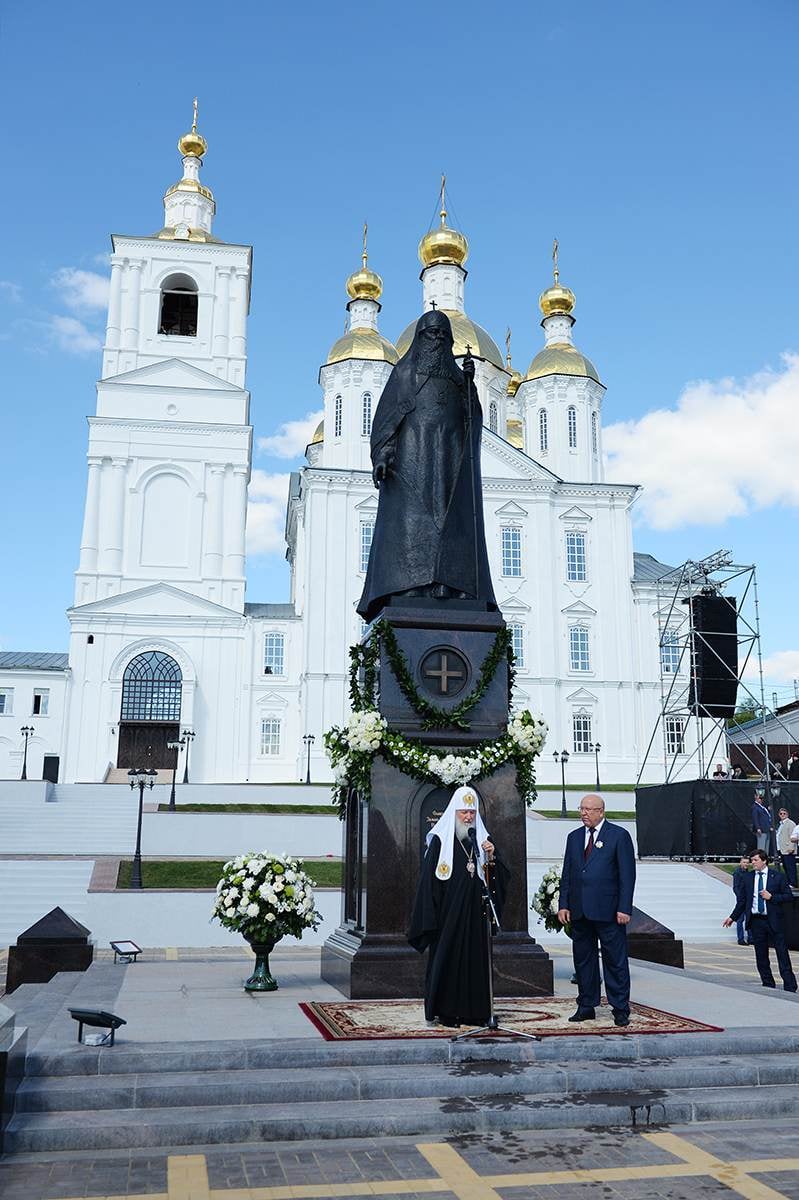
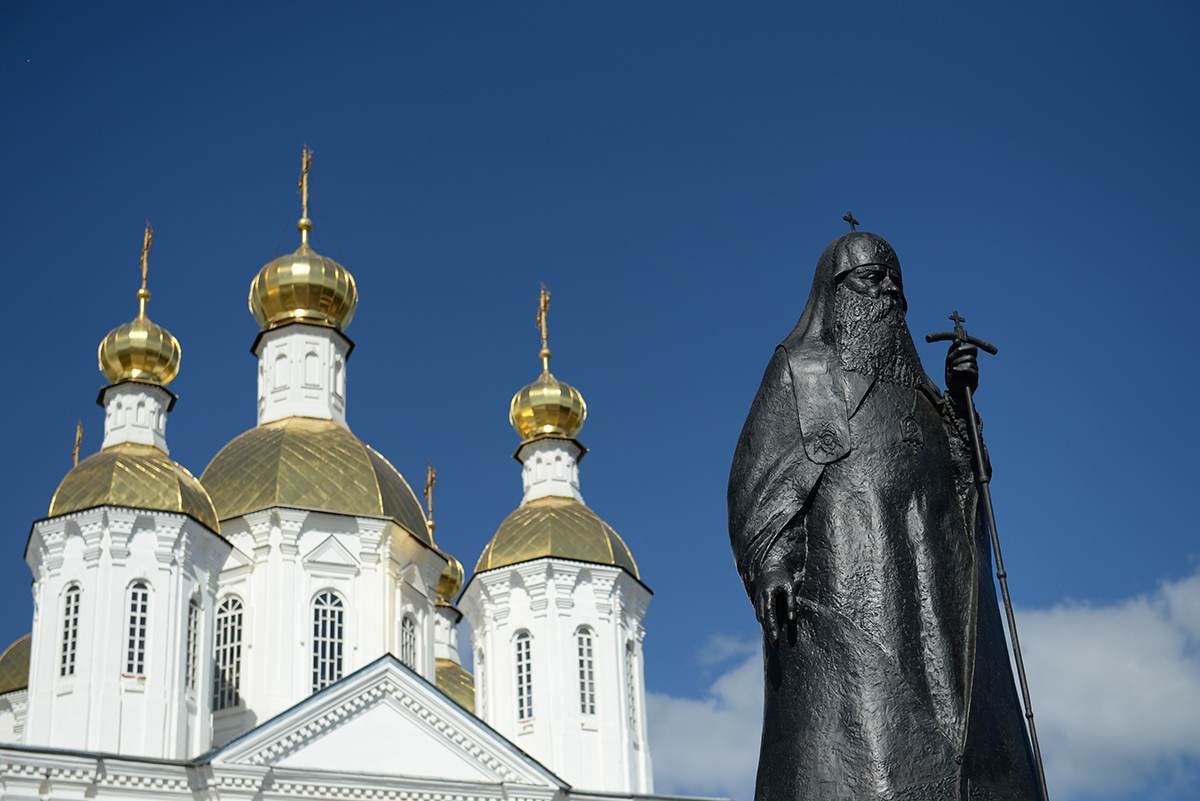
This was not a single occasion. Patriarch Kirill has consistently defended Metropolitan Sergius at annual memorial services, rejecting the witness of the New Martyrs as “false accusations.”
On May 15, 2020, the 76th anniversary of Sergius’s death, Kirill served a lityia (a brief memorial prayer service) and delivered a homily defending Sergius’s collaboration with Stalin:
Патриарх Сергий сыграл совершенно особую, историческую роль в сохранении нашей Церкви в тяжелейшие 20-е, 30-е и 40-е годы XX столетия. Он столкнулся с вызовом, с которым не сталкивался ни один глава Русской Православной Церкви, — он столкнулся лицом к лицу с властью, которая поставила своей целью уничтожение Русской Церкви.
Patriarch Sergius played a completely special, historical role in preserving our Church in the most difficult 1920s, 1930s, and 1940s. He faced a challenge that no head of the Russian Orthodox Church had faced—he came face to face with a power that set as its goal the destruction of the Russian Church.
— Patriarch Kirill, homily at lityia for Patriarch Sergius (Stragorodsky), May 15, 2020. Full text: “Святейший Патриарх Кирилл совершил литию по приснопамятному Патриарху Сергию (Страгородскому),” https://www.patriarchia.ru/article/66714
Patriarch Kirill justified Sergius’s capitulation as necessary survival in direct contradiction to our saints:
У него не было ни власти, ни иных возможностей вступить в непосредственный конфликт с государством, потому что такой конфликт завершился бы просто его физическим устранением. Ему нужно было оставаться в некоем диалоге с государством и максимально использовать самые малые возможности для того, чтобы остановить руку гонителей.
He had neither the power nor other means to enter into direct conflict with the state, because such a conflict would have ended simply in his physical elimination. He needed to remain in some kind of dialogue with the state and maximally use the smallest opportunities to stop the hand of the persecutors.
— Patriarch Kirill, homily at lityia for Patriarch Sergius (Stragorodsky), May 15, 2020. Full text: “Святейший Патриарх Кирилл совершил литию по приснопамятному Патриарху Сергию (Страгородскому),” https://www.patriarchia.ru/article/66714
Then Kirill claimed that Sergius never compromised on matters of faith, contradicting the witness of the saints:
Святейший Патриарх, конечно, должен был идти на какие-то компромиссы. Но эти компромиссы никогда не простирались на веру, на церковное устройство, то есть на те фундаментальные истины, на которых и зиждется жизнь Православной Церкви. Он защищал эти истины и эти принципы.
His Holiness the Patriarch, of course, had to make some compromises. But these compromises never extended to the faith, to the Church structure, that is, to those fundamental truths on which the life of the Orthodox Church is based. He defended these truths and these principles.
— Patriarch Kirill, homily at lityia for Patriarch Sergius (Stragorodsky), May 15, 2020. Full text: “Святейший Патриарх Кирилл совершил литию по приснопамятному Патриарху Сергию (Страгородскому),” https://www.patriarchia.ru/article/66714
Kirill dismissed the condemnations of the New Martyrs, all of whom are glorified as saints, as “false accusations”:
Люди, которые со стороны наблюдали за деятельностью Святейшего Патриарха Сергия, в то время Патриаршего местоблюстителя, особенно те, кто наблюдал издалека, в условиях полной личной безопасности, нередко направляли в адрес Местоблюстителя грозную, сокрушительную критику, обвиняя его в предательстве, в измене Православию. Но жизнь показала, что это не так, что это были ложные наветы. Святейший Сергий не поступился ничем, что имело принципиальное значение для дела спасения, которое призвана совершать Церковь, и его компромисс с властью распространялся на ту сферу, которая для власти считалась важной, но которая не являлась таковой для дела человеческого спасения.
People who observed from the side the activity of His Holiness Patriarch Sergius, at that time the Patriarchal Locum Tenens, especially those who observed from afar, in conditions of complete personal safety, often directed toward the Locum Tenens threatening, devastating criticism, accusing him of betrayal, of treason to Orthodoxy. But life has shown that this is not so, that these were false accusations. His Holiness Sergius did not compromise on anything that had fundamental significance for the work of salvation that the Church is called to accomplish, and his compromise with the authorities extended to that sphere which the authorities considered important but which was not important for the work of human salvation.
— Patriarch Kirill, homily at lityia for Patriarch Sergius (Stragorodsky), May 15, 2020. Full text: “Святейший Патриарх Кирилл совершил литию по приснопамятному Патриарху Сергию (Страгородскому),” https://www.patriarchia.ru/article/66714
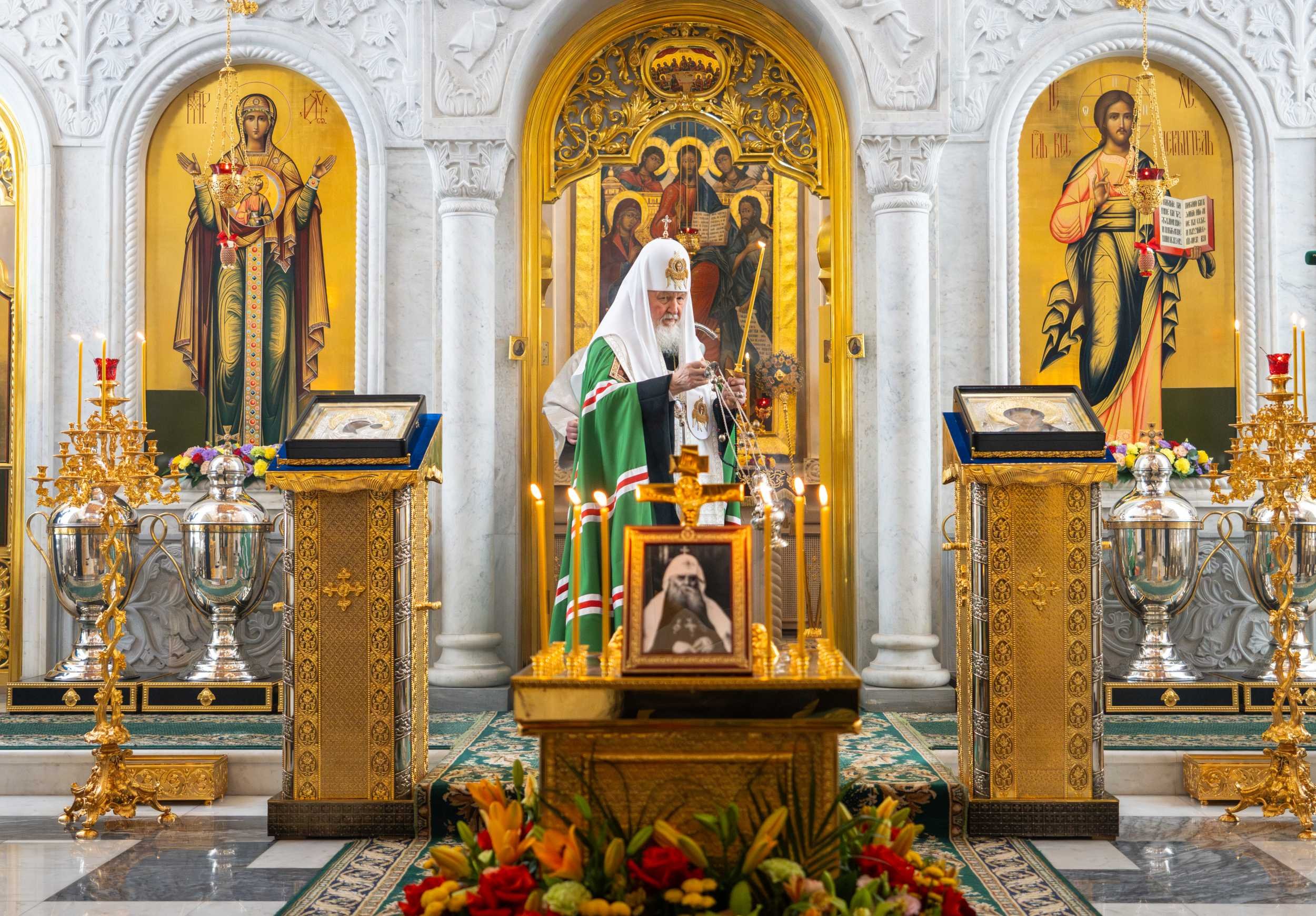
“Those who observed from afar, in conditions of complete personal safety”: Kirill dismisses the witness of ROCOR and the New Martyrs with this phrase, insulting and slandering them, claiming that they simply spoke these words in safety.
But were the New Martyrs safe observers?
These were bishops and priests in Soviet prisons and labor camps, many of whom were tortured and executed precisely because they refused to submit to Sergius. St. Victor of Glazov called Sergianism “worse than any heresy.” St. Paul of Yalta said it made Sergius “an apostate from Orthodoxy like the ancient libellatici.” Metropolitan Cyril of Kazan said Sergius’s claim to authority was “blasphemy.” Metropolitan Joseph of Petrograd and countless others went to their deaths rather than accept Sergius’s capitulation. In response to this outpouring of witness from saints, Patriarch Kirill audaciously calls their witness “false accusations” said from people who ”observed from afar”.
On September 8, 2023, the 80th anniversary of Sergius’s election as Patriarch, Kirill served a panikhida at Sergius’s burial place in the Epiphany Cathedral and argued that the Church was right not to oppose the Soviet regime:
Трудно представить, как бы повел себя наш народ, если бы Церковь призвала его к борьбе с тогдашней безбожной властью. Но Церковь этого не сделала — все было направлено на сохранение веры православной в нашей стране и, конечно, преодоление того отчуждения, которое имело место между властью и Церковью.
It is hard to imagine how our people would have behaved if the Church had called them to fight against the then-godless authorities. But the Church did not do this: everything was directed toward preserving the Orthodox faith in our country and, of course, overcoming the alienation that existed between the authorities and the Church.
— Patriarch Kirill, speech at the Epiphany Cathedral in Elokhovo on the 80th anniversary of Metropolitan Sergius’s election as Patriarch, September 8, 2023. https://www.patriarchia.ru/article/104865
“Overcoming the alienation between the authorities and the Church.” The “alienation” Kirill refers to was the 1918 anathema: the All-Russian Council’s condemnation of Soviet Power. By Kirill’s own logic, the Church was right to overcome an anathema pronounced by the All-Russian Council and confirmed by ROCOR!
He then praised Sergius for establishing “a new type of relations” with the state that had murdered the Church’s bishops and priests:
Попрошу всех вас помолиться о приснопамятном Святейшем Патриархе Сергии, который в самую, может быть, тяжелую годину всей истории Русской Православной Церкви выстоял в верности к Церкви, сумев преодолеть идеологические и политические преграды, которые стояли между Церковью и властью, и установить новый тип отношений, благодаря которому стали открываться храмы, монастыри, были выпущены заключенные священники и епископы, и возродилась наша Церковь.
I ask all of you to pray for the ever-memorable His Holiness Patriarch Sergius, who during perhaps the most difficult time in the entire history of the Russian Orthodox Church stood firm in faithfulness to the Church, having overcome the ideological and political barriers that stood between the Church and the state, and established a new type of relations, thanks to which churches and monasteries began to open, imprisoned priests and bishops were released, and our Church was reborn.
— Patriarch Kirill, speech at the Epiphany Cathedral in Elokhovo on the 80th anniversary of Metropolitan Sergius’s election as Patriarch, September 8, 2023. https://www.patriarchia.ru/article/104865
“Imprisoned priests and bishops were released.” Many of those priests and bishops were imprisoned precisely because they refused Sergius’s Declaration. Kirill credits Sergius with freeing men whose imprisonment his capitulation helped justify.
In May 2025, Kirill praised Sergius’s policy of accommodating the state as salvific for the Church:
Патриарху Сергию удалось вывести нашу Церковь из тяжелого кризисного положения, которое сопровождалось открытым конфликтом между Церковью и государством. В условиях той политической системы, которая существовала в нашей стране, такой открытый конфликт не мог закончиться ничем благополучным для Церкви. Надо было искать пути выхода из этого конфликта, и Святейший Патриарх Сергий нашел такой выход. Кому-то, конечно, это не понравилось, особенно тем, кто жил далеко за пределами нашего Отечества и ничем не рисковал, занимая другую позицию. Но то, что у Патриарха установился прямой контакт с высшим руководством нашей страны, в то время имело спасительное значение для самого бытия нашей Церкви.
Patriarch Sergius was able to carry our Church out of that difficult and crisis-ridden position which manifested itself in an open conflict between the Church and the state. The conditions of the political system that existed in our country were such that an open conflict could not end in anything prosperous for the Church. It was necessary to look for paths to exit out of this conflict. And so, holy Patriarch Sergius found these exits. Some did not like this, especially those who lived far away, outside of our fatherland, who did not risk anything and took a different position. But what he created was a direct contact with the highest authorities of our country at that time, which had a salvific significance for the existence of our Church.
— Patriarch Kirill, remarks at the memorial service (panikhida) for Patriarch Sergius, May 15, 2025. Transcript: https://www.patriarchia.ru/article/115716. Video: https://www.youtube.com/watch?v=caQ6JKCI1lY
“Some did not like this, especially those who lived far away.” “Some.” These are canonized saints who were tortured and shot in Soviet prisons. “Those who lived far away.” These are bishops the Church glorified as martyrs. Kirill dismisses them as distant critics who “did not risk anything.”
On May 15, 2024, Patriarch Kirill served a panikhida (memorial service) at the tomb of Patriarch Sergius in the Epiphany Cathedral in Elokhovo. Watch him venerate the man our many saints and elders condemned:
He has likewise described Sergius in overtly honorific terms:
Мы вспоминаем Святейшего Патриарха как исповедника. Он не был мучеником, но все его служение на посту Патриаршего Местоблюстителя и Патриарха было, несомненно, исповедничеством.
We remember Patriarch Sergius as a confessor. He was not a martyr, but all of his ministry as Locum Tenens and as Patriarch was, without a doubt, a confession of faith.
— Patriarch Kirill, remarks before the memorial service (panikhida) for Patriarch Sergius, Epiphany Cathedral in Elokhovo, May 15, 2024. Transcript: https://www.patriarchia.ru/article/86496. Video: https://www.youtube.com/watch?v=kYuIKKaWgp4
The word Kirill uses, “исповедник” (confessor), is a formal canonical category of sainthood designating one who suffered for the Orthodox faith under persecution but was not killed.[42] St. Maximus the Confessor had his tongue cut out and his right hand severed for refusing the Monothelite heresy. St. Mark of Ephesus, “Confessor of the Orthodox Faith,” stood alone against the false Union of Florence. St. Tikhon, the very patriarch who issued the 1918 anathema against Soviet Power, is called “Holy Confessor and Patriarch” in his troparion, and ROCOR canonized him in 1981 explicitly as “исповедник.”[43] Sergius reversed Tikhon’s anathema.
Patriarch Kirill now audaciously applies to Sergius the same canonical title that the Church gave to the patriarch Sergius betrayed.
The actual confessors in the Sergius story are the saints who refused his Declaration. Hiero-confessor Athanasius (Sakharov), Bishop of Kovrov, was himself a bishop of the Moscow Patriarchate who broke with Sergius’s administration over the 1927 Declaration. He spent over thirty years in Soviet camps and exile for this refusal. He is canonized under the formal title “Священноисповедник” (Hiero-confessor): a clergyman who suffered for the faith but was not killed.[44] The Jubilee Council of 2000 canonized hundreds of New Martyrs and Confessors of Russia, each assigned this precise liturgical rank. Kirill has taken the title that belongs to those who opposed Sergius and given it to Sergius himself. He has inverted the hagiographic categories: the collaborator receives the title of the saints he helped persecute.
The inflation is not limited to “confessor.” Throughout his speeches, Kirill calls Sergius “Святейший Патриарх Сергий,” “His Holiness Patriarch Sergius,” even when discussing the 1927 Declaration. But Sergius was not Patriarch in 1927. He was Metropolitan Sergius, and he did not receive the patriarchal title until September 1943, when Stalin personally convened a council for that purpose. On the night of September 4, 1943, Stalin summoned Sergius and two other metropolitans to the Kremlin for a meeting that lasted until 2:00 AM, with Molotov and NKVD Colonel G.G. Karpov present. When Sergius said a council could be assembled in a month, Stalin smiled and asked whether they could move faster: “Is it possible to show the Bolshevik tempo?” Karpov arranged military aircraft. Four days later, nineteen bishops elected Sergius as the sole candidate in a single-day council. The majority of the Russian episcopate was in camps or in graves.[45]
ROCOR’s bishops rejected the election weeks later, calling it “an uncanonical and political act, which was made to serve the interests of the Soviet communist government and its dictator Joseph Stalin.” They noted that “the confessing bishops, suffering for the faith in exile and prisons, were not invited. The martyr Church hiding in the ‘catacombs’ of Soviet Russia was not represented.”[46]
Kirill erases all of this. By calling Sergius “Patriarch” when discussing the 1927 Declaration, he confers patriarchal authority on what was a unilateral act by a Metropolitan whose authority the majority of bishops rejected. The anachronism is not careless; it is systematic, and it has intensified over time.[47] The saints condemned Metropolitan Sergius. Kirill has erased the Metropolitan.
In the same address, Kirill praised Sergius for negotiating with Stalin:
Ему удалось договориться с главой государства Сталиным о том, чтобы из лагерей и тюрем были отпущены наши архиереи и священники.
He was able to negotiate with the head of state Stalin to release our bishops and priests from camps and prisons.
— Patriarch Kirill, remarks before the memorial service (panikhida) for Patriarch Sergius, Epiphany Cathedral in Elokhovo, May 15, 2024. Transcript: https://www.patriarchia.ru/article/86496. Video: https://www.youtube.com/watch?v=kYuIKKaWgp4
The saints who refused to submit to Sergius were the ones in those camps and prisons. They were there precisely because they would not accept Sergius’s collaboration. Kirill frames this collaboration as a virtue. He also praised Sergius for “preserving unity”:
Он сумел сохранить единство нашей Церкви, восстановить его там, где оно было порушено.
He was able to preserve the unity of our Church, to restore it where it had been broken.
— Patriarch Kirill, remarks before the memorial service (panikhida) for Patriarch Sergius, Epiphany Cathedral in Elokhovo, May 15, 2024. Transcript: https://www.patriarchia.ru/article/86496. Video: https://www.youtube.com/watch?v=kYuIKKaWgp4
The New Martyrs said exactly the opposite: that Sergius broke unity by his betrayal, and that those who followed him went “into the abyss of the Church’s condemnation.”
The World Russian People’s Council, which Kirill chairs, co-sponsored this memorial conference. Two months earlier, this same organization declared the war in Ukraine a “Holy War” (see Chapter 18).[48] The same body that honors Sergius now subordinates the Church to the state’s war: Sergianism remains an active ideology.
On that same day, May 15, 2024, Kirill did not limit himself to oral remarks at a memorial service. He issued a formal pastoral letter (послание) to the entire Church: “archpastors, pastors, deacons, monastics, and all faithful children of the Russian Orthodox Church.” This is the highest-authority format a patriarch can use short of an encyclical. In it, he declared:
Пришло время с уверенностью засвидетельствовать, что Патриарх Сергий осуществлял свою миссию, стоя на недвижимом камне веры (Мф. 7:24). Он видел историческое бытие Церкви Бога живаго, столпа и утверждения истины (1 Тим. 3:15) в большой исторической перспективе, соотнося свои решения с далеким будущим и доказав, что его главным делом была победа, победившая мир, — вера наша (1 Ин. 5:4)
The time has come to testify with confidence that Patriarch Sergius carried out his mission standing on the immovable rock of faith (Matt. 7:24). He saw the historical existence of the Church of the living God, the pillar and ground of truth (1 Tim. 3:15) in a broad historical perspective, aligning his decisions with the distant future and proving that his chief work was the victory that overcomes the world: our faith (1 John 5:4).
— Patriarch Kirill, pastoral letter on the 80th anniversary of the repose of Patriarch Sergius, May 15, 2024. https://www.patriarchia.ru/article/105688
“The immovable rock of faith.” Kirill applies to Sergius the image Christ used for those who hear His words and do them (Matthew 7:24). The saints who heard Sergius’s Declaration and refused it called it blasphemy against the Holy Spirit. Kirill instead says Sergius stood on the rock of Christ.
In the same letter, Kirill placed Sergius in direct succession to St. Tikhon, the very patriarch who issued the 1918 anathema against Soviet Power that Sergius reversed:
Патриарх Сергий был духовным продолжателем дела своего прославленного предшественника — святителя Тихона (Беллавина), приняв от него всю полноту попечения о сохранении Православия, апостольской преемственности и каноничности.
Patriarch Sergius was the spiritual continuator of the work of his glorified predecessor, Saint Tikhon (Bellavin), having received from him the fullness of care for the preservation of Orthodoxy, apostolic succession, and canonicity.
— Patriarch Kirill, pastoral letter on the 80th anniversary of the repose of Patriarch Sergius, May 15, 2024. https://www.patriarchia.ru/article/105688
St. Tikhon anathematized the Soviet regime. Sergius declared its “joys and successes are our joys and successes.” Patriarch Kirill says Sergius continued St. Tikhon’s work. The saints who lived through both, contrary to the position of Patriarch Kirill, said Sergius betrayed it.
Then Kirill framed all criticism of Sergius as a Western geopolitical operation:
Не одно десятилетие западные советологические круги искусственно политизировали фигуру Патриарха Сергия, стремясь представить его деяния в искаженном виде, чтобы выбить звено из церковной традиции и поставить под вопрос историческую преемственность и каноничность нашей Церкви. Как в годы Холодной войны, так и сегодня, это вызвано антироссийскими политическими целями — попытками нарушить согласие между Церковью и народом, армией и государством, создать новые болезненные социальные и духовные кризисы в нашей стране.
For more than a decade, Western Sovietological circles have artificially politicized the figure of Patriarch Sergius, striving to present his deeds in a distorted light, in order to knock a link out of the chain of Church tradition and call into question the historical continuity and canonicity of our Church. As during the Cold War, so today, this is driven by anti-Russian political aims: attempts to disrupt the accord between the Church and the people, the army and the state, to create new painful social and spiritual crises in our country.
— Patriarch Kirill, pastoral letter on the 80th anniversary of the repose of Patriarch Sergius, May 15, 2024. https://www.patriarchia.ru/article/105688
Who exactly is he referring to when he says Western Sovietological forces? Is he implying that ROCOR is a Western Sovietological force?
“The accord between the Church and the people, the army and the state.” Here Kirill reveals exactly what he is defending: the fusion of Church, army, and state into a single national organism. Anyone who criticizes this fusion, whether the New Martyrs who condemned it in 1927 or voices today, is immediately labeled an agent of “anti-Russian political aims.” Again, the “anti-Russian” label dismisses those who disagree.
The saints who were tortured and shot in Soviet prisons for opposing Sergius become, by this logic, tools of Western subversion. The pastoral letter calls Sergius a “подвижник” (ascetic struggler), the same hagiographic vocabulary used for canonized saints.[49]
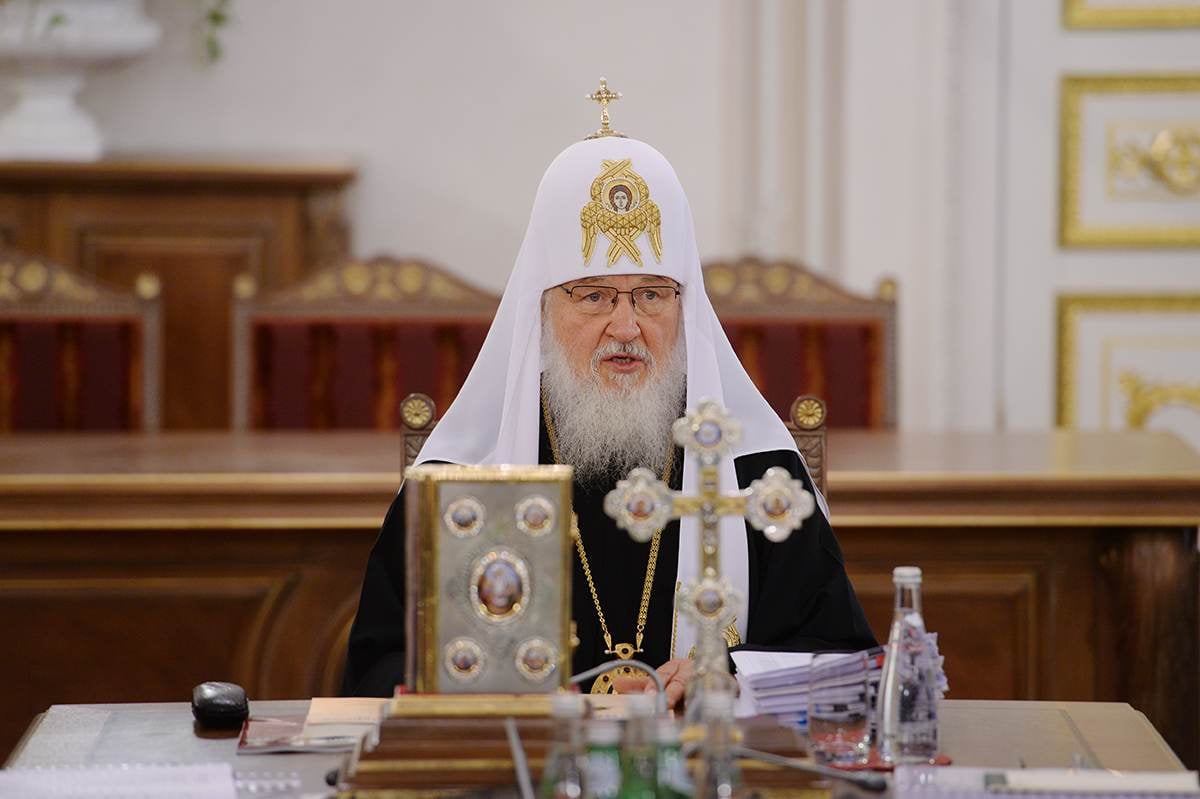
The Institutional Defense (1990–2024)
Kirill’s praise of Sergius rests on an institutional foundation that predates his patriarchate.
In 1990, the Moscow Patriarchate’s Bishops’ Council issued an official declaration (воззвание) in response to ROCOR’s demand that the Moscow Patriarchate renounce Sergius’s 1927 Declaration:
With all definiteness we are obliged to emphasize that the 1927 Declaration contains nothing that would be contrary to the Word of God, that would contain heresy, and thus would give grounds for departing from the organ of church governance that accepted it.
— Declaration of the Bishops’ Council of the Russian Orthodox Church, 1990. https://www.patriarchia.ru/article/99601[50]
“Contains nothing that would be contrary to the Word of God.” The saints who refused the Declaration and went to their deaths called it blasphemy and apostasy. The Bishops’ Council overruled them at the conciliar level.
The same document then falsified the saints’ own testimony, claiming their opposition was not about the Declaration at all:
The opposition to Metropolitan Sergius by Metropolitan Joseph of Leningrad and the departure from him in 1930 of Metropolitan Cyril of Kazan were not directly connected to the Declaration, but were the result of a misunderstanding of the line of the Deputy Locum Tenens in questions of church governance, which in those conditions was the only possible one.
— Declaration of the Bishops’ Council of the Russian Orthodox Church, 1990. https://www.patriarchia.ru/article/99601[51]
This is a direct falsehood. Metropolitan Cyril of Kazan wrote that Sergius’s claim to authority was “blasphemy.” Metropolitan Joseph of Petrograd’s followers cited the Declaration as the cause of their separation. The Bishops’ Council rewrote the saints’ motivation to make their principled stand against apostasy look like a bureaucratic misunderstanding about “church governance.”[52]
In 2006, Patriarch Alexy II, Kirill’s predecessor, continued the defense. At a press conference, he insisted the document should not even be called a “declaration” but a “послание” (message), and defended Sergius as “the position of a sincere patriot of Russia, not a servant of the godless regime.”[53]
The pattern is already visible: the 1990 council declared the saints’ separation groundless; now the patriarch bans even the name the saints gave to the document they condemned.
Kirill built on this foundation. For twenty years (1989–2009), he served as chairman of the Department for External Church Relations (DECR). In 2002, his department co-hosted a joint seminar with the Synodal Theological Commission titled “Relations of the Russian Orthodox Church and the Authorities in the 1920s–30s.” Kirill’s deputy, Archpriest Vsevolod Chaplin, represented him at the seminar. The resulting document, approved by the Holy Synod, declared that the very term “Sergianism” should not be used:[54]
The use of the term “Sergianism” in discussion is undesirable, as it is not neutral and itself expresses a definite position.
— “Final Document of the Seminar ‘Relations of the Russian Orthodox Church and the Authorities in Russia in the 1920s–30s,’” Point 1, DECR of the Moscow Patriarchate, May 27, 2002. Approved by the Holy Synod, July 18, 2002. https://mospat.ru/ru/news/84038/[55]
The document then called Sergius a “confessor” who never betrayed the faith:
The Deputy Patriarchal Locum Tenens in his efforts to normalize church life was concerned with the good of the Church and did everything possible in concrete historical circumstances… without betraying dogmatic and canonical principles. He was utterly careful in the choice of expressions and during the period of imprisonment behaved as a confessor, defending church interests.
— “Final Document of the Seminar ‘Relations of the Russian Orthodox Church and the Authorities in Russia in the 1920s–30s,’” Point 2, DECR of the Moscow Patriarchate, May 27, 2002. Approved by the Holy Synod, July 18, 2002. https://mospat.ru/ru/news/84038/[56]
“Confessor.” The exact word Kirill would use twenty-two years later in his 2024 speeches. This is not coincidence. Kirill’s department produced the language in 2002; Kirill repeated it as patriarch in 2024. The institutional line was set under his leadership: Sergius, according to Patriarch Kirill, was a saint-like figure who suffered for the faith, and those who use the word “Sergianism” are so-called polemicists, not witnesses. The saints who condemned Sergius as “worse than Nestorius” and an apostate who betrayed the Truth are overruled simply by a seminar at Kirill’s own DECR.
Six years later, still under Kirill’s DECR chairmanship, when Bishop Diomid of Anadyr accused the hierarchy of “neo-Sergianism as spiritual accommodation with worldly power,” the Synodal Theological Commission responded with an official canonical analysis published on the DECR website (mospat.ru):[57]
As for the term “neo-Sergianism,” it is a new fabrication, inappropriate and arbitrary. This term diminishes the service of Patriarch Sergius, and also implies incorrect parallels with the tragic period of the Russian Church’s history in the 20th century.
— Synodal Theological Commission, “Theological-Canonical Analysis of Letters and Appeals Signed by Bishop Diomid of Anadyr and Chukotka,” 2008, https://mospat.ru/ru/news/64410/[58]
“Diminishes the service of Patriarch Sergius.” The man the saints called a traitor worse than Nestorius has a “service” that must not be “diminished.”
Bishop Diomid, who accused the hierarchy of neo-Sergianism, was subsequently defrocked. This illustrates the pattern: when the Sergianism charge is raised inside the Moscow Patriarchate, the institutional response is disciplinary and delegitimizing.
The following year, in a speech honoring his mentor Metropolitan Nikodim (Rotov), Patriarch Kirill revealed the strategy behind the terminological policing. He admitted that “Sergianism” describes a real phenomenon, but performed a definitional sleight-of-hand to disconnect it from Sergius himself:
Есть такое у нас понятие, я его очень не люблю, но оно вошло в нашу историческую науку, такое понятие как «сергианство». Само по себе понятие с личностью Патриарха Сергия прямо не связано. Это скорее то, что Церковь переживала в более позднюю эпоху, когда было сломлено всякое сопротивление Церкви. Суть этого явления заключалась в том, что все, включая и кадровую политику, определяла власть.
There is this concept among us; I really dislike it, but it has entered our historical scholarship: the concept of “Sergianism.” The concept itself is not directly connected to the person of Patriarch Sergius. It is rather what the Church experienced in a later era, when all resistance by the Church had been broken. The essence of this phenomenon was that everything, including cadre policy, was determined by the state.
— Patriarch Kirill, speech at the conference “The Theological Legacy of Metropolitan Nikodim,” October 12, 2009. https://www.patriarchia.ru/article/89716
Kirill acknowledges the phenomenon: state control of the Church, including all appointments. But he places it in “a later era,” as if Sergius had nothing to do with it. The saints said the opposite: that Sergius inaugurated the submission, that the 1927 Declaration was the moment the Church’s inner freedom was surrendered. Kirill’s redefinition allows him to condemn the phenomenon while canonizing the man who started it.[59]
In 2013, Fr. Maxim Kozlov, first deputy chairman of the ROC’s Educational Committee and a Moscow Theological Academy professor, made the same move from the academic wing. He declared that “in the mouth of a churchman it is absolutely incorrect to speak of ‘Sergianism’” because it “assigns a negative connotation to the name of the Primate of our Church”:
Прежде всего (повторю эту мысль), в устах церковного человека абсолютно некорректно говорить о «сергианстве», ибо при этом усваивается отрицательная коннотация в имени Предстоятеля нашей Церкви.
First of all (I repeat this thought), in the mouth of a churchman it is absolutely incorrect to speak of “Sergianism,” because in doing so a negative connotation is assigned to the name of the Primate of our Church.
But in the same report he admitted that “the term ‘servilism’ or the term ‘collaborationism’ can be applied to the position of various hierarchs of the Soviet era”:
Термин «сервилизм» или термин «коллаборационизм» может быть приложен к позиции тех или иных иерархов советской эпохи.
The term “servilism” or the term “collaborationism” can be applied to the position of various hierarchs of the Soviet era.[60]
Even the MP acknowledges the reality. But the saints are forbidden their vocabulary.
Not all voices within the Moscow Patriarchate have been compliant. Archpriest Vladislav Sveshnikov, a well-known Moscow Patriarchate priest, wrote an essay titled “The Psychology of Neo-Sergianism” in which he named what Kirill’s entire institutional apparatus is doing:
The task of neo-Sergianism is to justify Sergianism, to not only search for theological and historical interpretations for it, but to glorify Sergianism.
— Archpriest Vladislav Sveshnikov, “The Psychology of Neo-Sergianism,” quoted in Archpriest Peter Perekrestov, “Why Now?,” Orthodox Life, Vol. 44, No. 6 (1994), pp. 40–43
“To glorify Sergianism.”[61] This is an MP priest describing the exact program this chapter documents. Sveshnikov also identified the defining features of neo-Sergianism: the loss of Christianity as a moral religion, the replacement of repentance with justification, and, as a result, indifference to martyrs among the young. His conclusion was a plea: “What a joyful sigh would resound from a multitude of hearts” if the Russian Church would honestly expose “all the wounds, sins, and defects of the recent past.”
Instead, the institution chose glorification.
In 1990, the Bishops’ Council declared that the Declaration “contains nothing that would be contrary to the Word of God.” In 2002, Kirill’s DECR declared the term “undesirable.” In 2006, Alexy II banned the word “declaration.” In 2008, Kirill’s DECR called “neo-Sergianism” a “fabrication.” In 2009, Kirill redefined Sergianism to mean something Sergius did not do. In 2013, the theological academy enforced the linguistic prohibition. In 2024, Kirill personally called Sergius a “confessor” standing on “the immovable rock of faith,” using the exact language his own department had formalized twenty-two years earlier.
ROCOR canonized these saints for their resistance to Sergius. Now Kirill calls that resistance a “misunderstanding,” calls their persecutor a confessor standing on “the immovable rock of faith,” and dismisses their witness as a Western political operation.
The current public ROCOR response has not matched the force of its own earlier anti-Sergianist witness.
The pattern is defensive and punitive. The institution rehabilitates Sergius and suppresses those who invoke his name as a warning about current behavior. Using the word “Sergianism” to describe the hierarchy’s accommodation with the state is officially “undesirable,” then “inappropriate and arbitrary,” and in Diomid’s case became part of the context for defrocking. This is Sergianism protecting itself: the system of accommodation with power now uses institutional power to suppress those who name it.
Sergei Chapnin, who spent fifteen years working within the Moscow Patriarchate as editor-in-chief of the Journal of the Moscow Patriarchate before being dismissed for his critical stance, summarized what Sergianism means in practice:
To be loyal to the state, to be loyal to the empire, is more important than following the commandments.
— Sergei Chapnin, Atlantic Council Eurasia Center, September 17, 2025, https://www.youtube.com/watch?v=JSp-10UsoOE&t=3013s
This is not historical analysis. It is eyewitness testimony from someone who worked inside the institution.
Kirill’s defense of Sergius is institutional policy he built as DECR chairman and now executes as patriarch, directed toward his glorification (canonization). The journal Orthodoxia, created at Patriarch Kirill’s blessing, has dedicated multiple issues to rehabilitating Sergius’s legacy. In 2024, A.V. Shchipkov, rector of the Russian Orthodox University of St. John the Theologian and deputy head of the World Russian People’s Council (which Kirill chairs), wrote in Orthodoxia:
It seems quite probable that sooner or later His Holiness Patriarch Sergius will be canonized.
— A.V. Shchipkov, “The Great Mission of Patriarch Sergius (Stragorodsky),” Orthodoxia No. 1 (2024), https://www.patriarchia.ru/article/105717[62]
In the same article, Shchipkov dismisses the witness of the saints as a fabrication:
The interpretation of the 1927 Epistle as supposedly an impermissible compromise with a godless state is deliberate and unconvincing.
— A.V. Shchipkov, “The Great Mission of Patriarch Sergius (Stragorodsky),” Orthodoxia No. 1 (2024), https://www.patriarchia.ru/article/105717[63]
He then explains what really motivates the critics:
In reality, the Epistle and its author are attacked not for political reasons, but because this political compromise allowed the Church to preserve the episcopate: the most important condition for its survival.
— A.V. Shchipkov, “The Great Mission of Patriarch Sergius (Stragorodsky),” Orthodoxia No. 1 (2024), https://www.patriarchia.ru/article/105717[64]
In other words: the saints who were tortured and shot for refusing Sergius’s Declaration attacked it not because it was blasphemy, apostasy, or a betrayal of Christ, but because it worked. Those who called Sergius worse than Nestorius were motivated by resentment that the Church survived.
This is all published on patriarchia.ru with Kirill’s blessing.
Shchipkov calls the very term “Sergianism” absurd: «Особенно нелепым выглядит использование термина “сергианство”» (“Especially absurd is the use of the term ‘Sergianism’”). And he deploys the standard counter-attack against those who condemn Sergius: that ROCOR «провозгласила вермахт христолюбивым воинством» (“proclaimed the Wehrmacht a Christ-loving army”) and that the emigration prayed for Hitler’s victory. His source for this claim is Gordienko et al.’s Politikany ot religii (Moscow, 1973), a Soviet Communist anti-religious propaganda book.[65] The Moscow Patriarchate’s own Kirill-blessed journal, published on patriarchia.ru, cites atheist propaganda to defend the man the saints called a traitor.
The argument that Sergius “preserved the episcopate” is the strongest academic defense of the Declaration. Serious historians make it: Nathaniel Davis (A Long Walk to Church) documented that by 1939 only four active bishops remained; Dimitry Pospielovsky (The Russian Church Under the Soviet Regime) characterized Sergius as facing “impossible choices”; William Fletcher (A Study in Survival) framed the entire period in survival terms. The argument is that without institutional continuity, there would have been no structure for Stalin to revive in September 1943.
The chapter’s own evidence refutes the claim that the Declaration preserved the Church in the sense now asserted. Between 1928 and 1934, over 51,625 clergy were arrested. Church closures and clergy executions continued unabated after the Declaration. Whatever institutional remnant survived, the Declaration did not stop the destruction around Sergius. It purchased Sergius’s personal freedom while the Church was devastated around him.
As Boris Talantov demonstrated, Sergius saved not the Church but himself. The four bishops who remained in 1939 were not preserved by the Declaration; they were the ones the state chose not to shoot. The millions of faithful in the Catacomb Church, who refused the Declaration and preserved Orthodoxy underground at the cost of their lives, are the ones who truly preserved the Church.
Whatever the historical merits of the Hitler charge, it does not answer the witness of the New Martyrs. St. Victor of Glazov, St. Paul of Yalta, St. Andrew of Ufa, Metropolitan Cyril of Kazan, and Metropolitan Joseph of Petrograd were not émigrés. They were not in ROCOR. They were bishops inside Soviet Russia, in Soviet prisons, who condemned Sergius from within the persecution. The Hitler deflection does not address their witness at all.
The Moscow Patriarchate’s Own Criteria Disqualify Sergius
The canonization campaign faces a problem the Moscow Patriarchate has not addressed: its own published criteria disqualify Sergius. At the Jubilee Council of Bishops in 2000, the very council that canonized hundreds of New Martyrs, Metropolitan Iuvenalii (Poiarkov) of Kolomensk, President of the Synodal Commission for the Canonization of Saints, stated the standard:
Члены Комиссии не нашли оснований для канонизации лиц, которые на следствии оговорили себя или других, став причиной ареста, страданий или смерти ни в чем не повинных людей, несмотря на то, что они пострадали. Малодушие, проявленное ими в таких обстоятельствах, не может служить примером, ибо канонизация — это свидетельство святости и мужества подвижника, подражать которым призывает Церковь Христова своих чад.
The Committee members did not find any grounds for the canonization of persons who, during investigation, incriminated themselves or others, thereby becoming the cause of the arrest, suffering, or death of completely innocent people, despite the fact that they suffered. The faintheartedness they showed in such circumstances cannot serve as an example, for canonization is a testimony to the holiness and courage of an ascetic struggler, which the Church of Christ calls her children to imitate.[66]
“Thereby making themselves the cause of the arrest, torment, or death of totally innocent people.” As documented above, Sergius’s wartime encyclicals publicly accused named bishops and priests of a “fascist turn,” after which several of them were arrested by Soviet security services. Archbishop Daniil lost his sight in captivity. Archpriest Serikov died in prison. Metropolitan Sergii Voskresenskii was shot under circumstances suggesting Soviet involvement. In what way does Sergius’s public denunciation of these clergy not constitute “making himself the cause of the arrest, torment, or death of totally innocent people”?
The Commission’s criteria apply “regardless of the reason for their suffering.” The standard does not permit an exception for those who denounced others out of political accommodation rather than under torture. In what way is compromising someone publicly “better” than doing so under interrogation?[67]
The Moscow Patriarchate published these criteria at its own council. It now seeks to canonize a man whom its own criteria explicitly disqualify.
Political Manipulation of the Historical Record
The machinery behind the canonization campaign extends beyond theological journals. In August 2024, the Rostov Region Procurator’s Office reversed its own 1993 resolution rehabilitating Archpriest Viacheslav Serikov for the charges of “high treason” from Criminal Case No. P-54273. The case file was reclassified.[68]
Fr. Serikov was one of the clergy Sergius publicly denounced in his March 1943 encyclical. He was arrested, convicted, and died in prison in 1953. In 1993, the Procurator examined the case and rehabilitated him, confirming that the charges were baseless, that Sergius’s accusations were false. Now, thirty-one years later, that rehabilitation has been revoked and the archival file sealed.
The timing is not coincidental. The reversal came three months after the May 2024 conference on “Patriarch Sergii and His Spiritual Legacy” and Kirill’s formal pastoral letter calling Sergius a “подвижник” standing on “the immovable rock of faith.” By re-criminalizing one of Sergius’s victims, the state apparatus removes a documented case that proves Sergius’s denunciations were slander. If Fr. Serikov is once again officially guilty of “high treason,” then Sergius’s accusation that he worked “at the Germans’ behest” is retroactively validated.
This is what a political canonization looks like in practice: not only theological rehabilitation of the denouncer, but legal re-condemnation of his victims.
On January 25, 2026, a roundtable at the Cathedral of Christ the Saviour for the journal’s fifth anniversary stated the explicit goal:
Наша задача состояла в том, чтобы изменить сложившийся стереотип отношения к Патриарху Сергию и мы встретили очень большой и живой отклик.
Our task was to change the established stereotype of attitudes toward Patriarch Sergius, and we met a very large and lively response.[69]
The man these anti-Sergianist saint-witnesses called a traitor worse than Nestorius, whose Declaration the Catacomb Church anathematized, and whom the witnesses surveyed here condemned: the Moscow Patriarchate is actively working to canonize him.
Holy New Martyr Bishop Damascene of Glukhov foresaw this exact moment. In 1929, he wrote directly to Sergius:
There will be no erasing you from the pages of history: either the Russian Church will inscribe your name among the multitude of its confessors, or it will relegate it to the list of those who have betrayed its world-saving ideals.
— Holy New Martyr Bishop Damascene of Glukhov, letter to Metropolitan Sergius, 1929. Source: Fr. Victor Potapov, By Silence God is Betrayed, pp. 18–19; originally from Pred Sudom Bozhiim (Montreal: Monastery Press, 1990), pp. 12–27
Damascene’s words were a personal challenge to Sergius: repent and become a true confessor of the faith, or remain forever among those who betrayed it. The choice belonged to Sergius alone, and he never repented. Nearly a century later, Kirill inverts the saint’s meaning entirely: he applies the title “confessor” to a man who never fulfilled the condition Damascene set. Damascene offered Sergius redemption through repentance; Kirill grants the title without it, turning the saint’s warning into a false vindication.
St. Seraphim of Viritsa, a saint who lived through the Soviet persecution and reposed in 1949, foresaw exactly this: a time when the Church’s betrayal would come not through open persecution but through institutional corruption, gilded domes hiding inner falsehood.
There will come a time when not the persecutions but money and the goods of this world will take people far from God. Then many more souls will be lost than in the time of the persecutions. On the one hand, they will be putting gold on the domes and will put the crosses on them and, on the other hand, everywhere evil and falsehood will reign. The true Church always will be persecuted. They who want to be saved will be saved with illnesses and afflictions. The way in which the persecutions will occur will be very sly and it will be very difficult for one to foresee the persecutions. Dreadful will be that time; I pity those who will be living then.
— St. Seraphim of Viritsa, Life, Miracles, Prophecies of Saint Seraphim of Viritsa (Orthodox Kypseli Publications, 2016), pp. 44–45
D. The Verdict
Patriarch Kirill has:
- Called Metropolitan Sergius “a confessor” who “worthily passed his way of the cross,” standing on “the immovable rock of faith”
- Dismissed the witness of canonized saints as “false accusations” made by “those who observed from afar, in conditions of complete personal safety”
- Claimed Sergius “in no way” violated dogma or canon
- Issued a formal pastoral letter to the entire Church declaring Sergius a “подвижник” (ascetic struggler) equal to St. Tikhon and framing all criticism as “anti-Russian political aims” driven by “Western Sovietological circles”
- Dedicated statues to the man the saints called “worse than Nestorius”
- Built the institutional defense across three decades: the 1990 Bishops’ Council declared that the Declaration “contains nothing that would be contrary to the Word of God”; his own DECR produced the 2002 document calling Sergius a “confessor”; his website published the 2008 analysis calling “neo-Sergianism” a “fabrication”; and a bishop who accused the hierarchy of Sergianism was defrocked
- Redefined “Sergianism” to mean something unrelated to Sergius, acknowledging the phenomenon while protecting the man who inaugurated it
- Blessed a journal whose stated purpose is to rehabilitate Sergius and whose authors call for his canonization
The New Martyrs, catacomb hierarchs, and confessors surveyed in this chapter condemned Sergius. Those who suffered imprisonment, torture, and death for refusing his Declaration judged it not as pragmatic necessity but as apostasy. ROCOR formally broke communion in September 1927.
The Moscow Patriarchate’s own actions betray the contradiction. In 2000, the Jubilee Bishops’ Council canonized Metropolitan Cyril of Kazan as a New Martyr, the very hierarch who declared Sergius “beyond correction,” who said he had “departed from that Orthodox Church,” who forbade prayerful communion with Sergianists, and who entered “fraternal communion with Metropolitan Joseph” in explicit opposition to Sergius. Yet the same Patriarch who venerates Cyril calls Sergius a “confessor” and dismisses the witness of those who condemned him as “false accusations.” The Moscow Patriarchate venerates a saint who condemned Sergius while working to canonize Sergius himself. These positions cannot both be maintained.
The eight questions
That break was not merely administrative. In September 1991, Archbishop Lazarus (Zhurbenko) of Tambov and Obayan received clergy leaving the Moscow Patriarchate through a formal act of repentance, documented in both Orthodox Russia (No. 22, 1991) and Orthodox Life (Vol. 42, No. 1, January-February 1992). Those being received were asked eight questions:
- Do you reject Metropolitan Sergius’s 1927 Declaration as heresy?
- Do you repent for any defamation of the Holy New Martyrs and Confessors?
- Do you renounce the heresy of ecumenism and joint prayer with heretics?
- Do you promise never to inform on fellow Orthodox to the authorities?
- Do you promise not to commemorate atheistic rulers in the services?
- Do you repent for subordinating the Church to political interests?
- Do you repent for participating in the veneration of the “eternal flame” (Soviet war memorial)?
- Do you repent for sacraments performed under spiritual compromise?
The scriptural basis cited was II Corinthians 6:17: “Wherefore come out from among them, and be ye separate, saith the Lord.”
ROCOR’s official journals published this reception service without correction or caveat, treating it as normative episcopal practice.
Yet within a decade, every one of these standards would be quietly abandoned. The warning had already been given. In 1993, the Siberian missionary I. Lapkin predicted with remarkable precision how the Moscow Patriarchate would neutralize ROCOR’s resistance:
The Russian Church will meet its end when the Moscow Patriarchate will agree to all the demands of the Free Russian Church, renounce the Declaration of Metropolitan Sergius, canonize the New Martyrs, leave the World Council of Churches, stop all ecumenical activity, all this without any corresponding inner rebirth. All this good may be done as a political move and then the Russian Church Abroad will have no reason not to sit down at the negotiation table. Then, by majority vote, the truth will be suppressed.
— I. Lapkin, quoted in Archpriest Peter Perekrestov, “Why Now?,” Orthodox Life, Vol. 44, No. 6 (November-December 1994), p. 46
The Moscow Patriarchate canonized the New Martyrs in 2000 without renouncing Sergianism. It never left the World Council of Churches. It never condemned the 1927 Declaration. And the reunion proceeded anyway.
In 2007, ROCOR entered full communion with this same Moscow Patriarchate without requiring any of these eight questions of Moscow. The Act of Canonical Communion (May 17, 2007) made ROCOR “an indissoluble, self-governing part” of the Moscow Patriarchate. Under its terms, the Patriarch of Moscow confirms all ROCOR episcopal elections and is commemorated in all ROCOR churches. The 2006 All-Diaspora Council in San Francisco had voted not to enter communion “at this time” due to unresolved issues including Sergianism, but the union proceeded nonetheless. No formal renunciation of Sergianism was required. No formal condemnation of the 1927 Declaration was issued. The standard ROCOR itself had established in 1991, the eight questions that treated the Declaration as heresy requiring repentance, was quietly abandoned.
Thus, every one of these eight questions now indicts not only Patriarch Kirill’s documented actions throughout this book, but the terms on which ROCOR entered communion with him.
He glorifies Sergius as a “confessor.” He defames the New Martyrs. He practices ecumenism. He subordinates the Church to political interests. He commemorates the state at Soviet memorials. The full implications of this contradiction are examined in Chapter 24: The Saints Who Ceased Commemoration.
On what possible basis can a Patriarch who glorifies this same man, who calls the martyrs’ witness “false accusations,” be excused?
The anti-Sergianist saints’ answer is clear: he cannot be excused. And their witness stands as a perpetual testimony against all who would follow Sergius’s path of accommodation.
The Sergianist spirit of legalism and compromise with the spirit of this world is everywhere in the Orthodox Church today. But we are called to be soldiers of Christ in spite of this!
— Fr. Seraphim Rose (1980), from Hieromonk Damascene, Father Seraphim Rose: His Life and Works (St. Herman Press), Chapter 52, pp. 394-398
Bp. Victor (Ostrovidov) of Vyatka, letter rejecting the 1927 Declaration (Dec 1927). RU: Прот. Михаил Польский, Новые мученики Российские, vol. 2 (Jordanville, 1957), pp. 73–76. EN: Russia’s Catacomb Saints (St. Herman Press, 1982), pp. 141–143. ↩
Abp. Andrew (Ukhtomsky) of Ufa, “Послание к братии,” Aug 18, 1928. RU: M. Zelenogorsky, Жизнеописание… Архиепископа Андрея (St Petersburg, 1997), pp. 240–241. EN: Orthodox.net, “Hieromartyr Andrew, Archbishop of Ufa”. ↩
St. Paul (Kratirov) of Yalta, “О модернизированной Церкви, или о Сергиевском православии,” May 1928. RU: Новомученики и исповедники Российской Церкви (Moscow, 1994), pp. 304–305. Synaxis: Russia’s Catacomb Saints, chronology entries for Bishop Paul (Kratirov) of Yalta, pp. 498, 606. EN: Orthodox.net, “Hieroconfessor Paul, Bishop of Starobela”, quoting Bishop Paul’s anti-Sergianist epistles but using a different episcopal title. ↩
St. Joseph (Petrovykh), “Resolution… on separating from Metropolitan Sergius,” Feb 6, 1928. RU: Bratonezh ed. (2011) via Azbyka (print ref). EN: Orthodox Life, vol. 31, no. 5 (1981), pp. 13–15 (St. Job of Pochaev Press). ↩
St. Cyril (Smirnov), letter (Feb 1934) forbidding prayerful communion with Sergianists. RU: Церковные ведомости № 3–4 (1934), p. 3; repr. Богословский Сборник 11–12 (2005), pp. 349–368. EN: Orthodox Russia № 18 (1978), p. 4 (trans. Fr. G. Lardas). ↩
St. Cyril (Smirnov), Metropolitan of Kazan, letter to Metropolitan Sergius (1929), quoted in Orthodox Life, Vol. 42, No. 1 (January-February 1992), p. 34. The full quote: “You have gone beyond all limits of absolute, despotic rule. Reason no longer speaks with you. You have adopted special measures: slander, coercion, and now it seems, even bribery… Disband your Synod while there is still time.” ↩
St. John of Shanghai and San Francisco, The Russian Church Abroad, 2nd Edition, Montreal, 1979, p. 9. ↩
Holy New Martyr Archbishop Nektary (Trezvinsky) of Yaransk, statement on cessation of communion with Metropolitan Sergius. Quoted in Ecclesiology of the Russian New Martyrs, Part 2, p. 15. Archbishop Nektary was arrested and exiled for his refusal to accept Sergius’s Declaration. ↩
Holy New Martyr Archpriest Simeon Mogilev, final testament to his flock. Quoted in Ecclesiology of the Russian New Martyrs, Part 2, p. 11. Fr. Simeon was martyred for his refusal to accept Sergius’s authority. ↩
St. Nectarius of Optina (†1928), one of the last Optina Elders. Before the 1927 Declaration, he called Metropolitan Sergius a renovationist. When it was objected that Sergius had repented of his earlier renovationism, Elder Nectarius replied: “Yes, he has repented, but the poison is in him still.” Before his death, he commanded that not a single Sergianist clergyman or layman be present at his funeral service. Sources: “Hieroconfessor Nectarius of Optina,” OrthoChristian.com, https://orthochristian.com/103380.html; Ecclesiology of the Russian New Martyrs, Part 2, p. 19. ↩
Послание Святейшего Патриарха Тихона от 19 января 1918 г. (ст.ст.) / 1 февраля 1918 г. (нов.ст.). RU full text unavailable (Russian Wikisource URL returns 404 as of Dec 2025); EN overview: Russian Presidential Library, https://www.prlib.ru/en/history/619733. Quote: “Властью, данною нам от Бога, запрещаем вам приступать к Тайнам Христовым, анафематствуем вас…”. ↩
Original Russian: “Будучи воспитан в монархическом обществе и находясь до самого ареста под влиянием антисоветских лиц, я действительно был настроен к Советской Власти враждебно, причем враждебность из пассивного состояния временами переходила к активным действиям как-то: обращение по поводу Брестского мира в 1918 г., анафемствование в том же году Власти и наконец воззвание против декрета об изъятии церковных ценностей в 1922 г.” ↩
Resolution of the Renovationist Council (“II All-Russian Council”), May 3, 1923. RU: «Собор вынес резолюцию о поддержке советской власти… [и] отверг анафематствование Патриархом Тихоном в 1918 году.» The council passed a resolution “об отмене анафематствования Советской власти” (about the annulment of the anathematization of Soviet Power). Source: https://dvagrada.ru/wiki/Обновленческий_собор_1923_года. This resolution has no canonical authority but demonstrates how the anathema was understood at the time. ↩
Original Russian: “Собор вынес резолюцию о поддержке советской власти… [и] отверг анафематствование Патриархом Тихоном в 1918 году.” ↩
ROCOR Synod of Bishops, Decree #107, January 9/22, 1970. Chairman: Metropolitan Filaret. Secretary: Bishop Laurus. Issued as a protest against the celebration of Lenin’s birth centennial. RU: «Владимир Ленин и прочие гонители Церкви Христовой, нечестивые отступники, поднявшие руки на Помазанников Божиих, убивавшие священнослужителей, попиравшие святыни, разрушавшие храмы Божии, мучившие братьев наших и осквернившие Отечество наше, анафема.» EN: “Vladimir Lenin and other persecutors of the Church of Christ, wicked apostates who raised their hands against the Anointed of God, killing clergy, trampling holy sites, destroying the temples of God, torturing our brethren and defiling our Fatherland, anathema.” The decree mandated that all ROCOR churches hold prayer services during Holy Cross week with readings from Patriarch Tikhon’s original 1918 message. Source: https://amilovidov.ru/en/lyubv/anafema-sovetskoi-vlasti-patriarh-tihon-stoit-v-ryadu-velichaishih.html. For the full text of the original 1918 anathema, see: https://azbyka.ru/otechnik/Tihon_Belavin/poslanie-patriarha-tihona-s-anafemoj-bezbozhnikam/. Original publication: Богословский Вестник, Сергиев Посад, 1918, Том I, Январь-Февраль, pp. 74-76. ↩
Original Russian: “Владимир Ленин и прочие гонители Церкви Христовой, нечестивые отступники, поднявшие руки на Помазанников Божиих, убивавшие священнослужителей, попиравшие святыни, разрушавшие храмы Божии, мучившие братьев наших и осквернившие Отечество наше, анафема.” ↩
Original Russian: “Властию, данною нам от Бога, запрещаем вам приступать к Тайнам Христовым, анафематствуем вас, если только вы носите еще имена христианские и хотя по рождению своему принадлежите к Церкви православной. Заклинаем и всех вас, верных чад православной Церкви Христовой, не вступать с таковыми извергами рода человеческого в какое-либо общение: «измите злаго от вас самех» (1Кор. 5, 13).” ↩
Original Greek: “ὅστις δ᾿ ἂν ἀρνήσηταί με ἔμπροσθεν τῶν ἀνθρώπων, ἀρνήσομαι αὐτὸν κἀγὼ ἔμπροσθεν τοῦ πατρός μου τοῦ ἐν οὐρανοῖς.” ↩
Original Greek: “«Ρώτησα ἕναν Πνευματικὸ μὲ κοινωνικὴ δράση, μὲ ἕνα σωρὸ πνευματικοπαίδια κ.λπ.: “Τί ξέρεις γιὰ μιὰ βλάσφημη ταινία;” “Δὲν ξέρω τίποτε”, μοῦ εἶπε. Δὲν ἤξερε τίποτε καὶ εἶναι σὲ μεγάλη πόλη. Κοιμίζουν τὸν κόσμο. Τὸν ἀφήνουν ἔτσι, γιὰ νὰ μὴ στενοχωριέται καὶ νὰ διασκεδάζη.»” ↩
“An Appeal to All the Christian World,” Orthodox Life, Vol. 11, No. 6 (November-December 1961), pp. 1-10. The appeal was issued in connection with the WCC Assembly in New Delhi, 1961. It states: “On the 15th of February 1930, the late Metropolitan Sergey, at that time Alternate Locumtenens of the Patriarchal See, was forced to make a statement to foreign reporters that in Russia the Church is not persecuted and that the churches are closed on the request of the faithful themselves, but not by force.” This was the same pattern Kirill would repeat at Nairobi in 1975. ↩
See Ivan Andreyev, Russia’s Catacomb Saints (St. Herman Press, 1982), pp. 109-129, 241-261. ↩
See Ivan Andreyev, Russia’s Catacomb Saints (St. Herman Press, 1982), pp. 241-261. See also Alexandra Kalinovskaya, “Hieromartyr Cyril of Kazan: A Pure and Faithful Servant of Christ,” OrthoChristian.com, drawing on A.V. Zhuravsky, In the Name of the Truth and Dignity of the Church: The Biography and Works of Hieromartyr Cyril of Kazan (Sretensky Monastery Press, Moscow, 2004): https://orthochristian.com/174025.html. Metropolitan Cyril was executed on November 7/20, 1937 (Old Style/New Style); he was glorified by ROCOR in 1981. ↩
Апология отошедших от митрополита Сергия (Apology for Those Who Have Departed from Metropolitan Sergius), 1928, attributed to Mikhail Novoselov, possibly co-authored with Protopresbyter Feodor Andreev. Novoselov (1864-1938) was secretly tonsured as the monk Mark in 1920 and consecrated Bishop of Sergiev in 1923. Canonized by the Moscow Patriarchate at the Jubilee Bishops’ Council (2000) as Martyr Mikhail (a layman), not recognizing his episcopal consecration; venerated in the True Orthodox tradition as Hieromartyr Bishop Mark of Sergiev. Russian text at: https://omolenko.com/novomucheniki/novoselov.htm ↩
Original Russian: “Сергианство для многих потому и ускользает от обвинения его в еретичности, что ищут какой-нибудь ереси, а тут — самая душа всех ересей: отторжение от истинной Церкви и отчуждение от подлинной веры в ее таинственную природу, здесь грех против мистического тела Церкви.” ↩
Grigorii Trofimov, “A Critical Approach to the Question of Canonizing Patriarch Sergii (Stragorodskii) of Moscow: In the Steps of the Moscow Conference on the Occasion of the 80th Anniversary of His Death,” Der Bote 3/2024, pp. 17–31; revised English version at ROCOR Studies, April 5, 2025, https://www.rocorstudies.org/2025/04/05/a-critical-approach-to-the-question-of-canonizing-patriarch-sergii-stargorodskii-of-moscow-in-the-steps-of-the-moscow-conference-on-the-occasion-of-the-80th-anniversary-of-his-death/. The September 1942 encyclical is available at Pravoslavnaia Entsiklopediia, https://www.sedmitza.ru/lib/text/439922/; the March 20, 1943 encyclical at https://www.sedmitza.ru/lib/text/439937/. ↩
Trofimov, op. cit. See also: Priest F. Golikov and S.V. Fomin, Krovʹiu ubelennye: Mucheniki i ispovedniki Severo-Zapada Rossii i Pribaltiki (1940–1955) (Moscow, 1999), pp. 22–26. ↩
Trofimov, op. cit. See also: G.I. Trofimov, “Protoierei Viacheslav Serikov,” in Chetyrnadtsatye Konstantinovskie kraevedcheskie chteniia im. A. Koshmanova (Rostov-na-Donu: Alʹtair, 2022), pp. 422–439. FSB Directorate Archive for Rostov Region, P-49273. ↩
Trofimov, op. cit. See also: V. Koroleva, Svet radosti v mire pechali: Mitropolit Alma-Atinskii i Kazakhstanskii Iosif (Moscow: Palomnik, 2004). ↩
Trofimov, op. cit. Fr. Nikolai Trubetskoy’s testimony is recorded in N. Shemetov, “Edinstvennaia vstrecha pamiati o. Nikolaia Trubetskogo,” Vestnik russkogo khristianskogo dvizheniia 128 (1978), p. 250. See also: M.V. Shkarovskii, Tserkovʹ zovet k zashchite Rodiny (Saint Petersburg, 2005), p. 197; A.V. Gerich, “Tragicheskaia sudʹba mitropolita Sergiia (Voskresenskogo),” Novyi Chasovoi 15–16 (Saint Petersburg, 2004), pp. 167–174. ↩
Elder John Krestiankin, May God Give You Wisdom! The Letters of Fr. John Krestiankin (Wildwood, CA: St. Xenia Skete, first English edition), pp. 353-354. The letter is marked “Sent to Europe” and titled “Human weakness.” After quoting Matthew 23:3, Krestiankin continues: “Thus shall we save ourselves. Thank God that the Light of His Truth illumines the darkness of life for you. The power of grace is not in human hands, but in God’s.” Krestiankin’s biographical context (5 years in the Gulag, 40 years as confessor at Pskov-Caves, reposed on the feast of the Russian New Martyrs 2006) and his general defense of the Moscow Patriarchate against the Catacomb Church are discussed in Chapter 31. ↩
On September 5, 1927, the Council of Bishops in Sremski Karlovci, presided over by Metropolitan Anthony (Khrapovitsky), decreed a formal break with the Moscow church authority in response to Metropolitan Sergius’s July 29, 1927 Declaration of loyalty to the Soviet regime. Published in Tserkovnye Vedomosti [Church Bulletin], no. 17–18 (Sremski Karlovci, 1927), pp. 1–2. Full English translation: “Encyclical Letter of the Council of Russian Bishops Abroad to the Russian Orthodox Flock,” ROCOR Studies, https://www.rocorstudies.org/2024/07/07/encyclical-letter-of-the-council-of-russian-bishops-abroad-to-the-russian-orthodox-flock/. See also Andrei Psarev, “Looking Toward Unity: How the Russian Church Abroad Viewed the Patriarchate of Moscow, 1927–2007”, The Greek Orthodox Theological Review 52, no. 1–4 (2007): 121–143. ↩
“The branch of the All-Russian Church located outside of Russia must cease administrative relations with the Moscow Church authority because of its enslavement to the godless Soviet power.” Encyclical of the Council of Bishops, September 5, 1927. Tserkovnye Vedomosti, no. 17–18 (Sremski Karlovci, 1927). English translation at ROCOR Studies (see note above). ↩
Status Quo, ROCOR?, http://www.saintjonah.org/articles/statusquo.htm ↩
Prof. Ivan Andreev, “Report to the Council of Bishops of the Russian Orthodox Church Outside of Russia,” 1950. Andreev’s report was based on firsthand testimony from members of the Catacomb Church who had witnessed the GPU’s methods. E.A. Tuchkov headed the GPU’s anti-religious division and personally oversaw the destruction of the Russian Church. The report documents that Tuchkov crafted the Declaration text and approached multiple hierarchs before finding one willing to sign it. ↩
Metropolitan John (Snychev), cited in Fr. Victor Potapov, By Silence God is Betrayed, p. 15. Metropolitan John (Snychev) of St. Petersburg (1927–1995) was a Moscow Patriarchate metropolitan and church historian, not a ROCOR or émigré source. His testimony that 90% of parishes in some dioceses rejected the Declaration comes from within the institution that now defends it. ↩
Encyclical of Deputy Patriarchal Locum Tenens Metropolitan Sergius of Nizhny Novgorod and the Provisional Patriarchal Holy Synod, July 16/29, 1927. Published in Известия ЦИК СССР и ВЦИК (Bulletin of the Central Executive Committee of the USSR and of the Supreme Central Executive Committee), August 18, 1927. ↩
Peter Voikov (1888–1927) was the Soviet ambassador to Poland and one of the Bolshevik participants in the murder of Tsar Nicholas II and his family. He was assassinated in Warsaw on June 7, 1927, by Boris Koverda (1907–1987), a nineteen-year-old Russian émigré. For details, cf.: P.N. Paganutstsi, “Boris Safronovich Koverda,” Kadetskaia pereklichka 3/1987, p. 36. ↩
Talantov’s “Open Letter of Kirov Believers” (1966) documented the closure of over 40 churches in the Kirov diocese. Metropolitan Nikodim (agent SVYATOSLAV), then heading the DECR and representing the Moscow Patriarchate internationally, denied the letter’s authenticity on BBC Radio (Feb 25, 1967), calling it “anonymous and therefore not deserving of trust.” Talantov publicly accused Nikodim of a “shameless lie” in Sergianism, or Adaptation to Atheism. Within days, the KGB summoned Talantov and threatened him with prison. He was arrested June 12, 1969, and died in the prison hospital in Kirov on January 4, 1971. Sources: “The Moscow Patriarchate and Sergianism” (University of Oregon), https://pages.uoregon.edu/sshoemak/325/texts/moscow_patriarchate_and_sergiani.htm; Chronicle of Current Events obituary, https://chronicle-of-current-events.com/2015/09/26/18-12-obituaries/; New York Times, “Parishioners Say Corrupt Hierarchy Aids Soviet Curbs,” Feb 12, 1967. ↩
Dmitry Pospielovsky, quoted in Constantine Prot. J. Kaitatsky, “A Brief Survey of the Relationship of the Russian Church Abroad to the Moscow Patriarchate,” Orthodox Life, Vol. 34, No. 5 (September-October 1984), p. 46: “all Sergii succeeded in gaining at the cost of such great sacrifice was a general staff without an ‘army.’” ↩
Archbishop Vitaly (Maximenko) of Eastern America and New York (1873–1960), Motivy Moei Zhizni (Themes of My Life), p. 25. Archbishop Vitaly was the founder of the Brotherhood of St. Job of Pochaev and Holy Trinity Monastery in Jordanville. Also quoted in Archpriest Peter Perekrestov, “Why Now?,” Orthodox Life, Vol. 44, No. 6 (1994), p. 42. ↩
Bishop Mark (Novoselov), “Sergianism is a Heresy, Not a Parasynagogue” (“Сергианство — ересь, а не парасинагога”). Quoted in The Holy New Martyrs of Central Russia (Vladimir Moss), p. 206. Novoselov (1864–1938) was secretly tonsured as the monk Mark and consecrated bishop. The Moscow Patriarchate canonized him at the Jubilee Council (2000) as Martyr Mikhail (a layman); the True Orthodox tradition venerates him as Hieromartyr Bishop Mark of Sergiev. See also [23]. ↩
In Orthodox hagiography, “confessor” (Greek: ομολογητής; Russian: исповедник) is a formal canonical category of sainthood distinct from “martyr” (μάρτυς / мученик). The word “martyr” means “witness” (μάρτυς): one who bears witness to Christ. The general pattern is that martyrs were killed for their witness and confessors suffered but survived; however, the boundary is not perfectly clean. The Church venerates St. Thecla as “Protomartyr among women” though she survived her condemnation and died naturally; St. Golindukha survived her torture and was told by an angel, “After going through so much, you are a martyr.” Meanwhile St. Maximus the Confessor had his tongue cut out and his right hand severed and died shortly after in exile, yet bears the title “Confessor.” The Church assigns these categories at glorification based on the full circumstances, with some flexibility. What is not flexible is the weight of the titles themselves: both “martyr” and “confessor” are formal hagiographic categories reserved for saints who suffered for their witness to Orthodox truth. The distinction dates to the earliest Church: the Letter of the Churches of Lyon and Vienne (late 2nd century), quoted by Eusebius in his Ecclesiastical History, provides the earliest surviving instance of “confessor” used as a technical term distinct from “martyr.” The Apostolic Tradition (traditionally attributed to St. Hippolytus of Rome; the attribution is disputed and the work is now widely regarded as pseudepigraphical), Chapter 10, states: “On a confessor, if he has been in bonds for the name of the Lord, hands shall not be laid for the diaconate or the presbyterate, for he has the honour of the presbyterate by his confession.” The Orthodox Church uses compound titles specifying the confessor’s state in life: “Священноисповедник” (Hiero-confessor) for clergy, “Преподобноисповедник” (Venerable Confessor) for monastics. These are formal hagiographic titles assigned at the time of glorification (canonization). ↩
ROCOR canonized Patriarch Tikhon in 1981 explicitly as “исповедник” (Confessor): «и иже во святых отец наших Тихона, Патриарха Московского исповедника» (ROCOR Archiepiscopal Council, 1981). The Moscow Patriarchate canonized him in 1989 using the rank “Святитель” (Holy Hierarch), the standard designation for bishop-saints, though his troparion for the October 9 feast calls him “О Holy Confessor and Patriarch, Father Tikhon.” He is also commemorated in the Synaxis of New Martyrs and Confessors of Russia. Sources: ROCOR glorification document via https://biography.wikireading.ru/286661; OCA troparion for the Glorification feast, https://www.oca.org/saints/troparia/2023/10/09/102906-glorification-of-saint-tikhon-patriarch-of-moscow-and-all-russia; MP calendar entry at https://azbyka.ru/days/sv-tihon-belavin. ↩
Hiero-confessor Athanasius (Sakharov), Bishop of Kovrov (1887–1962), was canonized in 2000 by the Jubilee Council as “Священноисповедник” (Hiero-confessor). He spent a cumulative total of over 30 years in Soviet camps and exile, repeatedly arrested for refusing to accept the Sergianist church administration. He composed liturgical services for the New Martyrs while in prison. See the life published by the Russian Orthodox Cathedral of St. John the Baptist, Washington, DC: https://stjohndc.org/en/orthodoxy-foundation/saints/hiero-confessor-athanasius-sakharov-bishop-kovrov. ↩
The Kremlin meeting is documented in G.G. Karpov’s transcript, archived at GARF (State Archive of the Russian Federation), f. 6991, op. 1, d. 1, pp. 1-10. English translation in Felix Corley, ed., Religion in the Soviet Union: An Archival Reader (NYU Press, 1996), Doc. 89. Karpov was immediately appointed chairman of the new Council for the Affairs of the Russian Orthodox Church, making an NKVD colonel the permanent state liaison to the Church. Beria and Malenkov were consulted before the meeting. Stalin also offered the metropolitans a mansion (the former German ambassador’s residence at 5 Chistyy Pereulok, which remains the Patriarchal Residence to this day), cars with fuel, food at state prices, state subsidies, and the right to open seminaries and academies. When Metropolitan Alexei asked about releasing imprisoned bishops, Stalin replied: “Present such a list, we will consider it.” The bishops were in camps because of his own orders. By 1939, only four ruling bishops remained active and free in the entire USSR (Nathaniel Davis, A Long Walk to Church, Westview Press, 1995). ↩
Definition of the Meeting of Russian Bishops in Vienna, October 16, 1943, published in Церковная жизнь (Church Life), 1943, No. 11, pp. 149-151. ROCOR maintained this rejection through every subsequent Moscow patriarch until the 2007 Act of Canonical Communion. See Protodeacon Andrei Psarev, “ROCOR Bishops’ Conference in Vienna, 1943,” ROCOR Studies, November 22, 2023, https://www.rocorstudies.org/2023/11/22/rocor-bishops-conference-in-vienna-1943/. ↩
Kirill’s 2020 lityia homily (patriarchia.ru/article/66714) used “митрополит Сергий, в то время Местоблюститель Патриаршего престола” (“Metropolitan Sergius, at that time Locum Tenens of the Patriarchal throne”) once, alongside dominant use of “Patriarch.” His 2024 pastoral letter (patriarchia.ru/article/105688) uses “Patriarch Sergius” or “His Holiness Patriarch Sergius” in every reference, including events of the 1920s and 1930s. The word “Metropolitan” never appears. The sole acknowledgment is “будущий Патриарх Сергий” (“the future Patriarch Sergius”), which frames the anachronism as destiny rather than error. The escalation tracks with the canonization campaign led by A.V. Shchipkov’s journal Orthodoxia, whose stated goal is to “change the established stereotype of attitudes toward Patriarch Sergius” (patriarchia.ru/article/119415). ↩
On March 27, 2024, the World Russian People’s Council (WRPC), chaired by Patriarch Kirill, adopted a declaration titled “The Present and Future of the Russian World” which described Russia’s military operation in Ukraine as having “the character of a Holy War.” Source: https://www.patriarchia.ru/db/text/6114547.html ↩
Patriarch Kirill, “Послание Предстоятеля Русской Церкви по случаю 80-летия преставления Святейшего Патриарха Сергия” (Pastoral letter of the Primate of the Russian Church on the 80th anniversary of the repose of Patriarch Sergius), May 15, 2024. The term “подвижник” (ascetic struggler/saint) is a hagiographic category designating one who undertook extraordinary spiritual labors, and its application to Sergius, combined with “исповедник” (confessor), builds the canonical vocabulary for future canonization. Full Russian text: https://www.patriarchia.ru/article/105688 ↩
Original Russian: “Со всей определенностью мы обязаны подчеркнуть, что Декларация 1927 года не содержит ничего такого, что было бы противно слову Божию, содержало бы ересь и, таким образом, давало бы повод к отходу от принявшего его органа церковного управления.” ↩
Original Russian: “Оппозиция Митрополиту Сергию Ленинградского митрополита Иосифа и отход от него в 1930 году митрополита Казанского Кирилла не были связаны непосредственно с Декларацией, а явились результатом непонимания линии Заместителя Патриаршего Местоблюстителя в вопросах церковного управления, которая в тех условиях была единственно возможной.” ↩
“Воззвание Архиерейского Собора к архипастырям, пастырям и всем верным чадам Русской Православной Церкви” (Declaration of the Bishops’ Council to archpastors, pastors, and all faithful children of the Russian Orthodox Church), 1990. Issued in response to the ROCOR Bishops’ Council in Masonville, Canada (May 1990), which demanded that the Moscow Patriarchate renounce Sergius’s 1927 Declaration as a condition for reunification. The Moscow Patriarchate’s council defended the Declaration at length, providing a point-by-point justification and claiming that “Soviet joys are our joys” merely expressed patriotic love of homeland, not endorsement of atheism. Full Russian text: https://www.patriarchia.ru/article/99601 ↩
Patriarch Alexy II, press conference remarks on the role of Patriarch Sergius (Stragorodsky) in the history of the Russian Church, April 17, 2006. Alexy II insisted the document should be called a “послание” (message), not a “декларация” (declaration), and defended Sergius as “a sincere patriot of Russia, not a servant of the godless regime” («Это позиция искреннего патриота России, а не прислужника безбожного режима»). Full Russian text: https://www.patriarchia.ru/article/8643 ↩
“Итоговый документ семинара ‘Отношения Русской Православной Церкви и властей в России в 20-е – 30-е годы’” (Final Document of the Seminar “Relations of the Russian Orthodox Church and the Authorities in Russia in the 1920s–30s”), joint seminar of the Synodal Theological Commission and the Department for External Church Relations (DECR) of the Moscow Patriarchate, May 27, 2002. The seminar was chaired by Metropolitan Filaret of Minsk (Chairman of the Synodal Theological Commission); DECR was represented by Archpriest Vsevolod Chaplin (Deputy Chairman) in the absence of Metropolitan Kirill. Approved by the Holy Synod of the Russian Orthodox Church on July 18, 2002. Full Russian text: https://mospat.ru/ru/news/84038/. ↩
Original Russian: “Использование термина «сергианство» в дискуссии нежелательно, так как он не является нейтральным, сам по себе выражает определенную позицию.” ↩
Original Russian: “Заместитель Патриаршего Местоблюстителя в своих усилиях по нормализации церковной жизни был озабочен благом Церкви и делал все возможное в конкретных исторических обстоятельствах… не изменяя вероучительным и каноническим принципам. Он был предельно осторожен в выборе выражений и в период заключения вел себя как исповедник, защищая церковные интересы.” ↩
“Подготовленный Синодальной Богословской комиссией Богословско-канонический анализ писем и обращений, подписанных Преосвященным Диомидом, епископом Анадырским и Чукотским” (Theological-Canonical Analysis of Letters and Appeals Signed by Bishop Diomid of Anadyr and Chukotka), Synodal Theological Commission, published on DECR website, 2008. Bishop Diomid had accused the hierarchy of “неосергианство как духовное соглашательство с мирской властью” (neo-Sergianism as spiritual accommodation with worldly power). He was subsequently defrocked by the Bishops’ Council in June 2008. Full Russian text: https://mospat.ru/ru/news/64410/. ↩
Original Russian: “Что же касается термина «неосергианство», то он является новым измышлением, неуместным и произвольным. Этот термин принижает служение Патриарха Сергия, а также предполагает некорректные параллели с трагическим периодом истории Русской Церкви в XX веке.” ↩
Patriarch Kirill, speech at the conference “The Theological Legacy of Metropolitan Nikodim (Rotov),” October 12, 2009. Kirill’s full speech is a defense of Metropolitan Nikodim’s strategy of working within the Soviet system to gain autonomy for the Church. He presents Nikodim as the man who fought against state control of Church appointments from within: «И вот владыка был первым человеком, который изнутри системы стал эту совершенно неправильную схему отношений Церкви и государства разрушать. У него был реальный диалог с властью, в результате которого власть очень часто меняла свое мнение.» (“And so, Vladyka was the first person who, from inside the system, began to destroy this completely wrong scheme of relations between Church and state. He had a real dialogue with the authorities, as a result of which the authorities very often changed their minds.”) The rhetorical structure is revealing: Kirill admits the phenomenon (state control) while praising both Sergius and Nikodim for their responses to it, and disconnecting the word “Sergianism” from Sergius himself. Full Russian text: https://www.patriarchia.ru/article/89716 ↩
Archpriest Maxim Kozlov, “Церковь и государство: историческая ретроспектива и современная ситуация” (Church and State: Historical Retrospective and Contemporary Situation), report at the formal convocation of the Moscow Theological Academy, October 14, 2013. Kozlov also said: «Думаю, даже самые жесткие критики Патриарха Сергия вот этого не могут ему вменить» (“I think even the most severe critics of Patriarch Sergius cannot accuse him of this”), referring to seeking personal comfort, while acknowledging that “servilism” was real among other hierarchs. Full Russian text: https://www.patriarchia.ru/article/94450 ↩
Archpriest Vladislav Sveshnikov, “The Psychology of Neo-Sergianism” (“Психология неосергианства”). Sveshnikov was a prominent Moscow Patriarchate priest and theologian. His essay was quoted at length in Archpriest Peter Perekrestov’s “Why Now?” in Orthodox Life, Vol. 44, No. 6 (November-December 1994), pp. 40–43. Fr. Peter noted that Sveshnikov, “although not in agreement with the ‘opening’ of parishes under the Church Abroad in Russia,” nonetheless identified the continuing pathology of Sergianism within the MP. ↩
Original Russian: “Представляется вполне вероятным, что рано или поздно Святейший Патриарх Московский и всея Руси Сергий будет канонизирован.” ↩
Original Russian: “Трактовка Послания 1927 года как якобы недопустимого компромисса с безбожным государством является нарочитым и неубедительным.” ↩
Original Russian: “На самом деле на Послание и его автора нападают не по политическим соображениям, но потому что данный политический компромисс позволил Церкви сохранить епископат — важнейшее условие ее выживания.” ↩
Shchipkov, writing in the Kirill-blessed journal Orthodoxia and published on patriarchia.ru, cites claims that Metropolitan Anastasiy (Gribanovskiy) supported the German “crusade against communism” and that the ROCOR newspaper За Родину (No. 73, December 3, 1942) «провозгласила вермахт христолюбивым воинством» (“proclaimed the Wehrmacht a Christ-loving army”). His source is Gordienko et al., Политиканы от религии (Moscow, 1973), a Soviet anti-religious propaganda book. This is the official institutional line: the Moscow Patriarchate’s own website hosts an article that defends Sergius by attacking his critics with Soviet-era propaganda sources. Source: A.V. Shchipkov, “The Great Mission of Patriarch Sergius (Stragorodsky),” Orthodoxia No. 1 (2024), https://www.patriarchia.ru/article/105717 ↩
Metropolitan Iuvenalii (Poiarkov) of Kolomensk, report to the Jubilee Council of Bishops of the Russian Orthodox Church, Church of Christ the Saviour, Moscow, August 13–16, 2000. Full text: http://www.patriarchia.ru/article/88661. ↩
Trofimov, op. cit. ↩
Trofimov, op. cit. The Rostov Region Procurator’s Office resolved on August 13, 2024, to reverse its own resolution dated June 18, 1993, to rehabilitate Archpriest Viacheslav Serikov. The archival investigative file from Criminal Case No. P-54273 (1944–1945) has been reclassified since the decision was taken. ↩
Roundtable at the Cathedral of Christ the Saviour, January 25, 2026, celebrating the 5th anniversary of the journal Orthodoxia. The article was published on January 27. A.V. Shchipkov noted that Patriarch Kirill blessed the journal’s creation. The journal has dedicated multiple issues to Patriarch Sergius (Stragorodsky), and Shchipkov stated their goal was to “change the established stereotype of attitudes toward Patriarch Sergius.” Source: https://www.patriarchia.ru/article/119415 ↩