
Embracing Evolution & Charles Darwin
The New Martyrs were shot confessing that man came from God, not from apes. St. Theophan the Recluse, a Russian saint, called for Darwin and his followers to be anathematized, then added that their teachings had already been anathematized by the Church. Evolution (Darwinism) was not a harmless academic theory in Russia. It was one of the weapons used by the atheist state against the Church. The martyrs rejected it as a blasphemy against creation, and Soviet interrogators recorded that confession before killing them.
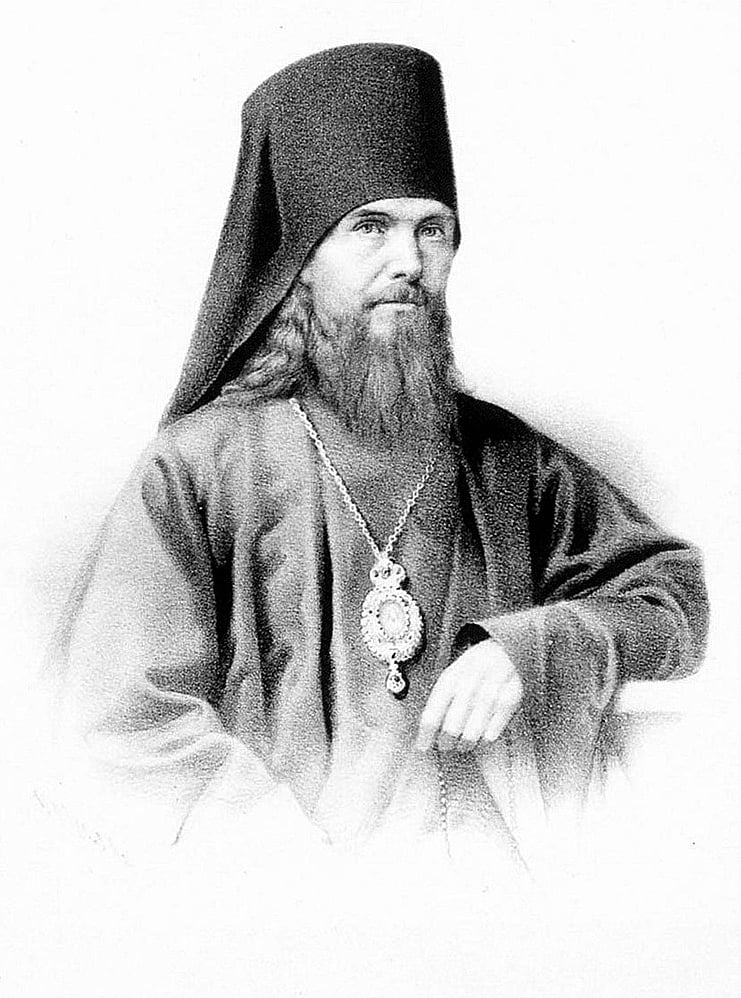
Patriarch Kirill now tells Russian students that evolution “testifies to an incredible divine plan,” and praises Darwin, who later called himself an agnostic, as “a very believing person.”
To understand the gravity of Kirill’s words, we must first ask what evolution actually requires an Orthodox Christian to believe.
What is Evolution?
The modern theory of evolution was taught and popularized by Charles Darwin.
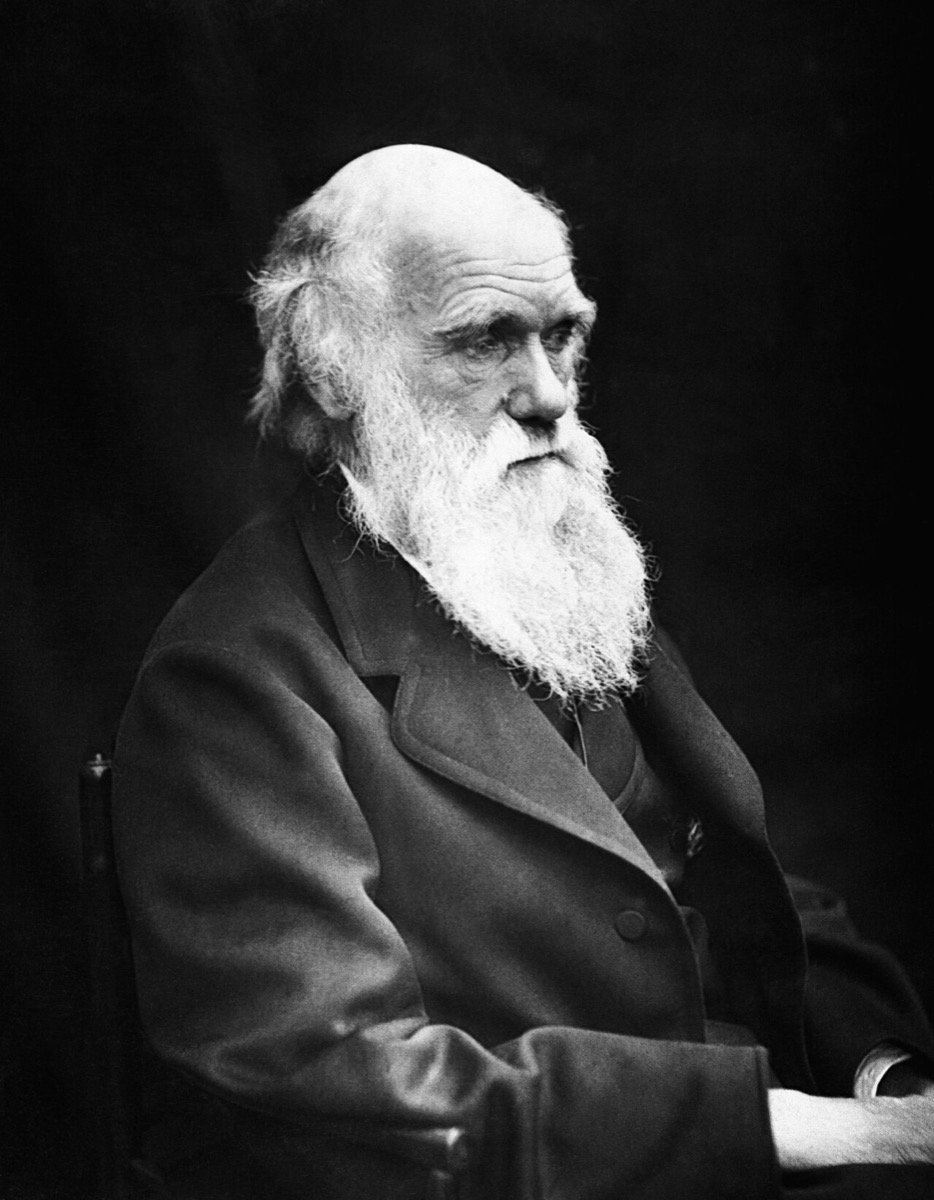
The theory of evolution proposes that all living things descend from a common ancestor. In plain language, this means that every creature belongs to one vast family tree, from the simplest living organisms to human beings.
According to this theory, life began from one ancient living source, something like a very simple single-celled organism or population. Over immense periods of time, its descendants slowly changed and split into new branches: fish-like creatures gave rise to amphibians, reptile-like creatures gave rise to mammals, and ape-like ancestors eventually gave rise to human beings. Natural selection drives this change: organisms are born with slight variations; those variations that help an organism survive and reproduce are passed on, and those that do not are eliminated.
What must Orthodox Christians accept to believe evolution?
Note: the following arguments assume full belief in Holy Scripture: “In the beginning” (Genesis 1:1)… “The Lord God formed man…” (Genesis 2:7)
In order for Orthodox Christians to believe the theory of evolution, we must accept all of the following tenets:
- That the days of creation in Genesis are allegorical.
Scripture tells us God created man on the sixth day, and the Fathers teach that each act of creation was instantaneous.
And God said, Let us make man in our image, after our likeness… So God created man in his own image, in the image of God created he him; male and female created he them… And the evening and the morning were the sixth day.
— Genesis 1:26-27, 31
The theory of evolution, on the other hand, depends on natural selection over immense periods of time. If the creation of man on the sixth day is interpreted literally, evolution cannot be true. The only way to reconcile the two is to treat the “day” in Genesis allegorically, as though “day” actually means millions of years.
- That death existed before Adam.
Evolution works through natural selection, and natural selection works through death. Organisms that fail to survive leave no offspring; those that do survive pass on their traits. Therefore, without death, there is no natural selection and thus no evolution. Death is the centerpiece and engine of the entire theory of evolution as taught by Charles Darwin.
If we believe that Adam (and therefore all humans) were a product of evolution, we must believe that death existed before God created Adam.
- That one kind of creature transformed into another.
The theory of evolution presented by Charles Darwin proposes common descent: all living things share a single ancestor. This means that humans did not appear separately, but descended from earlier primates, who descended from earlier mammals, all the way back to single-celled organisms.
However, if each kind of creature was created separately by God, there is no common descent, and the theory of evolution collapses.
(Note: variation within a kind, e.g. different breeds of dogs, is variation, not evolution. This common conflation is addressed directly by Fr. Seraphim Rose later in this chapter).
Scripture and the Fathers Deny All Three
The consensus patrum, the agreement of the Fathers, denies all three.
Against Tenet 1: Creation Was Literal and Instantaneous
Scripture itself resists the allegorical reading of days:
And the evening and the morning were the sixth day.
— Genesis 1:31
What is the evening and morning of a million years? The consensus patrum treats evening and morning as parts of a literal day, not as markers for geological ages.
Exodus makes the point even more plainly:
For in six days the Lord made heaven and earth, the sea, and all that in them is, and rested the seventh day.
— Exodus 20:11
Exodus presents the seventh day as the scriptural basis for the Sabbath commandment: six days of labor, then a real day of holy rest. The Church does not treat this rest as a symbol for millions of years. Orthodox Christians receive the Lord’s Day as a day of worship and rest; the tradition teaches us to refrain from our own work on that day except for true necessity or works of mercy.[1] If the commandment is received literally in the Church’s life, the six days on which the commandment rests cannot be quietly reinterpreted as ages.
This is not a private interpretation imposed on Scripture. It is the reading the Fathers themselves give. Orthodox interpretation of Scripture is permitted when it stands within the consensus of the Fathers; the Fathers are cited below precisely to show that this reading is not private opinion, but the mind of the Church.
The consensus patrum confirms the literal reading. St. Ephrem the Syrian, who died in 373, insisted that Genesis describes real events, not symbols:
So let no one think that there is anything allegorical in the works of the six days. No one can rightly say that the things that pertain to these days were symbolic, nor can one say that they were meaningless names or that other things were symbolized for us by their names. Rather, let us know in just what manner heaven and earth were created in the beginning. They were truly heaven and earth.
— St. Ephrem the Syrian, Commentary on Genesis I.1, Fathers of the Church (FC) 91, p. 74; online trans.: IATH, University of Virginia
The days themselves were literal periods of time, and each act of creation was instantaneous:
Although the light and the clouds were created in the twinkling of an eye, the day and the night of the first day were each completed in twelve hours.
— St. Ephrem the Syrian, Commentary on Genesis I.8, FC 91, p. 80; online trans.: IATH, University of Virginia
Everything God made appeared fully mature at the instant of its creation.
Just as the trees, the vegetation, the animals, the birds, and even mankind were old, so also were they young. They were old according to the appearance of their limbs and their substances, yet they were young because of the hour and moment of their creation.
— St. Ephrem the Syrian, Commentary on Genesis I.25, FC 91, p. 91; online trans.: IATH, University of Virginia
St. Basil the Great teaches the same thing in his Hexaemeron, nine homilies on the six days of creation. He defined the first day as twenty-four hours.
If it therefore says “one day,” it is from a wish to determine the measure of day and night… twenty-four hours fill up the space of one day.
— St. Basil the Great, Hexaemeron 2.8
Evolution cannot happen in seven literal days.
The Fathers did not imagine sacred history on the scale of millions of years. St. Irenaeus places the whole history of the world within thousands of years, not millions:
For in as many days as this world was made, in so many thousand years shall it be concluded.
For the day of the Lord is as a thousand years; and in six days created things were completed: it is evident, therefore, that they will come to an end at the sixth thousand year.
— St. Irenaeus of Lyons, Against Heresies 5.28, ANF Vol. 1, p. 1414
St. Theophilus of Antioch likewise counted the years from Creation in the thousands, and explicitly rejected errors of “thousands and tens of thousands”:
All the years from the creation of the world amount to a total of 5698 years, and the odd months and days.
For if even a chronological error has been committed by us, of, e.g., 50 or 100, or even 200 years, yet not of thousands and tens of thousands, as Plato and Apollonius and other mendacious authors have hitherto written.
— St. Theophilus of Antioch, To Autolycus III.28-29, ANF Vol. 2, pp. 292-293
The Church’s calendar tradition preserves the same horizon: sacred history is counted in thousands of years, not millions. The argument here is about scale, not about defending one exact chronological calculation against every manuscript tradition. The Septuagint, Masoretic, and Samaritan chronologies differ, but none of them offers the millions or billions of years evolution requires. The traditional Byzantine reckoning places Christ’s Nativity 5508 years after Creation, and a Paschalion table in the Typikon of the Great Church of Christ gives 2026 as the year 7534 from Creation.[2] Fr. Daniel Sysoev follows the same Septuagint chronology.[3]
St. Basil also taught that each creative act was instantaneous by divine command:
“Let the earth,” the Creator adds, “bring forth the fruit tree yielding fruit after his kind, whose seed is in itself”… all the trees, fir, cedar, cypress, pine, rose to their greatest height, the shrubs were straightway clothed with thick foliage… in one moment they came into being.
— St. Basil the Great, Hexaemeron 5.6
St. Ambrose of Milan taught the same in the West:
He did not speak in order that action should follow; rather, the action was completed with the Word.
— St. Ambrose of Milan, Hexaemeron 1.9, FC 42, p. 39
One might concede that God spoke on the sixth day but argue that creation then unfolded gradually after He spoke. St. Ambrose removes this: the action was not a consequence that followed the Word; it was completed with the Word. There is no gap after the command in which to insert millions of years.
St. Ambrose further confirms that only the twenty-four-hour period is given the term “day”:
Scripture established a law that twenty-four hours, including both day and night, should be given the name of day only…
— St. Ambrose of Milan, Hexaemeron 1.10, FC 42, p. 42
On the speed of God’s creative act, St. Ambrose was explicit: there was no delay, no gradual process. The act outpaced time itself:
And fittingly [Moses] added: “He created,” lest it be thought there was a delay in creation. Furthermore, men would see also how incomparable the Creator was Who completed such a great work in the briefest moment of His creative act, so much so that the effect of His will anticipated the perception of time.
— St. Ambrose of Milan, Hexaemeron 1.4, FC 42, p. 139
Evolution Is Impossible for an Orthodox Christian
No Ecumenical Council issued a separate definition on literal creation, but the Seventh Ecumenical Council taught: “If anyone rejects any written or unwritten tradition of the Church, let him be anathema.”[4] The consensus invoked here is not every incidental exegetical detail or every chronological calculation. It is the shared dogmatic horizon of the Fathers: Genesis is divine revelation about real creation; God creates by command, not by a death-driven natural process; man is uniquely formed by God; and death and corruption are tied to the Fall.
If creation was completed in “the twinkling of an eye,” in “the briefest moment,” there is no place in that patristic account for millions of years of gradual development. Darwinian evolution is incompatible with the consensus patrum.
St. John Chrysostom, the greatest preacher in Church history:
He only commanded, and they all shot forth.
— St. John Chrysostom, Homily 10 on the Statues, Nicene and Post-Nicene Fathers (NPNF) 1-09, p. 605
Some may contend that St. Augustine, often presented as flexible on creation, leaves the door open for evolution. But Augustine argued that God created everything simultaneously rather than over six temporal days, meaning he thought creation happened faster than six days, not over immense ages. Thus even where a Father differs on whether the days unfolded sequentially or simultaneously, the difference does not help evolution: both positions deny a long natural process. His whole project in The Literal Meaning of Genesis was to prove that Genesis should be read as literal history, not allegory:
The narrative in these books is not written in a literary style proper to allegory, as in the Canticle of Canticles, but from beginning to end in a style proper to history, as in the Books of Kings.
— Bl. Augustine, The Literal Meaning of Genesis, Ancient Christian Writers (ACW) 41, p. 43
The Books of Kings are written as history, with real events and real time. Augustine’s genre claim therefore does not support treating Genesis as a non-historical wrapper for evolutionary development.
Against Tenet 2: No Death Before the Fall
The Apostle Paul teaches that death entered the world through one man’s sin:
Wherefore, as by one man sin entered into the world, and death by sin; and so death passed upon all men.
— Romans 5:12
St. John Chrysostom comments on this passage directly:
“Wherefore as by one man sin entered into the world, and death by sin, and so death passed upon all men…” He having once fallen, even they that had not eaten of the tree did from him, all of them, become mortal.
— St. John Chrysostom, Homily 10 on Romans, NPNF1-11
St. Paul also teaches that creation itself was not originally corruptible; it was made so because of man’s sin:
For the creature was made subject to vanity, not willingly.
— Romans 8:20
St. John Chrysostom explains what this means:
What is the meaning of, “the creation was made subject to vanity”? Why that it became corruptible. For what cause, and on what account? On account of you, O man. For since you have taken a body mortal and liable to suffering, the earth too has received a curse.
— St. John Chrysostom, Homily 14 on Romans, NPNF1-11
Death Before Adam Is Impossible for the Orthodox Christian
If death did not exist before Adam, the entire theory of evolution immediately collapses. Evolution requires natural selection, and natural selection requires death. If death did not exist before Adam, Adam cannot be a product of evolution, because that would require death before Adam.
St. John Chrysostom taught that Adam’s body before the Fall was not corruptible or mortal:
That body was not thus corruptible and mortal; but like as some statue of gold just brought from the furnace…
— St. John Chrysostom, Homily 11 on the Statues, NPNF1-09, p. 607
St. John Chrysostom stated plainly that if Adam’s body had been mortal before the transgression, death could not have been its punishment:
Had he a mortal body when he sinned? Surely not: for if it had been mortal before, it would not have undergone death as a punishment afterwards.
— St. John Chrysostom, Homily 17 on 1 Corinthians, NPNF1-12
St. Ephrem the Syrian:
When God created Adam, He did not make him mortal, nor did He fashion him immortal, so that Adam, by either keeping or transgressing the commandment, might acquire from one of the trees, the [life] that he preferred.
— St. Ephrem the Syrian, Commentary on Genesis II.18, FC 91, p. 109; online trans.: IATH, University of Virginia
Death and thorns came only after the transgression:
Therefore, just as pangs were decreed against Eve and her daughters, and thorns and death against Adam and his posterity…
— St. Ephrem the Syrian, Commentary on Genesis III.32, FC 91, p. 121; online trans.: IATH, University of Virginia
St. Augustine:
The first human pair had natural bodies indeed, but bodies destined to die only if they sinned, bodies that would have received an angelic form and heavenly quality.
— Bl. Augustine, The Literal Meaning of Genesis, ACW 41, p. 91
Humans were destined to die only upon the introduction of sin. Sin did not exist in the world before the eating of the forbidden fruit, so death cannot have existed before Adam’s sin.
Against Tenet 3: No Creature Transforms Into Another
Scripture teaches that God created man directly, not through transformation from another kind:
And the Lord God formed man of the dust of the ground, and breathed into his nostrils the breath of life; and man became a living soul.
— Genesis 2:7
If man was formed from dust, he did not descend from animals. The consensus patrum does not support the claim that man descended from animals.
St. Augustine confirmed that God set permanent boundaries on the types of creatures:
He does not now make some new kind of creature which He did not then create in the works He finished.
— Bl. Augustine, The Literal Meaning of Genesis, ACW 41, p. 110
St. Luke of Crimea and Simferopol (Voino-Yasenetsky) was not an anti-scientific outsider. He was a professor of surgery whose pioneering work on purulent wounds won the Stalin Prize, the Soviet Union’s highest scientific award; he remains the only ecclesiastical figure ever to receive it.[5][6] The Soviet state itself honored him as one of its leading scientists.[7][8] He operated on soldiers during the war while serving as an archbishop, was glorified by the Moscow Patriarchate in 2000, and is venerated in Simferopol to this day.[9] This is what St. Luke said about Darwin:
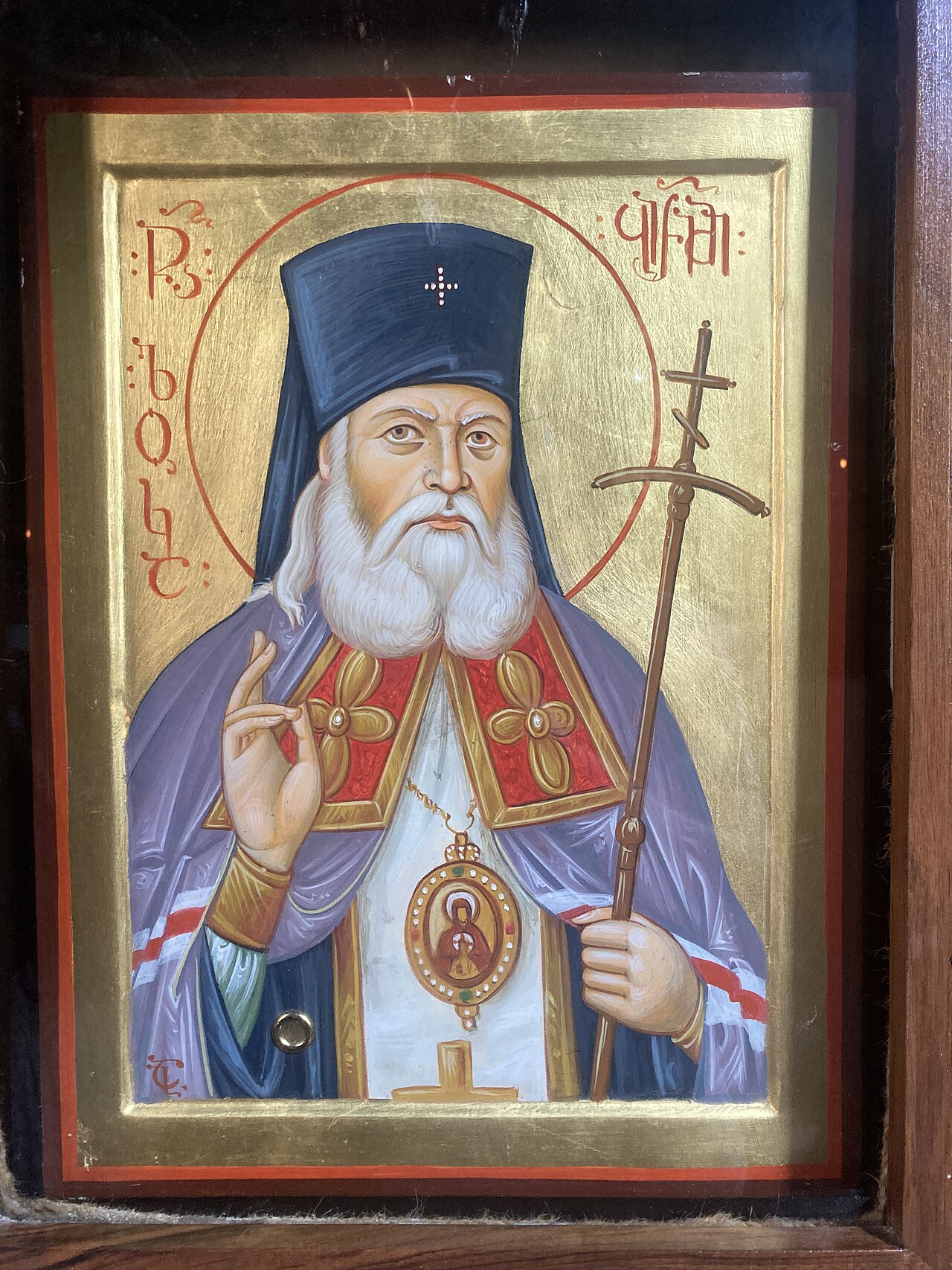
Darwinism, which declares that man, by means of evolution, has developed from the lower species of animals, and is not a product of the creative act of the Godhead, has turned out to be merely a supposition, a hypothesis, which has become obsolete even for science. This hypothesis has been acknowledged as contradictory not only to the Bible, but to nature itself, which jealously strives to preserve the purity of each species, and knows of no transition even from a sparrow to a swallow.
— St. Luke (Voino-Yasenetsky), “Science and Religion,” cited in Fr. Seraphim Rose, Genesis, Creation and Early Man, p. 809
This is Patriarch Kirill’s own saint, from Kirill’s own Church, and St. Luke called Darwinism “merely a supposition” that nature itself contradicts. The claim that rejecting evolution is anti-scientific cannot survive this witness.
St. Paisios the Athonite put the matter plainly:
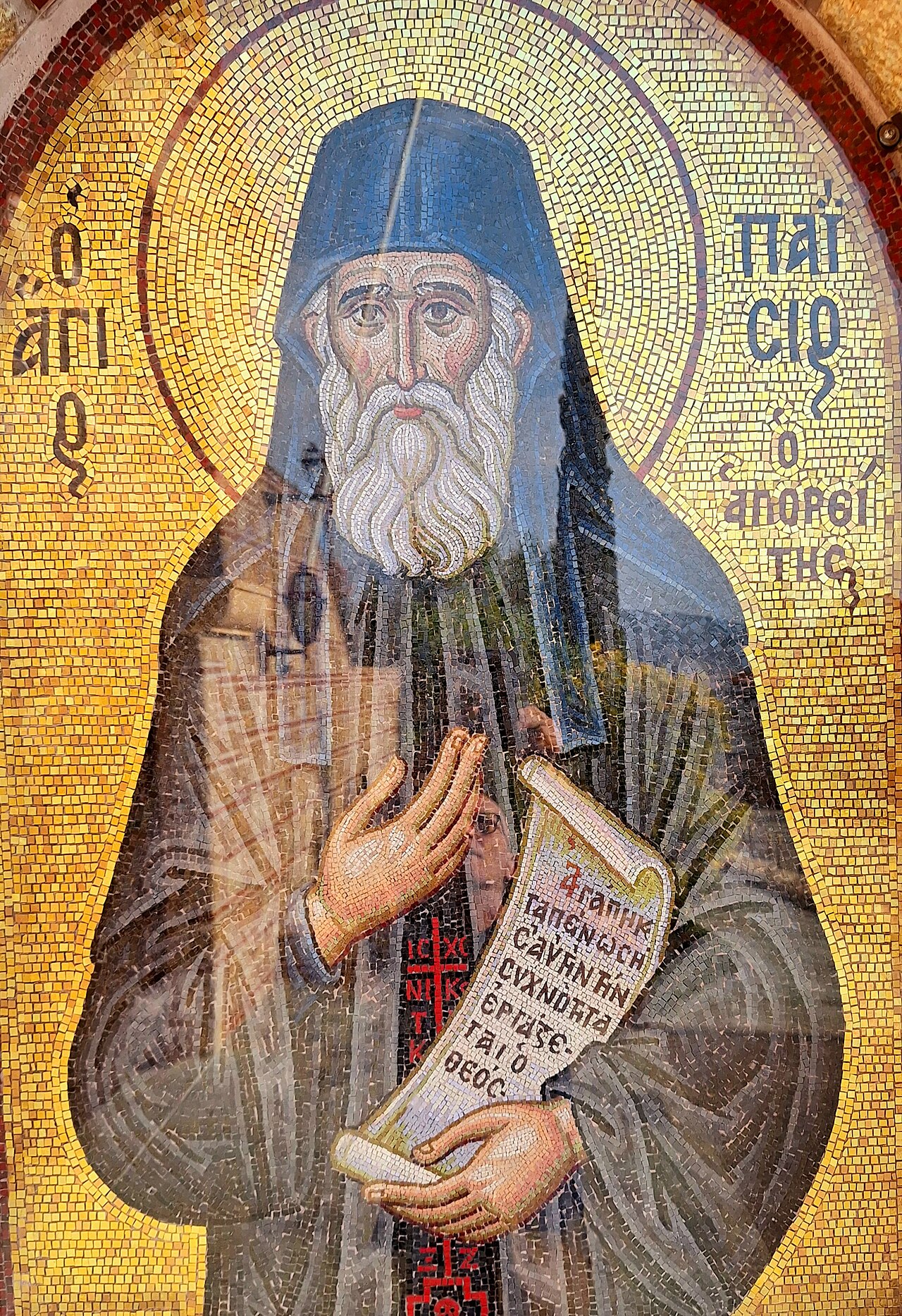
Christ was born of a human being, the Panagia! Are we supposed to believe that His ancestors were monkeys? What blasphemy!
— St. Paisios the Athonite, Spiritual Counsels, Vol. 1, p. 332
St. Paisios continued:
And those who support this theory don’t realize that they are blaspheming. They throw a stone and do not check to see how many heads they have cracked. All you will hear from them is, “Mine went further than the other fellow’s.” That’s what they are all about these days; they marvel at who will throw a stone the furthest. But they care nothing about those who are passing by and the many heads their stones will crack.
— St. Paisios the Athonite, Spiritual Counsels, Vol. 1, p. 332
The matter is not small. One of our most beloved contemporary saints called it blasphemy.
The theological consequences of this tenet are examined more fully below in “What Evolution Destroys.”
The Three Required Claims Collapse
Darwinian evolution requires all three claims to be true: the days treated as vast ages or otherwise emptied of their historical force, death before Adam, and the transformation of one creature into another. The consensus patrum denies all three. If even one fails, the theory cannot stand; all three fail under scrutiny.
With that witness in place, we can now turn to Patriarch Kirill’s own words.
What Kirill Actually Said
Here is what Patriarch Kirill told students at the Sirius Scientific and Technological University in September 2024:
Бог создал потрясающую Вселенную, он вложил в нас способность к развитию. Иногда говорили, что эволюция против, так сказать, Божьего замысла. Но она не против Божьего замысла, она свидетельствует о невероятном Божественном замысле, когда человек своими силами, опираясь на внешние факторы, может развиваться таким образом, как это произошло в результате эволюции. Поэтому для меня эволюция живого мира — Дарвин, кстати, тоже был очень верующим человеком — никогда не была фактором антирелигиозных аргументов.
God created an amazing Universe; He gave us the ability to develop. Sometimes they say that evolution is against God’s plan. But it is not against God’s plan; it testifies to an incredible divine plan, when a person, by his own efforts, relying on external factors, can develop in the way that happened as a result of evolution. Therefore for me the evolution of the living world — Darwin, by the way, was also a very believing person — has never been a factor for anti-religious arguments.
— Patriarch Kirill, quoted in Legoyda interview, https://www.patriarchia.ru/article/112547 (22 Oct 2024)
Kirill named Darwin directly and endorsed “the evolution of the living world” as testimony to God’s plan. Darwinian evolution cannot be held without accepting the three claims already described:
Tenet 1: Kirill says a person “can develop in the way that happened as a result of evolution.” Evolution, as taught by Charles Darwin, requires immense ages of gradual development. If man developed “as a result of evolution,” the Genesis account of God creating man on the sixth day cannot stand as real sacred history. The days must be turned into vast ages or otherwise emptied of their historical force. Therefore, Patriarch Kirill has not merely allowed spiritual allegory; he has subordinated Genesis to an evolutionary timescale that contradicts the consensus patrum.
Tenet 2: Evolution, as taught by Darwin, operates through natural selection. Natural selection requires death. By endorsing Darwinian evolution, Patriarch Kirill commits himself to a framework in which death was at work before man existed. Therefore, his statement places him on the side of death before Adam, which contradicts the consensus patrum.
Tenet 3: Kirill endorses “the evolution of the living world” as a whole. In Darwin’s theory, this means all living things share a common ancestor: fish became amphibians, reptiles became mammals, apes became men. If man is part of “the evolution of the living world,” he was not created separately in the patristic sense. Therefore, Patriarch Kirill has aligned his statement with the transformation of one creature into another, which contradicts the consensus patrum.
In a separate statement from 2016, Kirill went further: “It is naive to read Genesis as the textbook on anthropogenesis.”[10] In simpler words, Patriarch Kirill is telling us that Genesis should not be read as an actual account of how man came to be. But this is exactly how every Father cited above reads Genesis. St. Ephrem says “let no one think there is anything allegorical.” St. Augustine says it is written “in a style proper to history.” Patriarch Kirill is calling the Fathers naive.
He named Darwin, endorsed the theory, and denied that Genesis is literal history.
On Charles Darwin
Why Evolution Must Be Connected to Charles Darwin
The word “evolution” is used loosely, and different people mean different things by it. Some mean the full theory taught by Charles Darwin: common descent, natural selection, apes becoming men over vast ages. Others mean something far simpler: that dog breeds change over time, that organisms adapt to their environments, that variation exists within a species.
These are not the same thing. Fr. Seraphim Rose pointed out that Darwin’s own observations were not of evolution at all, but of variation:
The speculations of Darwin were based almost entirely upon his observations, not of evolution, but of variation. When he was traveling in the Galápagos Islands, Darwin wondered why there were thirteen different varieties of one kind of finch, and thought that it was because there was one original variety which had developed according to its environment. This is not evolution but variation. From this, he jumped to the conclusion that if you keep making small changes like that, eventually you will have an absolutely different kind of creature. The problem in trying to prove this scientifically is that no one has ever observed these larger changes; they have only observed changes within a kind.
— Fr. Seraphim Rose, Genesis, Creation and Early Man, p. 519
Darwin observed finches varying. He called it the beginning of evolution. His followers still use the same move: point to dog breeds, bacterial resistance, finch beaks, and say “see, evolution.” But variation is not evolution. Fr. Seraphim Rose went further:
I wish to make very clear to you: I do not at all deny the fact of change and development in nature. That a full-grown man grows from an embryo; that a great tree grows from a small acorn; that new varieties of organisms are developed, whether the ‘races’ of man or different kinds of cats and dogs and fruit trees — but all of this is not evolution: it is only variation within a definite kind or species; it does not prove or even suggest (unless you already believe this for non-scientific reasons) that one kind or species develops into another and that all present creatures are the product of such a development from one or a few primitive organisms.…
No one, ‘evolutionist’ or ‘anti-evolutionist,’ will deny that the ‘properties’ of creatures can be changed; but this is not a proof of evolution unless it can be shown that one kind or species can be changed into another, and even more, that every species changes into another in an uninterrupted chain back to the most primitive organism.
— Fr. Seraphim Rose, cited in Hieromonk Damascene, Not of This World, p. 512
The distinction is not merely semantic. Variation describes change within a kind. Evolution requires one kind of creature to become another. The first does not prove the second. Dog breeding proves dramatic variation within a kind, not the transformation of one kind into another. As evolutionary biologist Frank Hailer writes, “as far as evolutionary biologists are concerned, all dogs are just dogs.” Mainstream biology explains why: “Natural selection can only select on existing variation in the population; it cannot create anything from scratch.” Selection can exaggerate, suppress, and recombine what is available; it does not show that a dog can become something other than a dog.[11]
Fr. Seraphim Rose refused to even use the word “evolution” for these processes:
To use examples of observable microevolutionary processes as proofs of macroevolution simply confuses the two issues. To avoid any confusion in this appendix, the term evolution will mean strictly macroevolution. Microevolution will be more appropriately described by such terms as variation or adaptation.
— Fr. Seraphim Rose, Genesis, Creation and Early Man, p. 827
This conflation between variation and evolution enables a rhetorical pattern known in logic as the motte-and-bailey fallacy: a strong, controversial position is asserted (the bailey), but when challenged, the person retreats to a weaker, easily defensible position (the motte), then acts as though defending the weak position vindicates the strong one.
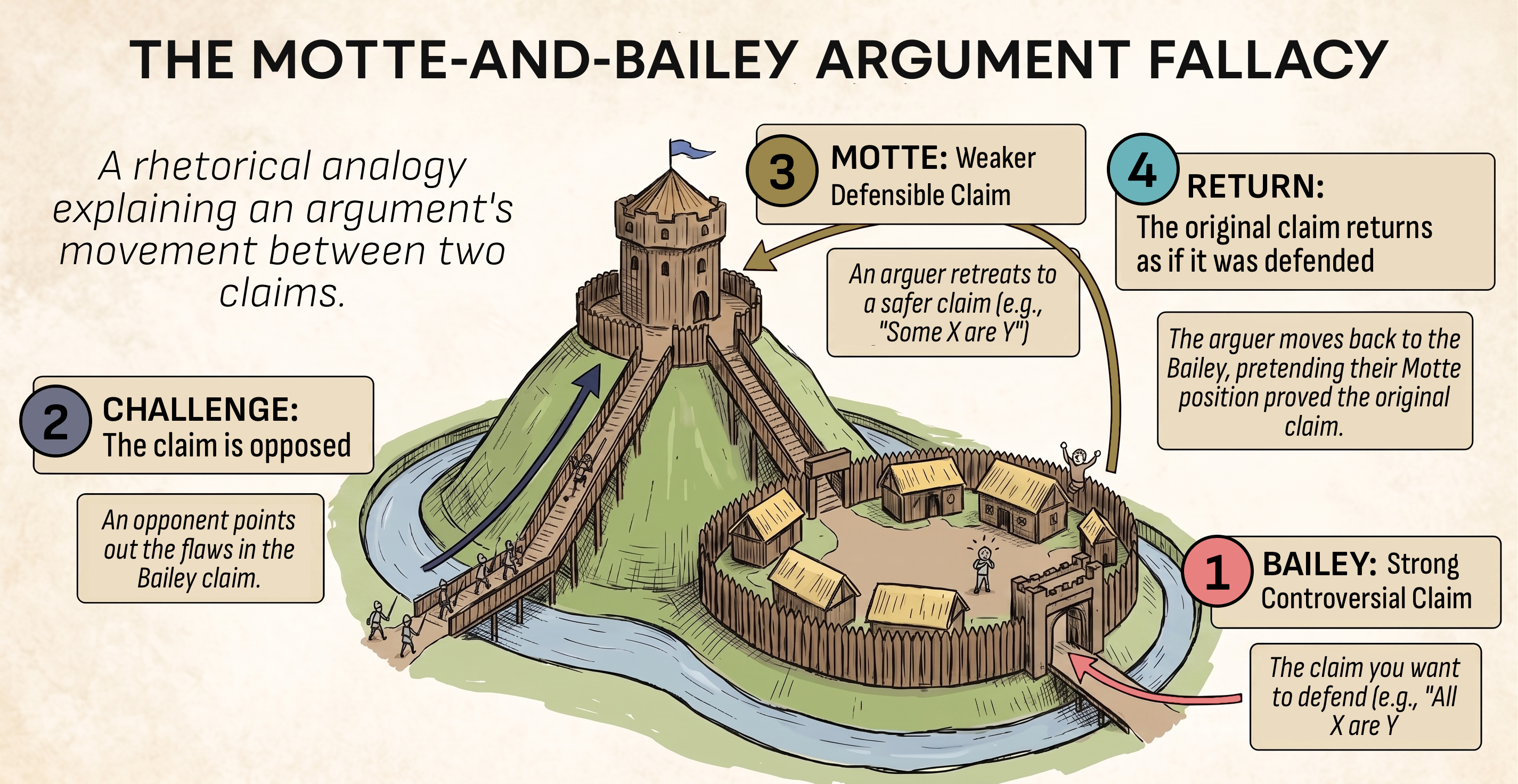
This does not need to be deliberate. Many Orthodox Christians who say they “believe in evolution” may sincerely mean only variation. But evolution as popularly understood means common descent: man descended from apes, all life shares a single ancestor, and death drove the process over immense ages. A person who holds the softer interpretation and defends “evolution” on that basis is unknowingly providing cover for the harder claim, because the word carries both meanings and ordinary people hear the stronger one.
None of these ordinary observations were called “evolution” before Darwin.[12]
In 1828, Noah Webster’s dictionary still defined “evolution” only as “unfolding or unrolling,” with no biological sense at all. The word was applied to these phenomena only after Darwin made it the dominant framework for explaining life. Therefore, the person who means “I just mean variation” is using Darwin’s word, borrowed from Darwin’s theory, to describe something that was understood long before Darwin was born. A well-understood and innocent phenomenon is given the same name as a blasphemous one. Acceptance of the word for the harmless case becomes a gateway to acceptance of the theory it actually names.
No saint ever condemned variation within a kind. They condemned the claim that man descended from lower animals, that death preceded sin, and that Genesis does not describe real history. That is Darwin’s theory. It cannot be reduced to the observations that preceded it and then defended under his name.
Patriarch Kirill does not leave room for this retreat. He did not say “I believe organisms adapt to their environments.” He said evolution “testifies to an incredible divine plan,” and he named Darwin directly, calling him “a very believing person.” That is an endorsement of a specific theory by a specific man.
Darwin Was Not a Believer
Was Darwin “a very believing person,” as Kirill claims?
Charles Darwin was baptized Anglican and studied at the University of Cambridge, originally intending to become a clergyman, but he gradually lost his faith. In 1879, twenty years after publishing On the Origin of Species, he described his own position:
I think that generally (and more and more as I grow older), but not always, that an Agnostic would be the most correct description of my state of mind.
— Charles Darwin, letter to John Fordyce, 1879[13]
Darwin was never Orthodox, never a churchman, and by his later testimony not a believing Christian in any ordinary sense.[14] The man Patriarch Kirill praised as “very believing” called himself an agnostic. The theory Kirill endorsed as testimony to God’s plan supplied an account of life that did not need God.
What Evolution Destroys
The three tenets previously covered are more than errors about Genesis. They dismantle what the Orthodox faith teaches about who man is, why Christ came, and what salvation means.
If man descended from apes, then the Theotokos descended from apes, and Christ took flesh from a creature whose ancestors were animals. If man is not directly God’s creation but the product of a process that made him from animals through death, the foundation of salvation is overturned. Fr. Daniel Sysoev put the question to his catechumens directly: “Why is the dogma of creation considered one of the most important dogmas in Christianity?”[15]
If man was not created by the One True God, and instead descended from monkeys, then there is no reason for God to save him: man is not God’s, he is not God’s creation. To God He is a foreign, unnecessary creature.
— Fr. Daniel Sysoev, Catechetical Talks, p. 132
The Soul
There is a further problem that even those who attempt to reconcile evolution with God cannot answer coherently: the souls of animals are not immortal. Only humans were made in God’s image, and only human souls do not perish. Metropolitan Hierotheos Vlachos, drawing on St. Gregory Palamas, explains why the soul of man and the soul of an animal are categorically different things:
Therefore since the soul of animals has only energy, it dies with the body. By contrast, the soul of man has not only energy but also essence: “The soul possesses life not only as an activity but also essentially, since it lives in its own right… For that reason, when the body passes away, the soul does not perish with it.” It remains immortal.
— Met. Hierotheos Vlachos, Orthodox Psychotherapy, p. 105, citing St. Gregory Palamas, 150 Chapters, ch. 30-33, 38
This poses a difficult question for those who attempt to reconcile evolution with Orthodoxy: when, in the millions of years of evolution, did animals gain an immortal soul?
The animal soul dies with the body. The human soul does not. These are not two points on a continuum; they are two categorically different realities. Evolution proposes a gradual transition from one to the other, but there is no gradual transition from mortal to immortal, from energy to essence.
Dr. Alexander Kalomiros, a Greek Orthodox medical doctor who attempted to reconcile evolution with Orthodoxy, admitted the problem openly: “We have nothing by which to conclude in which stage of evolution the breath of God was given to the animal.”[16] Fr. Seraphim Rose raised this same problem in his reply to Kalomiros, which became the definitive patristic refutation of attempts to insert God into the evolutionary framework.[17]
Even the defenders of this position cannot say when the soul appeared in the process of man evolving from a single-celled organism. This is not a reconciliation; it is a contradiction left unresolved.
The Trajectory of Man
The animals were spoken into existence by command, but God formed man differently. St. Ephrem notes:
Even though the beasts, the cattle, and the birds were equal [to Adam] in their ability to procreate and in that they had life, God still gave honor to Adam in many ways: first, in that it was said, God formed him with His own hands and breathed life into him.
— St. Ephrem the Syrian, Commentary on Genesis II.7, FC 91, p. 99; online trans.: IATH, University of Virginia
The form God gave to man was not that of a beast. St. Gregory of Nyssa writes:
Man’s form is upright, and extends aloft towards heaven, and looks upwards: and these are marks of sovereignty which show his royal dignity.
— St. Gregory of Nyssa, On the Making of Man VIII.1, NPNF2-05, p. 727
The animals were made by command. Man was formed by God’s own hands, received the breath of life directly, and was given an upright form that marks him as sovereign. In Orthodox terms, man is not produced by a created mechanism that God happens to supervise; he is formed by God’s direct action. If man evolved from animals, these distinctions disappear. Man is no longer God’s greatest creation, formed personally by His hands to look toward heaven; he becomes the latest product of the same process that produced every other animal. His original form is not the image of God; it is an ape.
The Fathers teach that man was created perfect and fell. Evolution teaches that man started low and climbed. These are opposite trajectories. Fr. Seraphim Rose stated the contrast plainly:
While Orthodox Patristic theology teaches that man fell from a blessed state in which he had no bodily needs, was dispassionate, possessed ineffable intelligence and the gift of prophecy, and was “wrapped about” by Divine grace — a condition that St. John Chrysostom likened to that of the angels — evolutionism teaches rather that man came up from the beasts through the law of bloody tooth and claw.
— Fr. Seraphim Rose, Genesis, Creation and Early Man, p. 84 (Editor’s Preface)
The Orthodox understanding of salvation depends on the first trajectory: man was made in glory, fell from that glory, and Christ came to restore him to it. If man evolved from apes, there is no original glory to fall from and no original state to be restored to. Fr. Seraphim Rose stated it simply:
Of course, if you believe in evolution, it makes no sense to talk about Paradise. You’re only fooling yourself if you try to combine these two different forms of thinking.
— Fr. Seraphim Rose, Genesis, Creation and Early Man, p. 570
Consider what this means for the resurrection. The Orthodox Church teaches that our bodies will be restored. Restored to what? St. Gregory of Nyssa answers:
The [general] resurrection promises us nothing else than the restoration of the fallen to their ancient state.
— St. Gregory of Nyssa, On the Soul and the Resurrection, cited in Rose, Genesis, Creation and Early Man, p. 779
Restoration means returning to an “ancient state.” If God created man directly, in His own image, then that ancient state is the original, perfect creation. But if man’s origin is an ape, and the ape’s origin is a lower mammal, and so on back to a single cell, then what exactly is being restored? The ape? The cell? Evolution provides no original state worthy of restoration. In the evolutionary framework there is no perfect beginning, only a long climb from something lesser. The Fathers’ teaching requires a fall from perfection. Evolution has no perfection to fall from.
Darwin, Marx, and the Soviet State
The patristic case against evolution stands on its own: the Fathers deny it, the canons condemn its premises, and the saints call it blasphemy. What follows is not an argument that evolution is heretical because Marxists used it. It is the historical record of what happened when Darwinism entered Russia: the state adopted it, the Church resisted it, and the New Martyrs died for that resistance. The Patriarch of Moscow now endorses what the martyrs rejected.
Darwin himself was not a communist.[18] But Marxists immediately recognized the usefulness of his theory. Within weeks of the Origin’s publication, Friedrich Engels, Marx’s closest collaborator, called it “absolutely splendid,” and Marx replied that it contained “the basis in natural history for our view.”[19] At Marx’s funeral, Engels made the parallel explicit: “Just as Darwin discovered the law of development of organic nature, so Marx discovered the law of development of human history.”[20]
Darwin’s theory mattered to Marxism because it offered an account of life without God, design, or transcendent purpose. Lenin later stated the point plainly: “Darwin put an end to the view of animal and plant species being… ‘created by God’ and immutable.”[21]
In Russia, Darwinism became a weapon against religious orthodoxy. It became the radical intelligentsia’s “latest and most exciting weapon” against tyranny and religious orthodoxy.[22] Dostoevsky observed that while the West treated Darwin’s theory as a “brilliant hypothesis,” Russia quickly treated it as an “axiom.”[23]
The Russian Orthodox Church recognized the danger. Beginning in 1864, theological journals at the Moscow and St. Petersburg academies mounted a sustained campaign against Darwinism. Their critics, “without exception, rejected every part of Darwinian thought.”[24] Russian theologians did not try to reconcile Darwinism with creation.[25]
The refusal reached official Church channels. Sergei Rachinsky, the first Russian translator of On the Origin of Species, tried to publish an article in the Holy Synod’s official journal arguing for harmony between Darwinism and Christianity. Konstantin Pobedonostsev, Procurator of the Holy Synod, refused to allow it.[26]
What the Holy Synod’s chief lay administrator would not allow into its official journal, Patriarch Kirill now presents as testimony to the divine plan.
St. Theophan the Recluse, a Russian saint who owned Darwin’s books and engaged the material firsthand, treated Darwinism as already condemned by the Church:
To the current Rite of Orthodoxy only the following item would have to be added: “To Buchner, Feuerbach, Darwin, Renan, Kardec, and all their followers: anathema!” But there is no need, either for a special council or for any kind of addition. All of their false teachings were anathematized long ago.
— St. Theophan the Recluse, cited in Rose, Genesis, Creation and Early Man, p. 791
Patriarch Kirill praises Darwin as “a very believing person.” St. Theophan named Darwin and his followers among those whose teachings were already anathematized.
Decades before the Revolution, St. Theophan also warned that Darwinian naturalism would destroy the Russian state:
Until these books are destroyed; until professors and literary men are forced not only not to hold to this theory, but even to demolish it; until then, faithlessness will grow and grow, and with it, self-will and the destruction of the present government. That’s the way the French Revolution went.
— St. Theophan the Recluse, cited in Rose, Genesis, Creation and Early Man, p. 792
The Bolsheviks proved St. Theophan’s warning. After 1917, Darwinism became part of the Soviet state’s anti-religious program. The Moscow Darwin Museum became a mass-education tool for materialist atheism; the Soviet Union later called itself “the second homeland of Darwinism”; and the Communist Party ordered anti-religious propaganda to answer questions about the origin of life with “materialist natural science.”[27][28][29]
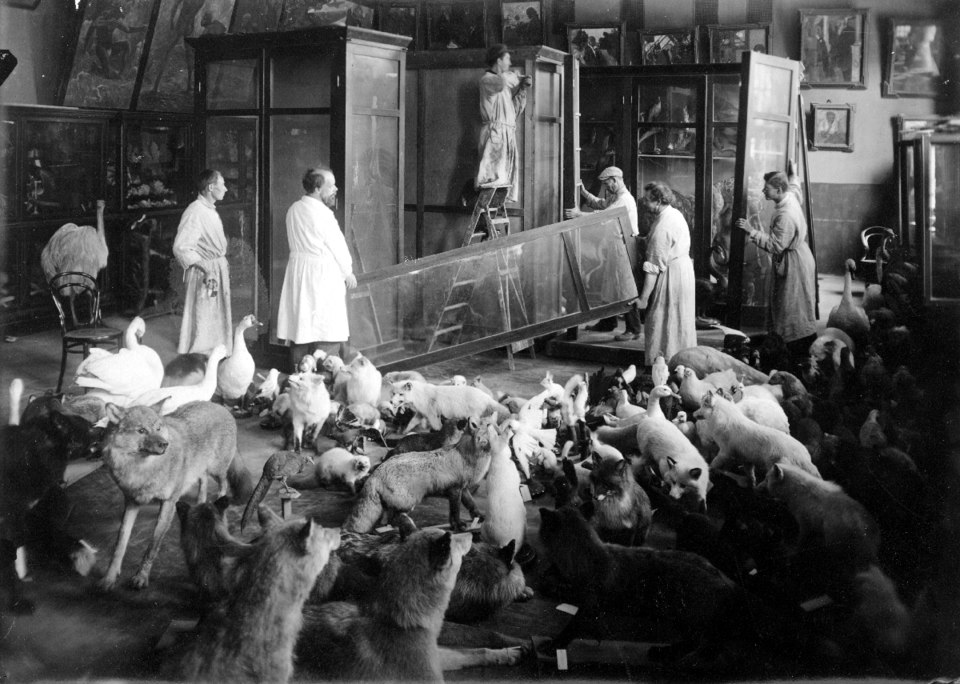
Lenin insisted that science must serve militant materialism.[30] Evolution was taught in Soviet schools as ideological doctrine.[31] To confess that God created man was to contradict the regime. Russian priests were shot for it.
Hieromartyr Paul Andreyev told his parishioners that “the Soviet authorities preach the teaching of Darwin, that man proceeded from apes, but that this is a blasphemy and a lie.” He was sentenced to death and shot.[32]
Hieromartyr Varlaam (Nikol’sky), abbot of a Moscow diocese monastery, was asked during interrogation: “Did you say in the schools they do not correctly explain the origin of man?” He answered: “A student asked me where man came from, saying that the teacher had said man originated from apes. I answered that man came from God.” He was shot.[33]
Hieromartyr Nicholas Pokrovsky, a priest of the Tikhvin region, declared at his interrogation: “I am a religious man. I have never denied and never will deny my convictions. To take the question of the origin of man, I prove to believers and am myself convinced that man was created by God, though science says the opposite.” He was shot.[34]
This is why the Soviet history matters. Darwin was not a Bolshevik. But in Russia, Darwinism functioned as anti-creation anthropology, and the New Martyrs died for rejecting it. They died under the same Soviet regime whose legacy this book has already traced through Sergianism and the DECR. The Patriarch of Moscow commemorates the New Martyrs while endorsing the very claim they were killed for rejecting: that man descended from apes.
The Saints Kirill Contradicts
These are Russian saints, from Kirill’s own Church.
St. John of Kronstadt, the great wonderworker of late imperial Russia:
In their blindness they reach the point of insanity, deny the very existence of God, and maintain that everything stems from blind evolution. But he who has an intellect does not believe in such insane ravings.
— St. John of Kronstadt, cited in Fr. Seraphim Rose, Genesis, Creation and Early Man, p. 794
St. Barsanuphius, Elder of Optina, saw where Darwin’s logic led:
The English philosopher Darwin created an entire system according to which life is a struggle for existence, a struggle of the strong against the weak, where those that are conquered are doomed to destruction and the conquerors are triumphant. This is already the beginning of a bestial philosophy, and those who come to believe in it wouldn’t think twice about killing a man.
— St. Barsanuphius of Optina, cited in Rose, Genesis, Creation and Early Man, p. 795
That warning was not theoretical. In Germany, Darwinian ethics later became a language for subordinating the weak to the strong, the person to the species, and Christian mercy to biological progress.[35]
Holy Hieromartyr Vladimir, Metropolitan of Kiev, the first bishop martyred under the Communists in 1918, warned the faithful not to accept a teaching that lowered man to the level of animals:
Brethren, do not listen to the pernicious, poison-bearing teaching of unbelief, which lowers you to the level of animals and, depriving you of human worth, promises you nothing but despair and an inconsolable life.
— Hieromartyr Vladimir of Kiev, cited in Rose, Genesis, Creation and Early Man, p. 796
Holy Hieromartyr Hilarion (Troitsky), glorified by the Russian Orthodox Church in 2000, identified the spiritual root of evolution: pride.
The Church calls us to humility when she calls Adam our ancestor. But evolution? Descent from a monkey? No matter how modestly someone may judge himself, still he cannot avoid thinking with some pride: at least I am not a monkey, at least some progress has been realized in me. This is how evolution, by calling a monkey our ancestor, feeds our pride.
— Holy Hieromartyr Hilarion (Troitsky), “The Incarnation and Humility,” Московские церковные ведомости, 1913, nos. 51-52
If Adam is our ancestor, we must humble ourselves: he was perfect and we have fallen. If the ape is our ancestor, we congratulate ourselves: we have risen. The first disposition leads to repentance. The second leads away from the Incarnation, which requires the acknowledgment that man fell and needs to be saved.
St. Justin Popovich of Serbia defined the stakes in a single sentence:
That theology which bases its anthropology on the theory of “scientific” evolution is nothing but a contradiction in terms. In reality, it is a theology without God and an anthropology without man.
— St. Justin Popovich, cited in Rose, Genesis, Creation and Early Man, p. 86
Slipping Darwin Past the Fathers
Some Orthodox Christians try to keep both positions: they accept evolution, but insist they still believe in God as Creator. Fr. Seraphim Rose spent over a thousand pages documenting what the Orthodox Church has always taught about creation. His challenge to those who would insert God into Darwin’s framework remains unanswered:
If you can explain to me how one can accept the Patristic interpretation of the book of Genesis and still believe in evolution, I will be glad to listen to you; but you will also have to give me better scientific evidence for evolution than that which so far exists, for to the objective and dispassionate observer the “scientific evidence” for evolution is extremely weak.
— Fr. Seraphim Rose, Genesis, Creation and Early Man, p. 452
Fr. Seraphim Rose identified theistic evolution as a capitulation born from fear of appearing unscientific:
“Theistic” evolution, as I understand its motives, is the invention of men who, being afraid that physical evolution is really “scientific,” stick “God” in at various points of the evolutionary process in order not to be left out, in order to conform “theology” to the “latest scientific discoveries.” But this kind of artificial thinking is satisfactory only to the most vague and confused minds.
— Fr. Seraphim Rose, Genesis, Creation and Early Man, p. 608
The effect is not an open attack on the faith. It is quieter and more dangerous: it teaches Orthodox Christians to read Scripture through Darwin instead of through the Fathers.
It offers an alternative explanation of creation to that of the Holy Fathers; it allows an Orthodox Christian under its influence to read the Holy Scriptures and not understand them, automatically “adjusting” the text to fit his preconceived philosophy of nature.
— Fr. Seraphim Rose, Genesis, Creation and Early Man, p. 500
This is precisely what Kirill’s position does: it teaches Orthodox Christians to read Genesis and not understand it, because Genesis must be adjusted to fit evolution. The Fathers are not consulted; they are bypassed.
The Man Who Taught the Truth
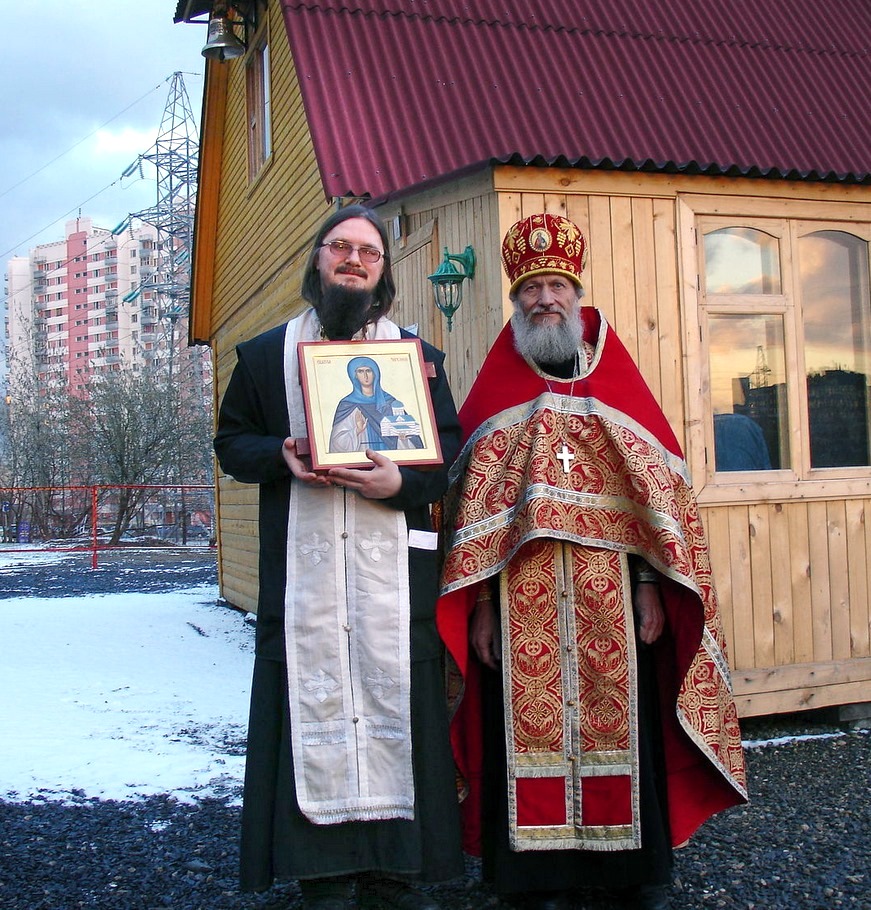
Fr. Daniel Sysoev, a Moscow Patriarchate priest and missionary, devoted his life to this question. He wrote A Chronicle of the Beginning, a nearly 500-page defense of the patristic doctrine of creation. He taught catechism classes on it, answered letters about it, and was precise about where the line falls:
The consensus patrum (the agreement of the Fathers) forbids rejecting a literal understanding of the six days of creation. Merely rejecting the literal duration of the Six Days is not heresy; it is simply an erroneous interpretation. What is heresy is the teaching that death and corruption existed prior to the fall into sin.
— Fr. Daniel Sysoev, Letters, p. 12
In The Law of God, he stated the consequence in a single sentence:
For if death did not come into the world through man, Christ died in vain. He misdiagnosed us, and therefore He did not save us.
— Fr. Daniel Sysoev, The Law of God, p. 174
In A Chronicle of the Beginning, he drew the full implication:
If the first Adam was a myth and a metahistory, the second is also a fairy tale and a legend! If original sin is not alive in men, death is pointless violence on the part of a malicious demiurge, and Golgotha and the Tomb were in vain.
— Fr. Daniel Sysoev, A Chronicle of the Beginning, p. 142
He also cited the Council of Carthage’s anathema:
If any man say that Adam, the first-created man, was created mortal, and would have died in the body though he had not sinned, that is, would have left his body not in punishment for sin but by natural necessity, let him be anathema.
— Council of Carthage, Canon 123 (also numbered Canon 109), cited in Sysoev, A Chronicle of the Beginning, p. 142
The Council of Carthage was a local council, but the Quinisext Council (692) explicitly ratified its canons in Canon 2, giving them ecumenical reception.[36] The principle is not limited to the Pelagian controversy that occasioned it: Adam was not created mortal. The Apostle Paul (Romans 5:12) and every Father cited in this chapter teach the same doctrine independently. The council’s anathema confirms what the Fathers already taught unanimously.
If death existed before Adam sinned, then death is not the wages of sin. If death is not the wages of sin, then Christ did not come to destroy death. If Christ did not come to destroy death, then Golgotha and the Tomb were in vain.
The Ancient Parallel Was Anathematized
Origen offers the ancient parallel. He treated the creation narrative not as history but as a theological container for deeper spiritual truths. Origen said that reading the creation of man literally was “most clearly impious.”
Origen was anathematized at the Fifth Ecumenical Council in 553.
On the creation of man, Origen calls the literal reading impious:
But if anyone suppose that this man who is made “according to the image and likeness of God” is made of flesh, he will appear to represent God himself as made of flesh and in human form. It is most clearly impious to think this about God.
— Origen, Homilies on Genesis 1, FC 71, p. 63
Origen needed Genesis to be allegory because his system required it: pre-existent souls, material creation as a remedy for a pre-cosmic fall, and apokatastasis, the belief that all souls, including the devil, will eventually be saved. Those doctrines were condemned. If Genesis described a literal, historical, good material creation, his system collapsed.
The point is not that every spiritual or allegorical comment on Genesis is Origenism. The point is the structural move: an external system is allowed to control the meaning of Genesis, and the plain history of creation is reinterpreted so that the external system can survive.
Kirill repeats that structural move. Origen subordinated Genesis to Neoplatonic cosmology. Kirill subordinates Genesis to Darwinian evolution. Both treat the creation narrative as a theological wrapper around a non-literal core, and both do so to harmonize Scripture with a system external to the patristic tradition.
The Orthodox Fathers read Genesis as literal, historical, supernatural creation.
His Own Patriarchate Disagrees
Kirill’s position is not even the consensus of the Moscow Patriarchate. Metropolitan Hilarion (Alfeyev), who served as chairman of the Department for External Church Relations from 2009 to 2022, stated on the Moscow Patriarchate’s own website:
Никакая эволюция между видами в этом тексте не просматривается. Каждый вид создается Богом отдельно… мы отвергаем то, что называется макроэволюцией, то есть представление о том, что один вид мог трансформироваться в другой, условно говоря, обезьяна в человека.
No evolution between species is visible in this text. Each species is created by God separately… We reject what is called macroevolution, that is, the idea that one species could transform into another, say, an ape into a human.
— Met. Hilarion (Alfeyev), https://www.patriarchia.ru/article/102136 (10 Mar 2020)
This was not an isolated disagreement. The late Fr. Vsevolod Chaplin, who served as chairman of the Synodal Department for Church-Society Relations, called Darwin’s theory “insufficiently proven” in an official response published on patriarchia.ru.[37] The martyred Fr. Daniel Sysoev and Fr. George Maximov published extensively on the incompatibility of evolution with Orthodox theology. Kirill’s own DECR chairman rejected macroevolution; his own Church-Society chairman called Darwin unproven; a priest of his own Patriarchate defined death before the Fall as heresy. Kirill attempts to overrule them all.
This is not a narrow witness. The Council of Carthage anathematizes the teaching that Adam was created mortal. St. Basil, St. Ephrem, St. John Chrysostom, and St. Augustine all taught instantaneous creation by divine command. Five Russian saints condemned evolution as “insane ravings,” “bestial philosophy,” and “poison-bearing teaching.” Fr. Seraphim Rose spent a thousand pages demonstrating its incompatibility with Orthodoxy. Fr. Daniel Sysoev defined death before the Fall as heresy, and Kirill stood at his coffin to sing “Eternal Memory” for him.
On what basis does the Patriarch of Moscow now teach the opposite?
Kirill Could Not Agree With Himself
In May 2023, Kirill preached:
Совесть есть не результат эволюции человеческого сознания, а результат того, что человек есть Божие творение, и никакой эволюцией невозможно объяснить готовность к самопожертвованию. Эволюция предполагает борьбу сильного за выживание, но это закон джунглей, по которому страшно жить.
Conscience is not the result of the evolution of human consciousness, but the result of the fact that man is God’s creation, and no evolution can explain the willingness to self-sacrifice. Evolution presupposes the struggle of the strong for survival, but this is the law of the jungle, and it is terrifying to live by.
— Patriarch Kirill, Ascension Day sermon, https://www.patriarchia.ru/article/104542 (25 May 2023)
According to Kirill in 2023, conscience is not the result of evolution, evolution cannot explain self-sacrifice, and evolution is the law of the jungle. A year later, the same Patriarch told a university audience that evolution “testifies to an incredible divine plan.”
The Verdict
Kirill’s position requires all three claims that Scripture and the Fathers deny: deep time, the transformation of one creature into another, and death before Adam. Origen does not rescue him. The Fathers read Genesis as real, historical, supernatural creation.
To teach against the consensus patrum is not a matter of academic disagreement. It is not a question of scientific sophistication. The consensus of the Fathers is how the Holy Spirit speaks through the Church across centuries. To contradict it is to contradict the voice of the Spirit in the Fathers. The Orthodox word for this is heresy.
Kirill has never engaged the Fathers on creation. He has never addressed the problem of death before the Fall. He has never answered Chrysostom, who asked, “Had he a mortal body when he sinned? Surely not.” He has simply ignored them.
The Fathers spoke clearly about creation. Kirill spoke against them. He could not even agree with himself.
Fr. Daniel Sysoev, Catechetical Talks, pp. 284-285. Sysoev teaches that the Lord’s commandment means “on these days we must do no work of our own,” that Sunday should be dedicated to God, and that exceptions include unavoidable public-service work, true necessity, and works of mercy for the sick or helpless. ↩
The Typikon of the Great Church of Christ contains a Paschalion table headed “From the Creation of Man” that gives AD 2026 as AM 7534. The same table gives AD 1992 as AM 7500, AD 2000 as AM 7508, and AD 2025 as AM 7533. See Typikon of the Great Church of Christ, pp. 184-185. ↩
Fr. Daniel Sysoev, A Chronicle of the Beginning, pp. 161-163. Sysoev states that his chronology follows the Septuagint because “it is this text which the Church accepts as canonical, and its dates serve as the basis of Orthodox chronology”; his table gives “Creation of the world” as 5508 years before Christ. ↩
Seventh Ecumenical Council (787), Definition of the Holy and Ecumenical Seventh Council: “If anyone rejects any written or unwritten tradition of the Church, let him be anathema.” See also the Synodikon of the Sunday of Orthodoxy, which preserves the same principle. ↩
The Stalin Prize was institutionalized in 1941 as the Soviet Union’s highest state prize. “The first prize of 200,000 rubles was awarded to Voino-Yasenetsky Valentin Feliksovich, professor of surgery etc. etc., for his two books ‘Delayed Resection of Infected Wounds of the Large Joints’ and ‘Essays on the Surgical Treatment of Purulent Wounds.’” See Mark Popovsky, From Crimea to the Stars: The Life of Archbishop Luke Voino-Yasenetsky (in English translation), pp. 132-133. ↩
“Archbishop Luke was the only winner who was not working at a university or similar research institution, and definitely the only one who held an ecclesiastical position. In the twelve years that the award existed, no other person who had been a former exile or was considered to be against the regime was nominated.” Popovsky, From Crimea to the Stars, p. 133. ↩
“On Sunday January 27, 1946, banner headlines in the famous newspaper ‘Pravda’, the official organ of the Communist Party, screamed: ‘Glory to the laureate of the Stalin Prize, the pioneering group of Soviet intellectual giants!’” Popovsky, From Crimea to the Stars, p. 133. ↩
Stalin’s reply telegram read: “To the Archbishop of Tambov Luke Voino-Yasenetsky, Professor of Surgery. Please accept my greetings and the gratitude of the USSR Government for your support of our orphanages.” St. Luke had donated 130,000 rubles of his prize money to orphan victims. Popovsky, From Crimea to the Stars, p. 133. ↩
“In November 1995, the Ukrainian Orthodox Church canonized him as a saint in accordance with the people’s will and perception. In March 1996, his remains were transferred to the Church of the Holy Trinity in Simferopol, where they are housed in a silver reliquary donated by Greece. Crowds of devout pilgrims flock to the church every day to pay their respects and worship the Saint.” The Russian Church declared him a saint in 2000, and the Ecumenical Patriarchate of Constantinople followed in 2019. Popovsky, From Crimea to the Stars, pp. 145-146. ↩
Pravmir, “Patriarch Kirill Does Not See Contradictions Between Religion and Science” (2016). https://www.pravmir.com/patriarch-kirill-not-see-contradictions-religion-science/ ↩
Frank Hailer, “Why dog breeds aren’t considered separate species,” The Conversation, March 14, 2016. Hailer writes: “as far as evolutionary biologists are concerned, all dogs are just dogs,” and, under the heading “We’ve sped up dog evolution — but not enough,” explains that the power of artificial selection has not changed the fact that dog breeds are not separate species. “Natural selection can only select on existing variation in the population; it cannot create anything from scratch” comes from “20.10: The Limits of Selection,” Biology LibreTexts, adapted from OpenStax/Boundless material. See also Jill U. Adams, “Genetics of Dog Breeding,” Nature Education 1(1):144 (2008), which describes modern dog breeds as “largely closed populations that receive little genetic variation beyond that which existed in the original founders” and quotes Elaine Ostrander that restrictive breeding practices reduce effective population size, increase genetic drift, and result in “loss of genetic diversity within breeds.” ↩
The word “evolution” did not carry its modern biological meaning before Darwin. As Peter Bowler established, the term was “not generally used to describe the theory of the transmutation of species” before 1859. See Bowler, “The Changing Meaning of ‘Evolution,’” Journal of the History of Ideas 36, no. 1 (1975), p. 95. The Latin evolutio means “to unroll,” and “the first biological use of the term ‘evolution’ was to describe the growth of the embryo in the womb.” It was Herbert Spencer, not Darwin, who “did most to popularize the term ‘evolution’ in its modern context.” Darwin himself “seldom used the term”; his theory “came to be tagged ‘evolution’” after the fact. See also Bowler, Evolution: The History of an Idea (Berkeley: University of California Press, 1984), pp. 8-9. Noah Webster’s American Dictionary (1828) still defined “evolution” only as “unfolding or unrolling,” with no biological sense at all. The Origin of Species (1859) does not contain the word “evolution”; Darwin did not adopt it as the name of his theory until The Descent of Man (1871). See The Reception of Charles Darwin in Europe, ed. Eve-Marie Engels and Thomas F. Glick (London: Continuum, 2008), p. 436. ↩
Charles Darwin, letter to John Fordyce, May 7, 1879. Published in Francis Darwin, ed., The Life and Letters of Charles Darwin (London: John Murray, 1887), Vol. 1, p. 304. ↩
Darwin’s unbelief was not merely a late-life label. Ralph Colp notes that before Darwin married Emma Wedgwood, “her only unease was over his lack of religious faith.” In 1861 Emma begged him to pray and to direct his admirable qualities “upwards”; Colp concludes that Darwin, after reading her letter, “did not alter his disbelief.” See Ralph Colp Jr., Darwin’s Illness (Gainesville: University Press of Florida, 2008), pp. 22, 79. Moreover, as Stephen Jay Gould and Ernst Mayr have shown through researching Darwin’s notebooks, Darwin identified himself as a philosophical materialist as early as May 1838, several months before he developed the idea of natural selection as the driving force behind evolution. See Gould, Ever Since Darwin (New York: W. W. Norton, 1977), pp. 24-25; Mayr, One Long Argument (Cambridge, MA: Harvard University Press, 1991), p. 15; also Rose, Genesis, Creation and Early Man, pp. 36-37n. ↩
Fr. Daniel Sysoev, Catechetical Talks, p. 132. Sysoev frames the dogma of creation as inseparable from salvation: “No one on earth can deliver a person from death, except for the One Who created man from the beginning. This is very important! Why is the dogma of creation considered one of the most important dogmas in Christianity?” ↩
Dr. Alexander Kalomiros, letter to Fr. Seraphim Rose. Kalomiros, a Greek Orthodox medical doctor and self-described “Christian evolutionist,” argued that Adam was an “evolved beast” who “at the appropriate point in his evolutionary development received the grace of God and thus became man.” He admitted: “We have nothing by which to conclude in which stage of evolution the breath of God was given to the animal.” Cited in Rose, Genesis, Creation and Early Man, p. 3 (Editor’s Note). ↩
Fr. Seraphim Rose’s reply to Dr. Kalomiros, published posthumously in Epiphany Journal (Fall 1989-Winter 1990) and later in The Christian Activist (Spring/Summer 1998), “has become the definitive introduction to the Patristic doctrine of creation and the definitive Patristic refutation of the modern theory of evolution.” See Rose, Genesis, Creation and Early Man, p. 3 (Editor’s Note). ↩
Darwin found the idea of linking evolution to socialism “quite simply, a foolish idea.” He was a prosperous liberal Whig, not a radical. See Vucinich, Darwin in Russian Thought, and the Marx-Darwin correspondence. Alister E. McGrath also notes that Edward Aveling, one of Marx’s English followers, treated Darwin’s evolutionary views as reinforcing Marxist materialism, but Darwin “did not wish to endorse such an association.” See McGrath, “The Ideological Uses of Evolutionary Biology in Recent Atheist Apologetics,” in Denis R. Alexander and Ronald L. Numbers, eds., Biology and Ideology from Descartes to Dawkins (Chicago: University of Chicago Press, 2010), p. 342. ↩
Alexander Vucinich, Darwin in Russian Thought (Berkeley: University of California Press, 1988), citing Marx-Engels correspondence, December 1859. ↩
Friedrich Engels, speech at the graveside of Karl Marx, Highgate Cemetery, London, March 17, 1883. https://www.marxists.org/archive/marx/works/1883/death/burial.htm ↩
Vladimir Lenin, What the “Friends of the People” Are and How They Fight the Social-Democrats, 1894. https://www.marxists.org/archive/lenin/works/1894/friends/01.htm ↩
Loren Graham, Science in Russia and the Soviet Union (Cambridge: Cambridge University Press, 1993), p. 58. Graham writes: “Science was regarded by many Russian intellectuals as a natural ally of political change and as a natural enemy of tyranny and religious orthodoxy. Darwinism was the latest and most exciting weapon in this struggle.” Graham also notes that Darwinism “supplied both opposition to religious creationism and, at least implicitly, support for social and political change,” and that radical Russian intellectuals could turn it “into a message of anthropological materialism, even atheism.” Ibid. ↩
F. M. Dostoevsky, The Diary of a Writer, 1876. Cited in Vucinich, Darwin in Russian Thought, p. 110. ↩
Vucinich, Darwin in Russian Thought, p. 108. Vucinich’s assessment covers both groups of theological critics (those arguing from Scripture and those arguing from science) across the period 1864-1917. ↩
Vucinich, Darwin in Russian Thought, pp. 243-244. On Erich Wasmann’s attempt to reconcile evolution and creation, Vucinich notes that Russian theologians “did not produce a single effort of this kind.” ↩
James Allen Rogers, “Russia: Social Sciences,” in Thomas F. Glick, ed., The Comparative Reception of Darwinism (Austin: University of Texas Press, 1974), p. 267. Rogers notes that to Pobedonostsev, Darwin taught that “the fundamental law of life is the preservation of the strong and the extirpation of the weak.” ↩
The Moscow Darwin Museum was founded privately by Aleksandr Kohts in 1907, nationalized in 1918, and opened to the public in 1924. See Mirjam Luisa Bujara, “Darwinism, Nature, and Society in the Soviet Union” (UC Berkeley, 2019). ↩
The Soviet Union declared itself “the second homeland of Darwinism” at the centenary of On the Origin of Species in 1959. See Vucinich, Darwin in Russian Thought, and Bujara, “Darwinism, Nature, and Society.” Nikolai Krementsov traces the earlier 1932 jubilee context in which the slogan “The Soviet Union is the second birthplace of Darwinism” was coined. See Krementsov, “Darwinism, Marxism, and Genetics in the Soviet Union,” in Alexander and Numbers, eds., Biology and Ideology from Descartes to Dawkins, p. 239. ↩
Resolution of the Twelfth Party Congress, April 1923. Cited in David Joravsky, Soviet Marxism and Natural Science 1917-1932 (New York: Columbia University Press, 1961), pp. 77-78. Krementsov similarly notes that Darwinism was included in Marxist curricula and became “an important part of the huge antireligious campaign mounted by the Bolsheviks in the early years of their rule.” See Krementsov, “Darwinism, Marxism, and Genetics in the Soviet Union,” p. 222. Eduard I. Kolchinsky writes that Soviet Russia proclaimed Darwinism “one of the scientific bases of the official ideologies,” that by the early 1930s it was obligatory in higher education in biology, agriculture, medicine, and philosophy, and that the 1932 Darwin jubilee became a “broad political campaign” involving the Union of Militant Atheists. See Kolchinsky, “Darwinism and Dialectical Materialism in Soviet Russia,” in Eve-Marie Engels and Thomas F. Glick, eds., The Reception of Charles Darwin in Europe (London: Continuum, 2008), pp. 522, 527, 542. ↩
V. I. Lenin, “On the Significance of Militant Materialism” (O znachenii voinstvuiushchego materializma), Under the Banner of Marxism (Pod znamenem marksizma), No. 3, 1922. Cited in Joravsky, Soviet Marxism and Natural Science, pp. 79-80. ↩
Krementsov, Stalinist Science, pp. 227-239. Krementsov writes that Soviet education was expected to produce “above all a loyal adept of the party line,” with curricula including Marxism-Leninism, dialectical materialism, and atheism. After the 1948 VASKhNIL session, Lysenko’s doctrine was authorized “not only as the only permissible scientific theory, but also as a part of official ideology.” Genetics was purged from curricula, departments were reorganized, new courses and departments of “Darwinism and genetics” were created, and secondary-school biology teaching was rewritten so that the “undivided rule” of Michurinist biology was established in the educational system. ↩
Hieromartyr Paul Andreyev (1880-1937). Cited in Rose, Genesis, Creation and Early Man, p. 806. ↩
Hieromartyr Varlaam (Nikol’sky) (1872-1937). Cited in Rose, Genesis, Creation and Early Man, p. 805. ↩
Hieromartyr Nicholas Pokrovsky (1895-1937). Cited in Rose, Genesis, Creation and Early Man, p. 806. ↩
Richard Weikart, From Darwin to Hitler: Evolutionary Ethics, Eugenics, and Racism in Germany (New York: Palgrave Macmillan, 2004), pp. 3-10, 73-75, 229-232. Weikart explicitly rejects the simplistic claim: “Obviously, Darwin was no Hitler”; “Nazism was not predetermined in Darwinism or eugenics, not even in racist forms of eugenics”; and “It would be foolish to blame Darwinism for the Holocaust, as though Darwinism leads logically to the Holocaust.” His narrower claim is that when the question is restricted to “ethics, the value of human life, and racism,” the historical connections become significant. On death and progress, he writes that “Darwin clearly viewed death and destruction as an engine of evolutionary progress,” and that this represented “a radical shift from the Christian conception of death as an unnatural, evil foe to be conquered.” ↩
The Quinisext Council (Council in Trullo, 692), Canon 2: “We set our seal likewise upon all the other holy canons set forth by our holy and blessed Fathers,” listing the canons of “the Council of Carthage” among those ratified. See New Advent, Council in Trullo, Canon 2. The Quinisext Council’s canons are received as having ecumenical authority in the Orthodox Church. ↩
Patriarchia.ru, “В Русской Православной Церкви критикуют резолюцию ПАСЕ, направленную против креационизма” (“The Russian Orthodox Church criticizes the PACE resolution directed against creationism”), October 12, 2007, https://www.patriarchia.ru/article/3465. Fr. Vsevolod Chaplin stated that Darwin’s theory “has not received sufficient proof in science and therefore cannot be considered an unquestionable truth” («эта теория не получила достаточных доказательств в науке и поэтому не может считаться непререкаемой истиной»). On Fr. George Maximov, see his article “The impasse of ‘Orthodox’ evolutionism”, which defends the patristic teaching on Genesis and identifies Darwinian views of the origin of species and mankind as an attempted importation into Orthodoxy. ↩