
Correct Critique Is Not a Bridge to Schism
Truth can be weaponized. Everything documented in this book about Patriarch Kirill’s heresies is real, his ecumenism is documented, and the canonical tradition demands a response.
Unfortunately, two groups in particular will attempt to use this evidence not to defend the faith, but to recruit for their own schisms:
- The schismatic OCU (Orthodox Church in Ukraine), and by extension Patriarch Bartholomew of Constantinople, who uncanonically granted them a tomos of autocephaly. This nuance is very important, and is outlined in Chapter 28.
- Schismatic Old Calendarist groups, such as the GOC (Genuine Orthodox Christians), TOC (True Orthodox Christians), and the many different sects that have broken from the canonical Orthodox Church over calendar changes in the twentieth century.
This chapter pre-emptively calls out both.
On Hypocrisy
The Church has never taught that heresy in one place authorizes schism in another. Both the OCU and the Old Calendarist groups, focusing on the splinter in the eyes of others, have chosen to ignore the beam in their own eye.
And why beholdest thou the mote that is in thy brother’s eye, but considerest not the beam that is in thine own eye? Or how wilt thou say to thy brother, Let me pull out the mote out of thine eye; and, behold, a beam is in thine own eye? Thou hypocrite, first cast out the beam out of thine own eye; and then shalt thou see clearly to cast out the mote out of thy brother’s eye.
— Matthew 7:3-5[1]
St. Paisios identified exactly these two dangers:
Two opposing sides [extremities] always torment the Mother Church, as well as those who support them, because the two sides usually stab each other in the back… In other words, it is as if the one extremity is maintained by a possessed person who is spiritually insolent (contemptuous about everything), while the other extremity is maintained by a madman who has a child-like zealousness along with narrow-mindedness.
— St. Paisios the Athonite, Epistles, p. 156
The spiritually insolent are the OCU, and the child-like zealousness and narrow-mindedness are best exemplified by the schismatic Old Calendarists.
The canonical Ukrainian Orthodox Church shows the right path in avoiding these two dangers: they oppose Patriarch Kirill and ceased commemoration of him, while also not joining with the OCU. This demonstrates that one can reject and fight against heresy without schisming from the canonical Church.
Often when proponents of Patriarch Kirill defend him, they do so not by engaging with canonical Orthodox critics, but by calling attention to these schismatics. Thus, these schismatics do nothing but allow Patriarch Kirill to escape rebuke, and thus not only is nothing gained from what they point out, but anyone who makes these valid points against Kirill is now erroneously lumped in with these schismatics.
The Error of those who support the OCU
Dr. Vassa Larin
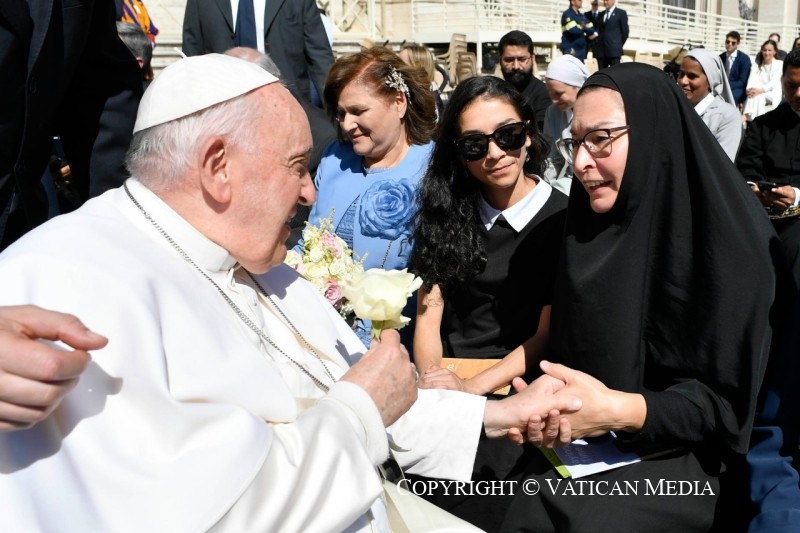
Dr. Vassa Larin is a notable figure of the schismatic OCU. She gained her notoriety from previously being a ROCOR (Russian Orthodox Church Outside of Russia) nun, and for her program “Coffee with Sister Vassa” where she made numerous problematic statements.
Dr. Vassa received her theological formation at the Pontifical Oriental Institute in Rome under Jesuit Archimandrite Robert Taft, who financed her studies.[2] Why is this important? The Pontifical Oriental Institute was founded in 1917 by Pope Benedict XV and entrusted to the Jesuit Order in 1922 by Pope Pius XI, the same order that created and steered the Unia from the sixteenth century onward.[3] This is the institution that formed Dr. Vassa’s theological worldview.
This same Jesuit worldview is manifest in Dr. Vassa Larin’s numerous Ecumenistic sentiments and activities, which include meeting Pope Francis, acknowledging him as a canonical bishop by kissing his hand and thus receiving his “blessing.”
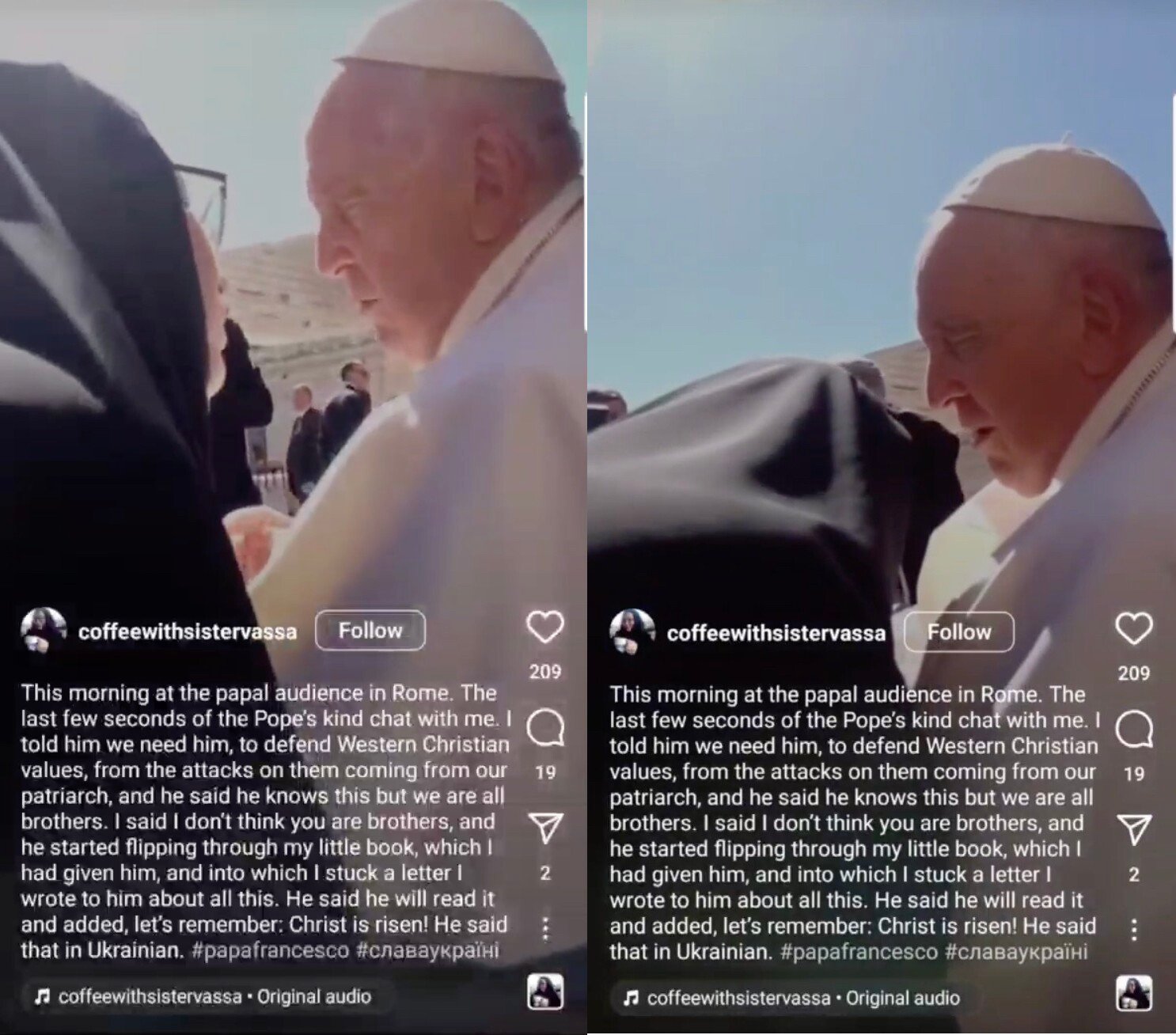
(Our saints do not allow for us to meet with the Pope, to kiss him and receive his blessing, as outlined in Chapter 1: Recognition of the Pope)
But this is only the most visible manifestation. The theological issues with Dr. Vassa are numerous. She called the ecclesiology of St. Cyprian “absurd” and dismissed traditional Orthodox teaching on the boundaries of the Church as “dishonest.”[4] She described the sacred canons as “fetters.”[5] She counseled a mother to accept her son’s homosexuality as a “God-given gift, and cross” rather than seek repentance and healing.[6] She dismissed the Orthodox tradition of distinguishing from the heterodox as “distasteful” and labeled the rationale of both the Slavonic Typikon and the first-century Didache “bigoted,” arguing it clashes with “multiculturalism” and “ecumenical dialog.”[7] She walks around in public without her monastic habit, wearing it only when it serves her purposes, declaring: “I don’t consult a bishop across the ocean about it, because I am not mentally impaired.”[8]
Thus, Dr. Vassa Larin demeans monastic obedience as a sign of mental impairment, which is a grievous insult both to monastics and to the mentally impaired.

Despite all of this, Sister Vassa now portrays herself as a brave voice against Patriarch Kirill’s war theology. However, in 2022, while explicitly naming ROCOR’s commemoration of Patriarch Kirill and clergy sympathy for Putinism, she posed the question herself: why stay in ROCOR? Her answer then was: “Because I love my Church.”[9]
In other words, she once argued for remaining in her Church and witnessing truthfully from within it. Only after years of conflict with ROCOR culminated in formal discipline did she present the same anti-Kirill critique as part of a move into the schismatic OCU.
In her 2024 article, Larin builds a patristic case that Kirill’s “Russian World” theology constitutes publicly preached heresy warranting cessation of commemoration according to the canons.[10]
Of course, even a broken clock is right at times, and so Dr. Vassa is completely right in pointing out these canons and witness of the saints, despite being a schismatic. However, she nullifies her own case by having previously referred to our Holy Canons as “fetters,” and by calling out Patriarch Kirill while herself residing within the schismatic OCU. She dismisses our Holy Tradition and our Holy Canons when they inconvenience her, and embraces them only when they benefit her narrative.
Proponents of Patriarch Kirill benefit greatly from having Ecumenists such as Sister Vassa make these arguments. When Sister Vassa cites the canons, she makes it easy for anyone who desires to appeal to our Holy Canons to be dismissed as being “in league” with schismatic thinking. Of course, this is an impious accusation, because our saints appealed to our Holy Canons. Nonetheless, these individuals, in going against Patriarch Kirill, do more harm than good without attending to their own non-canonicity.
Archimandrite Cyril Hovorun
A Ukrainian theologian who formerly served in the canonical Ukrainian Orthodox Church, Archimandrite Cyril Hovorun in his academic work correctly identifies problems in Kirill’s war theology, and much of his work confirms the arguments in this book.
Unfortunately, much like Larin, he is an ecumenist who fled to schism.
He served as interim director of the Huffington Ecumenical Institute, promoting “Christian unity, with special emphasis on the Orthodox, Anglican, and Catholic Churches.”[11] He concelebrated with OCU schismatics multiple times since 2018 and was considered for the OCU’s primatial throne.[12] In 2023, Kirill suspended and subsequently defrocked him for “repeated violations” through concelebrating with clergy of the Ecumenical Patriarchate, with which Moscow had broken communion; he is now under Constantinople, though his valid defrocking means Constantinople has no canonical standing to receive him (see Chapter 28).[12]
He has also argued that coronavirus “can be transmitted through the Eucharistic Body of Christ.”[13] A man who teaches that one can contract disease from the Body and Blood of Christ has a broken theological compass. A man who communes with schismatics cannot credibly condemn another man’s ecclesiology.
The Old Calendarist Error
The Old Calendarists are groups that broke from the canonical Orthodox Church in the twentieth century, primarily over the adoption of the Revised Julian Calendar (New Calendar) by several local churches in the 1920s. They include the GOC (Genuine Orthodox Christians) in Greece, the TOC (True Orthodox Christians) in Russia, and numerous smaller sects. Many of them have declared the canonical Orthodox Church “graceless” and set up parallel hierarchies claiming to be the only true Church.
Few things have been more damaging in the fight against Ecumenism in the Orthodox Church, than the schismatic Old Calendarists.
The extent of the damage they have caused is so serious, that anyone who even speaks of the Holy Canons is immediately considered an “Old Calendarist extremist.” Thus, absolutely no benefit is gained from them speaking against heresy, but only detriment.
Is anyone who invokes our Holy Canons a “schismatic”?
Of course, the Russian New Martyrs who refused Sergius were not Old Calendarists. St. Paisios was not an Old Calendarist. The canonical Ukrainian Orthodox Church is not Old Calendarist. Canon 15 of the First-Second Council is of course not an “Old Calendarist document.” The conflation is a political tactic, not a theological argument. Of course, the Old Calendarists almost certainly only assist Ecumenists in their activities, as all who voice concern can easily be brushed aside as deluded individuals with the sickness of “super-correctness,” as Fr. Seraphim Rose teaches.[14]
Many Old Calendarists claim that Canon 15 of the First-Second Council (which permits the faithful to cease communion from a bishop who preaches heresy publicly, without canonical penalty; see Part VI) renders heretical bishops “automatically deposed” prior to synodal decision, that such bishops are “no longer bishops” without any conciliar action. They cite the patristic principle that heresy is “self-condemning” (Titus 3:10-11). This book agrees that heresy is self-condemning (see Chapter 25 for the full treatment, including the Fifth Ecumenical Council and Blessed Theophylact). The question is not whether the heretic has condemned himself, but what follows from that condemnation. The Old Calendarist interpretation, that self-condemnation means automatic deposition, is arbitrary and subjective.
Diagnostic action is not juridical authority
The First-Second Council did not introduce anything new or unknown in the Church’s life, much less claim to override the canonical order established by the Ecumenical Councils. The Seventh Ecumenical Council designated deposition and excommunication as punishments for heretics, imposed by synods of living, presiding bishops. A local council in 861 did not and could not claim supra-ecumenical authority to bypass this.
The distinction is between diagnostic and juridical action (see Chapter 25 for the full canonical treatment, including the “pseudo-bishops” language of Canon 15 and the diagnostic/juridical framework established in the Rudder). When the faithful cease commemoration of a bishop, they are not claiming he is formally deposed. They are simply diagnosing heresy and exercising their ancient right to cease communion, a right that carries no penalties and invites honor. However, when Old Calendarists claim that World Orthodoxy bishops are “automatically” graceless and deposed without synodal trial, they claim juridical authority they do not possess.
This book takes communion with heresy seriously (Chapter 26) but does not adopt the conclusion the schismatic Old Calendarists reach. As established in the preceding chapters, the patristic consensus is that communion with heretics is itself a fall requiring repentance; Patriarch Kirill’s documented teachings and actions meet the patristic criteria for cessation of commemoration under Canon 15 and the broader canonical tradition. However, whether he is formally deposed is a juridical question requiring synodal determination. What the faithful can do, and what the saints command, is separate from manifest heresy when it is publicly preached.
The diagnosis is ours to make. The final juridical sentence belongs to future councils.
Reading Into the Saints What Is Not There
Old Calendarist apologists have compiled extensive patristic documentation of separation from heresy, tracing the pattern from the Apostles through the twentieth century.[15] The evidence they present is very sound, but they are not so different from Ecumenist Dr. Vassa Larin, in that they reach the wrong conclusion, which is schism.
The same saints honored for blessed disobedience (Chapter 33) also demonstrate that cessation never meant permanent separation as the Old Calendarists surmise. And in every single example the Old Calendarists cite, the saints did the opposite of what the Old Calendarists do.
Let’s examine a couple of their own proofs now.
St. Athanasius the Great broke communion with the Arians. He was exiled five times. He worshipped in the desert. However, he never declared the Arian-held churches “graceless.” He never set up a permanent parallel patriarchate. He never re-baptized anyone who had received sacraments under Arian bishops. He never felt the need to ordain Orthodox bishops in regions where an Arian bishop already existed. Athanasius might have supported the uncanonical group of Paulinus created by Lucifer of Sardinia but himself never followed the example of Lucifer by placing new bishops in regions where an Arian existed.
St. Gregory the Theologian established a house church in Constantinople, the Anastasis, because the imperial church had been in heretical hands for over forty years. However, he never declared the imperial church graceless. He was installed as Archbishop of Constantinople by Emperor Theodosius I in 380 and presided at the opening of the Second Ecumenical Council in 381. When his appointment was challenged, he resigned rather than cause division. The Nicene faith he had defended from a house church was vindicated by the very council he stepped down from.
St. Maximus the Confessor broke communion with all five patriarchates when they fell into Monothelitism (the heresy that Christ possessed only one will, condemned at the Sixth Ecumenical Council in 681). However, he never established a parallel hierarchy. He never declared the existing patriarchates graceless. He submitted to torture and martyrdom rather than commune with heresy, but he never preached the need to set up parallel patriarchates.
St. Mark of Ephesus refused to sign the Union of Florence. However, he never left the Patriarchate of Constantinople. He never set up a parallel church. He remained a metropolitan of the canonical Church until his death.
The Johannites refused communion with the bishops who replaced St. John Chrysostom after his unjust deposition. They endured thirty-four years of persecution. However, they never formed a permanent parallel jurisdiction, instead their enemies set up parallel hierarchies. They never declared the Church of Constantinople graceless.
St. John of Damascus resisted iconoclasm from the Monastery of Mar Saba in the Patriarchate of Jerusalem. However, he never declared iconoclast-held churches graceless. And never preached the need to set up a parallel Orthodox jurisdiction in place of the iconoclast Church of Constantinople.
In not one of these cases, not a single one, did the saints do what Old Calendarists do. None of them declared other churches “graceless.” None of them set up permanent parallel hierarchies claiming to be “the true Church.” None of them re-baptized anyone. None of them declared that sacraments performed under heretical bishops were automatically invalid. None of them claimed juridical authority to depose bishops without synodal action. None of them questioned the sanctity of saints canonized by the canonical Church, as the Old Calendarists commonly and brazenly do.[16]
Thus, the Old Calendarists read into the saints that which is not there.
They document the diagnostic action (cessation of communion) and then inflate it into juridical claims (gracelessness, automatic deposition, exclusive ecclesial validity) that the saints themselves never made. The very evidence they compile for cessation of commemoration is simultaneously evidence against their very own position, because every saint who ceased commemoration did exactly what this book advocates, and nothing more.
In every case, the saints were vindicated within the canonical structure, not outside it. The separation was temporary, diagnostic, and directed toward the restoration of right faith within the existing Church. It was never the foundation for a permanent alternative institution claiming exclusive grace.
Even when Old Calendarist apologists compile explicit lists of “parallel hierarchies” from Church history, every example tells the same story: Evagrius, the Johannites, the Arsenite-Josephite division, emergency ordinations during the Arian persecution.[15] Every one was temporary. Every one was resolved by reintegration into the canonical structure. Not one became a permanent competing institution.
Their strongest modern example refutes them most decisively. The Russian Catacomb Church’s Declaration of Serpukhov (1927), in which clergy broke communion with Metropolitan Sergius, explicitly states: “we do not depart from the lawful Locum Tenens Metropolitan Peter” and “we shall give ourselves over to the judgement of a future council.” The Catacomb Christians did not claim to be a permanent parallel church. They temporarily separated from Metropolitan Sergius while submitting themselves to a future council’s judgment.
The schismatic Old Calendarists of our time are incapable of such humility.
How Canonical Orthodoxy Scandalized Them
Having named the grievous error of schismatic Old Calendarists, one must also ask how many Old Calendarists were scandalized into schism by those within the canonical Orthodox Church itself.
How many of these now Old Calendarists watched their canonical hierarchs embrace heterodox patriarchs, pray with heretics, sign ambiguous declarations, and heard absolutely nothing against it? No outcry from the faithful. No resistance from clergy. Only explanations. Justifications. Condescending dismissals. “The Patriarch knows what he’s doing.” “It’s complicated.” “We shouldn’t judge.” “Don’t be an extremist.” They watched canonical Orthodox Christians who claim to care about the faith treat every compromise with a shrug, and every one of their own objections as extremism.
Thus, these Old Calendarists were scandalized. And yet, not many even in the canonical Church understand that to scandalize others is a grievous sin that they will answer to God for in the final judgment. More importantly, many don’t understand what the term “scandal” means in the true patristic sense of things.
On scandal
St. Nikodemos the Hagiorite dedicates an entire discourse in his Christian Morality to the sin of scandal. He defines it, following St. Basil the Great:
Everything that leads one into apostasy from true piety, or creates a temptation to error, or fosters impiety, or in general, everything that impedes us from obeying the commandment of God unto death itself.
— St. Basil the Great, Second Discourse Concerning Baptism, cited in St. Nikodemos the Hagiorite, Christian Morality[17]
The Greek word σκάνδαλον, from which “scandal” derives, literally means a stumbling stone laid in someone’s path. St. Nikodemos develops this image into a concrete analogy: the higher the rank of the one who sins, the larger the stone in the road, until at the rank of Patriarch it becomes a mountain blocking the way entirely:
The same sin of fornication, if committed openly by an ordinary person and private individual, is a small scandal; if committed by a monk, it is a great scandal; if committed by a Hierodeacon, it is a greater scandal; if committed by a Priest, by a spiritual Father, by an Abbot, it is an even greater scandal; if committed by a Hierarch, it is a very great scandal; if committed by a Patriarch, it is the greatest scandal of all. The scandal caused by an ordinary person is like a small rock or pebble that is found in the middle of a road, and many people stumble at it; the scandal caused by a monk is like a large rock, at which many people stumble; the scandal caused by a Deacon is like a larger rock; the scandal caused by a Priest is like an even larger rock. The scandal caused by a Hierarch is like an enormous stone, at which everyone stumbles—clergy and laity, men and women, unimportant persons and important persons—and they are either crushed beneath this obstacle or themselves imitate the same sin; or, at the very least, their hearts become lukewarm and they are deterred from the path of virtue. The scandal that a Patriarch would cause resembles a mountain which completely blocks the path of virtue and does not allow anyone to pass. The greater the scandal, the greater, consequently, the punishment that those who cause it will receive.
— St. Nikodemos the Hagiorite, Christian Morality, Discourse X[17]
The point St. Nikodemos makes is that hierarchs and patriarchs are very capable of errors, and on account of the prestige of their rank and role, when they commit these errors, everyone stumbles: clergy and laity, men and women, important persons and unimportant persons. A Patriarch’s scandal is not a stumbling stone. It is a mountain that blocks the path of virtue entirely. No one can pass.
Rather than imitating the saints, as every Orthodox Christian is called to do (see Chapter 27), the faithful instead imitate these hierarchs in their sin. Or, at best, they adopt their lukewarmness and indifference, which is precisely what has happened in regards to Patriarch Kirill. Some are crushed: scandalized into schism, into Old Calendarism, into abandoning the Church altogether. Others imitate the sin: hierarchs who see Kirill’s ecumenism go unpunished learn that ecumenism carries no cost. And the rest become lukewarm: they hear about the Havana Declaration, the “Holy War” decree, the defrocked priests, and they shrug. “It’s complicated.” “We shouldn’t judge.” Their hearts grow cold.
This is the teaching of the compiler of the Rudder and the Philokalia, applied to the very office Patriarch Kirill holds. St. Nikodemos warns that the one who caused all of this will answer for every single one of them.
Moreover, those who scandalize are “doubly condemned,” both for the sin itself and for the scandal it causes, even if no one is actually scandalized by it. St. Basil teaches that “he who did it or said it is liable to the charge both of the sin itself and of the scandal that it occasions, even if he to whom the scandal is caused does not perceive it as such.”[17]
Who scandalized them?
When hierarchs accommodate ecumenism, when they pray with heretics and sign ambiguous declarations, and when the faithful stay silent and take it lightly, their indifference scandalizes zealous Orthodox Christians into joining Old Calendarist schisms. What does St. Nikodemos say? They will answer for it proportionally to their rank.
Often many in our canonical Churches do not understand that God will hold them responsible for those who left the canonical Orthodox Church on account of their lukewarmness and indifference to heresy, which our saints were not in any way indifferent to.
And what does canonical Orthodoxy call Old Calendarists when they object too loudly? Deluded. Schismatic. Zealots. Extremists. These are the same labels Protestants and Papists apply to Orthodox Christians for the very same reasons. We object to this from the heterodox, but then immediately treat other Orthodox Christians the way we do not wish to be treated.
Old Calendarists err. They have left the Church.
However, where is our humility? We who pray before every communion that we are the “chief of sinners,” where is that conviction when it comes to those we drove away? We find no fault in ourselves. We blame Old Calendarists for leaving, but never ask whether our own silence, our own cowardice, our own lukewarm accommodation of heresy is what scandalized them into leaving in the first place. Should not we in the canonical Orthodox Church take the greater blame? Or will we refuse to do even that?
St. Paisios the Athonite explains this mechanism behind why the Old Calendarists are scandalized:
Unfortunately, western rationalism has even influenced the Eastern Orthodox leaders; and they are therefore only physically in the Eastern Orthodox Church of Christ, while their entire being is in the West, which, they see, reigns in a secular manner. If they were to see the West spiritually through the light of the East, the light of Christ then they would see the spiritual twilight of the West, which is gradually losing the light of the noetic Sun, of Christ, and heading towards the depths of darkness. They meet up and have sessions at which they confer endlessly about matters for which there is no room for discussion about matters which were not even discussed by the Holy Fathers over the course of two thousand years. All such activities are inspired by the cunning one, the devil, and only serve to bewilder and scandalise the faithful, and to push them, some into heresy and others to schisms, which is how the devil gains ground.
— St. Paisios the Athonite, letter on ecumenism, in Hieromonk Isaac, Saint Paisios of Mount Athos, p. 428
Now properly understanding the definition of scandal, we can understand the word of St. Paisios, the very saint many of us revere. St. Paisios says that the actions of Ecumenists are the very thing that scandalizes the faithful into schism. We see that this is the case, with many zealous individuals who see this unjustifiable war, who see the amount of people who are willing to go out of their way to make excuses for Patriarch Kirill while condemning and criticizing others freely.
We see that the hearts of many in the canonical Church are as hard as rock. No one pities the Old Calendarists. No one sees themselves to blame. No one recognizes that the impiety of the clergy and patriarchs pushes some of these bright and zealous minds into schism. And sure, it is the hierarchs that are most responsible for their ecumenist activities, but the faithful also bear responsibility for this too, for their palpable indifference and selfishness.
When asked about Christians who had fled to a schismatic church because of their bishop’s behavior, St. Paisios responded:
If you want to help the people, you should not take what your bishop is doing lightly.
— St. Paisios the Athonite, in Hieromonk Isaac, Saint Paisios of Mount Athos, p. 665
The Old Calendarists watched their hierarchs embrace heterodox patriarchs and sign ambiguous declarations while canonical Orthodox Christians took it lightly, disobeying the words of St. Paisios, all the while offering lukewarm explanations and justifications, while cutting down those who were scandalized. The Old Calendarists saw that the canons were invoked only against them, never against hierarchs. That “obedience” was demanded downward of them but never required upward.
Every Orthodox bishop, at his own consecration, solemnly promises before God to observe the canons of the Holy Apostles, the Seven Ecumenical Councils, and the Provincial Councils.[18] The Old Calendarists watched those same bishops break that promise and then punish anyone who reminded them of it. And then they concluded (wrongly but understandably) that the canonical Church had abandoned the faith entirely.
Why No One Steps Up
If a patriarch, or even a few bishops, would simply rise and resist, how many of these schismatics might find the courage to return and see the error of their ways? If they saw that Ecumenism was being fought from within, that this unjust war was being resisted, that cessation of commemoration was possible without leaving the Church, that the canonical tradition actually worked, would the schismatics not have reason to reconsider?
Fr. Theodore Zisis
Fr. Theodore Zisis retired as Professor of Patrology at Aristotle University of Thessaloniki, where he holds the permanent title of Professor Emeritus, and is the author of over forty-five major works on patristic theology. The Serbian Orthodox Church’s official website calls him “a Patristic giant in Greece” and “one of Greece’s most important modern Patristic scholars.”[19]
Reflecting on the Monothelite crisis, Zisis notes that when the emperor fell into heresy, “much of the Church with him, and a considerable part of the people turned to heresy.” In the end, only one patriarch remained faithful: St. Sophronius of Jerusalem. And what happened?
The whole priesthood and the Orthodox people gathered around him.
— Archpriest Theodore Zisis, Blessed Disobedience or Evil Obedience?, Palimpseston Publishing, 2006[20]
One patriarch. That was enough. The faithful rallied. Orthodoxy survived.
Archpriest Theodore Zisis adds his own prayer:
God grant that in our days the Lord would show the world at least one patriarch or two or three bishops, spotless from the shame of ecumenism, so that “the priesthood and the Orthodox people” could unite around them.
— Archpriest Theodore Zisis, Blessed Disobedience or Evil Obedience?, Palimpseston Publishing, 2006[21]
Notice what this prayer admits. Protopresbyter Theodore Zisis has to pray for “at least one patriarch or two or three bishops” because, as things stand, there are none. If such hierarchs existed and were fighting, he would not need to pray for them.
Thus, the Old Calendarists rightly look at canonical Orthodoxy and see exactly what Fr. Theodore Zisis sees: no one stepping up. No St. Sophronius, nor anyone to rally around. No one willing to admit that, despite the error of the schismatics, their concerns about Ecumenism in the Church are valid.
In 2017, Archpriest Theodore Zisis himself finally stepped up. He ceased commemoration of his metropolitan over the ecumenist declarations of the Crete Council (the 2016 Holy and Great Council held in Crete, attended by ten autocephalous Orthodox churches, whose ecumenist statements remain contested; see Chapter 3: The Selective Standard: Havana vs Crete), invoking the very same Canon 15 of the First-Second Council (861), the same canon cited in this book repeatedly. Fr. Theodore Zisis was thus suspended from priestly duties and barred from communion the very next day.[22] One of the most respected patristics scholars in Greece invoked the canonical tradition, and was immediately punished.
This is why no one steps up. And this is what the Old Calendarists see.
Again, the response of the Old Calendarists is wrong. Schism is never justified. Setting up parallel synods and jurisdictions is wrong. Using the saints to justify something they themselves never did with their actions is wrong. But their perception of lukewarmness is accurate. Thus, that accuracy is an indictment of canonical Orthodoxy. And the Old Calendarists will unfortunately continue to attack the canonical Church and continue to recruit believers zealous for the faith, until someone finally decides to speak up. As Theodore Zisis says, only a single Patriarch and a couple of bishops spotless from the shame of Ecumenism are needed to do this.
Elder John Krestiankin: “A Priest Cannot Think Only of His Own Salvation”
The most telling witness on this point comes from inside the Moscow Patriarchate itself. Elder John Krestiankin of the Pskov-Caves Monastery (1910-2006), a five-year Gulag survivor and one of the most beloved spiritual fathers of the late Soviet and post-Soviet Russian Church, was no friend of cessation of commemoration. He defended the Moscow Patriarchate against both the Catacomb Church and ROCOR’s Russian parishes, as documented in Chapter 31. Yet in a letter to a priest who had been thinking of withdrawing from pastoral labor to pursue his own salvation in reclusion, Krestiankin articulated the positive duty that silent clergy everywhere have forgotten:
The war against the Church and Orthodoxy began from the moment of their inception and will continue until the very last day of the world’s earthly life. All faithful people of the Church, from layman, to priest, to hierarch, participate in this struggle for the purity of Orthodoxy, but each one struggles in his own place and in his own way…
There, dear Fr. A., make your choice! We are indebted to those who stood steadfast and preserved Orthodoxy through hard work, torture, and pain of heart. After all, if it were not for their podvig, you would not be a priest. We are also indebted to those who were forced to resign against their will—their blood fortified those who served.
My dear, we cannot escape podvig. A priest cannot only think about his own personal salvation.
Behold I and the children which God has given me (Heb. 2:13).
If the Lord sends you into reclusion for ascetic activity, then you must go, but your self-will could turn your reclusion into a catastrophe for you. Won’t we be responsible before the Lord if, having distanced ourselves, we leave Orthodoxy to be plundered by its antagonists? We don’t necessarily have to enter into open combat, but we are obligated to stand up for the Truth.
— Elder John Krestiankin, May God Give You Wisdom! The Letters of Fr. John Krestiankin (Wildwood, CA: St. Xenia Skete), pp. 392-393
This is as close to a patristic indictment of clerical silence as any contemporary Russian elder has left us. The clergy who stay silent while their patriarch blesses missiles, venerates Sergius, and communes with Rome are not, by Krestiankin’s standard, quietly tending their own salvation. They are leaving Orthodoxy “to be plundered by its antagonists,” and they will “be responsible before the Lord” for it.
Elder John Krestiankin does not require priests to leave their dioceses. He does not require them to “enter into open combat.” He requires them only to “stand up for the Truth.”[23]
Elsewhere in the same correspondence he makes the principle absolute. Told of a priest performing post-mortem baptisms, Krestiankin instructed his correspondent: “definitely and immediately inform your ruling bishop about this. The rest is up to him. You must under no circumstances remain silent.”[24] Silence in the face of non-Orthodox practice, he taught, is never an option. It is the duty of both clergy and laity to act. Those who invoke Krestiankin’s institutional loyalty to justify doing nothing about Patriarch Kirill have read one side of him and ignored the other.
The Patristic Model: Cessation Without Schism
St. Paisios ceased commemorating Patriarch Athenagoras over his ecumenist activities. By 1971, the majority of the monasteries of Mount Athos had done the same.
What they did not do: leave the Church. They ceased commemoration, remained in their monasteries, and waited. This is the canonical model.
On the Old Calendarists themselves, St. Paisios was direct:
We are united with the Church, with all the Patriarchates, and through them with the Apostles and with Christ. Whereas these poor folk [the Old Calendarists] are cut off.
— St. Paisios the Athonite, in Hieromonk Isaac, Saint Paisios of Mount Athos, p. 410
Notice that St. Paisios the Athonite does not show hatred towards the Old Calendarists as many in the canonical Church do. He pities them, calling them poor folk.
The few Old Calendarists there are have split into I-do-not-know-how-many groups. All they do is split off into smaller groups and anathematize each other.
— St. Paisios the Athonite, in Hieromonk Isaac, Saint Paisios of Mount Athos, p. 410
Elder Philotheos Zervakos (1884-1980), one of the most revered Greek elders of the twentieth century, witnessed the calendar controversy firsthand. He opposed the calendar change. He fought ecumenism throughout his life.
He would seem, to the uninformed, like a natural Old Calendarist ally. His judgment was the opposite:
The fanatical zealots and super zealots of the Old Calendarists, worshippers of the Old Calendar, believe and say that the New Calendar Sacraments are invalid and the Holy Spirit doesn’t descend because the Old Calendar is absent. There is no greater deception, impiety, and insanity than this… The Old Calendarists fell into many great delusions in order to keep the Old Calendar, greater and worse delusions than the New Calendarists.
— Elder Philotheos Zervakos, Letter 8, September 23, 1975, in Paternal Counsels, Vol. II, trans. Fr. Nicholas Palis; John Sanidopoulos, “Elder Philotheos on the Schismatic Old Calendarists”[25]
“Greater and worse delusions than the New Calendarists.” An elder who fought ecumenism his entire life judged the Old Calendarist solution worse than the ecumenist disease.[26]
Fr. Dimitrios Gagastathis of Platanos, Thessaly (1902-1975), the beloved “Papa-Dimitri,” was Elder Philotheos Zervakos’s direct spiritual correspondent on precisely this question. A married parish priest with nine daughters, he served the Church of Greece continuously for forty-two years under the New Calendar. He refused to meet visiting “dignitaries of the foreign churches” and asked aloud what clergy who “collaborate with the Pope and the heretics” could possibly believe (treated at length in Chapter 1). Yet on the calendar question, his position was equally clear:
How do the Old-Calendarists say that our sacraments are invalid? In 1947, while ministering to the Blessing-of-the-Water Service, I was chanting “Great are You, O Lord, and marvelous are Your works” when steamy smoke rose up out of the bowl; the water in it had become heated. Even within the cups held by pious parishioners, the water also became heated. How then do they say that our sacraments are invalid?
How can God work miracles in accordance with the New Calendar if it is not right? How, then, has it been possible for Saint Bessarion’s miracle to have happened in the village of Dousikon? This is sufficient to show us that the right faith, love, and keeping of the commandments play an important role in the sanctification of man. Nothing else counts.
I wrote to Fr. Philotheos Zervakos and he responded to me correctly about this matter. I too, the unlearned one, believe from my life experience, that thirteen days can neither cast you out from nor place you into the Kingdom of God. I also asked the Archangels about this issue and they told me: “Stay where you are.”
— Papa-Dimitri Gagastathis, “On the Calendar Issue,” Papa-Dimitri: The Man of God (Orthodox Witness, 2009), pp. 96-98
The distinction this witness makes is unmistakable. Papa-Dimitri refused ecumenical contact to the point of walking away from foreign-church dignitaries who came to his town, and at the same time he refused the Old Calendarist solution. He remained in the canonical New Calendar Church of Greece, consulted his elder, and went on serving Divine Liturgy every morning under the same calendar the Old Calendarists call graceless.
Refusing heresy does not require schism, and this humble village parish priest of Platanos, revered by Zervakos himself and by Elders Amphilochios Makris of Patmos, Ephraim of Katounakia, and Archimandrite Emilianos (Vafeidis) of Simonos Petra, is the living proof.
Metropolitan Augoustinos Kantiotes of Florina (1907-2010) was one of the most outspoken opponents of ecumenism in the twentieth century. He canonically ceased commemoration of Patriarch Athenagoras, invoking Canon 15, along with Metropolitan Amvrosios, Metropolitan Paul, and the fathers of the Holy Mountain. He did this as a bishop of the Church of Greece.
Did he ever join the Old Calendarists? Of course not. He remained a bishop of the canonical Church throughout his episcopate (1967-2000), resisting ecumenism from within rather than fleeing to a parallel hierarchy.
This is the model. Not Vassa Larin’s path (fleeing to the OCU). Not the Old Calendarist path (declaring World Orthodoxy graceless).
The path of St. Paisios, of Augoustinos Kantiotes, of the canonical Ukrainian Orthodox Church: cessation of commemoration under Canon 15, remaining within the canonical framework.
This Book’s Position
This book advocates cessation of commemoration of Patriarch Kirill based on the evidence documented in Parts I through VIII and the canonical framework established in Part VI. This is the same action taken by St. Paisios and the monasteries of Mount Athos, by the Russian New Martyrs who refused Metropolitan Sergius, by the canonical Ukrainian Orthodox Church in May 2022, and by Metropolitan Augoustinos Kantiotes.
This book does not in any way whatsoever advocate joining Old Calendarist jurisdictions, setting up parallel hierarchies, declaring the Moscow Patriarchate “graceless,” re-baptizing or re-chrismating anyone.
Cessation of commemoration is the canonical response of the faithful to publicly preached heresy, honored by the Church’s own canons and witnessed by her saints. Schism is not. St. John Chrysostom teaches that to make a schism in the Church is no less an evil than to fall into heresy, and that not even the blood of martyrdom can wash away this sin.[27]
The Pattern
Larin, Hovorun, and the Old Calendarists all use correct critique as a bridge to schism. Larin and Hovorun subordinate the Church to Western academic liberalism; Old Calendarists subordinate it to their own parallel hierarchy. Where Kirill communes with Monophysites, they commune with schismatics. The errors differ in flavor, not substance. The saints who ceased commemorating heretical patriarchs did not flee to schismatic bodies. St. Paisios ceased commemorating Athenagoras. He did not join the Old Calendarists.
Canonical Orthodoxy must acknowledge that it has failed the very people it now condemns. The Old Calendarists looked at canonical Orthodoxy and saw and see accommodation, compromise, and silence. They were wrong to leave. But the saints make clear that canonical Orthodoxy scandalized them into doing this.
If this book accomplishes anything, may it be this: that faithful hierarchs develop a consciousness, realize that resistance is possible, and that the consensus of the fathers supports them. And perhaps, if enough rise, those in schism will see that canonical Orthodoxy still has life in it, and find a way home.
May the schismatics who rightly question the actions of Patriarch Kirill not use their critique as a bridge to justify their schism.
Original Greek: “τί δὲ βλέπεις τὸ κάρφος τὸ ἐν τῷ ὀφθαλμῷ τοῦ ἀδελφοῦ σου, τὴν δὲ ἐν τῷ σῷ ὀφθαλμῷ δοκὸν οὐ κατανοεῖς; ἢ πῶς ἐρεῖς τῷ ἀδελφῷ σου, ἄφες ἐκβάλω τὸ κάρφος ἀπὸ τοῦ ὀφθαλμοῦ σου, καὶ ἰδοὺ ἡ δοκὸς ἐν τῷ ὀφθαλμῷ σου; ὑποκριτά, ἔκβαλε πρῶτον τὴν δοκὸν ἐκ τοῦ ὀφθαλμοῦ σου, καὶ τότε διαβλέψεις ἐκβαλεῖν τὸ κάρφος ἐκ τοῦ ὀφθαλμοῦ τοῦ ἀδελφοῦ σου.” ↩
Dr. Vassa Larin’s doctorate (Ph.D., 2008) was conferred by the Ludwig Maximilian University of Munich, but her dissertation was directed by Jesuit Archimandrite Robert Taft, S.J. at the Pontifical Oriental Institute in Rome, where she served as his graduate assistant (2006-2008). In a 2009 ROCOR Studies interview, Larin stated that Taft “offered to finance and direct my work” and “taught me the basics of liturgical scholarship and its methodology.” Her dissertation was published in the Institute’s Orientalia Christiana Analecta series. See ROCOR Studies. ↩
Protopresbyter Fr. George D. Metallinos, UNIA: The Face and the Disguise, Apostoliki Diakonia (Church of Greece), 1992, ch. 6 (“Unia and the Christian East”): “From the very first moment of implementation of the idea of Unia and the formation of Uniate communities, the supervision and the steering of this movement was assigned to the Order of Jesuits, the most reliably dedicated servants of Papal authority; if the expression may be permitted, they were Papacy’s ‘commandos.’” ↩
Dr. Vassa Larin, “Coffee with Sister Vassa” episode titled “Can Non-Orthodox Be Called ‘Churches’?” (2016), YouTube. She characterized St. Cyprian’s ecclesiology as “absurd”: “Think about how absurd it is to embrace or pretend to embrace a black and white ecclesiology today.” She called traditional Orthodox teaching on the boundaries of the Church “dishonest”: “This kind of pretending that ecclesiology… pretending that it’s black and white, is not honest theologically.” Full transcript documented in working notes. ↩
Dr. Vassa Larin, “Coffee with Sister Vassa” episode titled “Is ‘Christian Unity’ an Orthodox Concern?” (2016), YouTube. She described the sacred canons as “fetters”: “The holy canons are in no wise fetters that have the church chained up for all the ages.” She dismissed concerns about calling non-Orthodox bodies “churches” as “quibbling” and mocked traditional Orthodox terminology for the Uniates. Full transcript documented in working notes. ↩
ROCOR Synod of Bishops, Circular Communique, July 19, 2017. The Synod condemned Larin’s publicly-posted email exchange (July 2, 2017) in which she counseled a mother whose son came out as homosexual, calling homosexuality a “God-given gift, and cross” and advising the mother to find a parish “acceptive of your son’s particular gift-and-cross.” The Synod stated the counsel “contradicts the Church’s teaching on sexuality, repentance and family life” and “presents a grave spiritual danger.” Full text at https://orthodoxlife.org/epistles/synod-nun-vassa/. ↩
Dr. Vassa Larin (posting as Barbara Larin), Facebook post, February 4, 2026, https://www.facebook.com/SisterVassa/posts/pfbid0967ZJAuRiNb62hjmhuygEJLgy4i3Uyp74mbHapz3MR6maZw3Qns3oFZsydwbZQbfl. Reported in Tobias Straney, “Barbara Larin: Church’s Fasting Cycle Is ‘Bigoted,’ Contrary to ‘Multiculturalism,’” Union of Orthodox Journalists, February 4, 2026, https://uoj.news/news/86337-barbara-larin-churchs-fasting-cycle-is-bigoted-contrary-to-multiculturalism. She referred to “the bigoted rationale of the Typikon and Didache” and called the Orthodox practice of distinguishing from the heterodox “distasteful.” ↩
Dr. Vassa Larin, public statement (2025), quoted in “Former Sr. Vassa announces apostasy from canonical Orthodoxy, joins state-sponsored Ukrainian schismatics,” OrthoChristian.com, May 19, 2025, https://orthochristian.com/169861.html. Bishop Luke of Syracuse requested she return to a convent and cease her online activism. She refused, citing worldly responsibilities (writing a book in Rome, paying for her Viennese apartment), and stated she had spent “27 of the 34 years of my monastic life” living and working in the world. On wearing monastic clothing without obedience: “I don’t consult a bishop across the ocean about it, because I am not mentally impaired.” ↩
Dr. Vassa Larin, “To Leave or Not to Leave One’s Church,” Public Orthodoxy (Fordham University), May 10, 2022, https://publicorthodoxy.org/2022/05/10/to-leave-or-not-to-leave-ones-church/. She wrote: “Why am I not leaving, even while we commemorate Patriarch Kirill, and many of our clergy sympathize with Putinism? Because I love my Church. That’s my best answer.” ↩
Dr. Vassa Larin, “On ‘Heresy’ and the Commemoration of Patriarch Kirill,” Public Orthodoxy (Fordham University), April 12, 2024. https://publicorthodoxy.org/2024/04/12/heresy-and-commemoration-of-pat-kirill/ ↩
Archimandrite Cyril Hovorun served as interim director of the Huffington Ecumenical Institute at Loyola Marymount University, whose stated goals include: “Promote Christian unity, with special emphasis on the Orthodox, Anglican, and Catholic Churches.” See the Institute’s official description. ↩
Archimandrite Cyril Hovorun was suspended from priestly service by Patriarch Kirill on September 25, 2023, for “repeated violations” through concelebrating with clergy of the Ecumenical Patriarchate (with which Moscow had broken communion). He was subsequently defrocked by the Moscow diocesan court on October 31, 2023, confirmed by Kirill on December 29, 2023. He came under the Ecumenical Patriarchate, which does not recognize Moscow’s defrocking. Earlier reports indicated he was considered for the OCU’s primatial throne. See “Fr. Cyril (Hovorun), supporter of schismatics, suspended by Patriarch Kirill,” OrthoChristian.com, September 26, 2023, https://orthochristian.com/156272.html; and “Cyril Hovorun defrocked by Patriarch Kirill,” OrthoChristian.com, January 18, 2024. ↩
Archimandrite Cyril Hovorun, “COVID-19 and Christian (?) Dualism,” Public Orthodoxy, March 23, 2020. https://publicorthodoxy.org/2020/03/23/covid-19-and-dualism/ ↩
Fr. Seraphim Rose’s teaching on “super-correctness” is documented extensively in Hieromonk Damascene (Christensen), Father Seraphim Rose: His Life and Works (Platina: St. Herman of Alaska Brotherhood, 2003), ch. 63. Rose distinguished between Old Calendarists who legitimately resisted ecumenism (whom he praised) and those who declared World Orthodoxy “graceless” and “no churches at all” (whom he opposed as exhibiting “cold-hearted elitism”). His critique targeted the latter position specifically. That position, the premature declaration of gracelessness and the establishment of permanent parallel jurisdictions, is precisely what defines modern Old Calendarism today. ↩
See, for example, Subdeacon Nektarios Harrison, The History of Resistance: From the Apostles to the Twentieth Century (2024), which documents patristic examples of separation from heresy across nearly 400 pages. The historical evidence is valuable. The conclusion, that these examples justify permanent parallel hierarchies and the declaration of World Orthodoxy as “graceless,” is nowhere supported by the sources cited. ↩
Old Calendarist groups have questioned or rejected the sanctity of numerous saints canonized by the canonical Church. St. Paisios the Athonite and St. Porphyrios of Kavsokalyvia are called “deluded,” “pseudo-saints,” and “magician” in schismatic Esphigmenou publications; Fr. Daniel Sysoev records that zealots attempted to rebaptize Fr. Paisios because he remained in communion with a New Calendarist Church (Why Do Believers Quarrel?, p. 37). An Old Calendarist Abbess Magdalene published a book titled Nectarios Kephalas: Iconoclast, Latinist and Ecumenist attacking St. Nektarios of Pentapolis, prompting Elder Philotheos Zervakos to write a rebuttal. St. Iakovos (Tsalikis) of Evia has also been grouped with Paisios and Porphyrios as a “pseudo-saint.” The HOTCA (Holy Orthodox Traditionalist Church of America) has explicitly rejected the sainthood of St. Chrysostomos of Smyrna. The theological logic is consistent: because the canonical Churches are allegedly “graceless,” anyone who remained in communion with them cannot be a genuine saint. See John Sanidopoulos, “Schismatic Blasphemies Regarding the ‘Deluded’ Paisios and ‘Magician’ Porphyrios”. ↩
St. Nikodemos the Hagiorite, Christian Morality, Discourse X (“Concerning the Fact That Christians Should Not Cause Scandal to One Another”). The definition of scandal follows St. Basil the Great, Second Discourse Concerning Baptism, Resp. 10, §1 (PG 31:1617C). The hierarchy of scandal and double condemnation are from pp. 369-379 of the English translation. St. Basil’s teaching that scandalizers are liable “both of the sin itself and of the scandal that it occasions, even if he to whom the scandal is caused does not perceive it as such” is from Resp. 10, §2 (PG 31:1620B). ↩
At every episcopal consecration in the Orthodox Church, the bishop-elect makes a solemn profession that includes the promise to uphold the sacred canons. In the Third Confession of Faith, the bishop-elect promises “to observe the Canons of the holy Apostles, the Seven Ecumenical Councils, and the Provincial Councils, the traditions of the Church, and the decrees, orders and regulations of the Holy Fathers” (from the Rite of Episcopal Consecration in the Euchologion; English translation from Orthodox Life 46, no. 4 [1996]). ↩
Serbian Orthodox Church official website, “Review of Following the Holy Fathers by Fr. Theodore Zisis”. ↩
Original Russian: “а вместе с ним и Церковь, и немалая часть народа повернулась к противоположному”; “Вокруг него собирается всё священство и православный народ.” ↩
Original Russian: “Дай-то Бог, чтобы и в наши дни Господь явил миру хотя бы одного патриарха или двух-трёх епископов, незапятнанных позором экуменизма, дабы возле них смогли бы объединиться «священство и православный народ».” ↩
On the Sunday of Orthodoxy (March 5, 2017), Fr. Theodore Zisis announced from the ambo of the Church of St. Anthony the Great in Thessaloniki that he was ceasing commemoration of Metropolitan Anthimos. The next day, Metropolitan Anthimos suspended him from priestly duties, barred him from communion, summoned him before a spiritual court, and stripped him of his honorary title of Archpriest. Fr. Zisis described the penalties as “unjust, hasty, and anti-canonical.” See “Fr. Theodore Zisis Suspended from Priestly Duties, Excommunicated,” OrthoChristian.com, March 16, 2017, https://orthochristian.com/101912.html. ↩
Elder John Krestiankin, May God Give You Wisdom! The Letters of Fr. John Krestiankin (Wildwood, CA: St. Xenia Skete, first English edition), pp. 392-393. The letter is titled “A Priest Cannot Think of His Own Salvation Only” and is addressed to “Dear Fr. A.” It is dated May 18, 2001. Krestiankin prefaces the passage with a catalogue of Russian hierarchs of the 1920s-30s who chose various forms of confession: “His Holiness Patriarch Tikhon received the Patriarchal staff during the most tragic moment of struggle… Vladyka Gregory (Lebedev) retired from the episcopacy, then theologized and prayed while sitting on a henhouse… Vladyka Barnabas (Belaev) took on the podvig of foolishness for Christ in prisons, exile, and reclusion… The two brother bishops Varlaam and Herman (Riashentsev) labored in their God-blessed field until they were torn from it, then traveled eighteen years by convoy through prisons and exile, to their martyric end.” ↩
Elder John Krestiankin, May God Give You Wisdom! The Letters of Fr. John Krestiankin, pp. 288-289. In the same letter Krestiankin invokes the 1915 Practical Instruction for the Clergy (Nechaev): “People who were baptized improperly or not baptized at all at the time of death should not be commemorated, nor buried according to Christian rite.” His principle is explicit: when a priest encounters non-Orthodox practice, the duty is not private tolerance but immediate report to the ruling bishop, who alone has authority to act. The same logic applies to any canonical abuse observed in one’s ecclesiastical environment: report, do not acquiesce. ↩
Original Greek: “«Οι φανατικοί ζηλωταί και υπερζηλωταί παλ/γίται, λατρευταί του παλαιού ημερολογίου… όχι λέγουν και φρονούν· είναι άκυρα τα Μυστήρια, δεν κατέρχεται το Πνεύμα το Άγιον, διότι απουσιάζει το παλαιόν ημερολόγιον, διότι οι Αρχιερείς και Ιερείς δεν είναι παλ/γίται!!! Ταύτης της πλάνης, της ασεβείας, της παραφροσύνης, μεγαλυτέρα ουκ έστι.… Επομένως αι πλάναι των παλ/γιτών είναι πλειότεραι και χείροντες των πλανών των νεοημ/γιτών.»” ↩
Old Calendarists commonly appeal to Elder Philotheos Zervakos’s relationship with Metropolitan Cyprian of the Synod in Resistance (originally a Florinite) as evidence that Zervakos supported Old Calendarism. This conflates two different things. Zervakos blessed Cyprian’s moderate position in 1969, but by 1973 he was writing to Fr. Dimitrios Gagastathis: “But are even the so-called True Orthodox Old Calendarists exempt from anathemas? They are transgressors and despisers of the first Tradition: the great commandment of Love. They have despised, violated, and cast aside the commandment of Love, hating one another, biting one another, beating one another. They re-Baptize and re-Chrismate many New Calendarists who have been Baptized in the name of the Father and of the Son and of the Holy Spirit… Certain Old Calendarist zealots believe and think that the Mysteries are invalid without the [Old] Calendar and that without the [Old] Calendar there is no salvation. There is no greater heresy than this!” (Letter to Fr. Dimitrios Gagastathis, Paros, May 16, 1973). This letter was published and circulated by Cyprian’s own group. Zervakos consistently distinguished between those who maintained the sacramental theology of the Church, as Cyprian’s group did, and those who dogmatized the calendar as a condition of grace. The movement that claims his legacy today largely holds the position he called “the greatest heresy.” The GOC’s 1974 encyclical formally codified the position that New Calendarist sacraments are graceless, one year after this letter. Pre-existing relationships do not override a man’s own direct words. ↩
St. John Chrysostom, Homilies on Ephesians, Homily 11: “I assert and protest, that to make a schism in the Church is no less an evil than to fall into heresy.” In the same homily, Chrysostom approvingly cites “a certain holy man” who taught that “not even the blood of martyrdom can wash out this sin.” PG 62:85. Also cited in The Rudder (Pedalion), commentary on Apostolic Canon 31. ↩