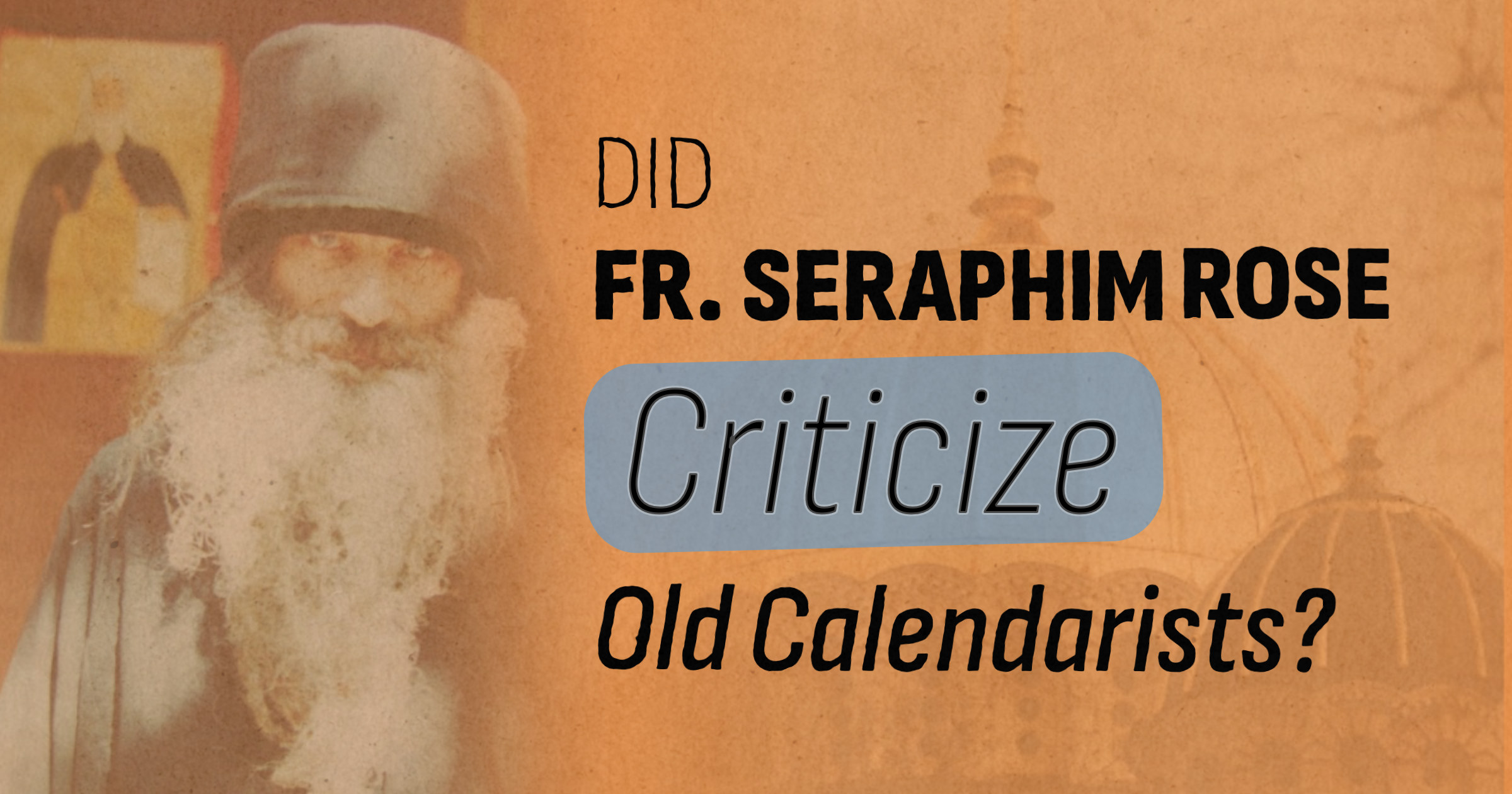
In light of ROCOR’s recent move toward the glorification of Fr. Seraphim Rose, Old Calendarists have predictably rushed to claim him as a defender of their cause.[1]
The argument is always the same: Fr. Seraphim supported the Old Calendarists, his real adversaries were only the extremists at Holy Transfiguration Monastery in Boston, and his criticisms never applied to the “genuine” Old Calendarist movements. They insist that later publishers censored his pro-Old Calendarist writings to serve an ecumenist agenda. This is the story they tell every person who encounters Fr. Seraphim’s name for the first time.
Old Calendarists misrepresent the record, quoting his early sympathy while ignoring the sustained criticisms he leveled at them as they descended during and after the death of Fr. Seraphim Rose into zealotry, schism, and blasphemy.
What follows is the full record: Fr. Seraphim’s own writings, letters, and recorded lectures, cited by source, page, or timestamp, proving that his critique was directed at Old Calendarist ecclesiology as a whole.
Fr. Seraphim explicitly rejected gracelessness
The defining claim of Old Calendarist ecclesiology is that New Calendar churches are graceless and their sacraments invalid. Fr. Seraphim rejected this repeatedly and without ambiguity.
In a 1979 letter to Fr. Basil Rhodes, Fr. Seraphim stated his position plainly:
We do not deny the grace of your Sacraments any more than you deny ours.
— Fr. Seraphim Rose, Letter #262 to Fr. Basil Rhodes (1979), Letters, p. 494
In a recorded Q&A during his August 1981 lecture on Fr. George Calciu,[2] a pilgrim asked directly about Old Calendar Greeks who maintained that the official churches had no grace. Fr. Seraphim’s response:
We follow our bishops and our bishops don’t believe that. They’re asked to make a statement like that: there’s no grace in the new calendar sacraments.
— Fr. Seraphim Rose, “Orthodox Christianity and Suffering: The Sermons of Fr. George Calciu,” recorded Q&A, St. Herman of Alaska Christian Pilgrimage, Part 2 (August 1981), 00:45
He confirmed that priests coming out of Russia undoubtedly “have sacraments,” that “we have a deeper unity: we’re all the same Church,” and that we are told “not to make categorical judgments on churches like that.” Fr. Dimitry Dudko was a priest in the Moscow Patriarchate; Fr. George Calciu was a priest in the Romanian Patriarchate. Both are churches that Old Calendarists consider graceless. Fr. Seraphim said their witness “shows that Orthodoxy’s very much alive in impossible conditions.” You cannot say Orthodoxy is “very much alive” in a church you believe has no grace.[3]
Old Calendarists will point out that Fr. Seraphim never concelebrated with New Calendar Greeks and that he criticized ecumenism just as strongly as he criticized zealotry. Both are true and neither helps their case. Not concelebrating is not the same as declaring graceless. Opposing ecumenism while remaining in communion is prophetic witness within the Church. Declaring gracelessness, setting up parallel synods is schism. Fr. Seraphim chose the first path his entire life. The Old Calendarists chose the second.
Old Calendarists deliberately blur this distinction. They treat cessation of commemoration and schism as the same thing, because the conflation is how they recruit. But the saints prove otherwise. St. Paisios ceased commemorating Patriarch Athenagoras over his ecumenist activities. By 1971, the majority of the monasteries of Mount Athos had done the same. What they did not do: leave the Church, set up parallel hierarchies, declare the Patriarchate graceless, or re-baptize anyone. They ceased commemoration, remained in their monasteries, and waited. Cessation of commemoration is a diagnostic action: the faithful recognize heresy and withdraw from it. It is not a juridical claim to depose bishops or invalidate sacraments. From St. Athanasius and St. Mark of Ephesus to the Russian New Martyrs, the examples Old Calendarists invoke do not establish permanent alternative institutions claiming exclusive grace. The 1927 Serpukhov declaration, for example, maintained allegiance to Metropolitan Peter and submitted its case to a future council.[4] Old Calendarists cite these same witnesses as justification for doing the opposite.
ROCOR rejected the 1974 graceless encyclical
Fr. Seraphim was in ROCOR.[5] ROCOR had relations with certain moderate Old Calendarist groups. But in 1974, the GOC[6] Synod under Archbishop Auxentios published an encyclical declaring the mysteries of the official Church of Greece null and void:
… as a consequence, its Mysteries are deprived of sanctifying grace.
— GOC Synod under Archbishop Auxentios, 1974 encyclical, quoted in Dimitri Kitsikis, The Old Calendarists and the Rise of Religious Conservatism in Greece
That is Matthewite ecclesiology[7] adopted officially.
ROCOR rejected gracelessness before the 1974 encyclical, and Fr. Seraphim followed his bishops. As early as St. Thomas Sunday 1973, he wrote to Fr. Neketas Palassis:
Father, let us not introduce that kind of ‘strictness’ into the Church Abroad… There does not have to be absolute agreement on all issues.
— Fr. Seraphim Rose to Fr. Neketas Palassis, St. Thomas Sunday 1973, Letters from Father Seraphim, p. 226
The GOC moved away from ROCOR, not the other way around. Even Subdeacon Nektarios’s own book acknowledges that ROCOR “did not endorse the 1974 Greek Encyclical.”[8]
Fr. Seraphim was in communion with moderate Old Calendarists within a ROCOR framework that rejected gracelessness. He was not in communion with people who declared the sacraments of the Church null and void. This is the very careful sleight of hand that the Old Calendarists constantly engage in.
And even that limited communion did not last. The Matthewites severed communion with ROCOR after 1975. Then in 1978, ROCOR severed communion with the Auxentios faction after the archbishop consecrated a bishop in Portugal without consulting the Russians (Harrison). By 1978, ROCOR was not in communion with any Greek Old Calendarist body. Fr. Seraphim spent the last four years of his life in a church that had broken with all of them.
His critique went far beyond Boston
Old Calendarists try to narrow Fr. Seraphim’s later criticisms to the Boston monastery of Fr. Panteleimon alone. This is dishonest. Fr. Seraphim was fighting against Matthewite ecclesiology being imported into ROCOR through Fr. Panteleimon’s circle.[9] He feared that those under this influence might “be led into a sect and out of the Church.”[10] That is a critique of an entire ecclesiology, not one monastery.
In a 1979 talk, “The Extremes of Ecumenism and Zealotry,” Fr. Seraphim described the Old Calendarist movement directly and cited an Old Calendar bishop’s phrase for the pattern:
… among these old calendarists, there have been schism after schism over the question of strictness.
The correctness disease… which occurs when people quote the canons, the fathers, and the typicon in order to prove that they are correct and everyone else is wrong… only produces continual schisms, and in the end it only helps the ecumenical movement by reducing the witness of sound orthodoxy.
— Fr. Seraphim Rose, “The Extremes of Ecumenism and Zealotry” (1979 lecture excerpt), https://www.youtube.com/watch?v=q9OvzaB66z4; related pilgrimage report in The Orthodox Word, vol. 16, no. 2 (91), March-April 1980, pp. 61-65
His conclusion, his description of a group that excommunicated ROCOR, and his warning to converts were equally direct:
… the excessive reaction against ecumenism has the same worldly spirit which is present in the ecumenical movement.
… excommunicated our Russian church abroad because our bishops refused to declare that all other Orthodox churches are without grace. This group now declares that since 1924 only it has had grace, and only it is orthodox.
With our calculating, rationalistic Western minds it is very easy to think we are being zealous and strict when actually we are chiefly indulging our passions for self-righteousness.
— Fr. Seraphim Rose, selected excerpts from “The Extremes of Ecumenism and Zealotry” (1979), https://www.youtube.com/watch?v=q9OvzaB66z4
Old Calendarists frequently link to this talk as evidence that Fr. Seraphim opposed ecumenism. He did. They apparently hope you will stop listening after the first minute.[11]
In a 1980 report published in his own journal, “the reaction against ecumenism and renovationism in Greece has also produced some extreme groups” whose “name-calling and schisms” have “caused the old-calendarist movement as a whole to lose influence.”[12] Not “the Panteleimonite movement.” “The old-calendarist movement as a whole.”
To Daniel in 1976:
There is a fear, increased by knowledge of the Greek Old Calendarist situation, of falling into a sectarian mentality: that ‘we alone are pure’.
— Fr. Seraphim Rose, letter to Daniel (1976), Letters, p. 418
Not the “Panteleimonite situation.” The “Greek Old Calendarist situation.”
On December 8, 1981, he wrote:
How tragic that some are now leading their flocks (albeit still very small flocks) out of communion with the only people who can still teach them what Orthodoxy is and help them to wake up from their fantasies of a ‘super-correct’ Orthodoxy that exists nowhere in the world.
— Fr. Seraphim Rose, quoted in Fr. Damascene Christensen, Life and Works, ch. 63, “Super-Correctness”
He described the zealots just as plainly:
… fighting windmills with their jesuitical logic and justifying their own ‘purity,’ while what is needed is loving and aware hearts.
— Fr. Seraphim Rose, quoted in Fr. Damascene Christensen, Life and Works, ch. 93, “The Resurrection of Holy Russia”
He saw where the entire movement was heading. In June 1976:
The ‘right wing’ of Orthodoxy will probably be divided into many small ‘jurisdictions’ in future, most of them anathematizing and fighting with the others.
— Fr. Seraphim Rose, Letters, p. 422
In July 1980:
There are so many groups of ‘correct’ Orthodox in Greece now (none in communion with the others) that a new group will only prove the devil’s power to divide Orthodox Christians.
— Fr. Seraphim Rose, Letters, p. 557
That was not a critique of Boston. That was a critique of the movement.[13]
“We helped to create a monster, and for that I repent”
Near the end of his life, Fr. Seraphim said:
I regret many of the ‘pro-zealot’ articles we published in The Orthodox Word in the earlier years: we helped to create a monster, and for that I repent!
— Fr. Seraphim Rose, quoted in Fr. Damascene Christensen, Life and Works, ch. 99, “Hope”
Fr. Damascene writes that he was “quite emphatic about that.”[14]
Earlier he had written:
We feel ourselves badly betrayed. … All these years we trusted that they were of one mind and soul with us. … But really, it seems that all this time they were only building for their own glory, cruelly abusing the trust of our simple Russian bishops, priests, and laymen. … We fear that all our articles about ‘zealotry’ in the past years have helped to produce a monster!
— Fr. Seraphim Rose, quoted in Fr. Damascene Christensen, Life and Works, ch. 63, “Super-Correctness”
Fr. Damascene explains that the leaders of this movement:
… had thought that Fr. Seraphim wanted absolute strictness just like they did, but in this they were wrong. Fr. Seraphim wanted Truth, which is on a deeper level altogether.
— Fr. Damascene Christensen, Life and Works, ch. 63, “Super-Correctness”
They assumed the Platina fathers would naturally fall in line with their movement. When it became clear Fr. Seraphim would not follow their party line, they were “truly disappointed.”[14] This is the same dynamic playing out today: Old Calendarists claim Fr. Seraphim as their own, and when you show them what he actually said, they are disappointed all over again.
In his last years, he began communing laypeople from other jurisdictions. When asked if he feared being denounced by ultra-zealots, he replied:
You don’t know me very well if you think I’d be worried about that. Whether I get in trouble or not, I KNOW that this is the right thing to do!
— Fr. Seraphim Rose, quoted in Fr. Damascene Christensen, Life and Works, ch. 99, “Hope”
Fr. Seraphim was not alone in this judgment. St. Paisios the Athonite said plainly:
We recognize their Mysteries as valid and they recognize ours. Whereas these poor folk are cut off.
— St. Paisios the Athonite, quoted in Hieromonk Isaac, Saint Paisios of Mount Athos, p. 714
Elder Joseph the Hesychast, also canonized, left the zealots after receiving a vision of the broken rock of their movement sinking into the sea, saying:
They have made a grave error. This cannot be the truth of God.
— Elder Joseph the Hesychast, quoted in Elder Ephraim of Philotheou, My Elder Joseph the Hesychast, p. 265
Elder Philotheos Zervakos wrote in 1975:
The Old Calendarists falsely boast and claim that they are ‘genuine Orthodox.’ They are genuine CACODOX because they don’t have Faith in God, they have faith in the Old Calendar.
— Elder Philotheos Zervakos, Paternal Counsels, vol. 2 (1975)
The saints confirm what Fr. Seraphim concluded: this spirit is not of God.
Modern Old Calendarists are Matthewites in Florinite clothing
Old Calendarists today often call themselves Florinites. But Chrysostom of Florina did not intend what modern “Florinites” have built. When he had fellow bishops in 1938, he disagreed with Germanos of Demetrias about whom to consecrate and did not proceed, showing a canonical restraint his successors would abandon.[15] After 1952 he was the sole remaining hierarch, making further consecrations canonically impossible. He died in 1955 without a successor. The Florinites had no hierarchy for five years, until ROCOR supplied them with bishops in 1960 (Harrison). After ROCOR united with the Moscow Patriarchate in 2007, the Old Calendarists broke communion with them and now consider ROCOR part of heretical World Orthodoxy. They received their entire hierarchy from a church they now reject.
Their own apologist proves the point
Subdeacon Nektarios himself concedes the point. In his pamphlet, he distinguishes two meanings of “Florinite ecclesiology”: Chrysostom of Florina’s personal position, where New Calendar mysteries “remain valid” pending a future Pan-Orthodox Synod; and the official GOC Synodal Encyclicals of 1935, 1950, and 1974.[16] Of the second, he writes that it:
… aligns with the Matthewite understanding: namely, that the Official Church of Greece became schismatic in 1924 by adopting the anathematized Gregorian Calendar, rendering its Holy Mysteries invalid.
— Subdeacon Nektarios Harrison, Saint Seraphim Rose On the Old Calendarists, p. 10
The GOC’s official position today is Matthewite. Subdeacon Nektarios said so. They call themselves Florinites, but they abandoned Chrysostom of Florina’s own ecclesiology.
His GOC history compounds the problem. The GOC’s own episcopal succession depends on Bishop Theophil of Sevres, who followed the New Calendar. Subdeacon Nektarios admits this “does not affect the validity of the consecration” and that communion with New Calendarists “did not deprive them of the sacramental Grace of the Holy Spirit.”[17] The GOC’s hierarchy stands on a premise their own gracelessness rhetoric demolishes.
It gets worse. Subdeacon Nektarios himself edited Metropolitan Philaret of New York: Zealous Confessor for the Faith (Uncut Mountain Press, 2022), which includes a Brotherhood of St. Herman essay that calls the “We are the only pure ones left” position “zeal not according to knowledge,” labels the demand to commune or else admit gracelessness “un-Orthodox mechanistic logic,” and states that ROCOR’s breaks of communion were “not because of any legalistic definition of the lack of grace-giving Sacraments in such bodies, but because of pastoral considerations.”[18] The book Harrison edited refutes the position Harrison defends.
Chrysostom of Florina himself walked this back. In 1945, he clarified that the New Calendarists were guilty of a potential (dynamei) schism, not an actual (energeia) one, and that only a Pan-Orthodox gathering had the right to pronounce on the validity of New Calendar mysteries.[19] Modern Old Calendarists do the opposite of what Chrysostom of Florina did. They maintain permanent parallel synods, declare New Calendar sacraments suspect, and treat canonical churches as fundamentally graceless. That is not Florinite. That is Matthewite ecclesiology wearing a Florinite name.
The GOC itself proved this. In 1974, they adopted the Matthewite position. In 1986, they condemned Metropolitan Cyprian for holding the moderate position that World Orthodoxy was merely “ailing” rather than graceless.[20] Then in 2014, they reversed course and adopted the very Cyprianite ecclesiology they had condemned Cyprian for holding twenty-eight years earlier. The Matthewites condemned this reversal as “crypto-ecumenism.”[21]
The Old Calendarists cannot agree among themselves on what they believe, but they are certain everyone else is wrong. Their inconsistency becomes a rhetorical shield. Confront them with gracelessness, and they point to a moderate bishop. Press that defense, and it collapses: his jurisdiction still maintains a parallel synod, while his followers disagree among themselves on the very questions that supposedly justify their separation. Challenge that, and they invoke yet another faction’s position. They are unified only in what they oppose, never in what they affirm. That is not the pattern of a Church preserving holy Tradition. It is the Protestant pattern of private judgment in Orthodox vestments.
They blaspheme the saints
Matthewite ecclesiology does not stop at declaring sacraments invalid. It requires rejecting the saints of the churches it condemns. If a church is graceless, it cannot produce holiness; if it cannot produce holiness, its saints are not saints. Old Calendarists follow this logic to its conclusion.
Fr. Seraphim Rose addressed this exact behavior. In his study of Blessed Augustine’s place in the Orthodox Church, he warned:[22]
At the least, it is impolite and presumptuous to speak disrespectfully of a Father whom the Church and her Fathers have loved and glorified. Our “correctness,” even if it is really as “correct” as we may think it is, can be no excuse for such disrespect… let those who are more “correct” than they in their understanding fear to lose this grace through pride.
— Fr. Seraphim Rose, “The Place of Blessed Augustine in the Orthodox Church,” The Orthodox Word, vol. 14, no. 2 (March-April 1978), p. vii
In the same study, he gave a concrete example:
… the unfortunate recent attempt in Greece to deny the sanctity of St. Nectarios of Pentapolis, a great wonderworker of our own century, because he has supposedly taught incorrectly on some doctrinal points.
— Fr. Seraphim Rose, “The Place of Blessed Augustine in the Orthodox Church,” The Orthodox Word, vol. 14, no. 2 (March-April 1978), p. 44
In 1975, an Old Calendarist abbess named Magdalena published a book attacking the great wonderworker. Elder Philotheos Zervakos answered it in a letter dated March 27, 1976, refuting her claims and warning against the errors of fanatical Old Calendarists.[23]
They did it to St. Nectarios in the 1970s. They are doing it to St. Paisios today. Subdeacon Nektarios himself, in a December 2024 article for Orthodox Traditionalist, calls the canonized saint “Father Paisios,” questions his sanctity, accuses him of a “false prophecy,” and argues that the “heretical Ecumenical Patriarchate” has no authority to glorify anyone.[24] The same man whose books we have cited throughout this article, whose own publications confirm that ROCOR rejected gracelessness, that the official Florinite position is Matthewite, and that the GOC’s hierarchy depends on a New Calendar bishop, also refuses to call a canonized saint a saint.
These are the people who want you to believe they are Florinites and not Matthewites. Chrysostom of Florina never denied the sanctity of New Calendar saints. He held the schism was potential, not actual, pending a Pan-Orthodox council. The Matthewites denied the saints. When Subdeacon Nektarios demotes St. Paisios, he is not following Chrysostom of Florina. He is following Bishop Matthew of Bresthena. The name on the label changed; the ecclesiology did not.
Fr. Seraphim condemned this spirit before it reached St. Paisios. The Old Calendarists who claim his name are doing the very thing he warned against: using their “correctness” as license to blaspheme the saints. In doing so, they place themselves squarely in the company of the Matthewites and Panteleimonites: the very groups they insist Fr. Seraphim was not talking about. He was. This is what he was talking about.
They became what they are after his death
Subdeacon Nektarios argues that Fr. Seraphim never called Old Calendarists “schismatic.”[25] This is dishonest in a different way than it appears. Fr. Seraphim died in 1982. The GOC condemned Metropolitan Cyprian in 1986 for being too moderate. They broke communion with ROCOR after 2007. They reversed their own ecclesiology in 2014. The Old Calendarists became what they are now after Fr. Seraphim’s repose, then reached back across the grave to claim his support for positions he never saw and would have condemned.
Fr. Seraphim never supported Old Calendarists who maintained permanent parallel jurisdictions and declared the rest of Orthodoxy graceless. That combination is what makes them schismatic, and it solidified after his death. Old Calendarists will also argue that Fr. Seraphim would never have accepted ROCOR’s 2007 reunion with Moscow. Perhaps. But even if true, that does not make them any less Matthewite. Opposing a reunion is not the same as declaring all of World Orthodoxy graceless, rejecting its saints, and maintaining permanent parallel synods. Old Calendarists habitually raise valid points and then reach the wrong conclusions with them.
What he did see, he called a “monster.” He called their trajectory “sectarian,” their approach “self-willed schism,” and repented of ever amplifying them. He prophesied that the right wing would fracture into small jurisdictions anathematizing each other, and that is exactly what happened.[26]
Old Calendarists will also point to the fact that later editions of Orthodoxy and the Religion of the Future removed a 1975 passage where Fr. Seraphim listed “the True Orthodox Christians (Old Calendarists) of Greece” among jurisdictions resisting apostasy.[27] They are right: it should not have been removed, and we do not defend that decision. But someone else censoring Fr. Seraphim’s early sympathy after his death does not mean he agreed with your ecclesiology. It means a publisher made a bad editorial choice. Fr. Seraphim’s 1975 sympathy is not in dispute. What happened after 1975 is the entire point of this article. Put the passage back. Read it alongside everything documented above. The arc from sympathy to “we helped to create a monster, and for that I repent” only becomes clearer.
A note to readers: Old Calendarists are experts in whataboutism. They never stay on one argument for long, because no single argument can survive direct scrutiny. The moment one position is refuted, they abandon it and raise another that has nothing to do with what was just discussed. Show them what Fr. Seraphim said, and they will pivot to Metropolitan Philaret. Press them on Philaret, and they will pivot to the Anathema Against Ecumenism. Press them on the Anathema, and they will pivot to whether ROCOR should have reunited with Moscow. Then to Patriarch Kirill. Then to ecumenism in World Orthodoxy. Then to Professor Andreev’s paper on the Moscow Patriarchate. Then to Communism. Each pivot takes you further from the evidence they cannot answer. This is how they sustain positions that collapse under examination: not by engaging with the evidence, but by making sure nobody stays on one topic long enough to hold them accountable. A person arguing in good faith answers the argument in front of them. A person who cannot answers a different one. Nobody calls them on this. We are calling them on it now.
The Old Calendarists’ attempt to claim Fr. Seraphim only works if you ignore everything he said after 1975. They are counting on you not reading his letters, not listening to his lectures, and not checking the sources, while allowing them to change the subject as fast as possible when their claims are proven wrong.
ROCOR Council of Bishops, “Epistle of the Council of Bishops to All Archpastors, Pastors, Monastics and Faithful Children of the Russian Orthodox Church Outside of Russia”, May 5, 2026. The Council recognized Fr. Seraphim’s righteous course of life and blessed the preparation of his ecclesiastical glorification. See also the ROCOR Synodal Secretariat for Inter-Orthodox Relations, “On the glorification of Hieromonk Seraphim (Rose)”, May 6, 2026. ↩
“Orthodox Christianity and Suffering: The Sermons of Fr. George Calciu,” recorded Q&A, St. Herman of Alaska Christian Pilgrimage, Part 2 (August 1981), starting at 00:45. ↩
Same Q&A at 00:56, 02:49, 03:15, 03:24, and 03:46 respectively. He also said “we should be open and loving towards these people.” In July 1976, he spelled out his own position: “A sound ‘moderate’ stand that will emphasize true Orthodoxy, firmly oppose ecumenism and modernism, but not go overboard in ‘defining’ such things as the presence or absence of grace, or practicing ‘rebaptism’ of those already Orthodox” (Reception & “Corrective Baptism”). ↩
See Subdeacon Nektarios Harrison, The History of Resistance: From the Apostles to the Twentieth Century (Uncut Mountain Press, 2024), Appendix II, pp. 333-338. The Serpukhov declaration is reproduced on pp. 337-338 and sourced there to Ivan Andreyev, Russia’s Catacomb Saints (St. Herman of Alaska Press, 1982), pp. 58-59. Its clergy expressly maintained allegiance to Metropolitan Peter and submitted themselves to the judgment of a future council. ↩
The Russian Orthodox Church Outside of Russia. ↩
The “Genuine Orthodox Church” of Greece, the main Old Calendarist body. ↩
The hardline position, named after Bishop Matthew of Bresthena, that all New Calendar churches are schismatic and their sacraments invalid. ↩
Subdeacon Nektarios Harrison, The Genuine Orthodox Church of Greece: An Official History (Uncut Mountain Press), p. 81. ↩
They were pushing ROCOR to adopt the position that viewed all Orthodox patriarchates as graceless (Fr. Seraphim Rose: Reception & “Corrective Baptism”). ↩
Fr. Seraphim Rose to Alexey Young, January 28/February 10, 1976, quoted in Fr. Seraphim Rose: Reception & “Corrective Baptism” (Center for Traditionalist Orthodox Studies), p. 27. ↩
In the same talk, Fr. Seraphim also stated that ROCOR’s bishops “have refused to cut off all contact and communion with Orthodox churches who are involved in the ecumenical movement, recognizing that the ecumenical movement is still a tendency that has not yet come to its conclusion.” ↩
“The Orthodox Christian Pilgrimage,” The Orthodox Word, vol. 16, no. 2 (91), March-April 1980, p. 65. ↩
To Bishop Gregory Grabbe: “Our Russian Church Outside of Russia can continue to be a beacon-light to the other Orthodox Churches, but it will not be so if we become a sect such as [the super-correct faction] would make us out to be (and a sect which would only be warring with other small ‘sects’ in Greece)” (Life and Works, ch. 93, “The Resurrection of Holy Russia”). On the mysteries of other churches: “There are those who would wish to make everything absolutely ‘simple’ and ‘black and white.’ They would wish him and his Synod to declare invalid the Mysteries of the new calendarist or Communist-dominated Churches, not realizing that this is not the business of the Synod to make decrees on such a sensitive and complex question” (Not of This World). ↩
Fr. Damascene Christensen, Father Seraphim Rose: His Life and Works, ch. 63, “Super-Correctness,” and ch. 99, “Hope.” ↩
Harrison, Genuine Orthodox Church of Greece. ↩
Subdeacon Nektarios Harrison, Saint Seraphim Rose On the Old Calendarists From 1962-1982 (Uncut Mountain Press), p. 10. ↩
Subdeacon Nektarios Harrison, The Genuine Orthodox Church of Greece: An Official History (Uncut Mountain Press), p. 75. ↩
Brotherhood of St. Herman of Alaska, “Our Living Links with the Holy Fathers: Metropolitan Philaret of New York,” The Orthodox Word, vol. 12, no. 1 (66), January-February 1976, p. 5; reprinted in Subdeacon Nektarios Harrison, ed., Metropolitan Philaret of New York: Zealous Confessor for the Faith (Uncut Mountain Press, 2022). ↩
Kitsikis, The Old Calendarists and the Rise of Religious Conservatism in Greece. See also Chrysostomos of Florina, “A Clarification of the Pastoral Encyclical” (1945), translated text at imoph.org. ↩
“The Old Calendar Church of Greece,” Orthodox Life, vol. 44, no. 4 (July-August 1994), pp. 46-50. The article explains that Metropolitan Cyprian followed Chrysostomos of Florina in refusing to declare the State Church devoid of grace, distinguishing his position from extremist Old Calendarist groups. ↩
See the official 2014 common ecclesiological statement, “The True Orthodox Church in Opposition to the Heresy of Ecumenism”. Archbishop Andrei of the Russian Orthodox Autonomous Church answered the union in “The Union of the Greek Old Calendarists: An Uncanonical ‘Unia’”, calling it “a veiled form of ecumenism, or crypto-ecumenism.” ↩
Fr. Seraphim Rose, “The Place of Blessed Augustine in the Orthodox Church,” The Orthodox Word, Vol. 14, No. 2 (March-April 1978). ↩
Elder Philotheos Zervakos, “Elder Philotheos (Zervakos) Defends His Spiritual Father, St. Nectarios of Aegina: A Momentous Letter of Historic Importance,” letter dated March 27, 1976, Agios Kyprianos, no. 323 (November-December 2004), pp. 114-116. The editorial introduction identifies Abbess Magdalene’s anti-St. Nectarios book and Zervakos’s refutation. ↩
Subdeacon Nektarios Harrison, “The Saints of True Orthodoxy: A Comparative Analysis of the ‘Saints’ of the New Calendarists”, Orthodox Traditionalist, December 23, 2024, updated April 19, 2025. ↩
Harrison, Saint Seraphim Rose On the Old Calendarists From 1962-1982, pp. 26, 50. Harrison writes that Fr. Seraphim did not reject Old Calendarists as schismatics and never called them heretics or schismatics. ↩
For “sectarian mentality,” see Fr. Seraphim Rose, letter to Daniel (1976), Letters, p. 418. For “self-willed schism,” see Fr. Seraphim Rose, Letter #316 to Fr. Demetrios, September 4/17, 1981, Letters. For his repentance over helping to “create a monster,” see Fr. Damascene Christensen, Father Seraphim Rose: His Life and Works, ch. 99, “Hope.” See also the Brotherhood of St. Herman essay in Harrison’s own edition of Metropolitan Philaret of New York: Zealous Confessor for the Faith (Uncut Mountain Press, 2022), discussed above under “Their own apologist proves the point.” ↩
Harrison, Saint Seraphim Rose On the Old Calendarists; original at Orthodoxy and the Religion of the Future (St. Herman of Alaska Brotherhood, 1975). ↩